Birthday Messages That Work on Autopilot
Birthday automation is the closest thing a restaurant has to free money: collect each guest's birthday once, then let the system send a personal, timed offer every year without anyone remembering a date. Done well, it fills tables with parties of three, four or five — because nobody celebrates a birthday alone.

Key takeaways
- Send the first birthday message 7–10 days before the birthday, with a reminder before expiry.
- A tangible gift (free dessert, starter or glass of sparkling wine) outperforms a percentage discount.
- Collect only the day and month, with a clear purpose and a separate marketing opt-in.
- Use a unique code or booking link per guest so redemptions can be measured.
- One reminder is enough — never chase an unredeemed offer with bigger discounts.
- Birthday parties bring the whole table, so the real revenue is the party, not the free dessert.
Most restaurant marketing is a treadmill: every campaign needs a new idea, a new design and a new send, and the moment you stop, the bookings stop. Birthday automation is the exception. You build it once, and it runs every day of the year, sending a personal message to exactly the guests whose birthday is coming up. Nobody on your team has to remember a date, check a list or write a message. The system does it, and the guest feels remembered.
The reason it works so well is simple: a birthday is one of the few occasions when the guest has already decided to go out. They are not deciding whether to eat out; they are deciding where. A well-timed message with a genuine gift tips that decision your way, and it brings the whole party with it. Industry guides commonly put birthday email open rates well above ordinary promotional sends, and benchmarks from email platforms have put birthday emails at several times the transaction rate of standard campaigns. Your own numbers will vary, but the direction is consistent: a personal message about a personal occasion outperforms a generic offer, every time.
Why birthdays work better than any other campaign
Three things make birthdays special as a marketing trigger. First, the date is personal and predictable: you know it a year in advance, and it never moves. Second, the emotion is positive: a birthday message is welcome in a way a discount blast never is, because it is about the guest, not about your slow Tuesday. Third, the party effect: the average birthday booking brings three or more guests, so one redeemed offer produces several paying covers, plus drinks, desserts and the chance to win new regulars from the rest of the table.
That party effect is the key to the economics, and it is why the cost of the gift matters less than it first appears. A free dessert that costs you €2–€3 in ingredients can anchor a table of four spending €25–€35 per person. Even a free main course, which costs more, is cheap customer acquisition when the birthday guest brings three friends who have never visited you before. Price the offer against the party's total bill, not against the guest's bill alone, and birthday automation stops looking like a cost and starts looking like the best deal in your marketing budget.
Nobody celebrates a birthday alone. The free dessert is the excuse — the party is the revenue.
Why automation, not memory
A restaurant that sends birthday messages by hand will do it well for a month and then stop. Birthdays fall on weekends, staff change, the list lives in someone's head or a spreadsheet nobody opens. Automation removes the human bottleneck: the trigger is the date, the message is pre-written, the code is unique, and the only human job is checking the results once a month and refreshing the offer once a year. That reliability is the whole point. A guest whose birthday you remember three years running is a guest who stops considering anywhere else.
The automation, piece by piece
A birthday automation has five parts, and every tool that offers one — email platforms, loyalty systems, booking tools, POS marketing add-ons — implements the same five parts under different names. Understanding them helps you set the system up correctly and spot what is missing when a tool disappoints.
- The field. A birthday field on the guest record, holding at least the day and month. Year is optional and usually unnecessary.
- The trigger. A rule that fires a set number of days before the birthday — typically 7 to 10 days — and repeats yearly.
- The message. A template with merge fields for first name, offer, expiry date and booking link.
- The code. A unique redemption code per guest, or a personal booking link, so redemptions can be traced.
- The follow-up. A reminder rule that fires before expiry, and only to guests who have not yet redeemed.
Most email and marketing tools handle this out of the box: you create a date-based automation, set the trigger to "7 days before birthday," and the system sends to each guest when their date arrives. Loyalty platforms and booking systems with built-in marketing often include a ready-made birthday campaign you only need to switch on and customise. If your current tool cannot do date-based triggers, that is a genuine reason to change tools — birthday automation is too valuable to run from a spreadsheet.
The three-message shape
The sequence that works for most restaurants has three messages, not one. The first, 7–10 days before the birthday, is the invitation: the gift, the dates it is valid, the booking link. The second, on or just before the birthday itself, is a short warm wish for guests who have not booked yet — no new offer, just a reminder that the gift is waiting. The third, two to three days before expiry, is the last call: "Your birthday treat expires on Sunday — book your table." Each message has a different job, and none of them repeats the same wording. Guests who have already booked or redeemed drop out of the sequence automatically; that suppression is essential, because nothing kills the charm faster than a reminder for an offer already used.
Collecting birthdays without breaking GDPR
Birthdays are personal data, so the GDPR applies — but it does not block you. It asks for three things: a clear purpose, minimal data, and genuine consent. Tell the guest what the birthday is for ("so we can send you a birthday treat"), collect only what you need (day and month are enough; the year adds nothing to the automation and adds privacy risk), and collect it as part of a marketing opt-in, never as a condition of booking, ordering or joining Wi-Fi.
The best collection moments are the ones where the guest is already signing up for something. A loyalty programme signup is the classic: name, email, birthday, in one short form, with a line explaining the birthday treat. A newsletter signup with an optional birthday field works too, provided the field is clearly optional and the purpose is stated beside it. Booking forms can carry an optional birthday field after the booking is complete — never as a required field, and never bundled into the booking terms. Our guide to building an email list from zero, GDPR-safe, covers the same separation principle for email addresses, and it applies word for word to birthdays.
Two practical rules keep the data clean. First, validate gently: a date picker or a day/month dropdown beats a free-text field, because free text produces "soon," "don't know" and impossible dates that break the automation. Second, make the birthday editable: guests change their minds, correct typos and sometimes gave you a partner's birthday by mistake. A link in every birthday message — "update your details" — plus an option in the loyalty account keeps the list accurate and demonstrates the control the GDPR expects you to give.
Birthday data: the minimum that works
- Collect: first name, email or phone, day and month of birthday, marketing consent.
- Do not collect: birth year, unless you have a real reason (such as an age-restricted offer).
- Do not require: a birthday as a condition of booking, ordering or Wi-Fi access.
- Always offer: a way to update or delete the birthday, in every message and in the account.
What about the birthdays you already hold?
Many restaurants already sit on birthday data collected years ago — from loyalty cards, old booking systems or paper forms — with no record of what guests were told. Do not simply switch automation on for that list. Send a re-permission message through a channel you do have permission for: "We'd love to send you a birthday treat each year — confirm your birthday and your permission here." Guests who confirm become your clean, working list. Guests who do not confirm stay out of the automation. It feels like starting over, but a list of 300 confirmed birthdays that actually redeems beats a list of 3,000 doubtful ones that generates complaints.
Timing and the validity window
Timing is the most argued-over detail in birthday marketing, and the evidence points consistently in one direction: a week to ten days before the birthday. Guides from restaurant marketing platforms converge on 7–10 days, and the reasoning is practical. Birthdays are usually celebrated with a group, and groups need time to agree on a date and a venue. A message that arrives the day before is too late for a group booking. A message that arrives a month early is forgotten before anyone acts. Seven to ten days is the window where planning is happening and your restaurant can still enter the conversation.
The validity window matters just as much. A single-day offer — valid only on the birthday itself — excludes guests who celebrate on the nearest weekend, which is most of them. A window of two to four weeks, centred on the birthday, covers the weekend before and the weekend after, and gives the reminder message something real to count down to. Restaurant guides commonly recommend around two weeks as the sweet spot, with a month at the generous end for fine dining, where bookings are made further ahead. Whatever you choose, print the expiry date in every message: "Valid until Sunday 15 November" beats "valid for a limited time" because a specific date creates a specific decision.
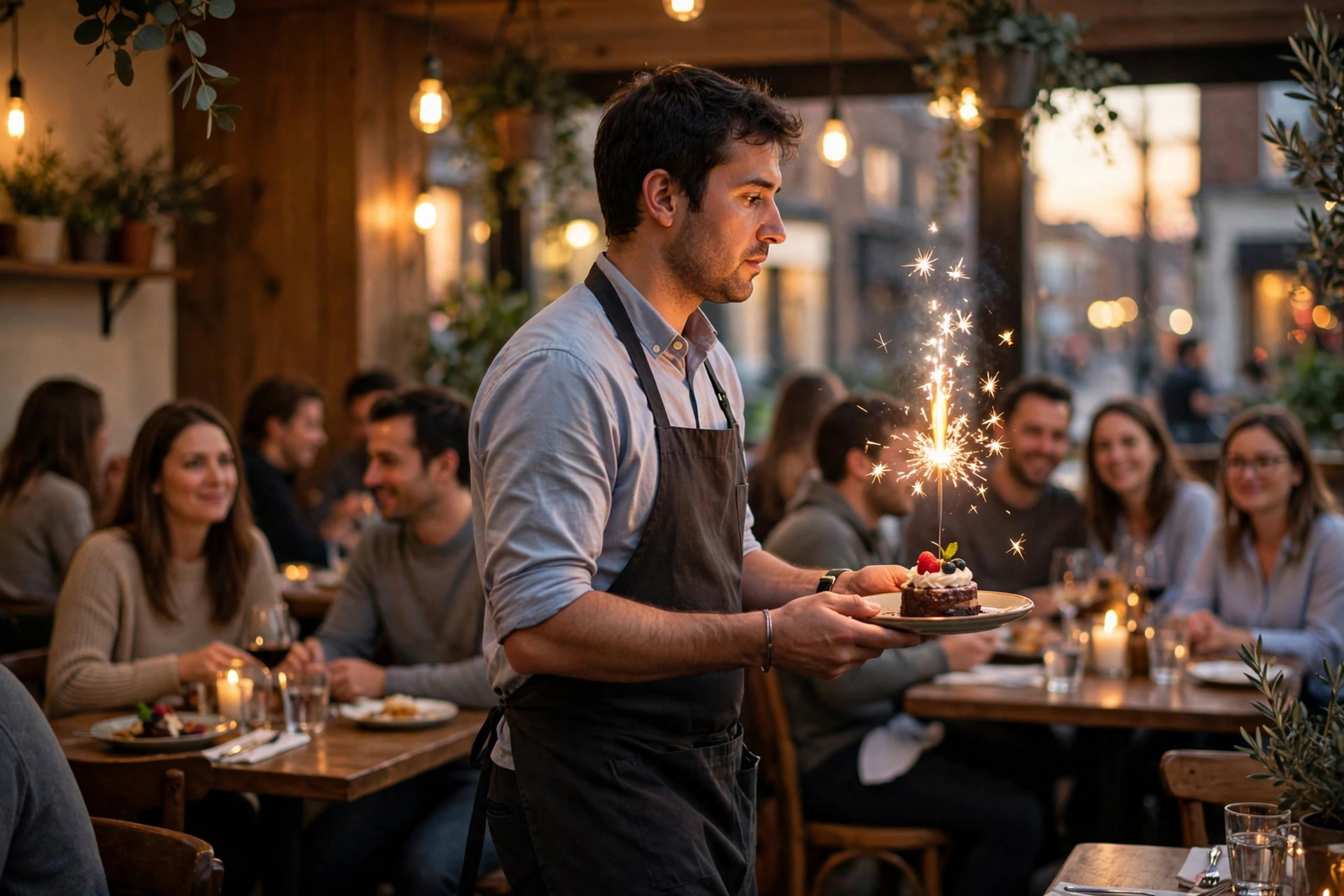
Edge cases worth handling
Two edge cases come up in every programme. The first is the guest who signs up days before their birthday: most tools fire the trigger only for birthdays already in the system, so a guest who joins on 1 November with a 3 November birthday may receive nothing until next year. Fix it with a welcome rule: if a birthday falls within the next 14 days of signup, send the birthday message immediately. The second is the leap-day birthday: decide once — celebrate on 28 February or 1 March in non-leap years — and apply it consistently. Small details, but they are exactly the details guests notice when they go wrong.
Choosing the offer: gift beats discount
The strongest finding across birthday programmes is consistent: a tangible gift outperforms a percentage discount. A free dessert feels like a present; 15% off feels like a promotion. A glass of sparkling wine feels like a celebration; 20% off feels like a negotiation. The gift also costs you less than it looks: your cost is ingredients and a few minutes of staff time, while the guest perceives the menu price. And a gift is easy to redeem — the guest shows the message, the server brings the item — while a percentage discount invites questions about what it applies to and arguments at the bill.
| Offer | Guest perception | Your approximate cost | Best for |
|---|---|---|---|
| Free dessert | A real treat, easy to understand | Low (€2–€4 ingredients) | Most restaurants; the safe default |
| Free starter | Generous, feels substantial | Medium (€4–€8) | Restaurants with strong starters |
| Glass of sparkling wine | Celebratory, adult, photogenic | Low–medium (€2–€5) | Bars, bistros, evening venues |
| Free main course | Very generous, memorable | Higher (€8–€15) | Regulars and VIP guests |
| 20% off the bill | Abstract, easy to forget | Varies with spend | Only if gifts genuinely do not fit |
| Party offer (e.g. free dessert for the guest + 10% for the table) | Rewards bringing friends | Low–medium | Group-friendly venues |
Costs above are rough ingredient-cost estimates for a typical independent restaurant, not menu prices — your own food cost will differ, so price the offer from your own margins before launching.
Tier the offer by guest value
Not every guest deserves the same gift, and tiering is where a birthday programme becomes a loyalty programme. A first-time guest gets the standard gift — a free dessert. A regular who visits monthly gets something bigger — a free main course, or a complimentary glass of something better. A guest who has not visited in six months gets the standard gift plus a reason to return, because the birthday is the best excuse you will ever have to win them back. Tiering needs visit data, which most loyalty and POS systems already hold; if yours does not, start with one tier and add tiers once you can see visit frequency. Our comparison of restaurant loyalty programmes shows which tools expose that data easily.
A free dessert feels like a present. Fifteen percent off feels like a promotion. Guests remember presents.
Writing the message: subject lines and personalisation
The best birthday messages are short, warm and specific. The subject line does most of the work, because it decides whether the message is opened at all. The strongest patterns are simple: the guest's name, the word birthday, and the gift, in that order. "Happy birthday, Anna — dessert is on us" outperforms "A special offer just for you" because it is personal, it names the occasion, and it promises something concrete. Avoid shouting capitals, avoid more than one emoji if you use one at all, and never hide the offer behind a vague tease — a birthday message that makes the guest click to discover the gift is a birthday message that gets deleted.
Personalisation beyond the first name is what separates a good programme from a forgettable one. If you know the guest's favourite dish, name it: "The chocolate fondant you loved last time is on us this week." If you know they always book on Fridays, say so: "Your usual Friday table is waiting." If they visited with a large group last year, invite the group: "Bring the gang — the table is big enough." None of this requires advanced technology; it requires a guest record with a notes field and a template with one or two merge fields beyond the name. Start with the name and the offer, add one personal detail when you can, and never fake one — a wrong "favourite dish" is worse than no favourite dish at all.
What the message must contain
- The guest's first name and a genuine birthday wish — not a headline, a greeting.
- The gift, stated plainly, with any conditions in one short line ("one per guest, dine-in only").
- The validity dates, as calendar dates, not "for a limited time."
- How to redeem: show the message, quote the code, or book with the personal link.
- One booking button or link — not three links competing for the click.
- An update-details link, so the guest can correct or delete their birthday.
Photography and tone
One good photograph beats a designed banner: a real dish, a real table, a real celebration. Guests can tell stock photography from your restaurant, and a birthday message with a photo of your own dessert outperforms a generic graphic every time. Tone follows the same rule: warm, brief and human, as if written by the owner rather than a marketing department. Read the message aloud before sending it; if it sounds like something you would say to a guest at the door, it is ready.
The three-message sequence, ready to adapt
Below is a complete sequence you can adapt to your own voice. Replace the bracketed parts, keep the structure, and test the first month before changing anything. The sequence assumes email as the main channel; for SMS, shorten each message to one or two sentences and keep the same three beats.
Message 1 — 7 to 10 days before: the invitation
Subject: Happy birthday, [First Name] — [gift] is on us
"Happy birthday, [First Name]! Your birthday is coming up, and we'd love to celebrate it with you at [Restaurant]. Come in any time between [start date] and [end date] and your [gift] is on us — just show this message or quote code [CODE]. Book your table here: [booking link]. We can't wait to see you. — The team at [Restaurant]"
Message 2 — on the birthday, only if not yet redeemed: the wish
Subject: Happy birthday, [First Name]!
"Happy birthday, [First Name]! Just a quick wish from all of us at [Restaurant] — and a reminder that your [gift] is waiting until [end date]. If you haven't booked yet, there's still time: [booking link]. Have a wonderful day!"
Message 3 — 2 to 3 days before expiry, only if not yet redeemed: the last call
Subject: [First Name], your birthday treat expires on [end date]
"Hi [First Name], a last gentle nudge: your birthday [gift] at [Restaurant] expires on [end date]. If you'd like to use it, book here before then: [booking link]. If the dates didn't work out this year, no worries — we'll be here next birthday too."
Notice what the third message does: it gives the guest an honourable way out. "We'll be here next birthday too" removes the pressure, preserves goodwill, and — paradoxically — often produces the booking, because a guest who does not feel chased is a guest who feels welcome. Never follow an expired offer with a bigger one. The sequence ends at expiry, and the next message the guest receives is next year's invitation, possibly with a different gift.
Measuring and improving the programme
Birthday automation earns its keep in numbers, and the numbers are simple to track if every message carries a unique code or a personal booking link. Without that link, you are guessing; with it, you can report the programme's value in one line a month. Track these five numbers:
- Messages sent. How many birthday invitations went out this month. This is your programme's size.
- Redemption rate. Redeemed codes divided by messages sent. A healthy programme redeems a visible minority of sends — if the rate is near zero, the offer, the timing or the redemption friction is wrong.
- Party size. Average covers on redeemed birthday bookings. This is where the real revenue hides.
- Revenue per redeemed visit. Total bill of the party, minus the cost of the gift. Compare it with your average table revenue.
- New guests acquired. How many of the party had never visited before. This is the programme's long-term value.
Review the numbers monthly, but change only one thing at a time: the offer, the timing, the subject line, or the validity window. Change two things and you will never know which one worked. A common first improvement is the validity window — extending from one week to three weeks often lifts redemptions more than any change of wording. The second is the reminder: programmes that add the expiry reminder typically redeem noticeably more than programmes that send a single message, which is why the three-message shape above is the default, not the luxury version.
Training staff for redemption day
Automation fails at the table if staff do not know the offer. Brief the team monthly: what this month's birthday gift is, how the code works, what to say ("Happy birthday! The dessert is on us tonight"), and what never to say ("Do you have a code? No code, no dessert"). A birthday guest who has to argue for their gift will not return, and will tell the table about it. Make redemption the easiest transaction of the night: one code, one button, no manager approval. If you run digital stamp cards alongside birthday automation, make sure a birthday visit also earns its stamp — small consistencies like that are what turn a one-off celebration into a habit.
Measure the party, not the dessert. One redeemed birthday can be worth four new regulars.
Beyond birthdays: anniversaries and milestones
Once the birthday automation runs cleanly, the same machinery serves every other personal milestone, and each one is cheaper to add than the last because the trigger, the template and the measurement already exist. The most valuable is the first-visit anniversary: "A year ago today you first ate with us — come back this week and the starter is on us." It re-activates guests at exactly the moment they might be drifting, and it costs the same as a birthday gift.
Other milestones worth automating, in order of value: the loyalty anniversary (a year in the programme, with a tier upgrade or a special gift); the tenth-visit milestone (a free main course, or a dish named after the guest for the night — restaurants that do this well create stories guests retell); and the wedding or celebration anniversary, for guests who celebrated with you and told you so. Each milestone follows the same rules as birthdays: a clear purpose for the data, a tangible gift, a dated validity window, one reminder, and no chasing after expiry.
What not to automate: anything that guesses at a personal occasion you were not told about. Do not infer a birthday from a booking name, do not guess an anniversary from a reservation, and do not send milestone messages to guests who never gave you the date. The trust that makes birthday automation work is built on the guest telling you, and the system remembering. Break that deal once, and the messages stop feeling like care and start feeling like surveillance.
Start with birthdays, get one full year of clean data and honest numbers, and only then add the next milestone. A restaurant that remembers one occasion perfectly will beat a restaurant that remembers five occasions badly — and the guest who gets a birthday message three years running is already your best marketing channel, because they bring the table with them.
If birthday automation is your first step into automated guest messaging, the companion piece is our guide to SMS marketing rules and permissions, which covers the consent and opt-out rules that apply when birthday reminders go out by text. And if your signup forms are not yet collecting birthdays at all, a booking-focused website makes the difference: PowerfulWebsite builds restaurant sites free, with plans from €59 to €239 a month including hosting and maintenance, and the signup and booking forms are built to collect exactly this kind of guest data properly.
Frequently asked questions
When should a restaurant send a birthday message?
Send the first birthday message 7 to 10 days before the guest's birthday, so they have time to plan but not so much time that they forget. Add a reminder a day or two before the offer expires, and keep the total redemption window around two to four weeks. Sending on the day itself is too late for most birthday planning, and sending a month early is usually forgotten.
What is the best birthday offer for a restaurant?
A tangible gift beats a percentage discount: a free dessert, a free starter or a glass of sparkling wine feels more generous than 15% off and costs you less than it appears to. Match the offer to the guest where you can — regulars can receive something bigger, such as a free main course — and always put a clear expiry date on it so the guest has a reason to book now.
Is it legal to collect customers' birthdays under GDPR?
Yes, when you ask for the birthday for a clear purpose, tell the guest what you will use it for, and store only what you need — usually just the day and month, not the birth year. Collect birthdays as part of a marketing opt-in, never as a condition of booking or ordering, and let guests update or delete their birthday at any time.
Should birthday messages go by email or SMS?
Use whichever channel the guest consented to. Email suits longer, prettier birthday messages with photos and a booking button; SMS suits short reminders close to the expiry date. Many restaurants send the main birthday message by email and the expiry reminder by text, but only to guests who consented to each channel separately.
How do I measure whether birthday automation works?
Track three numbers per month: how many birthday messages were sent, how many were redeemed (use a unique code or a booking link), and how much revenue those redeemed visits produced, including the rest of the party. A healthy programme redeems a visible share of its sends and brings parties, not just the birthday guest alone.
What if a guest never redeems their birthday offer?
Do not chase them with more discounts. One reminder before expiry is enough; after that, let the offer lapse quietly and try again next year with a different offer. Repeatedly extending expired birthday offers trains guests to wait for discounts, and it turns a celebration into a negotiation.
Want a website that brings table bookings?
PowerfulWebsite builds your restaurant's website for free — you only pay a monthly fee from €59/mo. Everything is included: domain, hosting, maintenance and updates.
See the packages