Christmas Booking Season: How to Prepare
The restaurants that win December start preparing in September. Open your Christmas party bookings by early autumn, publish a clear per-person menu price, require deposits for parties of 8+, and market to last year's bookers first — they are your warmest, cheapest audience. December rewards the prepared and punishes the improvisers.
Key takeaways
- Open corporate Christmas bookings in late August/September; regular December tables 6–8 weeks ahead.
- Publish one clear per-person price for your Christmas menu (Nordic julebord menus typically €50–€90/person, drinks extra) — planners book without calling.
- Require deposits for parties of 8+: €20–€50 per person or a percentage of the minimum spend, with written cancellation terms.
- Market in this order: last year's bookers (September) → loyalty list and socials (October) → targeted ads for remaining dates (November).
- Lock staffing early: confirm December availability in October, plan for the Friday/Saturday peaks, and simplify the menu where the kitchen needs it.
- Your website needs a dedicated Christmas page with the menu, prices, photos and an online booking or enquiry form — built before the marketing starts.
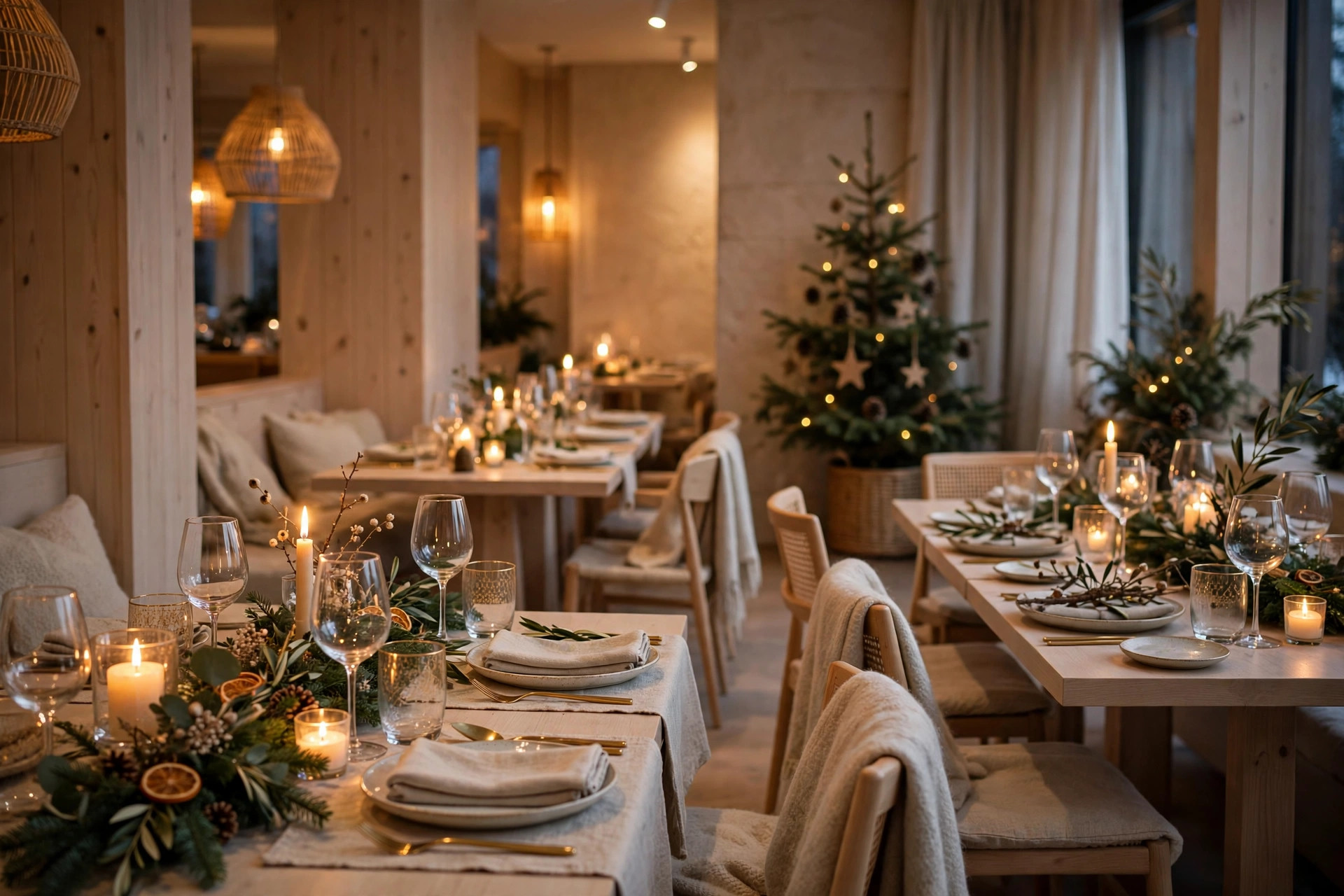
In the Nordics, December is not just a busy month — it is the month that carries the winter. The corporate Christmas party tradition (julebord in Norway, julbord in Sweden, joulupöytä in Finland) turns ordinary weekdays into fully booked evenings, and for many restaurants December generates a disproportionate share of annual revenue. A single Friday in mid-December can outperform an entire quiet January week.
But the season is unforgiving. Corporate planners book months ahead, and once their shortlist is made, it rarely changes. Kitchens run at capacity, staff burn out, and a restaurant that improvises its Christmas offering ends up with half the bookings, a stressed team and food costs that eat the margin. The difference between a great December and a painful one is almost entirely decided in September and October.
This guide is the full preparation playbook: the booking timeline, menu design, pricing and deposits, the marketing sequence, group-party operations, staffing, and the website checklist. It is written for Nordic restaurant owners, but the mechanics work anywhere with a strong festive dining season.
Why Christmas decides your winter
Understanding the economics of December explains why preparation matters so much. Three forces converge in the festive season, and all three reward the organised.
Force 1: the corporate calendar
Christmas parties are corporate budget items, and corporate budgets are spent early. Office managers and HR teams typically plan the staff Christmas dinner between August and October — in larger companies, the venue decision can be made a full year ahead. If your Christmas offering is not published when planners are shortlisting, you are not in the race. This is why the single most important Christmas action has a deadline in September, not December.
Force 2: the capacity math
December has roughly 20 prime party evenings (weekday evenings plus Fridays and Saturdays). Once those evenings are booked, they are gone — a restaurant cannot manufacture more December. Every week you delay publishing your Christmas offer is a week of prime evenings potentially lost to a competitor who published theirs. Conversely, selling out your prime evenings by October lets you sell the off-peak slots (Sundays, early December, January parties) with targeted offers.
Force 3: the January hangover
A strong December does more than pay December's bills. It fills your gift-card float (December's gift cards become January's quiet-week revenue), seeds your marketing list with new guests, and generates the reviews and photos that carry you through the dark months. Restaurants that treat December as a one-off miss half its value.
The Christmas booking timeline
Work backwards from Christmas. Here is the preparation calendar that experienced Nordic operators follow:
| When | What to do | Why it matters |
|---|---|---|
| Late August – September | Finalise the Christmas menu and pricing; publish a dedicated Christmas page on your website; open party bookings; email last year's bookers first | Corporate planners shortlist now — be findable and bookable |
| October | Launch public marketing (social, Google Business Profile, local press); confirm December staffing availability; order seasonal ingredients and lock supplier prices | Fill the prime Friday/Saturday evenings while demand is rising |
| Early November | Push remaining dates with targeted offers; set booking deadlines for large parties; confirm dietary-needs cutoffs | Scarcity converts: "4 Fridays left" beats "book now" |
| Late November | Finalise staff rotas; run a trial service of the Christmas menu; confirm all party details 48–72h ahead | Operational readiness decides review scores |
| December | Execute; collect deposits on time; capture photos, reviews and gift-card sales; note what to improve | December is harvest time, not planning time |
| Early January | Thank-you emails to party bookers; early-bird offer for next Christmas; debrief with the team | Next year's December starts here |
Set booking deadlines — and mean them
Two deadlines protect your December. First, a menu and headcount confirmation deadline for large parties (typically 7–14 days before the event), so the kitchen can order and staff can plan. Second, a final-numbers deadline 48–72 hours before, after which you charge for the confirmed number. Publish both in your Christmas terms, repeat them in the confirmation, and enforce them consistently. The bookers who push back are the ones most likely to no-show.
A Christmas menu that sells (and protects your margin)
The Christmas menu is a different product from your regular menu. It must be easy to sell to a planner who is comparing five venues, easy to cost, and easy for your kitchen to execute 200 covers a night.
Design for the planner, not the food critic
Corporate planners buy on three things: clarity, inclusivity and price certainty. A three-course set menu with one clear per-person price beats a sprawling à la carte Christmas offering every time. Offer two or three menu tiers (e.g. a classic Christmas table, a premium tier with better wines, and a lighter lunch option) so the planner can match their budget without a phone call. In the Nordics, the traditional Christmas buffet (julebord/julbord/joulupöytä) remains the anchor product — ham, herring, salmon, meatballs, root vegetables — but modern guests expect a strong vegetarian and vegan alternative built in, not bolted on.
Price from your costs, not your competitors
Typical Nordic Christmas party menus run roughly €50–€90 per person excluding drinks (around 550–1,000 kr in Sweden/Norway), with drinks packages adding another €25–€60. Treat those as market context, not instructions. Your price must cover your food cost, the extra December staffing, and the operational complexity — then add your margin. Underpricing December is the classic trap: you sell out your twenty prime evenings at a price that barely covers costs, while the competitor who priced confidently earns the winter's profit.
Build dietary options into the design
Ask for dietary requirements at booking with a firm deadline (7 days out), and design the menu so the vegetarian/vegan alternative is a genuine dish, not an apology. Kitchens that plan one inclusive alternative serve it 30 times a night without stress; kitchens that improvise per guest slow the whole service. Confirm final dietary numbers at the 48-hour checkpoint.
Margin checklist for the Christmas menu
Before you publish: food cost per cover calculated on the actual recipes; staffing cost per service night; a 10–15% buffer for December price spikes on seasonal ingredients; deposit terms that cover the cancellation risk; and a drinks package designed to be the profit engine (wine and glögg packages typically carry the evening's margin).
Pricing, deposits and minimum spends
December is the one month where firm commercial terms are universally accepted — guests expect them. Use that acceptance.
Deposits: the non-negotiable
Require a deposit for every party booking of 8 or more. A per-person deposit of roughly €20–€50, or 20–30% of the agreed minimum spend, commits the booker and filters out speculative reservations. Take it by card at booking time — ideally online, with a few clicks — and state in writing: the amount, the cancellation deadline for a full or partial refund, and what happens after the deadline (typically the deposit is forfeited, and the confirmed headcount is charged). Our guide to deposits and gift cards walks through the exact wording that keeps this friendly and enforceable.
Minimum spends for private rooms
If you have a private dining room or a sectioned-off area, set a minimum spend for prime December evenings — and stay firm. An empty private room earns zero; a room given away cheaply to a low-spending group costs you the evening it could have earned. Publish the minimum spend alongside the menu so planners self-select.
Protect the peak: no discounts in December
December is not the month for vouchers, Groupon-style deals or happy-hour pricing on party menus. Discounts in the peak season train guests to wait for deals and cannibalise your full-price bookings. Save your promotions for the genuinely quiet slots — early December weekdays, Sundays, and January — where they fill seats that would otherwise sit empty.
The Christmas marketing plan
Christmas marketing works in a strict sequence: warmest audience first, coldest last. Follow this order and you will spend less and book more.
September: your existing bookers
Email everyone who booked a Christmas party or a December table last year — personally, by name, before the public launch. Offer them first choice of dates and, if you like, a small early-bird incentive. These guests already know your food and your room; they convert at a rate no ad can match. This is also where the booking-data work pays off: a clean, consenting list of last December's guests is the highest-ROI marketing asset a restaurant owns (see our guide to using booking data for marketing, GDPR-safe).
October: go public
Publish the dedicated Christmas page (menu, prices, photos, booking button), update your Google Business Profile with festive hours, and start the social content calendar: behind-the-scenes menu prep, the decorated room, last year's party photos (with permission). Target local corporate planners explicitly — LinkedIn and Instagram ads geo-targeted to your city, aimed at office managers and HR, work well in the Nordics. Partner with local hotels and event venues that don't have their own restaurant; their overflow is your booking.

November: scarcity and the last push
By November, your messaging shifts from "we're open for Christmas" to "these are the dates still available". Show remaining availability honestly — a simple "3 Fridays left in December" banner converts planners faster than any discount. Retarget website visitors who viewed the Christmas page but didn't enquire. And start selling January: "too late for December? Book your New Year kickoff" turns overflow demand into next month's revenue.
Gift cards: December's quiet profit engine
Gift cards are the highest-margin product most restaurants sell — paid in full, often partially unredeemed, and they bring new guests through the door in January and February. Promote them from late November on your website, at the till, and in the thank-you email after every December party. A simple "give the gift of dinner" card, buyable online in two minutes, can add meaningful five-figure revenue across the season.
Group and corporate parties: handle them like a pro
Christmas parties are group bookings at maximum stakes — the planner's professional reputation is on the line. Our full guide to handling group bookings covers the mechanics; here is the December-specific layer.
One contact, one contract
Every party gets a single named contact on your side and a single decision-maker on theirs. Put the essentials in a short written agreement: date, time, room or area, menu tier, per-person price, drinks arrangement, deposit paid, cancellation terms, final-numbers deadline, and dietary cutoff. Email beats a handshake — memories differ, inboxes don't.
The corporate planner's checklist (give it to them)
- Exact arrival time and how late arrivals are handled (kitchen cutoff times).
- Drinks: package, on-consumption, or a pre-agreed bar tab limit — decided in advance, not at midnight.
- AV and speeches: microphone availability, background music policy, space for an awards moment.
- Coat storage, accessibility, parking and the nearest taxi rank — the details planners get asked about by their colleagues.
- An invoice made out correctly the first time: company name, VAT number, reference. Corporate clients remember invoicing pain longer than food.
After the party: the follow-up that books next year
A personal thank-you email a few days after the event — with a photo from the evening if you have permission — plus first refusal on the same dates next year, is how December regulars are made. Companies that had a flawless party rarely switch venues. The follow-up email is the cheapest customer acquisition in hospitality.
The 48-hour confirmation call
For every party of 12+, confirm by phone or email 48–72 hours before: final headcount, dietary needs, arrival time, drinks plan. This single habit eliminates most December disasters — the wrong menu count, the surprise vegan guest, the group arriving an hour late to a kitchen that has timed everything.
Staffing and operations for the December rush
A full dining room with an exhausted, understaffed team produces bad reviews that outlive December. Plan the people side as carefully as the menu.
Lock availability early
Ask staff for December availability in October — before rosters are a crisis. Be honest about the peak nights (the Fridays and Saturdays before Christmas) and incentivise them: premium pay, a team Christmas meal of your own in January, or first pick of January holiday days. Students and seasonal staff need longer onboarding than you think; recruit in October, train in November.
Simplify where the kitchen needs it
December is not the month for a 40-dish à la carte menu alongside three party menus. Many successful Nordic restaurants run a reduced regular menu in December so the kitchen can execute the Christmas offering flawlessly. Fewer dishes, done brilliantly, beats a sprawling menu done under pressure — and it keeps food costs predictable when ingredient prices spike.
Protect the team
Schedule real breaks, rotate the heavy stations, and brief everyone on the party plan before each service: who the contact is, the timings, the dietary notes, the drinks arrangement. A five-minute pre-service briefing prevents the mistakes that a tired team makes at 9 pm on the third consecutive 200-cover night. And plan the January rota generously — December's heroes need recovery time, or they won't be December's heroes next year.
Your website checklist for the Christmas season
Every marketing action in this guide points somewhere. That somewhere must be ready before September's first email goes out.
The dedicated Christmas page
One page, everything a planner needs: the Christmas menus with per-person prices, drinks packages, photos of the decorated room and last year's parties, available dates (or an honest "limited availability" note), deposit and cancellation terms, and a prominent booking or enquiry button. No PDFs, no "call for prices" — planners shortlist at 11 pm from their sofa, and the venue that answers their questions wins. If your site can't carry this page, that's a September problem to fix, not a December one to regret. PowerfulWebsite builds restaurant websites with exactly this kind of seasonal landing page included — published in days, not months.
Booking flow that captures the right data
Your Christmas enquiry form should ask for: event date (with alternatives), party size, menu tier, dietary notes, drinks preference, and the company details for invoicing. Each field you collect at enquiry time is a phone call you don't make later. And — since you'll want to email these planners next September — make sure the form captures marketing consent properly (our GDPR-safe booking data guide shows how).
Seasonal details that convert
- Opening hours: update Google Business Profile and your site with Christmas and New Year hours — including the days you're closed.
- Speed: December traffic spikes; a slow site loses the planner to the next tab. Test your Christmas page on a phone, on mobile data.
- Gift cards: a buyable-online gift card button, visible site-wide from late November.
- Photos: real photos of your room at Christmas beat stock imagery. Shoot this year's setup for next year's page.
Frequently asked questions
When should restaurants start taking Christmas bookings?
Open corporate Christmas party bookings in late August or early September and start marketing them in September. Regular December dinner bookings typically open 6–8 weeks out. The earlier you open, the earlier corporate planners — who book months ahead — can find you.
How much should a restaurant charge for a Christmas party menu?
In the Nordics, sit-down Christmas party (julebord/julbord) menus typically run €50–€90 per person excluding drinks, with drinks packages adding €25–€60. Set the price from your food cost and staffing needs, not from competitors — and publish one clear per-person price so planners can budget without calling you.
Should restaurants require deposits for Christmas bookings?
Yes, for parties of 8 or more. A per-person deposit (e.g. €20–€50) or a percentage of the minimum spend commits the booker and slashes December no-shows. State the deposit terms, the cancellation deadline and the refund policy in writing before taking payment.
How do you handle dietary requirements for large Christmas parties?
Ask for dietary needs at the booking stage with a firm deadline (e.g. 7 days before the event), build one vegetarian/vegan alternative into the menu design from the start, and confirm the final numbers 48–72 hours ahead. Designing the menu with alternatives included is far cheaper than improvising on the night.
What is the best way to market Christmas bookings?
Start in September with email to last year's bookers and loyalty members (your warmest audience), follow with a dedicated Christmas page on your website with menus, prices and a booking button, and run targeted social ads to local corporate planners in October–November. Scarcity — showing limited remaining dates — converts planners faster than discounts.
Want a website that fills your December?
PowerfulWebsite builds your restaurant's website free — you only pay from €59/mo. Everything included: domain, hosting, maintenance and updates. Plans run €59–€239/mo, VAT-inclusive, invoiced in EUR.
See the plans