Group Bookings: How to Handle Them Like a Pro
A large group booking is any party of 8 or more that needs special handling — and it is worth getting right: a single well-run table of 20 can out-earn a full turn of small tables, with lower marketing cost and more predictable revenue. The difference between a group that feels like chaos and one that feels like a private event comes down to three things: a written group policy, a set menu, and a deposit.
Key takeaways
- Draw the line in writing: 8+ guests triggers group handling; 10–12+ triggers a set menu and a deposit.
- Groups need 48–72 hours notice, one single contact person, and a dedicated booking form that captures dietary needs.
- Set menus for larger parties mean faster service, predictable food costs and calmer kitchens.
- A group no-show hurts 10x more than a table of two — deposits or card guarantees are standard practice, not rudeness.
- Steer groups toward off-peak slots with incentives; a full Tuesday beats a chaotic Saturday.
- Confirm everything in writing before the event: menu, headcount deadline, bill policy and cancellation terms.
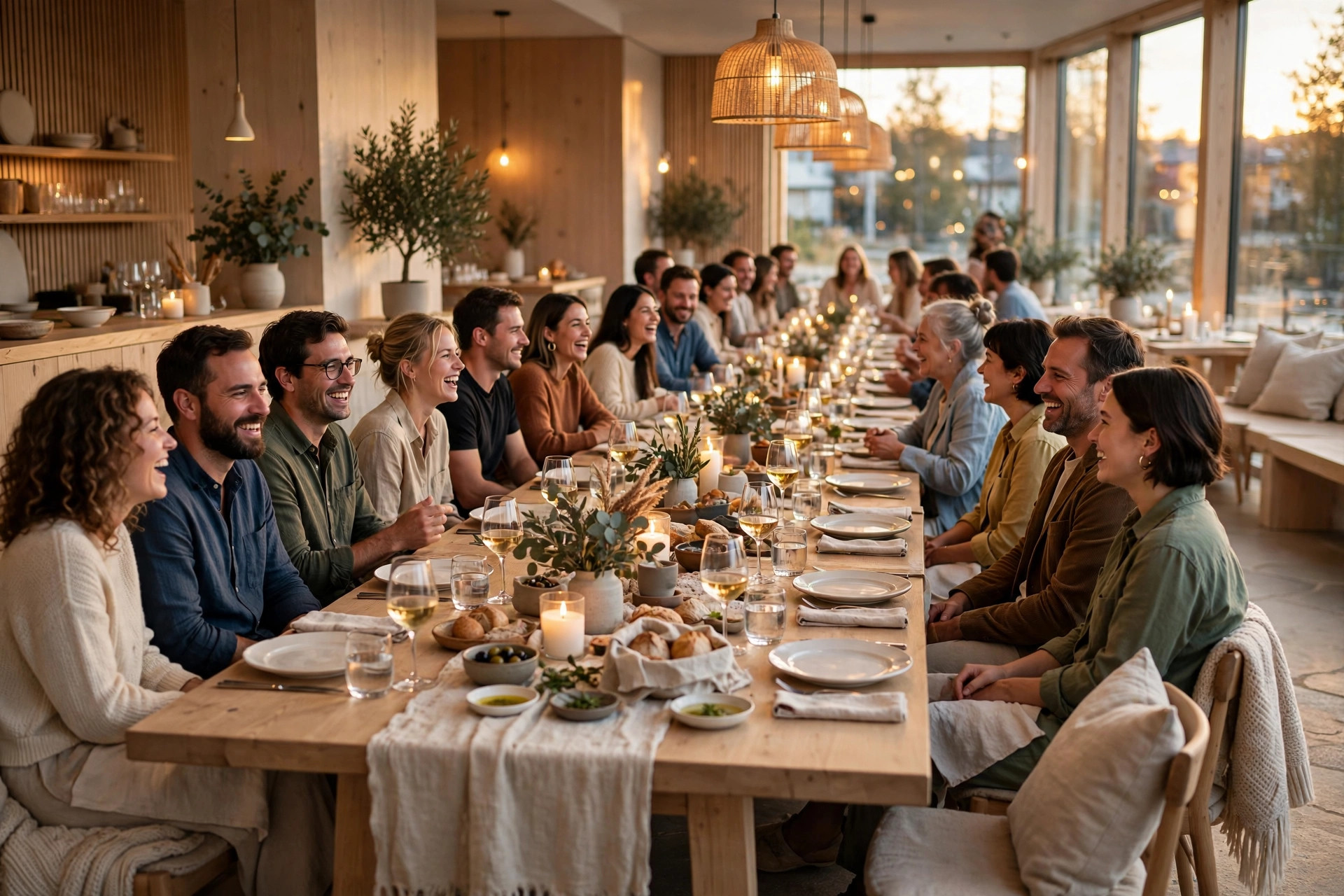
Every restaurant owner knows the feeling: the phone rings, and someone wants to book a table for 22 people on a Friday night. Your heart lifts — then sinks. Twenty-two covers is a great evening's revenue in one reservation, but it is also a kitchen's worst nightmare if it lands unprepared: the tables don't fit, half the guests have dietary requirements nobody told you about, and the bill at the end takes forty minutes of arithmetic.
This guide is the playbook that turns group bookings from a gamble into your most profitable reservation type. It is written for independent restaurants, cafés and bars in the Nordics, but the mechanics work anywhere. We cover the group policy you should publish on your website, the deposit levels that protect you, the set-menu-versus-à-la-carte decision, staffing maths, and a day-of execution checklist you can hand to your team.
What counts as a group booking?
Before anything else, define what a "group" means in your restaurant — because your booking flow, your staffing and your pricing all depend on it. The industry does not have one universal number, but a clear and common structure looks like this:
- 1–7 guests: normal booking. Tables, standard menu, no special handling.
- 8–11 guests: a large table. Needs a seating plan and a longer table, but the normal menu usually still works. Many restaurants start requiring a card guarantee here.
- 12+ guests: a group booking. This is where the pro rules kick in: a dedicated booking form, a set menu or limited menu, a deposit, and a named contact person.
- 30+ guests: effectively a private event. Think buyout pricing, a dedicated menu and possibly exclusive use of a section or the whole room.
Your exact numbers depend on your room. A 24-seat neighbourhood bistro might treat 6 guests as a group, because one large party eats a quarter of the dining room. A 120-seat restaurant with a private room might not switch to event rules until 20. The number itself matters less than the fact that you have one — written down, published on your website, and enforced consistently.
Why groups are worth the trouble
It is easy to see groups as a hassle and quietly discourage them. That is a mistake. Run properly, group bookings are one of the highest-margin revenue streams in a restaurant. Here is the arithmetic that makes the case:
The revenue math
Take a typical Nordic casual restaurant: average spend per guest around €45–55 (food plus one or two drinks — these are estimates of typical city-centre ranges, not promises). A group of 20 at €50 average is €1,000 in one reservation. To generate the same €1,000 from couples, you need ten separate tables — ten booking confirmations, ten table turns, ten separate bills. The group books once, sits for two to three hours, and the kitchen fires predictable covers.
Off-peak value
Groups are uniquely movable. A couple books when they want dinner; a 15-person birthday or company dinner can be steered. Offer an incentive for Tuesday, Wednesday or early-evening slots — a welcome drink, a discounted set menu — and you convert your emptiest nights into your best-margin nights. One group of 18 on a quiet Wednesday can double a typical midweek take.
Marketing value
Every group brings first-time guests. A Christmas party of 25 might contain 20 people who have never been to your restaurant. If the evening runs well, some of them become regulars — and the organiser becomes your unpaid sales rep, telling every other office and family group where to go. Groups are how neighbourhood restaurants become known restaurants.
The group revenue checklist
- One group of 20 at ~€50/head = ~€1,000 — the same as ten tables for two.
- Set menus cut kitchen uncertainty: you know the covers, the courses and the cost days ahead.
- Groups book off-peak if you give them a reason to: welcome drinks, early-bird set menus, free room hire.
- Every group of strangers is 15–20 potential regulars. Treat the evening as an audition.
Write a group policy — and publish it
Here is where most restaurants go wrong: the "policy" lives in the owner's head and changes depending on mood, day of week and who picks up the phone. One server promises à la carte for 18, another demands a set menu for 10, and the kitchen hears about the party at 6 pm. A written group policy ends this. It does not have to be long — one page on your website is enough — but it must cover these points:
What your policy must contain
- The threshold: from how many guests the group rules apply (e.g. 8+).
- Notice period: how far ahead groups must book — 48–72 hours is the Nordic norm for 8–12 guests; a week or more for 20+.
- Menu rules: at what size a set menu becomes required (typically 10–12+).
- Deposit: how much, when it is due, and when it is refundable.
- Final headcount deadline: the time by which the organiser confirms the exact number (usually 48 hours before).
- Cancellation terms: free cancellation window, then a per-head charge.
- Bill policy: how the bill is split (or not) — decided in advance.
- Duration: how long the table is theirs (2.5–3 hours is typical for groups).
Publishing this on your website does two jobs at once: it protects you when a group pushes back ("it's all on our site, we apply it to everyone"), and it filters your enquiries. Organisers who won't pay a deposit or won't confirm a headcount are telling you exactly what kind of booking that would have been.
A good website makes this easy. If your booking page has a dedicated group section with the policy, the form and the deposit payment in one place, the phone stops ringing with the same five questions. Online booking systems with group handling — the kind built into a modern restaurant website from PowerfulWebsite, from €59/month — let you route 8+ bookings to a separate flow automatically instead of losing them in a generic form.
The group booking form: what to ask
Never take a large group booking on a scrap of paper. A dedicated group booking form — online, on your website — collects everything you need in one go and creates a paper trail. Here are the fields that matter, and why each one earns its place:
- Organiser's full name, phone and email — you need one decision-maker, not twelve cousins.
- Date, arrival time and expected duration — groups underestimate how long they'll stay; agree it now.
- Exact guest count + final headcount deadline — and the per-head charge if numbers drop after the deadline.
- Occasion — birthday, company dinner, wedding rehearsal. This tells you the tone, the budget tolerance and whether to offer extras like a cake or a speech microphone.
- Menu choice — which set menu, or confirmation of the agreed selection.
- Dietary requirements and allergies — collected now, not discovered at the table. Allergies in particular are a safety issue: the kitchen needs them in writing, in advance.
- Seating preferences — one long table vs separate tables, private room interest, wheelchair access.
- Drinks plan — welcome drink package, wine pairing, open bar cap, or pay-as-you-go. Drinks are where group margins live or die.
- Bill arrangement — single payer, even split, or individual billing. Agree it at booking.
- Deposit payment — ideally paid right in the form, via a payment link.
One contact person, always
This deserves emphasis: insist on a single point of contact for every group. The moment twelve guests start calling the restaurant separately with changes, your staff drown. "All changes through the organiser, by email, 48 hours ahead" — put it in the policy and enforce it kindly but firmly.

Set menu vs à la carte for groups
This is the decision that shapes the whole evening. A set menu (also called table d'hôte or prix fixe) is a fixed-price multi-course meal with limited choices per course. À la carte lets every guest order anything from the full menu. For small parties, à la carte is fine. For groups, the comparison below explains why the industry standard sits where it does:
| Set menu | À la carte | |
|---|---|---|
| Kitchen load | Predictable — bulk prep, timed courses | Unpredictable — 20 different dishes at once |
| Service speed | Fast — the whole table eats together | Slow — staggered dishes, longer evening |
| Food cost control | Known in advance, easy to price | Harder to forecast; waste risk rises |
| Bill for the guest | Known upfront — no surprises | Variable — bill shock and bill disputes |
| Staffing | Fewer servers needed per cover | More hands needed to keep service smooth |
| Guest experience | Feels like an event; shared courses bond the table | Maximum choice, but long waits between courses |
| Best for | 10–12+ guests, company dinners, celebrations | Under 8 guests, foodie groups, flexible budgets |
The sweet spot: a limited group menu
You don't have to choose between a rigid set menu and total chaos. The middle path — a limited group menu — works brilliantly: 2–3 starters, 3–4 mains, 2 desserts, all priced per person, with dietary alternatives built in. Guests keep a sense of choice, the kitchen keeps a manageable number of dishes, and you can price it confidently. In the Nordics, a 3-course group menu in a mid-range restaurant typically lands around €45–65 per person (estimate — your costs and city decide the real number).
Price it as a package
Smart operators sell the group as a package: menu + welcome drink + coffee for one per-person price. Packaging does three things: it raises the average spend (the welcome drink has great margin), it removes price anxiety for the organiser, and it makes your quote instantly comparable to competitors'. Always quote the package price clearly — "€59 per person, everything included except additional drinks" beats a list of line items.
Staffing and kitchen planning
A group of 20 is not the same as ten tables of two — even though the cover count matches. The demand arrives all at once: 20 orders in five minutes, 20 mains to fire simultaneously, 20 desserts to plate. Plan for the wave, not the average.
Seat groups like an event
Groups need their own territory. Seat the whole party in one section — ideally a private room or a clearly defined area — so one server (or a dedicated team) owns the table. The classic failure mode is a group spilling across two servers' sections: orders get missed, nobody knows who is responsible, and the table feels abandoned. If your room can't host a single long table, two adjacent round tables with one team covering both still beats scattering guests across the dining room.
Staffing maths for groups
As a rough rule: one server can comfortably run a group of 15–20 on a set menu, because the courses go out together and the drinks are often pre-arranged. The same server would struggle with 15–20 à-la-carte guests across the room. For groups of 25+, add a second server or a runner, and for 40+, dedicate a section team. Brief everyone before the shift: who the organiser is, what the menu is, which allergies exist, when the speeches happen, and how the bill works. A five-minute pre-shift briefing prevents a night of improvisation.
Kitchen timing
Give the kitchen the group's menu choice and allergy list at least 24 hours ahead — not when the table sits down. For large groups on set menus, agree on course timing with the organiser: when does the welcome drink land, how long between courses, is there a speech between main and dessert (there usually is, and nobody told the kitchen). Stagger two groups' courses if you have two large parties on the same night: one group on starters while the other is mid-mains keeps the pass from melting.
The pre-shift group briefing (5 minutes)
- Organiser's name — greet them by name on arrival.
- Menu choice and per-person price, plus the drinks plan.
- Allergies and dietary requirements, in writing, to the kitchen and the floor.
- Timing: speeches, cake, course gaps — the evening's choreography.
- Bill arrangement: who pays, how it is split, deposit already taken.
Protect yourself from group no-shows
A no-show of two costs a restaurant roughly €55–70 in lost revenue — OpenTable's Restaurant Impact Report puts a table of two at about £55.70. Scale that to a group of 20 and you're looking at €500+ of prepped food, scheduled staff and a turned-away regular trade. Group no-shows are rare but catastrophic, which is why the industry protects itself with deposits. For a deeper dive into no-show tactics generally, see our guide to cutting no-shows.
Deposits and card guarantees
The standard tools: a per-guest deposit collected at booking (typically €10–25 per person as an industry estimate — set yours against your real average spend), or a card guarantee with a disclosed no-show fee. Deposits feel firmer but require no chasing; card guarantees feel lighter but need a compliant payment setup. For groups of 20+, a deposit is near-universal practice. The key is tone: frame it as "securing the table" rather than punishing anyone. Guests understand — a group that balks at a modest deposit is waving a red flag.
Cancellation terms that work
Match the terms to the risk: free cancellation up to 48–72 hours before, then the deposit is forfeited or a per-head fee applies. Reduce the headcount without penalty until the final-headcount deadline; after that, late reductions are charged. Write it in plain language on your group booking page and repeat it in the confirmation — the policy only works if the organiser actually saw it. Card guarantees and deposits for bookings deserve their own setup; do it once and it runs automatically.
Confirm the headcount twice
Groups shrink. The organiser books for 22, then 16 turn up — and you've prepped and staffed for 22. A two-step confirmation kills most of this: an email confirmation at booking, then a headcount reconfirmation 48–72 hours before the event ("please confirm your final number by Thursday 6 pm — we prepare based on this number"). This single habit is the highest-ROI action in group management.
The day-of playbook
Everything above is preparation. This is execution — the timeline that turns a reservation into an event the group talks about for months.
| When | What |
|---|---|
| 48 hours before | Final headcount confirmed by the organiser. Kitchen gets the menu and allergy list. Deposit/card guarantee verified. |
| Morning of | Tables set and checked, seating plan printed, briefing sheet for the team, welcome drinks and pre-orders prepped. |
| 1 hour before | Pre-shift briefing: organiser's name, menu, allergies, timing, bill. Bar knows the drinks plan. |
| On arrival | Greet the organiser by name. Coats sorted, seating confirmed, welcome drinks flowing within 10 minutes. |
| During service | Courses timed to the agreed plan; speeches and cake coordinated with the organiser; drinks topped up without being asked. |
| At the bill | The agreed bill arrangement, executed without drama. Thank the organiser personally — they chose you. |
| Next day | Thank-you email to the organiser with a review link and a "book your next event" nudge. Log what worked and what didn't. |
The welcome drink effect
Small rituals make groups feel hosted rather than merely seated. A welcome drink on arrival — even a simple sparkling wine or a signature mocktail — buys you the fifteen minutes a large group needs to settle, find seats and stop being loud. It costs a few euros per head and pays back in atmosphere, reviews and repeat bookings.
After the event: the follow-up that wins the next booking
The evening is not over when the last guest leaves. A thank-you message to the organiser the next day — with a link to leave a review and an easy way to book the next event — is where one-off groups become annual traditions. Office Christmas parties, birthday regulars, wedding-adjacent dinners: these rebook, and they rebook with bigger budgets. Log every group in your system with notes (organiser, occasion, what they ordered, what they loved) so next year's booking starts warm.
And make the rebooking frictionless: your website should make group enquiries as easy as standard bookings. A dedicated group section on your booking page — policy, form, deposit payment in one flow — turns enquiries into confirmed revenue while you sleep. That's exactly what a modern restaurant website from PowerfulWebsite is built to do, from €59/month with online booking included.
Frequently asked questions
How many guests count as a large group booking?
Most restaurants draw the line at 8–10 guests. Below that, a large table in the normal booking flow works fine. At 8 guests and above, the booking needs special handling: longer tables, kitchen preparation and usually a set menu. At 10–12 or more, deposits and a written group policy become standard practice in the Nordics.
Should restaurants take a deposit for large group bookings?
Yes — and most experienced restaurants do. A per-guest deposit of roughly €10–25 per person (an estimate, not a rule) or a card guarantee turns a casual maybe into a commitment. A group no-show of 15 people costs far more than a table of two, so deposits are simply proportionate risk management. Always disclose the deposit at the time of booking.
Is a set menu mandatory for big groups?
Not mandatory, but above 10–12 guests a limited set menu is the operational standard: the kitchen can prep in advance, service stays fast, and the bill is predictable. If the group insists on à la carte, agree on a narrower selection (for example 3 starters, 4 mains, 2 desserts) or add a surcharge and longer service time in writing.
What is a fair cancellation policy for group bookings?
Typical practice in the Nordics: free cancellation up to 48–72 hours before the event, then a per-head charge roughly equal to the deposit for late cancellations or no-shows. Put the policy in writing on your website and repeat it in the booking confirmation — a policy nobody saw is a policy nobody honours.
Can you add a service charge for large groups in the Nordics?
Automatic service charges are not customary in Finland, Sweden or Norway, and they must be agreed in advance to be fair and enforceable. The common Nordic practice is to build the extra service cost into the set menu price or to quote a flat event price per person — transparent from the start, no surprises on the bill.
How do you split the bill for a 20-person table?
Decide before the night, not during it. The simplest options: one card pays and the group settles privately, an even split per person, or individual billing from a pre-collected order list. Communicate your chosen method in the booking confirmation message so the group arrives with a plan — nothing kills a great evening faster than 20 minutes of bill arithmetic.
Want group bookings that run themselves?
PowerfulWebsite builds your restaurant's website for free — you only pay from €59/month. A dedicated group booking flow with your policy, deposits and confirmations built in. Everything included: domain, hosting, maintenance and updates.
See the packages