Lunch Menus Online: How to Fill Your Midday Tables
Lunch guests decide where to eat on their phones, usually within the hour before the meal. The restaurants that fill their midday tables are the ones with a fast, price-transparent lunch menu online — published early in the week, readable in ten seconds, and backed by a service promise the office crowd can trust.
Key takeaways
- Lunch is a different business from dinner: guests optimise for speed, price certainty and convenience, not experience.
- Publish the week's lunch menu online by Sunday evening — on your website and your Google Business Profile — so planners and last-minute deciders both find it.
- Price the lunch visibly. An unpriced menu loses the comparison to the competitor whose €13.50 daily special is one tap away.
- In Finland, accepting lunch-benefit cards (Edenred, Smartum, ePassi) and advertising it is one of the cheapest ways to win office workers.
- A 45-minute service promise, pre-ordering and grab-and-go options turn one-time visitors into weekly regulars.
- Track lunch covers, average ticket and repeat rate weekly — small tweaks to the offer compound fast at midday volumes.
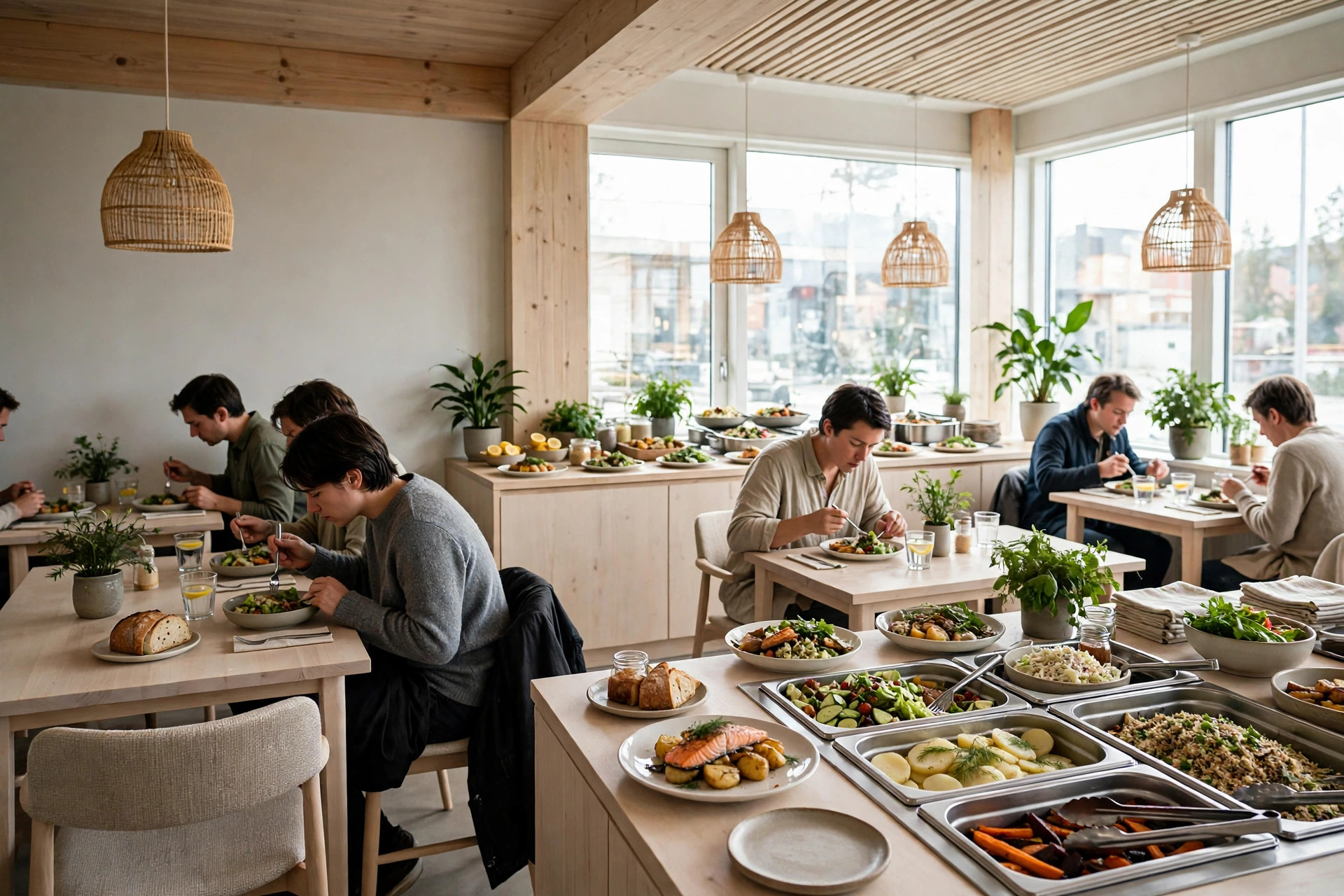
Dinner gets the romance, the reviews and the Instagram posts. Lunch gets the revenue — or at least, it should. For most independent restaurants in the Nordics, the midday shift is the most predictable, highest-volume service of the day: the same offices, the same streets, the same hungry people, five days a week. And yet many restaurants treat lunch as an afterthought, a shorter menu scribbled on a board and a hope that foot traffic does the rest.
Here is the uncomfortable truth: your lunch guests decided where to eat before they left the office. Industry surveys consistently show that the large majority of weekday lunch decisions are made within the hour — often within minutes — of the meal, and they are made on a phone. If your lunch menu is not online, not current and not readable in about ten seconds, you are not in the consideration set. You are invisible at exactly the moment the decision happens.
This guide is written for independent restaurant, café and lunch-spot owners in Finland, Sweden and Norway who want the midday shift to pull its weight. You will learn how lunch guests actually choose, what an online lunch menu must contain, how to design a lunch offer that sells itself, why the Finnish lunch-benefit system is a lever most owners underuse, and how to measure whether any of it is working. No fluff, no generic "post on social media" advice — just the mechanics of filling tables between 11:00 and 14:00.
The midday decision: how lunch guests choose
Lunch is the most rational meal of the day. Dinner is emotional — a craving, a celebration, a date. Lunch is logistics. A person with 45 minutes, a budget (often someone else's money, via a lunch benefit), and colleagues waiting will not deliberate. They will pick the option that removes uncertainty fastest.
That decision process looks like this, and it repeats in offices across Helsinki, Stockholm and Oslo every weekday around 11:15:
- Someone says "where are we eating?" — the search starts in a group chat, not a search engine.
- Two or three options surface — the usual places, plus whatever someone saw on Google Maps or Instagram this week.
- A 90-second comparison — today's menu, the price, how far the walk is, whether it's fast enough.
- The group commits.
Notice what is missing from that process: your beautiful interior, your chef's story, your dinner reviews. None of it matters at 11:15. What matters is whether your lunch menu is findable, current and legible in under two minutes on a phone screen. The Georgia Restaurant Association has reported that during the workweek, around half of diners go out for lunch only once every few months or less — which means every lunch outing is contested, and the winner is usually the path of least resistance.
The practical consequence: your online lunch menu is not a nice-to-have. It is the product page for your highest-volume shift. Treat it with the same seriousness you treat your booking page.
What lunch guests actually want
Ask a dinner guest what they want and you get poetry. Ask a lunch guest and you get a checklist. After years of watching midday services succeed and fail, the list is remarkably consistent:
1. Speed, stated explicitly
Lunch guests are buying time as much as food. A restaurant that promises "lunch in 30 minutes, guaranteed" beats a restaurant with a slightly better menu and an unknown wait. If your kitchen can do it, say so — on the website, on the door, on the Google profile.
2. Price certainty
The lunch guest — especially one paying with a benefit card capped at a daily maximum — needs to know the number before committing. A menu without prices at lunch is not mysterious; it is disqualified. Publish the daily price, every day, everywhere the menu appears.
3. A decision that takes ten seconds
Two to three mains, a salad option, one vegetarian dish. That is a lunch menu. A twelve-item menu at midday does not signal abundance; it signals a slow kitchen and a long decision. Constrain the choice and watch throughput rise.
4. Dietary information without asking
Vegetarian, vegan, gluten-free, lactose-free — marked on the menu, not available "on request". In the Nordics, mixed groups are the norm, and the person with the restriction often casts the deciding vote for the whole table. Marking dishes clearly is table-stakes, and it costs you nothing.
At 11:15, nobody is choosing your restaurant for its story. They are choosing it because the menu was findable, the price was visible, and the walk is short.
5. Proof it is open and serving now
Current opening hours on Google, today's menu dated today, a kitchen that is visibly in lunch service. Stale information — last week's menu still up, Christmas hours in March — reads as "this place might be closed" and the group moves on.
Your online lunch menu checklist
Here is the minimum viable online lunch menu. If any item on this list is missing, fix it this week — each one is a leak in the funnel between "hungry office worker" and "seated guest".
- This week's menu, dated, on your website. One page, one URL that never changes (e.g. yoursite.com/lunch), updated every week. A permanent URL accumulates search visibility; a weekly PDF upload does not.
- The same menu linked from your Google Business Profile. Use the menu link field and a weekly Google Post with the current menu. Most lunch searches never leave Google — meet them there.
- Prices on every item. No exceptions at lunch.
- Serving hours. "Lunch served 11:00–14:00" removes the "are they still serving?" doubt.
- Dietary labels. Vegetarian, vegan, gluten-free, lactose-free — marked per dish.
- How to order ahead. Phone number, pre-order link or takeaway note, visible without scrolling.
- Lunch-benefit cards accepted. In Finland, name them: Edenred, Smartum, ePassi. This single line wins customers.
That is it. No animations, no photo galleries, no brand video. A lunch menu page has one job: convert a hungry person into a decided person in under a minute. For a deeper treatment of menu design and updating workflows, see our guides to digital menus done right and a menu-updating workflow that actually works.
Design a lunch offer that sells itself
A good lunch offer has a shape. The most effective midday formats in the Nordics share a structure: a fixed daily price, a small rotating selection, and at least one path for guests who cannot sit down.
| Format | How it works | Best for | Watch out for |
|---|---|---|---|
| Fixed daily menu | 2–3 mains at one price, changes daily | Most independent restaurants | Needs weekly online updates to stay credible |
| Weekly rotating menu | Same structure all week, new dishes Monday | Kitchens with small teams | Regulars get bored by week three — vary the sides |
| Build-your-own bowl | Base + protein + toppings, one price | Health-focused crowds, fast throughput | Portion control discipline in the kitchen |
| Grab-and-go counter | Pre-packed salads, sandwiches, wraps | High foot-traffic locations | Waste management; clear labelling required |
| Pre-order for pickup | Order by 10:30, collect at 12:00 | Office-dense streets | Needs a simple ordering page — even a form works |
Two mechanics deserve special attention because they are underused:
The 45-minute guarantee
GloriaFood's widely cited lunch playbook suggests guaranteeing a 45-minute lunch — in, fed and out. Whether you state it as a guarantee or simply design the operation around it (limited menu, pre-set tables, card payment at the counter), the effect is the same: the office group that must be back by 13:00 can choose you without doing maths. Time-box the offer and say so.
Pre-ordering for the office crowd
The cheapest marketing channel in lunch is the office itself. A simple pre-order page — it can be a form on your website, it does not need an app — lets one person collect the whole team's order by 10:30. You get predictable volumes, the team gets zero waiting, and your restaurant becomes "the easy option" in that office's rotation. Several Nordic POS and ordering providers now bundle this; if yours does not, a basic web form still beats nothing.
The best lunch marketing is operational: a fixed price, a stated time promise, and an ordering path that removes every excuse not to come.
Digital vs printed menus at lunch
Lunch menus change constantly — daily dishes, sold-out items, price tweaks. That makes lunch the shift where the print-vs-digital question bites hardest. The honest answer, as with most things: use both, for different jobs.
| Factor | Printed menu / board | Digital menu (website + screens) |
|---|---|---|
| Reaches | Walk-in traffic at the door | Everyone deciding before they leave the office |
| Update speed | Days; every change is a reprint | Instant, from your phone |
| Cost of a change | €50–€500 per print run (estimates) | €0 |
| Dayparting | Not possible | Breakfast/lunch/dinner switch automatically |
| Sold-out handling | Marker pen on the board | Item removed in seconds |
| Sales effect | Neutral | Digital boards with photos lift average check ~3–5% (industry estimates) |
The critical distinction most guides miss: a QR code on the table is an in-restaurant tool. Your website's lunch page is a marketing tool that works while the guest is still at their desk. You need the second one far more than the first. A chalkboard outside the door catches the walker-by; the online menu catches everyone else — which is most of your potential lunch trade.
On cost: UK industry data suggests a typical independent restaurant reprints menus 3–4 times a year at roughly £100–150 per run — €400–600 a year just to stay current. A lunch menu that changes weekly makes that arithmetic brutal. Moving the canonical lunch menu online and keeping print for the door board is usually the right split.
The lunch page that converts
One URL, updated weekly. Today's date at the top. Prices on everything. Dietary labels. Serving hours. A pre-order or phone number above the fold. Lunch-benefit cards named. That page, done well, will outperform any social media campaign for midday covers — because it answers the only question being asked at 11:15: what are we eating, how much, and how fast?
The Nordic lunch-benefit play
Here is the lever most non-Finnish guides never mention, and the one that matters most in Finland: the employer-provided lunch benefit. A large share of Finnish office workers pays for lunch with a benefit card — Edenred, Smartum or ePassi — loaded by their employer, with a tax-free daily maximum set each year by the Finnish Tax Administration (roughly €13–14 per working day).
Three consequences follow, and they are all actionable:
1. Accept the cards, obviously
If you serve lunch in Finland and do not accept Edenred, Smartum and ePassi, a meaningful fraction of the office crowd cannot pay you — or rather, will not, because using the benefit is the whole point. Signing up with the providers is paperwork, not investment. Do it before you spend a euro on lunch marketing.
2. Say so, everywhere
"We accept Edenred, Smartum and ePassi" belongs on your lunch page, your Google Business Profile description, and the door. Groups choosing lunch filter on this; being silent about it is the same as not accepting the cards.
3. Price with the cap in mind
The tax-free maximum shapes what Finns expect a lunch to cost. A daily special priced at or just under the cap feels "free" to the benefit user; a lunch priced well above it triggers a mental surcharge. You do not have to price at the cap — but you should know where it sits, because your guests do. Sweden and Norway lack an equivalent nationwide system, which makes this a Finland-specific advantage worth exploiting fully.
In Finland, "we accept lunch-benefit cards" is not a payment detail. It is a customer-acquisition headline.
Speed of service: the 45-minute promise
Everything in this guide converges on one operational reality: lunch is a timed event. The restaurants that dominate midday are not necessarily the ones with the best food — they are the ones the office trusts to get people back to work on time.
Design the operation around a 45-minute window:
- Menu engineering: dishes that plate in under 8 minutes at volume. If a dish cannot survive the 12:00 rush, it does not belong on the lunch menu, however good it tastes at 19:00.
- Pre-set tables: water, cutlery and menus down before the rush. Every 90 seconds of setup is 90 seconds of perceived waiting.
- Payment at the counter or by card at the table: the bill is where lunch services die. Remove the wait for the bill and you remove the biggest source of "we won't make it back in time" anxiety.
- Stagger the offer: if you take pre-orders, fire them in waves. The kitchen that knows 40 covers are coming at 11:30, 12:00 and 12:30 is a different machine from the one guessing.
Then — and only then — put the promise in writing. "Lunch in 30 minutes or coffee is on us" is a bold version; "most guests are in and out within 45 minutes" is a safe one. Either way, a stated time promise converts better than any adjective about your food, because it answers the actual fear.
Measure what matters
Lunch is a volume game, which makes it wonderfully measurable. Track these four numbers weekly — on paper is fine — and review them every Monday with the team:
- Lunch covers per day. The headline number. Compare week-over-week, not day-over-day; Tuesdays are not Fridays.
- Average lunch ticket. Are guests adding the coffee, the dessert, the extra side? This is where the digital menu's 3–5% upsell effect shows up.
- Repeat rate. How many of this week's lunch guests were here last week? The office regular is the most valuable customer in lunch — five visits a month, zero acquisition cost.
- Online discovery clicks. Google Business Profile shows how many people tapped your menu link or called. If menu-link clicks rise and covers do not, the problem is the offer or the operation — not visibility.
Small tweaks compound at lunch volumes. Moving the menu publication from Tuesday to Sunday evening, adding the benefit-card logos to the door, or cutting one slow dish from the lineup can each move the weekly number by low single-digit percentages — and at 200 covers a day, that is real money by month-end.
Frequently asked questions
When should I publish my lunch menu online?
Publish the week's lunch menu by Sunday evening at the latest. Most office workers check lunch options between 10:30 and 11:30 on the day itself, and many plan the week on Monday morning. A menu that appears on your website and Google Business Profile early in the week captures both the planners and the last-minute deciders.
How much should a restaurant lunch cost in the Nordics?
A typical weekday lunch in Finland, Sweden or Norway costs the guest roughly €12–€18, with the Finnish lunch-benefit tax-free maximum sitting around €13–14 per working day. Price your lunch clearly and visibly online: lunch guests are far more price-sensitive than dinner guests, and an unpriced menu loses the comparison before it starts.
Should my lunch menu be different from my dinner menu?
Yes. Lunch guests optimise for speed, price certainty and a lighter meal; dinner guests optimise for experience. A short lunch menu — two to three mains, a salad option, one vegetarian dish — served fast and priced as a fixed daily offer, consistently outperforms serving the full dinner menu at midday.
How do I get nearby office workers to choose my restaurant for lunch?
Be findable in the 10 minutes before they decide: keep your Google Business Profile hours and menu link current, accept the local lunch-benefit cards (Edenred, Smartum, ePassi in Finland), offer a 45-minute service promise, and publish the week's menu online by Sunday evening. Then make reordering effortless with pre-ordering or a simple loyalty offer.
Is a digital menu or a printed menu better for lunch service?
Use both, for different jobs. A printed menu or board at the door catches walk-in traffic; the digital menu on your website and Google profile wins the guests who decide before they leave the office — which is most of them. Digital menus also let you update prices and dishes instantly, while a print run costs money every time the menu changes.
Do lunch-benefit cards really matter for a restaurant?
In Finland, yes, enormously. A large share of office workers pays with employer-provided lunch benefits (Edenred, Smartum or ePassi), and many will simply not consider a restaurant that does not accept their card. Accepting lunch-benefit payments and saying so clearly on your website and Google profile is one of the cheapest customer-acquisition moves a Finnish lunch restaurant can make.
Want a website that fills your lunch tables?
PowerfulWebsite builds your restaurant's website free — you only pay from €59/mo. Everything included: domain, hosting, maintenance and updates, with your lunch menu always current.
See the plans