Wolt vs Foodora in 2026: A Comparison for Restaurants
Short answer: in Finland there is no longer a contest — Foodora left the country in February 2026 and Wolt stands alone, charging an estimated 25–30% commission per delivered order. In Sweden and Norway both platforms still compete with broadly similar commission bands, and the real choice comes down to reach, negotiating room, and whether you can afford to let a third party take roughly a third of every ticket.
Key takeaways
- Foodora ended its Finnish operations on 27 February 2026 after ten years; Wolt is now Finland's only major delivery app, with Uber Eats arriving in April 2026.
- In Sweden and Norway, both Wolt and Foodora still operate — and their commission bands are similar at roughly 25–35% of the order value for full courier delivery.
- Wolt does not publish its restaurant commission; industry estimates put it at 25–30% in the Nordics, with lower rates for pickup and self-delivery.
- Finland's competition authority forced Wolt to drop exclusivity and price-parity clauses in 2025 — you can now legally price your Wolt menu differently from your own menu.
- The platforms are a customer-acquisition channel, not a profit centre: treat them as marketing spend and move repeat customers to a commission-free direct channel.
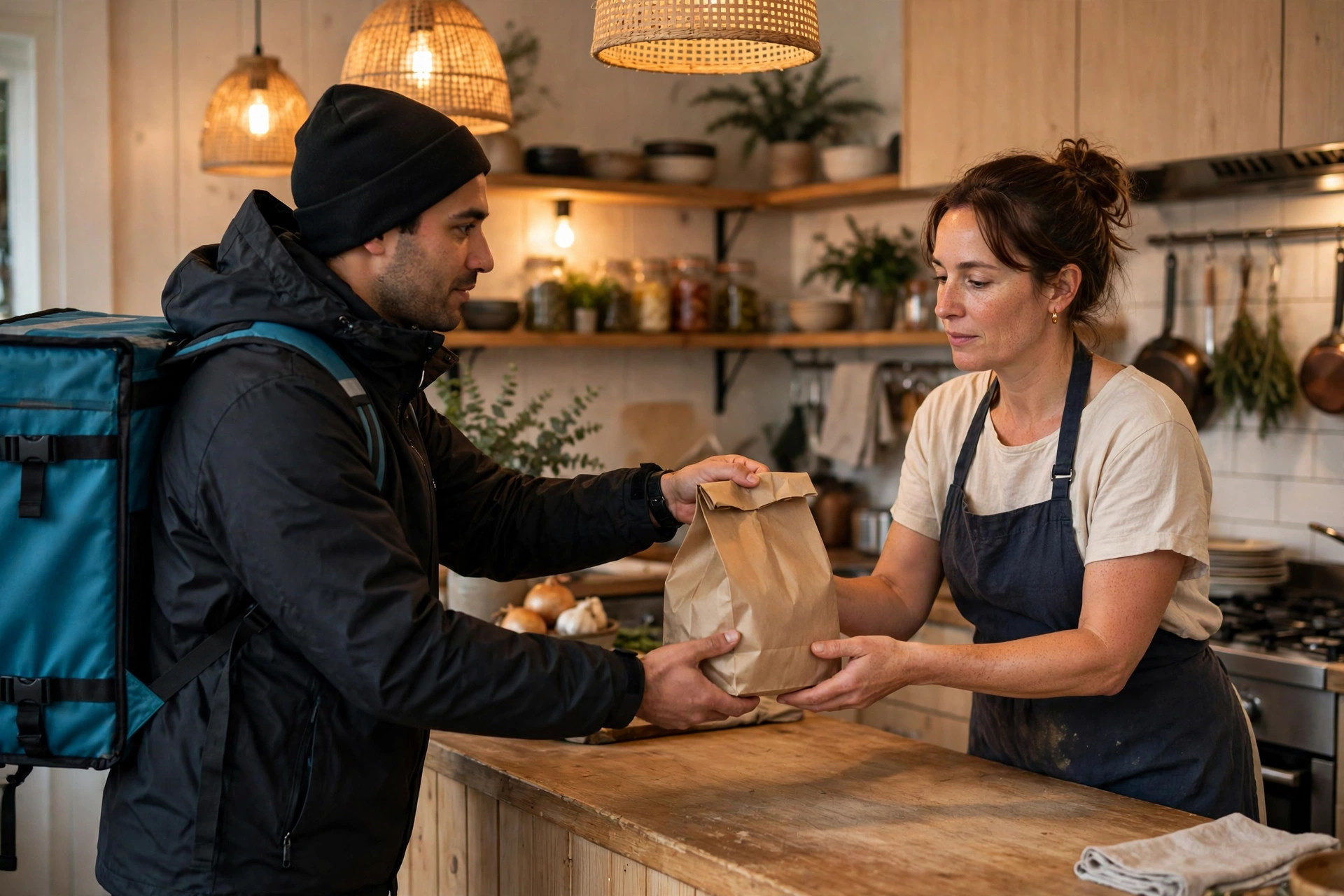
If you run a restaurant anywhere in the Nordics, Wolt and Foodora are not just apps on your customers' phones — they are gatekeepers to a meaningful share of your revenue. Every week you decide, consciously or not, how much of your kitchen's output flows through a channel that keeps around a third of the ticket. This guide gives you the full picture as it stands in late 2026: the commissions, the fees, the market reality after Foodora's dramatic Finland exit, and the regulatory ruling that changed what you are allowed to do about it all.
The 2026 headline: Foodora left Finland
The single most important fact for any Finnish restaurant owner reading this: the Wolt-versus-Foodora decision no longer exists in Finland. Foodora, owned by Delivery Hero, announced in early 2026 that it would withdraw from the Finnish market after ten years of operation. Change negotiations with its staff began in January 2026, and the app went dark across Finland on 27 February 2026. Around 80 local employees were affected, and the company had at its peak served more than a hundred Finnish cities and municipalities.
Why does this matter to you, beyond the obvious? Three reasons. First, if you are reading older guides — and most of the English-language comparison articles online are from 2023 or 2024 — they describe a two-player market that no longer exists in Finland. Second, the exit concentrated enormous pricing power in Wolt's hands: with an estimated 70–80% of the Finnish market already, Wolt is now the only major app-based food delivery platform in the country "for the time being", as the press coverage put it. Third, it underlines a lesson worth internalising: platforms come and go, and a business that is built entirely on rented reach is exposed to decisions made in Berlin boardrooms.
The picture is different elsewhere in the Nordics. In Sweden and Norway, Foodora continues to operate normally, and both platforms compete for restaurant partners. In Denmark, Foodora had already left earlier (2024). So this comparison still has real teeth for Swedish and Norwegian readers — and for Finnish readers, the Wolt sections plus the regulatory history remain the story that matters.
How much commission does Wolt charge restaurants?
Here is the uncomfortable truth at the centre of this comparison: Wolt does not publish its restaurant commission. Unlike some American platforms that list tiered pricing on public merchant pages, Wolt states only that "you pay a commission only on the orders you complete" and that the exact terms are in your individual agreement. The rate is negotiated per restaurant, and it can move with volume, exclusivity, and market.
That said, the industry estimates are consistent enough to plan around. Multiple independent analyses put Wolt's full-service delivery commission — where Wolt's couriers handle the delivery — at 25–30% of the order subtotal in the Nordics. Helsingin Sanomat, Finland's largest daily, has reported that delivery apps in the country take "around a third" of each order's price. Treat 25–30% as your working assumption and confirm your actual figure in your merchant agreement.
What is included — and what costs extra
Wolt's merchant pages do publish some useful facts. There are no fees to join, and you can end the partnership at any time. Payouts are flexible: you can choose to be paid every two weeks, once a month, or as often as every six days. The commission you pay only applies to orders completed through the platform — you do not pay for orders that never happen.
Beyond the headline commission, Wolt operates several commission variants depending on how the order is fulfilled:
- Standard delivery commission — the full rate (estimated 25–30%), applied when Wolt couriers deliver the order.
- Takeaway commission — a reduced rate for orders the customer collects from your venue themselves, since Wolt handles no delivery.
- Wolt+ commission — a slightly higher percentage (or, in some markets, a fixed fee) on orders from Wolt+ subscribers, who tend to have higher basket sizes. The higher cut is meant to offset the free delivery these customers get.
- Self-delivery commission — a lower rate when your own drivers handle the delivery while Wolt provides the marketplace.
One more thing to budget for: VAT is charged on the commission itself. In Finland that is the 25.5% standard rate (VAT-registered restaurants can generally reclaim it as input VAT, but it is still cash that leaves your account first). Self-funded promotions — the €0-delivery-fee campaigns and discounts you are offered inside the merchant portal — are exactly that: self-funded. The platform will happily let you spend your own margin to boost your visibility.
What Foodora charges in Sweden and Norway
Foodora is equally reticent about publishing a standard rate — Delivery Hero negotiates per market and per restaurant. In Sweden and Norway, the best-supported estimate for full marketplace delivery, where Foodora's riders do the delivery, is the same broad band as Wolt: roughly 25–35% of the order value. The same pattern applies: lower for self-delivery and pickup, higher if you opt into paid visibility and promotions.
Why the ranges are wide is worth understanding, because it is the key to any negotiation. Commission is not really a price list; it is a contract. The platform's offer depends on your order volume, your exclusivity (or lack of it), your city's competitive situation, and how much of the platform's marketing machinery you want. A high-volume pizzeria in central Stockholm will be offered different terms from a lunch café in a small Norwegian town. Always read your actual sign-up sheet — the numbers in this article are planning estimates, not quotes.
For Swedish and Norwegian restaurants, one structural advantage still exists: you have two platforms to play against each other. Competition for your signature is the single strongest lever you have in commission talks, and it is precisely what Finland lost in February 2026.
Wolt vs Foodora: the head-to-head comparison
Strip away the branding and the two platforms are structurally similar businesses: a marketplace, an app, a courier fleet, and a percentage of your ticket. The differences that matter for a restaurant owner are coverage, market power, and the small print. Here is the comparison as it stands in late 2026.
| Factor | Wolt | Foodora |
|---|---|---|
| Present in Finland (2026) | Yes — the only major app platform | No — exited 27 February 2026 |
| Present in Sweden and Norway | Yes | Yes |
| Estimated delivery commission | 25–30% (not publicly listed) | 25–35% (not publicly listed) |
| Joining fee | None | None |
| Pickup / takeaway rate | Reduced vs delivery | Reduced vs delivery |
| Self-delivery option | Yes, lower rate | Varies by market |
| Payouts | Every 6 days, every 2 weeks, or monthly | Periodic (per agreement) |
| Contract length | Can end anytime | Can end anytime |
| Exclusivity clauses (Finland) | Removed 2025 (regulator commitment) | N/A — exited |
| Price-parity clauses (Finland) | Removed 2025 (regulator commitment) | N/A — exited |
Two rows in that table deserve a longer explanation than a cell allows. The first is market power. In Finland, Wolt's estimated 70–80% market share plus Foodora's exit means the platform faces almost no competitive pressure to offer you better terms. Your negotiating position in Helsinki in 2026 is structurally weaker than your negotiating position in Oslo, where two platforms still bid for your signature.
The second is the regulatory history — because it is genuinely unusual, genuinely Nordic, and genuinely in your favour.
The exclusivity and price-parity investigation
Between 2022 and 2025, the Finnish Competition and Consumer Authority (FCCA) investigated Wolt over two types of contract clauses. The case is public and worth knowing about, because it directly changed what your merchant agreement is allowed to say.
What the FCCA investigated
Exclusivity clauses. Since 2022, both platforms had increasingly offered restaurants reduced commissions and marketing support in exchange for exclusivity — a commitment not to sell through the competing platform. The FCCA found that Wolt's exclusivity agreements caused more consumers to switch from Foodora to Wolt than the other way around, concentrating the market further.
Price-parity clauses. Most Wolt restaurant agreements also contained a clause saying your prices on Wolt could not be higher than the prices on your own sales channels. The FCCA concluded this harmed competition: it forced you to either pass Wolt's commission through to all your prices, accept lower margins everywhere, or run different menus on different channels. It also, the authority noted, reduced the competitive pressure your own direct channel could exert on Wolt's commission levels — allowing the platform to charge more than it could have in a free market.
What the FCCA case means for you
- Wolt committed to removing both exclusivity and price-parity clauses from all its Finnish agreements; the FCCA closed the case on 8 May 2025 with no sanctions proposed.
- You may now charge different prices on Wolt and on your own website or in-house menu in Finland — legally and contractually.
- If you signed before 2025, check whether your agreement still contains the old clauses and ask Wolt to update them.
Why this matters beyond Finland
The ruling is Finnish, but the logic travels. In Sweden and Norway, Foodora has used parity clauses too — there they applied mainly to the restaurant's own online channels. Even where the clauses still exist on paper, the Finnish precedent gives you language for the negotiation: you can point to a regulator that found these clauses anti-competitive and ask why your contract should differ. And in Finland, the practical consequence is immediate: a separate, higher-priced Wolt menu is now explicitly on the table as a margin-protection strategy.
Which platform actually brings more customers?
Commission is only half the equation. The other half is volume: a 30% cut of a hundred orders beats a 25% cut of ten. Platform reach in the Nordics is lopsided, and you should choose (where you still have a choice) with that in mind.
Finland: Wolt, by a landslide
With Foodora gone and Uber Eats still ramping up after its April 2026 launch, Wolt is where the delivery customers are. Its estimated 70–80% market share means that for most Finnish restaurants, the question is not whether to be on Wolt but how to be on Wolt without losing money on every order. Uber Eats is worth watching — its arrival is the first real competitive pressure Wolt has faced in Finland in years — but it will take time to build courier coverage and customer habits outside the biggest cities.
Sweden and Norway: genuinely two platforms
Here the market is split more evenly, and the customer bases overlap but are not identical. Foodora, as part of Delivery Hero, leans on strong positions in several Swedish and Norwegian cities and on its grocery and retail delivery alongside restaurant food. Wolt leans on brand warmth, a broad retail offering, and its own loyal user base. For a restaurant in Stockholm or Oslo, being on both is usually the volume-maximising answer — the customers are genuinely divided, and exclusivity discounts rarely compensate for losing half the app-based market.
The quality of the customer
There is a harder truth underneath the volume numbers: platform customers are the platform's customers, not yours. You do not get their email addresses, you cannot market to them directly, and their loyalty is to the app. Every platform order is a one-night stand; your job is to turn some of them into regulars on your own channel — your website, your phone number, your table. The platforms know this, which is exactly why the parity clauses existed. Now that they are gone in Finland, use the freedom.
Should your restaurant be on both platforms?
For Swedish and Norwegian readers, the honest answer is usually yes — with conditions. For Finnish readers, substitute "Wolt and Uber Eats" and the logic is the same once coverage matures. The case for multi-platform presence:
- Reach is additive. The customer bases overlap but are not identical. Being on both captures orders you would otherwise never see.
- Competition is leverage. Two platforms competing for your signature is the only real negotiating pressure you have. Use it at renewal time.
- Risk is diversified. Foodora's Finland exit is the cautionary tale: restaurants that depended on it had weeks to rebuild a delivery channel.
The case against is operational, and it is real:
- Kitchen chaos. Two tablets, two alert sounds, two refund processes, two sets of menu updates. During a Friday rush, this costs real money in mistakes.
- Menu management multiplies. Every price change, every 86'd dish, every seasonal menu must be updated in two portals — and on your own site.
- Cannibalisation. Some of your second platform's orders are not new customers; they are your own regulars choosing whichever app has the discount. You pay commission on both.
The deciding factor is capacity. If your kitchen can absorb the extra volume without quality slipping and you have one person responsible for keeping the platforms in sync, go multi-platform. If adding a second tablet means missed tickets and cold food, one platform done well beats two done badly.
Uber Eats and the other alternatives
The Nordic delivery market in late 2026 is more fluid than it has been in years, and it pays to look past the Wolt-versus-Foodora frame.
Uber Eats in Finland
Uber Eats launched in Finland in April 2026, filling the gap Foodora left. For Finnish restaurants this is genuinely good news: it is the first credible competitor Wolt has faced domestically in years, and new entrants typically offer aggressive launch terms — lower introductory commissions, marketing support, prominent placement — to build their restaurant base quickly. If you are renegotiating with Wolt, having a real alternative to cite changes the conversation. Uber Eats' global pricing model is tiered (Lite/Plus/Premium plans at roughly 20/25/30% in markets where it publishes them), though Finnish terms will be agreed per contract.
Smaller and newer players
Domestic platform Swype has been building its Helsinki courier workforce, and services like Sped are probing niches the giants ignore. These are worth a conversation, not a commitment: coverage is limited, but the commissions and terms can be friendlier, and some specialise in segments — corporate catering, suburban zones — where the big apps underperform.
Your own direct channel
And then there is the option the platforms never put in their pitch decks: your own website. A commission-free order page — pickup and, if you arrange it, delivery — costs you a flat monthly fee instead of a third of every order. For a restaurant doing even a modest number of platform orders a day, the maths flips quickly. PowerfulWebsite's Restaurant plan (€239/month, free build) includes an ordering system precisely for this reason: the commission saved on a handful of orders a week covers the subscription, and every order after that is pure margin.

The real maths: when does the platform pay for itself?
Commission is charged on revenue, not on profit — and that distinction is where most restaurants misjudge the deal. Take a €40 order with a 30% commission. The platform takes €12 off the top. Your food cost (say 30%, €12), packaging (€1.50), and labour still have to come out of what is left. Compare that with the same €40 order through your own channel: no commission, same food cost, and roughly €12 more staying in your business per order.
To keep the same euros after commission, your platform prices must be marked up by more than the commission rate — because the commission is also charged on the markup itself. The formula is simple: platform price = in-store price ÷ (1 − commission rate). At 30% commission, that means a 42.9% markup just to break even with your in-store margin. At 25%, it is 33.3%. Work it through for your actual menu before you sign anything.
Break-even markups by commission rate
- 25% commission → 33.3% markup (€10 dish must be priced at €13.33)
- 28% commission → 38.9% markup (€10 dish must be priced at €13.89)
- 30% commission → 42.9% markup (€10 dish must be priced at €14.29)
These are estimates to help you plan — always use your contract's actual rate.
The platform pays for itself when it brings you customers you would not otherwise have had: new neighbourhoods, late-night orders, rainy Tuesdays. It does not pay for itself when it merely moves your existing regulars from your phone to the app and takes a third for the privilege. That is the single most expensive mistake in delivery: paying acquisition commission on customers you already acquired.
Five rules for staying profitable on Wolt and Foodora
1. Price the platform menu separately
In Finland this is now explicitly your right. Build a Wolt menu with prices that cover your commission — a streamlined menu of your best-margin, travel-proof dishes, priced 30–40% above in-store. Customers accept platform prices; what they do not accept is a great dish arriving cold because your kitchen was drowning in low-margin orders.
2. Treat the platform as marketing, not as sales
Account for commission the way you account for ad spend: it buys you discovery. Set a monthly "platform budget" the same way you would for Google Ads, and measure it the same way — cost per new customer, not total orders. If the platform is mostly serving your regulars, that is not marketing. That is a tax.
3. Convert platform customers to your own channel
Every order that leaves your kitchen is a marketing opportunity. A card in the bag — "order direct next time and get 10% off" — with your website address turns a €12 commission into a one-time cost. Your own online ordering page should be one tap from your homepage, work flawlessly on mobile, and take payment without friction. This is the highest-return marketing you can do, and it costs almost nothing.
4. Be disciplined about self-funded promotions
The merchant portal will constantly invite you to fund discounts and free delivery to boost your ranking. Sometimes that is worth it — a launch week, a slow January. But every promotion comes out of your margin, not the platform's. Never run a promotion you have not costed, and never run one indefinitely. A "temporary" 20% discount that runs for six months is just a 20% pay cut.
5. Reconcile your payouts like your business depends on it
Because it does. Check every payout statement against your own order records: missing orders, wrong commission rates, refunds you never authorised, promotional discounts applied to the wrong items. Platform statements are complex by design, and errors overwhelmingly favour the platform. Fifteen minutes a week with a spreadsheet is the cheapest margin protection you have.
Frequently asked questions
Is Foodora still operating in Finland?
No. Foodora ended its Finnish operations on 27 February 2026, after ten years in the market. Wolt is now the only major app-based food delivery platform in Finland, although Uber Eats launched there in April 2026. In Sweden and Norway, Foodora continues to operate as usual.
How much commission does Wolt charge restaurants in Finland?
Wolt does not publish a fixed rate — the commission is agreed in your merchant contract. Industry estimates typically put delivery commission at 25–30% of the order subtotal, with lower rates for customer pickup and self-delivery. There is no joining fee, and you can end the partnership at any time.
Can I charge higher prices on Wolt than in my own restaurant?
In Finland, yes. Wolt used to include price-parity clauses in its restaurant agreements, but after the Finnish Competition and Consumer Authority's investigation, Wolt committed to removing both exclusivity and price-parity clauses in Finland, and the case was closed in May 2025. You are free to price differently across your own channels and Wolt.
Can my restaurant be on both Wolt and Foodora at the same time?
In Sweden and Norway, yes — many restaurants are listed on both platforms, and there is no requirement to be exclusive. In Finland the question is moot for Foodora, which left the market in 2026. Wherever you operate, check the exclusivity clause in your contract before signing.
Is Wolt or Foodora cheaper for restaurants?
The commission bands are broadly similar — both sit in the 25–35% range for full marketplace delivery where the platform provides the couriers. The bigger difference is reach: in Finland Wolt is effectively the only option, while in Sweden and Norway both platforms compete, which can give you more negotiating room.
What are the alternatives to Wolt in Finland?
Uber Eats launched in Finland in April 2026, and smaller or newer services such as Swype and Sped are building a presence. The other alternative is your own direct ordering channel — a commission-free order page on your website, which is exactly what PowerfulWebsite's Restaurant plan includes.
Want an ordering channel that costs €0 per order?
PowerfulWebsite builds your restaurant website free of build cost — you only pay from €59 a month, or €239 a month for the Restaurant plan with its own commission-free ordering system. Everything is included: domain, hosting, maintenance, and updates.
See the packages