Instagram Reels Ideas for Restaurants: 30 That Work in 2026
Instagram Reels are the single highest-reach format a restaurant can post: they reach roughly 30% of your audience compared to about 13% for static posts, and the best ones turn into bookings. The formula is simple — 7–15 seconds, a hook in the first 3 seconds, trending audio and a location tag — and this guide gives you 30 concrete ideas plus the system to film them without disrupting service.
Key takeaways
- Reels reach roughly 30% of your audience vs about 13% for static image posts — they are your discovery engine for new local customers.
- Post 3–5 Reels per week sustainably; consistency for 90 days beats a one-week posting burst every time.
- The winning format: 7–15 seconds, hook in the first 3 seconds, trending audio (5,000–50,000 uses), location tag on every post.
- Batch-film a month of Reels in one afternoon: one shoot session produces 8–16 videos and removes daily content pressure.
- Reels and TikTok do different jobs — polished discovery content for Instagram, raw personality for TikTok — adapt rather than cross-post identical clips.
- Measure profile visits and link clicks, not just views: a Reel's job is to start the journey that ends in a booking.
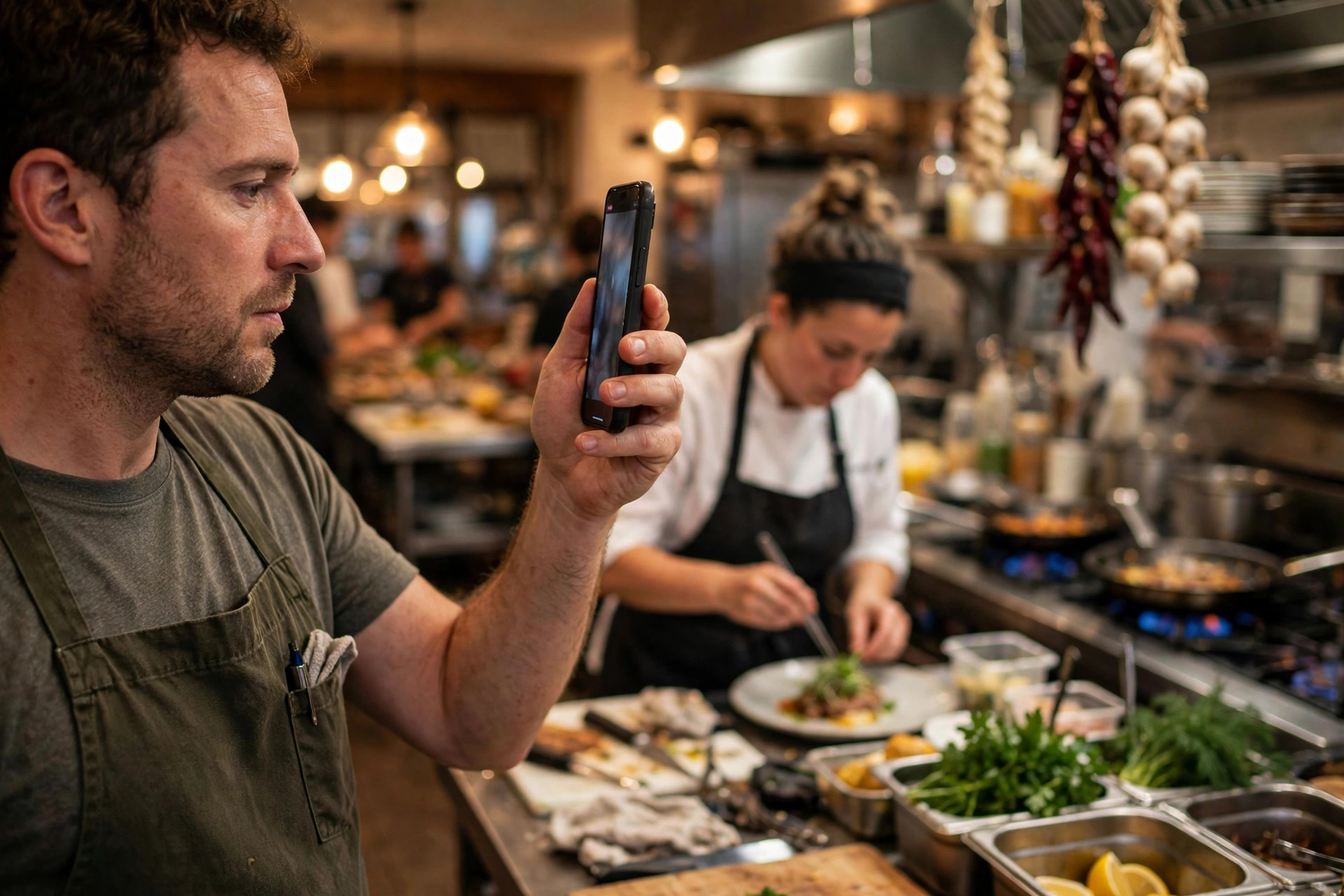
Every restaurant owner knows the feeling: you spend money you don't have on beautiful food, and then nobody outside the neighbourhood knows it exists. Instagram Reels are the cheapest distribution your food will ever get. One well-made 12-second clip of a steak hitting a hot pan can reach more local people in a day than a month of static posts — and it costs exactly nothing to publish. This guide is built for busy operators: 30 concrete, filmable ideas organised by category, the posting frequency that actually works without burning out your team, a batch-filming system that turns one afternoon into a month of content, and the honest numbers on Reels vs TikTok. No theory, no "just go viral" — just a working content engine for a working restaurant.
Why Reels are your highest-ROI format
Let's start with the uncomfortable truth: your static food photos are being shown to a fraction of your followers. Industry data consistently puts Reels reach at roughly 30% of your audience, compared to around 13% for static image posts. Instagram's algorithm heavily favours short video — it's the format the platform is built to distribute right now, and it pushes Reels to people who don't follow you yet. For a restaurant, that matters enormously: your best new customers are people who live nearby and have never heard of you, and Reels are the one format that reliably finds them.
Video also does something photos can't: it creates craving in motion. Steam rising off a bowl, cheese stretching, a cocktail being torched — movement triggers appetite in a way a still image never fully matches. That's why food content is one of the strongest-performing categories in short video. And unlike paid ads, organic Reels keep working: a good one gets discovered by new locals for weeks after posting.
The economics that matter to an owner
Think of Reels as free advertising with compounding returns. A single sponsored post to reach 10,000 local people might cost you €100–€300 in ad spend. A Reel that reaches the same audience costs one afternoon of filming and zero euros. Not every Reel will do that — most won't — but the ones that land more than pay for the whole system. The restaurants winning on Instagram aren't the ones with the biggest budgets. They're the ones with a repeatable system for capturing what already happens in their kitchen every day.
A single viral Reel rarely builds a regular crowd. A steady, recognisable presence does.
How often should a restaurant post Reels?
This is the question every owner asks, and the honest answer has three levels. The minimum viable rhythm is about 3 Reels per week — enough to stay in the algorithm's favour and keep your profile alive. The sustainable sweet spot for most restaurants is 3–5 per week, supplemented by Stories most days. Daily posting is the maximum, and it only works if you have a proper batch-filming system; without one, daily posting burns out your team within a month and the quality collapses.
| Level | Reels per week | Who it's for |
|---|---|---|
| Minimum viable | 3 | Solo operators, tiny teams — keeps the algorithm's attention |
| Sustainable sweet spot | 3–5 | Most restaurants — real growth without burnout |
| Maximum | 7 (daily) | Only with a batch-filming system and dedicated content time |
Industry benchmarks put restaurant and hospitality businesses at roughly 12–20 Reels per month — visual-first businesses with daily relevance. But the number that matters most is consistency over 90 days. Most restaurants post 2–4 Reels a month and call it a strategy; that isn't a strategy, it's hoping something sticks. Pick a frequency you can genuinely maintain for three months, build your system around it, and only increase once quality stays stable.
A weekly mix that works
Don't post five food close-ups in a row. A weekly content mix keeps your profile interesting and serves different jobs: 2–3 food showcase Reels, 1 promotional or special Reel, 1 behind-the-scenes Reel, and 1 team or customer feature. The food showcases drive discovery and craving, the behind-the-scenes builds trust, the team features build loyalty, and the promo Reels convert attention into bookings. Our monthly content calendar template for restaurants turns this mix into a fill-in-the-blanks plan.
The rules that make Reels work
Before the 30 ideas, the rules. These are the non-negotiables that separate Reels that get watched from Reels that get scrolled past:
- Hook in the first 3 seconds. Open with the sizzle, the flame, the cheese pull — the most visually dramatic moment first. Never open with your logo, the restaurant's front door, or a talking head introducing themselves.
- 7–15 seconds is the sweet spot. Short clips get watched to the end, and completion rate is one of the strongest signals the algorithm reads.
- Use trending audio with 5,000–50,000 uses. Sounds in this range give the best algorithmic distribution — big enough to be trending, small enough that your video isn't buried. Tap the audio name on any Reel to see its use count.
- Location tag on every single Reel. This is how Instagram shows your content to nearby non-followers. It costs two seconds and it's the highest-leverage habit in this whole guide.
- Add captions/subtitles. A large share of Reels are watched with sound off. On-screen text carries the message and doubles as a hook.
- End with a reason to act. "Book for Friday", "This weekend only", your profile link. A Reel without a next step is entertainment; a Reel with one is marketing.
- Don't post without a purpose. Every Reel should showcase a dish, promote an event, build trust, or entertain on-brand. "We should post something" is not a purpose.
The anatomy of a high-performing restaurant Reel
Seconds 0–3: the hook — your most dramatic visual, full-screen, no intro. Seconds 3–10: the story — the dish coming together, the technique, the reveal. Final frame: the details — what it is, when it's available, and what to do next. Caption: the hook in text form + location tag + 3–5 mixed hashtags (local + cuisine + branded). Share it to Stories immediately after posting for an extra visibility boost among existing followers.
The 30 ideas
Here they are — organised into five categories so you can rotate through them and never repeat yourself two weeks in a row. Each idea includes a filming tip: what to actually point the camera at.
Dishes that sell themselves (1–6)
1. The signature dish time-lapse. Film your most-ordered dish from raw ingredients to finished plate, then speed it up to 10–15 seconds. Time-lapse prep videos are among the most consistently high-performing restaurant formats — the transformation is inherently satisfying. Film tip: lock the phone on a tripod in exactly the same position; any movement breaks the effect.
2. The money shot. The cheese pull, the yolk breaking, the chocolate lava flowing, the steam rising off the ramen. Every menu has one dish with a moment — find yours and film it in slow motion. Film tip: shoot at 120fps and slow it down in editing; the drama doubles.
3. Plating POV. Strap the perspective to the chef: tweezers placing microgreens, sauce dots being dragged, the final wipe of the rim. This is the "chef's table at home" feeling. Film tip: film from directly above the pass, phone held steady with both hands.
4. Before and after. Raw ingredients on one side of the frame, the finished dish on the other — a hard cut between the two. The contrast does all the work. Film tip: keep the framing identical for both shots so the cut lands cleanly.
5. "POV: you ordered the ___." Film the dish's journey from the guest's perspective: it lands on the table, the first cut, the first bite reaction. This format lets viewers imagine themselves in the seat. Film tip: sit in the actual dining room, natural light, no staging.
6. The dessert reveal. Desserts are the highest-save category in restaurant content — people bookmark them for later. Film the spoon cracking the crème brûlée, the chocolate sphere melting, the affogato pour. Film tip: close-up, slow motion, natural sound on.
Behind the scenes (7–12)
7. Morning prep montage. Dough being kneaded, vegetables being chopped, stockpots steaming — the 6 AM work nobody sees. Set it to an upbeat trending sound. Film tip: film 5–6 short clips during one real prep session; edit into a 12-second montage.
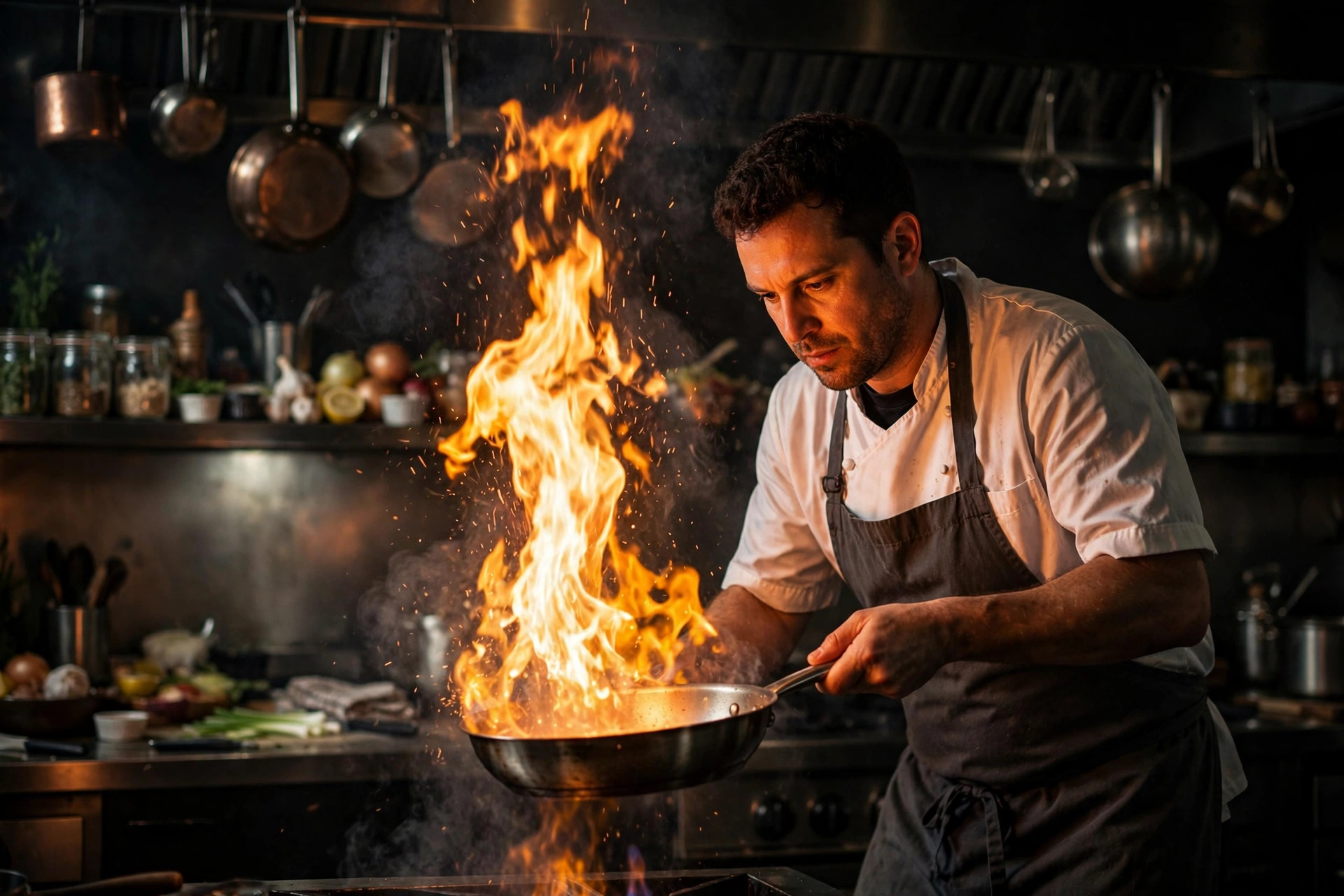
8. Technique showcase. Hand-pulled noodles, a flambéed pan, pizza tossed in the air, precise knife work. Skill-based videos get shared because they're impressive and educational. Film tip: ask your chef what they do that home cooks can't — that's the clip.
9. The market run. Film your morning at the local market or the fish delivery arriving — the boxes, the freshness, the handshake with the supplier. Nordic diners care deeply about provenance; show it. Film tip: even 3 clips (arrival, selection, back at the kitchen) make a complete Reel.
10. Dough day. Pizza dough being stretched, bread being scored, croissants being laminated. Dough content is oddly mesmerising and performs far above average. Film tip: flour-dusted hands in good side light; the texture is the star.
11. "What Friday night looks like." A fast-cut montage of a busy service: tickets printing, pans firing, plates flying, the dining room full. Energy is contagious. Film tip: film in short 2-second bursts through the evening; assemble the next morning.
12. Seasonal ingredient arrival. The first chanterelles of autumn, the first asparagus of spring, the Christmas ham delivery. Seasonal moments create urgency — "it's here now, it won't last." Film tip: film the unboxing moment; genuine excitement reads on camera.
Your people (13–18)
13. Meet the chef in 15 seconds. Name, how long they've cooked, their favourite dish on the menu, one unexpected fact. Quick cuts, big personality. Customers support restaurants where they know the people. Film tip: film during a quiet moment; keep answers to one sentence each.
14. Bartender's signature pour. Your bartender making the house cocktail with flair — the shake, the strain, the garnish, the first sip face. Cocktail videos consistently overperform because they combine skill, visual appeal and aspiration. Film tip: dark background, good side light, slow-mo on the pour.
15. "Our server's favourite." A server recommends their personal favourite dish in 10 seconds and says why. It humanises the team and sells the dish simultaneously. Film tip: film at the actual table they'd serve it at; authenticity over polish.
16. Day in the life of a line cook. Follow one team member through a shift — arrival, prep, service rush, the staff meal, clocking out. "Day in the life" content performs because people are nosy about jobs they've never done. Film tip: get their genuine permission first, and let them approve the final cut.
17. Team taste-test. The kitchen tries the new seasonal dish on camera; genuine first reactions, scored out of 10. Unscripted reactions are the most watchable content on the platform. Film tip: don't rehearse it — the first real take is always the best one.
18. Trend-jack with your staff. Take a trending format — "green flags", "things in our restaurant that just make sense", the sitcom-theme entrance — and film your team doing it. Trends give you free reach; your team's personality makes it yours. Film tip: move fast; trends have a shelf life of about a week.
Promotions that convert (19–24)
19. Today's special, announced properly. Not a text graphic — the actual dish, filmed, with the price and "today only" on screen. Post 2–4 hours before the promotion starts, when people are making dining decisions. Film tip: film it the moment it's plated; specials wait for no camera.
20. The happy-hour countdown. A clock-ticking edit: cocktails being made faster and faster as the "happy hour ends in 1 hour" text counts down. Urgency converts. Film tip: use the phone's built-in timer overlay or add countdown text in CapCut.
21. Limited-menu preview. Tease the Christmas menu, the Valentine's tasting, the summer terrace menu — one dish per Reel, released over a week. Scarcity plus anticipation is the oldest sales formula there is. Film tip: end every preview with the booking link or "reserve" prompt.
22. The gift-card push. November and December: film the physical gift card being handed over, the envelope, the "give them dinner" message. Gift cards are pure margin, and a Reel beats a poster in the window. Film tip: show hands exchanging it — gifting is a human moment, not a product shot.
23. Weekend brunch feature. Friday afternoon post: the full brunch spread, mimosas being poured, the sunny table by the window. Brunch content posted Friday consistently drives weekend bookings. Film tip: shoot in the morning light you'll actually serve it in — honesty sells.
24. "First 50 get ___." A genuine limited offer — first 50 bookings get the amuse-bouche, the welcome drink, the dessert. Film the reward, state the limit, watch the comments. Film tip: only do this with offers you can honour; nothing kills trust faster than a fake limit.
Community, trends and guests (25–30)
25. Customer first-bite reactions. With explicit permission, film a guest's genuine reaction to their first bite. Real delight is the most persuasive advertising ever made. Film tip: ask after the reaction, not before — "that was amazing, can we use that?" works better than staging it.
26. Repost guest content. A guest films a great Reel at your restaurant — repost it (with permission and credit) to your Stories and feed. User-generated content is social proof at scale, and reposting costs nothing. Film tip: make reposting easy with table signage showing your handle and location tag.
27. Answer a real question. "Do you have gluten-free options?" "Can we bring a dog to the terrace?" "Where do we park?" Answer the questions your staff hear daily — each answer is a Reel, and each one removes a booking objection. Film tip: put the question as on-screen text in the first second; the answer is the rest.
28. The pairing guide. Your sommelier or bartender matches three dishes with three drinks in 15 seconds. Educational content gets saved at very high rates, and saves are algorithmic gold. Film tip: line up all three pairings and do quick cuts between them.
29. The ambience walk-through. A smooth first-person walk: through the door, past the bar, to the best table, the food arriving. This lets potential guests visualise themselves in your space — a powerful psychological driver of reservations. Film tip: film at golden hour if your windows allow it; the light does half the work.
30. Your origin story in 15 seconds. Why this restaurant exists, in the owner's own words — old photos of the opening, the first menu, the "we almost didn't make it" moment. Story is the one thing chains can't copy. Film tip: mix old photos (screen-recorded with a slow zoom) with present-day footage.
Don't post five food close-ups in a row. Rotate the categories — discovery, trust, personality, conversion — and your profile starts working like a funnel.
Batch-film a month of Reels in one afternoon
Here's the system that makes 3–5 Reels a week possible for a busy restaurant: you don't film daily, you film monthly. One 90-minute session, once a month, produces 8–16 usable videos. That's the entire content engine.
The session plan
- Prep (15 min). Charge two phones, clear one prep table near good light, write a shot list of 10–12 ideas from the list above. Tell the kitchen which dishes you'll need plated and when.
- Film the food (40 min). Work through the shot list dish by dish. Film each idea as 3–4 short clips (5–10 seconds each) — wide, close-up, action, detail. Don't review footage yet; keep momentum.
- Film the people (20 min). Grab the chef, the bartender, one server. One question each, one take each. Done is better than perfect.
- Film the room (15 min). Empty dining room walk-through, the bar setup, the terrace — the evergreen "ambience" clips you'll reuse for months.
The editing workflow
Edit on the phone in CapCut (free) — it's what most restaurant accounts use, and it's fast. Build one template: your hook style, your caption font, your end card with the booking prompt. Then it's assembly-line work: drop clips in, add trending audio, add on-screen text, export. Save finished Reels as drafts in Instagram and schedule them across the month. Total ongoing time: roughly 2–3 hours a month for a full content calendar. Compare that with the daily scramble of "what do we post today" — which is how most restaurant accounts die.
Reels vs TikTok: where should you spend your time?
You don't have to choose — but you do have to adapt. The two platforms reward different things, and posting identical content on both underperforms on both.
| Instagram Reels | TikTok | |
|---|---|---|
| What wins | Polished clips: plating, atmosphere, finished dishes | Raw and spontaneous: kitchen chaos, staff personality, customer reactions |
| Typical engagement rate (food & beverage) | Around 0.5% | Around 3–4% — roughly 7x higher |
| Discovery speed | Steady; builds over weeks | Faster — content travels further, quicker |
| Audience skew | Broad; strong 25–45 | Younger; strong under-40, Gen Z discovery |
| Conversion path | Profile → link in bio → booking; Reserve button integrations | Discovery → search your name → Google/Instagram to book |
| Effort per post | Medium — benefits from light editing | Low — authenticity beats production value |
| Best posting rhythm | 3–5x per week | 3–5x per week |
The practical takeaway: film once, edit twice. The same afternoon's footage becomes a polished Reel for Instagram (clean cuts, trending audio, captions) and a rawer TikTok (natural sound, text overlays, personality forward). TikTok tends to convert discovery into visits faster — industry surveys suggest well over half of TikTok users have visited a restaurant after seeing it on the platform — while Instagram builds the long-term brand and owns the booking path. If you genuinely only have time for one, pick the platform where your actual customers already are: under-40 crowd, TikTok; broader local audience, Instagram. Our full Instagram strategy guide for restaurants covers how Reels fit into the bigger picture of profile, Stories and highlights.
Measuring what matters
Views are vanity; bookings are sanity. A Reel with 50,000 views and zero profile visits did less for your restaurant than one with 2,000 views and 200 profile visits. Check Instagram Insights weekly and track the chain that actually matters: views → profile visits → link clicks → bookings. The drop-off between each step tells you where the problem is — great views but no profile visits means the content entertains but doesn't sell the restaurant; profile visits but no bookings means your profile or booking flow needs work.
The metrics worth a weekly glance
- Saves and shares — the strongest quality signals. A saved Reel gets shown to more people; a shared one brings new ones.
- Profile visits per Reel — the bridge between content and customer. Rising profile visits mean your Reels are creating intent.
- Non-follower reach — are you finding new locals, or preaching to regulars? Both matter, but growth lives in non-followers.
- Completion rate — if viewers drop off at second 2, your hook failed. Re-cut the opening, not the whole video.
Then do the obvious thing most restaurants skip: double down on what works. If behind-the-scenes clips drive twice the profile visits of food close-ups, film more behind-the-scenes. Review monthly, adjust the mix, and let your own data — not trends, not competitors — set the strategy. And make the booking step frictionless: your Instagram bio link should land on a page where a guest can see the menu and book a table in under a minute. PowerfulWebsite builds restaurant websites where that path is the whole point — menu, booking and location on one fast page.
A Reel with 2,000 views and 200 profile visits did more for your restaurant than one with 50,000 views and none.
Mistakes that kill your Reels
- Opening with the logo. Nobody follows a logo. The first frame must be the most dramatic second of your footage — the flame, the pour, the pull.
- Posting the same five dishes forever. Repetition trains your audience to scroll past. Rotate through the 30 ideas; your regulars will notice the variety and your reach will thank you.
- Hard-selling in every Reel. "Order now! Book now! 20% off!" in every caption teaches people to ignore you. The ratio that works is roughly 4 value or entertainment Reels to 1 direct promotion.
- No location tag, no local hashtags. A beautiful Reel with no location signal is a billboard in the desert. Two seconds, every post, no exceptions.
- Ignoring your own analytics. Instagram tells you exactly which Reels drove profile visits. Not reading that data is like not reading your till receipts.
- Filming vertically-challenged content. Reels are 9:16. Film vertically, always. A horizontal clip awkwardly cropped is an instant scroll-past.
- Waiting for perfect. The restaurant down the street with a shaky phone and a great dish is out-reaching your unposted masterpiece. Ship it.
Frequently asked questions
How often should a restaurant post Reels on Instagram?
For most restaurants, 3 to 5 Reels per week is the sustainable sweet spot: enough to stay in the algorithm's favour without burning out the team. Minimum viable is around 3 per week; daily posting only works if you have a proper batch-filming system. Consistency matters more than volume — three good Reels a week for 90 days will beat 30 random ones posted in a burst.
What is the best length for a restaurant Reel?
7 to 15 seconds is the ideal length for most restaurant Reels. Short clips get watched to the end, and completion rate is a strong signal for the algorithm. The first 3 seconds decide everything: open with the hook — the sizzle, the cheese pull, the flame — not your logo or the restaurant's front door.
Should a restaurant post on Instagram Reels or TikTok?
Do both, but don't post identical content on each. Instagram Reels favour slightly polished clips — plating, atmosphere, finished dishes — and convert well into profile visits and bookings. TikTok rewards raw, spontaneous content — kitchen chaos, staff personality — and converts discovery into visits faster, especially with diners under 40. If you only have time for one, pick the platform where your actual customers already spend their time.
Do I need trending audio for my restaurant Reels?
Trending audio helps distribution — clips using sounds with roughly 5,000 to 50,000 uses tend to get better algorithmic reach than mega-trends everyone has already seen. But audio never saves a weak video. A great dish with natural kitchen sound will outperform a boring clip with the trend of the week. Use trending sounds when they fit; don't force them.
How do I get local customers to find my restaurant's Reels?
Add your location tag to every Reel, use a mix of local hashtags (#oslofood, #helsinkirestaurants, your neighbourhood name) plus cuisine hashtags, encourage guests to tag your location, and collaborate with genuinely local food creators. Location signals are how Instagram decides to show your Reels to nearby people who don't follow you yet.
Want a website that turns viewers into guests?
PowerfulWebsite builds your restaurant's website for free — you only pay from €59/month. Everything is included: a fast menu page your Reels can link to, online booking, domain, hosting, maintenance and updates.
See the plans