Ad Copy That Brings Table Bookings
Ad copy that brings table bookings does five things: it names one specific offer with a deadline, describes the food in sensory language, shows your own photography, gives one clear call to action, and sends the click to a page you own. Most restaurant ads fail on at least three of these — which is why fixing copy is usually cheaper than raising the budget.
Key takeaways
- Every booking-driven ad has the same five parts: one goal, one offer with a deadline, your own food photo, one call to action, and a trackable link to your own booking page.
- Keep copy short: headline with the offer, one line of sensory detail, the price, the deadline, the button. If it needs a second paragraph, sharpen the offer.
- "Book a table" beats "Learn more" every time — the CTA must name the action and open the booking flow, not the homepage.
- Sensory words (charred, buttery, slow-braised, crisp) sell the dish; urgency words (this Friday, only 12 seats, until Sunday) sell the timing.
- Nordic rules matter: EU law requires genuine reference prices on discounts, and Finland bans advertising alcohol happy hours — check the rules before your copy goes live.
- Test one thing at a time, give each test two weeks, and judge by cost per booking — never by likes.
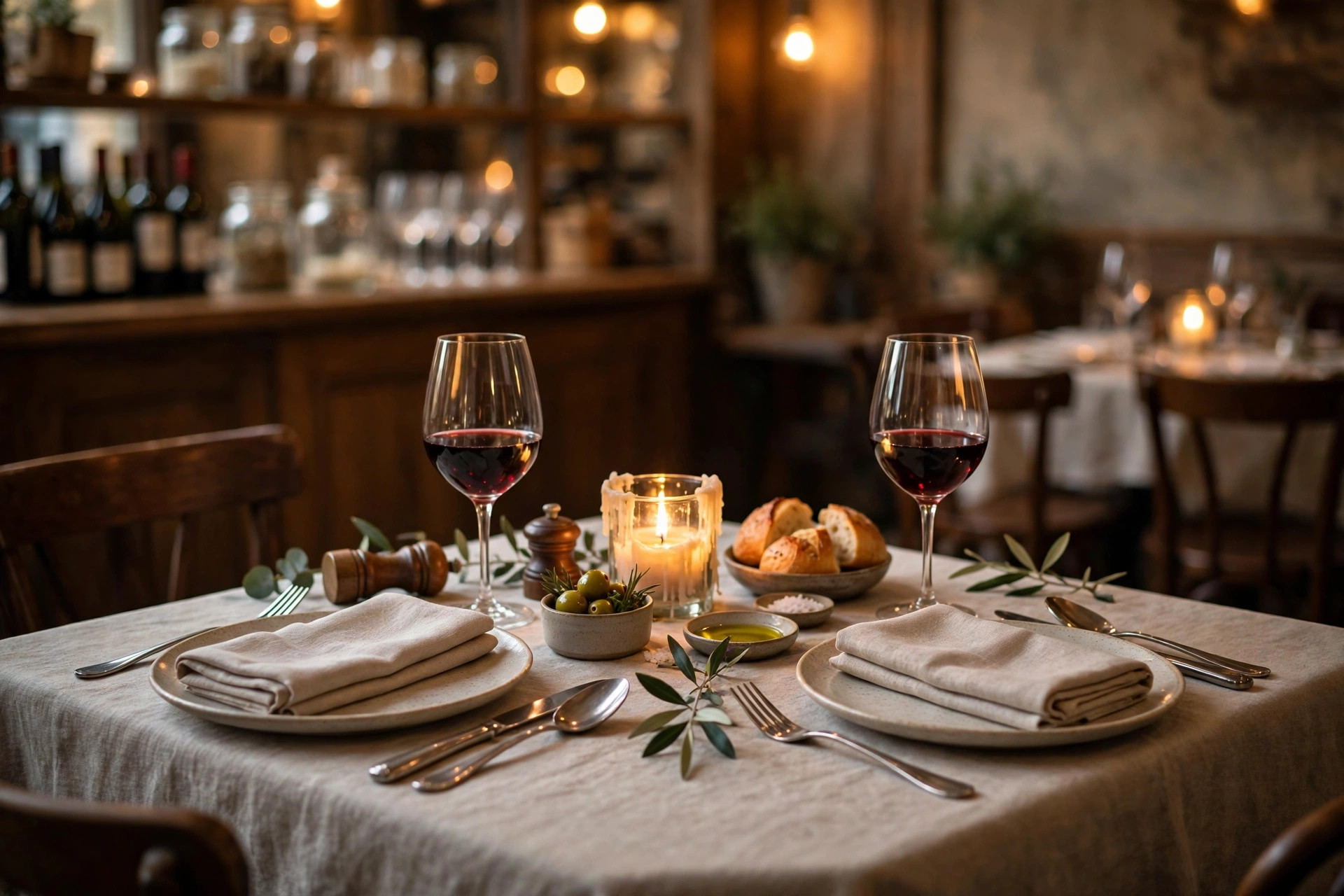
Scroll any feed on a Friday afternoon and you will see the two species of restaurant ad. The first says something like "Welcome to Bella Italia — authentic Italian cuisine in the heart of the city. Come and experience our warm atmosphere!" The second says "Friday night, sorted: wood-fired pizza, natural wine, tables from 18:00 — 6 left tonight. Book yours." Same budget, same platform. One of them is buying awareness; the other is buying bookings.
This guide is about writing the second kind. You will get the anatomy every booking-driven ad shares, copy examples for Google Search and social media that you can adapt (clearly labelled as templates, not anyone's real ads), the sensory language that makes people hungry, how to create urgency without sounding desperate or breaking Nordic advertising rules, and the mistakes that quietly eat restaurant ad budgets. Pair it with our keyword research guide — copy decides what happens after the click, keywords decide who clicks — and the Google Ads beginner's guide for the campaign mechanics.
What makes restaurant ad copy work
Strip away the platforms and the formats and restaurant ad copy has one job: to move a specific person, at a specific moment, from "I need to decide where to eat" to "I have booked a table there." Everything that serves that job stays; everything else is decoration.
That gives you a ruthless editing standard. Read every line of your ad and ask: does this make the decision easier, or does it make my restaurant sound nice? "Authentic Italian cuisine in the heart of the city" makes the restaurant sound nice — and could describe four hundred restaurants. "Wood-fired pizzas from €14, 5 minutes from Central Station, tables tonight" makes the decision easier. Specificity is the whole trick: the dish, the price, the place, the time.
There is also a timing dimension most guides skip. Restaurant decisions are unusually time-compressed — the gap between "I'm hungry" and "I've booked" is often under an hour on mobile. Your copy is competing not with other restaurants' poetry but with the back button. That is why the best restaurant ads read almost like signage: the offer first, the details second, the button always visible. Save the brand story for the website; the ad is a door, not a dining room.
The anatomy of an ad that books tables
No matter the channel, a restaurant ad that drives bookings has the same five parts. Miss one and the ad leaks; miss two and you are donating to the platform.
- One goal, one audience. "More weekday lunch orders from offices within two kilometres" tells you where, when, and to whom. "More customers" tells you nothing and measures nothing.
- One offer with a deadline. A limited-time dish, a set menu, a themed evening — something that gives people a reason to act this week, not someday. No deadline, no decision.
- Your own food, shown well. Your own photos or short vertical video of the dish you are advertising, in good light. Stock photos make every restaurant look the same — and diners can smell stock from three scrolls away.
- One call to action, ending on a page you own. "Book a table" should open your booking system or your own site — not a marketplace listing — so the guest, their contact details, and their consent stay with you.
- Trackability. A unique promo code, a tagged link, or a dedicated landing page per channel, so you can compare cost per booking and cut the weakest channel each month.
Notice what is not on the list: your founding story, your philosophy, your full menu. Those belong on the landing page, where the interested clicker goes to be convinced. The ad is the invitation; the page is the pitch. Confusing the two is the most expensive copywriting error in the business.
Google Search ad copy examples
Google Search ads are text-only, character-limited, and shown to people who have already told you what they want. The winning formula: mirror their search in the headline, add the offer and the differentiator, and end with the action.
Templates you can adapt (replace the bracketed parts — these are examples, not real ads):
- Headline: "Sushi in [Bergen] — Book a Table Tonight" Description: "Fresh nigiri & tasting menus from €[29]. 2 min from the harbour. Reserve online in 30 seconds."
- Headline: "Birthday Dinner [Oslo]? Private Room for 12" Description: "Celebrate with a 3-course menu at €[49]. Free corkage this month. Check availability now."
- Headline: "Best Ramen [Turku] — Open Late" Description: "Slow-simmered broth, handmade noodles. Kitchen open till 23:00. Walk-ins & bookings welcome."
- Headline: "Vegan Brunch [Helsinki] — Sat & Sun" Description: "Plant-based brunch buffet €[24], 10:00–14:00. Kids under 6 free. Book your table."
What makes these work: the headline contains the searcher's own words (Google bolds matching terms, which lifts click-through), the description carries one sensory or practical detail plus the price, and every one ends with an action. Use ad extensions — location, call, and sitelinks to the menu and booking page — because on mobile they can double your ad's screen space for free.
The 30-second relevance check
Before launching any search ad, type your keyword into Google and read the top three ads. If yours does not contain the searcher's words in the headline, name a concrete offer, or beat the others on specificity — rewrite it. You are not competing against silence; you are competing against the two ads directly above and below you.
Social media ad copy examples
Social ads interrupt someone's evening to create a craving; search ads meet someone who already has one. So social copy leads with the hook — the visual or the first line — and earns the click with desire, not information.
The structure that works: hook line → sensory sentence → offer with deadline → CTA button. Examples (templates — adapt the bracketed parts):
- Hook: "This is what Friday tastes like." Body: "Charred octopus, smoked paprika butter, grilled lemon — our autumn menu lands this week. 5 courses, €[59], until [30 Nov]." CTA: Book a table.
- Hook: "Your office lunch, upgraded." Body: "Slow-braised beef, truffle mash, proper coffee — lunch from €[16], served in 15 minutes or it's on us. Weekdays 11–14." CTA: See the menu.
- Hook: "12 seats. One night. Zero regrets." Body: "Guest chef [Name] takes over our kitchen [Friday]. 7-course tasting, €[89] with wine pairing. When they're gone, they're gone." CTA: Reserve now.
- Hook: "The brunch your group chat keeps talking about." Body: "Bottomless filter coffee, cardamom buns, shakshuka that actually has a kick — Saturdays 10–14, €[24]." CTA: Book a table.
Two platform notes. On Instagram and Facebook, the creative is the headline — put the budget into the food photography or a 15-second vertical video and keep the copy lean. And do not boost posts blindly: a boosted post optimised for engagement buys you likes from three time zones away, while an Ads Manager campaign optimised for bookings, targeted at a tight radius, buys you tables. Our Meta ads targeting guide covers the setup; this guide covers the words.
Sensory language: words that make people hungry
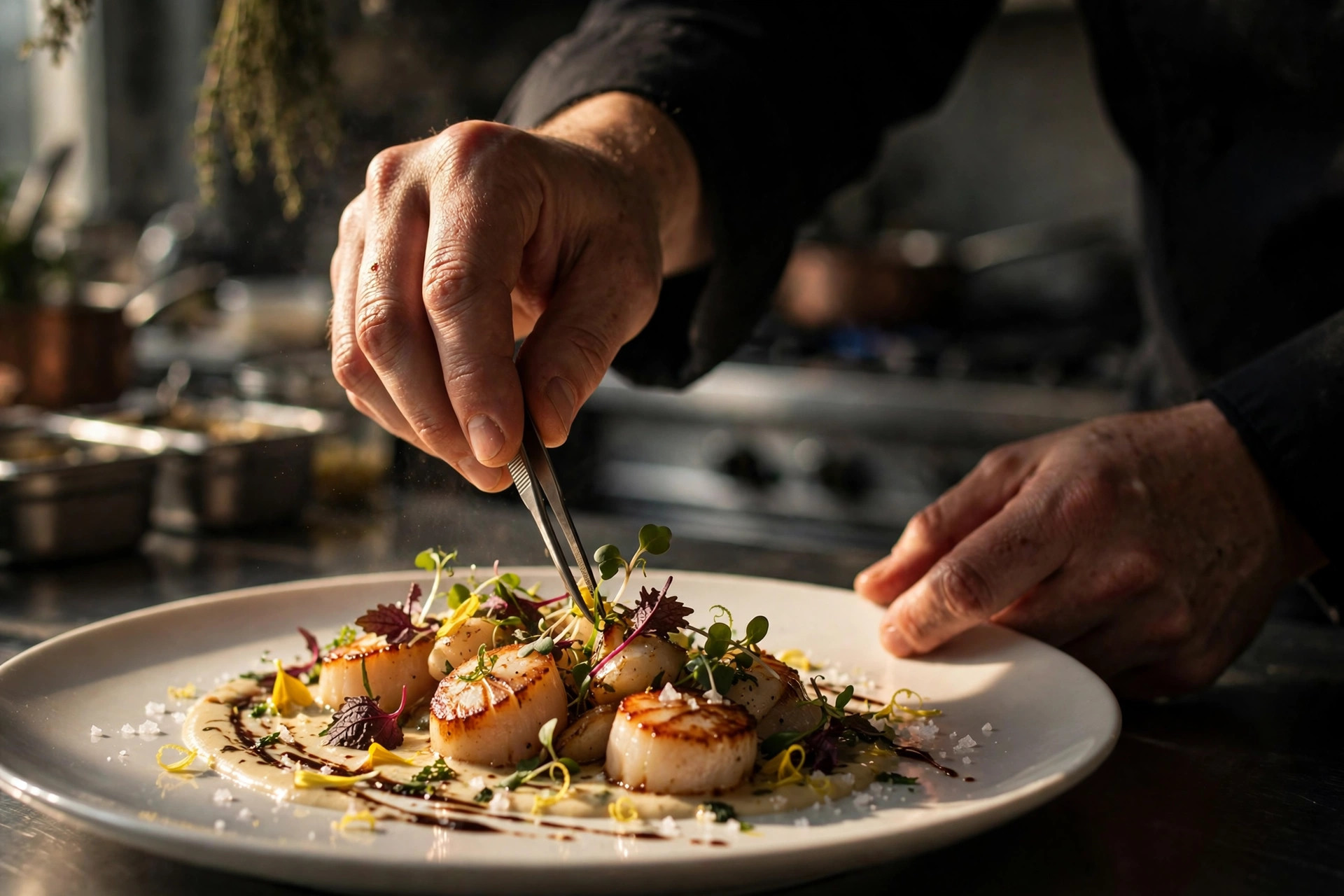
People eat with their eyes first and their imagination second. The copywriter's job is to feed the imagination with words that trigger taste, texture, aroma, and temperature — because a brain that has already "tasted" the dish is a brain halfway to booking.
The technique is simple: replace abstract adjectives with concrete sensory ones. "Delicious pasta" is abstract — every restaurant claims it, no brain pictures it. "Hand-cut tagliatelle, slow-braised ragù, shaved parmesan" is concrete — you can almost chew it. Keep a working list of high-converting sensory words and rotate them honestly (only for dishes they actually describe — "wood-fired" on a gas-oven pizza will be found out in one visit):
- Texture: crisp, buttery, charred, velvety, flaky, juicy, crackling
- Process: slow-braised, wood-grilled, hand-cut, house-smoked, marinated overnight, flame-seared
- Origin: line-caught, locally sourced, heritage-breed, day-boat, farm-direct
- Temperature and freshness: piping hot, ice-cold, just-baked, fresh from the grill
One caution from the psychology of appetite: sensory language works by creating an expectation, and unmet expectations punish harder than no expectations. If the ad promises "melt-in-your-mouth" and the dish arrives merely good, you have bought a one-star review along with the click. Promise what the kitchen delivers on a Tuesday, not what it achieved once on a perfect Saturday.
Offers and urgency that fill slow nights
Every restaurant has the same problem wearing different clothes: Tuesday is empty, Saturday is full, and the rent is due on both. Advertising's highest-ROI job is moving demand from the full nights to the empty ones — and that is a copywriting problem as much as a media-buying one.
The offers that work share a shape: specific, time-bound, and framed as an event rather than a discount. "Tuesday Tapas Night — 5 small plates €25, every Tuesday in November" fills Tuesdays; "20% off everything" trains guests to wait for discounts and, under EU rules, triggers reference-price obligations. Compare:
| Weak offer copy | Strong offer copy | Why it works better |
|---|---|---|
| "20% off this week!" | "Autumn tasting: 5 courses €59, until 30 Nov" | Names the experience and the deadline; no discount framing |
| "Come visit us soon" | "12 seats left for Friday's guest-chef night" | Scarcity is specific and verifiable |
| "Great lunch deals" | "Lunch in 15 minutes or it's free — weekdays 11–14" | A promise with a mechanism, aimed at office workers |
| "Happy hour 17–19!" | "After-work: small plates & mocktails from €8, Tue–Thu" | Event framing; avoids alcohol-discount advertising issues |
| "Book now for Christmas" | "Julebord tables: 8 dates left in December — reserve yours" | Seasonal urgency with a real number |
A Nordic compliance note that generic guides never mention: Finland's Alcohol Act prohibits advertising discounts on alcohol, including happy hours — "happy hour 17–19" style copy for drinks is not a clever tactic in Finland, it is unlawful. Sweden and Norway have their own strict alcohol marketing rules. Frame after-work offers around food, and check your country's current rules before any drinks-led campaign. Similarly, under the EU's Omnibus Directive, any advertised discount must show the genuine lowest prior price over the previous 30 days — never invent a "was €40" to make "now €29" look dramatic.
Urgency without desperation
Scarcity works when it is true and specific: "12 seats", "until Sunday", "this Friday only". It backfires when it is vague ("hurry!", "limited time!") — guests have learned that vague urgency usually means no urgency. The rule: if you cannot name the number or the date, do not claim the scarcity. True constraints (a small dining room, a guest chef's single night, a seasonal ingredient) are marketing assets — use them.
Calls to action that get clicked
The call to action is the smallest text in the ad and the largest determinant of what happens next. Its job is to remove the final hesitation: the guest knows what is offered and now needs to be told, plainly, what to do.
For sit-down restaurants, "Book a table" remains the clearest and most tested CTA — direct, unambiguous, and it sets the expectation of a reservation rather than a walk-in. "Reserve your table" suits formal venues; "Book now" works when space is tight. What to avoid: "Learn more" (learn what?), "Visit us" (when? how?), "Click here" (for what?). Every vague CTA is a small act of making the guest do your work.
But the button text is only half the CTA — the destination is the other half. "Book a table" must open the booking flow: your reservation widget, your booking page, a pre-filled form. If it opens your homepage and the guest has to hunt for the booking button, you have built a door that opens onto a maze. Audit this on your phone, because that is where most ad clicks land: tap your own ad's CTA and count the taps to a confirmed reservation. More than three, and the copy is not your problem — the page is. A website built around the booking button is the highest-ROI companion to any ad campaign.
The ad copy mistakes that waste money
Collected from the patterns that show up again and again in struggling restaurant accounts:
- Writing about yourself, not the guest. "We are passionate about authentic flavours" is about you. "Wood-fired pizza in 90 seconds, 5 minutes from the station" is about the guest's evening. Guests book the second.
- No offer, no deadline. Brand-awareness copy ("Experience our warm atmosphere!") asks for nothing and gets nothing. Every ad needs a reason to act now.
- Stock photos. Diners recognise stock food photography instantly, and it signals "this could be any restaurant." One honest photo of your actual dish outperforms a perfect photo of someone else's.
- Sending traffic to the homepage. The homepage answers "who are we?"; the ad clicker asked "can I book Friday?". Dedicated landing pages — or at minimum, the booking widget above the fold — convert the same traffic at multiples.
- Targeting everyone. "Anyone who enjoys dining out" includes tourists passing through and people who live too far to visit. A tight radius around the restaurant, set to people physically present, is the single highest-leverage setting in local advertising.
- No tracking. Running ads without a per-channel code, tagged link, or conversion setup is driving blindfolded — you cannot tell the profitable ad from the expensive one, so you will eventually cut the wrong one. Our paid vs organic budget guide shows how to split and measure spend.
- The staff doesn't know about the offer. A guest mentions the ad's "Tuesday Tapas Night" and the team stares blankly. Brief the floor before the campaign launches — the ad makes the promise, the staff keeps it.
- Judging after three days. Give copy tests at least two weeks and a full weekly cycle of demand before deciding. Restaurants live on weekly rhythms; three days of data is noise.
Testing and improving your copy
You do not need to be a copywriter to get better at copy — you need a testing habit. The method is unglamorous and it works:
- Change one thing at a time. Headline first — it carries most of the click decision. Then the offer, then the CTA, then the image. Changing everything at once makes the result unreadable.
- Run each test at least two weeks. Shorter than that and you are measuring day-of-week noise, not copy quality. Restaurants have weekly rhythms; respect them.
- Judge by cost per booking. Not click-through rate, not likes, not comments. The ad with the highest CTR that never books is the most expensive ad you run.
- Keep a log. One line per change: what you changed, when, and what happened to cost per booking. After three months this log is worth more than any course — it is your market's actual preferences, in your own handwriting.
- Steal structurally, not literally. When a competitor's ad keeps running for months, it is working — note its structure (offer first? price shown? which CTA?) and adapt the pattern to your restaurant. Never copy the words.
Start this week with the cheapest test available: rewrite your best-performing ad's headline three ways — one with the offer, one with the price, one with the deadline — and run them against each other. Two weeks later you will know something specific about your guests instead of only hoping. That is the entire philosophy of this guide in one exercise: specific beats clever, tested beats assumed, and booked tables beat everything.
Frequently asked questions
What is a good example of restaurant ad copy?
A strong restaurant ad has five parts: one specific offer with a deadline ("Autumn tasting menu — 5 courses, €59, until 30 Nov"), one sentence of sensory detail, your own food photo, one call to action ("Book a table"), and a link to a page you own. Example headline: "Friday Night, Sorted: 3-Course Dinner €39". Keep it short — one promise, one button.
How long should restaurant ad copy be?
Short. For Google Search ads: a 30-character headline with the offer, one or two description lines of detail, and the call to action. For social: one hook line, one sensory sentence, the offer with its deadline, and the button. If your copy needs a second paragraph, the offer is not clear enough — sharpen the offer, not the paragraph.
What call to action works best for restaurant table bookings?
"Book a table" is the clearest and most tested CTA for sit-down restaurants — direct, unambiguous, and it sets the right expectation. "Reserve your table" works equally well for formal venues. Avoid vague CTAs like "Learn more" or "Visit us"; they tell the guest nothing to do next. The button must open your booking page or reservation form, not your homepage.
Should restaurant ads include prices?
Yes, when the price is part of the offer — "3 courses €39" qualifies the click and attracts guests comfortable with your level. Under EU consumer rules, any discounted price must show the genuine prior reference price (the Omnibus Directive), so never invent a "was" price. For fine dining, price can stay off the ad; the booking page carries it.
How do I know if my restaurant ad copy is working?
Track cost per booking, not likes or clicks. Give each ad variant its own trackable path — a unique promo code, a tagged booking link, or a dedicated landing page — and compare bookings per euro spent. Change one element at a time (headline first), run each test at least two weeks, and keep a simple log of what you changed and what happened.
Copy is the last mile of your advertising — but it runs on the rails of keywords and budgets. If you have not done the keyword work yet, start with keyword research for restaurant advertising; if the budget side is fuzzy, our ad budget guide does the arithmetic. And when the clicks arrive, make sure they land somewhere that converts — that is a website job.
Want a website that turns ad clicks into table bookings?
PowerfulWebsite builds your restaurant's website free — you only pay from €59/mo. Everything included: domain, hosting, maintenance and updates, with the booking button where your ad traffic expects it.
See the plans