Meta Ads for Restaurants: A Targeting Guide
The most important targeting decision for a restaurant's Facebook and Instagram ads is the radius: a tight geographic circle around your address, matched to how far customers actually travel to you. Inside that radius, keep targeting broad, retarget your warmest audiences, and let photos of your real food do the filtering that interest settings no longer can.
Key takeaways
- Target by radius, not by interests: drop a pin on your address and size the circle to real travel behaviour (2–3 km in a dense city, up to 15–25 km in a small town).
- Build three audiences: new prospects in your radius, website and profile visitors for retargeting, and your customer list for lookalikes and win-backs.
- In 2026 most interest and demographic settings are suggestions to Meta's algorithm, not hard filters — broad-within-radius beats narrow stacks.
- Creative is targeting now: the photo or video you choose decides who responds, so test dishes against each other and scale the winner.
- Budget at least €300/month to start, track cost per booking or order (not likes), and expect 2–4 weeks of learning before judging results.
Every restaurant owner who has opened Meta Ads Manager knows the feeling: dozens of targeting options — interests, behaviours, demographics, lookalikes — and no idea which ones actually put guests in seats. Most end up doing what everyone does: a boosted post to "people interested in pizza" within 50 kilometres, €50 gone, nothing to show for it.
This guide is the targeting manual we wish every restaurant had. It is written for owners and small teams, not media buyers: no jargon without explanation, concrete settings you can copy, and the Nordic realities (small cities, strong lunch culture, seasonal tourism) that generic US guides never mention. If you want the full beginner walkthrough of Meta ads — objectives, formats, budgets — pair this with our Google Ads beginner's guide on the other half of the paid-search picture. But the targeting strategy below stands on its own.
Why targeting decides everything for restaurants
A restaurant is the most location-bound business there is. A clothing brand can ship anywhere; your dining room cannot. Every euro you spend showing an ad to someone who will never travel to your neighbourhood is a euro you will never get back. That is why targeting matters more for restaurants than for almost any other advertiser: geography is not one setting among many — it is the whole game.
It also matters because restaurant clicks are cheap. Industry benchmarks put restaurant and food clicks on Meta at roughly €0.50–€1 in the Nordics, with cost per thousand impressions (CPM) around €7–€9 for food and beverage — well below the cross-industry median. Cheap reach is a gift and a trap: it means you can afford to show your food to thousands of people, but it also means sloppy targeting burns money in small, invisible amounts that add up to hundreds of euros a month.
The third reason is intent. Nobody searches Facebook for a restaurant the way they search Google. People on Facebook and Instagram are scrolling — discovering, not deciding. Meta ads for restaurants are demand creation, not demand capture. That changes the job of targeting: you are not finding people who already want dinner, you are finding people near you who are most likely to be tempted by a great-looking plate of food.
What good targeting actually buys you
Concretely, good targeting buys three things. First, cheaper reach: a tight local audience with strong creative gets higher engagement, and Meta's auction rewards engagement with lower costs. Second, better conversion: people who live or work near you convert at far higher rates because the barrier to visiting is a short walk, not a plan. Third, learning: Meta's algorithm needs roughly 30–50 conversions per week to optimise properly. A small, relevant audience feeding it real bookings teaches it faster than a huge, lukewarm one.
How Meta targeting works in 2026
Before touching a single setting, understand what the machine does now, because the old playbook is dead. A few years ago you could layer interests like "foodies + Italian food + fine dining" and get a neatly filtered audience. Today, most of those settings have quietly become suggestions, not filters. Meta's Advantage+ system reads your signals, then goes and finds people it thinks will respond — often outside your neat little boxes.
This is not a conspiracy against small advertisers; it is how the algorithm got better at its job. With billions of data points, Meta's model predicts who will book a table better than your guesswork about who "likes restaurants". The restaurant advertisers winning in 2026 share one trait: they give the algorithm a clear geographic box and strong creative, then get out of its way.
The mindset shift: from filters to signals
Think of it this way. The old approach was filtering: "show my ad only to women aged 28–45 interested in sushi who live nearby." The new approach is signalling: "here is a tight area and a great sushi photo; find me the people in this area most likely to tap." The filter approach feels precise but starves the algorithm of data and raises your costs. The signal approach feels loose but lets the machine find patterns you would never think of — like that your best new customers are 55-year-old men who watch fishing videos. (Everyone has a story like that.)
Practically, this means: set your radius, set a broad age range, add at most one or two light interest signals if you must, and spend your energy on the creative. The photo or video is now the strongest targeting lever you have.
Boosted posts vs Ads Manager
Boosted posts are fine for learning and for amplifying your best organic content, but they cap what targeting can do: no custom audiences, no lookalikes, limited objectives, no placement control. Ads Manager unlocks everything in this guide — radius targeting, retargeting, and real measurement. Move to Ads Manager as soon as you are spending more than a few hundred euros a month, or as soon as you want bookings and orders rather than likes.
The radius: your single most important setting
If you take one thing from this guide, take this: drop a pin on your address and target by radius, not by city, interests, or anything else. This is the setting that decides whether your budget reaches future regulars or strangers who will never visit.
How wide should the circle be? Think about how far your customers actually travel — not how far you wish they would:
- Dense city centre (Helsinki, Stockholm, Oslo, Copenhagen): 2–3 km. People in dense cities rarely cross town for dinner on a weeknight. Your ad competing with the restaurant next door to the viewer wins on convenience.
- Suburbs and mid-size cities: 5–8 km, roughly matching your delivery zone if you deliver.
- Small towns and rural areas: 15–25 km. Your customers are used to driving; a 20-minute drive for a good dinner is normal.
If you run your own delivery, the rule is absolute: match the radius to the delivery zone. Paying to reach someone you cannot deliver to is the purest form of wasted spend. For dine-in, match the radius to your observed reality — check your booking system's postcodes or simply ask staff where regulars come from.
The location setting most people get wrong
Inside Ads Manager's location settings there is a dropdown that defaults to something like "everyone in this location". Change it to "people living in this location" for your prospecting campaigns. "Everyone" includes tourists passing through, commuters, and people whose phone briefly pinged your area — none of whom are likely to become regulars. Tourists deserve their own campaign (see the special cases section), not a share of your everyday budget.
One more exclusion worth making: if your radius overlaps areas you cannot serve or where competition is brutal and margins thin, cut them out. A pizza place in Espoo gains nothing from reaching central Helsinki. Be honest about your catchment.
The three audiences every restaurant needs
You do not need a dozen audiences. You need three, run as separate campaigns or ad sets so you can see what each one costs and delivers:
| Audience | Who they are | Job | Typical budget share |
|---|---|---|---|
| Cold prospects | People living in your radius who have not interacted with you | First visits: awareness, offers, events | 50–60% |
| Warm retargeting | Website visitors, profile engagers, video viewers (last 30–90 days) | Turn interest into bookings | 20–30% |
| Customers & lookalikes | Your email/phone list; people similar to them | Win-backs, loyalty, find more like them | 15–25% |
1. Cold prospects in your radius
This is your discovery engine: broad targeting inside your geographic box, best creative, objectives like Reach or Traffic. Do not narrow it with interest stacks — "people interested in pizza" shrinks your audience for no gain, because everyone is interested in pizza. Let the algorithm find the responsive people. Your job is to feed it great creative (more on that below) and a clear offer.
One exception: a single light interest signal can help in genuinely niche cases — a vegan restaurant layering "veganism", a steakhouse layering "barbecue". One signal, not five. And test with and without it; the broad version often wins.
2. Warm retargeting: your cheapest bookings
People who visited your website, engaged with your Facebook or Instagram profile, or watched your videos in the last 30–90 days already know you exist. Ads to this group are the cheapest and highest-converting you will ever run — this is where offers belong: a weekday lunch deal, a "book your Christmas table" reminder, a new menu announcement.
Setting this up requires the Meta Pixel (now called the Meta Pixel / Conversions API) on your website. If your site was built to convert paid traffic, this is a 15-minute setup; if your site cannot take a booking or show a menu properly on mobile, fix that first, because retargeting sends people back to the exact page they left. A fast, mobile-first site that turns ad clicks into bookings is the foundation — which is exactly what PowerfulWebsite builds free, with you paying only the monthly plan from €59/mo.
3. Your customer list and lookalikes
If you have an email or phone list — from your booking system, newsletter, or loyalty programme — upload it as a Custom Audience. Two uses: win-back campaigns ("we miss you — 15% off this month") aimed at guests who have not visited in 60+ days, and lookalike audiences that find new people resembling your best customers. Lookalikes of 1–3% of your country's population, constrained to your radius, are a proven prospecting source.
GDPR note for Nordic owners: you need a lawful basis to upload customer data for advertising. Consent given for marketing, or a clear legitimate-interest assessment documented in your privacy notice, generally covers this — but check your own setup, and never upload lists you bought or scraped. Our guide to using booking data for marketing, GDPR-safe, walks through the practicalities.
Targeting by occasion, not just demographics
Here is the targeting insight most restaurant guides miss: people do not decide restaurants by who they are, but by what the occasion is. The same person wants a quick €14 lunch on Tuesday, a romantic dinner on Friday, and a big group table for a birthday in March. Demographic targeting ("women 30–45") cannot see occasions. Your campaign structure can.
Build separate small campaigns around the occasions that matter to your business:
- Weekday lunch: target the radius around your restaurant during working hours, creative showing the lunch spread and price, objective driving menu views or "get directions" taps. The audience is people nearby right now — office workers, not the whole city.
- Weekend dinner: broader radius (people travel further on Saturdays), creative showing atmosphere and signature dishes, booking objective.
- Groups and celebrations: target with creative showing big tables and private-dining options; this is also where click-to-message ads shine, because group bookings start with questions.
- Seasonal peaks: Christmas tables, Valentine's, Mother's Day, graduation season. Start these 4–6 weeks early — the booking decision happens long before the date.
Each occasion gets its own creative, its own landing page or message flow, and its own measurement. A lunch campaign judged on dinner bookings will always look like a failure; judged on weekday covers, it might be your best performer.
Special cases: tourists, business lunches, and events
Tourists
If you are in a tourist-heavy location — central Stockholm, Bergen's harbour, Helsinki's Design District — tourists are a real segment, but they need a separate campaign, not a share of your local budget. Target "everyone in this location" (not "living in") with creative in English showing signature dishes and your proximity to landmarks. Time it to the season: a summer-terrace campaign in February is wasted money. And remember tourists decide fast — your ad should answer "what, where, how much" in three seconds and link straight to the menu.
Business lunches
Lunch is the Nordic restaurant's quiet goldmine. Target a tight radius around office districts on weekday mornings, with the lunch menu, price, and speed ("in and out in 40 minutes") front and centre. Job-title targeting exists but is increasingly unreliable; geography plus timing does the job better. If your lunch is genuinely good value, this is the campaign with the fastest payback.
Events and private dining
For event promotion — wine tastings, live music, Christmas parties — use a slightly wider radius than usual (people travel further for events) and a longer lead time. Click-to-Messenger/Instagram-DM ads work well here because event bookings involve questions: capacity, menus, prices. Answer fast; event intent cools within hours.
Creative-led targeting: let your food do the filtering
Here is the uncomfortable truth of 2026-era Meta ads: the creative is the targeting. When the algorithm is broad and the radius is fixed, the photo or video you choose decides who stops scrolling, who taps, and who books. Two restaurants with identical settings and different creative will get entirely different customers.
What works for restaurants, consistently:
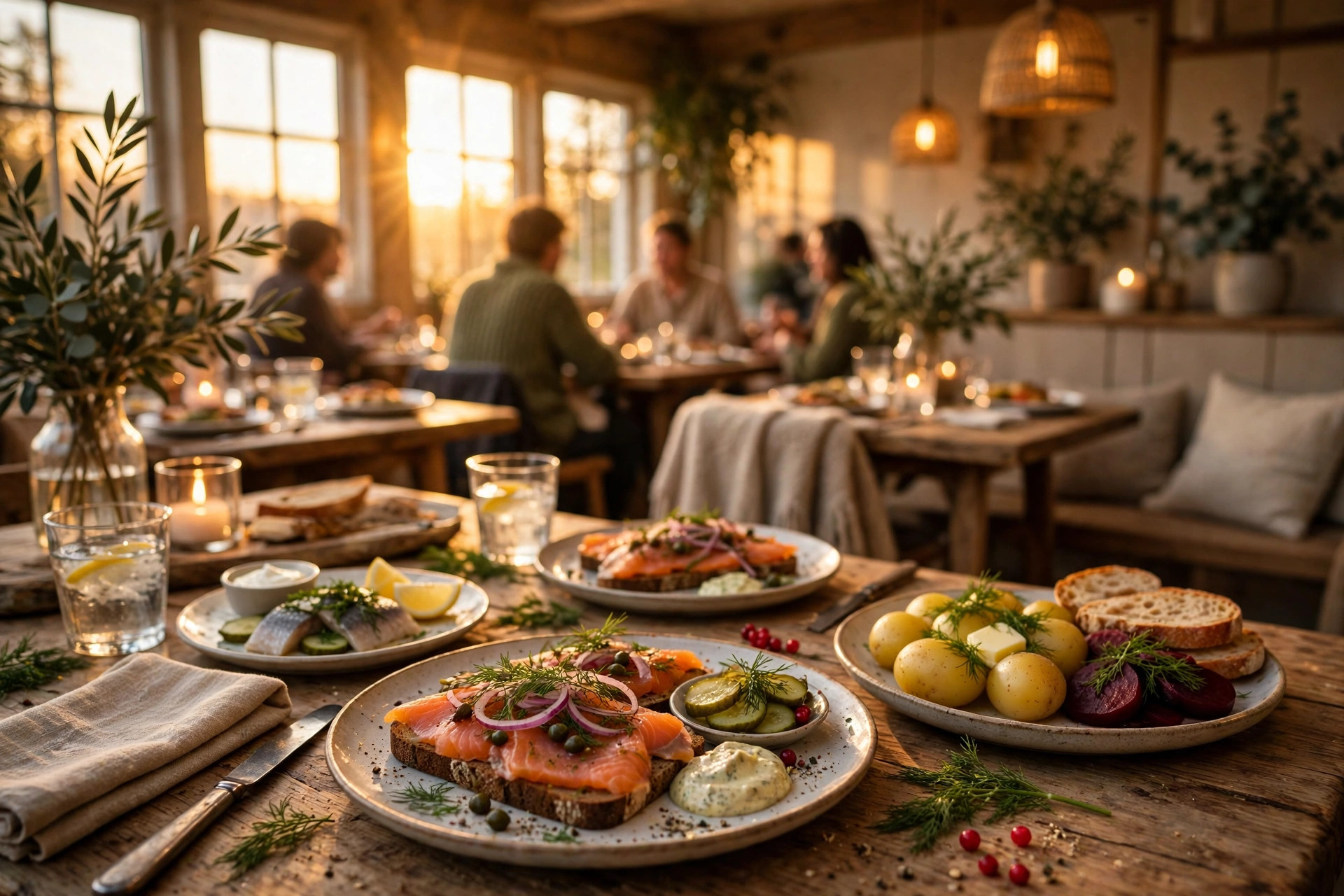
- Real food, close up. One hero dish, well lit, steam or texture visible. Not the dining room, not the logo — the food. Phone photos in good daylight often outperform polished shoots because they look like something a friend would post.
- Short video (15–30 seconds). Cheese pulls, sizzling pans, a bartender finishing a cocktail, a busy dining room at golden hour. Video earns cheaper reach and gives you a retargeting pool of video viewers for free.
- Carousel for menus. Walk viewers through a meal: starter → main → dessert → drinks. Each card a dish, the last card the booking CTA.
- People, not just plates. A full dining room is social proof. A chef finishing a plate is craft. Diners laughing is the experience you are selling.
The hero-dish test
Do not guess which dish to lead with — test it. Run one campaign with four ad variants, each leading with a different dish (burger vs pasta vs dessert vs drinks, say), identical targeting and budget. After a week, Meta will have crowned a winner on click-through rate and cost per booking. Scale the winner; retire the losers. Repeat quarterly — tastes and seasons change. This single habit beats any interest-targeting trick ever published.
Refresh creative every 3–4 weeks at minimum. Ad fatigue is real: the same photo shown to the same radius goes stale, costs creep up, and owners blame "the algorithm" for what is really a tired picture. Keep a rolling folder of new food photos — your phone is the production studio.
Measuring and fixing your targeting
Targeting is not set-and-forget; it is a loop. Here is the loop, in the order that matters:
- Track the right outcome. Not likes, not reach — bookings, orders, calls, "get directions" taps. Set up conversion tracking (Pixel + Conversions API) so Meta optimises toward real outcomes, not vanity metrics. An engagement-objective campaign optimises for comments; a conversions campaign optimises for customers. Choose accordingly.
- Know your numbers. What is a new guest worth to you? If your average check is €35 and a guest returns even twice a year, a €5–€10 cost per acquired guest is excellent business. Work backwards from your margins before you decide a campaign "isn't working".
- Give it time. A new campaign needs 2–4 weeks of learning before you judge it. Changing targeting every three days resets the learning and guarantees mediocrity.
- Fix in this order: radius too wide → shrink it. Costs rising after weeks of success → refresh creative. Clicks but no bookings → fix the landing page (slow? no booking button above the fold? menu hidden in a PDF?). Good clicks, good bookings, still unprofitable → your offer or your margins need work, not your targeting.
The five-minute targeting audit
Open your best campaign and check: (1) Is location set to a radius around your address, sized to real travel behaviour? (2) Is it "people living in this location", not "everyone"? (3) Are there more than two interest/demographic layers? If yes, remove them. (4) Is the creative a real photo of food, less than a month old? (5) Does the ad link to a page where a booking takes under a minute on a phone? Five yeses and your targeting is better than 90% of restaurants advertising on Meta.
One last structural point: Meta ads amplify what already exists. They amplify a great menu, a photogenic dining room, and a website that converts. They equally amplify a confusing website and a tired menu — expensively. Before scaling ad spend, make sure the destination deserves the traffic. Our paid vs organic social budget guide helps you decide how much of your marketing belongs in ads at all, and our Facebook page checklist makes sure your organic presence is ready to receive the paid traffic you are about to buy.
Frequently asked questions
Do Facebook ads work for restaurants?
Yes — restaurant and food ads are among the cheapest clicks in paid media, typically around €0.50–€1 per click in the Nordics, and the visual format is ideal for food. They work when location targeting is tight (a radius people will actually travel), the creative shows real food, and the landing page or profile makes booking easy. They fail when the radius is too wide or the ad points at a slow, confusing website.
Should restaurants use boosted posts or Ads Manager?
Start with boosted posts to learn the basics and promote your best-performing organic content, then graduate to Ads Manager. Boosted posts have limited targeting and no proper retargeting; Ads Manager gives you radius targeting, custom audiences, lookalikes, and placement control. A restaurant serious about paid social should move to Ads Manager within the first month or two.
What radius should a restaurant target on Facebook ads?
Match the radius to how far customers actually travel to you: roughly 2–3 km in a dense city centre, 5–8 km in the suburbs, and 15–25 km in a small town or rural area. If you deliver, match the radius to your delivery zone. A radius that is too wide is the single most common cause of wasted restaurant ad spend.
Should restaurants still target interests on Facebook, or go broad?
Go broad within a tight radius. In 2026 most interest and demographic settings act as suggestions to Meta's algorithm rather than hard filters, and over-narrowing interest stacks usually raises costs without improving results. Use one or two light interest signals at most — such as cuisine type — and let strong creative (real photos of your food) do the filtering instead.
How much should a restaurant spend on Meta ads to see results?
Budget at least €300 per month (roughly €10 per day) to give the algorithm enough data to optimise. A healthy long-term level for an established restaurant is 3–5% of monthly gross revenue allocated to all advertising, with Meta taking a share of that. Start small, measure cost per booking or order, and scale only what is profitable.
Want a website that turns ad clicks into table bookings?
PowerfulWebsite builds your restaurant's website free — you only pay from €59/mo. Everything included: domain, hosting, maintenance and updates. Fast, mobile-first pages built to convert paid traffic into reservations.
See the plans