Paid vs Organic Social: A Budget Guide for Restaurants
The short answer: use both. Organic social media is the foundation — it builds trust and a local audience for the cost of your time. Paid social is the amplifier — it puts your best content in front of strangers nearby, with a realistic starting budget of €100–€300 a month. The restaurants that fill tables with social media rarely choose one or the other; they run organic every week and paid in focused, measurable bursts.
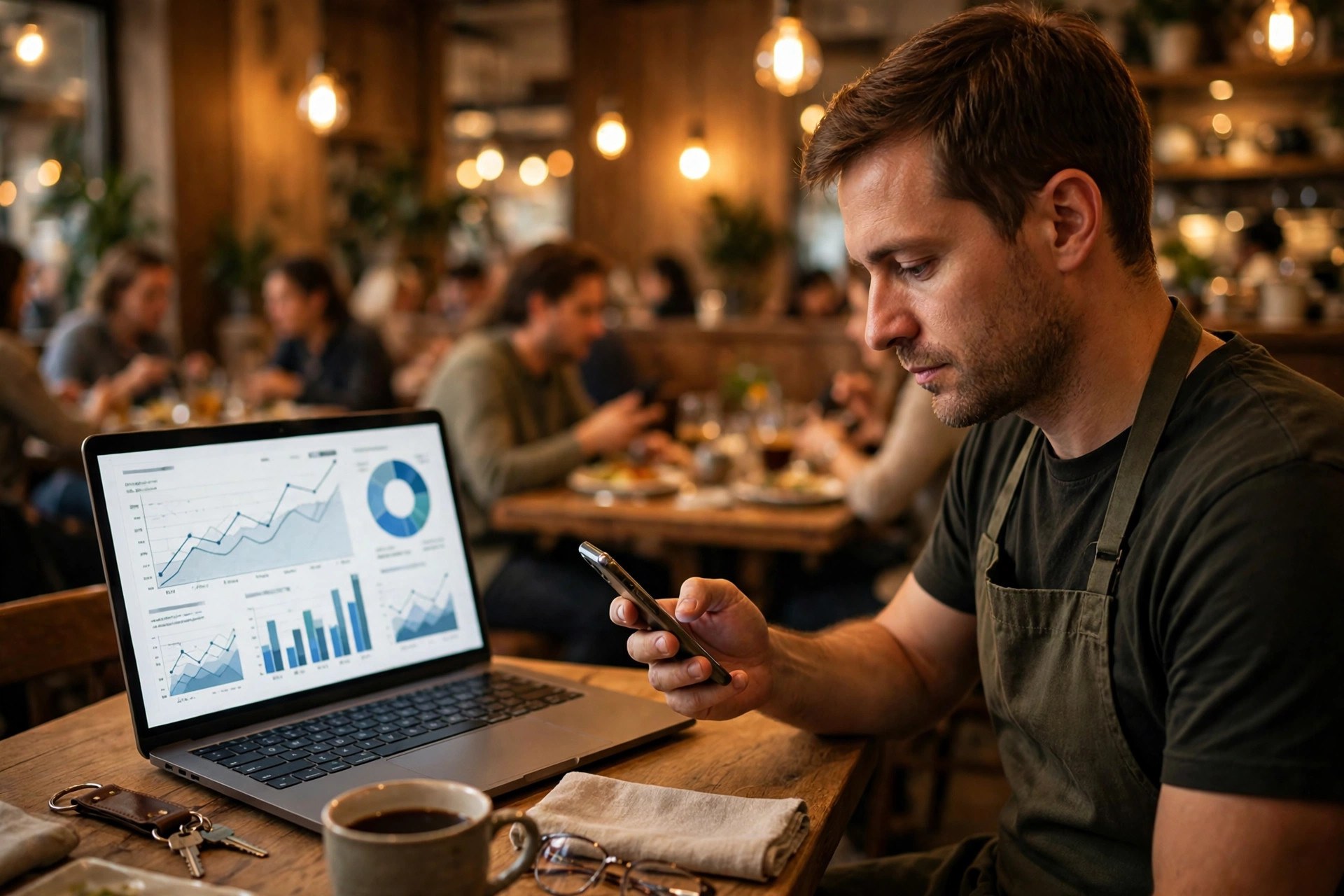
Key takeaways
- Organic social is not free — it costs 4–6 hours a week of staff time, or a content budget. Paid social is not expensive by default — €100–€300 a month is a serious starting budget.
- Organic builds trust and community; paid buys reach, precise local targeting and speed. They do different jobs.
- Use the 70-20-10 framework: 70% of your social effort on organic foundations, 20% on proven paid campaigns, 10% on experiments.
- Paid wins for openings, events, quiet dayparts and seasonal pushes. Organic wins for everyday community, reviews and word of mouth.
- Judge paid campaigns by cost per booking or cost per new guest — never by likes.
Every restaurant owner eventually faces the same question, usually after scrolling past a competitor's slick Instagram ad while their own last post sits at eleven likes. Should you be paying for social media ads, or is the free route enough? The honest answer is less satisfying than a simple yes or no, but it is more useful: paid and organic social media do different jobs, cost different things, and work best together — if you budget for both deliberately instead of drifting into ad spend by accident.
This guide is written for independent restaurants, cafés and bars in the Nordics and beyond that market on a real-world budget. You will find what organic actually requires (it is not free), what paid actually costs in 2026 (less than most owners fear), a practical 70-20-10 budgeting framework with worked examples at €150, €400 and €1,000 a month, and the decision rules that tell you which one to use for any given goal. It pairs naturally with our Instagram strategy guide for restaurants, which covers the organic content side in depth.
What organic social actually means for a restaurant
Organic social media is everything you publish and do without paying the platform: your regular posts, Stories, Reels and TikToks, the captions you write, the comments you reply to, the reviews you answer, the hashtags you use. Nobody hands Instagram money; in exchange, the algorithm decides how many people see what you made.
For a restaurant, organic social has three jobs. The first is discovery: Reels and TikToks can travel far beyond your followers, which is why one good kitchen video can do more for a quiet Tuesday than a month of feed posts. If you need inspiration, our collection of 30 Reels ideas for restaurants is built exactly for this. The second is consideration: when someone hears about you — a friend mentions your name, you appear on Google Maps — they check your Instagram the way they used to check a website. A living, current profile says "this place is alive"; a profile that last posted at Christmas says the opposite. The third is community: regulars, staff faces, behind-the-scenes moments and answered comments turn followers into people who feel they know you.
The compounding effect is real. A profile with two years of consistent posting, thousands of tagged guest photos and a few hundred answered reviews is an asset that keeps working every day, including the months you post less. Paid ads stop the instant the budget stops; organic keeps its value. But there is a catch that most "organic is free" advice glosses over: the reach ceiling.
Organic reach — the share of your own followers who actually see a post — has been shrinking for years on the big platforms. A typical restaurant post now reaches a single-digit percentage of its followers organically, and essentially zero non-followers unless a Reel or TikTok catches the algorithm's eye. That is not a conspiracy; it is the business model. Platforms make money when businesses pay for attention, so free attention is rationed. Organic is a slow, compounding game. It will not, on its own, announce your new Sunday brunch to the ten thousand people within three kilometres who have never heard of you. That is a job for paid.
What paid social actually buys you
Paid social — ads on Instagram, Facebook and TikTok — buys four things that organic cannot reliably deliver.
1. Reach on demand
With paid, you decide how many people see your content, not the algorithm. Set a budget and the platform spends it showing your ad to a defined audience until the money runs out. That makes paid the tool for anything time-sensitive: a new menu launch next Friday, Valentine's bookings, a midweek offer to fill a quiet dining room. Organic might get there; paid gets there by Thursday.
2. Targeting that matches how restaurants actually sell
Restaurants do not need the whole internet — they need people within a short drive or walk. Paid platforms let you target by location with remarkable precision: a radius around your address, specific neighbourhoods, even people who have recently been in an area. You can layer on age ranges, interests (foodies, parents, date-night planners) and behaviours. Organic gives you whoever the algorithm picks; paid lets you draw a circle on a map and say "these people, please."
3. Testing at scale
One of paid's least appreciated advantages: you can run several versions of the same ad — different photos, different headlines, different offers — inside one campaign, and the platform automatically shifts budget toward whichever performs best. One organic post gets one shot. A paid campaign gets as many shots as you are willing to create, with the machine doing the judging.
4. Measurement you can act on
Every euro of paid spend comes back with data: how many people saw the ad, clicked, visited your site, tapped the booking button. You can calculate exactly what a booking cost you and decide whether to spend more or stop. Organic analytics are directional; paid analytics are a ledger. As one restaurant marketing guide puts it, paid takes the guesswork out of cost versus return — you are buying data as well as attention.
The trade-off is that paid attention is rented. Stop paying and the traffic stops, usually within hours. And paid creative needs to be good: the same phone snapshot that does fine as an organic Story will underperform in an ad, where it competes with every other business in the feed. Budget for creative, not just for media spend — more on that in the framework below.
The true cost of "free" organic social
Organic social costs nothing in ad spend and a great deal in time. Before you compare the two on price, price the free option honestly.
A realistic weekly organic routine for a small restaurant looks like this: 1–2 hours shooting and editing short videos and photos, 1 hour writing captions and scheduling, 30–60 minutes a day checking and replying to comments and messages (split across the week), and an hour or two a month on planning and reviewing what worked. That is roughly 4–6 hours a week, every week, forever. If the owner's time is worth €30 an hour — and it is — organic "free" costs €500–€800 a month in labour. If a staff member does it, it costs their hours too, just on a different line of the budget.
Then there are the cash costs people forget: a scheduling tool (many have free tiers that suffice, but the good ones cost €10–€25 a month), the occasional professional photo shoot for the menu and hero images (€300–€1,000 a shoot, worth doing at least yearly), props and ingredients for content, and the learning curve of whoever runs the accounts. None of this is wasted money — it builds a durable asset. But it belongs in the budget next to the ad spend, not in a fantasy column labelled "free".
There is also an opportunity cost. The hours spent filming Reels are hours not spent on the floor, on supplier calls, on the menu. For owner-operators, that trade-off is the real price of organic, and it is why many restaurants start strong on social media and quietly fade after six weeks. Consistency is the whole game in organic; an honest cost estimate is what makes consistency sustainable. Batch your shooting — one slow afternoon every two weeks, as several successful operators recommend — and the weekly cost drops sharply.
What restaurants actually spend on paid social
Let us put real numbers on the table. Industry surveys consistently find that restaurants spend 3–6% of revenue on marketing in total, with newer restaurants sometimes pushing toward 10% in their first year. Social media — organic effort plus paid ads — typically takes a meaningful slice of that, though the split varies enormously.
For the paid side specifically, here is what 2026 pricing looks like on Meta's platforms (Facebook and Instagram), which remain the workhorse for restaurant advertising in Europe. These are typical ranges gathered from restaurant marketing benchmarks — treat them as estimates, because your city, your season and your creative quality all move the numbers:
- Cost per click (CPC): roughly €0.30–€1.00. This is what you pay each time someone taps your ad.
- Cost per 1,000 impressions (CPM): roughly €5–€12. This is what you pay for a thousand views of your ad.
- Typical starting budgets: €100–€300 a month for testing and small promotions; €500–€1,500 a month for restaurants running regular campaigns around events and seasons.
Do the maths on a €200 monthly budget at mid-range costs: that buys about 300–500 clicks or 20,000–40,000 impressions from people near your restaurant. If even 2–3% of those clickers book a table, that is 6–15 bookings a month from €200 — a cost per booking of roughly €13–€33. Whether that is good depends on your average spend per guest: at €40 a head for two, one booking pays for the whole experiment. This is the calculation that matters, and it is one organic social can never give you.
TikTok ads run on a similar auction and can be cheaper per impression, though the platform's minimum budgets and creative demands (native-feeling vertical video, not repurposed banners) make it a second step rather than a starting point for most restaurants. Our TikTok guide for restaurants covers the organic side first, which is where you should earn your confidence before paying there.
| Organic | Paid | |
|---|---|---|
| Cash cost | €0 ad spend; €10–€25/mo tools; occasional shoots | €100–€1,500/mo typical for independents |
| Time cost | 4–6 hrs/week, every week | 2–4 hrs/week to manage once running |
| Reach | Single-digit % of followers; strangers only via viral hits | As many targeted locals as your budget buys |
| Targeting | Algorithm decides | Radius, age, interests, retargeting — you decide |
| Speed | Months to compound | Results within days |
| Lifespan | Compounds; keeps working when you pause | Stops the hour the budget stops |
| Measurement | Directional (engagement trends) | Exact (cost per click, per booking) |
| Best for | Trust, community, discovery, reviews | Launches, events, quiet dayparts, new audiences |
The 70-20-10 budget framework
Here is a framework you can actually run. Split your total social media effort — time and money together — into three buckets:
- 70% — organic foundations. The non-negotiable weekly rhythm: 3–5 posts a week on your main platform, daily Stories when you can manage it, replies to every comment and message within a day, and a system for encouraging guests to tag you. This is the engine. Nothing paid works well without it, because ads send people to a profile that either looks alive or does not.
- 20% — proven paid campaigns. Money goes only to campaigns with a track record: the event format that filled tables last time, the boosted top-performing post, the retargeting audience of past website visitors. This is the amplifier, and it only amplifies what already works.
- 10% — experiments. A small, capped amount for trying one new thing at a time: TikTok ads for a month, a creator collaboration, a new offer format. Kill fast what does not work; promote winners into the 20% bucket.
What does that look like in euros? Here are three worked examples. The "total social budget" here means ad spend plus the cash costs of organic (tools, occasional shoots) — time is on top, priced honestly in the previous section.
The €150/month starter
Organic: free scheduling tool, phone photography, 4 hours a week of owner time. Paid: €100/month in ad spend (about €3/day) plus a €50/month reserve for one boosted post or small shoot props. Run one simple campaign: a 5 km radius around the restaurant promoting your best-performing organic post of the month. At typical CPMs this buys 8,000–20,000 local impressions — enough to learn what works.
The €400/month grower
Organic: a €15/month scheduling tool, one professional shoot a year (amortised ~€40/month), 5 hours a week. Paid: €300/month ad spend split into two campaigns — an always-on awareness campaign (€150) keeping your best content in front of locals, and a rotating promotion campaign (€150) tied to the month's event or seasonal menu. Add retargeting of website visitors once you have the traffic.
The €1,000/month serious player
Organic: part-time content help or an agency slice, two shoots a year, daily Stories. Paid: €700–€800/month across Meta and a TikTok test, with distinct campaigns for lunch, dinner and events, plus retargeting. At this level you should know your cost per booking to within a few euros and be scaling what beats it. If you cannot measure it, you should not be spending it — which brings us to measurement later.
When paid wins, and when organic wins
Frameworks are useful; decisions are better. Here is the shortlist of situations and which tool fits each.
Reach for paid when…
- You are opening or relaunching. Nobody knows you exist yet. Paid is the fastest way to introduce yourself to the neighbourhood.
- There is a date on it. Events, seasonal menus, Valentine's, Mother's Day, New Year's Eve — anything with a deadline needs guaranteed reach by a guaranteed date.
- A daypart is dying. Quiet Tuesday lunches or slow Sunday evenings are a targeting problem: you need a specific offer in front of specific people, now. Organic cannot promise that.
- You need new audiences, not the same regulars. Tourists in season, the business-lunch crowd, a younger demographic — paid finds strangers; organic mostly talks to people who already found you.
Lean on organic when…
- Building everyday trust. The "is this place any good?" check happens on your profile. Consistent, human, current content wins it.
- Turning guests into promoters. Reposting tagged photos, answering reviews, celebrating regulars — this is relationship work, and money cannot buy it.
- Your budget is truly zero. A new restaurant pre-revenue, a rough month — organic keeps the lights on socially while paid waits.
- The goal is depth, not width. Loyalty, community, staff culture, your story — these compound through content, not campaigns.
The one-line decision rule
If the goal has a date and a number — "40 covers next Friday", "200 brunch bookings in December" — that is a paid job, because you need guaranteed reach on a schedule. If the goal is trust and presence — "look alive, look loved, look local" — that is an organic job, because money cannot fake it. Most months, you need both.
The hybrid plays that work best
The highest return in restaurant social media does not come from organic or paid alone — it comes from the handoffs between them. These are the four hybrid plays worth building into your routine.
1. Boost only proven winners
Never boost a post to "see how it does". Post organically first; watch for 48 hours; put money only behind posts that already outperformed your average on saves, shares or profile visits. This is the single most efficient ad tactic a restaurant has, because the creative has already passed a real-world test. It also keeps your ad spend honest: if nothing organic is worth boosting this month, that is information — fix the content before buying reach for it.
2. Retarget your warmest audience
Install the Meta pixel on your website (a ten-minute job, usually via your site platform or tag manager) and build an audience of people who visited your menu or booking page but did not book. Showing a simple "still thinking about Friday night?" ad to this audience is routinely the cheapest booking you will ever buy — these people already raised their hand. This is also where your website earns its keep: a fast, mobile-friendly restaurant site that loads the menu in one tap turns ad clicks into bookings instead of bounces.
3. Turn guest content into ads
User-generated content — a guest's glowing Reel, a tagged photo of your signature dish — consistently outperforms polished brand creative in restaurant ads, and it costs nothing to obtain (ask permission, credit the creator). Pair it with a clear offer and a tight radius and you have an ad that feels like a recommendation, because it is one. Our guide to hashtag strategy for restaurants includes tactics for getting more of this content flowing in the first place.
4. Promote the calendar, post the everyday
Let paid own the calendar: events, seasonal launches, holiday bookings, the quiet-daypart offer. Let organic own the everyday: the dish of the day, the team, the room on a busy Friday, the regulars. When each channel has a clear job, neither cannibalises the other — and your reporting stays clean enough to learn from.
Measuring what matters
Paid social gives you numbers; the skill is looking at the right ones. For a restaurant, the hierarchy is simple:
- Cost per booking or cost per new guest. The only number that decides whether to scale or stop. Track it by tagging your booking links (UTM parameters are free and take minutes to set up) and asking "how did you hear about us?" at the table for walk-ins driven by offers.
- Click-through rate (CTR). What share of people who saw the ad clicked it. Below ~0.5% on Meta usually means the creative or the offer is wrong; above 1.5% means you have something worth scaling.
- Cost per click and cost per 1,000 impressions. Your efficiency gauges. If these drift up over weeks with the same audience, your creative is fatiguing — refresh it.
- Everything else. Likes, follows, video views: nice, not decisive. Never scale a campaign because the likes look good.
Set kill rules before you spend, when you are calm and rational. For example: any campaign that spends €30 without a single booking-link click gets paused and reworked; any campaign whose cost per booking exceeds your target for three days straight gets its budget halved. Rules beat feelings — feelings are how €500 disappears into a boosted post with a pretty picture and no offer.
And give organic its own honest scorecard, separate from paid: follower growth in your city (not worldwide), saves and shares per post, profile visits, and the volume of tagged guest content. Judge each channel by what it is for. Organic is your reputation compounding; paid is your acquisition machine. Both should be measured, neither should be judged by the other's numbers.
Common budget mistakes to avoid
Most wasted restaurant ad spend comes from a short list of avoidable errors. Run through this before every campaign:
- Boosting without targeting. The default boost audience is far too wide. Always narrow to a radius around your restaurant and an age range that matches your guests — ten minutes of targeting setup routinely halves the cost per click.
- Sending clicks to a bad destination. An ad is only as good as the page it lands on. If your menu takes four taps to find or your booking button is buried, you are paying for bounces. Your website should load fast, show the menu instantly and put booking one tap away — on mobile first, because that is where ad traffic lives.
- No offer, no reason to act. "Come visit us, we are great" is not an ad; it is a wish. Every paid post needs a reason to act now: a date, a dish, a deal, a deadline.
- Setting and forgetting. Check campaigns twice a week minimum. Audiences fatigue, costs drift, and a campaign that printed bookings in November can bleed money in January.
- Starving organic to feed paid. The classic trap: the profile goes quiet because all effort moved to ads, so the ads send people to a dead profile and convert poorly. The 70% organic foundation is not optional — it is what makes the 20% paid efficient.
Frequently asked questions
How much should a restaurant spend on social media advertising each month?
Most independent restaurants start with €100–€300 per month in paid ad spend, which buys roughly 300–1,000 clicks or 25,000–60,000 impressions on Meta platforms at typical EU rates. Restaurants with a busier calendar or larger covers often scale to €500–€1,500 per month. A common rule of thumb is 3–6% of total revenue for all marketing, with social taking a slice of that.
Is organic or paid social media better for a restaurant?
Neither wins on its own. Organic builds trust, community and discovery over time — it is the foundation. Paid buys reach, targeting and speed — it is the amplifier. The best results come from combining them: organic content that proves it resonates, then paid spend that puts it in front of people who have never heard of you.
Can a restaurant grow on social media without paying for ads?
Yes, but slowly and with real effort. Consistent posting, short-form video, quick replies to comments and messages, and encouraging guests to tag you can build a loyal local following for free. The limitation is reach: only a small share of your own followers see each organic post, and almost no strangers do. Growth without ads is real, just measured in months, not weeks.
What does paid social media cost a restaurant per click or per 1,000 views?
For Meta platforms (Facebook and Instagram) in Europe, typical restaurant campaigns see cost per click of roughly €0.30–€1.00 and cost per 1,000 impressions of roughly €5–€12, though both vary by city, season and creative quality. These are estimates, not guarantees — your actual costs depend on targeting, competition and how good your photos and videos are.
Should I boost my restaurant's Instagram posts or run proper ad campaigns?
The boost button is fine for a quick test, but proper campaigns through Meta Ads Manager win for anything you repeat. Ads Manager gives you precise location targeting, audience exclusions, multiple creatives in one campaign, retargeting, and honest performance data. Use boosts to test; use campaigns to scale.
Want a website that turns ad clicks into table bookings?
PowerfulWebsite builds your restaurant's website free — you only pay from €59/mo. Everything included: domain, hosting, maintenance and updates. Fast, mobile-first, and built to convert the traffic your social media earns.
See the plans