TikTok for Restaurants: A Beginner's Guide
TikTok is the highest-organic-reach channel a small restaurant can use in 2026 — and food is one of the few categories the algorithm genuinely loves. This beginner's guide covers everything from account setup to your first 30 days: what to post, how often, the music rules that trip up newcomers, and how to turn views into booked tables.
Key takeaways
- TikTok gives small accounts real organic reach — the algorithm judges the video, not your follower count.
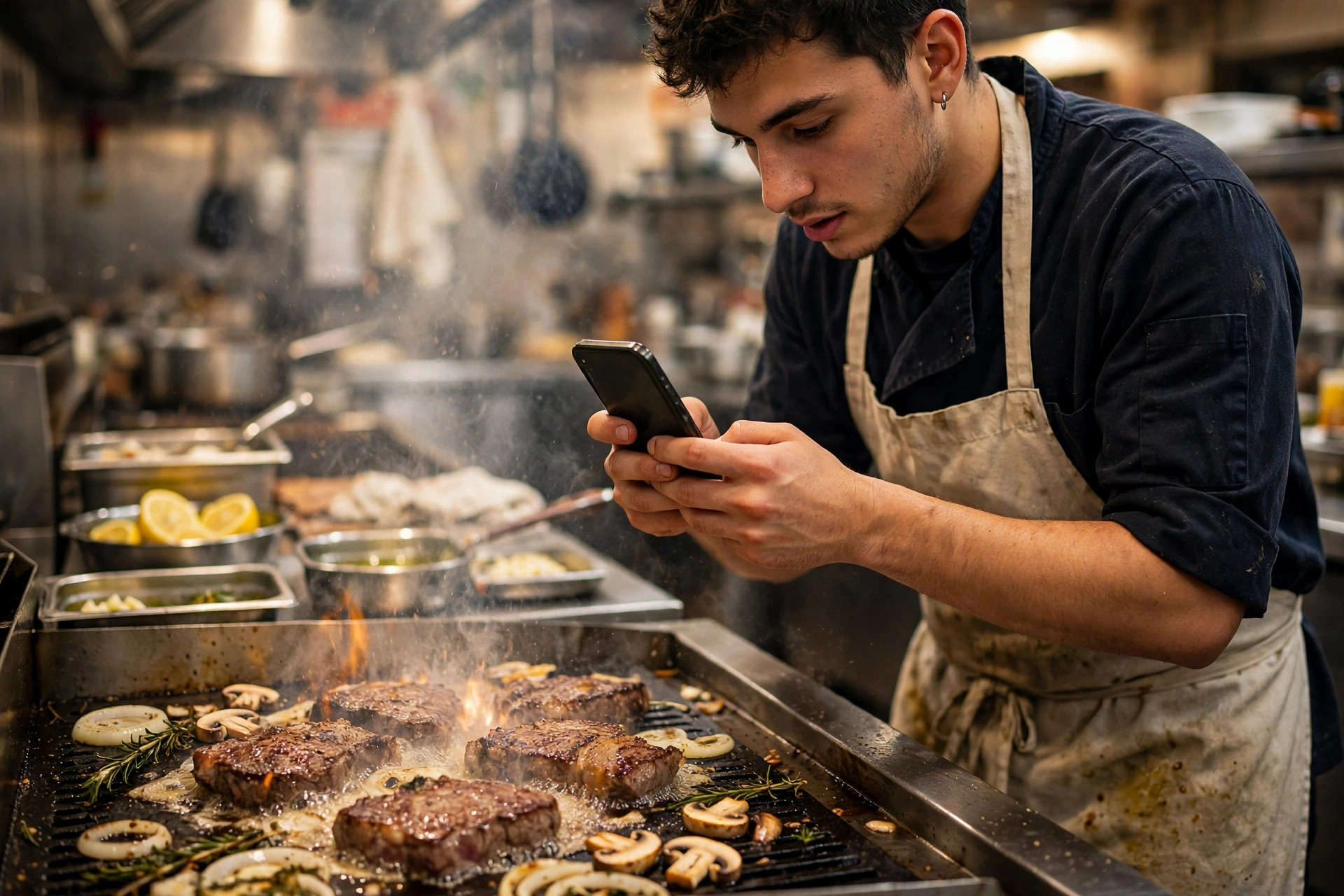
- Authentic phone footage outperforms polished production; restaurant owners with no video experience regularly beat professional creators.
- Set up a business account, use only the Commercial Music Library, and tag your location on every post.
- 3–5 posts per week is the sustainable rhythm; batch-film during one slower shift.
- Keep videos tight (under 30 seconds to start), hook viewers in the first two seconds, and always include a path to booking.
- Expect 60–90 days of consistent posting before significant foot-traffic impact — this is a compounding channel, not a quick fix.
You have seen the stories: a tiny ramen shop posts a 20-second video of noodles being pulled, and suddenly there's a queue around the block. It sounds like lottery luck, but it isn't — it's a platform whose mechanics happen to favour exactly what restaurants already have. Food is visual, emotional, and universal. Kitchens are full of motion, sound, and craft. And TikTok's algorithm, unlike every other social feed, shows your video to strangers based on how good the video is, not on how many followers you have.
That last point is the whole opportunity. On Instagram, a new restaurant account shouts into the void for months. On TikTok, your third video can reach 50,000 people in your city if it holds attention. This guide is the complete beginner's path: why the platform is worth your time, the mindset that makes restaurant content work, account setup done right, the copyright trap that catches newcomers, a concrete first-30-days plan, twelve proven content formats, discovery mechanics, a burnout-proof posting rhythm, and — most importantly — how to convert views into guests who actually walk through your door.
Why TikTok belongs in a restaurant's marketing
Let's start with the honest case for and against, because TikTok is not right for every restaurant — but it is right for more of them than owners assume.
The case for
Discovery is the product. TikTok's "For You" feed is a discovery engine: it tests every video on a small audience and pushes winners wider, regardless of who posted them. A restaurant with 40 followers can out-reach a chain with 40,000 if the video holds attention. No other platform offers a small business that kind of free distribution in 2026.
Food is algorithm-friendly. Food content is universally appealing, highly visual, and triggers immediate emotional responses — mostly hunger. Industry practitioners consistently report that restaurant content gets a structural tailwind: people watch food videos longer, share them more, and save them for later. Your content starts the race ahead.
It drives real visits. Surveys of diners have repeatedly found that a large share of TikTok users — one widely cited agency study put it at 38% — have tried a new restaurant because of a TikTok video, with many travelling further or spending more than usual after watching. Treat exact figures with healthy scepticism, but the directional truth is well established: TikTok changes where people eat.
The honest caveats
TikTok skews young — its core is under-40, and if your clientele is predominantly 60+, your effort is better spent on Google and Facebook. It demands video, which means someone on your team must be comfortable filming. And it is a slow compounder: most restaurants report 60–90 days of consistent posting before foot traffic moves meaningfully. If you need bookings next week, fix your Google Business Profile first. If you want a discovery engine that keeps working for years, start TikTok now.
The mindset shift: authenticity beats production
The single biggest mistake restaurant beginners make on TikTok is treating it like a TV commercial. They hire a videographer, script a polished brand film, post it — and get 200 views. Meanwhile the pizzeria next door films the cheese pull on a shaky phone and gets 2 million. This is not a fluke; it is the platform's core preference.
Rough beats polished
TikTok's audience has trained itself to distrust polish. Overproduced content reads as advertising and gets swiped past; slightly rough, genuine footage reads as a real recommendation from a real place. Restaurant owners with zero video experience regularly outperform trained creators precisely because they don't know the "rules" — they just film what actually happens. Your competitive advantage is that you are not a creator. You are a restaurant.
What "authentic" actually means in practice
- Film the real work: flour on hands, the lunch rush, the mistake that became a special. Process is content.
- Show real faces: your chef explaining one dish beats a voiceover every time. Let staff personalities come through.
- Sound like a human: talk to the camera the way you'd talk to a guest at the bar. Scripts kill warmth.
- Post the imperfect: a slightly wobbly shot of an incredible dish outperforms a perfect shot of nothing interesting.
This is liberating news for a small team: the barrier is not equipment or skill, it is the willingness to point a phone at an ordinary Tuesday and find the interesting 20 seconds in it. Our food photography guide covers the visual fundamentals — natural light, angles, backgrounds — that lift even the roughest phone footage.
Setting up your restaurant account
Ten minutes of correct setup prevents months of limitations. Do this before posting anything.
- Switch to a business account. Profile → menu → Settings and privacy → Account → Switch to Business Account, then choose a food/restaurant category. You unlock analytics, the commercial music library, and business features. (Note: business accounts can't use trending commercial songs — that's the trade-off, covered in the next section.)
- Claim a clear username. Your restaurant's name, exactly as guests would search it. If taken, add your city or neighbourhood — @atelierhelsinki beats @atelier_helsinki_official_2026.
- Write a one-line bio with a CTA. Cuisine + area + one action: "Neapolitan pizza · Kallio, Helsinki · Book below 👇". No slogans, no emojis-as-decoration.
- Link to ordering, not your homepage. TikTok allows a website link on accounts with 1,000+ followers or a registered business account. Point it at your online menu or booking page — the place where a viewer becomes a guest. Every extra tap between "that looks good" and a confirmed table costs you conversions.
- Profile photo and basics. Logo or storefront, recognisable at thumbnail size. Add your email for business inquiries.
One Nordic-specific note: consider posting in English, or with English on-screen text, even if your guests are local. English-language food content travels across the Nordics and reaches the tourist audience too — a Helsinki restaurant's English TikTok can pull viewers from Stockholm weekend-trippers. You can always add local-language captions as a second layer.
The 1,000-follower link rule
TikTok only gives most accounts a clickable bio link after 1,000 followers (registered business accounts may get it sooner). Until then, your conversion path is: great video → profile visit → "link in bio coming soon" → guest Googles you. Make sure your Google Business Profile is flawless, because that's where the motivated ones will land. Pin a comment on every video with your address and booking info as a bridge.
The music copyright trap beginners miss
This is the least glamorous section and the one that saves you the most trouble. TikTok's general music library — the trending songs everyone uses — is not cleared for commercial content. A restaurant is a business; using a chart hit in your promo video risks muted audio, a takedown, or a copyright claim. The platform has said this explicitly, and enforcement has only tightened.
What to use instead
- The Commercial Music Library: pre-cleared tracks available to business accounts. Less trendy, completely safe. Browse it before you need it and save favourites.
- Original audio: the sizzle of the grill, the crunch of the crust, your chef talking. Original sounds are both safe and — crucially — more distinctive than any trending song. ASMR-style kitchen audio is one of the highest-performing formats in food TikTok.
- Voiceover: record your own narration in the app. "This is why our ramen broth takes 18 hours" over footage of the pot.
Trending sounds do boost discoverability, and some restaurants run a second personal-style account to use them — but for your official business presence, stay inside the cleared library. A muted viral video helps nobody.
Your first 30 days: the starter plan
Don't aim for viral. Aim for ten published videos and a habit. Here's a week-by-week ramp that works for a busy small team:
Week 1: setup and first three videos
Complete the account setup above. Then film the three easiest videos in the business: a close-up reveal of your signature dish, a 15-second tour of your space, and a quick behind-the-scenes clip from morning prep. Keep each under 30 seconds, film vertically near a window, hold the phone steady (prop it on a stack of napkins if you must), add on-screen text naming the dish and your city. Post all three across the week. They won't go viral. That's fine — you're learning the tools.
Week 2: find your formats
Post three more, each in a different format from the table in the next section: one staff feature, one process video (dough, filleting, plating), one "story time" about the restaurant. Watch which one gets the most watch time and comments — that's your audience telling you what to make more of. Reply to every single comment; early engagement trains the algorithm that your account sparks conversation.
Weeks 3–4: build the rhythm
Settle into 3–4 posts per week. Designate one slower shift for batch filming: 45 minutes with a phone yields a week's worth of clips. Save finished videos as drafts and release them through the week. By day 30 you'll have 12–15 videos live, a feel for what your audience likes, and — the real prize — a filming habit that survives busy season.
12 content formats that work for restaurants
You will never run out of ideas again. Pick from this menu, rotate, repeat — the formats are proven, the execution is yours:
| Format | What to film | Why it works |
|---|---|---|
| The dish reveal | Close-up of your signature dish being finished or cut open | Pure appetite trigger; highest save rate |
| Behind the scenes | Morning prep, dough rising, the 6 a.m. bake | Shows craft; builds respect for pricing |
| Day in the life | Follow one staff member from opening to close | Humanises the business; great for hiring too |
| Staff picks | "Our bartender's favourite cocktail and why" | Faces outperform plates for comments |
| Cooking tutorial | Chef shows one technique in 30 seconds | Authority content; gets shared and saved |
| ASMR kitchen | Sizzle, crunch, pour — sound-first, minimal talking | Hypnotic watch time; the algorithm loves it |
| Customer POV | Walk in, sit down, first bite — filmed as the guest | Lets viewers mentally rehearse visiting |
| New dish launch | The creation, the tasting, the first guest reaction | Creates a reason to visit now |
| Menu hack / secret item | Off-menu combination or customisation | Insider feeling drives comments and shares |
| Story time | How the restaurant started; a funny service story | Vulnerability builds loyal followers |
| Competition / vote | "Help us name the new dessert" — vote in comments | Comments are algorithm gold |
| Trend participation | Your kitchen's take on a current format | Discovery boost — only if it fits naturally |
Mix evergreen formats (reveals, tutorials, behind-the-scenes) with timely ones (launches, trends) roughly 70/30. Evergreen content keeps working for months; timely content spikes. And remember the permission rule: get explicit consent before posting any guest's face, and brief staff that filming is part of the job — with an opt-out for anyone uncomfortable on camera. For the legal workflow, see our guide to using guest content in your marketing, permissions done right.

Hashtags, location tags, and discovery
TikTok's algorithm does most of the discovery work, but you should still give it clear signals about who each video is for.
The hashtag formula: 3–5, each with a job
Use three to five relevant hashtags per post: your city (#[yourcity]food, #[yourcity]eats), your cuisine (#[cuisine]tok equivalents like #pizzatok), and the dish or format (#cheflife, #asmrfood). Quality over quantity — hashtags help categorisation, but the video's watch time decides its fate. Check what successful local food accounts use and borrow the patterns, not the exact tags.
Location tag: non-negotiable
Tag your exact location on every single post. TikTok has been expanding local discovery surfaces (including a dedicated local feed in some markets), and location-tagged restaurant content is exactly what those surfaces are built to show. Say your neighbourhood and dish names out loud and in on-screen text too — the app transcribes speech, and spoken location keywords feed the same discovery system as tags.
Post timing
General guidance for food content: late morning (11:00–13:00, when people browse lunch options) and evening (19:00–21:00, downtime scrolling). But these are starting points, not laws — after a few weeks, your TikTok analytics show exactly when your audience is active. Post to your data, not to a blog post's timetable.
Posting rhythm without burnout
The number one TikTok killer for restaurants isn't the algorithm — it's the owner who posts daily for two weeks, burns out, and disappears for three months. The algorithm rewards consistency over bursts, and so does your audience.
The sustainable numbers
- Ideal: 1 post per day — only if you have a genuine content system and it doesn't degrade quality.
- Sweet spot: 3–5 posts per week. This is where most successful restaurant accounts live.
- Minimum viable: 2–3 posts per week. Below this, the algorithm starts forgetting you.
Batching: the whole secret
Never create content daily. Instead: one slower shift per week becomes filming hour — phone on a tripod during morning prep, capturing five or six raw clips in 45 minutes. Edit in TikTok or CapCut (free, and the industry standard for this), save as drafts, and release through the week. Keep a running note of ideas on your phone — every funny guest interaction, every beautiful plate, every seasonal change is a future video. The restaurants that post consistently aren't more creative than you; they're more organised.
Repurposing without penalties
Filming once and publishing twice is smart economics: the same kitchen clip can become a TikTok, an Instagram Reel, and a YouTube Short. Do it properly and each platform rewards you. Strip watermarks before cross-posting — TikTok visibly deprioritises videos carrying another platform's logo. Rewrite the caption and hashtags natively for each app rather than copy-pasting, and trim the edit to each platform's rhythm (TikTok favours slightly faster cuts than Reels). The 15 extra minutes of adaptation routinely doubles the reach you'd get from a lazy repost.
What to track weekly
Five minutes every Monday: which video got the most watch time, which got the most shares, which drove profile visits. Watch time and replays are the strongest signals — they tell you what to make more of. Follower count is the weakest signal; ignore it until everything else is healthy. For a fuller measurement framework, our guide to video reviews and testimonials that convert covers turning viewer trust into bookings.
Turning views into bookings
A million views and an empty dining room is a failure, not a success. Views are the top of the funnel; you need the rest of the funnel built or the views leak away. Here's the conversion layer most restaurant TikToks lack:
- Every video ends with a next step. On-screen text or pinned comment: address, opening hours, "book via link in bio." Assume the viewer knows nothing about you.
- Pin your three best videos. Pin a "what we're about" intro, your signature dish, and practical info (location/hours). New profile visitors see these first — they're your trailer.
- Make the bio link count. Deep-link to your booking or ordering page, not your homepage. If you can't get the bio link yet (under 1,000 followers), make your Google Business Profile immaculate — that's where motivated viewers go.
- Use TikTok-only offers to measure. A code like TIKTOK10 on screen lets you count exactly how many guests the channel brings. Measurable beats vibes.
- Close the loop on your website. When TikTok traffic lands on your site, it must convert in under a minute on a phone: menu, hours, booking button, done. A beautiful video that links to a slow, confusing website is money left on the table. If your site isn't built for that job, PowerfulWebsite builds restaurant websites for free — monthly plans from €59/mo with everything included, so the traffic you earn actually becomes tables.
The mindset to keep: TikTok is a discovery channel that feeds your booking engine. Judge it on profile visits, link taps, and attributed bookings — not on views. A video with 3,000 local views and 40 bookings beats a video with 3 million global views and zero.
The conversion test
Before your next video goes live, answer three questions: if a stranger watches this, do they know what you serve, where you are, and how to book? If any answer is no, add it — as on-screen text, a pinned comment, or your bio — before posting.
Comments, community, and growing up
TikTok rewards accounts that behave like community members, not broadcasters. The comment section is where casual viewers become regulars — and where your reputation gets built in public.
Reply fast, reply like a human
Respond to comments quickly, especially in the first hours after posting — early engagement signals to the algorithm that your video sparks conversation. Better yet, reply with video responses to good questions ("where are you located?" deserves a 10-second tour reply, not a text answer). Video replies get their own distribution and often outperform the original.
Negative comments: the playbook
Legitimate criticism gets a professional public reply and an invitation to continue privately — future guests judge you on how you handle it. Delete only spam and abuse. Paradoxically, a well-handled complaint in your comments often increases trust: it proves there are real humans behind the account who care. Never argue, never get defensive, never feed trolls.
Collaborate locally
Once you're posting regularly, the growth lever is other people's audiences: invite a local food creator for a meal, duet or stitch their video about your restaurant, collaborate with neighbouring businesses. Micro-creators with 5,000–50,000 local followers routinely drive more bookings per post than big names — their audience is your neighbourhood. One genuine local creator visit per month compounds faster than any ad spend at this stage.
And when the channel starts working, protect the habit that built it: the weekly filming hour, the drafts folder, the Monday metrics check. TikTok success for restaurants isn't a campaign — it's a kitchen routine, like prep and cleaning. The restaurants still posting in a year are the ones whose TikTok stopped being "marketing" and became just how the restaurant talks to the world.
Frequently asked questions
Is TikTok worth it for a small restaurant?
For most restaurants targeting under-40 diners, yes — it is the highest-organic-reach channel available, and food content has built-in advantages on the platform. Start only if you can commit to 3–5 short videos a week for at least two months; sporadic posting won't show results.
How often should a restaurant post on TikTok?
3–5 times per week is the sustainable sweet spot. Consistency beats volume — three posts a week for six months will outperform daily posting for two weeks followed by silence. Batch-film during one slower shift to stay consistent.
What equipment do I need to make restaurant TikToks?
Just your smartphone and good natural light. A €15 phone tripod helps with stability. Avoid expensive cameras — TikTok audiences actively prefer authentic, slightly rough footage over polished production.
Can I just repost my Instagram Reels on TikTok?
You can, and many restaurants do, but native posts perform better. At minimum, remove platform watermarks before cross-posting, and adapt captions and hashtags to each platform. The best approach is filming once and editing twice — one cut per platform.
How do I handle negative comments on my restaurant's TikToks?
Respond professionally and publicly to legitimate criticism, and move complex issues to a private conversation. Delete only spam or truly offensive content. Handling criticism well in public often increases trust — and engagement — more than the complaint costs you.
Do I have to follow trends and dances to succeed on TikTok?
No. Trend-jacking helps but is optional. Evergreen formats — dish reveals, kitchen behind-the-scenes, staff stories — perform reliably without any dancing. Use trends only when they fit your restaurant naturally; forced trend content reads as inauthentic.
Want a website that brings table bookings?
PowerfulWebsite builds your restaurant's website for free — you only pay the monthly plan from €59/mo. Everything included: domain, hosting, maintenance and updates.
See the packages