Video Reviews and Testimonials That Convert
Video testimonials convert restaurant browsers into bookers because viewers trust a real face more than a typed star rating: 71% of consumers feel more confident in a business's claims after watching a video testimonial, versus 38% after reading written reviews. You need only a smartphone, the right question at the right moment, and the guest's written permission. This guide shows the exact system — from the ask to filming, editing, and placing the clips where bookings happen.
Key takeaways
- Video testimonials beat written reviews on trust: viewers read faces and voices, not just words — 64% of consumers say they are more likely to buy after watching one.
- Informal beats polished: phone-shot clips in the restaurant score 41% on trust versus 26% for studio-style video.
- Ask at the emotional peak — the empty plate, the compliment to the waiter — and use a 3-question script so the guest knows what to say.
- Always get written permission before publishing; never incentivise testimonials that will appear on Google.
- Place your best 45-60 second clip on the homepage near the booking button, more on the booking page, and 15-30 second cuts on Instagram and TikTok.
- Start with five good testimonials; add one per month to keep the proof fresh.
Picture two restaurants side by side in Google results. Both have 4.5 stars. Both have a hundred reviews. One has a wall of text. The other has a forty-second video of a guest laughing, gesturing at an empty plate, saying "that was the best lamb I've had outside Istanbul — book the corner table." Which one would you choose?
You already know the answer, because your brain already made it. We process video as a personal recommendation; we process text as information. A written review says "the food was great" — a video shows you the face of someone whose evening was made, and you feel it. This is why restaurants that collect video testimonials see them work hardest precisely at the decision point: the homepage visit, the Google profile browse, the hesitation before tapping "Book a table".
This guide is the complete system for video testimonials at a restaurant: why they convert, what the research actually says, how to get real guests on camera without awkwardness, the exact questions to ask, how to film on a phone, the permissions and rules that keep you out of trouble, where to place each clip for maximum bookings, and a 30-day plan to go from zero to five published testimonials. It is written for restaurant, café and bar owners in the Nordics — the platform priorities are tuned for Google-first guests in Helsinki, Stockholm and Oslo — but the tactics work anywhere.
Why video testimonials convert better than written reviews
A written review is a claim. A video testimonial is evidence. When someone reads "amazing service", they have to decide whether to believe an anonymous sentence. When they watch a real person say it — with the laugh, the pause, the specific detail about the waiter who remembered their wine preference — belief arrives automatically. Viewers instinctively know that faking a video testimonial is hard: the person is putting their face and reputation behind the words.
That authenticity signal is why video operates, as one study puts it, closer to a personal recommendation than to a marketing message. And it is why video testimonials shine at the moment that matters most for a restaurant: the last 60 seconds before someone decides to book. Stars and text reviews get a guest to consider you — they filter you into the shortlist. Video pushes them over the line, because it answers the real question hiding behind every booking: "will I have an evening like that?" A face, a voice and a story answer it in a way a 4.6 average never can.
A written review is a claim. A video testimonial is evidence — viewers trust it the way they trust a friend's recommendation.
What the viewer actually learns from video
Written reviews compress an evening into a number and a sentence. Video carries information text cannot: the guest's tone when they mention the price (delighted or wincing), how the dining room looks and sounds on a Friday night, whether the place feels right for a date or a loud family dinner. These are exactly the questions guests try to answer from reviews, and video answers them in seconds. A 60-second testimonial can carry what would take 500 words of text — and viewers are far more likely to watch it through than to read the equivalent wall of words.
The decision-point effect
Think about where the booking decision actually breaks down. Your guest has already checked the menu, the location and the stars. The remaining doubt is emotional: "what if it's not as good as the reviews say?" A testimonial video placed next to the booking button attacks exactly that doubt. It is the closest thing to bringing a satisfied regular to stand beside the hesitating visitor and say "go — you'll love it."
What the numbers say
The research on video testimonials is consistent across industries, and it all points the same way. A 2025 analysis by Zebracat found that video testimonials helped 71% of consumers feel more confident in a product's claims, compared to just 38% who felt the same after reading written reviews — nearly double the confidence. In the same analysis, 64% of consumers said they were more likely to purchase after watching a testimonial video, and brands using testimonial videos on landing pages saw conversion-rate increases averaging 34%.
Other industry findings line up: 79% of consumers have watched a video testimonial to learn about a company, and 77% say one played a role in convincing them to make a purchase. Viewers retain roughly 95% of a message watched in video versus about 10% of one read in text. None of these numbers are restaurant-specific — but the direction is universal, and for restaurants the effect is arguably stronger, because the product is an experience: you cannot photograph a feeling with text.
Did you know?
Informal testimonial videos — filmed in the restaurant, on a phone, no studio — scored 41% on trust versus just 26% for polished studio footage (Zebracat, 2025). For a restaurant, "amateur" is a feature: it looks like proof, not advertising. Spend nothing on production; spend everything on the moment.
One more number that matters for planning: most consumers discover testimonials organically. Restaurants-malta's guide for local restaurants notes that reviews with photos already drive higher engagement, and that video adds the layer of tone and body language that makes a story memorable. Their recommendation — display video testimonials on both the homepage and the Google Business Profile — matches how guests actually browse: listing first, website second, booking third.
A note on honesty with statistics
Most video-testimonial statistics come from marketing vendors, not peer-reviewed journals — treat exact percentages as direction, not gospel. The consistent finding across independent and vendor sources alike is the direction: video outperforms text on confidence, trust and conversion. The practical takeaway is not "expect exactly 34% more bookings" but "this is the highest-leverage proof format available to you, and it costs nothing to make."
Where testimonials work hardest
Not every placement pays equally. The rule is simple: video testimonials belong wherever the visitor is closest to deciding. Ranking the placements by conversion impact:
- Homepage, next to the booking button. Your single best 45-60 second testimonial goes here. The visitor has the menu, the stars, the location — the clip closes the deal.
- The booking flow page. Two to three more testimonials on the page where the reservation actually happens. Doubt spikes right before committing; meet it with faces.
- Google Business Profile posts. Google lets you upload video to your business profile. Guests who never reach your website see them while comparing listings.
- Instagram and TikTok. 15-30 second vertical cuts of the best moments — the laugh, the "you have to try the duck" — with captions. Discovery platform for younger diners.
- A reviews/testimonials page. The full set lives here for the deep-research guests. Link it from the footer and the about page.
What about the menu page, the about page, the blog? Optional. The conversion engine is homepage + booking page + GBP + social. Everything else is nice-to-have.
Do not hide them in a carousel
Auto-playing carousels that rotate testimonials every five seconds are where video goes to die. Visitors rarely watch past the first slide, and a carousel signals "decoration" rather than "proof". Show one clip prominently with a real thumbnail — the guest's face, mid-sentence — and let the others live in a simple grid below. Make watching a deliberate choice: a visible play button on a human face gets clicks; slide three of six gets nothing.
Getting guests on camera: the ask, without the awkwardness
This is where most restaurant owners stall. The good news: only about 10% of diners always leave a review on their own, but 83% of consumers who were asked for a review actually wrote one. The gap between "nobody volunteers" and "nearly everyone complies when asked" is the entire business. Video is no different — the ask is the system.
Ask at the emotional peak
Timing is everything. The best moment is the peak of satisfaction: the empty plate pushed away with a happy sigh, the unsolicited compliment to the server, the "we have to come back" said to the table. Regulars who greet staff by name are gold — they already trust you, and their comfort on camera shows. Events, group dinners and celebrations work too: joy is photogenic. Never ask a table that is mid-meal, in a rush, or has shown any sign of friction. Read the room.
The script for the ask
Keep it short, warm, and pressure-free. Something like: "You seem to have had a great evening — would you be willing to say that on camera? Thirty seconds, on my phone, and I'll show you the clip before it goes anywhere." Three properties make this work: it is specific (thirty seconds, my phone), it is low-commitment, and it gives the guest control (preview before publishing). If they hesitate, smile and let it go — a pressured testimonial is worse than none, and the awkwardness will spread to neighbouring tables.
Only about 10% of diners always leave a review on their own — but 83% of those asked actually write one. The ask is the whole system.
The rules: permission and incentives
Two hard rules, no exceptions. First, written permission. Before a guest's face, voice or name appears in your marketing, get explicit written consent — a short release on paper, or a confirmation by text or email. It should state where the video may be used (website, social media, advertising) and that the guest can ask you to remove it. See our guide on using reviews in your marketing — get the permissions right for the details. Never republish a video a guest posted privately, or filmed without knowing, no matter how flattering it is.
Second, never incentivise reviews destined for Google. Google's policy prohibits offering anything of value in exchange for a review — including a free dessert for a video that ends up on your Business Profile — and violations can get the review removed or the profile penalised. For testimonials used only on your own website and social channels, small gestures of hospitality are common practice, but disclose them where the platform requires it, and never script what the guest says. The safest rule is the simplest: ask because the experience was great, not because you paid for the praise. Our guide on how to ask for Google reviews the ethical way covers the full do-and-don't list.
The questions that work: what to ask on camera
Never say "say something nice about us" — you will get thirty seconds of "uh, the food was... good." Give the guest a tiny structure with three questions. It takes the pressure off and guarantees a usable story:
- "What did you have tonight, and what stood out?" — Gets a specific dish named. Dish names are gold: they give the testimonial SEO value and let future guests picture their own meal.
- "What would you tell a friend who is deciding whether to come here?" — Frames the answer as a recommendation, which is exactly the format a hesitant visitor needs to hear.
- "Was there a moment this evening that surprised you?" — Pulls out the story: the amuse-bouche, the dessert, the server's kindness. Stories are what people remember.
Ask the questions conversationally, one at a time, and let the guest answer in full sentences — you can always trim. If they freeze, offer the interview format: you ask, they answer, you edit out your questions later. Tell them beforehand there are no wrong answers and that thirty honest seconds beat two polished minutes.
The finish line question
End every session with: "Is there anything you'd like to add?" It costs five seconds and regularly produces the best line of the clip — the unplanned, heartfelt sentence that no script would have found. Many of the most-used testimonial quotes in advertising history came from exactly this afterthought prompt.
Filming with a phone: the 5-minute setup
You need three things: a phone made in the last five years, decent light, and clear audio. Everything else is decoration.
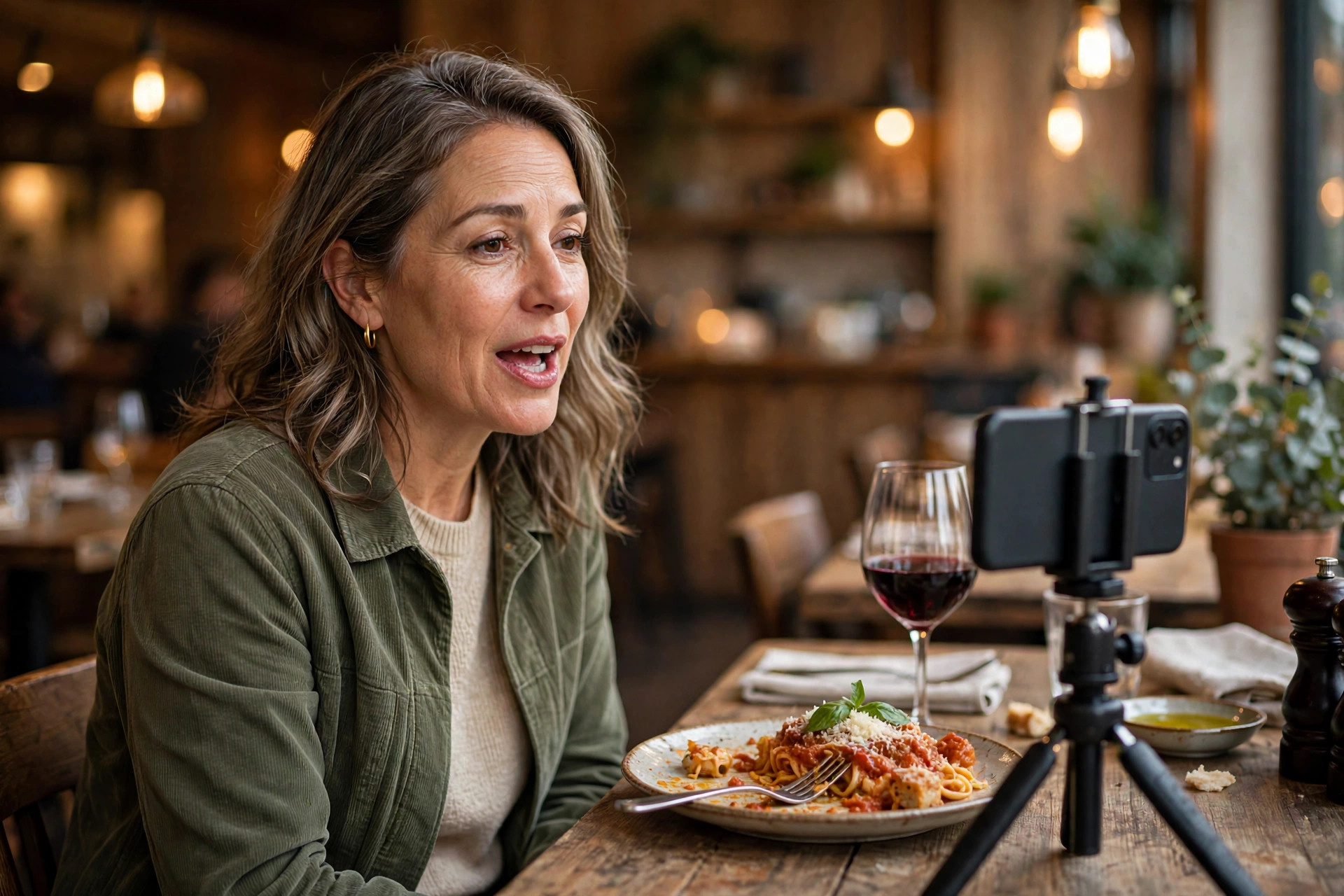
- Light: seat the guest facing the brightest soft light available — a window, or the warm pendant lamps of your dining room. Never put the light behind them (window behind = silhouette). Evening service light is usually flattering already; avoid the harsh white of the kitchen or the bar fridge glow.
- Audio: this is where amateur footage dies. Film somewhere quiet — away from the espresso machine, the kitchen pass and the speaker. A €20-30 lapel microphone that plugs into the phone is the single best investment; failing that, get the phone within arm's length and ask the guest to speak up slightly.
- Framing: shoot horizontal for the website, vertical for TikTok/Instagram — or shoot horizontal and crop a vertical cut later. Frame from mid-chest up, with the restaurant visible behind the guest (depth sells atmosphere). A small tripod or a stack of menus keeps the phone steady; shaky footage reads as careless.
- Length: tell the guest "thirty to sixty seconds", film up to two minutes, use the best forty-five. Trim ruthlessly in any free phone editor — cut pauses, false starts and your own questions.
- Captions: always add captions. Most social video is watched on mute, and captions make the testimonial work everywhere. Phone editors auto-generate them in seconds — review and fix the names of dishes.
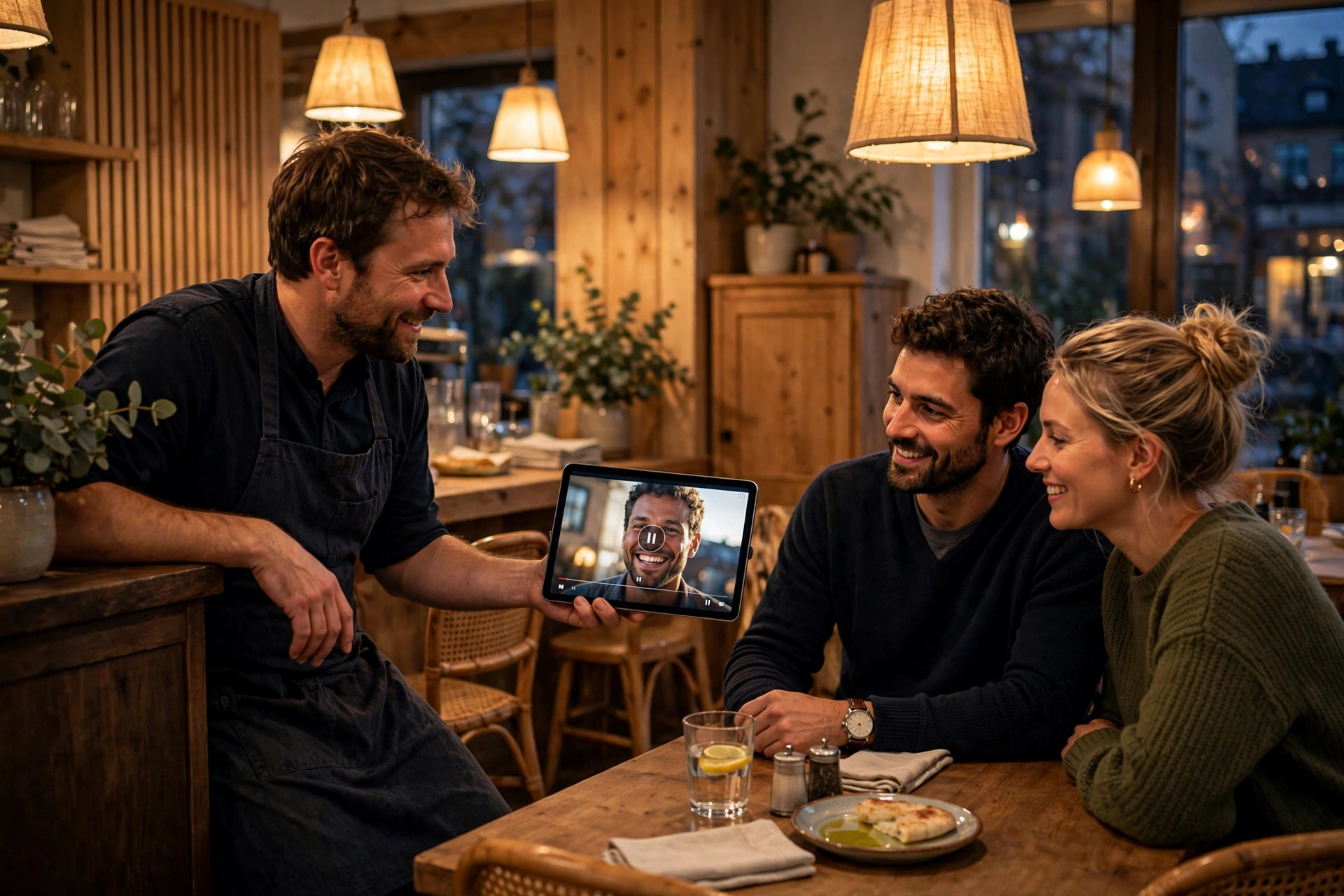
A word on the "testimonial booth" idea: some restaurants set up a small dedicated corner with a sign inviting guests to record themselves. It can work for events and groups, but for regular service the personal ask at the table produces better, more specific testimonials — the guest is still inside the experience, and the restaurant is the natural backdrop. Our guide to getting more Google reviews covers how the ask habit fits into the wider review system.
Video vs written: the honest comparison
Video wins on trust and conversion — but it is not a replacement for written reviews. They do different jobs, and a smart restaurant runs both. Here is the honest breakdown:
| Factor | Video testimonials | Written reviews |
|---|---|---|
| Trust and authenticity | Very high — face, voice and emotion are hard to fake | Moderate — anyone can write a sentence |
| Emotional impact | High — tone and body language carry the story | Low to moderate — depends on the writer |
| Conversion at decision points | Strongest — ideal near booking buttons | Strong for filtering, weaker for closing |
| Effort to collect | Higher — needs the ask, filming, permission, editing | Lower — a link or QR code is enough |
| Volume achievable | Low — a few dozen at most | High — hundreds over time |
| SEO and ranking value | Low direct value — Google reads text, not video | High — keywords and freshness feed local ranking |
| Skimmability | Low — must be watched | High — stars and snippets scan in seconds |
| Best placement | Homepage, booking page, GBP posts, social media | Google profile, Tripadvisor, website review section |
The conclusion is not "video instead of text" but "video at the close, text at the scale." Written reviews give you volume, keywords and Google ranking. Video gives you the emotional close. Restaurants that do only one leave money on the table: a profile with 300 written reviews and zero video looks credible but faceless; five great clips and twelve written reviews looks like a beloved secret nobody bothered to write about. Aim for both — and if you have to choose one new habit this month, collect the videos first, because nobody else in your street is doing it.
One video, many uses: repurposing done right
A single 60-second testimonial is raw material for a week of content. The repurposing chain looks like this:
- The master clip (45-60s, horizontal): homepage, booking page, testimonials gallery. This is the canonical version.
- The vertical cut (15-30s): the best moment, reframed for Instagram Reels and TikTok, with captions. One per testimonial.
- The quote card: the single strongest sentence as text over a food photo — for GBP posts and stories.
- The highlight reel (60-90s): once you have five testimonials, cut the best seconds of each into a montage. This becomes your social pinned post and your "why us" page hero.
- The Google Business Profile post: upload the clip directly to your GBP — guests comparing listings on Maps see it without visiting your site.
Repurposing is also how you justify the effort: one evening of asking regulars can fill a month of social content and a permanent homepage asset. Keep a simple folder — phone, cloud drive, wherever — with the master clips, the cuts and the signed permissions together. When a clip stops feeling fresh (the menu changed, the interior was renovated), archive it and replace it. Freshness is part of the persuasion: a testimonial about last month's menu sells better than one about 2022.
Transcribe for SEO
Search engines cannot watch video, but they can read. Put a short transcript or a two-sentence summary under each testimonial on your website, including the dish names and the neighbourhood. This turns your video page into keyword-rich content that helps the written review section rank — and it is good accessibility practice too. The full restaurant review strategy guide shows how video fits into the wider system of volume, velocity and rating.
Mistakes that kill trust
Video testimonials fail in predictable ways. Avoid these five:
- Overproducing. Studio lighting, scripted lines and a teleprompter turn a testimonial into an ad — and viewers can smell it. Remember: 41% trust for the informal clip, 26% for the studio one. Keep it real.
- Scripting the guest. The moment the words stop being theirs, the magic dies. Questions are fine; lines are not. If a clip sounds rehearsed, cut it — one stiff testimonial poisons the genuine ones beside it.
- Incentivising and hiding it. Anything that looks like a paid endorsement without disclosure — on any platform — erodes trust and can violate platform rules. On Google it is outright prohibited.
- Filming without permission. Publishing a guest's face without explicit consent is not just a trust problem, it is a legal one in the EU. Get the release signed before the clip leaves your phone.
- Letting them go stale. A testimonial wall from three years ago whispers "we were great once." Rotate: one new clip a month keeps the proof alive.
The moment the words stop being the guest's, the magic dies — one stiff testimonial poisons the genuine ones beside it.
There is also the reverse mistake: collecting clips and never publishing them. A folder of unedited footage helps no one. The bar for "good enough to publish" is low — clear audio, honest words, the guest's permission. Publish the imperfect clip today; replace it with a better one next month.
Your 30-day plan: from zero to five testimonials
Here is the concrete plan. No budget, no agency, no excuses.
- Week 1 — setup. Write the three questions on a card for the staff. Print five one-page release forms. Buy a small phone tripod and, if the budget allows, a €20-30 lapel mic. Pick your five happiest regulars and plan to catch them on their next visit.
- Week 2 — the asks. Ask two guests. Film at the table, 30-60 seconds each. Show them the clip, get the release signed on the spot. Do not chase perfection — chase completion.
- Week 3 — edit and place. Trim the two clips in a free phone editor, add captions, and put the best one on the homepage near the booking button. Upload both to your Google Business Profile. Cut one vertical version for Instagram.
- Week 4 — build the habit. Ask three more guests. Add the new clips to the booking page. Make "one testimonial a month" a standing task — assign it to a specific person and a specific week, or it will not happen.
That is it: five testimonials, one month, total cost somewhere between zero and the price of a tripod. Each clip works for you every day after — on the homepage, in Maps, in social — long after the evening it was filmed. Few marketing investments compound like that.
And when the clips are live, make sure the website around them is pulling its weight: a testimonial next to a broken booking button converts nothing. If your site needs the booking flow, the menu and the review sections rebuilt properly, that is exactly what we do at powerfulwebsite.com — the build is free, plans run €59–€239/mo, and review integration is part of every package.
Frequently asked questions
How long should a video testimonial be?
30 to 90 seconds. That is long enough to tell a real story — who the guest is, what they loved, what they'd say to a friend — and short enough that a visitor will watch to the end. Aim for 45-60 seconds as your standard; trim anything longer into a highlight reel. Viewers drop off fast: most will not finish a two-minute testimonial.
Do I need a professional camera to film guest testimonials?
No. A modern smartphone films in 4K and is all you need — and informal, phone-shot footage actually scores higher on trust than studio-quality video (41% vs 26% in one 2025 study). What matters is clear audio and good light: sit the guest facing a window or under warm interior light, keep the background quiet, and hold the phone steady on a small tripod or prop it on a table.
Can I offer a free dessert for a video testimonial?
Do not incentivise testimonials destined for Google — Google's policy prohibits offering anything of value in exchange for a review, and the review can be removed or your profile penalised. For testimonials used only on your own website and social channels, small gestures of hospitality are common practice, but disclose them if the platform requires it and never script what the guest says. The safest rule: ask because the experience was great, not because you paid for the praise.
Do I need written permission to publish a guest's video testimonial?
Yes — always get explicit, written permission before publishing a guest's face, voice and name in your marketing. A short release form on paper or a confirmation message by text/email is enough for most restaurant use. It should say where the video may appear (website, social media, ads) and that they can ask you to take it down. Never republish a video someone posted privately without asking first.
Where should video testimonials go on my restaurant website?
Put your best 40-60 second testimonial on the homepage, near the booking button — that is where undecided visitors need the final nudge. Add 2-3 more on the page that carries the booking flow, and upload short clips to your Google Business Profile posts. Keep the full set as a small gallery or on a reviews page, and repurpose the best moments as 15-30 second vertical clips for Instagram and TikTok.
How many video testimonials does a restaurant need?
Start with five good ones: three 45-60 second stories for your homepage and booking page, plus two shorter quote clips for social media. Quality beats quantity — five genuine, specific testimonials outperform twenty stiff ones. After that, add one new testimonial per month to keep the content fresh; freshness signals to visitors that guests are loving your restaurant right now, not two years ago.
Want a website that turns guest love into bookings?
Video testimonials only convert if the website around them works — fast pages, a visible booking button, review sections in the right places. PowerfulWebsite builds your restaurant's website for free; you only pay from €59/mo, with everything handled: domain, hosting, maintenance and updates.
See the packages