Restaurant Review Strategy 2026: The Complete Guide
A restaurant review strategy is a system for earning a steady stream of genuine reviews, responding to every one of them, and turning feedback into bookings. In 2026 it runs on three numbers — review volume, steady velocity, and a 4.2+ star rating — earned with QR codes, well-timed staff asks, automated follow-ups, and a 48-hour response habit. It takes no budget, roughly an hour a month once the system is built, and it is the single highest-leverage marketing a restaurant can do.

Key takeaways
- Reviews decide two battles: whether Google shows you (ranking) and whether the guest chooses you (conversion).
- Aim for 40+ Google reviews at 4.2 stars or higher, with 2–3 new reviews arriving every week — steady velocity beats one-time bursts.
- In the Nordics, Google is the priority platform, Tripadvisor matters for tourist traffic, Facebook is secondary; Yelp is largely irrelevant here.
- The system: staff ask at the right moment, QR codes at the table and on the receipt, automated follow-up the next day, and a response to every review within 48 hours.
- Never incentivise reviews, never buy them, never argue with a bad one in public — and never ask for Yelp reviews directly.
Reviews are the one marketing channel you cannot buy, and the one your competitors cannot copy. A paid ad disappears the day you stop paying; a great review profile keeps working every time someone searches "best sushi near me" for years. But most restaurants treat reviews as weather — something that happens to them — instead of a system they run. This guide fixes that: which platforms to focus on, the numbers to hit, how to earn reviews ethically, how to respond to every one of them, the rules that will get you penalised if you break them, and how to turn the feedback into actual revenue.
This is written for restaurant, café and bar owners in the Nordics, where the platform mix and the guest behaviour differ from what American guides assume. The tactics work anywhere; the priorities are tuned for Helsinki, Stockholm and Oslo.
Why reviews run the show
Reviews fight on two fronts at once. The first is ranking: Google's local results weigh review volume, average rating and review freshness when deciding which three restaurants get the local pack — those three spots that capture the overwhelming majority of clicks. The second is conversion: once a guest lands on your listing, your reviews are the first content they read, and they read them like a menu. Industry practitioners consistently report that steady review acquisition is a stronger ranking signal than total count alone, and that more reviews at a slightly lower rating beat a handful of perfect ones.
Then there is the asymmetry every owner knows in their gut: unhappy guests review without being asked; happy guests need a reason to bother. Left alone, your review profile drifts toward the complaints — not because your food is bad, but because only the motivated few speak up. A review strategy exists to correct that sampling bias, so your profile reflects the silent majority of guests who left happy.
Unhappy guests review without being asked; happy guests need a reason to bother. A review strategy corrects that sampling bias.
The economics of a good profile
Consider what a review profile is worth in practical terms. A guest choosing between two restaurants at similar prices and distances will pick the one with 180 reviews at 4.4 over the one with 23 reviews at 4.9 — volume reads as proof, not just praise. That choice happens dozens of times a day on every "restaurant near me" search in your area. And unlike ads, every review keeps earning: a review written in 2024 is still converting guests in 2026. The consultancy data is consistent on the recovery side too: Glance, a customer-experience consultancy, reports that 70 percent of unhappy customers whose problems are resolved are willing to come back — the audience for your review replies is not the complainer, it is the hundreds of silent readers deciding whether to give you a chance.
Which platforms matter in the Nordics
Not all review platforms are equal, and the ranking differs by market. In the Nordics the hierarchy is clear:
| Platform | Why it matters here | Your priority |
|---|---|---|
| Drives the local pack and Maps rankings; reviews appear in Search results everyone sees. Google explicitly allows asking for reviews via direct link or QR code. | Highest — this is where 80% of your effort goes | |
| Tripadvisor | Still the default for tourists choosing where to eat in an unfamiliar city. Strong seasonal spikes; ranking is heavily review-driven. | High for tourist-area and city-centre restaurants |
| Recommendations carry social weight; useful for local regulars and events. Reviews are less structured but still visible to friends. | Medium — keep it maintained, don't chase it | |
| Yelp | Near-irrelevant in the Nordics; dominant in the US. Its guidelines also prohibit asking for reviews directly. | None — let it grow organically if at all |
The platform choice shapes your tactics. Google is the one you actively feed: it allows the ask, it rewards the volume, and it displays the stars where decisions happen. Tripadvisor deserves a steady trickle of attention if tourists are a meaningful share of your covers — set up your profile properly (see our Tripadvisor setup guide for restaurants) and include it on your table cards. Facebook you keep tidy but don't engineer: claim the page, keep the hours right, respond when someone recommends you.
One platform-policy distinction to burn into memory: Google allows asking; Yelp forbids it. Never ask a guest directly for a Yelp review — the platform treats solicitation as a violation. This matters less in the Nordics where Yelp is marginal, but it is the clearest illustration of a general rule: every platform's rules are different, and you follow each one's.
The numbers that matter: volume, velocity, rating
Forget vanity metrics. Three numbers run your review strategy, in this order of importance:
1. Velocity — the steady stream
Review velocity — how many new reviews arrive per week or month — is the signal most restaurants ignore and the one that moves rankings most. A sudden burst of 30 reviews in a week followed by silence looks like a campaign; 4–6 new reviews every month for half a year looks like a beloved restaurant. Practitioners consistently report that steady acquisition outperforms spikes, and that bursts can even trip spam filters. Target: 2–3 new Google reviews per week, every week, forever.
2. Volume — the proof
Once velocity is steady, total volume becomes your moat. A practical target for a city restaurant: 40+ reviews minimum, triple digits as the real goal. Below ~40, guests read every review and one bad one dominates; above 100, the profile reads as established and individual outliers fade. Volume also feeds Google's local ranking — prominence is partly a function of how much the world talks about you.
3. Rating — the floor, not the ceiling
Your target is 4.2 stars or higher, not 5.0. A perfect 5.0 with few reviews reads as suspicious or new; a 4.3–4.7 with hundreds of reviews reads as a genuinely good restaurant that real humans eat at. Don't fear the occasional 3-star review — a mixed profile converts better than a suspiciously flawless one, because guests trust it. The number that actually hurts is anything below 4.0: at that point a meaningful share of searchers filter you out before reading a word.
The three numbers, at a glance
Velocity: 2–3 new Google reviews per week, steady — never a burst followed by silence.
Volume: 40+ as the floor, 100+ as the goal where your profile becomes self-sustaining.
Rating: 4.2+ is the target; 4.3–4.7 with volume beats a thin 5.0. Below 4.0 you are losing bookings to the number itself.
A note on tourist bias
Research from CUHK Business School on restaurant review behaviour found that reviews from tourists tend to be systematically more positive than reviews from locals: tourists value the experience — service, atmosphere, the memorable evening — while locals weigh fundamentals like price, consistency and value for money. The practical lesson: don't panic when local regulars rate you a touch lower than visitors; they are grading different things. And if your area is tourist-heavy, your overall rating may flatter slightly — the reviews worth reading carefully are the long, analytical ones from locals, because they predict repeat business.
The ask system: getting reviews without begging
The single biggest lever in this entire guide is embarrassingly simple: ask every happy guest. Most restaurants ask 5–10% of their diners and wonder why the count crawls. The restaurants that win make the ask part of the workflow — not a campaign, a habit. Here is the system, layer by layer:
Layer 1: the staff ask (highest conversion)
Your servers are your highest-converting review channel because they are already in the conversation at the natural moment. Train the team on three things: the moment (right after a genuine compliment — "I'm so glad you loved the risotto"), the tone (natural and specific, never scripted or pushy), and the tool (a QR code, not a URL to memorise). One sentence works: "If you have a moment, a Google review would mean a lot to our team — there's a code on your receipt." Make it part of the closing routine the way clearing the table is.
For a deeper dive on the ethics and exact wording, see our guide to asking for Google reviews the ethical way.
Layer 2: QR codes where guests already are
The QR code is the workhorse of the whole system — it collapses "search for us, find the right listing, figure out how to review" into one scan. Get Google's official short review link (from your Business Profile's "get more reviews" share option) and put the QR code:
- On every receipt or bill folder — the highest-converting placement, because the guest is already holding it and has just paid.
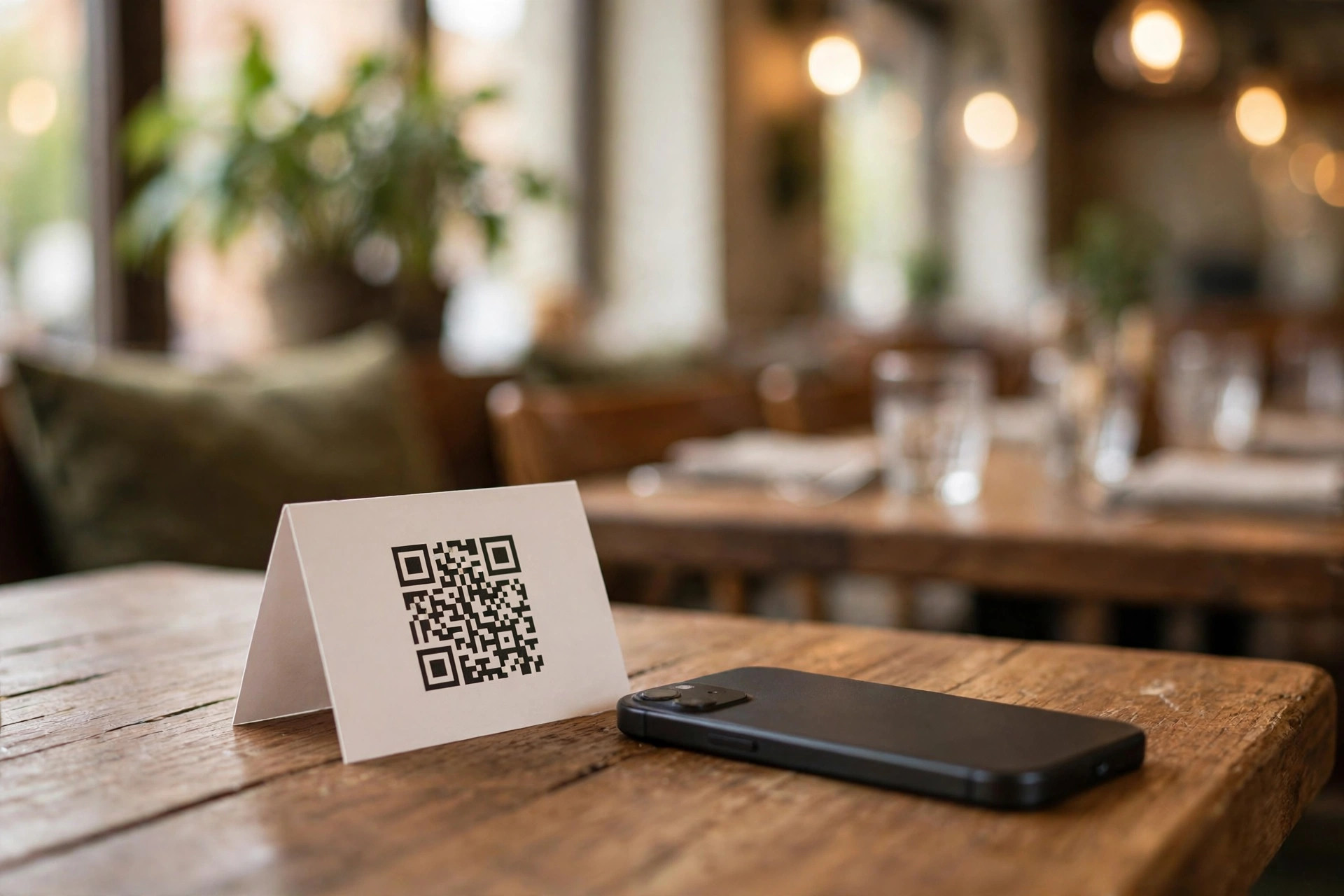
- On table tents or a small stand at the table — catches guests while they wait for the bill, when the meal is fresh in mind.
- At the host stand and near the exit — for the guest who forgot, and for takeaway customers.
- On takeaway packaging — your delivery and pickup guests never see a table tent.
One link per code, and make it the Google review link — not your homepage, not a link aggregator page with five platforms. Every extra choice loses reviewers. If you also want Tripadvisor reviews, a second small card ("Visiting from out of town? Tripadvisor reviews help travellers find us") works for tourist-heavy venues.
One QR code, one link, one platform. Every extra choice between the guest and the review form loses reviewers.
Layer 3: the next-day follow-up
In-person asks catch the guests your staff actually spoke to; everyone else slips through. The fix is an automated follow-up tied to your reservation or POS system: an SMS or email the next day thanking them for visiting and linking straight to the review form. Keep it to one message, send it Tuesday–Thursday mornings (weekend messages get buried), and make the link one tap. Reservation platforms and email tools can automate this entirely — set it once and it runs forever. This is also where collecting phone numbers and emails at booking time pays for itself many times over.
Layer 4: the digital touchpoints
Your website's contact and thank-you pages, your booking confirmation page, and your newsletter footer can all carry a quiet review link. These convert at lower rates than the in-person ask, but they cost nothing and they catch the guest who meant to review and forgot. Don't put review asks in the booking flow itself — that's the moment to reduce friction, not add tasks.
Responding to every review
If asking is the engine, responding is the steering. Reply to every review — positive and negative — within 48 hours. This is non-negotiable, and it is where most restaurants quietly fail: they answer the angry ones, ignore the glowing ones, and signal to Google and to readers that reviews go into a void.
The positive-review response
Most owners skip these because "they're already happy". That's exactly backwards — the response isn't for the reviewer, it's for the hundreds of future guests reading along. A good positive response has three beats:
- Genuine thanks — warm, specific, human.
- Mirror the specifics — name the dish, the server, the occasion they mentioned. This proves a human read it and subtly repeats your best selling points for future readers.
- A soft invitation back — a question or a tease ("Have you tried the autumn menu yet?") turns a review into a reason to return.
Bad: "Thanks for the great review!" Good: "Thank you, Sofia — I'm passing your words about the mushroom risotto straight to the kitchen, they'll be thrilled. The truffle season menu starts next month and I think you'll love it."
The negative-review response
Speed matters: industry surveys have found that the majority of customers who complain online expect a response quickly, with many hoping for one within the hour. You don't need the hour, but you do need the same day. The formula:
- Thank them for the feedback — even when it stings. Gratitude disarms.
- Acknowledge the specific issue — show you actually read it. No defensiveness, no excuses, no "but".
- Apologise briefly and take it offline — give a name and a direct contact (email or phone) so the conversation leaves the public page.
- Make it right privately — an invitation back, a voucher, a real fix. The consultancy data says 70% of unhappy customers whose problems get resolved will return; the public reply is the advertisement, the private fix is the product.
For word-for-word examples across the common scenarios, our five negative-review reply templates cover the late food, the wrong order, the rude-service claim, the unfair review and the outright fake one.
The response isn't for the reviewer — it's for the hundreds of future guests reading along. Write every reply for them.
| Review type | Response goal | Timing |
|---|---|---|
| Glowing 5-star with specifics | Thank, mirror the dish, invite back | Within 48 hours |
| Positive but vague ("nice place") | Thank warmly, add one specific detail about what you offer | Within 48 hours |
| Mixed 3-star with a real point | Acknowledge the point, note the fix, invite back to see it | Same day |
| Legitimate 1–2 star complaint | Apologise, take offline with a named contact, fix privately | Same day, ideally within hours |
| Unfair or fake review | Stay factual and calm for the readers, then report via platform tools | Same day |
The rules: what gets you penalised
Review platforms protect the trust that makes reviews valuable, and they enforce it. Breaking these rules can get reviews removed, your listing flagged, or in serious cases your profile suspended. None of them is worth it:
- No incentives, ever. Discounts, free desserts, loyalty points or prize draws in exchange for reviews violate Google's policies. Review platforms have become skilled at detecting incentivised reviews, and the removal often takes legitimate-looking reviews with it.
- No fake reviews. Don't write them yourself, don't ask staff or friends to, and don't pay for them. Beyond the platform penalties, fake reviews are illegal in the EU under the Unfair Commercial Practices Directive — this is consumer-protection law, not just platform etiquette.
- No review gating. Gating means filtering guests first ("how was your visit?" surveys that only send happy guests to Google and route unhappy ones to a private form). Google explicitly prohibits selectively soliciting only positive reviews. Ask everyone, equally.
- No review stations or kiosks at the counter. A tablet bolted to your counter that guests review from looks like the business controlling the process — Google has removed reviews left from on-site devices. The guest's own phone, their own time, their own words.
- Respect each platform's ask rules. Google and Tripadvisor allow asking; Yelp prohibits direct solicitation. When in doubt, the conservative reading of a platform's guidelines is the right one.
One more grey area to handle honestly: responding to reviews you suspect are fake. Never accuse a reviewer of lying in public — even when you're certain. A calm, factual reply ("We have no record of a visit matching this description, but we'd like to understand — please contact us at…") protects you with readers and keeps you inside policy. Then report the review through the platform's tools and move on. One fake review among hundreds is noise; a public fight with a reviewer is the story guests remember.
Turning bad reviews into revenue
Here is the counterintuitive truth about negative reviews: handled well, they make you more money than a wall of five stars. Guests don't trust perfection — they trust recovery. A one-star review with a thoughtful owner response and a visible fix converts better than the same complaint sitting unanswered, because the reader sees a restaurant that takes problems seriously.
The make-it-right economics
Do the arithmetic. A guest who had a bad experience and gets it fixed becomes a returning customer — and returning customers are dramatically more valuable than new ones. Analysts at RJ Metrics have reported that repeat customers spend several times more than first-timers. Against that, the cost of the recovery — a dessert, a glass of wine, a sincere invitation back — is trivial. The restaurants that treat every complaint as a retention opportunity aren't being generous; they're being rational.
The public-private two-step
The winning pattern for any serious complaint:
- Public: a fast, gracious reply that acknowledges the issue and names a contact. Future guests see professionalism.
- Private: a real conversation, a real apology, and a concrete make-good. The reviewer experiences being heard.
- Operational: if the complaint points at something real — slow Fridays, a cold dish, a brusque server — fix it in the operation, not just in the reply. Then mention the fix publicly in future responses ("since your visit we've changed how we…") so the negative review starts working as evidence of improvement.
There is a special category worth naming: the review that is useful. A three-star review that says "great food, but the room is too loud for conversation" is free market research from someone who paid you. Log these, look for patterns monthly, and act on the ones that repeat. Your review profile is the cheapest focus group in the restaurant business.
The 48-hour rule
Every review — positive or negative — gets a reply within 48 hours, negatives the same day. Put it on the calendar like a supplier order: a 10-minute daily check beats a monthly marathon. Google notices the activity, guests notice the attention, and small issues get caught before they become review patterns.
Mining reviews for business intelligence
Once reviews are flowing, they become a data source most restaurants never tap. Once a month, read your last 20–30 reviews with a notebook open and ask four questions:
What dishes get named?
The dishes guests mention by name are your real signature dishes — not the ones you think are signatures. Feature them: in the menu layout, in Google Posts, in your website copy, in the server's recommendations. If a starter keeps appearing in five-star reviews, it deserves a photo on your site and a line in your Google Business Profile description.
What words do guests use?
Guest language is SEO gold. If reviewers keep writing "cosy", "great for dates", "best lunch in the area" or "dog-friendly terrace", those are the phrases your website should contain — they are literally the words your market uses to describe what they want. This is how local SEO for restaurants should be built: from real guest vocabulary, not from a keyword tool's guesses.
What complaints repeat?
One complaint about slow service is an anecdote; five in a month is a staffing schedule problem. Categorise negative feedback monthly — food, service speed, noise, price perception, booking experience — and the patterns will tell you where the next euro of improvement belongs. This is also how you catch problems before they become your reputation: the third "had to wait 40 minutes" review is a warning the first two already gave you.
Who are your regulars in waiting?
Reviewers who name staff, mention visiting "again", or write in detail are your highest-value guests — they are already emotionally invested. Thank them personally when you can, remember their names, and make sure the team knows who they are. A guest who feels recognised writes the next review too.
The monthly review dashboard
A strategy without measurement is a hope. Once a month, spend 20 minutes recording five numbers:
- New reviews this month (target: 8–12 on Google — the 2–3 per week habit)
- Average rating, trailing 90 days (more useful than the all-time average; shows your current direction)
- Response rate (target: 100% — every review answered)
- Median response time (target: under 48 hours; negatives same-day)
- Repeat-complaint themes (the pattern log from the mining section above)
Track these in a simple spreadsheet and watch the trend lines, not the absolutes. A rating that climbs from 4.1 to 4.4 over six months of steady velocity is a strategy working; a rating stuck at 4.0 with two reviews a month is a strategy that needs the ask system rebuilt. Google Business Profile's built-in insights show you the visibility side — searches, calls, direction requests — so you can correlate review activity with actual guest behaviour.
The Nordic playbook
Global review guides assume American platforms and American habits. In the Nordics, adjust:
Google first, Tripadvisor for the tourists, Yelp never
Your review energy goes to Google — it's the platform that ranks you and the one every local uses. Tripadvisor earns its place if you're in a city centre, near an attraction, or anywhere tourists eat: summer visitors and Christmas-market crowds decide almost entirely on Tripadvisor rankings. Yelp you can safely ignore; no Nordic guest is choosing dinner on it.
Seasons create review waves — ride them
Nordic restaurants live on seasonal spikes: summer terraces, crayfish season, Christmas tables, winter tourism in Lapland. Each wave brings a flood of first-time guests — the exact population most likely to review if asked, and most likely to vanish silently if not. Before every peak season, restock the table cards, brief the seasonal staff on the ask, and make sure the QR codes still scan. A summer season done right can add 50–100 reviews in three months; done passively, it adds almost none.
Two languages, one review profile
Guests review in Finnish, Swedish, Norwegian and English — sometimes all four on the same listing. That's fine; Google translates well enough. But respond in the reviewer's language whenever you can — it doubles the signal that a human is behind the account. For tourist-heavy venues, an English response to an English review is expected; for a neighbourhood restaurant, answering in the local language matters more.
The Janteloven caution
Nordic guests are culturally reluctant to praise loudly — and equally reluctant to complain to your face. That makes the private, low-pressure ask essential: a QR code on the receipt outperforms a verbal ask precisely because it doesn't put anyone on the spot. Don't mistake Nordic reserve for dissatisfaction; your quietest regulars are often your best reviewers once the friction is gone.
Nordic guests won't praise loudly to your face — but they will scan a QR code on the receipt. Remove the friction and the reserve disappears with it.
GDPR and the follow-up message
The next-day SMS or email follow-up is powerful, but in the EU it needs a lawful basis: use contact details guests gave you for the booking to send booking-related messages (confirmation, reminder, thank-you with a review link), and keep marketing emails to guests who opted in. A thank-you message tied to a visit is on far safer ground than a newsletter signup they never made — but keep it to one message, make unsubscribing trivial, and never buy lists.
Frequently asked questions
How many reviews does my restaurant need?
A practical target is 40 or more reviews at 4.2 stars or higher on Google, with 2–3 new reviews arriving every week. Volume matters more than perfection: a restaurant with 150 reviews at 4.3 will generally outrank one with 20 reviews at 4.8, because consistency and freshness signal to Google that the business is actively serving happy customers. On Tripadvisor, more reviews directly lift your ranking among travellers comparing options.
Is it OK to ask customers for reviews?
On Google, yes — Google explicitly allows businesses to ask for reviews with a direct link or QR code, and says reviews help businesses stand out in Search and Maps. On Tripadvisor, asking is also accepted practice. The one platform to handle differently is Yelp, whose guidelines prohibit businesses from asking customers for reviews directly — let Yelp reviews arrive organically. Whatever you do, never offer incentives for reviews: Google prohibits it, and it can lead to review removal or penalties.
Should I reply to positive reviews too, or only negative ones?
Reply to every review, positive and negative. Answering positive reviews signals active management to Google, shows prospective diners you pay attention, and gives you a natural place to reinforce what guests loved — mention the dish they praised by name, thank them warmly, and invite them back. A response that references specifics beats a generic thank-you and reads as genuine to everyone reading along.
How should I handle a fake or unfair review?
Respond first, report second. Post a calm, factual, professional reply that does not accuse the reviewer of lying — future guests are the real audience, and your composure is what they judge. Then use the platform's reporting tools to flag the review if it genuinely violates policy (spam, conflicts of interest, or a review of a visit that never happened). Do not argue in public, and never offer payment to have a review removed.
Can I offer a discount or free dessert for a review?
No. Offering anything of value in exchange for a review violates Google's policies and can get the reviews removed or your profile penalised. It also backfires with guests: incentivised reviews read as inauthentic, and review platforms have become good at detecting them. Ask because you want honest feedback, make leaving one effortless, and earn the stars with the experience itself.
How long does it take for a review strategy to show results?
Expect visible momentum in 4–8 weeks: your average rating stabilises, weekly review volume picks up, and guests start mentioning reviews at the table. Ranking effects in Google's local results take longer — typically 3–6 months of steady velocity, because freshness and consistency compound. The mistake is the one-time push: 30 reviews in a week followed by silence performs worse than 4–6 new reviews every month for half a year.
Want a website that turns great reviews into bookings?
Your reviews convince guests to choose you — your website closes the deal. PowerfulWebsite builds your restaurant's website for free; you only pay from €59/mo, with review integration, the menu and the booking flow handled. See what your site could look like.
See the packages