Bar Website Essentials: What Yours Needs in 2026
A bar website needs ten things in 2026: a readable drinks menu as real text, opening hours and address findable in seconds, a phone number and booking option, an events page, atmosphere photography, mobile-first speed, and local SEO so Google shows you for "bars near me". Cost estimate: roughly €800–2,500 via a freelancer or €49–189/month as a subscription; DIY starts around €15/month.
Key takeaways
- Your drinks menu is the most-visited page — it must be real text, readable on a phone, never a PDF.
- Hours, address and phone number must survive the five-second test on a mobile screen.
- An events or what's-on page is what separates bar sites from restaurant sites — keep it current.
- Most guests find you on Google while already out: mobile speed and local SEO beat fancy design.
- A verified Google Business Profile is half of your "website" — treat it as seriously as the site itself.
- Realistic 2026 budgets: €800–2,500 one-off from a freelancer, or €49–189/month with everything handled.
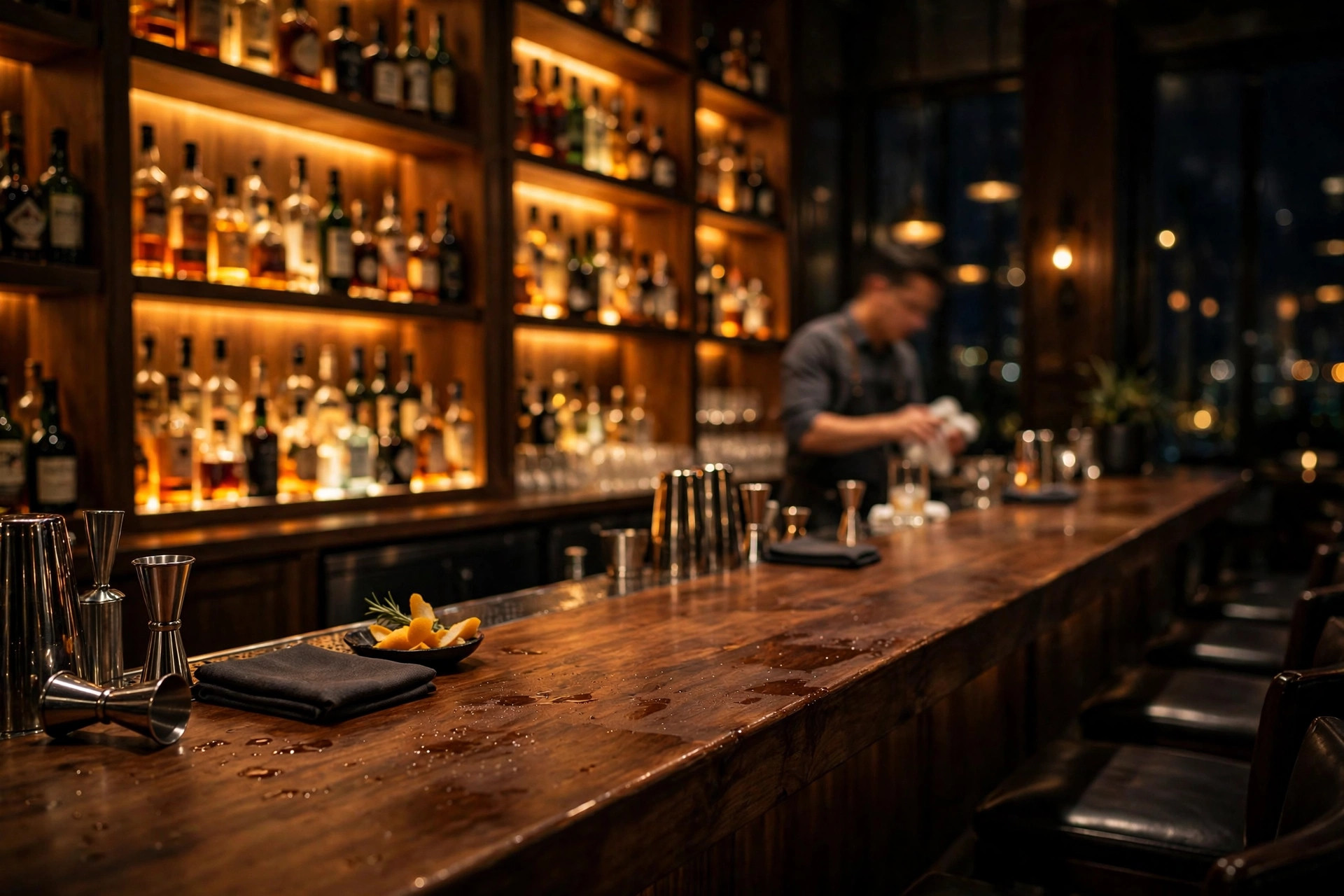
Nobody plans a bar night the way they plan a restaurant dinner. Restaurant guests research: they compare menus, read reviews, book days ahead. Bar guests decide in the moment — a group chat lights up at 18:40, someone suggests "somewhere with good cocktails near the station", and three bars get thirty seconds each on a phone screen. Your website is one of those three bars. It either answers every question instantly or loses the night.
That is why bar websites fail in a specific way. They are built like restaurant websites — long heritage stories, tasting notes, chef portraits — when bar guests want logistics. What do you pour? Are you open now? Where exactly are you? Is there live music tonight? Can I book the corner table for eight? This guide is the checklist: the ten things a bar website needs in 2026, what each one should contain, how much it costs to get built, and the three mistakes that quietly cost bars their busiest nights.
The 10 essentials every bar website needs in 2026
Before the detail, the overview. If your site does these ten things well, it beats 90% of bar websites — and the bar for "well" is lower than most owners fear.
- Drinks menu as readable text — cocktails, beer, wine, spirits with prices; updated when the menu changes, readable on a phone without pinching.
- Opening hours — today's hours visible on the homepage; holiday exceptions listed, not buried.
- Address and getting there — street address plus a map link that opens the visitor's navigation app.
- Phone number and email — clickable on mobile (tap-to-call), answered or checked regularly.
- Booking or table request — even a simple form beats "just walk in" for groups and private hire.
- Events and what's on — live music, quizzes, tastings, seasonal menus; this page is your reason to exist beyond Friday drinks.
- Atmosphere photography — the room, the light, the drinks in hands; photography is the product preview.
- Private hire information — capacity, packages or minimum spend, a contact form that goes somewhere monitored.
- Fast mobile experience — under three seconds to load on a phone; every button thumb-reachable.
- Findability — a verified Google Business Profile, consistent name-address-phone everywhere, and the city or neighbourhood named on the site.
Notice what is not on the list: a blog, an online shop, a loyalty programme, an animated hero video. Those can come later. Most bars that skip the basics to build the extras end up with a beautiful site that tells nobody when it is open — and guests do not forgive that.
Your drinks menu is the homepage, not an attachment
Ask ten bar owners what their most-visited web page is and nine will guess the homepage. It is almost always the menu page. Guests deciding between bars compare the same thing you would compare: the drinks list. Do they have the cocktails I like? Is there anything interesting on tap? Can I afford it? A menu that answers those questions wins the night.
The critical rule: the menu must be real text on the page, not a PDF and not a photo of the printed menu. This is the single most common failure on bar websites, and it fails on three fronts at once. Phones cannot zoom a PDF gracefully. Google cannot read it, so your cocktails never appear in search results — nobody will ever find you by searching "espresso martini [your city]" if the drink only exists inside a PDF. And updating it is such a chore that owners stop doing it, which is how websites end up advertising last summer's menu in October.
The menu update test
If changing a cocktail's price on your website takes longer than changing it on the printed menu, your site is set up wrong. A good bar site lets you edit the menu in under ten minutes from your phone — that is the entire difference between a menu that is current and one that quietly lies to guests.
What belongs on the menu page: every cocktail with its ingredients and price, the beer list (draught first, then bottles), the wine-by-the-glass selection, spirits worth mentioning, and non-alcoholic options — the fastest-growing section of most bar menus in 2026, and the one guests increasingly search for first. Prices should be shown honestly. The old habit of hiding prices "to look premium" backfires on a phone: guests assume expensive, close the tab, and pick the bar that told them a negroni costs €14.
Seasonal menus and specials
Bars that rotate cocktails seasonally should date-stamp their menu pages ("Autumn 2026") and keep the previous season's page live but marked as past. This does two useful things: regulars can see what is new without hunting, and Google indexes a growing archive of drink names associated with your bar — free search visibility that compounds over years.
The five-second test: hours, location, contact
Here is the test every bar website should pass: hand your phone to a friend, open your site, and count five seconds. Can they tell you whether you are open right now, where the bar is, and how to call you? If not, your site fails the only exam that matters on a Friday evening.
Most failures come from hiding logistics behind navigation. Opening hours live on a "Contact" subpage. The address is an image. The phone number is text that cannot be tapped. Fix all three with one design rule: the homepage header or the first screen on mobile shows today's hours, the neighbourhood, and a tap-to-call button. Everything else can scroll.
A note on hours specifically: list exceptions. Bars lose more goodwill to "closed for a private event" surprises than to almost anything else online. A simple line on the homepage — "Closed Sat 10 Oct for a private event" — turns a wasted trip into a customer who comes back next week. Google Business Profile lets you set special hours too; use it, because Google shows your hours before your website in most searches.
Reservations and private hire: capture the group
Walk-ins fill Tuesday. Groups fill Saturday — and groups plan ahead, which means they book through websites. A bar that cannot take a table request online hands every birthday party, after-work group and Christmas dinner to the competitor whose form works.
You do not need a full reservation platform. For most bars, a simple form works: date, time, party size, name, phone, and a notes field. The form must do two things reliably: confirm to the guest immediately ("we reply within 24 hours") and actually reach someone who checks it daily. The graveyard of bar websites is full of forms that send to an inbox nobody opened since 2023.
Private hire deserves its own page
Private hire is the highest-margin revenue most bars can add, and it is almost entirely won online — nobody cold-calls a bar for a 40-person event anymore. The page needs: capacity (standing and seated), what's included (space, staff, AV, cloakroom), example packages or minimum spends, and photos of the room set up for events. Price ranges as estimates are fine and better than silence; "exclusive hire from around €1,500 on weeknights" filters out time-wasters and invites serious enquiries. Link this page from your main navigation — it is a landing page for corporate searches like "private bar hire [city]".
Events and what's on: the page that makes you a destination
This is what separates a bar website from a restaurant website. Nobody checks a restaurant's site for "what's on this Thursday". Bar guests do — live music, DJ sets, pub quizzes, wine tastings, sports screenings, seasonal launches. Your events page is the reason a guest visits your site twice, and the reason they choose you over the identical bar two streets away.
The page has one job: answer "what's happening this week?" List events with date, time, price or free entry, and whether booking is needed. Then — and this is where nearly every bar fails — keep it current. An events page advertising March in October is worse than no events page at all, because it tells the visitor the whole site is abandoned. If you cannot commit to updating it weekly, replace the page with a simple "Weekly: quiz every Thursday · DJ every Friday" format that stays true for months.
An events page advertising March in October is worse than no events page at all — it tells the visitor the whole site is abandoned.
One more reason to bother: events are search-engine gold. "Live jazz [city]", "pub quiz near me", "wine tasting October" — these are searches with immediate intent, made by people ready to go out tonight. A bar with an events page can rank for them; a bar without one cannot. Instagram posts about the same events vanish from search entirely.
Photography that sells the atmosphere
For a bar, photography is not decoration — it is the product preview. Guests cannot taste a cocktail through a screen, but they can feel a room: the low light, the crowd's energy, the condensation on a glass. The bars that convert best online photograph three things and skip everything else: the room at its best hour, the drinks in hands, and people enjoying themselves.
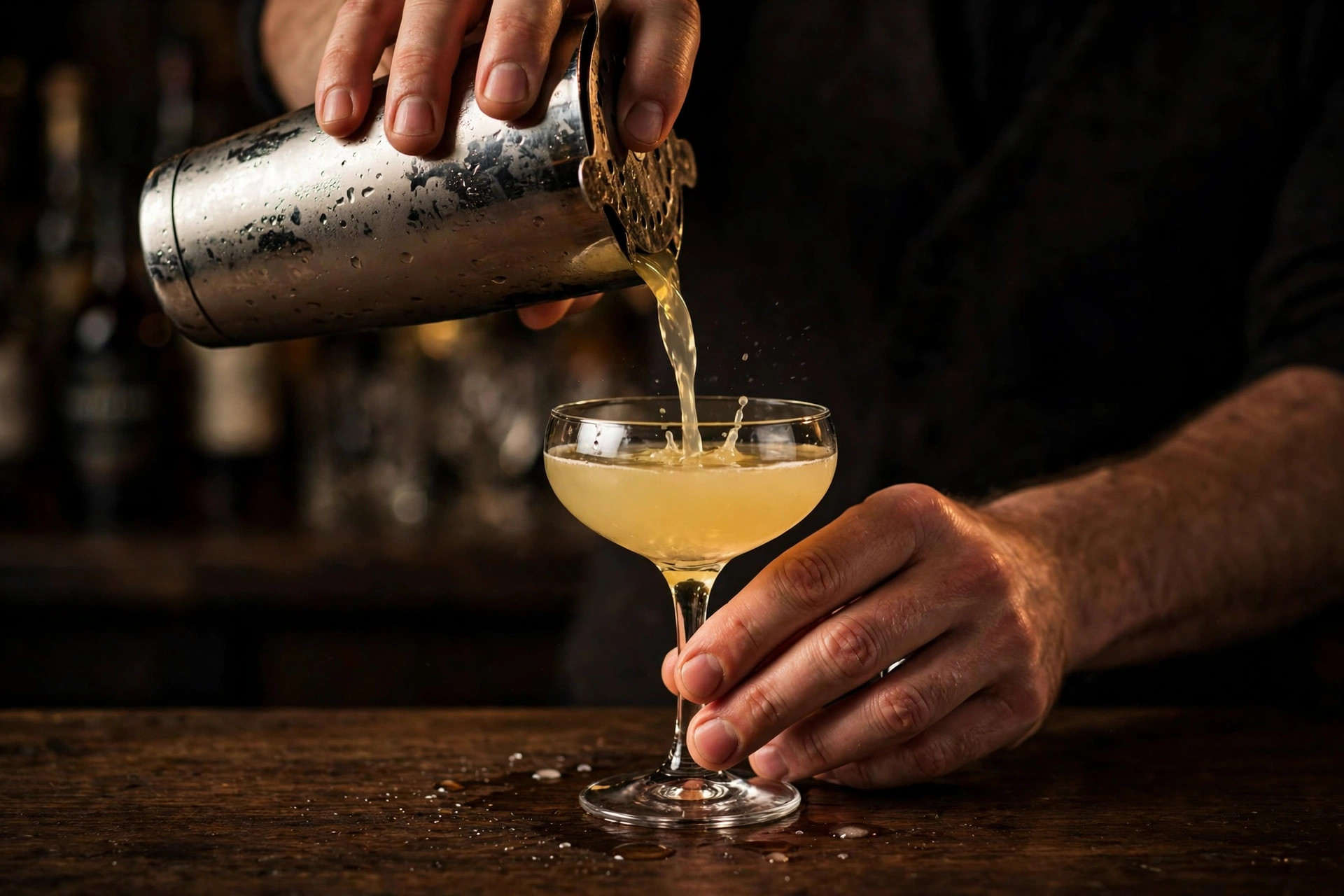
You do not need a professional shoot on day one — a modern phone, the bar's actual lighting, and twenty minutes before opening will beat stock photography every time. Stock photos of cocktails are a trust-killer: guests spot them instantly, and a bar faking its own drinks raises the question of what else is faked. But do invest in a proper photographer once revenue allows; great bar photography gets reused everywhere — website, Google profile, socials, event listings — and it is the single highest-return marketing spend most bars can make.
What to photograph, specifically
- The room at golden hour — 30 minutes before the evening crowd, lights low, bottles glowing. This is your hero image.
- Signature drinks being made — hands, motion, flame or smoke if you use it. Process shots outperform finished-product shots.
- Full tables, happy noise — ask regulars' permission; a busy room is the strongest signal a bar can send.
- Details — the bar top, the glassware, the menu design. Texture photographs make a site feel crafted.
Mobile first: your guests are already out
Here is the statistic that should shape every decision about your bar website: the overwhelming majority of your visitors arrive on a phone, and a large share of them are already outside — walking, in a taxi, standing on your street deciding whether to come in. They are not browsing; they are verifying. Your site has one task in that moment: load fast and answer fast.
"Fast" has a number: under three seconds to usable on a mobile connection. Every second beyond that costs you a measurable share of visitors, and the fixes are unglamorous — compress images before uploading, skip the autoplaying video background, avoid the fancy animation library. A plain site that loads in two seconds beats a cinematic one that loads in eight, every single night of the week.
Design for thumbs. The call button, the map link, the booking form — all reachable and tappable without zooming. Test the whole site yourself on your own phone, on mobile data, standing outside your own bar. If you would not use it in that moment, your guests will not either.
Local SEO: owning "bars near me"
Nobody searches for your bar by name until they already know it. Everyone searches by situation: "cocktail bar near me", "best bars in [neighbourhood]", "where to watch the match [city]". Local SEO is the discipline of showing up for those searches, and for bars it matters more than for almost any other business — because the search happens minutes before the purchase.
The three pillars
1. Google Business Profile. This is half your web presence. Claim it, verify it, and treat it like a second homepage: correct hours (including holidays), the right categories ("Cocktail bar", not just "Bar"), 20+ real photos, and replies to every review — including the bad ones, especially the bad ones. A profile with recent photos and answered reviews outranks an identical bar with a neglected profile, consistently.
2. Consistency. Your bar's name, address and phone number must be written identically everywhere: your website, Google, social profiles, event listings. Search engines treat mismatches as different businesses and split your visibility between them.
3. Location language on your site. Name your city and neighbourhood naturally in the copy — "a cocktail bar in the heart of Kallio", "five minutes from the central station". You are not keyword-stuffing; you are telling Google and guests where you are, in words people actually search.
The search happens minutes before the purchase. For bars, local SEO is not marketing — it is being open for business.
Reviews deserve their own mention. Guests trust recent reviews more than your own copy, and Google weighs review count, recency and your response rate in rankings. Put a gentle nudge on the site — a QR code on the receipt or the table tent works better than any email campaign — and reply to everything within a day. A thoughtful reply to a two-star review convinces more future guests than ten five-star reviews you never acknowledged.
How much does a bar website cost in 2026?
The honest answer depends on how much of the work you want to do yourself — and how much you value your evenings. Here are the realistic 2026 ranges for a proper bar site (menu, booking form, events, local SEO basics), all as estimates:
| Route | Typical cost (est.) | Build time | Best for |
|---|---|---|---|
| DIY builder (Wix, Squarespace…) | €15–30/month + your time | 10–30 hours of your evenings | Tight budgets; owners who enjoy tinkering |
| Freelancer | €800–2,500 one-off | 2–4 weeks | A custom look on a modest budget |
| Agency | €2,500–6,000 one-off | 4–8 weeks | Cocktail bars, groups, venues with events |
| Subscription (e.g. PowerfulWebsite) | €49–189/month, €0 build cost | Days | Hands-off: design, hosting, updates included |
Whatever route you choose, budget the running costs honestly: domain (~€15/year), hosting or builder plan (€15–50/month), and either your time or someone's fee for updates. One-off builds also need a maintenance plan — an unmaintained site is a liability within a year. This is the quiet argument for the subscription model: the menu updates, the holiday hours, the security patches all happen without you remembering. If you'd rather pour drinks than push updates, services like PowerfulWebsite build the site free and handle everything for a monthly fee.
For context on what similar hospitality businesses pay, our pizzeria website cost guide for 2026 breaks down pricing, content and ordering for a comparable venue type — and if you run a café alongside the bar, the seven elements of café website design overlap heavily with what works here.
Three mistakes that cost bars guests every week
1. The PDF menu. Covered above, worth repeating because it is that common: if your menu is a PDF, a photo, or missing entirely, you are invisible to menu-searchers — the highest-intent guests you get.
2. The abandoned events page. A what's-on page last updated in spring tells every visitor the bar might be closed. Either update it weekly or simplify it to a permanent weekly rhythm.
3. The Instagram-only presence. Instagram is a discovery channel, not a business foundation. When the Friday-night group chat asks "is it open, where is it, do we need to book?", the answer has to exist on Google and your website — not three DMs deep in an inbox you check on Mondays. Bars with a proper site capture the planners; bars without one get the leftovers.
Instagram is where guests discover you. Your website is where they decide. Discovery without a decision point is just entertainment.
FAQ
What should a bar website include?
At minimum: a drinks menu as real readable text (not a PDF), opening hours, address with a map link, a phone number, an events or what's-on section, atmosphere photography, and a booking or contact option. Everything else — shop, blog, loyalty signup — is optional until those basics are perfect.
How much does a bar website cost in 2026?
Estimates for 2026: a DIY builder site costs roughly €15–30 per month plus your time; a freelancer typically charges €800–2,500 one-off; an agency build runs €2,500–6,000; a subscription service with zero build cost runs about €49–189 per month with hosting and updates included. Annual upkeep — domain, hosting, updates — adds roughly €100–500 on top of one-off builds.
Does my bar need a website, or is Instagram enough?
Instagram is excellent for discovery, but it cannot replace a website. Guests deciding between three bars on a Friday night check Google first, where an Instagram-only bar often looks closed, unlisted or abandoned. A website also converts: reservations, private-hire enquiries and menu browsing all happen far more reliably on a site than in DMs.
What is the best website builder for a bar?
For a simple bar site, the mainstream builders (Wix, Squarespace, Webflow) all work; choose the one whose templates match your bar's mood and whose editor you can update in under ten minutes. What matters more than the platform is whether you will keep the menu, hours and events updated — an outdated site on any platform costs you more than a simple one that is current.
How do I get my bar to show up on Google searches like "bars near me"?
Three things drive it: a verified Google Business Profile with correct hours, photos and categories; your bar's name, address and phone number written identically on your website and everywhere else online; and a fast mobile site with the city or neighbourhood mentioned naturally in the copy. Reviews help too — reply to every one.
Want a bar website that fills tables?
PowerfulWebsite builds your bar's website free — you only pay from €49/month. Everything included: domain, hosting, menu updates, events page and maintenance.
See the packages