Booking Conversion: Measure It, Improve It
Booking conversion is the share of people who start a booking and actually finish one. A healthy online booking flow converts 60–80% of attempts; most restaurants have no idea what theirs is — and every point of improvement is free revenue, because it costs nothing in extra marketing.

Key takeaways
- Booking conversion has two definitions: funnel conversion (bookings ÷ attempts, healthy at 60–80% online) and website conversion (bookings ÷ visitors, typically 2–5%). Track both.
- Improving funnel conversion from 60% to 75% is the equivalent of increasing website traffic by 25% — at zero marketing cost.
- The biggest conversion killers are unclear availability, too many form fields, forced accounts and a flow that breaks on mobile.
- Showing the nearest available times when the requested slot is full recovers 15–30% of guests who would otherwise abandon the booking.
- Phone converts better per attempt (85–95%) but captures far fewer attempts — 25–40% of online bookings happen outside staffed hours.
- Conversion does not end at "confirmed": automated reminders typically cut no-shows by 20–30%, which is where much of the recovered revenue actually lands.
Every restaurant owner knows the feeling: the dining room has empty tables on a Thursday, the website had hundreds of visitors this week, and somehow the two facts never meet. The gap between them has a name — booking conversion — and it is the most under-measured number in restaurant marketing. Owners track covers, sales and review ratings, but almost nobody tracks how many people tried to book and gave up halfway. Those are the cheapest guests you will ever acquire: they already found you, already chose you, and were lost by your own booking flow.
This article shows how to measure booking conversion properly, what a good number looks like for each channel, where bookings actually die, and which fixes earn their keep first. The angle is Nordic throughout — MobilePay and Finnish bank payments, GDPR-safe guest data, and the dinner culture of Helsinki, Stockholm and Bergen, where guests book late, eat early by European standards, and expect the whole thing to take under a minute on a phone.
What booking conversion actually measures
Booking conversion answers one question: of the people who showed intent to book, how many ended up with a confirmed reservation? The confusion starts because "showed intent" can be measured at two different points, and the two give wildly different numbers. If you measure from website visitors, a good restaurant converts 2–5%. If you measure from people who opened the booking widget and picked a date, a good restaurant converts 60–80%. Both numbers are real, both are useful, and quoting one when you mean the other is how benchmarks become nonsense.
Think of it as a funnel with three gates. Gate one is the website: a visitor becomes a booking attempt when they click "book a table" and reach the booking form. Gate two is the booking flow: an attempt becomes a confirmed reservation when the guest completes the form. Gate three is the visit itself: a confirmed reservation becomes a seated guest when they actually show up. Each gate has its own conversion rate, its own failure modes and its own fixes — and improving the wrong gate wastes the effort. A restaurant with a beautiful website and a broken booking form needs gate-two work, not more traffic. A restaurant whose bookings confirm fine but whose guests no-show at 20% needs gate-three work, not a new website.
The number that matters most: funnel conversion
For most restaurants, the single most valuable number is gate two — completed reservations ÷ booking attempts. It isolates your booking flow from everything else: marketing, seasonality, reputation. Traffic can fall for reasons outside your control; the booking flow is entirely yours. If 100 people start a booking and 62 finish, your funnel conversion is 62%. Raise it to 75% and you have 13 more reservations from the same traffic — the equivalent of increasing your website visitors by 21%, without spending a euro on ads. That is why this article spends most of its time on gate two, and why the improvement plan in section eight starts there.
Improving funnel conversion from 60% to 75% is the equivalent of increasing traffic by 25% — at zero cost. The guests are already there. Your booking flow is turning them away.
How to measure it: the funnel and the numbers you need
Measuring booking conversion needs three numbers, all of which your existing tools already record. Website visitors comes from Google Analytics or your booking provider's dashboard. Booking attempts is the number of sessions that reached the booking form and selected a date — most booking systems (DinnerBooking, Bookatable-style platforms, and the widgets built into modern restaurant websites) report this as "booking starts" or "widget opens". Completed reservations is the number of confirmed bookings in the same period. All three must cover the same period, and the honest minimum period is four weeks: a single week is too noisy, distorted by one busy Saturday or one public holiday.
Set it up as a simple weekly sheet with five columns: visitors, attempts, completed, funnel conversion (completed ÷ attempts), and website conversion (completed ÷ visitors). Add a sixth column for the no-show rate (no-shows ÷ completed), because a booking that never arrives is not revenue. Review it on the same Monday as your other KPIs — if you track the five numbers in our guide to restaurant KPIs, add booking conversion as the sixth row. The routine only works if it is boring and regular.
Segment before you judge
A single blended conversion rate hides the truth. Segment by channel at minimum: direct website bookings, Google (Reserve with Google and Business Profile), social media links, and phone. Segment by device too — mobile versus desktop — because a flow that converts at 75% on desktop and 45% on mobile has a mobile problem, not a demand problem. And segment by day-part: Friday dinner attempts behave nothing like Tuesday lunch attempts, and a blended number will flatter the weekday and hide the weekend. Most booking systems export this breakdown already; if yours does not, a month of manual tagging in a spreadsheet will tell you more than another year of guessing.
Two measurement traps deserve a warning. First, do not count cancelled-then-rebooked reservations twice — deduplicate by guest and date, or your conversion looks better than it is. Second, do not compare a week that includes a public holiday or a local festival with an ordinary week; compare like with like, or compare with the same week last year. The point of measurement is to detect change caused by your fixes, and noise is the enemy of that.
What good looks like: benchmarks by channel
Benchmarks are only useful when the definition matches, so here are the ranges with the definitions attached. Online booking widgets typically convert 60–80% of attempts into confirmed reservations. Phone reservations convert at 85–95% per attempt, because a human can offer alternatives, answer questions and close the sale. Website visitors overall convert at roughly 2–5% into bookings — a number that sounds low until you remember that most visitors are browsing the menu, checking opening hours or looking for the address, not booking. Walk-in conversion from a QR code at the door or a "book" button in Google Maps tends to sit between the two, because the intent is higher than a casual website visit.
None of these is a pass-or-fail line. A small fine-dining restaurant with a tasting menu and a €120 average spend will convert differently from a 120-seat casual pizzeria, and both can be healthy. What matters is your trend and your worst segment: a funnel conversion of 55% that climbs to 68% over two months is a success story, while a flat 70% with a mobile segment at 40% is a problem wearing a good average as camouflage. Set your target from your own baseline — ten points above where you are now, over a quarter — rather than from a number in an article.
| Channel / stage | Definition | Healthy range | Watch out when |
|---|---|---|---|
| Online booking funnel | Completed ÷ attempts | 60–80% | Below 55% |
| Phone reservations | Confirmed ÷ calls with intent | 85–95% | Below 80%, or many missed calls |
| Website → booking | Completed ÷ visitors | 2–5% | Below 1.5% with steady traffic |
| Mobile funnel | Completed ÷ mobile attempts | 55–75% | 10+ points below desktop |
| No-show rate | No-shows ÷ completed | Under 8% with reminders | Above 12% for two weeks |
| Waitlist fill | Waitlist guests seated ÷ cancellations | 50%+ of freed tables | Tables stay empty after cancels |
Online vs phone: the comparison that misleads
Phone looks better on every per-attempt metric, and that tempts owners to keep the phone as the main channel. It is a trap. Restaurants that rely primarily on phone reservations miss 30–40% of potential bookings that happen outside staffed hours — late evenings, early mornings, and the middle of a busy service when nobody can pick up. Industry data shows 25–40% of online restaurant reservations happen outside typical business hours. A phone call takes 2–4 minutes of staff time; an online booking takes none, and it records the details without transcription errors (phone bookings carry a 5–12% error rate; online systems under 1%). The right comparison is not conversion per attempt but reservations per week — and on that measure, online wins for almost every restaurant. Keep the phone for VIP guests and complex requests, and enter every phone booking into the same system so the floor sees one book, not two. Our comparison of online booking vs phone covers the trade-offs in detail.
The booking page: where most conversions die
Most booking funnels die in the same three places, and all three are fixable without a rebuild. The first is the form itself. Every additional field reduces completion: name, phone, email, date, time and party size are all you need to hold a table. Account creation is the worst offender — forcing a guest to create a password before they can book is the fastest way to lose a booking that was already yours. Address fields, marketing opt-ins presented as obstacles, and "how did you hear about us" asked before the booking is confirmed all cost conversions. Collect the extra information after the booking is confirmed, when the guest is already committed and happy to help.
The second killer is trust, or rather the absence of it at the exact moment the guest hesitates. A booking page should answer the three silent questions every guest asks: can I cancel (state the policy plainly, in one line, before the confirm button), will I be charged now (say so — "no payment taken, no card required" if that is true), and is this the real restaurant (the page should carry the restaurant's name, address and phone number, not only the booking provider's branding). If you take deposits or card details, say exactly when and how much, before the guest reaches that step — a surprise card request is an abandonment machine.
Speed and clarity beat design
The third killer is speed. A booking widget that takes four seconds to load loses guests who would have booked in two, and the loss is invisible because those guests never appear in any report — they never became attempts. Keep the widget light, load it after the page's main content, and test it on a mid-range phone on a 4G connection, not on office wifi. Clarity matters as much as speed: the "Book a table" button should be visible without scrolling on every page, including the menu page, and it should say what it does. "Reserve" is vague; "Book a table" is a promise. The booking flow itself should show progress — date, then time, then details, then confirmation — so the guest always knows how close they are to done. A guest who can see the finish line finishes.
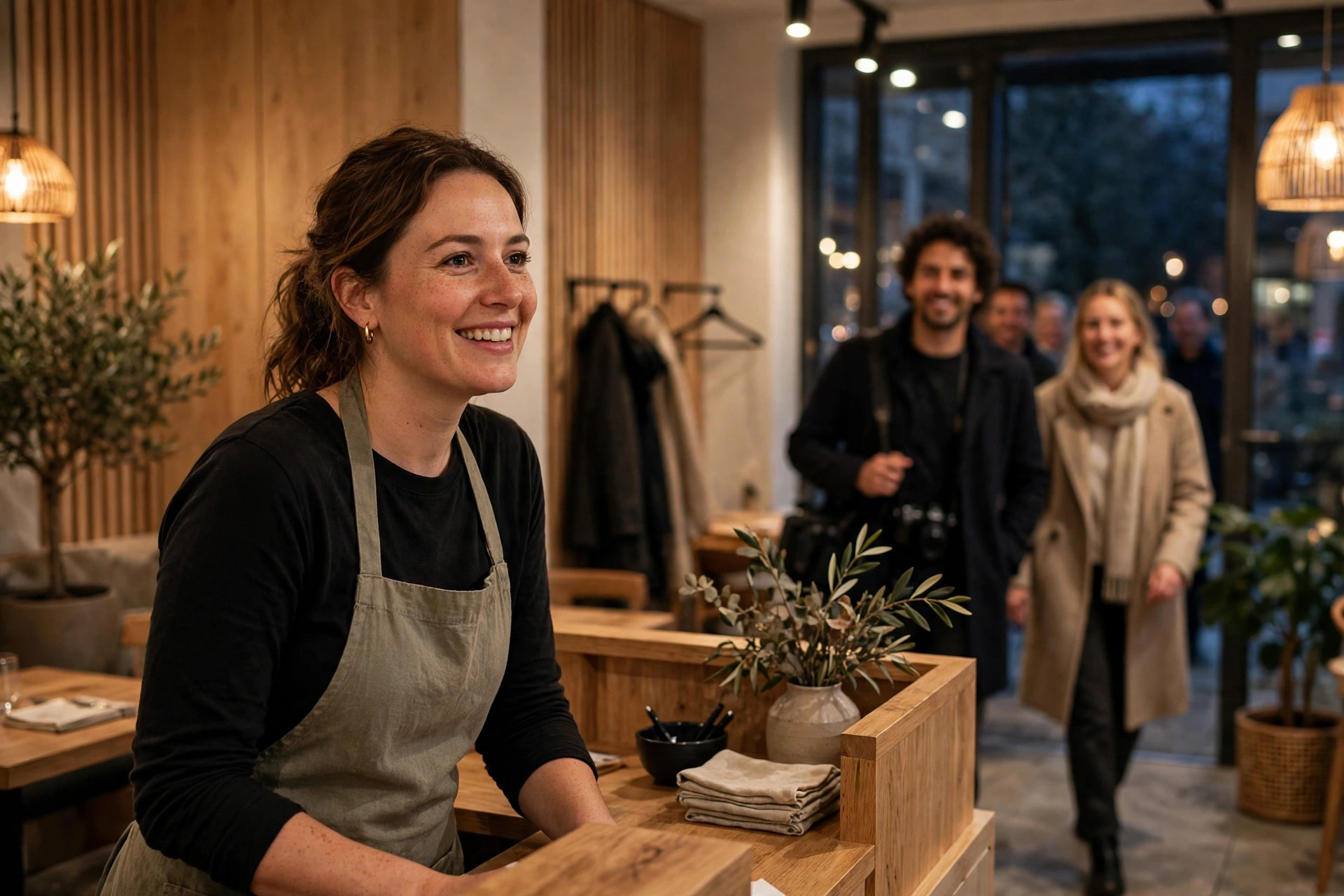
Every field you add to the booking form costs you bookings. Name, phone, email, date, time, party size — that is the whole form. Everything else can wait until after the guest has confirmed.
Mobile: where most bookings actually happen
Over 60% of restaurant bookings now happen on mobile devices, and the share is higher still for younger guests and for same-day bookings — the exact guests a restaurant most wants. Yet most booking flows are still designed on a desktop and merely tolerated on a phone. The result shows up in the segmented numbers: a desktop funnel at 75% and a mobile funnel at 45% is not a demand problem, it is a design problem, and it is the single most common conversion gap we see in Nordic restaurants.
The mobile checklist is short and non-negotiable. Date and time pickers must be thumb-friendly — large tap targets, no fiddly dropdowns, no pinch-zooming. The form must fit the screen without horizontal scrolling, and the keyboard must match the field: numeric for party size and phone number, email keyboard for email. The booking button must stay visible while scrolling, and the confirmation must arrive as a page the guest can screenshot, plus an SMS or email within seconds — a guest who is not sure the booking worked will call, and a guest who calls during service costs staff time twice. Test the whole flow yourself, on your own phone, once a month: book a table for two next Friday, from the street, on 4G. If it takes more than ninety seconds or more than six taps, fix it before you spend anything on marketing.
MobilePay deserves a specific mention, because it changes the deposit question in Finland. Where a card hold feels formal and foreign to a Finnish guest, a MobilePay payment feels ordinary — most Finns use it weekly. If you take deposits for large parties or peak times, offering MobilePay alongside cards removes a real friction point. The same logic applies to the confirmation message: an SMS with the booking details and a one-tap "add to calendar" link is worth more than a beautifully designed email that arrives in the promotions tab.
Availability and alternatives: recovering the "fully booked" guest
The number one reason guests abandon bookings is unclear or limited availability — and the fix is not more tables, it is better alternatives. When a guest asks for Saturday at 19:00 and it is full, a page that says "fully booked" has just ended the conversation. A page that says "19:00 is full — 18:15 and 20:45 are available, or join the waitlist and we will text you if a table opens" keeps it going. Showing the nearest available times automatically recovers 15–30% of guests who would otherwise leave, according to booking-platform data. It is the highest-return fix in this entire article, and for most restaurants it is a setting in the booking system, not a project.
The waitlist is a conversion tool, not an apology
A waitlist turns a rejection into a reservation-in-waiting. The rules are simple: tell the guest their position and what happens next, text them the moment a table opens, and give them a short window to claim it before it passes to the next person. A waitlist that never contacts anyone is worse than no waitlist at all — it collects disappointed people and teaches them not to try again. Used properly, it also feeds the no-show recovery in gate three: when a table cancels, the waitlist fills it within minutes, and the "waitlist fill" row in the benchmark table above tells you whether that is actually happening.
Availability is also a pricing and pacing question. If every Saturday at 19:00 is full and every Saturday at 17:30 is empty, the restaurant does not have a demand problem — it has a distribution problem. An early-bird offer, a shorter table time for the first seating, or a small incentive for off-peak times moves demand into the empty slots. Booking data shows you exactly where the gaps are: look at attempts by requested time, not just confirmed bookings by seated time, and the pattern will be obvious. Guests who tried for 19:00 and left are the clearest signal your booking system produces — and most restaurants never look at them.
A page that says "fully booked" ends the conversation. A page that offers 18:15, 20:45 and a waitlist keeps it going — and recovers 15–30% of the guests who would otherwise have left.
No-shows and deposits: conversion does not end at "confirmed"
A confirmed booking is not a seated guest. No-show rates with phone bookings and a paper book typically run 18–22%; with automated confirmation sequences they fall to 5–8%. That gap is pure revenue: for a 60-seat restaurant with a €45 average spend, cutting no-shows from 18% to 6% on weekend evenings recovers hundreds of euros per night. The arithmetic is why gate three belongs in a conversion article at all — the best booking flow in the world is worthless if a fifth of its output never arrives.
The cheapest fix is reminders. An automated confirmation immediately after booking, a reminder 24–48 hours before, and a same-day nudge with a one-tap confirm-or-cancel link typically cut no-show rates by 20–30%, and the effect is larger when cancelling is as easy as confirming — guests who can cancel in one tap do cancel, early enough for the table to be resold. Our templates for booking confirmations that reduce no-shows give you the wording, and the eight tactics in how to cut no-shows cover the rest.
Deposits and card holds: the stronger tool, used carefully
Deposits and card holds are the stronger medicine, and they should be used where the risk justifies them: large parties, tasting menus, Friday and Saturday peaks, and the Christmas party season. Booking-platform data consistently shows that requiring a card hold makes guests roughly 16% less likely to no-show and 15% less likely to cancel at the last minute, and that deposits cut no-shows by more than half on average. But they also cost funnel conversion — every deposit requirement loses some guests at gate two. The right balance is to apply them narrowly: deposits for parties of six or more and for peak slots, reminders for everything else. State the amount, the deadline and the refund rule before the guest reaches the payment step, and never take a deposit for an ordinary Tuesday table — the friction costs more than the no-shows it prevents. For the commercial detail, see our guide to deposits and gift cards.
The no-show maths
A 60-seat restaurant doing 1.5 turns on weekend evenings with a €45 average spend loses about €810 per night at an 18% no-show rate, and about €270 at 6%. The difference — roughly €540 a night, or over €2,000 a month on Fridays and Saturdays alone — is what automated reminders and a waitlist are worth. The reminder system typically costs a fraction of that, which is why it pays for itself in the first week.
The 30-day improvement plan: measure, fix one thing, measure again
Improvement works when it is sequential: one change, one measurement, then the next change. Changing the form, the availability display and the reminder timing in the same week tells you nothing about which one worked. The plan below runs in three two-week steps, and each step starts from the numbers you measured in section two.
Days 1–14: fix the form and the availability display
Week one is measurement: build the weekly sheet, segment by channel and device, and find your worst gate. In most restaurants that will be the booking form or the availability display. Week two is the fix: cut the form to the six essential fields, remove forced account creation, move extra questions to after confirmation, and turn on automatic alternative times in the booking system. These are configuration changes, not a rebuild — a competent web partner or the booking provider's support team can do them in a day. If your website itself is the problem — slow, or with the booking button buried — that is a bigger conversation, and it is the one our website packages are built around: a free build, plans from €59/mo to €239/mo, with the Restaurant plan including an ordering system.
Days 15–30: reminders, waitlist and the mobile test
Week three is gate three: turn on automated confirmations and reminders, set the waitlist to text guests the moment a table opens, and check that cancelled tables are actually being refilled. Week four is the mobile test: book a table on your own phone, from the street, on 4G, and fix whatever slows you down. Then measure again — same sheet, same definitions, four weeks after you started — and compare. A funnel conversion up five points and a no-show rate down five points is a realistic month, and it is worth more than most marketing campaigns: those guests were already yours, and now they arrive.
Keep the sheet going after day thirty. Booking conversion drifts: a booking-system update changes the form, a new menu page buries the button, a seasonal menu brings a different crowd. The monthly check — five minutes, same sheet — catches the drift before it costs a season. And when the numbers move, write down what changed that week: the note next to the number is what turns a spreadsheet into institutional memory.
Nordic specifics: MobilePay, GDPR and dinner culture
Three Nordic details change how booking conversion works in practice. The first is payments. Finnish guests expect MobilePay, and Swedish and Norwegian guests expect Swish and Vipps respectively; a deposit flow that offers only international cards adds friction for exactly the guests most likely to book. Where your booking provider supports it, offer the local mobile payment option first. The second is data. GDPR applies to every guest record you hold, and booking data is personal data: you need a lawful basis (the booking itself is one), a clear retention rule, and no marketing use of booking emails without consent. Our guide to using booking data for marketing, GDPR-safe covers the practical rules, including how long to keep records and what to do when a guest asks to be deleted.
The third is dinner culture, and it is the one most imported advice gets wrong. Nordic guests eat earlier than southern Europeans — the peak booking slot in Helsinki or Stockholm is 18:00–19:00, not 21:00 — and they book later in the day and closer to the meal: a large share of reservations are same-day, and many are made late at night when the restaurant is closed. That combination is why online booking matters more here, not less: the guest who decides at 23:00 to book lunch tomorrow cannot call anyone, and if your booking flow does not work at 23:00 on a phone, the booking goes to the restaurant whose flow does. It is also why the early-evening slots deserve the most attention in your availability display — the 17:30 and 18:00 tables are where the recovered conversions live.
Seasonality sharpens all of this. Summer terraces and the Christmas party season compress demand into a few weeks, and during those weeks the booking flow is the business: a broken form in December costs more in a week than in a whole quiet February. Test the flow before the season, not during it — the last week of November is too late to discover that the deposit step fails on iPhones. And in the quiet months, the same numbers tell a different story: low conversion in January is usually a demand problem, not a flow problem, and the fix is an offer, not a redesign.
Frequently asked questions
What is a good booking conversion rate for a restaurant?
For online booking widgets, 60–80% of started bookings resulting in a confirmed reservation is a healthy range; phone reservations typically convert at 85–95% because a human can offer alternatives. For website visitors overall, 2–5% completing a booking is realistic. Compare yourself with the same channel and the same definition — mixing definitions is the most common reason benchmarks look wrong.
How do you calculate restaurant booking conversion rate?
There are two useful formulas. Booking-funnel conversion = completed reservations ÷ booking attempts × 100. Website conversion = completed reservations ÷ website visitors × 100. Track both: the first shows whether your booking flow works, the second shows whether your website turns browsers into bookers.
Why do guests abandon online bookings?
The most common reasons are unclear or limited availability with no alternatives offered, too many form fields, forced account creation, a booking flow that breaks on mobile, and surprise requirements such as deposits or card details appearing late. Showing the nearest available times when the requested slot is full recovers 15–30% of guests who would otherwise leave.
Online booking vs phone: which converts better?
Phone converts better per attempt (85–95% vs 60–80% online), but online captures far more attempts — 25–40% of online bookings happen outside staffed hours, and restaurants that rely on phone alone miss 30–40% of potential bookings. The best setup is online as the default channel, with phone kept for VIP guests and complex requests, and every phone booking entered into the same system.
How can I reduce no-shows without deposits?
Automated confirmation and reminder messages — an email or SMS 24–48 hours before the booking, plus a same-day nudge — typically cut no-show rates by 20–30%, and by more when guests can confirm or cancel with one tap. A clear, friendly cancellation policy and a waitlist that refills cancelled tables do the rest. Deposits and card holds are the stronger tool, but reminders alone recover most of the loss.
Want a website that brings table bookings?
PowerfulWebsite builds your restaurant's website for free — you only pay the monthly plan from €59/mo. Everything included: domain, hosting, maintenance and updates. Plans run from €59/mo to €239/mo, with the Restaurant plan including an ordering system, plus a one-time €25 domain handling fee.
See the packages