Delivery Menu Optimisation: Dishes That Survive the Trip
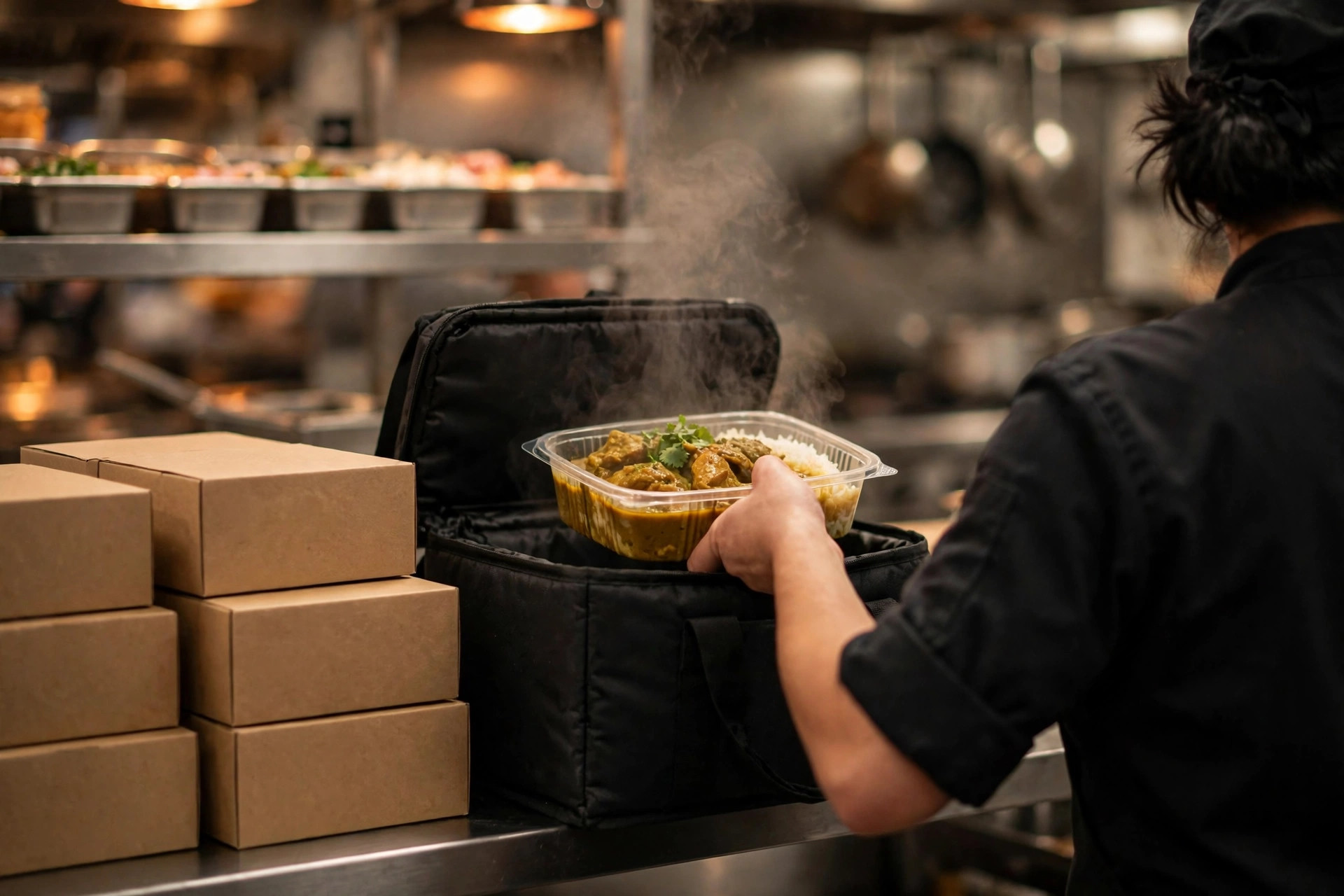
The dishes that make your dining room famous are often the worst dishes to deliver. A delivery menu is not a copy of your dine-in menu — it is a shorter, tougher list of dishes that still taste like themselves after 30 minutes in a bag, and that still make money after the platform takes its cut.
Key takeaways
- Curries, braises, stews, rice dishes, dumplings and baked pasta are the most reliable delivery dishes; delicate fried food, dressed salads and runny eggs are the riskiest.
- Steam is the invisible enemy: it softens fries, crusts and breading within minutes. Venting and separating components are the fixes.
- A delivery menu should have 15–25 items, not 60 — fewer items means faster prep, fewer mistakes and better food.
- At a 25–30% platform commission, delivery prices need to be roughly 33–43% above dine-in prices to protect the same margin.
- Test every dish with the 30-minute test: cook it, pack it, leave it sealed for 30 minutes, then taste it.
- In Nordic winters, heat loss is faster and bags get colder — dense, saucy dishes and good insulated packaging matter even more from November to March.
Every restaurant owner who has moved onto Wolt or Foodora knows the moment. A regular orders their favourite dish for delivery, the courier arrives, the food travels for twenty-five minutes across town — and the customer opens a box that looks nothing like the plate they remember. The sauce has soaked through the breading. The fries have gone limp. The salad is warm and wilted. The customer does not blame the courier, the weather, or the distance. They blame you, and they leave a rating that says so.
Delivery is not your dining room with a longer walk to the table. It is a different product, with different physics, different economics and different expectations — and it needs its own menu. This guide, written for restaurant, café and bar owners in Finland, Sweden, Norway and beyond, covers which dishes travel well and why, which ones to drop or redesign, how packaging really works, how to price so delivery earns money, and how to test every dish before it reaches a customer.
Why Dine-In Dishes Fail on Delivery
A dish that spends twelve minutes on the line behaves very differently after twenty-five to forty minutes in a delivery bag. In the dining room, the journey from pass to table takes seconds and the food is at its peak. On delivery, that same dish is sealed in a container, carried downstairs, loaded onto a bike or into a car, ridden through traffic in rain or minus ten degrees, and then often left on a counter while the customer finds plates. The dish you designed for a thirty-second journey is being asked to survive a thirty-minute one.
Three forces do the damage. The first is heat loss: hot food cools fastest when it is thin, flat or spread out, while dense food holds heat because there is more mass storing thermal energy. A pot of stew stays hot; a plate of tempura does not. The second force is steam. Hot food releases moisture constantly, and a closed lid traps it — that trapped moisture turns crispy coatings soggy and pizza crusts chewy, and it works fast: a breaded dish sealed piping hot can lose its crispness within twenty minutes. The third force is movement. Food slides, sauces slosh and garnishes migrate in a delivery bag, so anything that depends on precise plating arrives as a pile.
Time also changes flavour. Some dishes improve with a short rest — sauces mingle, spices bloom, grains absorb flavour. Others peak the second they leave the kitchen: a poached egg, a medium-rare steak, a soufflé. Carryover cooking makes it worse, as meat keeps cooking in its own heat inside a sealed container, so a steak ordered medium arrives closer to well done. That is physics, not a packaging failure, and no container fixes it.
None of this means delivery food has to be mediocre. It means the menu has to be designed for the journey. The restaurants that do best on Wolt and Foodora are not the ones with the biggest menus or the fanciest dishes. They are the ones whose food arrives looking and tasting like the food they are proud of — because they chose dishes that can make the trip.
The Nordic delivery reality
Nordic conditions make all of this harder. In Helsinki, Stockholm or Oslo, a courier in January rides through snow and wind at minus five or minus ten degrees, and every minute outside pulls heat out of the food faster than the same ride in July. Delivery distances also tend to be longer here than in dense southern European cities, so a thirty-minute delivery is normal, not exceptional. Design for the worst journey, not the best one: if your menu works in February, it will work in June.
The Five-Part Travel Test
Before you decide whether a dish belongs on your delivery menu, run it through five questions — an honest look at the dish and what happens to it between your pass and a customer's table. A dish that passes all five is a safe delivery item; one that fails two or more should be redesigned or dropped.
1. Does it hold heat?
Dense, moist, saucy food holds heat; thin, dry, flat food loses it. A curry in a deep container stays hot because the sauce is a thermal mass, while a grilled chicken breast on its own cools quickly. If the dish is lukewarm after twenty minutes in a bag, it needs a redesign — more sauce, a deeper container, or removal from the menu.
2. Can the crisp part stay separate from the wet part?
Great delivery food is often food that can be packed in pieces. Sauce in a cup. Dressing away from the lettuce. Crisp toppings in a small container. Bread away from the soup. The rule is simple: anything wet and anything crisp must travel apart, or the wet part will win. This is why a burger with the sauce in a separate pot arrives better than a burger that was sauced in the kitchen, and why a salad with dressing on the side is a different product from a dressed salad. Separation is the cheapest quality improvement in delivery, and it costs almost nothing beyond an extra small container.
3. Does it still taste good when it drops from hot to warm?
Some dishes have a wide temperature window: they taste good piping hot, and they still taste good pleasantly warm. Chilli, biryani, dumplings, roasted chicken and baked pasta all pass this test. Others have a narrow window: a poached egg, a delicate tempura, a thin steak cooked to a specific doneness. Those dishes are unforgiving, and a ten-minute delay turns them from excellent to disappointing. A forgiving dish is a good delivery dish. An unforgiving dish belongs in the dining room, where you control the timing.
4. Does it have structure?
Structure is a dish's ability to stay recognisable after being carried. A lasagne square has structure. A braised short rib has structure. A delicate tower of crisp pastry, microgreens and sauce does not. Ask whether the dish still looks like itself after a bumpy bike ride. If the dish depends on height, a drizzle pattern, or a garnish placed with tweezers, it will not survive. Flat, sturdy, self-contained dishes travel; tall, fragile, architectural dishes do not.
5. Can the customer finish it easily at home?
The last test is about the customer's experience. Can the dish be reheated in two minutes if it has cooled? Pizza revives in a skillet, dumplings can be re-steamed, fries improve in an air fryer — though never fully. Delivery food should also be complete in the bag: if the dish needs a component you cannot send, it is not a delivery dish yet.
The travel test, in one line
Hot, dense, saucy, separable and sturdy: if a dish ticks those five boxes, it will probably arrive as good as it left. If it ticks two or fewer, redesign it or keep it dine-in only.
Dishes That Travel Best
The best delivery dishes share the same traits: saucy or moist, dense enough to hold heat, built from separable components, and forgiving about temperature. Here are the categories that consistently perform.
Curries, stews and braises
These are the undisputed champions of delivery. A curry, a beef stew, a braised lamb shank or a chilli con carne travels in its own sauce, which protects it from drying out, keeps it hot, and actually improves as the flavours settle during the ride. If your restaurant serves any kind of braised or slow-cooked dish, it should be the hero of your delivery menu — the same logic applies to tagines, goulash and Nordic meat stews such as Finnish lihakeitto or Swedish kalops.
Rice dishes and grain bowls
Biryani, pilaf, fried rice and rice bowls all hold heat and resist collapse. Rice is dense, absorbs flavour from the sauce around it, and reheats well. Grain bowls work for the same reason, provided the crunchy or fresh elements are packed separately so the hot base does not wilt them.
Dumplings, buns and filled dough
Dumplings are a delivery natural: sealed, holding heat inside a small parcel, easy to re-steam or pan-fry, and not dependent on crispness. The same applies to bao buns with fillings packed separately, empanadas, sturdy samosas and calzones.
Baked pasta and lasagne
Lasagne is sturdier than most other pasta dishes and reheats better than almost anything. Baked pasta — mac and cheese, pasta al forno — holds heat in a dense mass. Plain pasta with a thin sauce is a known problem: the noodles keep absorbing sauce and continue to cook, arriving over-soft with little sauce left. Choose baked or thick-sauce versions, pack the sauce generously, and send the pasta slightly undercooked so it finishes in transit.
Roasted meats and barbecue
Roast chicken, pulled pork, brisket and barbecue all travel well because they are dense, flavourful, and taste good even when they have dropped from hot to warm. Roasted vegetables travel better than sautéed ones for the same reason. Slice meats a little thicker for delivery than you would for dine-in, so they do not dry out.
Soups, pho and ramen
Soups and stews are among the best delivery foods there are: liquid stays hot, does not change consistency, and reheats easily. Pho and ramen work well provided the noodles travel separately from the hot broth — pack them apart with a note telling the customer to combine them. Use containers with a genuinely tight seal: a leak ruins not just the soup but everything else in the bag.
Sturdy sandwiches, wraps and pizza
A well-built sandwich with protected bread — sauce separate, wet fillings contained — travels far better than its reputation suggests. Pizza holds up remarkably well, especially thicker crusts, and is one of the easiest delivery foods to revive at home. The risk is thin-crust pizza over long distances, where the crust goes soft and the cheese congeals — a slightly thicker base and restrained wet toppings serve delivery better.
| Estimated travel time | Best bets | Proceed carefully | Usually skip |
|---|---|---|---|
| Under 15 minutes | Almost anything well packaged | Fries, thin pizza, burgers, dressed salads | Very delicate tempura or runny egg dishes |
| 15–30 minutes | Curries, rice dishes, dumplings, pasta, braises, soups | Pizza, burgers with sauce separate, sturdy sandwiches | Fries, dressed salads, fried seafood, soft eggs |
| Over 30 minutes | Stews, curries, braises, baked pasta, rice bowls | Roasted meats, dumplings, soups with noodles separate | Anything crispy, salads, pizza, fried food |
Use this table as a planning tool. If your typical delivery radius is twenty minutes, the middle row is your menu; if you serve a suburb forty minutes away, the bottom row is the honest one — and it may mean a shorter menu for distant postcodes. Some restaurants on Wolt already do this quietly: the menu a customer sees depends on their distance.
The restaurants that do best on delivery are not the ones with the biggest menus. They are the ones whose food arrives looking and tasting like the food they are proud of.
Dishes to Drop or Redesign
Every menu has dishes that are beloved in the dining room and disastrous in a bag. Keeping them on the delivery menu damages your reputation, one soggy order at a time. Here are the usual suspects, and what to do with each.
Fries and other fried sides
Fries are the most complained-about delivery item in the business: when fried food is covered for delivery, it steams, and the steam destroys the crispness within minutes. The same fate awaits tempura, nachos, fried calamari and onion rings. You have three options: drop them and replace them with a side that travels — roasted potatoes, rice, or a sturdy slaw with dressing separate; keep them but engineer them for travel with thicker cuts, vented packaging and packing them last; or sell them with an honest note explaining that two minutes in a hot oven or air fryer brings them back.
Dressed salads
A dressed leafy salad wilts in a warm, sealed container. The dressing soaks the leaves, the heat softens them, and the salad arrives as a warm, limp version of itself. The fix is component separation: pack the leaves, the protein, the crunchy toppings and the dressing in separate containers, and let the customer assemble. It is more packaging, but it is the difference between a salad and a complaint. Alternatively, choose salads built for travel: grain-based salads, bean salads, roasted vegetable salads and slaws all hold up far better than leafy ones.
Eggs and delicate sauces
Poached eggs, soft-scrambled eggs and hollandaise have a narrow temperature window and cannot be reheated without splitting or overcooking. A brunch dish built around a runny yolk is a dine-in experience, not a delivery one. Build breakfast delivery around dishes that survive: frittata slices, shakshuka, or breakfast bowls with the egg cooked firm.
Fish cooked to a precise doneness
A medium-rare salmon fillet needs to be eaten immediately; left in a hot container it keeps cooking and dries out, and it does not reheat well. Fully cooked fish — fish and chips with vented packaging, baked fish in sauce, fish stew — is a safer bet. When in doubt, keep the delicate fish on the dine-in menu and offer the robust versions for delivery.
Anything that depends on plating
If a dish only works when it is stacked, drizzled or garnished with precision, it will not survive a bike ride. Redesign it flat and sturdy, or drop it. This is not a downgrade — it is a different design brief. The question is not "is this dish beautiful on the plate?" but "is this dish still itself after thirty minutes in a bag?"
A note on food safety
Hot food should stay above 60°C to prevent bacterial growth, and should not spend more than two hours below that threshold. Dense, saucy dishes in insulated bags usually hold above 60°C for 30–45 minutes; thin or crispy items can drop below it much faster. If a dish cools quickly, it is a food-safety risk as well as a quality risk — another reason to choose dishes with thermal mass.
Packaging That Protects Quality
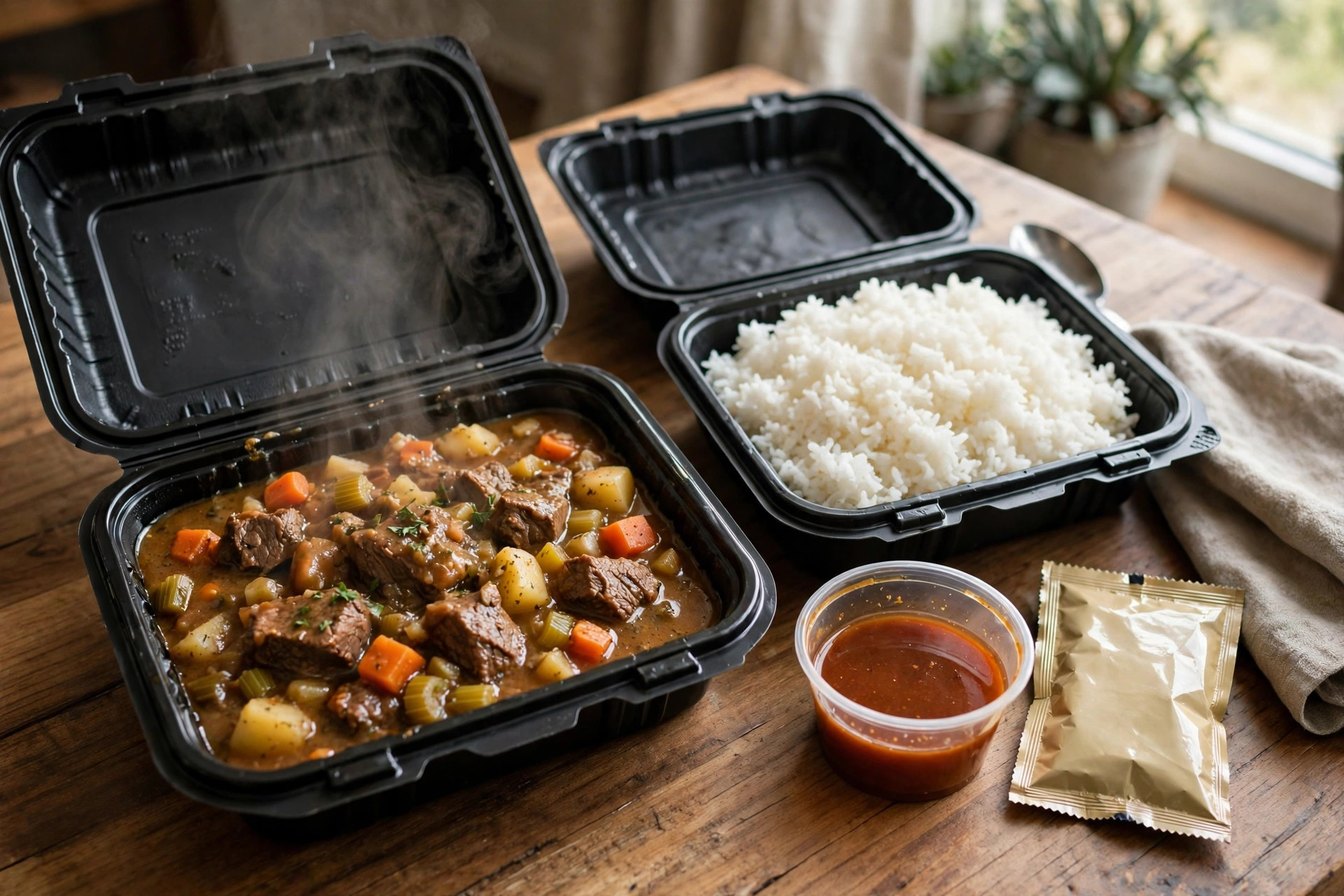
Packaging is not an afterthought: it decides whether your careful cooking arrives as intended or as a soggy mess. Quality containers cost roughly €0.50 to €1.50 extra per order in Nordic wholesale prices — but a single refund or a one-star review costs far more.
Vent hot food, seal cold food
The most important packaging rule is counter-intuitive: hot, crispy food needs air. A sealed lid traps steam, and steam is what kills crispness. Use vented containers for fried food, pizza and anything with a crust or coating. Cold food is the opposite: salads, desserts and cold drinks need a tight seal. Never put hot and cold items in the same bag without separation.
Separate, label, and seal properly
Sauces, broths, dressings and dips travel in their own small containers, always, and hot and cold items go in separate bags. Label every container clearly. Use containers that actually close: a lid that pops open in transit ruins the whole order. Test your containers the way you test your dishes — pack a real order, shake the bag, carry it downstairs, and see what leaks.
Choose materials customers respect
Nordic customers notice packaging, and they notice when it is wasteful or cheap. Sturdy, recyclable or compostable containers signal the same care as the food inside them. Spend the packaging budget where it protects quality: a vented box for the pizza, a leak-proof tub for the soup, a proper seal for the curry. If you use a platform, the courier brings the bag — but the containers are yours, and they are your last chance to protect the food.
Pricing Your Delivery Menu for Profit
A delivery menu that arrives perfectly and loses money on every order is not a success. The economics of delivery are unforgiving, and they are the reason so many restaurants quietly lose money on platforms while their order counts look healthy. The maths is simple, but it has to be done honestly.
Start with the commission. On Wolt and Foodora in the Nordics, the commission is agreed per contract and not published, but industry estimates put it at roughly 25–30% for courier-delivered orders. On top of that come the costs most owners forget: packaging at €0.50–€1.50 per order, VAT charged on the commission, refunds and remakes, and any promotion you fund yourself — a 20% discount costs you a fifth of your revenue to save a fraction of the commission. Our earlier guide to delivery commissions and what they really cost walks through the full calculation; the short version is that the all-in cost of a marketplace order typically lands at 30–40% of the ticket.
That changes the pricing question completely. If you charge your dine-in price on a delivery app, you are making your dine-in margin minus a quarter or a third of the price. To keep the same margin after the commission, the price has to rise by the commission divided by one minus the commission: at 25% commission that means a 33% markup, at 30% a 43% markup. In practice, few restaurants pass the full amount on. A common compromise is a 15–25% delivery markup, accepting a thinner margin, and steering repeat customers towards a direct channel where you keep the full price. Our own-delivery versus platforms comparison shows the break-even point — for many restaurants it arrives sooner than they expect.
| Dine-in | Delivery, same price | Delivery, +25% price | |
|---|---|---|---|
| Price the customer pays | €20.00 | €20.00 | €25.00 |
| Platform commission (30%) | — | −€6.00 | −€7.50 |
| Packaging | — | −€1.00 | −€1.00 |
| Food cost (30%) | −€6.00 | −€6.00 | −€6.00 |
| Contribution left | €14.00 | €7.00 | €10.50 |
The table makes the point plainly: at the same price, a delivery order contributes half what a dine-in order contributes, before labour, rent or utilities are even counted. A 25% markup recovers part of the gap but not all of it. That is why the delivery menu should favour dishes with low food cost and high perceived value — grain bowls, curries, baked pasta, stews — and why it should be short. Every item on the delivery menu has to earn its place twice: once on quality, once on margin. A dish with a 40% food cost that travels badly is a double loss; a dish with a 28% food cost that travels brilliantly is the backbone of the menu.
Two pricing habits are worth adopting. First, price the delivery menu as its own menu, not as a copy of the dine-in prices with a percentage added — and make sure your best-margin dishes are the ones customers see first. Second, review the delivery menu's margins every quarter, the way you review your dine-in menu: ingredient prices move, commission terms change, and a dish that was profitable in spring may not be profitable in autumn.
At the same price, a delivery order contributes about half what a dine-in order contributes. Price the delivery menu as its own menu — not as a copy of the dine-in prices.
The 30-Minute Test: How to Audit Your Menu
The most useful test in delivery costs nothing and takes half an hour. It is the test DoorDash's own merchant guidance recommends, and it is the test every restaurant should run before a dish goes on a platform. Cook the dish exactly as you would for a customer. Pack it exactly as you would for a customer — same container, same bag, same sauce cups. Seal it, leave it on a counter at room temperature for thirty minutes, then open it and taste it honestly. Would you be proud to serve this to a regular? Would you pay full price for it? If the answer is no, the dish is not ready for delivery.
Run the test at your real delivery distance, not your best-case one. If your average delivery is twenty-five minutes, test at thirty. If you serve a suburb that takes forty minutes on a Friday evening, test at forty. Test in winter conditions too, or at least simulate them: leave the bag near a cold draught or outside for a few minutes. The point is to find the failure before the customer does.
How to run the audit across the whole menu
Set aside one quiet afternoon and test your top ten delivery candidates in a single session. For each dish, record appearance on opening, temperature after thirty minutes, and taste, and write down the specific failure — "crust soft", "sauce absorbed", "lukewarm" — because the failure tells you the fix. Most failures have a fix that costs nothing; the dishes that have no fix are the ones to drop.
Repeat the audit twice a year, and every time you change a container, a supplier or a recipe. Packaging changes are a common silent killer: a new, cheaper container that seals tighter can turn a previously fine dish soggy, and you will not know until the reviews tell you. The thirty-minute test is your early warning system. It is also a useful training exercise for the kitchen team — once a cook has tasted a dish after thirty minutes in a bag, they never pack it the same way again.
Listen to the reviews as audit data
Your platform reviews are a free, continuous version of the same test. Read them weekly and tag every quality complaint by dish and failure type: cold, soggy, small portion, missing item, leaked. If the same dish collects the same complaint three times, that is not bad luck — it is a failed dish. Our guide to managing reviews on delivery platforms explains how to turn those complaints into a weekly routine: reviews are not just reputation, they are product data.
Building a Smaller, Smarter Delivery Menu
With the travel test, the dish categories and the pricing maths in hand, the final step is to build the menu itself. The most successful delivery menus are short: typically fifteen to twenty-five items, with six to ten heroes that share core ingredients and can be assembled quickly. A focused menu built this way can keep food costs in the ideal 28–32% range while generating many combinations from a few base components.
Start from your best travellers, not your best sellers
Look at your dine-in best sellers and ask which of them pass the travel test — those are your starting point. Then look for dishes that share ingredients with them: the same braised meat in a stew, a rice bowl and a sandwich; the same sauce across two or three dishes. Shared ingredients mean less waste, faster prep, and fewer stock items.
Design for the kitchen, not just the customer
A delivery menu also has to be fast. During a Friday rush, your kitchen serves the dining room and the delivery apps from the same line. A dish that takes twelve minutes to plate and four containers to pack slows everything down. Choose dishes that can be prepped in advance, assembled in a few minutes, and packed in one or two containers.
Keep the menu alive
A delivery menu is not a document you write once. Review it quarterly: drop the dishes that generate complaints, promote the ones that generate repeat orders, and test new candidates with the thirty-minute test before adding them. Keep the heroes stable — customers return for the dishes they love — but rotate the supporting cast with the seasons.
Finally, remember that the delivery menu is also a marketing tool. Use real photos of the actual packed dish, not the dine-in plating — a customer who sees a beautifully plated dish and receives a sealed container feels misled, even if the food tastes good. And if your restaurant takes direct orders through its own website, use the same disciplined list there: a website with its own ordering system keeps the full price of every order.
Design for the worst journey, not the best one. If your menu works on a cold February evening at a thirty-minute radius, it will work all year.
Delivery is a permanent part of the restaurant business in the Nordics, and it rewards the restaurants that treat it as its own craft. The work is not glamorous — testing dishes in sealed containers, rethinking packaging, repricing a menu, dropping a beloved dish that cannot make the trip — but the reward is real: food that arrives as good as it left, customers who order again, and a delivery channel that contributes instead of draining. Start with the thirty-minute test this week.
Frequently Asked Questions
What foods travel best for delivery?
Saucy braises, curries, stews, rice dishes, dumplings, baked pasta, roasted meats and grain bowls travel best. They hold heat, keep their structure, and often taste better after a short rest. Delicate fried food, dressed salads, thin-crust pizza and runny egg dishes travel worst.
How long can food stay hot during delivery?
In a good insulated bag, dense hot food such as stew, curry or rice typically stays above the 60°C food-safety threshold for 30 to 45 minutes. Thin, flat or crispy items cool much faster, often dropping below serving temperature within 15 to 20 minutes.
Should my delivery menu be different from my dine-in menu?
Yes. A delivery menu should be a shorter, tougher version of your dine-in menu: typically 15 to 25 items that travel well, share ingredients, and survive a 30-minute ride. Copying the full dine-in menu onto Wolt or Foodora is the most common delivery mistake.
How much should I charge on delivery apps compared with dine-in?
To keep the same margin after a 25 to 30% platform commission, delivery prices typically need to be about 33 to 43% higher than dine-in prices. Many restaurants use a smaller markup of 15 to 25% and accept a thinner margin, or move repeat customers to a commission-free direct ordering channel.
Why do my fries always arrive soggy?
Steam is the cause. Hot fries release moisture inside a closed container, and that moisture softens the coating within minutes. Vented packaging, thicker-cut fries, packing them last, and keeping sauces separate all help — but fries remain one of the riskiest delivery items.
How do I test whether a dish works for delivery?
Cook the dish, pack it exactly as you would for a customer, leave it sealed for 30 minutes at room temperature, then open and taste it. If it still looks and tastes like the dish you are proud of, it belongs on the delivery menu. Test at your real delivery distance, not your best-case one.
Want a website that takes commission-free delivery orders?
PowerfulWebsite builds your restaurant website free of build cost — you only pay from €59 a month, or €239 a month for the Restaurant plan with its own ordering system. Everything is included: domain, hosting, maintenance, and updates.
See the packages