Own Delivery vs Platforms: Doing the Math
Own delivery beats food delivery apps once you pass roughly 25–35 deliveries a day in a tight radius; below that, the platforms' commission is usually cheaper than paying a driver to wait. The deciding factor is not the commission percentage alone — it is your volume, your delivery radius, and how many of your orders come from regulars who would order from you anyway.
Key takeaways
- Platform commissions for courier-delivered orders typically run 25–30% of the order subtotal in the Nordics; self-delivery and pickup rates are much lower, around 13–15%.
- Own delivery replaces a percentage cost with mostly fixed costs — driver wages, mileage, insurance and software — so it only wins at steady volume.
- On a €40 order, a 30% commission costs €12 before food, labour or packaging; an in-house driver costs roughly €7–€11 per drop depending on distance and idle time.
- The break-even point for most small restaurants sits around 25–35 deliveries a day; run the formula in this article with your own numbers.
- The hybrid model is the most common answer: platforms for discovery, your own ordering channel for regulars.
- Moving regulars to direct ordering is where the real money is — every repeat order that leaves the app is commission you keep.
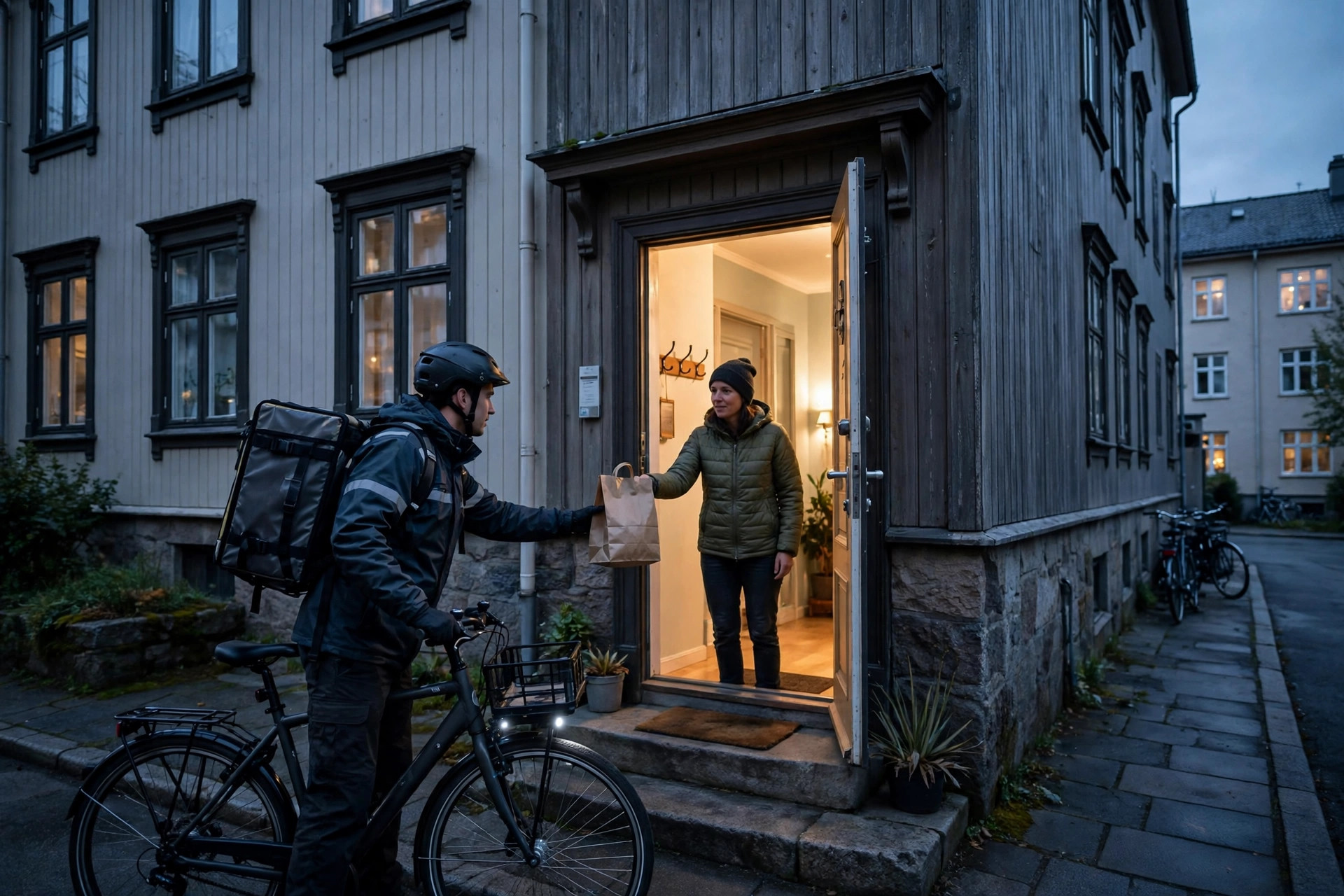
Every restaurant owner who sells through Wolt or Foodora has had the same moment: the payout lands, and it is noticeably smaller than the sales figure on the tablet. The commission is not a surprise — you agreed to it — but month after month it adds up to one of the largest single costs in the business, often bigger than rent per order. So the question comes up naturally: would it be cheaper to deliver the food ourselves?
This article does the maths properly. Not with slogans about "taking back control" and not with platform marketing either, but with the actual cost lines on both sides: commission percentages, driver wages, mileage, insurance, idle time, software fees and packaging. It is written for restaurant, café and bar owners in Finland, Sweden, Norway and Denmark, where Wolt and Foodora dominate, labour costs are high, and distances and weather change the equation. By the end you will be able to calculate your own break-even point, and you will know whether own delivery, platforms, or a mix of both fits your restaurant.
The two costs you are really comparing
The comparison looks simple — a percentage versus a wage — but the two costs behave completely differently, and that difference is the whole story. A platform commission scales perfectly with your sales: busy Friday, big commission bill; dead Tuesday, nothing. Own delivery is the opposite: most of the cost is fixed once you put a driver on the rota, whether they do two drops or twenty.
That means the platforms are cheap insurance against quiet days and expensive on busy ones, while own delivery is expensive insurance against quiet days and cheap on busy ones. Any honest comparison has to be done per order at your actual volume, not in the abstract. A restaurant doing 10 deliveries a day and a restaurant doing 60 are not choosing between the same two options, even if they pay the same commission rate.
Commission is a tax on revenue, not on profit
The first thing to internalise is that commission is charged on the order subtotal — on revenue — before you have paid for a single ingredient. Food cost, rent, wages and packaging all still have to come out of what is left. On a €40 order at 30% commission, the platform takes €12 and you are left with €28 to cover food (typically €10–€13), packaging (€1–€2), labour and everything else. If your food cost is 30%, the order contributes roughly €15–€17 before labour and fixed costs. That is survivable, but it leaves very little room for mistakes: one refund, one remake, one wrong item, and the order loses money.
Own delivery costs, by contrast, are mostly flat per drop. A driver who costs you €9 per delivery costs €9 whether the order is €15 or €60. That flatness is why own delivery gets dramatically better as your average order value rises, and why it gets worse as your radius grows: distance is the one cost that scales with every drop.
The four questions that decide it
Before any numbers, four questions narrow the answer for most restaurants. How many deliveries do you do per day, on an average week, not your best week? How far do your customers live — a dense 2-kilometre radius, or scattered across a whole city? What share of your delivery orders comes from repeat customers who already know you? And do you have staff capacity to absorb driving, or would you need a dedicated hire? If your volume is low, your radius is wide, most orders are first-timers, and you would need a new hire, the platforms are almost certainly the right call for now. If the opposite is true on all four, own delivery deserves a serious calculation.
What the platforms charge in 2026
In the Nordics the two platforms that matter are Wolt and Foodora, with Uber Eats present in Sweden and Denmark. Exact commission rates are set in individual merchant contracts and are not published, so treat every figure here as a typical range, not a quote — and always confirm your own rate before signing. Industry estimates consistently put Wolt's commission for courier-delivered orders at roughly 25–30% of the order subtotal. Foodora operates in a similar band. For a detailed breakdown of what the headline rate does and does not include, see our guide to delivery commissions: what they really cost.
Self-delivery and pickup change the rate
Both major platforms offer a lower rate if you deliver with your own couriers or if the customer picks up. Self-delivery rates are typically around 13–15% — the platform still takes a cut for the order flow and the payment, but you are not paying for their courier network. Pickup-only arrangements can be lower still. This matters because it creates a middle path: keep the platform's storefront and customer traffic, but run the last mile yourself. For restaurants that already have a driver, switching a platform listing to self-delivery is often the cheapest first step, and it requires no new technology.
There are also smaller charges hiding behind the headline rate. Payment processing is usually included in the commission, but promotional placements, discounted delivery campaigns and sponsored positions inside the app are extras, and they are easy to agree to in a busy moment and forget. Payout timing matters too: Wolt offers payouts every two weeks, monthly, or every six days depending on your settings. A two-week payout cycle is a real cash-flow cost for a small business, even though it never appears as a fee.
What the commission actually buys you
It is worth being fair about what you get for 25–30%. You get instant access to an audience of hungry customers who open the app without knowing your name. You get a courier network that scales up on Friday night and down on Tuesday without you hiring anyone. You get payment handling, refunds handling, customer support and a proven ordering flow. For a new restaurant, that is genuinely valuable: building the same reach yourself would take months and real marketing spend. The commission is not a scam; it is a price. The question is only whether it is the right price for orders you could have won anyway.
Paying 30% to reach a customer who has never heard of you can be a good deal. Paying 30% on every order from a regular who lives two streets away is a leak.
The platform comparison in our Wolt vs Foodora comparison for restaurants looks at coverage, fees and features side by side if you are choosing between the two.
What own delivery really costs
Own delivery has five cost lines, and restaurants that forget one of them end up surprised. Get all five into your spreadsheet before you decide.
1. Driver wages and employer costs
This is the biggest line. In Finland, a delivery driver on an hourly wage costs the employer the gross wage plus social contributions — pension, social security, unemployment insurance and accident insurance — which together add roughly 20–25% on top of the gross wage. A €15 hourly wage is therefore closer to €18–€19 per hour in real cost. Sweden, Norway and Denmark have their own contribution structures, but the pattern is the same: budget the fully loaded hourly cost, not the number on the payslip. If you use gig-style couriers paid per drop, the rate per drop replaces the hourly maths, but you still need to cover enough drops per hour to make the shift worthwhile for the courier, or they stop accepting your shifts.
2. Mileage and vehicle costs
Fuel, wear, insurance and depreciation are real even when the driver uses their own car — and if they do, you should be paying a mileage allowance, which in Finland is a tax-free kilometre allowance up to a set annual limit, with rates revised yearly. A typical urban delivery round trip of 4–6 kilometres costs roughly €2–€3 in mileage allowance alone, more if you run a car or van yourself with commercial insurance. E-bikes and mopeds cut this dramatically in dense city centres, which is one reason city-centre restaurants have an easier own-delivery maths than suburban ones. Winter matters too: in Helsinki or Oslo in January, a bicycle courier is slower, colder and more likely to call in sick, and a car costs more per drop.
3. Insurance and liability
Personal car insurance usually excludes business use, so a driver delivering in their own car without the right cover is a risk you are carrying whether you know it or not. Commercial vehicle insurance, or a rider on the driver's policy, costs money and takes admin. You also carry the liability for late, cold or wrong deliveries in a way the platforms absorb for you today: when a platform courier is late, the customer blames the platform; when your driver is late, they blame you. That reputational cost is hard to put in a spreadsheet, but regulars notice it.
4. Ordering software and payment processing
Customers need somewhere to order. A basic online ordering system on your own website costs a flat monthly fee plus card processing of roughly 1.5–3% per transaction, depending on provider and volume. PowerfulWebsite's Restaurant plan, for example, is €239 per month including an ordering system, with the website build free and a one-time €25 domain handling fee — a flat cost that does not grow with order volume, which is exactly the property that makes own delivery attractive at scale. Compare that flat fee with a percentage commission: at €5,000 a month in delivery sales, a 25% commission is €1,250; at €20,000 it is €5,000. The flat fee stays €239 either way.
5. Idle time and management time
Idle time is the cost restaurants most often forget. A driver scheduled for a four-hour dinner shift who does six deliveries has cost you four hours of wages spread over six drops. On a quiet Tuesday that can mean €12–€15 per delivery in labour alone, before mileage. Someone also has to build the rota, handle sick days, brief drivers, answer "where is my food" calls and manage complaints. In a small restaurant that someone is usually you, and your time is not free. Budget at least a few hours a week for delivery management, even with good software.
The cost stack, per delivery
As a rough guide for a Nordic city restaurant: driver labour €5–€9, mileage or vehicle €2–€4, ordering software and payment €1–€2, packaging €1–€2. That puts a realistic own-delivery cost at roughly €9–€17 per drop before management time — and the labour slice collapses as drops per hour rise. Two drops an hour is expensive; five drops an hour is cheap. Density is everything.
A €40 order, three ways
Abstract percentages are hard to feel. Here is the same €40 order — a typical two-person delivery order in the Nordics — run through the three realistic channels, using the typical ranges discussed above. Food cost is held at 30% (€12) and packaging at €1.50 in all three, so the differences are purely about the delivery channel.
| Cost line | Platform, courier-delivered (30%) | Platform, self-delivery (~15%) | Own channel, own driver |
|---|---|---|---|
| Order value | €40.00 | €40.00 | €40.00 |
| Platform commission | −€12.00 | −€6.00 | €0 |
| Payment processing | included | included | −€1.00 (approx. 2.5%) |
| Driver labour + mileage | €0 | −€8.00 (estimate) | −€8.00 (estimate) |
| Food cost (30%) | −€12.00 | −€12.00 | −€12.00 |
| Packaging | −€1.50 | −€1.50 | −€1.50 |
| Left before rent, kitchen labour & fixed costs | €14.50 | €12.50 | €17.50 |
Two things jump out. First, own delivery wins this order by €3 over the full platform rate — but only because we assumed a reasonably efficient €8 delivery cost. If the driver did only two drops that hour, the labour slice doubles and own delivery loses. Second, platform self-delivery looks worst here, because you pay both the commission and the driver. That is not a mistake in the table: self-delivery only makes sense when the platform's reach brings you orders you would not otherwise get, or when it is a stepping stone while you build your direct channel. Paying a commission on top of your own driver cost, for customers who already know you, is the worst of both worlds.
Now run the same order at €20 — a single lunch. The 30% commission is €6, and an €8 delivery cost suddenly eats more than the commission saved. Small tickets favour platforms; large tickets favour own delivery. This is why pizza and family-meal restaurants, with big average orders, were the first to build their own fleets, while single-bowl lunch spots mostly stay on the apps.
Commission scales with the ticket; a driver's cost does not. The bigger your average order, the stronger the case for your own delivery.
The break-even point
Here is the formula that settles it for your restaurant. Work out your fully loaded cost per delivery hour — driver wages including employer contributions, plus vehicle costs — and divide it by the commission you would save per order. The result is the number of deliveries per hour your driver must complete to break even against the platform.
The formula, with an example
Suppose a driver costs you €19 per hour fully loaded, and mileage adds €2.50 per drop. Your average order is €35, and the platform commission you would avoid is 28%, or €9.80 per order. Each delivery therefore saves €9.80 in commission but costs €2.50 in mileage, a net saving of €7.30 per drop. To cover the €19 hourly cost, the driver must complete €19 ÷ €7.30 ≈ 2.6 drops per hour. In a dense neighbourhood with short trips, three drops an hour is realistic at dinner peak; in a spread-out suburb, it may not be. If your driver only manages two drops an hour, own delivery loses money on that shift — and you would have been better off on the platform that night.
Run the same calculation with your numbers, and run it separately for lunch and dinner, weekday and weekend. Most restaurants find that dinner peak passes the break-even easily while weekday lunch does not, which points to a part-time answer: own drivers at dinner, platforms at lunch, or a hybrid where your driver covers the dense core zone and the platforms take the far-flung orders.
Why 25–35 deliveries a day is the usual threshold
The often-quoted threshold of around 25–35 deliveries a day comes from this same maths applied to a typical single-driver dinner shift. A driver working a four-hour evening shift at three drops an hour completes twelve deliveries. Two drivers, or a longer shift plus lunch, gets you into the mid-twenties. Below that, the fixed cost of scheduling a driver dominates; above it, the commission you avoid starts to outweigh the wage bill. Treat the threshold as a starting estimate, not a law: a restaurant with a €60 average order breaks even much earlier than one with a €20 average order, and a restaurant in a dense city centre breaks even earlier than one serving a whole suburb.
Who owns the customer
Cost per order is only half the argument, and arguably the smaller half. The bigger one is customer ownership. When someone orders through an app, the platform owns the relationship: it has the customer's name, address, order history and attention, and it can show them your competitor tomorrow. You get an anonymised order and a payout. You cannot email that customer about your new menu, invite them to a tasting, or offer them a loyalty reward — unless they find you independently.
When someone orders direct, you own all of it. That changes the economics over time in a way a single-order comparison misses. A regular who orders direct twice a month for a year is worth twelve commission-free orders plus whatever you learn from their habits. The same regular on a platform costs you 25–30% twelve times over, and you never learn their name. This is why the hybrid model beats both pure options for most restaurants: the platforms are an acquisition channel, and your direct channel is a retention channel, and they should be measured differently. Acquisition can justify a commission; retention should not pay one.
Data you can actually use
Direct ordering gives you order history you can act on: who orders what, how often, from which neighbourhood, and what they spend. That feeds three things platforms never give you. First, targeted offers — a "we miss you" discount to someone who has not ordered in six weeks costs you a few euros and can win back a regular. Second, menu decisions — if direct customers keep adding the same extra, it belongs on the menu. Third, delivery planning — knowing your real demand by zone and hour lets you schedule drivers efficiently, which feeds back into the break-even maths. None of this requires sophisticated software; a simple ordering system with an exportable order list is enough to start.
The platform's customer list is the platform's asset. Your customer list is your asset. Every order that moves from one list to the other compounds.
The hybrid model
Most restaurants that do this maths end up neither fully on platforms nor fully independent. The hybrid model is simple: stay on Wolt and Foodora for discovery and overflow, and build a direct ordering channel for regulars and for your dense core zone. It sounds like a compromise, but it is actually the structure that matches how customers behave: new customers find you in the app, regulars order from your website.
How to split the two channels
A practical split looks like this. Keep your platform listings live, with your full menu, and let them catch new customers, tourists, and orders outside your core zone. Run your own driver — or a courier-on-demand service — inside a tight radius, say 2–3 kilometres, where drops are fast and cheap. Push direct ordering to everyone who already knows you: in-store signs, your website, your Google Business Profile, your social media, and a card in every delivery bag. Price the direct menu slightly lower than the platform menu, or add a loyalty benefit that only exists direct — both are legitimate, and in Finland, platform price-parity clauses were removed following competition authority action in 2025, so you are free to price channels differently.
Watch the split monthly. A healthy hybrid trend is platform share of delivery falling slowly — from, say, 80% to 60% over a year — while total delivery volume grows. If platform share is not falling, your direct channel is not being promoted hard enough. If total volume is falling, you may have cut platform visibility too aggressively. The goal is not to leave the platforms; it is to stop paying them for customers who are already yours.
Courier-on-demand as a middle step
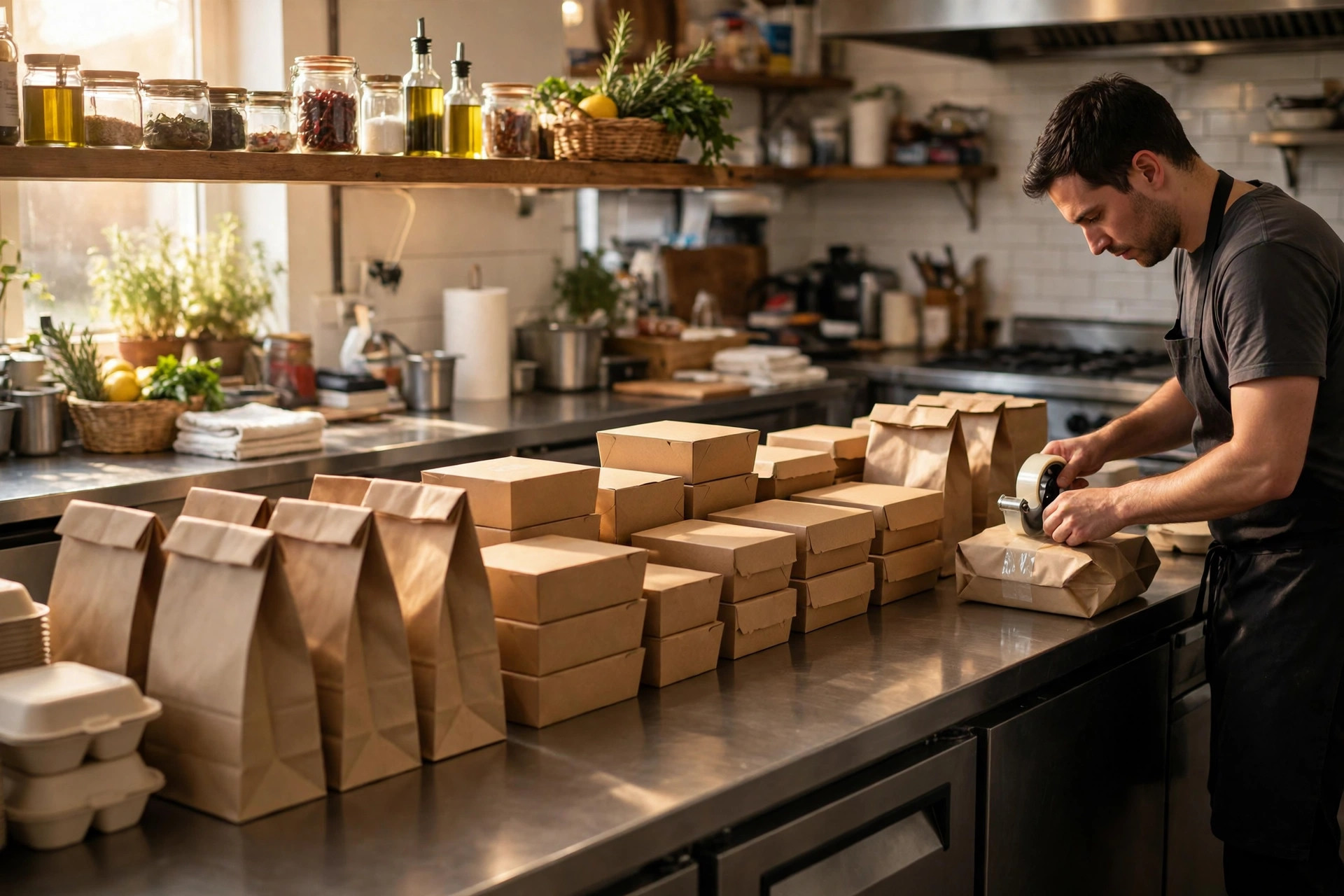
If hiring a driver feels like too big a jump, courier-on-demand services fill the gap. Wolt Drive and similar services let customers order on your website while a platform courier network does the delivery for a flat fee per drop, typically in the €6–€9 range depending on distance. You keep the customer relationship and the menu pricing, and you pay a flat fee instead of a percentage. For many restaurants this is the ideal stepping stone: it proves whether direct ordering works for your customers before you commit to a driver rota. The per-drop fee is higher than an efficient in-house driver, but there is no idle-time cost and no hiring.
How to move regulars to direct ordering
Building a direct channel is pointless if nobody uses it. Customers default to the app because it is easy, familiar and already on their phone. Moving them takes a reason and a reminder, repeated patiently.
Give them a reason, not a lecture
Customers do not switch channels to improve your margins; they switch for their own benefit. The three reasons that work are price, perks and convenience. Price: a direct menu that is a euro or two cheaper per dish, or free delivery over a threshold that the app does not offer. Perks: a stamp card or loyalty discount that only exists on direct orders — every tenth delivery free, for example. Convenience: saved favourites, one-tap reordering of their usual, and a checkout that takes thirty seconds because their address is already saved. One of these is usually enough; all three together are very persuasive.
Remind them at the right moments
The best reminder is physical: a card in every delivery bag, including platform bags, that says where to order direct next time and what they get for it. This is your packaging speaking for you, and it is why your takeaway packaging deserves as much thought as your menu. Other moments work too: a line on the receipt, a sign at the counter for pickup customers, a post on your social channels when the direct channel launches, and a note on your Google Business Profile. Do not rely on a single announcement; customers need to see the direct option three or four times before they try it. And respect the platforms' rules on your listings themselves — promote your direct channel through your own materials, not by steering customers away inside the app.
Make the first direct order effortless
The first direct order is the hardest. Make sure the ordering page loads fast on a phone, the menu is identical to what customers expect, payment works with MobilePay and cards, and the delivery time shown is honest. A customer who tries direct ordering once and waits ninety minutes for cold food will never try again — and will tell friends. It is better to launch direct ordering in a small zone with a realistic time promise than to launch city-wide and disappoint. Early reliability matters more than early reach.
Checklist before you switch
Use this as a go/no-go list before committing to own delivery or a hybrid setup. If you cannot tick most of these, stay on the platforms for now and revisit in six months — the maths may change as your volume grows.
- Volume: you do at least 20–25 deliveries a day, or you can see a credible path to it within a few months.
- Density: most of your delivery customers live within a 3-kilometre radius, or you will limit own delivery to that zone.
- Average order: your average delivery ticket is at least €25–€30, so the commission saved per order is meaningful.
- Regulars: a visible share of your platform orders comes from repeat customers you could convert to direct.
- Staffing: you have a driver solution — an existing staff member with spare hours, a new part-time hire, or a courier-on-demand service.
- Insurance: business driving is covered, whether through your own policy or the driver's.
- Ordering channel: your website takes orders and payments, works on a phone, and shows honest delivery times.
- Packaging: your food travels well for 20–30 minutes — see our takeaway packaging design guide if it does not.
- Backup plan: when your driver is sick or the bike breaks, the platforms are still live to absorb the orders.
And keep the platforms live either way. Even restaurants with a strong direct channel keep a platform listing for discovery, for tourists, and for the nights their own driver cannot cover. Leaving entirely is rarely necessary, and it throws away the one thing platforms are genuinely good at: putting you in front of people who have never heard of you. The goal of doing the maths is not to pick a side. It is to stop paying a percentage for customers who are already yours, and to keep paying it only where it earns its keep.
Frequently asked questions
Is own delivery cheaper than using Wolt or Foodora?
It depends on volume. At steady, dense volume — roughly 25–35 deliveries a day within a small radius — own delivery is usually cheaper per order, because you replace a percentage commission with mostly fixed costs. At low or patchy volume, the platforms are cheaper, because you pay nothing when no orders come in.
How much commission do Wolt and Foodora charge restaurants?
For orders delivered by the platform's couriers, expect roughly 25–30% of the order subtotal; the exact rate is set in your merchant contract and is not published. Self-delivery and pickup orders carry a much lower rate, typically around 13–15%. Always confirm the current rate in your own contract before signing.
How many deliveries a day make own delivery profitable?
As a rule of thumb, around 25–35 deliveries per day within a tight radius is where an in-house driver starts to beat a 25–30% commission. Below that, the fixed cost of a scheduled driver outweighs the commission saved. Run the break-even formula in this article with your own wage, mileage and average order value to get your exact number.
Can I use both platforms and my own delivery at the same time?
Yes — and most restaurants that do the maths end up here. The hybrid model uses platforms for discovery and new customers, while regulars order direct from your own website. You keep the reach of the apps and stop paying a percentage on every repeat order.
What does own delivery cost besides driver wages?
Mileage or vehicle costs, employer social contributions, insurance for business driving, an ordering system and payment processing, packaging, and the management time to schedule drivers and handle complaints. Idle time is the hidden one: a driver on shift with no orders still costs you.
How do I move regular customers from apps to direct ordering?
Make direct ordering cheaper or better: a small price gap between app and direct menus, a loyalty stamp on direct orders, and a card in every platform delivery bag pointing to your own ordering page. Never break platform rules on your listings — promote your direct channel in your own packaging, receipts and in-store materials instead.
Want a website that takes direct orders — commission-free?
PowerfulWebsite builds your restaurant's website free — you pay only from €59/mo. The Restaurant plan (€239/mo) includes an ordering system, so regulars can order direct and you keep every euro. One-time €25 domain handling fee; everything included: domain, hosting, maintenance and updates.
See the packages