Takeaway Packaging Design That Gets Noticed
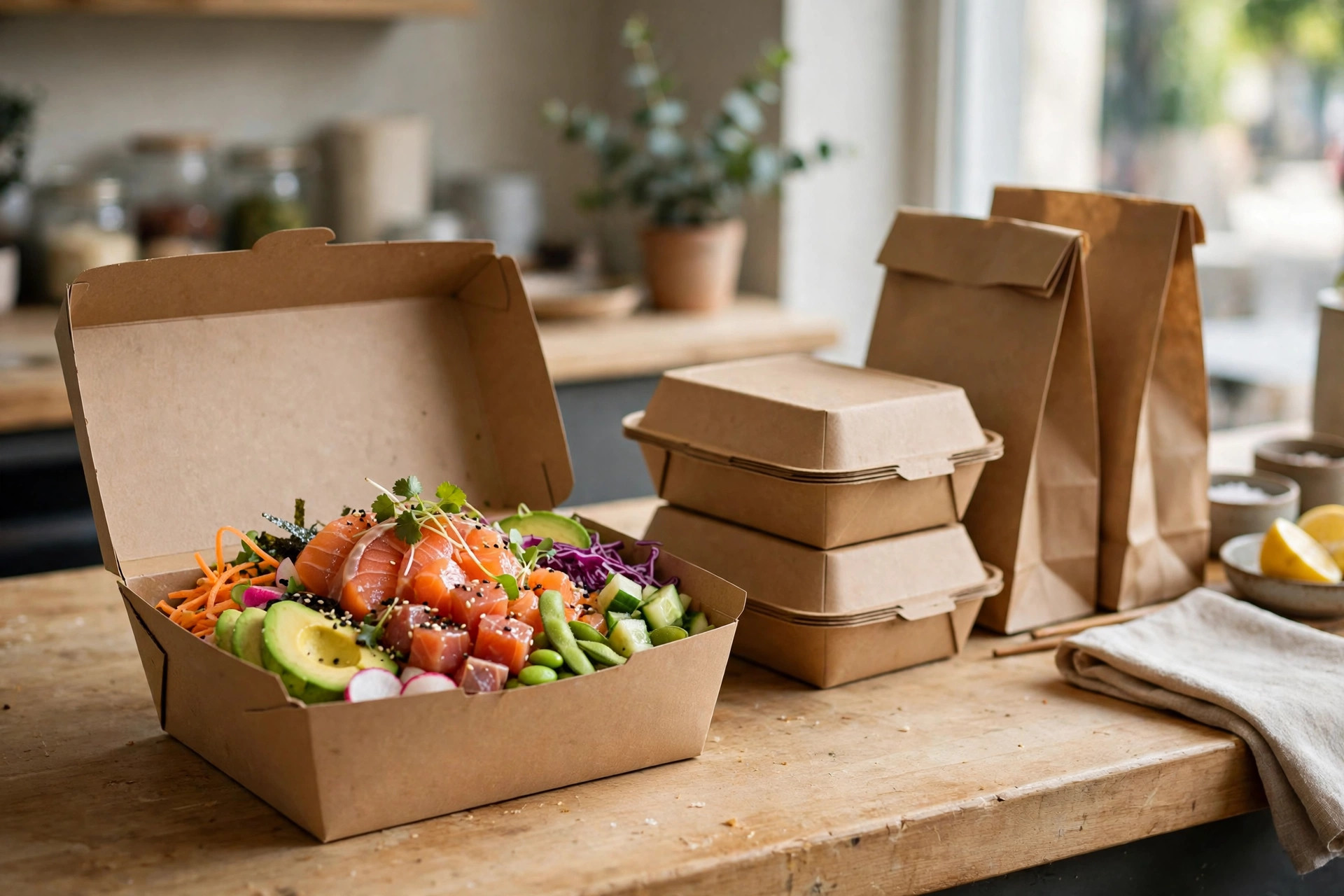
Takeaway packaging gets noticed when it does three jobs at once: it protects the food, it makes the order recognisable in seconds, and it carries your brand into the customer's home. Get the system right — box, bag, label, and one good line of copy — and every delivery becomes free advertising.
Key takeaways
- Packaging is your most-seen marketing surface: every delivery puts your brand in a customer's hands, kitchen, and often their social media.
- "Gets noticed" means recognisable, not loud — one strong colour, one clear logo placement, and consistent design across every item beat a busy design.
- The EU's PPWR regulation applies since August 2026: PFAS limits are already in force, BYO containers become mandatory in 2027, and single-use plastics phase out toward 2030.
- Typical costs (estimates): printed paper bags €0.05–0.15/unit at 1,000+, custom pizza boxes €0.20–0.40 in bulk, bagasse clamshells €0.15–0.30.
- You don't need a full custom print run to look branded — stickers on quality stock containers get most restaurants 80% of the effect at a fraction of the cost.
For a dine-in guest, your restaurant is the room, the music, the plates. For a delivery guest, your restaurant is a box. That box travels through the city with your name on it, sits on someone's kitchen table for twenty minutes, and gets photographed more often than your dining room ever will. Yet most restaurants choose their packaging the way they choose cleaning supplies: whatever the wholesaler has, cheapest per unit, done.
This guide treats takeaway packaging as what it is — a marketing channel you already pay for. You will learn what actually makes packaging get noticed (and what is just noise), what the EU's 2026 packaging rules require of you, what materials cost in honest numbers, how to build a complete packaging system on three different budgets, and how to audit what you use today. It is the physical half of your restaurant brand identity; the words on the box should sound like the words on your website.
Why your packaging is your best advert
Consider what a single delivery order does for you. The courier carries your bag through the street — a moving billboard. The customer opens it at home — a private brand moment with zero competition for attention. If the food photographs well in your box, it may end up on Instagram — earned media you did not pay for. And the box sits in the recycling pile for days, a reminder for the next order. No other marketing you buy works that hard per euro.
Packaging also does quiet commercial work. A sturdy, well-designed box keeps fries crisp and sushi intact, which means fewer "arrived cold/soggy" complaints and fewer refunds. A bag with your logo and a QR code turns a one-time delivery-app order into a direct relationship — the customer scans, lands on your own ordering page, and next time you keep the commission. In a business where delivery platforms take up to 30% per order, a QR code on the bag is not decoration; it is margin recovery.
The industry numbers back up the attention: food service typically spends 8–10% of operating costs on takeaway packaging, and for small independents without bulk-buying power the share is often higher. That is too much money to spend on something you have not designed. If packaging is already one of your biggest line items, it deserves the same thought as your menu.
What "gets noticed" actually means
Most packaging advice confuses "noticed" with "loud." Neon colours, giant logos, jokes on every surface — that gets glanced at, not remembered. What actually gets noticed, in the sense that customers recognise and reorder, is consistency with one strong signal. Here are the design principles that separate memorable packaging from forgettable:
One strong signal, not five
Pick a single recognisable element and repeat it on every item: one brand colour, one pattern, one illustration style, one great tagline. A kraft bag with a single deep-green logo and matching green stickers is more memorable than a full-colour photo print, because the brain files it under one thing. Restraint photographs better, too.
Design for the stack, not the shelf
Your packaging will be seen stacked in a courier's thermal bag, piled on a hallway table, half-open on a sofa. Design for those moments: a logo that reads upside-down, a colour visible from the side of the box, a bag that stands up on its own. The prettiest flat-lay design in the catalogue means nothing if it disappears in a delivery pile.
Function is the design
The most "designed" packaging in the world fails if the lid pops open, the sauce leaks, or the box collapses under a burger. Venting for fried food (steam is the enemy of crispness), grease-resistant lining for anything fried, a real seal for soups, compartments that keep hot and cold apart — these are design decisions, and customers notice their absence immediately. Start every packaging choice with the food, not the logo.
Leave room for the human touch
The packaging that gets photographed most often is not the glossiest — it is the one with a handwritten name, a stamped "made fresh at 18:40," a sticker that says "enjoy!" in the restaurant's voice. Build one blank space into the design for a human mark. It costs nothing and it is the thing people remember.
Say one thing in words
You get one line of copy on the packaging. Make it the line that earns the second order: your website or QR code, a review ask, a "order direct and save" note. Everything else — the story, the values, the manifesto — belongs on the website the QR code points to.
The EU packaging rules, in plain language
Packaging design in Europe is no longer just a branding choice — it is a compliance question. The EU Packaging and Packaging Waste Regulation (PPWR, Regulation 2025/40) has applied since 12 August 2026, replacing the old Packaging Directive with rules that apply directly in every member state. Here is what a restaurant owner actually needs to know:
- Already in force: limits on PFAS ("forever chemicals") in food-contact packaging — there is a de facto ban on intentionally adding them. Ask your supplier for confirmation, in writing, that your boxes, wraps, and bags are PFAS-free.
- Already in force: every packaging type you place on the market needs an EU declaration of conformity from the manufacturer — technical documentation proving it meets the rules. Your supplier should provide this; if they cannot, find one who can.
- From 2027: you must let customers bring their own containers for takeaway food and drinks, at no extra charge. Set your house rules now (clean containers only, sizes you can fill quickly) rather than improvising later.
- Toward 2030: bans on certain single-use plastic formats, minimum recycled content in plastic parts, and an aim for 10% of takeaway to be served in reusable packaging. The direction is unambiguous: less single-use, more reusable, more recyclable.
The practical takeaway: when you redesign your packaging now, design for 2030, not 2024. Choose mono-materials your local recycling actually accepts, avoid plastic-lined "paper" that cannot be recycled in practice, and keep your supplier's conformity documents in a folder. Nordic municipalities are typically ahead of the curve on enforcement — and Nordic customers notice greenwashing faster than most.
Compostable is not automatically the answer
Compostable packaging only works where industrial composting infrastructure exists and food-soiled packaging actually gets collected separately — which is uneven across Nordic municipalities. In many places, a recyclable mono-material container that goes in the normal recycling stream has a better real-world outcome than a compostable one that ends up incinerated. Ask your local waste company what they can process before you pay the compostable premium.
Material choice: the honest comparison
Every material is a trade-off between cost, food performance, and end-of-life. Here is how the common options compare for a typical small restaurant, with cost ranges drawn from current supplier listings — treat them as estimates for budgeting, and always get three quotes for your exact sizes:
| Material | Typical cost per unit (est.) | Best for | Watch out for |
|---|---|---|---|
| Kraft paper boxes & bags | €0.05–0.15 (printed bags, 1,000+ units) | Dry food, burgers, bakery; the classic branded look | Needs grease-resistant or PLA lining for wet/greasy food; PE-lined versions are hard to recycle |
| Bagasse (sugarcane fibre) | €0.15–0.30 (clamshells) | Hot meals, bowls, anything that needs rigidity without plastic | Costs roughly double basic plastic; check it is certified compostable, not just "biodegradable" |
| PLA (plant-based plastic) | €0.10–0.25 (cups, lids) | Cold drinks, salads, clear lids | Not heat-safe; only compostable industrially — useless where that infrastructure is missing |
| rPET / PET | €0.08–0.20 (salad bowls, domes) | Cold food where visibility sells (salads, desserts) | Single-use plastic; fine while legal, but design your exit before 2030 |
| Aluminium containers | €0.10–0.25 | Oven-ready meals, gratins, catering trays | Recyclable but energy-intensive; not microwave-friendly for the customer |
| Reusable (deposit system) | €2–5 per container, reused 20–50 times | Regulars, office lunch routes, dine-in takeaway | Needs a return logistics setup; start with a small pilot, not the whole menu |
Two rules of thumb cut through the complexity. First: mono-material beats multi-material — a plain kraft box recycles cleanly; a kraft box with a plastic window, foil lining, and a sticker does not. Second: match the material to your actual waste stream, not the catalogue's claims. A "recyclable" composite that your municipality cannot process is landfill with better marketing.
On minimum orders: custom-printed bags typically start at 5,000 units, custom boxes at 500–1,000, and printed cups at 1,000+. Lead times run 2–4 weeks for printed items. If those numbers scare you, the budget ladder in the next section is for you — most restaurants should not start with full custom.
The five-piece packaging system
Stop thinking in single items and think in a system. A complete takeaway packaging set for most restaurants has five pieces, each with a job:
1. The food container
The box, bowl, or clamshell the food travels in. Chosen for food performance first: vented for fried food, sealed for soups, rigid for anything stacked. This is where material choice matters most — and where most packaging failures happen.
2. The carry bag
The most visible piece — it is what the courier carries through the street. A sturdy kraft bag with your logo, in your brand colour, does more advertising per euro than anything else on this list. Twisted or flat handles, sized so the containers do not slide around inside.
3. The seal: stickers and labels
A branded sticker that closes the bag does three jobs: tamper evidence (customers trust sealed orders), brand presence, and a surface for the human touch — a handwritten "enjoy!" or the order number. Stickers are also the cheapest way to brand stock containers, which brings us to the budget section.
4. The cup and sleeve
For cafés and drink-heavy concepts, the cup is the container. Double-wall for hot drinks, a sleeve that carries your logo and — critically — does not slide off. Cup sleeves are cheap, high-visibility branding real estate.
5. The insert: napkin, cutlery, and the one line of copy
What goes inside the bag alongside the food: napkins, cutlery (wood or bamboo, not plastic, in 2026), and a small card or the sticker with your one line — the QR code to your ordering page, the review ask, the discount code for the second order. This is the piece most restaurants forget, and it is the piece that earns the repeat order.
Three ways to look branded on any budget
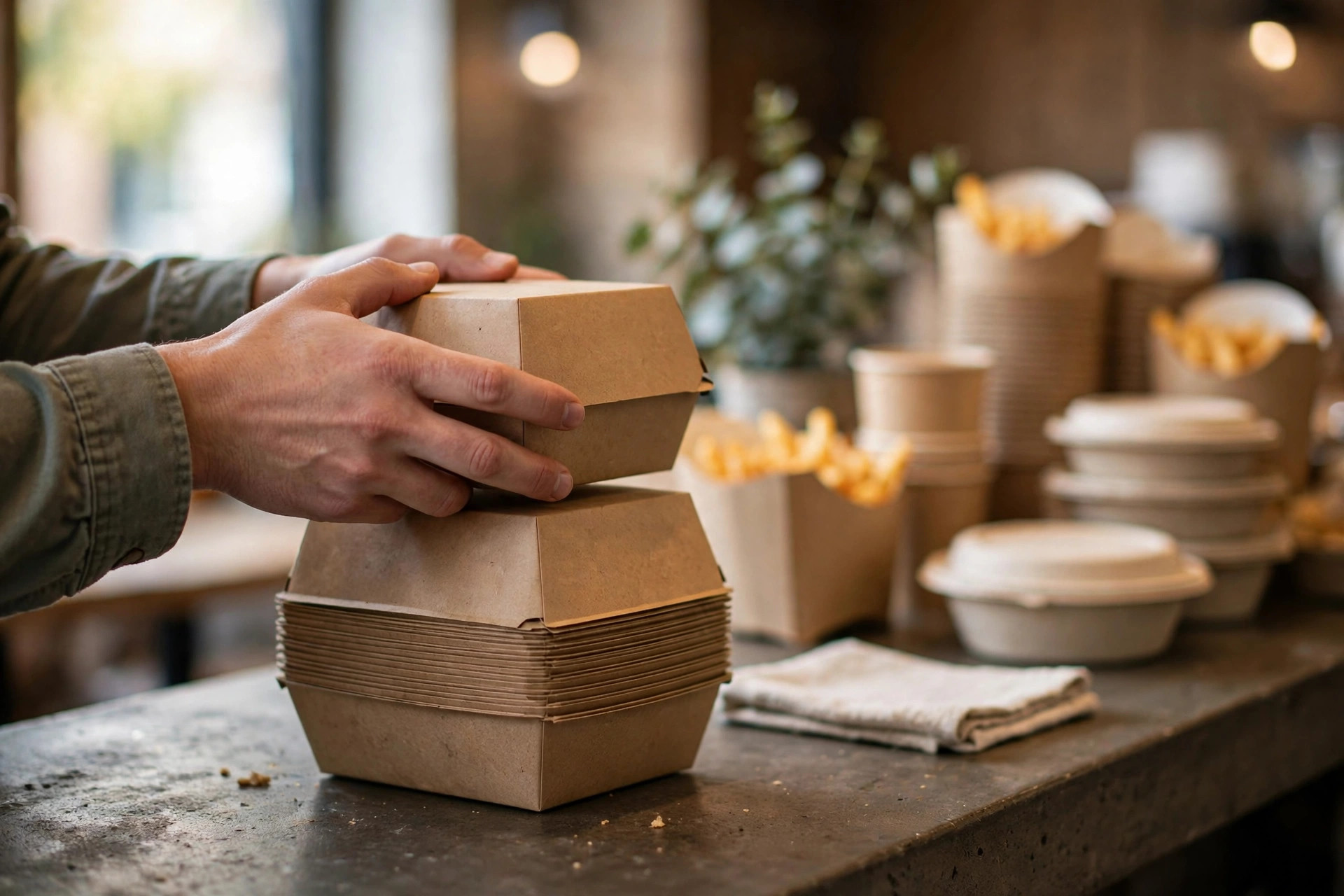
Full custom-printed packaging is beautiful and expensive, with minimum orders in the thousands. Most small restaurants should climb this ladder instead — each rung looks professional, and you only move up when the volume justifies it:
Rung 1: Stock containers + custom stickers (from ~€0.03/order extra)
Buy quality unprinted kraft boxes and bags from a wholesaler, and add professionally printed stickers with your logo — one to seal the bag, one on the box. This gets you roughly 80% of the branded effect for a fraction of the cost, with no minimum-order pain. It is also the fastest route: stickers arrive in days, custom print takes weeks.
Rung 2: One-colour print on kraft (from ~€0.08–0.15/unit at 1,000+)
When you are ordering 1,000+ bags or boxes at a time, a single-colour print (your logo in one brand colour on kraft) is the sweet spot of cost and impact. One colour keeps print costs low, kraft keeps material costs low, and the look — minimal, honest, Nordic — suits most concepts better than full-colour gloss anyway.
Rung 3: Full custom design (from ~€0.50+/unit at 1,000–5,000+)
Full-colour custom boxes, shaped containers, inside print, embossing. Justified when takeaway is a large share of revenue and the packaging is genuinely part of the product experience — premium sushi, dessert concepts, corporate catering. Get structural samples before committing: a beautiful box that does not stack will cost you more in courier complaints than it earns in Instagram posts.
Whichever rung you are on, keep the design system identical — same logo placement, same colour, same sticker. Customers should not be able to tell which rung you bought.
Packaging mistakes that cost you orders
Before redesigning anything, check whether you are making one of these five expensive mistakes:
1. The soggy-box problem
Fried food in a sealed container is a steam chamber. Without venting, fries arrive limp, coatings go soft, and the customer blames the kitchen — not the box. If you sell anything fried for takeaway, vented containers are not optional; they are the difference between a repeat order and a one-star review mentioning "soggy."
2. Leaks and lid failures
Soups, curries, and poke bowls need a real seal — a fitted lid, ideally with an inner seal for delivery. A lid that pops open in a courier's bag ruins the meal, the bag, and the customer's evening. Test every container with a full portion, shaken, before you order 5,000 of them.
3. Over-packaging
A box inside a bag inside another bag, three sauce containers for one portion, cutlery nobody asked for. Over-packaging annoys exactly the customers you want — the environmentally aware ones who order regularly — and it inflates your per-order cost. Pack what the food needs, nothing more, and make cutlery opt-in rather than automatic.
4. The wrong size
One box size for the whole menu means small portions rattle around (and look stingy) while large portions get crushed. Two to three container sizes cover nearly every menu. Oversized packaging also means oversized delivery bags, more storage space, and higher freight costs — size is money at every step.
5. Invisible branding
Plain white boxes, unmarked bags, no website, no QR code — the order arrives, gets eaten, and leaves no trace. The customer who loved it cannot find you again except through the delivery app, where you pay commission on every reorder. One sticker with your name and QR code fixes this for cents per order. Our guide to building an email list the GDPR-safe way shows what to do with the traffic that QR code earns you.
The 6-step packaging audit (do this before you buy anything)
Run this audit on your current packaging before spending a euro on redesign. It takes an hour and usually finds the savings that pay for the upgrade:
- Order your own food. Seriously — order delivery from your restaurant on a busy Friday night. Photograph everything on arrival: the bag, the seals, the food inside. You will see problems no spreadsheet shows.
- Cost it per order. Add up every piece in an average order — box, bag, stickers, cutlery, napkins, sauce containers. Most owners underestimate this by 30–50%. If it is over €1 per order, the redesign conversation pays for itself.
- Check the food performance. For each menu category (fried, sauced, cold, baked), ask: does the container keep it at its best for 30 minutes? Fix the failures before the branding.
- Check the compliance folder. Do you have a declaration of conformity for each packaging type? Written PFAS-free confirmation? If not, request both from your supplier this week — the PPWR already requires them.
- Count the brand surfaces. How many of your five system pieces carry your name? If the answer is zero or one, stickers are your fastest win.
- Write the one line. Decide the single message your packaging carries — QR to your own ordering page, a review ask, a second-order discount — and put it on the bag. This turns packaging from a cost into a channel.
When you talk to suppliers, ask these five questions before discussing price: What is the minimum order for printed vs. unprinted? What is the lead time? Is it PFAS-free, in writing? What is the exact end-of-life — recyclable where, compostable how? And can I get 20 samples to abuse-test with real food? A supplier who hesitates on any of these is telling you something.
And remember the insert's job: that QR code should point somewhere that earns its keep. If it lands on a slow, generic page, you have wasted the best marketing surface you own. A fast site with your menu, your photos, and direct ordering — which is exactly what PowerfulWebsite builds, free to set up from €59/mo, with the Restaurant plan at €239/mo including its own ordering system — turns the bag into a direct-sales channel that pays no commission. Pair it with food photos that actually sell on your delivery listings, and the whole takeaway experience starts working as one system.
Frequently asked questions
How much does custom takeaway packaging cost for a small restaurant?
Expect roughly €0.05–0.15 per printed paper bag at 1,000+ units, €0.20–0.40 per custom pizza box in bulk (500+), and €0.15–0.30 per bagasse clamshell. Full custom-printed boxes start around €0.50–1.50 per unit at 1,000+ units, with minimum orders typically 500–5,000 pieces. These are typical supplier-listing estimates — always get three quotes, because print colours, coatings, and freight move the price.
What is the most eco-friendly takeaway packaging option?
Reusable packaging is the most eco-friendly option — the EU's PPWR regulation pushes exactly in that direction. Among single-use options, mono-material recyclable containers (paper or rPET that local recycling actually accepts) beat compostables in most Nordic municipalities, because industrial composting infrastructure is uneven. Bagasse and FSC-certified kraft paper are solid middle-ground choices; avoid plastic-lined "paper" that can't be recycled in practice.
Does branded takeaway packaging really help win repeat orders?
Branded packaging won't fix bad food, but it does three things plain packaging can't: it makes the order recognisable in a stack of deliveries, it turns the unboxing into a brand moment guests photograph, and it gives you surfaces — the bag, the sticker, the box lid — for a QR code, a review ask, or a discount code that drives the second order. Think of it as your cheapest repeat-business channel.
What do the EU packaging rules mean for my restaurant in 2026?
The EU Packaging and Packaging Waste Regulation (PPWR) has applied since 12 August 2026. For restaurants it already means PFAS limits on food-contact packaging, and from 2027 you must let customers bring their own containers at no extra charge. Single-use plastic formats get banned in stages toward 2030, with a push for 10% of takeaway in reusable packaging. Check that your supplier provides a declaration of conformity for each packaging type.
Should I let customers bring their own containers?
Yes — and from 2027 the EU rules require you to accept them at no extra charge anyway. Set simple house rules now: clean containers only, standard sizes you can fill quickly, no liability for spills from customer containers. Many regulars love it, it cuts your packaging bill, and it's the easiest sustainability win a small restaurant can claim honestly.
Want packaging that drives orders to your own site?
PowerfulWebsite builds your restaurant's website free — you only pay from €59/mo. Everything included: domain, hosting, maintenance and updates, with direct ordering so the QR code on your bag keeps the commission.
See the packages