Takeaway Packaging: A Guide and Supplier Tips
Good takeaway packaging does four jobs at once: it keeps hot food hot and crisp food crisp for 20–30 minutes, it survives a bicycle ride without leaking, it stays inside EU single-use plastics rules, and it makes your restaurant look professional at the customer's door. The way to get all four is to match the container to the dish first, choose the material second, and only then think about branding.
Key takeaways
- Match the container to the dish, not to the catalogue: steam, grease, liquid and weight each demand a different format.
- Expanded polystyrene containers and cups are banned in the EU since July 2021; bagasse and kraft board are the usual replacements.
- Budget roughly 3–6% of takeaway revenue for packaging, and track it monthly as a percentage of sales, not as a lump sum.
- Ventilation is what keeps fried food crisp; a sealed box is the fastest way to serve soggy chips.
- Branding does not need custom printing: a quality kraft bag, a sticker and a card inside can carry the whole look.
- Always test samples with your real dishes — a 30-minute hold test and a leak test — before committing to a supplier.
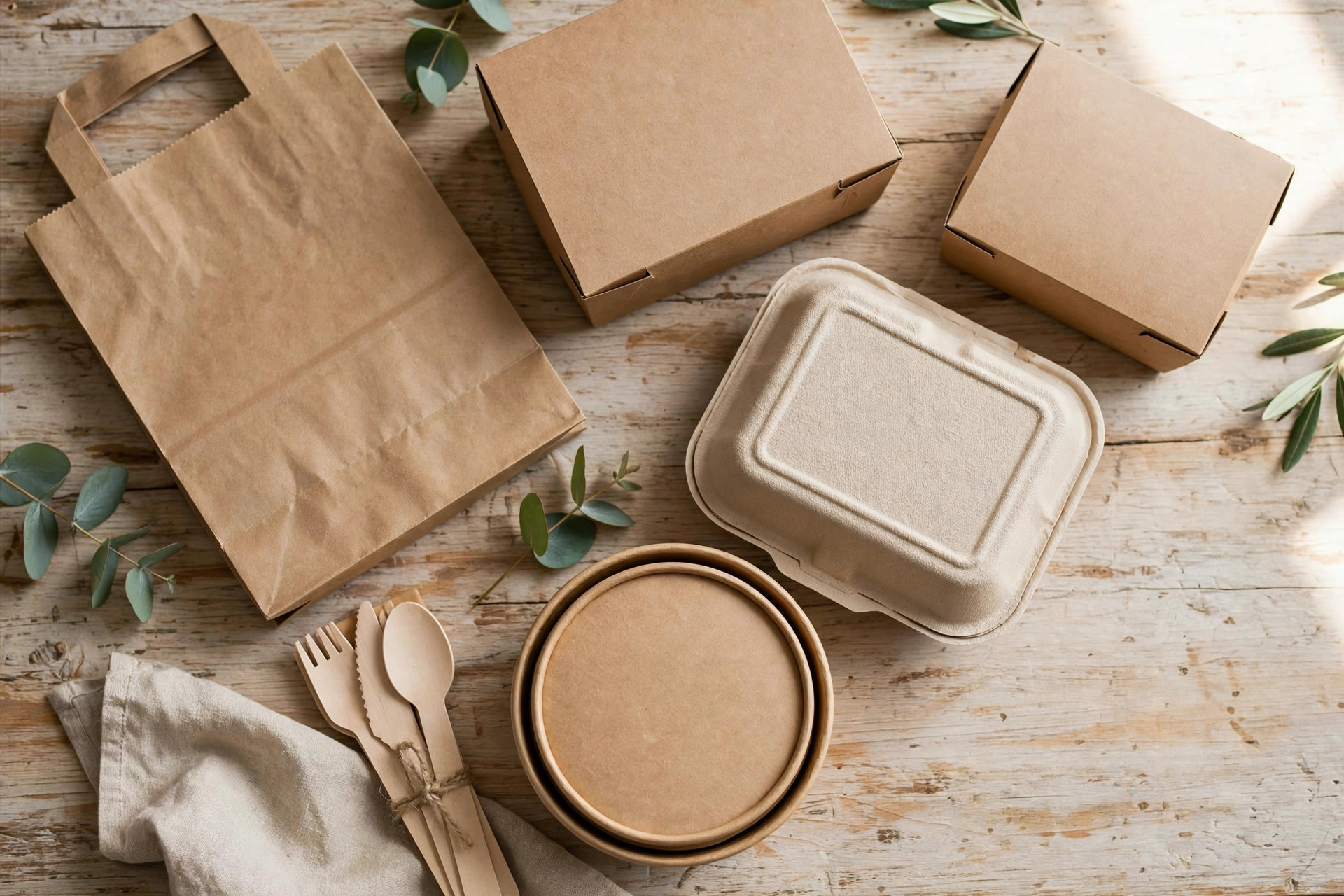
Packaging decisions usually show up when something goes wrong. Chips arrive soft, a curry leaks into the bag, a salad is warm, a branded sticker peels off before the bag reaches the customer. Each of those failures costs more than the few cents a better container would have cost, because the customer does not blame the box — they blame the restaurant. And in delivery, the box is the only part of your restaurant the customer ever touches.
This guide is written for restaurant, café and bar owners in the Nordics who sell takeaway or delivery, whether through Wolt and Foodora, their own ordering channel, or a counter. It covers how to match containers to dishes, what the main materials actually do, the EU rules that constrain your choices, what packaging should cost, how to brand on a small budget, and how to pick a supplier you can rely on. If you are also weighing up delivery channels, read our guide to own delivery vs platforms: doing the math — packaging cost sits inside that calculation too.
What packaging has to do
A takeaway container has a harder job than a plate. A plate holds food for ten minutes in a warm room; a container has to hold it for twenty to thirty minutes in a bag on a bicycle, in rain, in January, stacked under other orders, and then present it as if it had just left the kitchen. Thinking about the job in four parts makes the choice much easier.
Temperature: hot stays hot, cold stays cold
Heat escapes through the lid, the walls and the air gaps, so insulation matters more than thickness alone. A lidded, snug-fitting container keeps a hot dish in the safe, enjoyable zone far longer than a shallow open tray with a loose flap. But insulation has an enemy: steam. Hot food releases moisture continuously, and in a sealed container that moisture condenses on the inside of the lid and rains back onto the food. That is why chips go soggy in a closed box and why salads wilt next to a hot main. The answer is ventilation for crisp food, sealing for wet food, and separation wherever the two meet.
Structure: survive the ride
Delivery bags are stacked, tilted and jostled. A container needs a lid that locks, walls that do not buckle under another order, and a base that stays flat when the food is heavy. Round soup containers need lids that actually seal — press-on lids with a proper rim, or tamper-evident closures — because a soup leak ruins the whole bag, not just the soup. Bags matter too: a flat-bottomed kraft bag with strong handles carries boxes upright, while a thin plastic bag lets everything slide and tip. Test the whole system — container plus bag — not just the container on its own.
Food safety and presentation
Materials in contact with food must be food-safe and suitable for the temperature: a container rated for cold use can warp or leach under a steaming curry. Grease resistance matters for fried and fatty dishes, since oil soaking through a box looks terrible and weakens the board. And presentation is not vanity: customers eat with their eyes first, and a clean, well-fitting container with the food visible through a window or neatly arranged signals care before the first bite. If your food looks good in the box, customers photograph it; if it looks like an accident, they photograph that too.
The customer never sees your kitchen. The box is your kitchen, as far as they are concerned.
Matching the container to the dish
Start from the menu, not the supplier catalogue. List every takeaway dish, group them by what they demand of a container — hot and wet, hot and crisp, cold, liquid, heavy — and assign one format to each group. The goal is a small set of formats that covers the whole menu: fewer sizes means faster packing, fewer stock-outs and better bulk prices.
| Dish type | Best format | Why | Watch out for |
|---|---|---|---|
| Curries, stews, rice dishes | Bagasse clamshell or rigid paper bowl with fitted lid | Handles heat, grease and moisture without softening | Compartment boxes can let sauces mix; test the seal |
| Burgers, wraps, handheld food | Kraft clamshell, vented | Grease-resistant, keeps shape, lets steam escape | Unvented boxes make buns soggy within minutes |
| Fried food: chips, chicken, tempura | Vented fry carton or clamshell with airflow | Ventilation preserves crispness | Never pack fried food under a sealed lid with hot sauces |
| Soups, sauces, dressings | Round container with press-on or tamper-evident lid; small sealed pots for sauces | Leak-proof, stackable | Always bag liquids upright and separate from dry items |
| Salads, poke bowls, cold dishes | Clear-lid bowl or windowed kraft box | Visibility sells the dish; lid keeps it chilled | Keep cold items away from hot mains in the same bag |
| Sushi | Flat tray with clear lid | Presentation matters; pieces must not slide | Needs a flat, rigid base — flimsy trays bend and spill soy sauce |
| Bakery, sandwiches, pastries | Windowed kraft box or sandwich wedge | Shows the product, protects shape | Greaseproof lining for buttery pastries |
| Hot drinks | Double-wall cup with sip lid and sleeve | Insulation and a secure lid for transport | Single-wall cups need sleeves and still cool fast |
Two practical rules follow from the table. First, sauces and dressings always travel separately, in small sealed pots — a salad drowned in dressing during a twenty-minute ride is a complaint, not a meal. Second, never put hot and cold items in the same sealed compartment: pack them in separate containers inside the bag, and use a bag with enough structure to keep them apart. These two rules alone prevent most of the "food arrived ruined" complaints that restaurants blame on the courier.
The "one bag, one system" principle
Design the bag as a system, not a collection of boxes. A typical delivery bag should contain: the main container, a sealed sauce pot, cutlery in a paper wrap, a napkin, and your card or sticker. Everything has a place, the packer follows the same sequence every time, and the bag closes neatly. When packing becomes a system, it becomes fast — and during a Friday rush, packing speed is as important as packing quality. Time your packing during a test run: if a standard order takes more than ninety seconds to pack, simplify the format set.
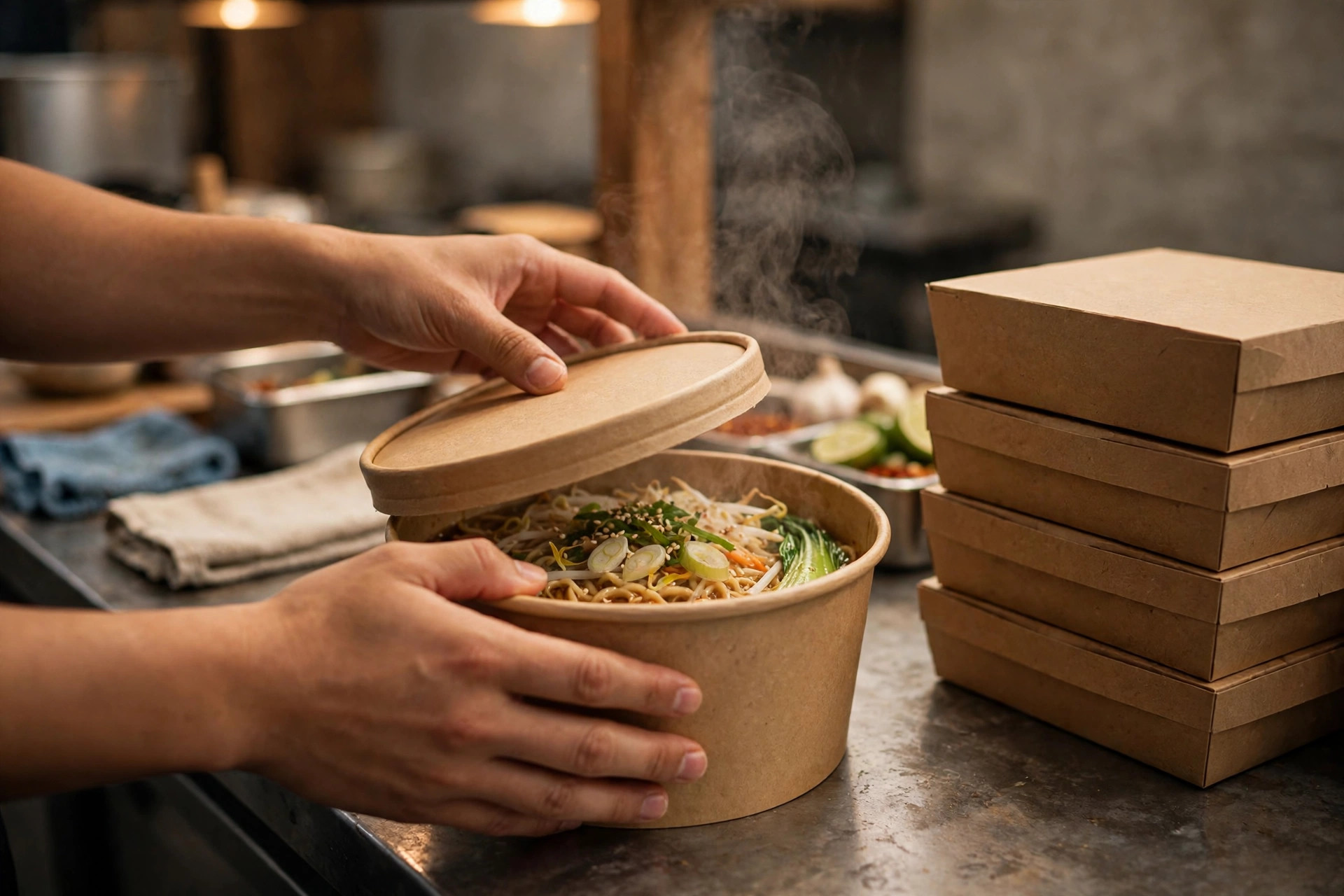
Materials compared
Five materials dominate restaurant takeaway supply in Europe. Each has a real job; none is best at everything. Prices below are typical per-unit ranges for case quantities in the Nordics, labelled as estimates — your supplier's quote is what counts.
Kraft paperboard
Kraft board is the workhorse: meal boxes, clamshells, sandwich wedges, bowls and carry bags. It looks natural and premium, prints well, is widely recyclable, and covers most dishes at a modest price — roughly €0.15–€0.60 per unit depending on size and format. Its weakness is liquid and prolonged heat: uncoated board softens under very wet dishes, so for curries and soups choose board with a suitable lining, or switch to bagasse. FSC-certified board is widely available and worth specifying, since customers increasingly notice it.
Bagasse (sugarcane fibre)
Bagasse is the fibre left after sugarcane juice extraction, moulded into rigid clamshells, plates and bowls. It is naturally grease- and moisture-resistant without a plastic lining, stays rigid under a full hot portion, and is usually industrially compostable. It is the closest like-for-like replacement for the old polystyrene tray, and it suits hot, wet dishes better than any paper option. Expect roughly €0.15–€0.40 per unit for standard sizes. Look for PFAS-free products, as EU rules on fluorinated coatings are tightening.
Polypropylene (PP) and other rigid plastics
PP containers are microwave-safe, crack-resistant and excellent for reheatable meals and heavy, saucy dishes, and they give a clean, professional look for grab-and-go. They are reusable in principle, though most customers treat them as disposable. Their downside is the obvious one: plastic, with all the customer perception and regulatory attention that brings. Use PP where its performance genuinely matters — soups, reheatable meal prep, liquid-heavy dishes — not as a default. Typical cost is roughly €0.10–€0.35 per unit.
Aluminium foil pans
Aluminium pans are oven-safe, recyclable and ideal for hot entrées, casseroles and family-size portions, with lids available in board or foil. They handle high heat better than any fibre option and are cheap — often under €0.20 per unit. Their weakness is presentation: a foil pan looks functional rather than premium, so they suit catering and family meals better than a single plated dish. They also dent, so they need a carry bag with structure.
PLA and other bioplastics
PLA (polylactic acid) looks and feels like conventional clear plastic and is used for cold cups, salad lids and clear containers. It is industrially compostable, not home-compostable, and it softens at high temperatures, so it is a cold-use material only. Treat "bioplastic" claims carefully: a PLA cup is only compostable where industrial composting accepts it, and in many Nordic waste systems it currently goes to incineration or general waste. Buy PLA for a genuine functional reason — clarity for cold drinks and salads — not as a green badge.
The label checklist
Before you trust any sustainability claim, ask for the specification sheet and check four things: the material and any coating; the food-contact approval; the end-of-life claim (recyclable, industrially compostable to EN 13432, or home-compostable) and what that means in your municipality; and whether the product is PFAS-free. If a supplier cannot produce the sheet, treat the claim as marketing.
The EU rules you cannot ignore
Packaging choice in Europe is not just a commercial decision; it is a regulated one, and the rules have already changed once in ways that caught restaurants out. Knowing the current position saves you from buying stock you cannot legally use.
The Single-Use Plastics Directive
Under the EU Single-Use Plastics Directive, in force since July 2021, expanded polystyrene food containers and cups, plastic cutlery, plates, stirrers and straws may no longer be placed on the market. This is a market restriction, not a levy: you cannot absorb the cost and carry on using them. If you still have polystyrene stock in the back room, it is a compliance risk and cash tied up in boxes you cannot use — replace it with bagasse, kraft board or another compliant format. The same directive also requires caps to stay attached to beverage bottles and sets collection targets, which mostly affect suppliers rather than restaurants, but the direction of travel is clear.
What is coming: packaging and packaging waste rules
The EU's newer Packaging and Packaging Waste Regulation tightens the screws further over the coming years: more recyclability requirements, labelling rules, and restrictions on certain formats and substances, including PFAS in food-contact packaging. National implementation varies — Finland, Sweden, Norway (through the EEA agreement) and Denmark transpose EU rules on their own timetables and add national measures such as producer-responsibility fees. The practical advice is to buy from suppliers who track the regulation for you and can confirm, in writing, that each product complies in your market. A supplier who cannot answer a regulation question is a supplier to replace.
Food-contact safety
Separately from plastics rules, all food-contact materials must comply with EU framework rules: they must not transfer substances into food in harmful quantities or change its taste or smell. In practice this means buying food-grade products from established suppliers, not the cheapest unbranded import you find online, and checking that the product is rated for your use — hot fill, microwave, freezer, or cold only. Keep supplier specification sheets on file; if a food-safety inspector ever asks, that file is your answer.
Regulation is not going to get looser. Buy formats that will still be legal in three years, not just this year.
What packaging costs per order
Packaging is one of those costs that feels small per order and grows quietly into a real number. Industry guidance suggests budgeting roughly 3–6% of takeaway revenue for disposable packaging supplies. On €10,000 a month of takeaway sales, that is €300–€600 a month. If you are spending far above that, something is wrong: too many container sizes, over-portioning of extras, or a supplier price that crept up unnoticed.
Counting the full order, not just the box
Cost the whole bag, not the headline container. A typical delivery order's packaging stack looks like this: main container €0.20–€0.50, sauce pot €0.05–€0.10, carry bag €0.15–€0.35, cutlery set €0.05–€0.15, napkin €0.02–€0.05, sticker or label €0.03–€0.08. That puts a realistic all-in cost at roughly €0.50–€1.20 per order, before any custom printing. On a €25 order that is 2–5% — inside the guidance band, but only just, which is why extras matter: every free extra sauce pot, every double-bagged order, every oversized box for a small dish pushes the percentage up. Audit the extras quarterly. Restaurants are often surprised how many sauce pots leave the building for free.
Where the savings actually are
Three levers move packaging cost more than haggling over a cent per box. First, reduce the number of formats: every size you stock is a separate case to buy, store and manage, and slow-moving sizes tie up cash. A menu that fits five formats will almost always beat a menu that needs twelve. Second, buy by the case from one or two suppliers rather than in dribs and drabs from many; case pricing is typically 20–40% cheaper per unit than small packs. Third, standardise the packing sequence so staff stop improvising — improvisation means double bags, extra napkins and wrong-size boxes, all of which cost money without the customer noticing any benefit. Price negotiation comes fourth, not first.
Branding without blowing the budget
Custom-printed packaging looks wonderful and costs accordingly: print runs, plate charges, minimum orders in the thousands, and storage for all of it. For most independent restaurants, there is a cheaper route to the same effect, and customers barely notice the difference.
The three-piece branding kit
A quality unprinted kraft bag, a custom sticker with your logo and website, and a small card inside the bag will carry your whole brand. The sticker closes the bag and puts your logo in the customer's hand; the card is where the marketing lives — a thank-you, a discount for direct ordering next time, or a QR code to your menu. This kit costs a few cents per order, needs no minimum print run, and can be changed whenever you want. It also turns your packaging into a direct-ordering channel: if you are building commission-free ordering alongside platform sales, the card in the bag is the cheapest way to move a regular from the app to your own website, as we explain in our guide to own delivery vs platforms.
When custom printing is worth it
Custom printing earns its keep when volume is high and the format is stable — typically several hundred orders a week of the same box or bag, with artwork you will not change for a year. At that point the per-unit premium over unprinted stock shrinks, and the consistency across every order is genuinely valuable. Before committing, ask for a printed sample on the actual material, check the colours in daylight, and confirm the minimum reorder quantity and lead time. A beautiful printed box that takes six weeks to reorder is a liability, not an asset. And keep one rule: never print anything on packaging that could go out of date — no prices, no phone numbers you might change, no offers with an expiry date. Print the brand, not the details; put details on the sticker or card you can swap.
Print the brand, not the details. A logo lasts for years; a phone number or a price might not last the season.
Choosing a supplier
Restaurants need more than a printer or a warehouse. You need a supplier who understands how packaging is used, keeps quality consistent across batches, and can restock you at short notice. Here is how to choose one properly.
Shortlist, sample, test — in that order
Start with two or three suppliers, not ten: in the Nordics, the practical options are national foodservice wholesalers, specialist packaging suppliers, and cash-and-carry outlets for emergencies. Ask each for samples of every format you plan to use — a reputable supplier sends samples free or cheaply — and test them with your real dishes, not with water. A box that holds water fine can still fail under a greasy curry, because grease attacks board differently from water. Compare on four things, in this order: performance in your tests, unit price per case, minimum order quantity, and delivery lead time. A supplier who is 5% cheaper but delivers in ten days instead of two will cost you a weekend of sales eventually.
Questions to ask before you commit
- Can you hold buffer stock for my top formats, or guarantee a restock within 48 hours?
- What are the case sizes and minimum orders — and what happens to the price if I order half a case?
- Do you provide specification sheets with food-contact approval, material, coating and end-of-life claims?
- Are your products PFAS-free, and can you confirm EU single-use plastics compliance in writing?
- What is the lead time for custom-printed items, and what is the minimum reorder?
- Who do I call when a delivery is short or a batch is faulty — and what is the replacement policy?
- Can you consolidate my whole packaging order into one delivery, so I am not managing five suppliers?
Also agree on a backup: a second supplier or a cash-and-carry source for your top two formats, so a single stock-out never stops your takeaway service. And review the relationship twice a year. Packaging prices move with paper and energy markets, and a supplier who was cheapest eighteen months ago may not be cheapest now — but do not switch on price alone if the current supplier's quality and reliability are proven. A failed batch during a busy weekend costs far more than a few cents per box.
The packing-station workflow
Good packaging fails if the packing station is chaos. During a rush, staff pack fast, and fast packing with a bad layout means wrong boxes, missing cutlery and lids that do not close. A little station design prevents most of it.
Layout: everything within reach, in order
Arrange the station in packing sequence: containers on the left, lids next to them, sauce pots and cutlery after, bags and stickers last. Label the shelves with the dish groups, not the product codes — "curry bowls" beats "BG-850" at 7pm on a Friday. Keep the station stocked before the rush, not during it, and assign one person to packing during peak if volume justifies it. Splitting packing from cooking is one of the highest-return changes a busy takeaway kitchen can make: the cook stops breaking flow to fold boxes, and the packer builds speed through repetition.
Quality check: the ten-second rule
Before a bag closes, the packer spends ten seconds checking: right dishes, lids fully closed, sauces included, cutlery and napkins in, bag upright and sealed with the sticker. That ten seconds prevents the most expensive kind of complaint — the missing item — which costs a refund, a remake, a courier trip and a review. Some restaurants add a simple checklist card at the station for the first month after a format change; it feels unnecessary until it catches three mistakes in a week. And when a complaint does come in about packaging, log it: three leaks of the same format is a signal to change the format, not to blame the packer.
Testing before you commit
Never roll a new format out across the whole menu on the strength of a catalogue photo. Two simple tests, done in your own kitchen, will tell you almost everything you need to know.
The 30-minute hold test
Pack the dish exactly as you would for delivery, put it in your delivery bag, and leave it for thirty minutes — the realistic worst case for a local delivery. Then open it and judge honestly: temperature, texture, condensation, and whether anything has leaked or softened. Do this for your five best-selling takeaway dishes with every candidate format. A format that passes for a salad may fail for a curry, and you want to learn that in the kitchen, not from a customer review.
The ride test
Put the packed bag on a bicycle or in a car, ride your actual delivery radius, and open it at the other end. This catches the failures the hold test misses: lids that pop under vibration, boxes that buckle when stacked, bags whose handles tear under a heavy order. Do it once per new format, and again whenever you change bag supplier — bags fail more often than boxes, and they are the cheapest part of the system, so they get the least attention. If you deliver by bicycle in winter, do the ride test in winter: cold stiffens board and plastic, and a lid that seals in summer may not seal at −10°C.
Packaging is not the most glamorous part of running a restaurant, but it is the part your delivery customers judge you by, every single order. Get the dish-to-container match right, stay inside the rules, keep the format set small, and test before you commit — and the box stops being a cost to minimise and starts being an asset that brings customers back. If you want help turning that repeat business into direct orders, PowerfulWebsite builds restaurant websites free — you pay only the monthly plan, from €59/mo, with ordering included on the Restaurant plan at €239/mo.
Frequently asked questions
What is the best takeaway packaging material for hot food?
For hot, wet dishes, moulded bagasse (sugarcane fibre) and rigid paperboard bowls with fitted lids are the most reliable: they hold heat, resist grease and moisture, and do not soften under a full portion. For burgers and handheld food, kraft clamshells with ventilation work best, because trapped steam is what makes fried food go soggy.
Is polystyrene packaging banned for restaurants in the EU?
Yes. Under the EU Single-Use Plastics Directive, expanded polystyrene food containers and cups, along with plastic cutlery, plates and straws, may no longer be placed on the market since July 2021. Any remaining polystyrene stock is a compliance risk — replace it with bagasse, kraft board or another compliant format.
How much should a restaurant spend on takeaway packaging?
Industry guidance suggests budgeting roughly 3–6% of takeaway revenue for disposable packaging. Track it monthly as a percentage of takeaway sales, not as a lump sum: a rising percentage usually means over-portioning, too many container sizes, or a supplier price increase you have not noticed.
What does EN 13432 mean on packaging?
EN 13432 is the European standard for packaging that breaks down in industrial composting facilities. It is not the same as home composting, and a product that is industrially compostable may not break down in a garden compost heap. Ask your supplier for the specification sheet, and check what your local waste system actually accepts.
How do I choose a takeaway packaging supplier?
Shortlist two or three suppliers, order samples of every format you plan to use, and test them with your real dishes before committing. Compare unit price per case, minimum order quantities, delivery lead times, and whether they can hold buffer stock for you. A supplier who cannot restock you before a busy weekend is the wrong supplier, whatever their prices.
Can branded packaging really win repeat orders?
Packaging alone will not win a customer back — the food does that. But branded, well-chosen packaging turns every delivery into a reminder of your restaurant, and a card or sticker inside the bag is the cheapest direct-marketing channel you own. If you are building direct ordering alongside platform sales, your packaging is where the two channels meet.
Want a website that turns takeaway customers into regulars?
PowerfulWebsite builds your restaurant's website free — you pay only from €59/mo. The Restaurant plan (€239/mo) includes an ordering system, so customers order direct and you keep every euro. One-time €25 domain handling fee; everything included: domain, hosting, maintenance and updates.
See the packages