Food Photographer Cost: Hiring Guide for Restaurants
Hiring a food photographer in 2026 costs roughly €400–€900 for a half-day menu shoot covering 10–20 dishes, or roughly €40–€120 per finished image — before VAT. The number swings on the pricing model, the styling, and how many dishes you shoot, which is exactly why a proper brief is the best money-saving tool in this whole article.
Key takeaways
- A half-day menu shoot in the Nordics typically costs roughly €400–€900; a full production day with styling runs €1,000–€2,000 (estimates, before VAT).
- Photographers price per image, per hour, per half/full day, or as a package — per image suits small updates, packages suit full menus.
- The usage licence for your menu, website, delivery apps and social media is usually included; paid advertising licences are the classic hidden extra.
- A written shot list agreed before shoot day is the single biggest cost saver: the kitchen plates fast, the photographer shoots fast, nobody stands around on your euro.
- Ask every photographer the same nine questions, and get the dishes, image count, revisions, licence and VAT status in writing before anyone cooks anything.
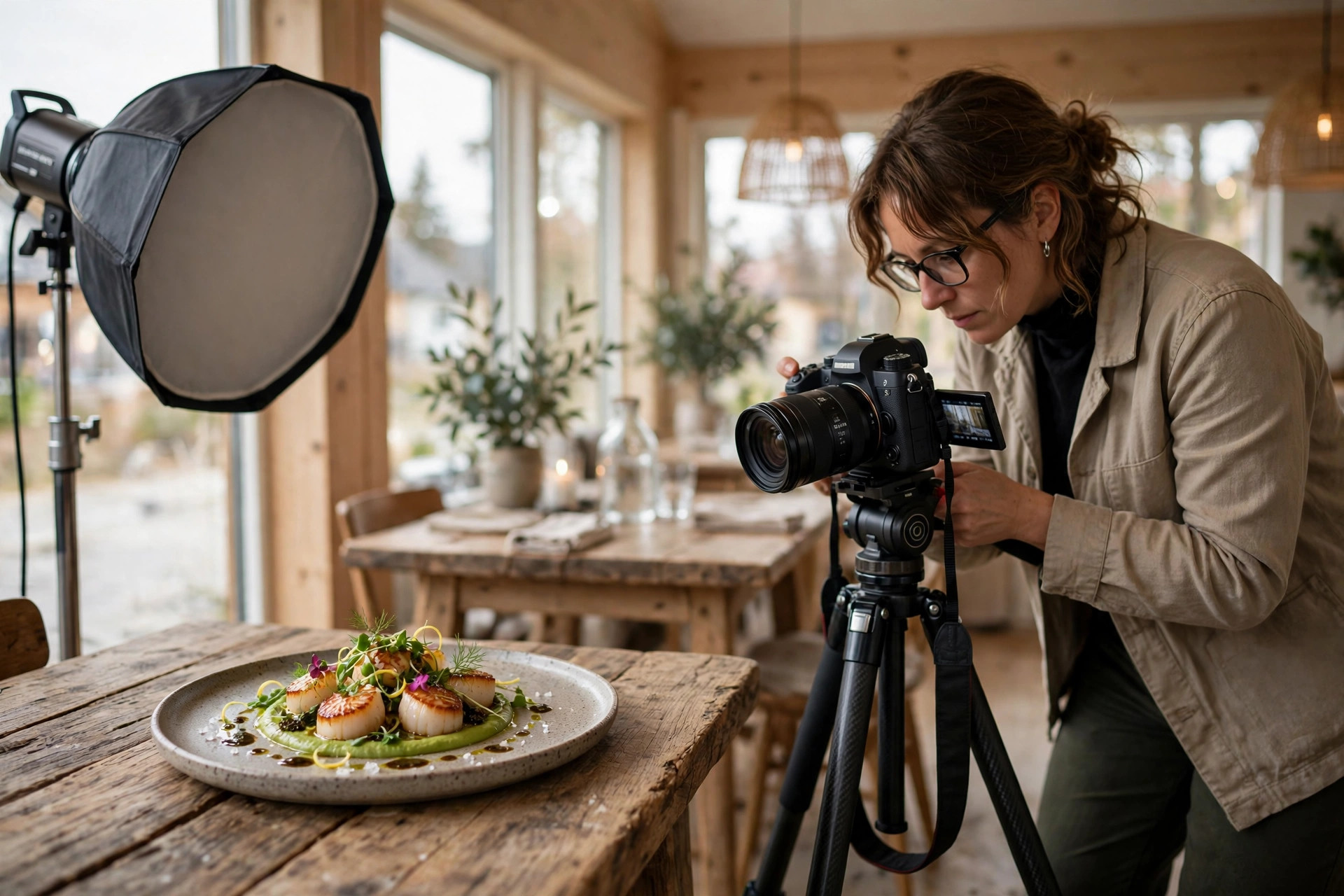
Your menu photos are the hardest-working staff members you have: they sell the dish on the website, on the delivery apps, on Google and on Instagram, around the clock, without wages. So the question isn't really whether good food photography is worth paying for — it's how much to pay, what exactly you're buying, and how to brief the photographer so the money lands on the images that actually sell tables. This guide answers all three: real 2026 price ranges for restaurant shoots, how the pricing models work, the hidden extras that ambush first-time buyers, and a copy-ready brief template you can send today.
What a food photographer costs in 2026
Let's start with the numbers everyone asks for. The honest answer is that food photography pricing is a band, not a number — but the bands are surprisingly consistent across the photographers who publish their rates. Converted to euros and adjusted for the Nordic market, a restaurant owner in Helsinki, Stockholm or Oslo in 2026 can expect roughly these figures. Treat them as estimates to calibrate your budget, not as quotes: the exact price depends on the scope, the stylist, the usage rights and the city.
| Shoot type | Typical Nordic range (excl. VAT) | What you usually get |
|---|---|---|
| Small menu session, up to 2 hours | €300–€500 | 5–12 dishes, one simple setup, edited finals for menu and web |
| Half-day menu shoot (3–4 hours) | €400–€900 | 10–20 dishes, a few styled setups, menu/web/delivery-app licence |
| Full production day (up to 8 hours) | €1,000–€2,000 | 25–45 dishes plus interiors, chef portraits and detail shots |
| Per finished image | €40–€120 | Edited, licensed image; always with a minimum image count |
| Food stylist (if needed) | €500–€1,200/day | Hero-item styling, props, hold-time tricks for difficult dishes |
| Minimum booking | €300–€500 | The floor: a small café with four pastries still books the half day |
A few things to notice. First, the ranges come from published 2026 price lists in the US and UK — American small menu shoots at $350–$500, UK half days at £350–£775, full days up to $5,000 — mapped onto the Nordic market where day rates for specialist commercial photographers sit in the same ballpark. Nobody has published a comprehensive Finnish or Swedish rate survey for food photographers specifically, so consider the table a working band for budgeting, and let actual written quotes tighten it.
Second, notice how much cheaper a simple menu shoot is than a styled production. The difference is throughput versus craft. Photographing twenty plated lunch items against one locked background is a volume job: the kitchen plates in sequence, the photographer barely moves, and eight to twelve dishes fly past the lens every hour. A hero shoot with styled surfaces, a garnish pass, a second angle and careful light is three to five dishes an hour. Same camera, same restaurant — wildly different price per dish. Knowing which job you're buying is the first step to not overpaying.
Third, remember VAT. Nordic VAT on photography services is 25.5% in Finland, 25% in Sweden and Norway — and many photographers quote ex-VAT to businesses. A €900 quote ex-VAT is €1,129.50 on the invoice in Finland. Always ask whether a quote is inclusive or exclusive of VAT before you compare numbers; it's the most boring line item on the invoice and the one that most often causes a surprise.
How food photographers price their work
Food photographers generally sell their time and their deliverables in one of four ways. Each one suits a different kind of restaurant job, and each one hides a different risk. Here's how they work and which one fits your situation.
Per image
You pay for each finished, edited photograph — typically roughly €40–€120 for restaurant work, with a minimum image count (often 5–10) so the morning is worth the photographer's travel and setup. Per-image billing is the most transparent model: the deliverable count is visible and comparable across quotes. The risk is that production minimums get folded into the per-image number invisibly, and complex retouching may be billed on top — a $20-per-image "basic touch-up" surcharge appears on several published price lists. Per image suits small updates: five new seasonal dishes, a refreshed cocktail menu, a handful of replacements.
Hourly or half-day rate
The photographer reserves their time — commonly €80–€200 per hour at the professional level — and you get what gets shot in the window. This model suits small, predictable jobs: a two-hour session for a café refresh, for example. The risk is the opposite of per-image: the rate reserves capacity but doesn't guarantee output. If the kitchen is slow or you spend the first hour deciding what to cook, you burn paid time. Hourly works when you have a shot list and the kitchen can plate on demand — otherwise it punishes disorganisation harder than any other model.
Full-day rate
A flat fee for the day — roughly €1,000–€2,000 in the Nordics for a food specialist, more with art direction and crew. Full days suit brands, campaigns, new openings and anything where one image can take an hour: styled hero shots, advertising concepts, complex sets. The day rate buys the photographer's focus for the whole day, but it doesn't by itself promise a dish count. If you book a day rate, still ask how many finished images you can expect, so the day has a measurable outcome.
Menu package
A fixed price for a defined outcome: "up to 15 dishes, two setups, 25 edited finals, delivered in five working days." Packages are the easiest model to budget — and the easiest to misread. A package is only comparable if it states the dishes, the angles, the crops, the number of finals, the revision rounds and the licence. Two packages at the same price can differ by a factor of two in delivered value. The guide to food photos that actually sell is worth a read alongside any package quote, because it shows what a good menu image needs to contain — and lets you judge whether the package will deliver it.
Per-image pricing suits restaurants because owners think in menu items and want to compare quotes — but the cheapest quote per image is rarely the cheapest shoot.
What moves the price up or down
Two quotes can differ by a factor of three for the "same" shoot. Here's what actually moves the number, so you can see which factors you control.
Dish count and throughput
The biggest single driver. A 20-dish delivery-app menu shot on one locked background is a half-day volume job; 20 styled hero images is a two-day production. Be honest about which one your menu needs — the best sellers deserve the hero treatment, the lunch items don't.
Styling complexity
Every setup change costs time: a new surface, new props, new light, new garnish pass. Each change eats 15–30 minutes of paid time. Fewer setups = lower price. Group dishes by background and shoot them in batches.
Food stylist or not
A stylist roughly doubles the day's cost but can be the difference between a good and a great result for difficult food: ice cream, melting cheese, foam, cocktails, anything that has to look perfect for hours under hot lights. For most plated restaurant menus, the kitchen team plating with the photographer directing is enough — many photographers will tell you honestly which of your dishes need a stylist before you book.
Location: your restaurant or a studio
On-location shoots in your own kitchen are the norm for restaurants, and the food is freshest where it's cooked. A studio is faster for the photographer (no setup/teardown in your dining room) but adds food transport and freshness problems. Some photographers work around your opening hours — setting up in the quiet morning and leaving before lunch service — so you don't need to close.
Usage rights and licence
A licence for menu, website, delivery apps and social media is usually included in restaurant packages. Paid advertising, print campaigns, packaging and third-party use typically cost extra — sometimes substantially, because an image that runs in a national ad campaign is a different product from one that sits on a menu page. State where the images will appear when you ask for the quote.
Experience and reputation
A beginner at €300–€600 for the day versus an established specialist at €1,500+ isn't just marketing — it's years of styling judgment, faster problem-solving on set, and an editing workflow that doesn't need three revision rounds. For a straightforward menu shoot the difference is modest; for a rebrand or opening it's the whole game.
Timing and season
Rush delivery (24–48 hours) often carries a per-image surcharge — around €40 per image appears on published lists. Weekend shoots, evening shoots after service, and December dates all cost more. Book the shoot in the shoulder season if you can, and never shoot the week before Christmas unless you've budgeted for it.
What's included — and the extras that surprise owners
A food photography quote is really three prices in one: the creative fee (the photographer's time and skill), the expenses (travel, props, food costs, studio, assistant), and the licence (what you're allowed to do with the images). Problems start when a quote blends all three into one number and the owner discovers the licence didn't cover what they assumed. Here's how to read a quote like a buyer.
The licence question, decoded
- Usually included: your menu, your website, your social media, your delivery-app listings. This covers roughly 90% of restaurant needs.
- Usually extra: paid advertising campaigns, print ads, billboards, packaging, third-party marketing (a delivery platform using your photo in their ad).
- Ask in writing: "Is full ownership/buyout included, or a licence? For which media, which territories, and how long?" A forever, everything, everywhere licence costs more — but a menu-only licence that blocks your Instagram is worse.
- Watch for: prices that look identical until you notice one includes the licence and the other invoices it separately.
The extras, one by one
Travel. Most photographers include travel within their city and charge beyond it — commonly per kilometre or a flat fee. If you're outside the photographer's city, get the travel number in writing; it can be the difference between the cheapest and the most expensive quote.
Food costs. You supply the food — that's the deal on almost every restaurant shoot. The kitchen cooks the dishes; the photographer shoots them. What costs extra is food the photographer sources for styling (backup produce, hero garnishes) and dishes cooked purely as camera models and never served.
Props and surfaces. Most food photographers bring a kit of backdrops, boards and linens and lend them on the day. If you want your own tableware in the shots — and you usually should, because it's your brand — clean it the night before and bring the undamaged pieces. Scratched plates and chipped rims show up cruelly at high resolution.
Revisions and retouching. "All images edited" usually means colour and exposure correction across the set. Individual attention — removing a smudge, compositing, fixing a wilted leaf — is often billed per image (around €15–€20 on published lists) or per hour. One or two revision rounds on the finals are typically included; define how many, and what counts as a revision versus a reshoot.
Rush delivery. Standard delivery is roughly one to five working days after the shoot. If you need the images for Friday's menu launch, say so up front and budget the rush fee — surprises here are expensive and entirely avoidable.
VAT. Worth repeating because it bites first-time buyers: confirm whether every number is inclusive or exclusive of VAT. In Finland that's 25.5% — a fifth of the invoice you didn't budget for if you assumed the quote was all-in.
A €600 quote with the licence, travel and VAT in writing is cheaper than a €450 quote with three asterisks. Read the asterisks, not the headline number.
The perfect brief: what to send before you ask for a quote
Here's the uncomfortable truth about food photography quotes: photographers can't price what you haven't described. A vague "we need some menu photos" gets you a vague range, a padded estimate, or three quotes you can't compare because each photographer imagined a different shoot. A tight brief gets you three comparable numbers and a shoot day with no expensive standing around.
Write the brief once, send it to every photographer, and your quotes become apples-to-apples. It takes about an hour and saves more money than any negotiation. Here's the template — fill in the brackets and send it as-is:
The one-page brief
- Who and where: restaurant name, address, cuisine, and the website or Instagram where the photographer can see your current look.
- What: the exact dish count, grouped by category (e.g. "18 dishes: 8 mains, 5 desserts, 5 cocktails"). State which dishes are heroes and which are volume shots.
- Where the images will live: menu (print/web), website, delivery apps, social media, paid ads. This determines the licence and the file specs — be exhaustive now or pay for a re-licence later.
- Look and references: 3–5 reference images showing the style you want — lighting, mood, backgrounds. Reference images are worth a thousand adjectives: "bright and airy, like these" beats a paragraph of art direction.
- Logistics: shoot location (your restaurant), proposed dates, service hours to work around, where the setup can go (window light availability), who from the kitchen will plate.
- Deliverables: number of finished images, file formats and sizes (web + print), number of revision rounds, delivery deadline, who owns the raw files.
- Budget signal: your budget band. Photographers aren't mind readers; a band ("roughly €600–€900") lets them scope the shoot to the money instead of quoting their dream production and scaring you off.
Two honest notes on the budget line. First, naming a band doesn't lock you into spending it — it filters out photographers who can't work within it and invites the right ones to design a shoot that fits. Second, the band should be realistic against the price table above. A €300 budget for 30 styled dishes will get you silence or a polite decline; the same €300 for 8 volume shots gets you three serious quotes.
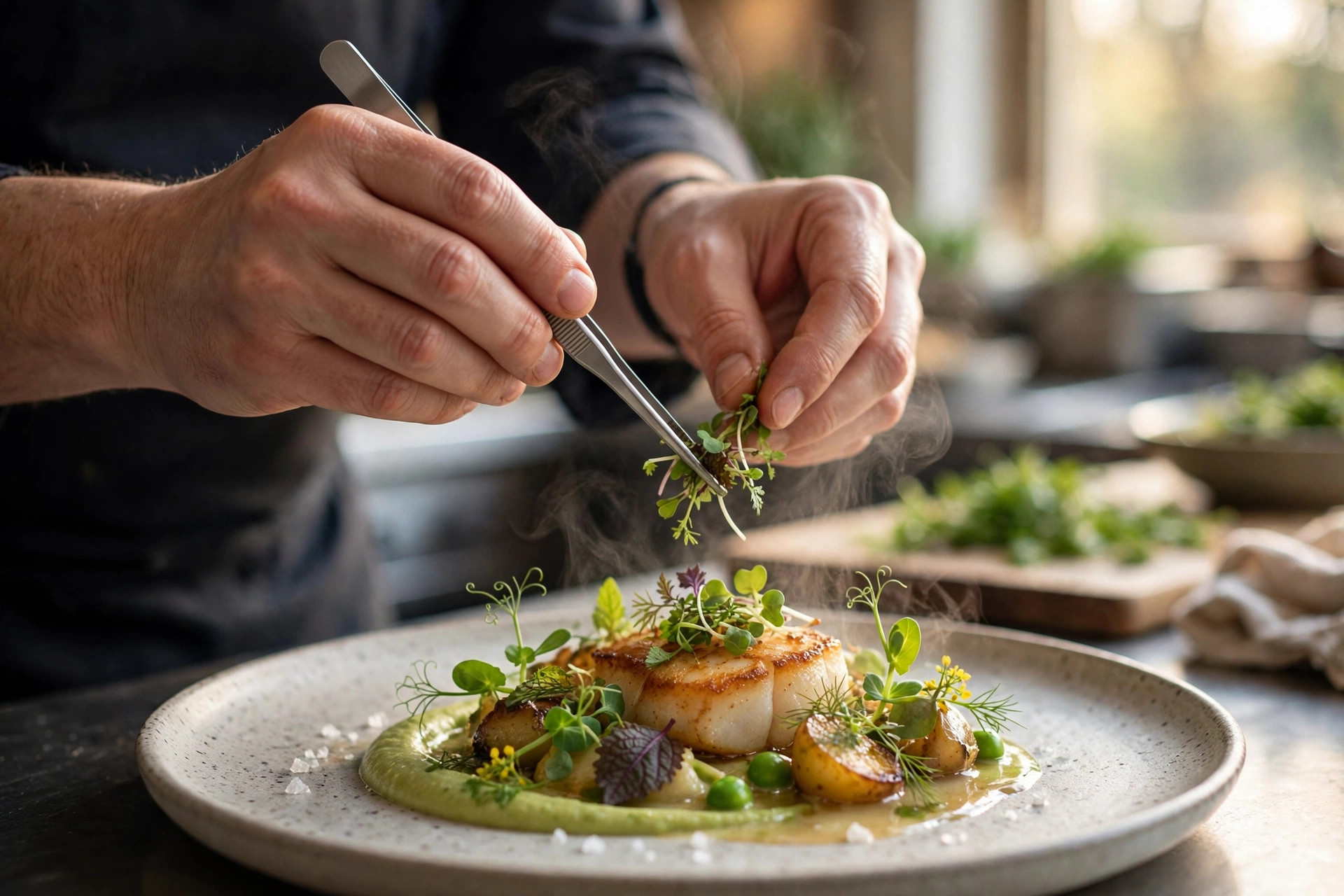
A shot list that saves you real money
The brief says what; the shot list says in what order. On shoot day, the most expensive resource in the room is the clock — and the clock runs slowest when the kitchen is deciding what to cook next while the photographer waits with the lights on. A shot list agreed the day before turns the shoot into an assembly line: plate, shoot, next.
The reason the shot list saves money is throughput. Published photographers' rate guides describe the two speeds clearly:
| Shoot style | Pace | Half-day yield | Best for |
|---|---|---|---|
| Volume / delivery-app style | 8–12 dishes per hour | 20–30 dishes | Full menu coverage, delivery apps, simple web menus |
| Styled hero shots | 3–5 dishes per hour | 10–15 dishes | Best sellers, homepage, social campaigns, print |
| Mixed (heroes + volume) | Plan 4–5 hours | 8–10 heroes + 10–15 volume | The sweet spot for most restaurants |
Most restaurants should book the mixed version: hero treatment for the 8–10 dishes that drive the most revenue and the most clicks, volume style for the rest. Your best sellers earn the styling time; the lunch special doesn't need a garnish pass.
How to build the shot list
Start from your sales data, not your ego. List dishes by revenue and by how often guests ask "what does it look like?" — that's your hero list. Then add the categories that round out the menu. For each dish, note the setup (background), the angle, and any special requirement ("needs the stylist — foam collapses"). Group by setup so the photographer changes the set as rarely as possible: all dark-background dishes together, all bright ones together.
Print two copies. Give one to the kitchen the day before with plating order marked, and keep one on set. Number the dishes. When the photographer calls "number 14", the kitchen should already be plating number 15. This is the entire secret of a shoot that finishes on time: the kitchen runs one dish ahead, always.
One more cost-saver buried in the shot list: shoot your variants now. The vegetarian version of the burger, the gluten-free pizza, the cocktail in the tall glass and the coupe — reshooting one dish later costs a minimum booking (€300–€500) all over again. A variant on the day costs ten minutes.
Nine questions to ask before you book
Send your brief to three photographers, get three quotes, and then ask every one of them the same nine questions. The answers — not the headline price — are what you're really buying.
The nine questions
- "What exactly is included in this price?" Dishes, setups, finished images, revision rounds, delivery time. If it's not listed, it's not included.
- "What licence do I get?" Media, territory, duration. "For your menu, website, delivery apps and social media, forever" is the answer you want for restaurant work.
- "Is that price inclusive or exclusive of VAT?" Boring, essential. In the Nordics the difference is 25–25.5%.
- "Do I need a food stylist for my dishes?" The honest ones will tell you which dishes need one and which don't — and quote styling separately.
- "How many dishes can we realistically shoot in this session?" This exposes whether the quote is built on volume speed or hero speed. If the number sounds too good, ask how many setups it assumes.
- "Who brings props and backdrops?" Most bring a kit; confirm it, and ask what you should prepare from your own tableware.
- "What does the revision process look like?" How many rounds, what counts as a revision, and what a reshoot costs.
- "When do I get the finals, and in what formats?" Web-sized and print-sized files, named by dish — future you will be grateful.
- "Can I see a full gallery from one restaurant shoot?" Portfolios show the ten best images ever taken. A full gallery shows the consistency of the other forty — and consistency is what your menu needs.
Then the paperwork: a short written agreement covering the date, the fee, the deliverables, the licence, the payment terms and the cancellation policy, signed before anyone preheats an oven. Professional photographers expect this — the ones who resist it are the ones you needed it for.
When you shouldn't hire a photographer at all
Here's the part a photography blog isn't supposed to tell you: not every restaurant needs a professional shoot. The honest decision is about stakes, not snobbery. Run through this comparison and see where your situation lands:
| Situation | DIY with a phone | Hire a professional |
|---|---|---|
| New opening or rebrand | Too risky — this imagery defines you for years | Yes: this is the highest-stakes shoot you'll do |
| Full menu of 20+ dishes | Slow, inconsistent across dishes | Yes: half-day volume shoot, ~€400–€900 |
| 5 seasonal dishes, twice a year | Perfect DIY: window, tripod, one afternoon | Overkill — the minimum booking eats the budget |
| Daily social content | Always DIY: speed beats perfection | No — book a pro for the quarterly hero batch instead |
| Fine dining / tasting menu | The food deserves better | Yes: styling is half the result here |
| Delivery-app listing refresh | Fine: apps compress images heavily anyway | Only if the current photos are actively losing you orders |
The pattern most successful restaurants land on is a hybrid: one professional shoot per year (or per major menu change) for the hero library, and DIY phone photography for everything between — daily specials, seasonal updates, social posts. The pro shoot gives you the consistent, high-quality base; the phone keeps it fresh. Our phone photography guide walks through the exact setup, and the food photography basics article covers the lighting and styling principles that make DIY shots look deliberate instead of accidental.
And whichever route you choose, the photos have to live somewhere that converts. A beautiful image on a slow, confusing website is a wasted shoot — which is why the menu page matters as much as the menu photography. PowerfulWebsite builds restaurant websites with proper menu pages designed to show off food photography, from €59/month — the site is built free, and the photography investment finally gets the stage it deserves. Interior shots matter too: our guide to restaurant interior photography covers the other half of the visual story.
The smartest photography budget in restaurants isn't DIY or professional — it's professional once a year and DIY every week, with the same style running through both.
Frequently asked questions
How much does a food photographer cost for a restaurant?
As a rough estimate, expect roughly €400–€900 for a half-day menu shoot covering 10–20 dishes in the Nordics, or roughly €40–€120 per finished image. A full production day with styling typically runs €1,000–€2,000, before VAT. Most photographers set a minimum booking of roughly €300–€500. Get every quote in writing with the number of dishes, images, revisions and usage rights spelled out.
How much does food photography cost per photo?
Per-image pricing usually lands between roughly €40 and €120 per finished, edited photo for restaurant work, with minimum image counts so the shoot is worth the photographer's time. Simpler delivery-app style shots cost less per image than styled hero shots. Per-image suits small updates; for a full menu, a half-day or package rate is usually cheaper.
Is the usage licence included in the price?
Usually, yes, for everyday use: most restaurant packages include the right to use the photos on your menu, website, delivery apps and social media. Paid advertising, print campaigns and third-party use (such as a delivery platform's marketing) may need a separate licence. Ask for the licence in writing and state where the images will appear.
Do I need a food stylist?
Often not. For most plated restaurant menus your kitchen team can plate for the camera with the photographer directing, and you save roughly €500–€1,200 a day. A stylist earns their fee on hero items that must hold their looks for hours — ice cream, melting cheese, foam, cocktails — and on advertising shoots. Ask the photographer honestly which of your dishes need one.
Is food photography more expensive in big cities?
Slightly, but less than owners expect. Published price lists show some photographers charging the same rates in London and Manchester, for example. What does change with the city is access to specialists: Helsinki, Stockholm and Oslo have more experienced food photographers and stylists than smaller towns, which matters for complex shoots more than for a straightforward menu session.
How do I prepare my restaurant for the shoot day?
Agree on a shot list in advance — it is the single biggest cost saver. Schedule the shoot outside service hours, keep the kitchen staffed for rapid plating, clean your best plates and glassware, and decide where the setup goes (window light first). Print the brief and the shot list and give both to the kitchen team the day before.
Want a website where your food photos sell?
PowerfulWebsite builds your restaurant's website for free — you only pay from €59/month. Everything is included: a proper menu page that shows off your dishes, domain, hosting, maintenance and updates.
See the plans