May Day Brunch: How to Sell Every Table
A sold-out May Day brunch is not luck — it is a campaign. Restaurants that sell every table price from real food costs (typically €38–55 per adult in the Nordics, estimates), run two timed seatings instead of one, sell tickets in advance with deposits, and start marketing six weeks before 1 May. Here is the full playbook, from pricing maths to the kitchen plan.
Key takeaways
- May Day (1 May) is the spring's strongest single-day brunch occasion in the Nordics — in Finland it is Vappu, the country's biggest celebration, and demand is genuine.
- Price from your food cost: Nordic restaurant May Day brunches typically land at €38–55 per adult (estimates), with a drinks package adding €12–20 of high-margin revenue.
- Two timed seatings (e.g. 11:30 and 14:30) roughly double capacity versus one — but only commit if your kitchen can turn the room in under 45 minutes.
- Prepayment or a per-person deposit is non-negotiable on May Day; it converts reservations into revenue and eliminates the holiday no-show tax.
- Open bookings six weeks out, publish the menu four weeks out, and sell against the real competitor: the picnic.
- Capture every guest's contact details on the day — a sold-out brunch is the cheapest email list you will ever build.
May Day brunch has a peculiar status in Nordic restaurant marketing: everybody knows it should be a goldmine, and every year a surprising number of restaurants leave tables empty. In Finland, 1 May is Vappu — the country's biggest celebration, a two-day spring festival of picnics, sparkling wine and student traditions. In Sweden and Norway the day matters less culturally, but the spring-brunch logic is identical: the first public holiday of the warm season, when people are desperate to celebrate outdoors and will pay a premium to do it well.
This article is written for restaurant, café and bistro owners who want to stop treating May Day as a slightly busier Sunday and start treating it as what it is: a one-day, high-demand, price-insensitive revenue event. The playbook below covers pricing, formats, advance sales, the six-week marketing timeline, operations, and the follow-up that turns one brunch into twelve months of repeat visits. It draws on what Nordic restaurants actually charge and run — Helsinki's May Day brunches in 2026, for example, sold at around €42 per adult with seatings at midday and mid-afternoon — and on the hard economics of one-day peaks.
Why May Day is your biggest spring revenue day
Three facts make 1 May different from every other brunch day of the year. First, demand is concentrated and inelastic: people have decided to celebrate that day long before they have decided where. Second, the spending mindset is festive — guests order drinks, desserts and extras they would skip on a normal Sunday. Third, it is a public holiday with almost no competing obligations: no work, no school runs, nowhere else the family needs to be.
In Helsinki, Vappu is a two-day affair. 30 April is the evening celebration; 1 May is the day celebration, centred on picnics — famously the Kaivopuisto park gathering. That picnic culture is your real competition, and it is worth understanding: the picnic competes on atmosphere and price (a bottle of sparkling wine and supermarket pastries), not on food quality or comfort. A restaurant brunch wins against a picnic on exactly three things: weather insurance, zero cleanup, and food nobody has to prepare. Your entire marketing message should be built on those three advantages.
Even outside Finland, the economics hold. Spring's first public holiday creates the year's first true "occasion brunch" — the booking groups are larger (4–8 people versus 2–4 on a normal Sunday), the average spend is higher, and guests are planning weeks ahead rather than deciding on Saturday night. A normal Sunday brunch sells convenience; a May Day brunch sells celebration. Price and plan accordingly.
Pricing your May Day brunch
Start with the market, then check it against your costs. Nordic restaurant May Day brunches in recent years have clustered in a clear band. The figures below are estimates from published 2026 menus — use them as benchmarks, then price from your own food cost:
| Format | Typical Nordic price per adult (estimates) | Children (estimates) | Best for |
|---|---|---|---|
| Café set menu (3 courses) | €29–39 | Half price 6–12 | Small cafés, bistros, first-timers |
| Restaurant buffet brunch | €38–55 | €15–25 for 6–12, free under 5–6 | Mid-size restaurants with a kitchen that can produce in bulk |
| Hotel-style grand buffet | €55–85 | Half price for children | Hotels, large dining rooms, premium positioning |
| Drinks package add-on | €12–20 | N/A | Every format — highest margin item on the menu |
Helsinki's 2026 May Day brunches illustrate the band well: hotel restaurants charged around €42 per adult with children's prices of roughly €15 for ages 6–12 and free for under-5s, running seatings at midday and mid-afternoon. That is the number to beat or match in a capital city; in smaller towns, the lower end of the band applies.
Price from food cost, not from the neighbour
The benchmark band is a sanity check, not a pricing method. The method is: cost your menu per guest, then set the price so food cost lands at 28–33%. Buffet economics are unforgiving — industry analysis of buffet operations puts food cost at 30–45% of revenue, with well-run operations netting 5–15% margins — so a May Day brunch priced at €45 needs to cost you €12.60–14.85 per guest in food. Cost every pan, not the menu in your head: weigh the salmon, count the pastries, include the butter and the coffee.
The drinks package deserves its own paragraph because it is where the profit lives. A glass of sparkling wine on arrival plus coffee and juice refills costs you €3–5 per guest and sells for €12–20. Almost every guest who buys brunch buys the package when it is presented as part of the ticket rather than an upsell at the table. Frame it in the booking flow: "Brunch €45, with drinks €59" converts far better than a waiter asking later.
The May Day pricing checklist
- Adult price holds food cost at 28–33% (€38–55 typical in the Nordics, estimates).
- Children: half price 6–12, free under 5–6 — families are your best customers on 1 May, do not price them out.
- Drinks package priced at 3–4x its cost, sold in the booking flow, not at the table.
- Price includes everything: no surprise supplements on the day (the one exception is premium add-ons like oysters, clearly listed in advance).
- VAT-inclusive, published price — Nordic guests expect the number on the menu to be the number on the bill.
One seating or two? The maths of selling every table
This is the single biggest revenue decision of your May Day. A 60-seat restaurant selling one brunch seating at €45 grosses €2,700 before drinks. Two seatings at the same price gross €5,400. The difference is not a rounding error — it is the entire profit of the day.
The standard Nordic pattern is two seatings: 11:30–14:00 and 14:30–17:00, with a 30–45 minute reset between. It works because a set menu or buffet can be reset quickly, and because May Day guests accept fixed seating times on a holiday — they are planning their whole day around the booking. What does not work is two seatings with an à la carte menu and a kitchen that needs 90 minutes to turn a table. If your reset takes longer than 45 minutes, you will run the second seating late, the food will suffer, and the reviews will follow you for a year.
The decision test
Commit to two seatings only if all three are true: (1) your menu is a buffet or set menu with bulk-produced dishes; (2) you have enough front-of-house staff to clear and reset every table in 30 minutes; (3) your kitchen can hold or regenerate the full spread for a second full room without a quality drop. If any one fails, run one seating — a single, excellent, fully-booked brunch at €49 beats two half-empty, chaotic ones at €45 every time.
First-timers should almost always start with one seating. You will learn your real production capacity, your real staffing needs, and your real demand — and next year you can sell two seatings with confidence instead of hope. There is a special cruelty in running a second seating at 40% occupancy: the staff cost is the same, the food waste doubles, and the empty room photographs badly on social media.
The menu that sells itself
Guests do not book a May Day brunch because of your menu. They book because it is 1 May and they want to celebrate — the menu's job is to make the booking feel safe and to photograph well enough to share. That changes how you design it. Familiar formats, one or two signature touches, and nothing that requires explanation.
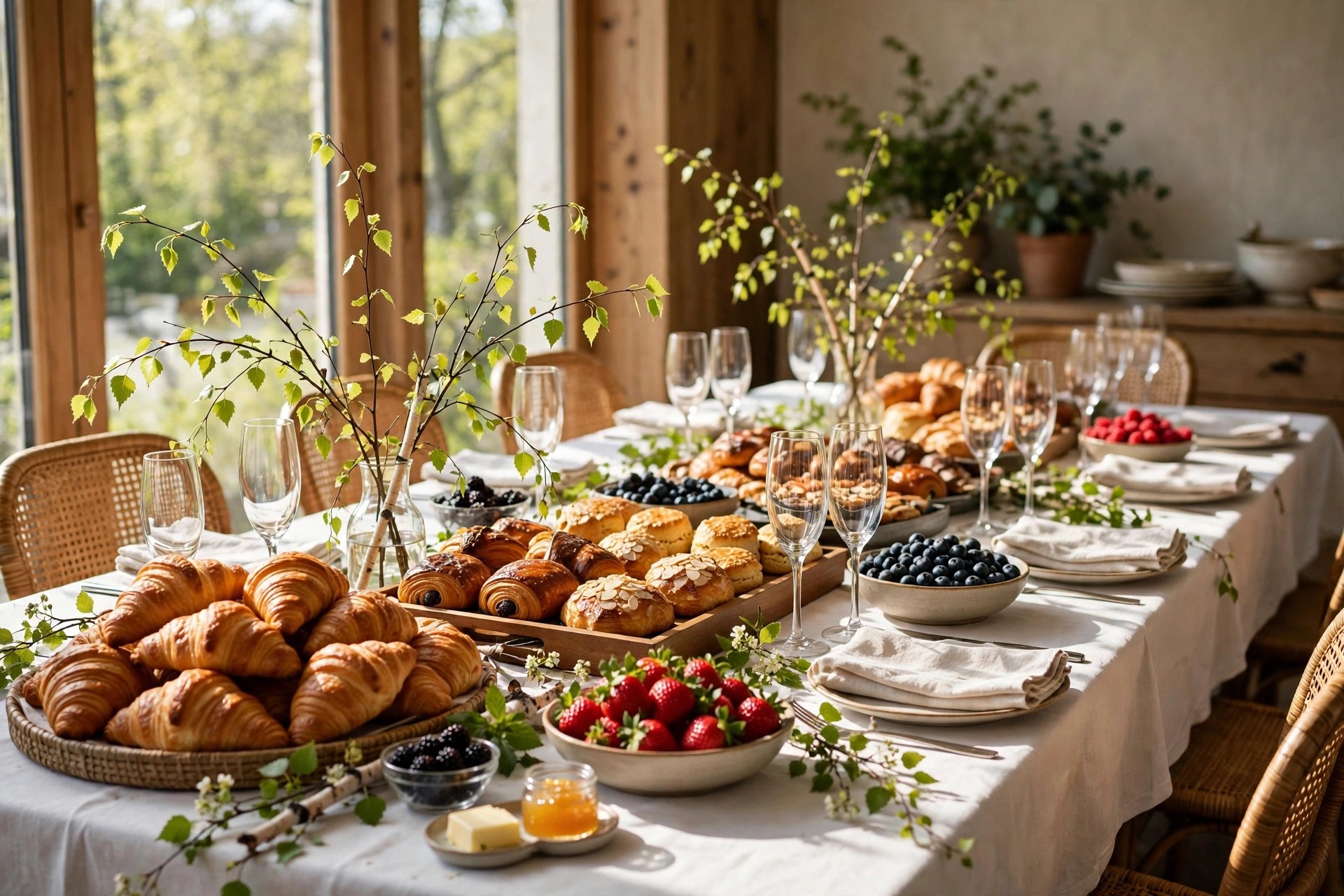
The anatomy of a May Day buffet that sells: a bread and pastry station (croissants, Danish pastries, rye bread — the smell does half your marketing), a cold station with smoked and cured fish (salmon in some form is non-negotiable in the Nordics on a celebration day), a warm egg station (eggs Benedict or a baked egg dish, produced in hotel pans), a salad and vegetable section for the health-conscious half of every group, a proper dessert table with doughnuts — munkki in Finland is the May Day dessert, full stop — and a children's corner with pancakes or waffles. Add sima, the traditional Finnish May Day mead, if you are in Finland; elsewhere, a spring spritz on arrival does the same emotional job.
Design for production, not for the photo shoot
Every dish on a May Day menu must survive being produced for 120–200 covers in a two-hour window. That rules out anything plated to order, anything with more than three components assembled at service, and anything the kitchen has never made at volume. The test question for each dish: "Can we make 40 portions of this in one hotel pan, in one oven cycle, with the staff we have?" If the answer is no, it is a normal-weekend dish, not a May Day dish.
Dietary coverage is not optional on a group-booking day. Mark vegan, gluten-free and lactose-free options clearly on the published menu — the person booking for a group of eight will choose the restaurant where nobody in the group has to ask awkward questions. In the Nordics, expect roughly one in five guests to need some accommodation; design the buffet so the default spread already covers most of it rather than bolting on a sad separate plate.
Advance tickets and deposits: killing no-shows
Here is the uncomfortable truth about holiday bookings: without a financial commitment, 10–20% of your "fully booked" room will not show up. On a normal Tuesday that is an annoyance. On 1 May, when you turned away real guests to hold those tables, it is the difference between profit and loss. Every empty May Day table is a table someone else wanted.
The fix is prepayment, and May Day is the easiest day of the year to require it. Guests expect to pay in advance for concerts, flights and festivals — a brunch ticket feels completely normal when the whole city is buying tickets for everything else that week. Your options, in order of effectiveness:
- Full prepayment per person. The cleanest model. The booking is a purchase, the no-show rate drops to near zero, and your cash flow arrives in April instead of May. Best for set menus and buffets with a fixed price.
- Deposit per person (€10–20). A softer ask that still filters out the non-committal. Deducted from the final bill, forfeited on late cancellation. Works well for first-time May Day operators who are nervous about asking for full payment.
- Card details with a cancellation policy. The minimum. State it plainly at booking: "Cancellations within 48 hours are charged in full." Then actually charge — a policy you do not enforce is a suggestion, and guests can tell.
Whatever you choose, the mechanics matter as much as the policy. Take the payment or card details inside the booking flow, not in a follow-up email. Every extra step between "I want to book" and "I have paid" loses you a percentage of guests. If your current booking system cannot take deposits, this is the year to fix that — see our guide to deposits and gift cards for securing bookings. And confirm every booking 48 hours before with a message stating the seating time, the price, and the cancellation terms. Most no-shows are not malice; they are forgotten bookings. The confirmation message is the cheapest insurance in hospitality.
The six-week sales timeline
May Day plans are made early. The group chat that decides "brunch at that place on 1 May" happens in late March or early April — by the last week of April you are selling to stragglers, not planners. Your campaign must be fully live before the planners decide. Here is the timeline that works:
Six weeks out (mid-March): open bookings
Publish a dedicated May Day brunch page on your website with the date, seatings, price, menu outline and the booking button. This page is the single most important asset of the campaign — it is what Google indexes, what guests link in group chats, and what your social posts point to. If you only do one marketing action for May Day, make it this page. Announce the opening on social media and to your email list on the same day: "May Day brunch bookings are open."
Four weeks out: publish the full menu
The menu reveal is your second announcement wave. Photograph three to five hero dishes — the salmon, the dessert table, the drinks — and publish the full menu on the page. Email it to your list with the subject line doing the work ("Our May Day brunch menu is here"). This is also the moment to pitch local media and food bloggers; they are compiling their "where to brunch on 1 May" lists right now, and inclusion is free advertising to exactly the right audience.
Two weeks out: urgency and the picnic argument
Now the message shifts from information to persuasion. Post the seating that is filling fastest ("Second seating 70% full"), share behind-the-scenes preparation, and make the picnic argument explicitly: the weather forecast for 1 May is a coin flip every year, and your dining room is warm, dry and set. If the forecast looks bad, say so — gleefully. Weather is the best salesperson a restaurant brunch has ever had.
Final week: fill the gaps
The last tables go to the undecided. A short, geo-targeted social campaign in the final week can move the needle — but only if the menu page and booking flow already exist and work on a phone. No ad spend fixes a missing page. Email the waitlist first when a table frees up; a released table with ten people waiting for it sells in minutes. For the full seasonal rhythm around this campaign, see our seasonal advertising calendar for restaurants.
Operations: staffing and kitchen for a one-day peak
Marketing fills the tables; operations decide whether May Day was profitable or merely busy. A one-day peak is operationally different from a busy weekend: there is no tomorrow to recover, the room turns on a fixed clock, and every guest arrived with celebration-level expectations.
Staffing first. Schedule for the peak, not the average: a May Day brunch needs roughly 30–40% more front-of-house hands than a normal Sunday, because the room is full from the first minute, the drinks package keeps glasses empty, and the reset window between seatings is brutal. Brief the team on the day's specific mechanics — seating times, the drinks package script, the allergen list, the reset drill — the day before, not in a huddle while guests are arriving. And feed your people: a staff meal before service is the cheapest morale investment of the year.
The kitchen plan
The kitchen runs on a production schedule, not on orders. Work backwards from the first seating: when does each hotel pan go in the oven, when is the cold station fully set, when is the dessert table finished? Build the schedule on paper, with times, and assign every item to a name. The two things that kill May Day kitchens are (1) starting too late, because the prep list was in someone's head instead of on the wall, and (2) the second seating's food not being ready, because the first seating consumed the buffer. Cook for 110% of the first seating and have the second seating's proteins already in progress before the first seating ends.
Waste is the silent margin killer on buffet days — unmanaged buffets can lose hundreds of euros a day to overproduction and plate waste. The defences are unglamorous: smaller pans refilled often rather than grand displays that die at the end of service, a clear end-of-service plan for leftovers (staff meals, same-day specials), and a post-mortem the next day where you write down what ran out and what was thrown away. That one page of notes is worth more than any consultant for next year's May Day.
Turning brunch guests into regulars
A sold-out May Day brunch puts 100–200 of the warmest prospects you will ever meet in your dining room in a single day: people who already like your food, already paid your prices, and are in a celebratory mood. Letting them walk out without capturing the relationship is the most expensive mistake of the whole campaign.
The mechanics are simple. A small card on every table — "Thank you for spending May Day with us" — with a QR code to your newsletter signup and a modest incentive for the next visit (a dessert on the house in May, a 10% weekday lunch voucher). Collect the email addresses at the moment of maximum goodwill: after the meal, not before. One email a week later — photos from the day, a thank-you, the summer terrace opening date — converts a one-time brunch guest into a repeat customer at a cost of essentially zero. Compare that to the cost of acquiring the same customer through ads, and the follow-up email is the highest-ROI message you will send all year.
And do the unglamorous thing: the day after, write the post-mortem. What sold out first, what was left over, which seating filled faster, what the staff said, what guests photographed. File it where you will find it in March next year. Restaurants that improve their May Day every year are not luckier than you — they just kept notes. If you want the broader playbook for turning seasonal peaks into year-round revenue, our Easter campaign guide covers the same mechanics for the spring's other big occasion.
Frequently asked questions
How much should I charge for a May Day brunch?
In the Nordics, restaurant May Day brunches typically land at €38–55 per adult for a proper buffet (Helsinki prices from 2026 were around €42 per adult). These are estimates to benchmark against, not rules — price from your own food cost. Children's pricing usually runs half price for ages 6–12 and free for under-5s. An alcohol package adds €12–20 per person and is one of the best margin lifts available.
Should I run one May Day brunch seating or two?
Two seatings roughly doubles capacity — e.g. 11:30–14:00 and 14:30–17:00 — and is the standard way Helsinki restaurants sell out May Day. It works best with a set menu or buffet so the kitchen can reset quickly. One seating suits small rooms and first-timers: less operational stress, higher per-guest spend, but a hard ceiling on revenue. Decide based on your kitchen's ability to turn the room in 30–45 minutes.
How far in advance should I open May Day brunch bookings?
Six weeks before 1 May is the sweet spot. That means opening bookings in mid-March, publishing the menu two weeks later, and running the sales campaign across April. May Day plans are made early — groups book the moment they see a date worth committing to, and the picnic-versus-brunch decision is usually settled by mid-April.
How do I stop no-shows ruining my May Day brunch?
Take a deposit or full prepayment per person at booking. May Day is the one day of spring when demand genuinely exceeds supply, so guests accept prepayment without complaint. At minimum, take card details with a clear cancellation policy (e.g. full charge for cancellations within 48 hours). Confirm every booking 48 hours out with a message that states the seating time, price and cancellation terms — most no-shows are really forgotten bookings. Our booking confirmation templates cover the exact wording.
Is a May Day brunch worth it for a small café?
Yes, if you keep the format simple: one seating, a set menu or compact buffet of dishes you can produce in bulk, and pre-sold tickets so you know your cover count. Small cafés lose money on May Day when they try to run their normal menu at holiday volume. The trick is to sell a limited, premium version of what you already do well, priced 20–30% above your normal weekend average.
Should I do anything for May Day Eve, 30 April?
If you have the stamina, yes — a May Day Eve dinner captures the crowd that celebrates the night before and turns a one-day event into a two-day revenue window. Keep it simpler than the brunch: your normal menu plus one festive special and a late kitchen. Market it to the brunch waitlist first; people who missed out on 1 May tables are the warmest leads you will ever have.
Want a website that sells out your May Day brunch?
PowerfulWebsite builds your restaurant's website for free — you only pay from €59/mo. Everything included: domain, hosting, maintenance and updates. Publish your brunch menu in minutes, take deposits online, and get found on Google before 1 May.
See the plans