Restaurant Music Branding: Sound That Sells Your Concept
Restaurant music branding means choosing your dining room's soundtrack on purpose: the right tempo and genre can lift revenue by about 9% and keep guests at the table longer, while the wrong volume drives them away. This guide covers the research, the daypart playlists, and the licensing rules for Finland, Sweden, and Norway.
Key takeaways
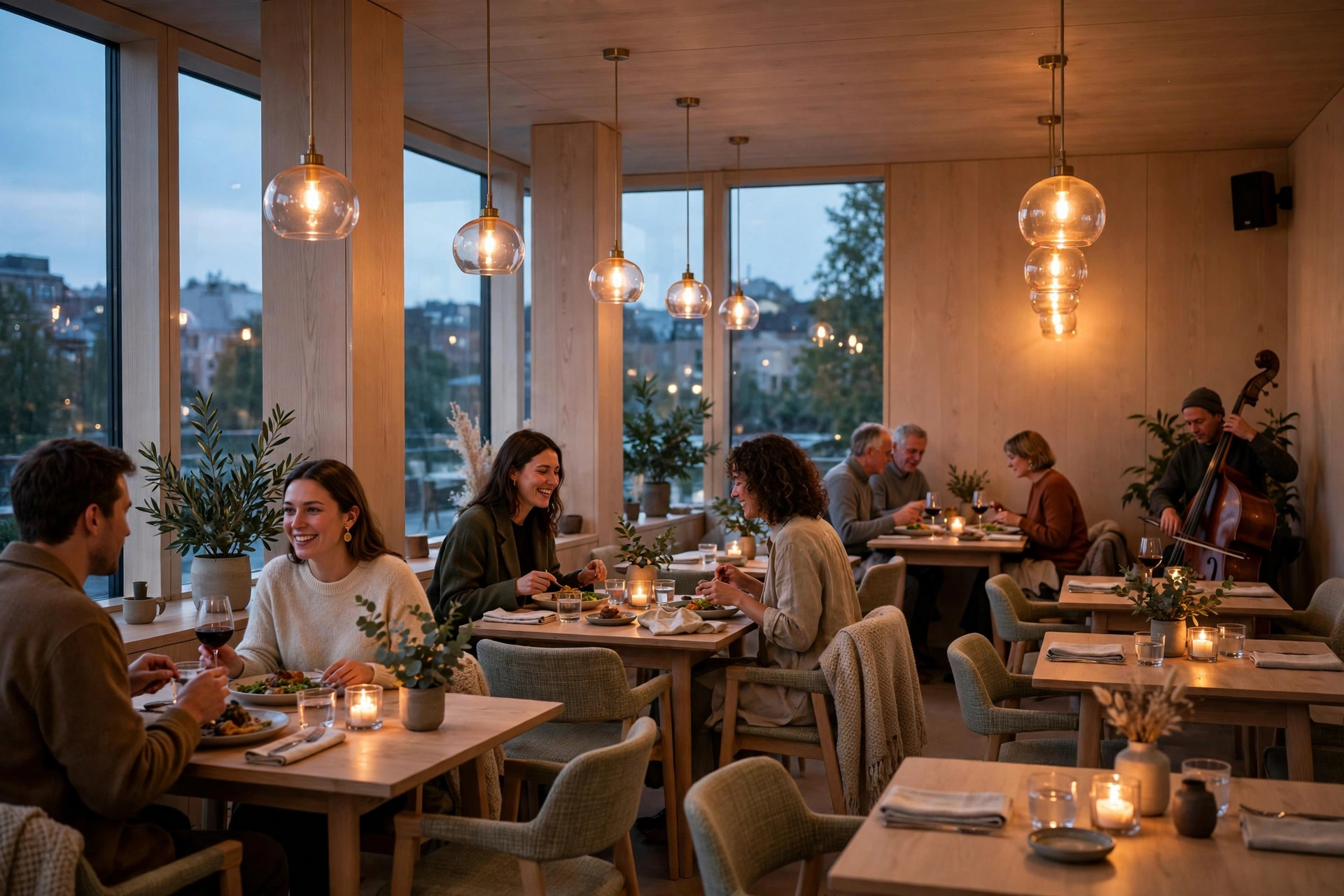
- Restaurant music branding is a deliberate choice about what your dining room sounds like — the audio equivalent of your interior design, not whatever playlist happens to be on.
- The research is unusually concrete: brand-fit music lifted revenue by 9.1% across 16 Stockholm restaurants, and slow tempos keep guests seated longer while fast tempos turn tables faster.
- Tempo is your most useful dial: under 72 BPM for lingering dinners, 90 BPM and above for busy lunches and high-turnover services.
- A personal Spotify account is not legal in a restaurant. You need a business music service or direct licences from your national collecting societies — Teosto and Gramex in Finland, STIM and SAMI in Sweden, TONO and Gramo in Norway.
- Write your sound down on one page — genres, tempos, volume limits, and daypart playlists — so the atmosphere survives your day off.
Walk into two restaurants on the same street, serving similar food at similar prices. In one, the music fits the room so well you barely notice it — the evening feels relaxed, the wine tastes a little better, and nobody checks the time. In the other, a chart playlist blares at the wrong volume and the whole meal feels rushed. The food did not decide which room you would come back to. The sound did.
This guide treats music as what it is: a branding and revenue tool, not background noise. You will learn what restaurant music branding means in practice, what the research actually found about tempo, genre, and spending, how to build daypart playlists that match each service, what the licensing rules are in Finland, Sweden, and Norway, and how much a legal setup costs. It pairs naturally with our guide to restaurant brand voice — this is the audible half of the same brand.
What restaurant music branding actually is
Restaurant music branding — sometimes called sound branding or sonic branding — is the decision to choose your dining room's soundtrack on purpose and keep it consistent. It is the audio equivalent of choosing your furniture, your lighting, and your wall colours. Every restaurant has a soundtrack; the only question is whether anyone chose it or whether it is whatever the last person on shift felt like playing.
Think of it in three layers. The first is identity: the music should sound like your restaurant looks. A wood-fired pizzeria, a white-tablecloth fine dining room, and a late-night cocktail bar can all play good music and still sound nothing alike. The second layer is behaviour: tempo and volume quietly steer how long guests stay, how fast they eat, and whether they order a second drink. The third layer is memory: guests rarely remember a playlist track by track, but they remember how a room felt, and sound is a large part of that feeling.
Most small restaurants manage music by accident. Someone connects a personal phone to a speaker, a playlist runs on shuffle, the volume depends on who is nearest the speaker, and the only rule is that nobody complains out loud. That is not a strategy, and it is also not free: an unchosen soundtrack still shapes the room, it just shapes it randomly. The fix is not expensive or complicated. It is a one-page set of decisions, written down, that any member of staff can follow.
Sound branding is not background music
Background music is what you put on so the room is not silent. Sound branding is what you put on so the room sounds like your restaurant. The difference shows up in the details: a branded soundtrack avoids songs with lyrics that clash with the concept, keeps a consistent energy level within each service, never repeats the same artist twice in an hour, and changes with the daypart instead of running the same playlist from lunch to closing. Guests should be able to walk in blindfolded and know roughly what kind of restaurant they are in.
The five questions every sound brand answers
Before choosing a single song, answer five questions in writing. Who is your guest at 19:00 on a Friday — a couple on a date, a group of colleagues, families with children? What three words describe the feeling you want — warm, elegant, energetic, calm, playful? What does your concept sound like in one sentence, for example "a relaxed Italian trattoria that happens to be in Helsinki"? What must the music never do — drown out conversation, feel like a nightclub at lunch, play explicit lyrics where children eat? And what does success look like — longer stays and higher bar spend, or faster turns and more covers? If you cannot answer these, no playlist will save you, because you are choosing songs for a room you have not defined.
What the research says: music moves money
Restaurant owners are rightly suspicious of claims that a playlist can change revenue. The good news is that this is one of the most studied questions in hospitality, with field experiments going back forty years — and the results are more specific, and more useful, than the usual "music creates atmosphere" hand-waving.
The tempo experiments
The classic study is Ronald Milliman's 1986 restaurant experiment, published in the Journal of Consumer Research. Over several Friday and Saturday evenings, a restaurant alternated between slow music (no faster than 72 beats per minute) and fast music (no slower than 94 BPM). With slow music, guests stayed at the table for 56 minutes on average, against 45 minutes with fast music — and the total bill rose, almost entirely because of drinks: bar spend was $30.47 per group with slow music against $21.62 with fast music. Food spend barely moved. Milliman's earlier supermarket study found the same pattern in retail: slow music slowed the pace of shoppers and raised daily sales by roughly 38% compared with fast music.
A 2024 field experiment at an Italian restaurant in Tel Aviv, the largest of its kind with 282 tables and data pulled directly from the till, refined the picture. Slow music again kept guests seated longer — 80 minutes against 57 — but this time the total bill did not differ significantly between the groups. The one clear difference: servers in the fast-music section received slightly higher tips. The lesson is not that slow music prints money. It is that tempo is a real operational lever, and its effect depends on what you are trying to optimise: lingering and drinks, or turns and tips.
The brand-fit experiment
The study the industry still talks about was run in Stockholm in 2017 by HUI Research together with Soundtrack Your Brand. Sixteen restaurants compared two conditions over twenty weeks: playlists curated to match each venue's concept, against randomly selected popular songs. The researchers analysed nearly 1.8 million transactions. The result: brand-fit music lifted total revenue by 9.1% compared with random popular music. The lift was strongest where you would want it — dessert sales up 15.6%, side dishes up 11.1%, and beverages up 7.6%. Guests also reported better moods, and the effect appeared to work below conscious awareness: people did not notice the music more, they simply spent more.
Other studies fill in the genre picture. In a 2003 restaurant study, classical, jazz, and popular music all led guests to say they would spend more on their main course than easy listening or silence did. In a well-known supermarket experiment, French music made shoppers buy more French wine, and German music more German wine — the soundtrack primed the choice. And in a British restaurant study, classical music produced higher spend per head than pop music or silence, concentrated in starters, coffee, and total food spend. The pattern across all of it: congruence wins. Music that matches the concept beats music that is merely popular.
What the numbers actually say
Brand-fit music: +9.1% revenue, +15.6% desserts, +7.6% drinks (HUI Research, 16 Stockholm restaurants, ~1.8 million transactions, 2017). Slow music (≤72 BPM): guests stay ~11 minutes longer and spend more at the bar (Milliman, 1986). Fast music (≥94 BPM): faster turns and slightly higher tips (Tel Aviv field experiment, 2024). Treat these as directional evidence from real venues, not guarantees — your room, your guests, and your prices will shape your own results.
What competitors get wrong about this research
Most articles quote the 9.1% figure and stop there, as if any playlist labelled "curated" produces it. The Stockholm study compared music matched to the brand against random popular songs — the effect came from fit, not from quality alone. A beautifully curated jazz playlist in a burger joint would likely perform worse than a decent rock playlist that fits.
Tempo: the dial you can turn
If you change one thing about your restaurant's music, change the tempo. It is the single most studied variable in this field, the easiest to control, and the one with the clearest link to how your dining room behaves. Tempo is measured in beats per minute (BPM), and most streaming and business music services let you filter or schedule by it.
| Tempo | Typical BPM | What it does | Best for |
|---|---|---|---|
| Slow | 60–72 | Guests linger, eat slower, order more drinks and desserts | Fine dining, date nights, wine bars, long dinners |
| Medium | 73–90 | Relaxed but not sleepy; conversation stays easy | Neighbourhood restaurants, cafés, family dinners |
| Upbeat | 91–110 | Energy rises, guests eat faster, tables turn sooner | Busy lunches, casual dining, bars before midnight |
| Fast | 111+ | High energy, quick decisions, shorter stays | Fast-casual, late-night bars, pre-club crowds |
The practical rule follows directly from the research: match the tempo to the job of the hour. At lunch, when your margin depends on turning tables, an upbeat playlist in the 90–110 BPM range helps the room move. At dinner, when your margin depends on a second glass of wine and a dessert, slow the room down to 60–72 BPM and let guests stay. The mistake is running one tempo all day — the lunch playlist that fills tables at noon is the same playlist that rushes a couple out of their anniversary dinner at 20:00.
Volume matters as much as tempo
Volume is the other dial, and it is the one guests complain about most. The research is blunt: in one hospitality survey, 90% of respondents said music in a restaurant or bar had previously made them leave or vow never to return — and the complaint was almost always volume, not genre. The rule of thumb used by sound consultants is simple: at a table, guests should be able to talk at a normal volume without raising their voices, and staff should not need to shout orders across the pass. If you have to lean in, the music is too loud for dinner service. A practical check: stand at the farthest table during a full service and hold a normal conversation. If you strain, turn it down — and then write the volume setting down so the next shift does not turn it back up.
Volume also shapes what guests order. Louder music has been linked in experiments to faster, less considered choices — more sweets and fast food, fewer greens and careful picks — because noise raises stress and shortens deliberation. Softer music does the opposite: guests take their time, read the menu properly, and are more likely to order the dish you actually want to sell. If your dessert menu is a profit centre, quiet is a sales strategy.
Genre is a signal, not a taste test
Genre tells guests who you are before they read the menu. Classical music signals formality and raises what guests are willing to spend — which is why it works in fine dining and fails in a sports bar. Jazz signals relaxed sophistication. Local and traditional music signals authenticity: an Italian trattoria playing Italian songs feels more genuine than the same room playing global chart pop, and the research on wine buying shows that music from a dish's country of origin strengthens the association with the food. The test is not whether you like the genre. It is whether a first-time guest would guess your concept from the sound alone.
Matching music to your concept
Start with the room, not the songs. Write down your concept in one sentence, your price level, your busiest hours, and the age and mood of your typical Friday-night guest. Then choose music that a guest would expect to hear in that room — and that your staff can stand to hear for eight hours.
Five common Nordic concepts, five sound directions
Fine dining and white-tablecloth restaurants. Classical, modern classical, and restrained jazz at 60–70 BPM, low volume, no vocals during the main service if the room is small. The music should be felt rather than heard, and it should make a €60 main course feel like the right price. Avoid anything with a recognisable chorus that pulls attention away from the table.
Neighbourhood bistros and trattorias. Warm, melodic, and local: Italian songs in an Italian restaurant, French chanson in a French bistro, Nordic folk and soft pop in a Scandinavian kitchen. Medium tempo, 75–90 BPM, with enough energy to feel alive on a Tuesday. This is the concept where the country-of-origin effect works hardest.
Casual dining, burgers, and pizza. Upbeat and familiar: indie, rock, and current pop at 90–110 BPM, slightly louder than fine dining, with lyrics allowed. The goal is energy and turnover, not contemplation. Keep the playlist broad enough that a table of teenagers and a table of parents both find something they recognise.
Cafés and brunch spots. Acoustic, lo-fi, and mellow singer-songwriter material at 70–85 BPM in the morning, rising gently toward lunch. Cafés are where regulars work and read, so the music must sit under conversation, not on top of it. Silence between songs is fine; a café that never stops talking at its guests feels anxious.
Cocktail bars and late-night venues. The sound is part of the product. Tempo climbs through the evening — 90 BPM at 18:00, 110+ after 22:00 — and the volume follows the crowd. This is also the concept where live music and guest DJs earn their keep, because the music is why people came, not a backdrop to something else.
The consistency test
Play your current playlist to a colleague who has never visited your restaurant, without telling them anything about it, and ask them to describe the place they imagine. If they describe a different restaurant than yours, your soundtrack is working against your brand. Run the test once a quarter, and run it again after any big change — a new menu, a refurbishment, a new target audience. Sound branding drifts silently: a playlist built for last year's concept keeps playing long after the concept moved on.
Daypart playlists: one room, four soundtracks
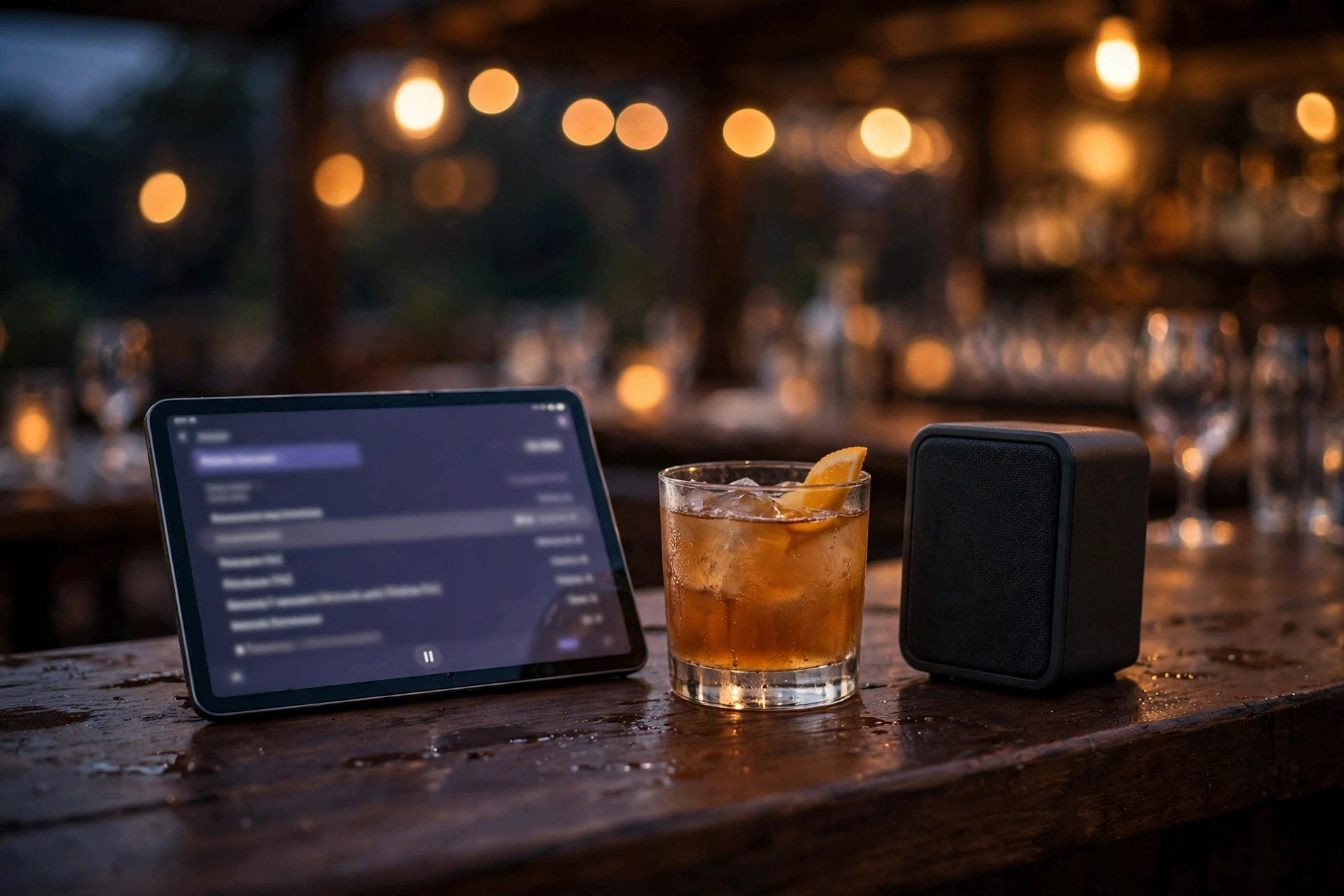
A restaurant is not one room through the day. It is four different rooms that happen to share the same tables: the morning coffee crowd, the lunch rush, the quiet afternoon, and the evening service. Each one needs its own sound, and the most common mistake in restaurant music is using one playlist for all four.
Morning: wake the room gently
For cafés and breakfast service, keep the tempo at 70–85 BPM with acoustic and mellow material, volume low enough that a newspaper reader forgets it is there. The morning guest wants calm and a sense of the day starting well. This is also the service where regulars form their strongest habits — the same gentle opening playlist every morning becomes part of why they come back.
Lunch: energy and turnover
Lunch is a throughput business. Raise the tempo to 90–110 BPM, lift the volume slightly, and choose familiar, upbeat tracks that keep the room moving. Guests at lunch are on the clock; the music should respect that instead of fighting it. If your lunch service is slow, the music is not the main problem — but the wrong tempo will not help either.
Afternoon: the long tail
The afternoon is where many restaurants lose money quietly: a few tables, a lot of empty chairs, and a playlist still running at lunch energy for nobody. Drop the tempo back to 75–85 BPM, lower the volume, and let the room breathe. Afternoon guests are often working, meeting, or lingering over coffee — they stay longer when the room feels calm, and a lingering guest with a laptop is still a guest who orders a second coffee.
Evening: the main event
Evening is where sound branding earns its money. Start at 75–85 BPM as the first tables arrive, drift down toward 60–72 BPM as the dining room fills and the wine starts flowing, and only raise the energy again if the concept calls for it — a bar that turns into a late-night venue, for example.
Licensing: the legal part most owners skip
Here is the part that costs real money if you get it wrong. Playing music in a restaurant is a public performance, and a personal streaming subscription does not cover it. Spotify's own terms limit its service to personal, non-commercial use, and Premium changes nothing — it removes advertising for the subscriber, it does not add public-performance rights. The same applies to Apple Music, YouTube, and every other consumer service. If customers can hear it, it needs a business licence.
Who collects the money in the Nordics
Music has two sets of rights, and in the Nordics they are collected by different organisations in each country. The songwriting — the composition — is handled by Teosto in Finland, STIM in Sweden, and TONO in Norway. The recording — the actual performance on the track — is handled by Gramex in Finland, SAMI in Sweden, and Gramo in Norway. A venue that plays recorded music generally needs licences from both sides, and the fees depend on the size of the room, the type of venue, and how the music is used.
The practical consequence is that "I pay Spotify" is not a defence, and neither is "I only play the radio" — radio in a commercial room is still a public performance. The collecting societies do inspect venues, and the fines for unlicensed use in the US system start at $750 per song; Nordic societies work differently, but backdated licence fees and penalties for a year of unlicensed playing can still run into thousands of euros. Check your own situation with your national society before assuming you are covered.
The easy route: a business music service
Most small restaurants solve licensing by subscribing to a business music service, which bundles the necessary rights for its catalogue into the subscription. The best-known is Soundtrack Your Brand — built by former Spotify engineers, and the company behind the Stockholm study — with prices typically in the range of €30–€50 per month per zone (estimates; check current pricing before signing). Cloud Cover Music is the budget option at roughly €17–€40 per month, and Rockbot sits around €20–€50 with guest song requests built in. All three offer scheduling by time of day, curated playlists, and multi-zone control, which is exactly the tooling a daypart strategy needs.
Read the fine print before choosing: coverage varies by market and by contract, and a service that is fully licensed in the US may rely on your own direct licences for some rights in the Nordics. Ask the provider, in writing, what is covered in your country, and keep the answer. If you run live music, DJs, or karaoke, those need separate arrangements — a background-music subscription does not cover a band.
Licensing checklist for a Nordic restaurant
Stop using personal streaming accounts in the dining room — today, not eventually. Confirm whether your business music service covers both composition and recording rights in your country, or whether you need direct licences from Teosto/Gramex, STIM/SAMI, or TONO/Gramo. Keep the licence documents where your manager can find them. Budget roughly €20–€50 per month for a single-zone business service, plus any direct society fees for your venue size. And remember: the licence is a cost of doing business, like the coffee machine — the alternative is a fine, not a saving.
Choosing a music service
There are three realistic options for a small restaurant: a business streaming service, a royalty-free catalogue, or doing it yourself with direct licences. The right choice depends on how much control you want and how much time you will actually spend on music each week.
| Option | Typical cost (estimate) | Licensing | Best for |
|---|---|---|---|
| Business streaming (Soundtrack, Cloud Cover, Rockbot) | €17–€50/month per zone | Bundled for the catalogue, varies by country | Most restaurants: legal, scheduled, low effort |
| Royalty-free catalogue | From ~€25/month per location | Included for the catalogue; no society fees on those tracks | Venues that want a fixed cost and do not need chart hits |
| Own playlists + direct licences | Society fees by venue size, often €100s/year | Yours to arrange with Teosto/Gramex, STIM/SAMI or TONO/Gramo | Multi-site groups and venues with a very specific sound |
| Personal Spotify / Apple Music | ~€11/month | None — not legal for commercial use | Nobody. Do not use it. |
For a single restaurant, a business streaming service is almost always the right answer: it is legal, it schedules itself, and it costs less than one table's dinner bill per month. Royalty-free catalogues make sense if you want a distinctive sound without chart music — ambient and instrumental catalogues suit fine dining and cafés well, and the flat fee is predictable. The do-it-yourself route only pays off at scale, when you have several venues and a manager who genuinely enjoys programming music.
Hardware: the unglamorous part that matters
A great playlist through bad speakers is a bad playlist. You do not need audiophile equipment, but you do need even coverage: small ceiling or wall speakers spread through the room beat one loud speaker by the bar, because volume is even and no table sits in a dead spot or a blast zone. If you have a terrace, give it its own zone with its own volume control — the terrace in July and the dining room in January are different rooms. Test the sound from the worst table in the house, not from the bar, and check it again when the room is full: a room full of people absorbs sound, and the volume that was right at 17:00 is wrong at 20:00.
Live music: a different decision
Live music is a marketing event, not a background-music decision. A jazz trio on Friday nights or an acoustic set on the terrace can be the reason guests choose your restaurant — but it changes the economics (musician fees, typically €150–€400 per evening for a small act, as an estimate), the licensing (live performance rights), and the room (a band needs space, and the tables near it become the loud tables). Treat live music as a scheduled event with its own promotion, and read our guide to loyalty events for how to make a recurring night pay. Do not let a band become the default soundtrack by accident.
Your one-page sound guide
All of this collapses into a single page that lives by the till, in the staff handbook, and in the music app. If a new employee can run your soundtrack from it on their first shift, it is good enough. If only you know how the music works, it is not a system — it is a habit, and habits break on your day off.
What goes on the page
Start with the concept sentence and the three feeling words from the first section. Then list the playlists by daypart, with the service, the tempo range, and the volume setting for each: morning, lunch, afternoon, evening, and late night if you have one. Add the hard rules: maximum volume, no explicit lyrics before 21:00, no repeating an artist within the hour, and what to play when the system fails (a named fallback playlist, not silence and not someone's phone). Name the person responsible for the music each week, and the date of the next quarterly review.
How to measure whether it works
Music is measurable if you measure the right things. Pick one metric per goal and watch it for a month after each change. If the goal is longer stays and higher bar spend, watch average dwell time and drinks per cover from your till data. If the goal is faster lunch turns, watch covers per hour between 11:30 and 13:30. If the goal is atmosphere, ask guests directly — a single question on the feedback card, "How was the atmosphere today?", tells you more than any analytics dashboard. And run the blindfold test from the concept section every quarter: if a stranger can guess your restaurant from the sound alone, the brand is working.
Finally, remember that your website has to sound like your dining room too. The words on your site, the photos, and the music in the room are all the same brand speaking — if the site promises a calm, elegant evening and the dining room plays chart pop at full volume, one of them is lying. Our guide to restaurant brand identity covers the visual half of that promise, and if your website is not yet pulling its weight, a site that brings in table bookings starts with PowerfulWebsite — the build is free, and plans run from €59 to €239 per month including hosting, maintenance, and updates.
Frequently asked questions
Can I play Spotify in my restaurant?
No. A personal Spotify account — including Premium — is licensed for personal, non-commercial use only, and its terms explicitly forbid playing it in a business. You need a business music service such as Soundtrack Your Brand, Cloud Cover Music, or Rockbot, or direct licences from your national collecting societies (Teosto and Gramex in Finland, STIM and SAMI in Sweden, TONO and Gramo in Norway).
How loud should restaurant music be?
Quiet enough that guests can talk at a normal volume without raising their voices, and staff do not need to shout across the pass. A practical test: stand at the farthest table during a full service and hold a normal conversation. If you have to lean in, it is too loud. Write the volume setting down so every shift keeps it the same.
What tempo works best for a restaurant?
It depends on the job of the hour. Slow music at 60–72 BPM keeps guests seated longer and supports drinks and dessert orders, which suits dinner service. Upbeat music at 90–110 BPM moves the room faster and suits busy lunches where turnover matters. Most restaurants should schedule both, changing tempo with the daypart rather than running one playlist all day.
How much does licensed restaurant music cost?
A business music service typically costs roughly €17–€50 per month per zone, depending on the provider — Soundtrack Your Brand at the higher end, Cloud Cover Music at the lower end (estimates; check current pricing). Direct licences from the collecting societies are priced by venue size and type, and often run into hundreds of euros per year. A personal streaming account at ~€11 a month is cheaper but not legal for commercial use.
Does music really increase restaurant sales?
The best evidence says yes, when the music fits the brand. A 2017 Stockholm study across 16 restaurants and nearly 1.8 million transactions found brand-fit music lifted revenue by 9.1% compared with randomly chosen popular songs, with desserts up 15.6% and beverages up 7.6%. Tempo studies also show slow music lengthens stays and raises bar spend, while fast music turns tables faster. Treat these as directional evidence, not guarantees — your own till data is the final judge.
Should my restaurant play the same music all day?
No. Your dining room is a different room at breakfast, lunch, afternoon coffee, and dinner, and the soundtrack should change with it. Schedule separate playlists per daypart — gentle in the morning, upbeat at lunch, calm in the afternoon, slow and warm in the evening — and programme the changes by the clock so they happen whether or not anyone remembers.
Want a website that sounds like your restaurant?
PowerfulWebsite builds your restaurant's website for free — you only pay from €59/month. Everything included: domain, hosting, maintenance, and updates, with booking and ordering built in on the Restaurant plan at €239/month.
See the packages