Restaurant Newsletter Ideas: 12 Topics That Get Opened
The restaurant newsletters that get opened are not the ones with the most news — they are the ones with one clear reason to open: a new menu, a subscriber-only table, a dish worth leaving the house for. This guide gives you 12 such topics, with subject lines, timing and a full-year calendar, so you never stare at a blank email again.
Key takeaways
- One newsletter, one message, one action — newsletters that announce five things get none of them read.
- The 12 strongest topics mix money-makers (new menus, events, subscriber-only offers) with relationship-builders (behind the scenes, supplier stories, staff picks).
- Once or twice a month beats weekly sending for most independent restaurants; more than that usually raises unsubscribes.
- Subject lines should promise one concrete thing, not summarise the whole email — curiosity plus specificity wins.
- Under GDPR, every subscriber must have actively consented, and every email must carry a one-click unsubscribe.
- Your list is the only marketing channel you truly own: no algorithm decides whether your regulars see it.
Every restaurant owner knows the feeling. You spend an evening writing a newsletter, send it to 800 people, and watch the open rate land somewhere embarrassing. Then you conclude that email does not work, and go back to posting on social media and hoping the algorithm is kind. That conclusion is wrong, but understandable: most restaurant newsletters fail for fixable reasons. They arrive too often, say too much, promise nothing in the subject line, and read like a company announcement rather than a reason to book a table.
This article is about the other kind. It covers the 12 newsletter topics that consistently earn opens for independent restaurants, cafés and bars — drawn from what actually ranks, what practitioners report, and what fits a Nordic restaurant's reality: small teams, seasonal menus, GDPR, and guests who value honesty over hype. For each topic you get what to include, a subject-line example, and when to send it. Later sections cover frequency, subject lines, list building, segmentation, measurement and a full 12-month calendar you can copy. If you are starting from zero subscribers, read our guide to building an email list from zero, GDPR-safe first, then come back here for what to send.
Why most restaurant newsletters go unopened
Before the 12 topics, it helps to understand why the average restaurant email underperforms. The inbox is not a noticeboard; it is a triage ward. Your guests scan sender names and subject lines in seconds and delete anything that looks like work. Three mistakes account for most failures.
The announcement trap
Many restaurant newsletters read like internal memos: opening hours changes, a new supplier, a staff rota note, a paragraph about values. None of that is a reason to open an email. Guests open emails that promise something for them — food they want, a table they want, a price they want, an evening they want. Every topic in this guide passes that test: it answers the reader's silent question, "what is in this for me?"
The five-announcements problem
The most common structural mistake is packing one email with five unrelated items: a new menu, an event, a job advert, a holiday greeting and a discount. Readers do not read five things; they read none, because the email has no clear point. Experienced email marketers repeat one rule: one send, one offer, one call to action. If you ask people to do two things, they often do neither. The rest of the email exists to make that one thing desirable.
The stranger problem
Emails from a generic brand name, with no human voice and no memory of the reader, feel like spam even when they are technically consented. The fix is cheap: send from a name people recognise (your restaurant's name, or better, the owner's or chef's name plus the restaurant), write like a person, and reference things your guests actually know — the dish they loved, the season, the neighbourhood. A newsletter that could have been sent by any restaurant in any city will be treated like one.
Your guests do not open newsletters. They open reasons: a dish, a table, an evening, a price.
The 12 topics that get opened
Here they are, roughly in order of booking power. You do not need all 12 every month — rotate them across the year, and let the calendar in the final section do the planning for you. Each topic includes what to put in it and a subject line to steal or adapt.
1. The new menu or seasonal dish launch
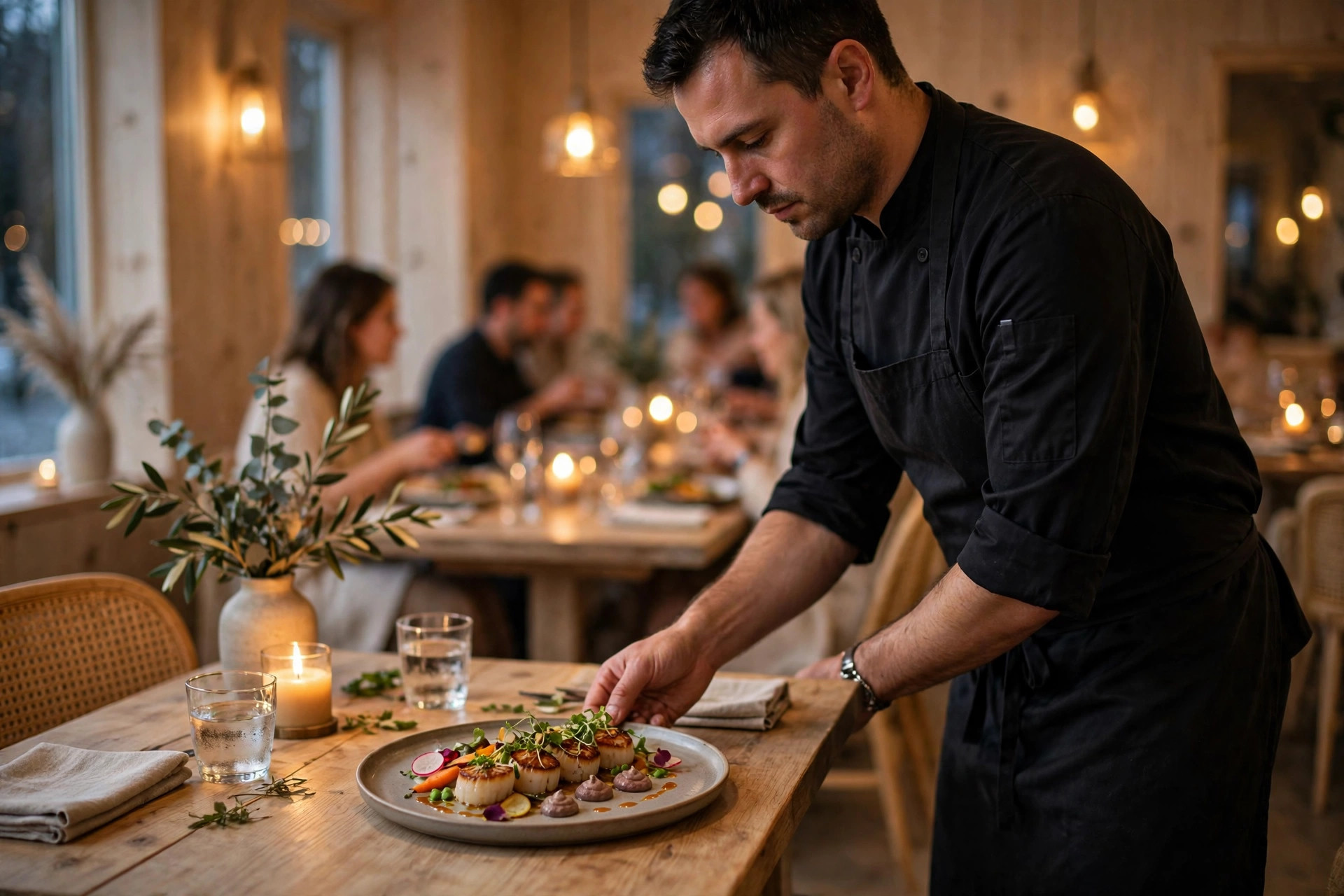
This is the single strongest restaurant newsletter topic, and it is the one most restaurants underuse. A new menu is news your guests can taste. Lead with one hero dish, photographed properly, with a short story: why this dish, why now, what is in it. Name the ingredients and the supplier if they are interesting — Nordic guests care about provenance, and "chanterelles from a forager in Savo" beats "seasonal mushrooms" every time. Add the practical details: from which date, whether booking is recommended, and one booking button. Send it a few days before the menu launches, not on the day, so readers can plan. Subject line: "Our autumn menu lands Thursday — and one dish is already selling out."
2. The subscriber-only offer
Exclusivity is the reason to subscribe in the first place. A subscriber-only offer can be a free dessert with a main course on a quiet Tuesday, a two-for-one lunch in the first week of a new menu, or early access to a popular event. Keep two rules: make it genuinely unavailable elsewhere (if the same code is on Instagram, it is not exclusive), and give it a deadline. Offers without deadlines get saved for later and forgotten. One caution: do not train guests to wait for discounts. Use subscriber offers monthly at most, and alternate them with non-discount topics, or your full-price Fridays will start to look like the exception. Subject line: "Subscribers only: dessert is on us this Tuesday."
3. The event invitation
Wine tastings, chef's table evenings, live music nights, beer-pairing dinners, Christmas table bookings — events are the newsletter's natural territory because they have a date, a capacity and a deadline, which is exactly what an email needs to convert. Give the date, the price, what is included, and how many seats remain (if true). Send the first invitation two to three weeks ahead, then one reminder a week before, and only to people who have not yet booked. For more on filling the room, see our guide to marketing your seasonal menu, which covers the same launch logic. Subject line: "12 seats, one night: our game dinner on 14 November."
4. Behind the scenes: a day in your kitchen
Guests are far more curious about kitchens than owners expect — the success of kitchen dramas and chef documentaries proves it. A short behind-the-scenes email builds the relationship that makes the next offer email work: a photo of the morning bread bake, a note on how a dish was developed, a profile of a cook or a bartender. Keep it short and visual, and always end with something bookable, even if it is just "come and taste it this weekend". This topic rarely sells a table on its own, but it is what keeps people subscribed between the selling emails. Subject line: "What 5 a.m. looks like in our bakery."
5. The supplier or ingredient story
Nordic diners reward restaurants that can say where their food comes from. A supplier story — the fisherman, the farm, the small brewery, the mushroom forager — gives your restaurant a story no chain can copy, and it flatters the supplier, who will often share the email with their own audience. Visit the supplier if you can, take real photos, and quote them in their own words. One supplier story per quarter is plenty; more than that and the newsletter starts to read like a trade magazine. Subject line: "The cheese in tonight's special comes from one farm. We went to see it."
6. The recipe or cooking tip
Sharing a recipe feels counterintuitive — why give away what you sell? Because a guest who cooks your simplified home version on a Tuesday is more, not less, likely to book the real thing on Saturday, and because recipes are the most forwarded and saved type of restaurant content. Pick a simple dish or a signature sauce, write it for a home kitchen, and be honest about what will differ at home. A monthly recipe also gives lapsed subscribers a reason to stay: even if they cannot visit this month, the email is still useful. Subject line: "Our brown butter sauce, in five steps, for your kitchen."
7. Staff picks: what we actually eat and drink
A short "what the team orders" email is fast to write and surprisingly persuasive, because it replaces marketing language with personal taste. Ask three staff members for their current favourite dish and drink, with one sentence each on why. It works especially well for drinks lists and specials that guests otherwise overlook. It also gives your team a visible role, which most staff enjoy — just check with them before publishing names or photos. Subject line: "We asked the kitchen what they order. The answers surprised us."
8. The birthday, anniversary or "we miss you" email
Automated personal emails are a different species from newsletters, but they belong in this list because they have the highest open rates in restaurant email. A birthday email sent a week before the date, offering a free dessert or a glass of sparkling wine, converts well because it arrives with a built-in occasion. A "we miss you" email to guests who have not visited in 60 to 90 days, with a simple reason to return, is the cheapest win-back campaign a restaurant can run. Both need only a birth date or a last-visit date, collected with consent at booking or signup. Subject line: "Your birthday is coming. Dessert is on us."
9. The local guide or neighbourhood round-up
Position your restaurant as the local expert: a short guide to the neighbourhood — the market, the theatre, the walk before dinner, the bar after. This topic works because it is useful even to people who are not planning a visit this week, and because it gets forwarded to friends planning a trip. Keep it genuinely local and specific; a generic city guide adds nothing. Mention partner businesses by name, and they may return the favour. Subject line: "The perfect Saturday in our neighbourhood, dinner included."
10. The seasonal calendar: what is coming, and when to book
Twice a year, send a forward-looking email: the seasons ahead, the events planned, the dates that always sell out (Valentine's Day, Mother's Day, New Year's Eve, the Christmas table season). Guests who plan ahead are your best guests, and this email tells them exactly when to act. It also reduces the annual panic of "we forgot to promote Christmas until November". Pair it with early-booking incentives for the dates you most want to fill. Subject line: "The six dates that sell out every year — and when to book them."
11. The question, poll or vote
Ask readers to choose: which dish should return to the menu, which cocktail should be the summer special, what should the new dessert be called. A vote email gets replies, and replies are gold — they improve deliverability, they tell you what guests want, and they turn passive subscribers into participants. Announce the winner in the next email, and put the winning item on the menu, or the exercise was theatre. Keep the vote to one question with two or three options; a survey is homework, a vote is fun. Subject line: "You decide: which dish comes back?"
12. The honest update: renovations, closures, new openings
Guests forgive closures and changes when they hear about them first and directly. A renovation update, a holiday closure notice, a new location announcement — these emails get opened because they contain practical information people need. Be specific about dates, what changes, and what stays the same, and give readers something to look forward to: a reopening evening, a first-week offer, a photo of the work in progress. The worst version of this email is the one guests never receive and learn about from a locked door. Subject line: "We close for two weeks in January. Here is why — and what returns."
How often should you send?
The honest answer is: less often than you fear, more regularly than you manage. Practitioners and benchmarks converge on a similar range. Most independent restaurants do well with one newsletter a month plus one targeted message — an event invitation, a seasonal launch, a birthday or win-back email. That is one to two emails a month for most subscribers, with automated personal emails on top for the people they apply to. Some guides suggest up to two or three promotions a week plus a monthly newsletter, but that cadence belongs to larger operations with dedicated marketing staff and a constant stream of genuine news; for a small restaurant it usually ends in unsubscribes and a tired list.
What matters more than the exact number is regularity. A newsletter that arrives on the first Thursday of every month trains readers to expect it; a newsletter that arrives three times in one week and then disappears for four months trains them to ignore it. Pick a rhythm you can sustain for a year — monthly is a fine promise — and put it in your calendar before you promise it to anyone. If you have a genuinely urgent item, such as a sold-out date or a last-minute cancellation release, send it as an extra; readers forgive extras that are genuinely useful and punish extras that are merely promotional.
Watch one number as your early warning: the unsubscribe rate. If it creeps above roughly 1 to 2% per send, you are sending too often, to the wrong people, or about the wrong things. Do not panic over a single spike after a long silence — a list that has not heard from you in months will always shed some names — but a rising trend means it is time to cut frequency or improve targeting before you damage the list further.
Pick a rhythm you can keep for a year. Monthly and reliable beats weekly and exhausted.
Subject lines that earn the open
The subject line is the whole game, because it is the only part of your email most people will ever read. A few principles, drawn from what practitioners consistently report, will improve yours immediately.
Promise one concrete thing
"October newsletter" promises nothing. "Our mushroom menu is here" promises a meal. Specificity beats cleverness: name the dish, the date, the offer. If the email's best sentence is buried in paragraph three, move it to the subject line.
Keep it short enough for a phone
Most inboxes cut subject lines at around 40 to 50 characters on a phone screen. Front-load the important words — "Free dessert Tuesday" beats "This Tuesday, we have a special offer for our subscribers". Test how yours looks on your own phone before sending.
Use curiosity, not clickbait
A question or a mild tease works — "You decide: which dish comes back?" — as long as the email answers it honestly. Clickbait that overpromises ("You won't believe what we did!") trains readers to distrust you, and distrust is the one thing a newsletter cannot recover from.
Send from a name people recognise
The sender name matters as much as the subject line. "Sofia at Bistro Aalto" will usually outperform a bare brand name, because it looks like a person, not a system. Keep the sender name consistent so readers learn to recognise it, and keep the sending address on your own domain rather than a free mailbox.
Timing: test, but start with the safe windows
Tuesday to Thursday, late morning (around 10:00 to 12:00) or late afternoon (around 16:00 to 18:00), is the most commonly recommended window — inboxes are calmer than on Monday, and late-afternoon sends catch people while they are deciding where to eat. Some practitioners report Thursdays performing best. Treat all of this as a starting point: after a few sends, your own data will tell you when your guests open, and that beats any general rule.
The anatomy of a newsletter people finish
A good restaurant newsletter has a simple shape. It opens with the point — the dish, the date, the offer — in the first two lines, because many readers will never scroll further. It follows with one short story or one good photo that makes the point desirable. It ends with one button: book a table, reserve a seat, claim the offer. Everything else is optional, and most of it should be cut.
Design matters less than owners fear, but mobile matters more. Most of your readers will open on a phone, so use one column, large text, one hero photo rather than a collage, and buttons big enough to tap. Keep the email short enough to read in under two minutes; if it takes longer, it is two emails, and you should send the second one next month. Always include your address, your opening hours link, and a one-click unsubscribe — the last one is a legal requirement under GDPR and a trust signal besides.
The 60-second newsletter check
- Can a stranger tell what this email is about from the subject line alone?
- Does the first screen contain one clear action — book, reserve, claim?
- Would you open this if it came from a restaurant you liked but had not visited in months?
- Is there exactly one button, not four?
Growing your list without breaking GDPR
A newsletter is only as good as its list, and a list built badly is a liability. Under GDPR, you need a lawful basis for email marketing, and for newsletters that almost always means consent: the person actively agreed to receive your emails, you told them what they would receive, and you recorded it. Pre-ticked boxes do not count. Neither do business cards dropped in a bowl for a different purpose, or email addresses copied from booking systems without permission.
The practical collection points are simple: a signup form on your website (ideally on every page, not buried on a contact page), a short form or QR code at the table and the counter, a consent checkbox at online booking, and a signup prompt on your Wi-Fi landing page. Offer a reason to subscribe that is honest and specific — "our monthly menu letter, plus subscriber-only tables" — rather than a vague "join our newsletter". A small incentive helps: a welcome drink on the next visit is a classic, but keep it modest, or you will collect bargain-hunters who unsubscribe after claiming it.
Two things to never do: buy a list, and add every customer who ever booked a table. Purchased lists contain people who never consented, and their complaints and spam reports will damage your sender reputation — the invisible score that decides whether your emails reach the inbox at all. A smaller list of people who genuinely want your emails will outperform a large list of strangers on every metric that matters: opens, bookings, and revenue per send. Clean your list regularly, too: remove hard bounces immediately, and after a year of no opens, send one last "do you still want to hear from us?" email before removing the silent names. A list that shrinks by a third and doubles its bookings is a success, not a failure.
Segmentation: one list, many newsletters
Segmentation sounds like enterprise software, but for a small restaurant it means one simple thing: do not send everyone the same email. At minimum, split your list into three groups: regulars, new subscribers, and lapsed guests. Regulars get early access and insider topics; new subscribers get a short welcome sequence (a hello, a story, an invitation) before they join the main newsletter; lapsed guests get win-back emails with a reason to return, not the standard newsletter they already ignored.
If you collect one more piece of information — dietary preference, neighbourhood, lunch versus dinner — you can go further: vegetarians hear about the new plant-based menu first, lunch guests hear about the lunch offer, event lovers hear about the tasting evening. You do not need expensive tooling for this; most email tools support simple tags, and a restaurant with a few hundred subscribers can manage tags in a spreadsheet. The rule is to segment only as far as you will actually use: five segments you never mail differently are worse than two segments you do.
Segmentation also protects your sender reputation. Targeted emails get opened more, and opened emails teach mailbox providers to trust your future sends. The reverse is also true: blasting your whole list with irrelevant offers teaches providers to filter you. Relevance is not just good marketing; it is deliverability.
What to measure (and what to ignore)
Four numbers tell you almost everything: the open rate (are subject lines and sender names working?), the click rate (did the email make people act?), the unsubscribe rate (are you sending too much or too irrelevantly?), and bookings attributed to the email (did it make money?). For bookings, the simplest method is a dedicated booking link or a code in each email, so you can count what came from it without expensive attribution software.
Hospitality benchmarks typically put a healthy open rate between roughly 20% and 40%, with a click rate around 2 to 3%. Treat those as orientation, not targets: a list of 200 loyal regulars should open far above a list of 5,000 casual signups, and a birthday email will outperform a general newsletter every time. Compare each email with your own previous emails, not with industry averages. One metric to mostly ignore is the total subscriber count: it flatters you while hiding the truth, which is how many of those people still open, click and book.
After every send, spend ten minutes on three questions: which subject line would I test next time, which segment responded best, and what one thing will I change in the next email? Newsletters improve by iteration, not by redesign. A restaurant that sends twelve steadily improving newsletters a year will outperform one that sends two ambitious ones and gives up.
Compare each email with your own last one, not with industry averages. Improvement compounds; perfection stalls.
Your 12-month newsletter calendar
Here is a ready-made year. It assumes one newsletter a month plus the automated personal emails (birthdays, win-backs) running quietly in the background. Swap topics to fit your own seasons, but keep the rhythm: one selling email, then one relationship email, alternating through the year.
| Month | Topic | Why now |
|---|---|---|
| January | The honest update: what returns after the break | Reopen with a story, not silence |
| February | Valentine's and the seasonal calendar | Early booking for the dates that sell out |
| March | Supplier story: spring's first ingredients | Relationship-building before the busy season |
| April | New menu launch | Spring menus deserve a proper announcement |
| May | Event invitation: terrace opening or tasting evening | Outdoor season is a natural event |
| June | Staff picks and the summer drinks list | Light, personal, highly shareable |
| July | Local guide: summer in the neighbourhood | Tourists and staycation guests plan now |
| August | Subscriber-only offer for the quiet weeks | Fill the late-summer dip before it arrives |
| September | New menu launch: autumn | The strongest selling email of the year |
| October | Behind the scenes: how a dish is developed | Builds appetite for the Christmas season |
| November | Christmas tables and the seasonal calendar | Christmas bookings decide December revenue |
| December | Recipe gift + New Year invitation | Ends the year generously, opens the next |
Notice what the calendar does: it never asks you to invent news. Every month has a natural reason to write, because restaurants always have a season, a dish, a supplier, an event or a date approaching. If a month looks empty, the answer is usually not a better topic but a better look at your own calendar — the quiet weeks are exactly when an email earns its keep.
Mistakes that kill open rates
Five mistakes recur so often they deserve a checklist of their own. First, sending without consent or without an unsubscribe link — illegal under GDPR, and fatal to your sender reputation. Second, the "monthly newsletter" that is actually a PDF attachment or a wall of text with no button; if readers cannot act in one tap, they will not act at all. Third, discount-only emails, which train guests to never pay full price. Fourth, silence: a list you have not emailed in six months is a list you must win back, not a list you can sell to. Fifth, and most common, the email that tries to say everything. If your draft has five topics, pick the strongest one, send it, and save the rest for the next four months. Your future self will thank you.
One more, specific to the Nordics: sending in English only when half your guests speak Finnish, Swedish or Norwegian. If your guest base is multilingual, either segment by language or keep the email short and visual enough that language matters less. A beautiful photo of a dish needs no translation; a paragraph of wordplay does.
Finally, remember what the newsletter is for. It is not a content obligation or a brand exercise. It is the cheapest way to fill a quiet Tuesday with people who already like you. Start with one topic from this list, send it to the list you have — even if that list is forty people — and improve from there. Forty people who open are worth more than four thousand who do not. And if you need a website that turns those opens into bookings, with online ordering and a booking flow that works on a phone, PowerfulWebsite builds restaurant websites free — you pay only the monthly plan, from €59/mo, with everything included.
Frequently asked questions
How often should a restaurant send a newsletter?
For most independent restaurants, once or twice a month is the sweet spot: one regular newsletter plus one targeted message, such as an event invitation or a seasonal menu launch. Sending more often than weekly usually pushes unsubscribe rates up, while sending less than monthly means guests forget who you are.
What is a good open rate for a restaurant newsletter?
Hospitality email benchmarks typically put a healthy open rate between roughly 20% and 40%, with smaller, well-targeted lists at the higher end. If your open rate is under 15%, check your subject lines, your sender name and whether your list still contains people who never asked to hear from you.
What should a restaurant newsletter include?
One clear message, one clear action. Lead with the single most useful thing — a new menu, an event, a subscriber-only offer — then support it with one short story or photo. Newsletters that try to announce five things at once usually get none of them read.
How do restaurants build an email list under GDPR?
Collect explicit consent: a signup form on your website, a card at the table, or a checkbox at booking that is not pre-ticked. Record when and how each person consented, send only what they signed up for, and include a one-click unsubscribe in every email. Never buy a list — those people never consented, and complaints will damage your sender reputation.
Is email better than social media for restaurants?
They do different jobs. Social media is best for discovery and reaching people who have never visited; email is best for turning past guests into repeat guests, because it reaches people who already chose to hear from you and it is not filtered by an algorithm. Most restaurants need both, but email is where bookings most reliably come from.
What is the best day and time to send a restaurant newsletter?
Tuesday to Thursday, late morning or late afternoon, works well for most restaurants: inboxes are calmer than on Mondays, and late-afternoon sends catch people while they are deciding where to eat. Test your own list, though — a lunch spot and a fine-dining restaurant have different rhythms, and your own open-rate data beats any general rule.
Want a website that turns readers into bookings?
PowerfulWebsite builds your restaurant website free — you pay only the monthly plan from €59/mo. Everything included: domain, hosting, maintenance and updates, plus online ordering on the Restaurant plan.
See the packages