Sell Your Private Dining Room Online
Selling your private dining room online means giving event bookers everything they need to say yes without calling you: real photos of the room, honest capacities, sample menus with prices, your food and beverage minimums, and an enquiry form that captures the details in one go. Most restaurants under-sell their private room because their website shows a single photo and a phone number — the venues winning the corporate and celebration trade publish the full package and let the room sell itself around the clock.
Key takeaways
- Your private room is likely your highest-margin space: one booking, predictable covers, premium pricing, and guests who arrive ready to spend.
- Event bookers decide on five things: capacity and layouts, menus with real prices, privacy level, practical details (AV, accessibility, location), and how fast you respond.
- A private dining page needs real room photos, honest capacities, sample menus, published minimum spends and a structured enquiry form — not a phone number and a stock photo.
- Minimum spends beat room hire fees for most restaurants: they frame the conversation around the experience, not a charge for an empty room.
- Speed wins enquiries: respond within a few hours with a concrete proposal, not a "let's schedule a call". Bookers shortlist 3–4 venues and pick the responsive one.
- In the Nordics, the corporate Christmas season (pikkujoulut / julbord / julebord) is the private dining jackpot — market it from September, not November.
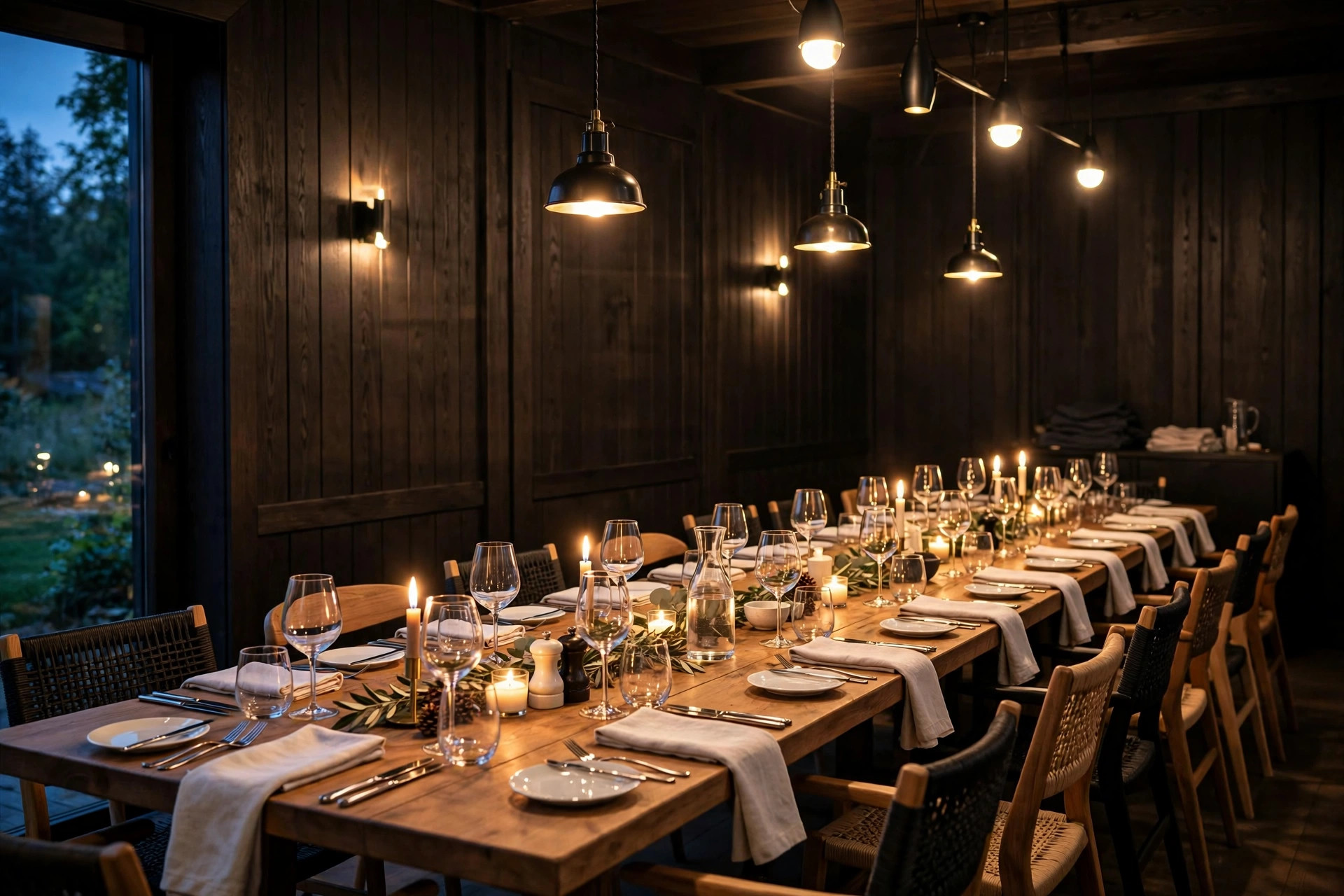
Somewhere in your restaurant there is a room, a mezzanine or a curtained-off corner that sits empty four nights a week while you worry about filling tables. Meanwhile, across town, an office manager is googling "private dining room" for the company Christmas party, clicking through venues, and booking the one whose website answered her questions. That booking — twenty people, a set menu, wine pairings, a minimum spend of a few thousand euros — is the single most profitable reservation your restaurant can take. And most restaurants lose it to a competitor with a better web page.
This guide is the complete playbook for selling your private dining room online: the economics that make it worth the effort, what event bookers actually look for, the anatomy of a private dining page that converts, pricing models with real numbers, the enquiry-to-booking workflow, Nordic seasonality, and where your website fits next to marketplaces. Written for independent restaurants in the Nordics, but the mechanics work anywhere event bookers have a browser.
Why your private room is your best table
Run the numbers on a private dining booking and the case makes itself. A twenty-person event at a €60 average spend is €1,200 in one reservation — booked weeks in advance, with the menu chosen ahead, the wine pre-selected, and a deposit already paid. Compare that with earning the same €1,200 from ten separate tables of two: ten confirmations, ten table turns, ten bills, ten chances for a no-show. The private room concentrates your revenue into a single, predictable, high-trust transaction.
The margins are better too, for structural reasons:
- Predictable covers, predictable costs. You know the headcount and the menu days ahead. Food cost is plannable, staffing is plannable, waste drops.
- Premium pricing is normal. Event bookers expect to pay for exclusivity. A set menu at €65 per person for a private event feels standard; the same menu at €65 in the main dining room might feel expensive. The room itself justifies the price.
- Drinks attach at high rates. Welcome drinks, wine pairings, a bar tab with a cap — private events drink more per head than regular tables, and drinks are your best margin.
- Off-peak value. Private events can be steered to the nights you need: the Tuesday that dies, the January that everyone dreads. A full private room on a quiet Wednesday can double a midweek take.
- Zero acquisition cost per guest. You market to one organiser, and twenty guests walk through your door — many of them first-timers who may become regulars.
The catch is that none of this happens by accident. The room doesn't sell itself while it's invisible online. Event bookers — office managers, PAs, brides, birthday organisers — shortlist venues from their laptops, usually comparing three or four options in one sitting. If your website shows one dark photo and "call for availability", you're not in the comparison. You're the venue they skipped.
What event bookers actually want
Before building the page, understand the buyer. A private dining booker is not a diner choosing dinner — they're an organiser spending someone else's money (the company's, the family's, the wedding budget) and their own reputation. They're anxious about exactly five things, and your website needs to answer all five before they ever contact you:
1. Will we fit — and will it feel right?
Capacity is the first filter. Venue booking data shows private dining enquiries clustering around 20, 30 and 50 guests, with the sweet spot at about 20 — a single long table where everyone can talk. State your capacities honestly and in every configuration: seated dinner, cocktail/standing, and the room's dimensions if you have them. "Seats 24 for dinner, 40 standing" beats "perfect for events" every time. And be honest about the room's character: a booker choosing between your oak-panelled room and a competitor's white-box space is choosing on atmosphere, so describe it like a human, not a brochure.
2. What will it cost?
The second filter, and the one most restaurants hide. Bookers have a budget and a boss; "contact us for a quote" reads as "this will be expensive and take three days." Publish your food and beverage minimums per day of week, your set menu prices, and whether there's a room fee. You don't need to publish every permutation — a clear starting point ("private events from €1,500 minimum spend, menus from €55 per person" — your real numbers, labelled as starting points) lets a booker self-qualify in ten seconds. The ones who can't afford you filter themselves out; the ones who can arrive already half-sold.
3. What will we eat and drink?
Sample menus with real prices, plus drinks options: welcome drink packages, wine pairings, open-bar caps. Event menus should be simpler than your à la carte — 3 courses, limited choices, dietary alternatives built in. If you can show a sample Christmas menu in September, do it: December bookers are deciding now. For the operational side of running set menus for large parties, our group bookings playbook covers the kitchen and service mechanics in depth.
4. Is it actually private — and practical?
Bookers need to know the privacy level (fully enclosed room? curtained section? semi-private alcove?), plus the practical details that kill deals late: AV equipment and screens for speeches and presentations, microphone availability, wheelchair accessibility, parking and public transport, and whether the room has its own toilets. Corporate bookers in particular will ask about screens and mics — if you have them, say so loudly; if you don't, say what's possible.
5. Will this be easy to organise?
The organiser is doing this on top of their real job. A structured enquiry form, a named contact person, a response within hours, and a clear path from "interested" to "booked" is what separates the venue that gets the event from the venue with the nicer room. Ease beats elegance at the decision point.
The booker's five questions — answer all five on your page
- Fit: honest capacities in every configuration, room dimensions, real photos.
- Cost: published minimum spends, menu prices, room fee policy.
- Food: sample event menus with prices, drinks packages, dietary handling.
- Practical: privacy level, AV, accessibility, transport, toilets.
- Ease: structured enquiry form, named contact, fast response promise.
Anatomy of a private dining page that sells
Your private dining page is a sales page, not an information page. It has one job: turn a comparing booker into an enquiry. Here's the structure that does it, in order:
The hero: the room, the capacity, the price anchor
Open with your best photo of the room set for dinner — not an empty room, a set room with candles lit, because bookers are buying the evening, not the square metres. The headline states the offer plainly ("Private dining for 10–40 guests in the heart of [city]"), and the first screen includes the two numbers every booker scans for: capacity and the starting price ("events from €1,500"). Everything else is detail they can scroll to.
The gallery: set for dinner, set for drinks, the details
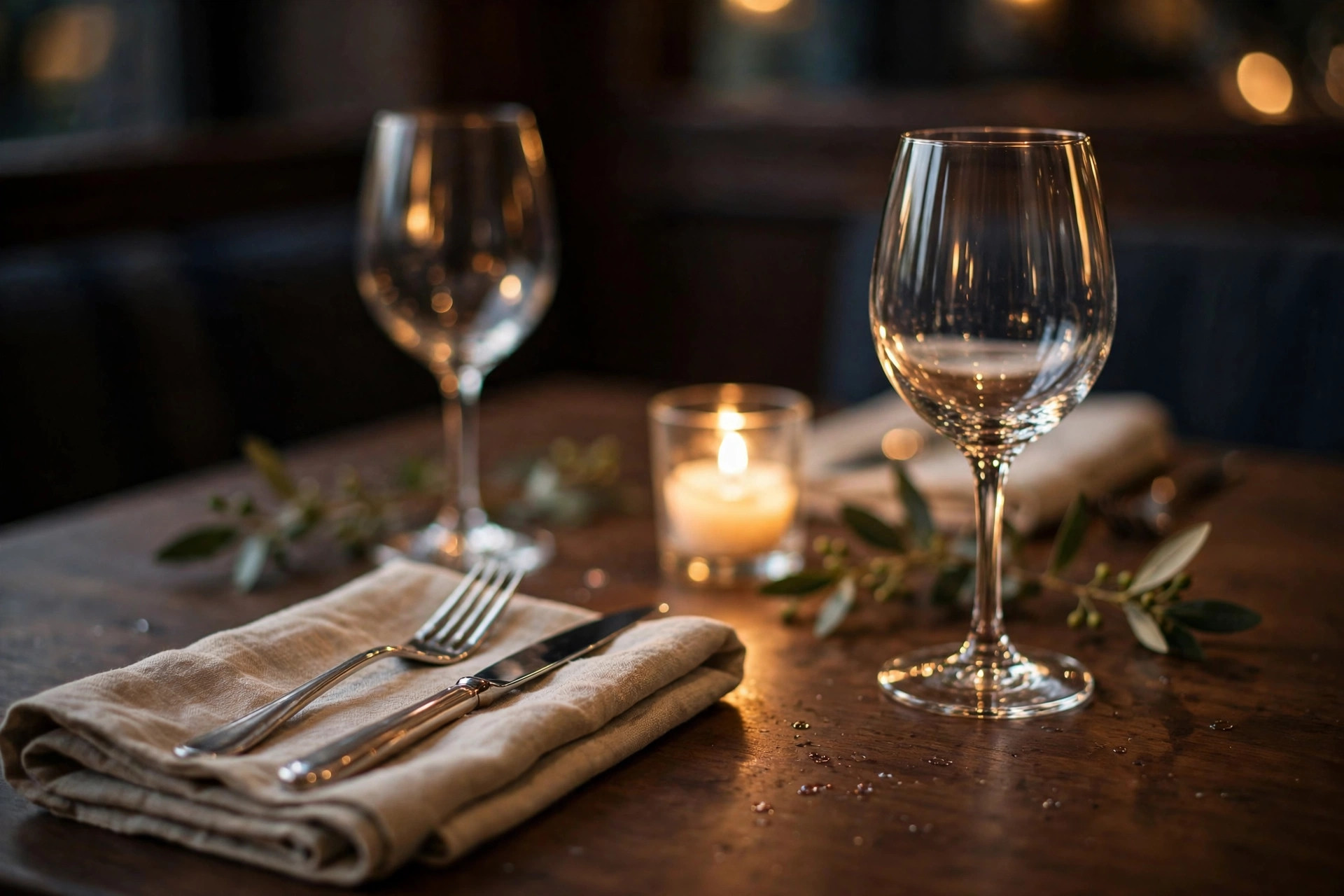
Eight to twelve photos minimum: the room set for a seated dinner, the room in cocktail configuration, table details (glassware, candles, place settings), the entrance or bar area guests will use, and — the photo most venues forget — the room with actual people in it, at an actual event. Empty rooms photograph smaller and colder than they are. If you've hosted events, ask a friendly organiser for permission to use two or three candid shots; they're worth more than any staged photography.
Capacities and layouts, stated plainly
A small table or list: seated dinner capacity, standing/cocktail capacity, whether the room splits, the configurations available (one long table, rounds, boardroom). If the room can be combined with an adjacent space, say so. Bookers are doing spatial maths in their heads — give them the numbers.
Sample menus with prices
Two or three event menus (e.g. a 3-course at one price point, a premium 4-course, a standing/canapé option) with per-person prices, plus drinks: welcome drink, wine pairing, open bar with a cap. Label them as samples — "menus change with the season; your event menu is confirmed with our team" — and keep them current. A 2024 Christmas menu still on the page in October 2026 tells the booker everything about how the venue is run.
Minimum spends, published per day
A simple line: "Food and beverage minimums: Monday–Thursday €X, Friday–Saturday €Y, Sunday €Z." This is the single highest-converting element on the page, because it's the question every booker has and almost no venue answers. (More on pricing models in the next section.)
The enquiry form — structured, not a blank box
Never use a generic "contact us" form for private dining. A dedicated enquiry form captures: event date (with 2nd and 3rd choice), guest count, occasion type (corporate, birthday, wedding, Christmas party, other), seating vs standing, menu interest, drinks plan, budget range, and contact details. Every field you pre-ask is a round of email you don't have to play. The form should also set expectations: "we respond within 4 business hours" — and then you must actually do it.
Trust signals and the fine print
A short FAQ on the page itself (deposits, cancellation terms, dietary handling, timing), your deposit and cancellation policy in plain language, and the practical details (AV, accessibility, transport). No invented testimonials — bookers can smell them, and in the Nordics understatement beats hype. Real specifics ("the room has hosted 200+ company dinners") beat adjectives.
Pricing models: minimums, packages, room fees
There are five common ways to price a private dining room. Most successful venues use a blend — typically a minimum spend as the foundation, with packages layered on top. Here's how they compare:
| Model | How it works | Best for | Watch out for |
|---|---|---|---|
| Food & beverage minimum | Guest commits to a minimum spend on food and drinks; the "price" of the room | Almost every restaurant — the industry standard | Set it against real revenue: too high and the room sits empty |
| Per-person packages | Fixed price per guest: e.g. 3-course menu + welcome drink + coffee for €X | Corporate bookers who need one number for approval | Drinks outside the package need clear rules |
| Room hire fee | Flat fee for the space, plus food and drinks on top | Daytime meetings, buyouts, low-spend events | Feels like paying for air; harder to justify than a minimum |
| Ticketed / per-seat pricing | Fixed price per seat for public events (wine dinners, chef's tables) | Ticketed public events you organise yourself | You carry the risk if seats don't sell |
| Dynamic / peak pricing | Higher minimums on peak dates (Fridays, December), lower off-peak | Venues with strong seasonal demand | Publish the bands — surprise pricing kills trust |
Setting the minimum: work backwards from the room
The minimum should approximate what the room would earn as normal tables on that night — that's the revenue you're giving up. A room that seats 20, at your average spend per head, over one seating: that's your Saturday minimum. Then discount it for quiet nights to steer demand where you need it — a Tuesday minimum at 60–70% of Saturday's fills the room on nights that would otherwise sit empty. Revisit the numbers twice a year; a minimum you set in 2024 and never touched is either losing you money or losing you bookings.
Packages: the corporate booker's love language
Corporate organisers need a single number to put in the approval email. Build two or three packages: a standard (3-course menu + welcome drink), a premium (4 courses + wine pairing), and a drinks-reception option (canapés + open bar with a cap). Price them per person, all-inclusive except extras, and quote them verbatim on the page. Packaging raises average spend (the welcome drink has excellent margin), removes price anxiety, and makes your quote instantly comparable — "€79 per person, everything included" beats a spreadsheet of line items.
Deposits and cancellation terms
Private dining deposits are near-universal: typically 25–50% of the minimum spend or a fixed per-person amount, due at booking, with the balance on the night or invoiced after. Publish the terms plainly: when the deposit is due, when it's refundable (free cancellation up to 14–30 days out is common for private events; inside that window the deposit is forfeited), and the final headcount deadline. A policy nobody saw is a policy nobody honours — put it on the page and repeat it in the confirmation. Our guide to deposits and card guarantees covers the mechanics and the wording that keeps it friendly.
From enquiry to confirmed booking
The page gets you the enquiry. The next 48 hours decide whether you get the event. Bookers shortlist three or four venues and pick the one that makes deciding easy — which usually means the one that responded first with something concrete.
The 4-hour rule
Respond within four business hours, every time. Not with "thanks, let's schedule a call" — with a concrete proposal: the room, the date, a suggested menu and package, the minimum spend for that night, and the next step ("I can hold the date until Friday — shall I send the booking confirmation?"). An enquiry that waits 48 hours for a reply has already booked your competitor. Assign one named person to own private dining enquiries; nothing kills conversion like a generic info@ inbox where enquiries go to be forgotten.
The proposal, not the phone call
Nordic bookers — especially corporate ones — prefer written proposals to phone calls. Send a one-page proposal: the event summary (date, guests, room, configuration), the menu and drinks, the per-person price or minimum, the deposit and cancellation terms, and a simple accept mechanism (reply "yes", sign digitally, pay the deposit link). Every round of "can we jump on a quick call?" adds friction and days. Make "yes" the easiest action in the email.
Take the deposit online
The booking isn't real until money moves. Send a deposit payment link with the proposal — card payment or invoice for corporate clients — and confirm the booking the moment it's paid. Chasing deposits by phone is where private dining pipelines go to die; a payment link in the proposal email closes the loop while the booker is still excited. For the confirmation-message craft that keeps the organiser warm between booking and event, see our no-show prevention guide — the same confirmation discipline that protects regular tables protects events worth thousands.
Between booking and event: stay in touch
A private event booked eight weeks out can go cold. Schedule two touchpoints: a menu and headcount confirmation 2–3 weeks before ("final menu choices and guest count by [date]"), and a logistics check 48 hours before (arrival time, speeches, cake, AV needs, bill arrangement). This is also when you upsell honestly: the better wine pairing, the welcome cocktail, the late-night bar extension. The organiser wants the event to shine; you're the expert — advise them.
Filling the room in the quiet months
A private dining room earns its keep in the months the main dining room struggles. The strategy is simple: know your seasons, and market the room before the season, not during it.
The Nordic Christmas jackpot
The corporate Christmas party — pikkujoulut in Finland, julbord in Sweden, julebord in Norway — is the single biggest private dining season in the Nordics. Companies book early: serious December enquiries start arriving in September, and the best dates (Friday and Saturday nights in the first three weeks of December) are gone by late October. If your Christmas page and menus aren't live by early September, you're competing for leftovers. Publish a dedicated Christmas private dining page: the festive menus, the December minimums, the available dates. Then email it to every corporate booker from last year in September — your warmest leads are last year's organisers.
January to March: the corporate meeting season
After Christmas comes the quiet quarter — and the opportunity. January through March is prime time for company kick-offs, board dinners and client entertainment, all of which want private rooms on weeknights. Market the room for daytime and early-evening use: boardroom lunch configurations, meeting packages with AV, "exclusive use from 17:00" offers. A room fee model can work well here, since daytime food spend is lower — or a modest minimum that reflects a working dinner rather than a celebration.
Summer: weddings, birthdays and the terrace question
Summer private dining skews social: wedding rehearsal dinners, milestone birthdays, family celebrations. If your room opens onto a terrace or courtyard, that's your summer headline photo. Keep one eye on the practical: summer bookers ask about air conditioning, sunlight and noise from the street — answer before they ask.
The always-on tactics
Regardless of season: keep the private dining page in your main navigation (not buried three clicks deep); mention the room in your email newsletter twice a year with a seasonal angle; put a small "host your event with us" card on tables in November and August; and make sure your Google Business profile lists "private dining" among your attributes. The room should be findable by someone who has never heard of you, searching "private dining room [your city]" at 9 pm on a Tuesday.
The seasonal marketing calendar
- September: Christmas menus live; email last year's corporate bookers.
- November: table cards for Christmas parties; December dates nearly full.
- January: pivot the page to meetings and kick-offs; weeknight offers.
- April: summer angle — terraces, weddings, rehearsal dinners.
- Year-round: page in main navigation; Google profile attributes set; seasonal newsletter mention.
Your website vs marketplaces
Should you list the room on a venue marketplace, a reservation platform, or just your own site? The honest answer is that they do different jobs, and the comparison below shows where each one earns its place:
| Your own website | Venue marketplace (e.g. Tagvenue) | Reservation platform (e.g. OpenTable) | |
|---|---|---|---|
| Best for | Converting bookers who found you; your highest-margin channel | Discovery — bookers comparing venues in your city | Standard table bookings; weak for private events |
| Cost | Your site cost, no commission (€59–€239/month for a full site) | Listing usually free; commission or lead fees on booking | Subscription + per-cover fees |
| Control | Full — your photos, prices, enquiry form, branding | Limited — their template, their layout | Minimal — built for tables, not events |
| Booker intent | High — they came to you | Medium — they're comparing you with four others | Low for events — they're booking dinner |
| Data | Yours — every enquiry, every visit | Theirs — you get the lead, they keep the behaviour | Theirs |
The winning setup for most independent restaurants: a proper private dining page on your own website as the conversion hub, plus one marketplace listing for discovery that links back to your page. The marketplace finds bookers who don't know you exist; your website converts them at zero commission and keeps the relationship. What doesn't work is relying on a reservation platform's private dining feature as your only online presence — those tools are built around the question "table for six on Friday?", and private dining is a fundamentally different question: "which venue can give forty of us our own room, a menu within budget, and space for speeches?"
One more channel worth owning: search. "Private dining [your city]" is a high-intent, low-competition search in most Nordic cities — a dedicated, well-structured page with real content (capacities, menus, prices, FAQ) can rank on the strength of specificity alone, because most competitors' pages are a photo and a phone number. That's an SEO battle you can win with one good page.
The launch checklist
Everything above, compressed into the order you'd actually do it. A focused week gets the room selling:
- Photograph the room properly. Set for dinner, set for drinks, details, and — if possible — with guests at a real event. This is the highest-ROI task on the list.
- Fix the numbers. Capacities in every configuration, minimum spends per day of week, two or three sample menus with prices, drinks packages, deposit and cancellation terms. Write them down before you publish them.
- Build the page. Hero with capacity + price anchor, gallery, capacities, menus, minimums, structured enquiry form, FAQ, practical details. One page, everything on it. A restaurant website from PowerfulWebsite (from €59/month, build free) carries this kind of page with the enquiry form and booking flow built in.
- Write the enquiry workflow. Who owns enquiries, the 4-hour response rule, the one-page proposal template, the deposit payment link. Test it with a fake enquiry before a real one arrives.
- Publish the minimums everywhere. Your page, your Google Business profile attributes, one marketplace listing. Consistency builds trust; contradictions kill it.
- Launch to your warmest leads first. Email last year's event organisers and your regulars: "our private room is now bookable online — here's the Christmas menu." Warm beats cold, always.
- Market the season ahead. Christmas page live by September; meetings angle in January; summer angle in April. The room sells in the season before the season.
Your private room is the most profitable square metres in your restaurant — but only if bookers can find it, price it and enquire about it without picking up the phone. Build the page, publish the numbers, answer in four hours, and the room starts earning like the asset it is.
Frequently asked questions
How much does it cost to book a private dining room?
Most restaurants do not charge for the room itself — they set a food and beverage minimum spend instead, which is the guaranteed revenue for giving you exclusive use of the space. As a rough guide: a small private room for 10–20 guests in a Nordic city restaurant might carry a minimum of €1,000–€3,000 depending on the day (estimates — always confirm with the venue), with weekend evenings at the top end. A few venues add a separate room hire fee on top, often waived if you meet the minimum.
How far in advance should you book a private dining room?
Venue marketplace data shows private dining bookings clustering at 20, 30 and 50 guests with average lead times of around 40–60 days — and the bigger the room, the earlier you should start. As a rule of thumb: for 20 guests, a few weeks' notice is often enough; for 30–50 guests, start six to eight weeks out, especially for a weekend date or December. Corporate Christmas parties in the Nordics often book as early as September and October.
What is a food and beverage minimum?
A food and beverage (F&B) minimum is the minimum amount your party must spend on food and drinks for the restaurant to give you exclusive use of the private room. If your bill comes in under the minimum, you pay the minimum anyway — it is effectively the price of the room, expressed as a spending commitment rather than a hire fee. Minimums are usually higher on Fridays and Saturdays and lower on quiet weeknights.
Should a restaurant charge a room hire fee or a minimum spend?
Most restaurants find a minimum spend works better than a room hire fee: it keeps the conversation about the food and the experience instead of a charge for an empty room, and it is easier to justify. A separate room fee makes sense when the room genuinely costs you a service — for example a buyout of your whole dining room — or for daytime meetings where food spend will be low.
What is the best group size for a private dining room?
Venue booking data shows the sweet spot is around 20 guests — a single long table where everyone can talk without anyone feeling too far from the conversation. At around 30 guests a single long table stops working and you need round tables or a split layout; at 50 you are in buyout or large-section territory. Match the room to the number honestly — a 12-person party rattling around a 40-person room feels as bad as a 30-person party squeezed into a 16-person room.
Want a private dining page that books events while you sleep?
PowerfulWebsite builds your restaurant's website for free — you only pay from €59/month. A dedicated private dining page with your menus, minimum spends and enquiry form built in. Everything included: domain, hosting, maintenance and updates.
See the packages