The Phone Booking Script That Fills Tables
Most booking calls are lost in the first ten seconds — not to competitors, but to indifference. A calm greeting, a clear flow and a confirmation routine turn the phone from an interruption into your most reliable source of full tables. Here is the complete phone booking script, the record to keep, and the no-show system behind it.
Key takeaways
- Answer within three rings, every time: name the restaurant, give your name, and sound glad they called — the greeting sets the whole call.
- Run the same seven steps on every booking: date, party size, time, contact details, special needs, read-back, confirmation routine.
- Always read the details back. The twenty-second repeat catches most errors before they become empty tables.
- Confirm every booking immediately and remind the day before — confirmation is the single most effective no-show prevention there is.
- Write down more than the name: phone number, occasion, preferences and allergies turn a booking into service intelligence.
- For large parties, state your cancellation terms kindly at booking time. Agreed terms are honoured far more often than surprises.
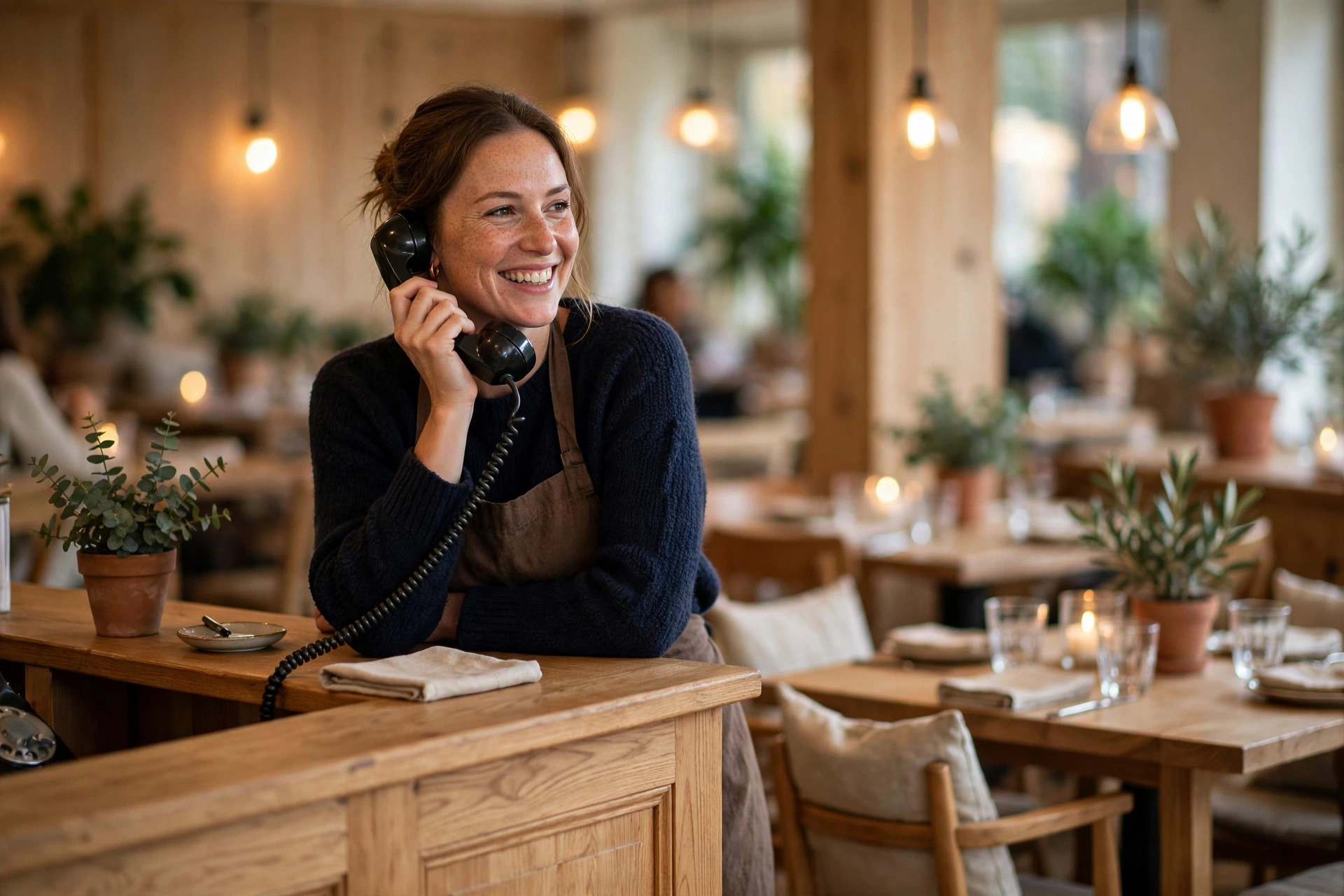
It is Friday at 5pm. The dining room is half-set, the kitchen is in the middle of prep, and the phone rings. Someone answers on the sixth ring, slightly out of breath, and says "yeah?" — and just like that, a table of eight that was ready to book decides to try the place down the street instead. Nobody in your restaurant will ever know it happened. There is no review, no complaint, no data point. Just an empty table on Saturday that nobody can explain.
The phone is the most under-managed revenue channel in most restaurants. Websites get redesigned, Instagram gets curated, but the phone — where the highest-intent guests arrive, where the large parties and special occasions book — is left to whoever happens to be nearest when it rings. This article fixes that: a complete, steal-this booking script, the exact record to keep, the no-show system that protects your weekends, and how to train staff who would rather do anything than answer the phone.
Why the phone still fills tables in 2026
Every few years someone declares the phone dead. Online booking keeps growing — and yet the phone persists, because it serves the bookings that matter most. Think about who calls: the couple booking an anniversary dinner, the office manager arranging the Christmas party for fourteen, the parents who need a high chair and want to know it will actually be there, the tourist whose online booking failed, the guest with a serious allergy who needs a human answer before they commit. These are not low-value interactions. They are your biggest tables, your special occasions, your most anxious — and therefore most loyal, once reassured — guests.
The Nordic picture
In Finland, Sweden and Norway, online booking is deeply embedded — Nordic guests are comfortable booking everything from ferries to haircuts online. That makes the remaining phone calls even more significant: the people who still call are disproportionately the ones with complex, high-value needs. A caller asking about a confirmation dinner for twenty in Oslo is not going to be satisfied by a web form. The restaurants that handle these calls brilliantly own the most profitable segment of the booking market almost by default, because so many competitors handle them badly.
The guest who picks up the phone has already chosen you. Your only job on the call is not to un-choose you.
There is also a defensive reason to take the phone seriously: every unanswered or badly handled call is invisible. Unlike a website, where analytics show you the drop-off, a lost phone booking leaves no trace. Owners who say "we don't get many phone bookings" often mean "we don't convert many phone calls" — and they have no way to know, because nobody is counting.
The anatomy of a perfect booking call
Every good booking call runs the same seven steps, in the same order, whether the caller wants a table for two on Tuesday or a wedding reception for sixty. The order matters: it moves from the facts that determine availability (date, size, time) to the facts that determine service (contact, needs), and ends with the two things that protect you (read-back, confirmation).
- Greet. Restaurant name, your name, warmth. Ten seconds, sets the tone.
- Date and party size. These two facts determine everything about availability. Get them first.
- Time. Offer what you have; when the requested time is gone, offer the nearest alternatives immediately — never just say "we're full."
- Contact details. Name (spelled), phone number (repeated back digit by digit). This is non-negotiable: no number, no booking.
- Special needs. Occasion, seating preferences, allergies, high chairs, wheelchair access. Ask every time — "anything we should know to make the evening work for you?"
- Read back. Repeat the full booking. Twenty seconds that prevent the wrong-date disaster.
- Confirm and close. State what happens next (confirmation text, reminder), mention anything they should know (cancellation terms for large parties), thank them warmly.
Two to three minutes for a standard booking. The structure is what makes it fast: without it, calls meander, details get missed, and the caller has to repeat themselves — the fastest way to sound unprofessional.
The script, word for word
Here is the full script. It is written for a fictional restaurant so you can hear the rhythm — replace the name and adapt the details, but keep the structure. Print it, put it by the phone, and let new staff read from it until it becomes muscle memory. Reading from a script is not unprofessional; needing one and not having one is.
The booking script
Host: "Good evening, Restaurant Aalto, this is Emma — how can I help you?"
Caller: "Hi, I'd like to book a table for Saturday."
Host: "We'd love to have you. Which Saturday did you have in mind — this coming Saturday the 11th?"
Caller: "Yes, the 11th. There will be six of us."
Host: "A table for six on Saturday the 11th — lovely. What time were you thinking?"
Caller: "Around seven?"
Host: "Let me check… I can offer you 6:30 or 7:45 — seven o'clock itself is just taken. Would either of those work?"
Caller: "7:45 is fine."
Host: "Perfect — 7:45 it is. May I take the name for the booking?"
Caller: "It's Lindqvist."
Host: "Lindqvist — could you spell that for me, please? … Thank you. And a phone number where we can reach you on the day?"
Caller: "040 555 0134."
Host: "040 555 0134 — got it. Is there anything we should know to make the evening work for you — an occasion, seating preferences, allergies, anything like that?"
Caller: "It's my mother's 70th, and one of us is in a wheelchair."
Host: "Happy 70th to your mother — we'll make sure of a comfortable table with good access. Let me read everything back: a table for six, Saturday the 11th at 7:45, under the name Lindqvist, phone 040 555 0134, birthday celebration, wheelchair access needed. Is that all correct?"
Caller: "Yes, that's right."
Host: "Wonderful. I'll send a confirmation text right after this call, and a short reminder on Saturday morning — you can confirm or cancel with one tap. We look forward to seeing you, and happy birthday to your mother!"
Notice what the script does beyond collecting facts. It confirms the date out loud ("this coming Saturday the 11th") because "Saturday" is ambiguous. It offers alternatives instead of refusals. It spells the name — misspelled names lose bookings at the door. It asks about needs with an open question, not a yes/no. And it ends with the confirmation routine, which is where no-shows go to die.
The first ten seconds
Callers decide within seconds whether they trust the person who answered. The greeting formula is: business name → your name → warm offer of help. "Good evening, Restaurant Aalto, this is Emma — how can I help you?" Every element earns its place: the business name confirms they reached the right place, your name makes it personal, and the tone says this call is welcome.
The rules
- Three rings maximum. After four rings, callers start rehearsing their annoyance. If the phone routinely rings unanswered during service, that is a staffing problem with a revenue cost — fix the staffing, not the phone.
- Smile. It sounds like a cliché because it works: callers hear a smile in the voice within a second. Stand up if you can — you sound more alert standing.
- Never "yeah?", never just the business name barked. Both tell the caller they are an interruption. They are revenue.
- Match the time of day. "Good morning / good afternoon / good evening" — small, but it signals attentiveness.
After four rings, the caller is no longer deciding where to book. They are deciding whether to hang up.
The five hard moments
Standard bookings are easy. These five situations are where tables are won or lost — rehearse them specifically.
1. "We're fully booked"
Never stop at "we're full." The script is: acknowledge, offer the nearest alternatives, offer the waitlist. "Saturday at 7 is fully booked, I'm afraid — I could do 5:30 or 9:15 the same evening, or 7 o'clock on Friday. Would any of those work? And I can put you on the waitlist for Saturday 7 in case anything opens up." A waitlist, actually worked — call people back when tables free up — converts a meaningful share of refusals into bookings.
2. "Can you guarantee us a window table?"
Do not promise what the floor plan cannot deliver. "I can't guarantee a specific table, but I'll note 'window preferred, anniversary' on the booking and we'll do our very best." An honest note beats a broken promise — the guest who was promised a window table and doesn't get one is angrier than the guest who was promised effort.
3. Twelve people on a Saturday
Large parties get the full treatment: confirm the exact headcount ("is twelve final, or might it change?"), take a contact number for the organiser, state your large-party terms kindly (see the next section), note every need, and schedule a personal reconfirmation call for the day itself. Twelve-person bookings are where the money is and where the chaos lives.
4. Allergies and special needs on the call
Take it seriously and write it down verbatim — "coeliac, not preference" matters in the kitchen. If you are unsure whether the kitchen can handle a request, say so honestly and offer to check with the chef and call back. For the full system behind this, see our guide to gluten-free and special diets on your menu.
5. "How much is it?"
Have the answer ready: average spend per person, set-menu prices, any minimums. "Most guests spend around €45–60 per person for three courses" (adjust to your reality) is infinitely better than "uh, it depends." Price questions are buying signals — the caller is mentally committing. Answer crisply and keep the booking moving.
The reservation record that prevents disasters
A booking is not a name on a page. It is a small dossier, and every field in it prevents a specific failure. Whether you keep a paper diary, a spreadsheet or a booking system, capture all of these:
| Field | Why it matters | The failure it prevents |
|---|---|---|
| Date (with weekday) | "Saturday the 11th" — weekday catches date errors | The wrong-Saturday empty table |
| Party size | Determines table assignment and staffing | Six guests, a table for four |
| Time | Drives the seating plan and turn times | Double-booked prime time |
| Name (spelled) | Guests must find their booking at the door | "We have no reservation under that name" |
| Phone number | Confirmation, reminders, day-of contact | Unreachable no-show; can't warn about delays |
| Occasion | Service intelligence: birthday, anniversary, business | The missed moment that would have earned loyalty |
| Seating / access needs | Wheelchair, high chair, quiet corner | The guest who can't use their table |
| Allergies / dietary needs | Kitchen must prepare before service | The dangerous improvisation |
| Source | How they found you: Google, regular, referral | Marketing flying blind |
| Taken by | Who to ask when something is unclear | The mystery booking nobody owns |
The "source" field deserves a special mention: it is the cheapest marketing research you will ever do. After a month of noting where bookings come from, you will know whether your Google listing, your Instagram or your regulars' word of mouth is filling your tables — and you will know where to invest.
A note on GDPR
Phone numbers are personal data. Under the GDPR you may keep them for the purpose the guest gave them — managing the booking — and you should delete them when that purpose ends rather than hoarding them indefinitely. Do not add booking phone numbers to a marketing list without separate, clear consent; "they gave us their number" is not marketing consent. A simple retention rule — booking data deleted or anonymised a few months after the visit — keeps you compliant without any real effort.
Confirmations and reminders: the no-show system
No-shows are not a character flaw in your guests; they are a commitment problem, and commitment is built by confirmation. The system has three layers, and each one earns its place.
Layer 1: immediate confirmation
Send a text or email within minutes of the call, restating date, time, party size and anything agreed (cancellation terms, deposit). This does two jobs: it lets the guest catch errors while the call is fresh, and it converts a verbal promise into a written commitment — psychologically a much stronger thing.
Layer 2: the day-before reminder
A short message the day before — or morning of — with a one-tap confirm-or-cancel option. The magic of the reminder is not the confirmation; it is the cancellation. Guests whose plans changed will mostly not call to cancel — but they will tap "cancel" in a text. Every cancellation you receive the day before is a table you can re-sell; every no-show is a table you cannot.
Layer 3: the personal call for large parties
For parties of eight or more, call the organiser on the day. It takes two minutes, it finalises the headcount ("still twelve, or has it changed?"), and it makes the booking feel like an event rather than a vague plan. Large-party no-shows are the expensive ones — this call is the cheapest insurance you have.
The reminder's real job is not the confirmation. It is the cancellation — the tap that turns a silent no-show into a re-sellable table.
State the terms at booking time
For large parties, set menus and peak dates, cancellation terms and deposits are standard practice across the Nordics — but only if they are agreed upfront. "For parties of eight or more we take a €20 per person deposit, refundable up to 48 hours before" — stated warmly during the call and repeated in the written confirmation — is honoured far more often than terms sprung on arrival. Consistency matters: apply the policy to everyone, every time, or it is not a policy.
Training staff who hate the phone
Many of your staff — especially younger ones — genuinely dread phone calls. They grew up texting. Telling them to "just answer it" produces exactly the flat, rushed calls this article is trying to eliminate. Train the fear away instead.
Role-play, not lectures
Pair up: one person plays the caller (give them difficult scenarios — the fully-booked Saturday, the wheelchair user, the caller who won't give a phone number), the other works the script. Rotate. Ten minutes of role-play before a shift teaches more than any manual, because the staff member discovers that the script handles the hard moments for them — they do not have to improvise, they just have to follow the steps.
The cheat sheet by the phone
Tape a one-page card next to every phone: the greeting, the seven steps, the read-back formula, the large-party terms, and the "if unsure" rule ("I'm not certain — let me check and call you right back"). Nobody should have to memorise the script before they are allowed to answer. Permission to say "let me check" is the single most calming thing you can give a nervous staff member — and it produces better answers than guessing.
Make it someone's job
"Whoever is nearest" is how calls get answered badly. During service, designate the phone person per shift — usually the host or the most senior front-of-house staff member. Everyone else's job is to not answer. One trained person answering every call beats five untrained people answering randomly, and it gives you one throat to choke when the standard slips.
Moving callers to online booking — gently
Some callers do not need the phone at all — they called because it was easier than figuring out your website. For these guests, the kind move is to offer the online route without forcing it. Never refuse a phone booking to push someone online; the caller who wanted a human and got a lecture will not book at all.
The gentle redirect sounds like this: "I can take that booking right now, of course — and for next time, you can also book directly on our website in about thirty seconds, if that's easier." Then, if they are interested: "I'll text you the link with your confirmation." You have served them now and equipped them for later. Over months, this steadily moves the simple bookings online — which frees the phone for the complex, high-value calls where the human touch actually earns its keep.
This only works if the online route is genuinely thirty seconds. A booking form buried three clicks deep, a form that does not work on phones, or a "call us to book" dead end will send them straight back to the phone — annoyed. Our mobile optimisation checklist for restaurants covers exactly what the phone-booker sees when they land on your site.
The hybrid setup that captures everyone
The end state is not "phone versus online." It is both, feeding one book: the phone script in this article handling the high-value calls, and a simple online booking route catching everyone else around the clock. The two channels even reinforce each other — the confirmation text from a phone booking can carry your online booking link, and the website's tap-to-call button (prominent, on every page, on mobile) catches the guest who started online and decided they would rather talk.
What breaks the hybrid is fragmentation: phone bookings in a paper diary, online bookings in an inbox, walk-ins nowhere — and nobody with the full picture on a Saturday night. Whatever tools you use, they must converge on one shared, real-time view of the book. That is also the moment to be honest about your website: if guests cannot find a booking button in seconds on their phone, the hybrid is leaking. The seven signs your restaurant website needs a redesign is a useful self-audit, and our honest DIY-vs-professional comparison covers what a proper booking setup actually costs.
PowerfulWebsite builds restaurant websites free — plans from €59/month — with the booking button, tap-to-call and digital menu built in from day one, so the phone script in this article and the website are finally working the same book instead of competing for it.
Frequently asked questions
What should you say when answering a restaurant phone?
Answer within three rings with the restaurant name, your name and a warm offer of help — for example: "Good evening, Restaurant Aalto, this is Emma — how can I help you?" Name the business first so callers know they reached the right place, give your own name so the call feels personal, and smile while you speak: callers genuinely hear it in your voice. Never answer with just "hello" or a bare business name.
What details should I take for a phone reservation?
The minimum is date, party size, time, the guest's name and a phone number — without a callback number you cannot confirm or warn them about problems. Also note the occasion, seating preferences, allergies and special needs (high chair, wheelchair access), where the booking came from, and who took the call. Read every detail back to the caller before hanging up; the twenty-second read-back catches most errors before they become empty tables.
How do I reduce no-shows from phone bookings?
Confirm every booking immediately by text or email, send a reminder the day before with a one-tap confirm-or-cancel option, and call personally for parties of eight or more on the day. State your cancellation terms kindly at booking time so they are agreed, not sprung. Bookings that are confirmed twice — once at booking, once before the visit — no-show far less often, because confirming twice makes the commitment feel real.
Should I take a deposit or card details for phone bookings?
For normal tables of two to six, usually not — the friction costs you more bookings than the no-shows cost you. For large parties (typically eight or more), private rooms, set menus and peak dates like New Year's Eve, deposits or card guarantees are standard practice in the Nordics and guests expect them. Whatever your threshold, state it at booking time, put it in the written confirmation, and apply it consistently.
Phone or online reservations — which should a small restaurant use?
Both, because they serve different guests. The phone captures older guests, large parties, special occasions and complex requests — typically your highest-value bookings. Online booking captures everyone else, around the clock, without tying up staff. The winning setup is a hybrid: a well-run phone script for callers plus a simple booking widget on your website for everyone else, both writing to the same book.
How long should a restaurant booking call take?
A standard booking for two to four guests should take about two to three minutes: greeting, date, party size, time, contact details, special needs, read-back and confirmation. Large parties and special requests take longer, and that is fine — rushing a twelve-person booking to save a minute is how you lose the twelve people. If the call is dragging because the guest is asking about the menu or directions, answer briefly and offer to text them the link.
Want a website that turns callers into confirmed tables?
PowerfulWebsite builds your restaurant's website for free — you only pay from €59/month. Every plan includes online booking, tap-to-call and a digital menu, so the phone and the website finally work the same book.
See the plans