Walk-Ins vs Reservations: Finding the Balance
Neither reservations-only nor walk-ins-only wins for most restaurants — the right answer is a deliberate mix, usually starting around 60–70% of tables for reservations with the rest protected for walk-ins. Reservations bring predictable revenue and planned, higher-value parties; walk-ins bring faster table turns, a fuller bar and resilience against no-shows. The restaurants that earn the most don't pick a side — they run a system that protects each channel from the other's weaknesses.
Key takeaways
- Walk-ins can turn tables faster — industry analyses suggest up to four turns on a busy night versus around two for reservation-heavy rooms — and they erase the no-show problem entirely.
- Reservations deliver predictability: planned staffing, larger parties, special occasions and guest data you can market to. But no-show rates of 10–20% at peak can leave your best tables empty.
- Most successful full-service restaurants land around a 60–70% reservation / 30–40% walk-in split; casual spots skew walk-in, fine dining skews reservation.
- Protect the mix with honest turn times, a managed digital waitlist, and a no-show policy guests understand: 15-minute hold, automated reminders, deposits for peak nights.
- The mix is a dial, not a policy — Christmas season, Valentine's, summer terraces and quiet January each call for a different setting.
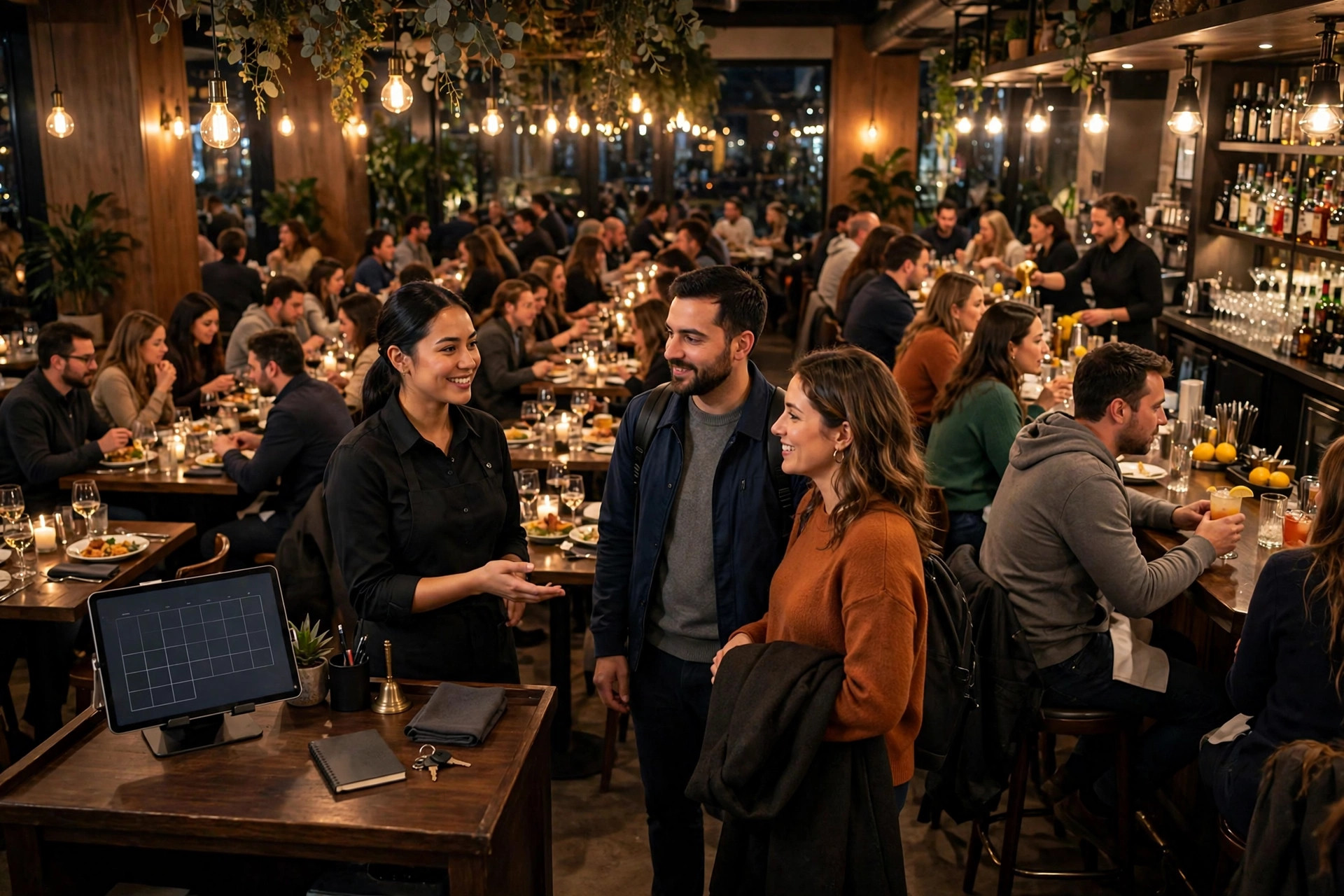
Every restaurant owner in the Nordics has stared at this question, usually on a Friday night. The reservation book shows a full house, but three tables sit empty because their parties never arrived — while a queue of walk-ins waits by the door, growing more impatient by the minute. Or the reverse: you went walk-in only for the summer terrace season, and now a party of twelve that would have been your best table of the month has booked somewhere that takes reservations. This article is the honest version of the debate: what each model actually earns you, what each one costs, the ratios that work for different concepts, and the day-to-day system that keeps both channels pulling their weight. No ideology — just the maths of seats, turns and no-shows.
The case for walk-ins
Start with the strongest argument for walk-ins, because it's the one reservation loyalists tend to underestimate: walk-ins match how people actually decide to eat out. A large share of dining decisions is spontaneous — the couple strolling through the city centre, the colleagues who finish work and want food now, the tourists who picked your street because it looked lively. Every one of those guests is invisible to a reservations-only restaurant. Walk-ins capture demand you can never forecast, and in Nordic city centres with real foot traffic — the Esplanadi in Helsinki, Aker Brygge in Oslo, Drottninggatan in Stockholm — that demand is substantial.
The second argument is turnover. Reservation-based service is inherently slower: tables are held for guests who arrive late, linger because they planned the evening, and occupy seats on either side of their slot that you can't safely sell. Industry analyses of table turnover have suggested that reservation-heavy restaurants average around one and a half to two turns per table on a busy night, while rooms running on walk-ins can reach three or four turns when the queue is steady. Whether your room hits those exact numbers depends on your concept, but the mechanism is real: with walk-ins, a table is either occupied and earning, or free and fillable — there is no dead time spent waiting for someone who may not come.
Then there's the bar. Walk-in guests usually wait, and waiting guests buy drinks. A party that waits twenty minutes for a table and spends it at the bar with two cocktails has already out-earned many seated dinners on margin — drinks are the highest-margin items you sell. This is the quiet engine of walk-in economics: the queue itself is a revenue stream, as long as the wait is managed well enough that people stay instead of leaving.
Finally, walk-ins erase the industry's most hated line item: the no-show. A walk-in can't no-show. Every seat filled is a seat paying, and every empty seat is immediately available — no diary full of ghost bookings, no staff standing around tables held for nobody, no awkward decision about when to release a table. For a small team, that simplicity is worth real money: nobody is tied up managing a reservation book during service.
Where walk-ins shine brightest
Walk-ins work best where three conditions hold: steady foot traffic, a concept that doesn't need planning (no tasting menus, no elaborate occasions), and a room that can absorb surges — a bar area for the queue, flexible table combinations, fast turns. Casual lunch spots, neighbourhood bistros, pubs with kitchens, and restaurants on tourist streets are the natural habitat. The common thread is that the guest's decision is low-stakes: a €15–25 lunch or a casual dinner doesn't need a reservation to feel safe.
The foot-traffic requirement is non-negotiable
Here's the honest caveat, and it's a big one in the Nordics: walk-ins require a stream of passers-by, and that stream is seasonal. A restaurant that thrives on walk-ins in July can starve in February, when it's dark at 16:00, minus ten degrees, and nobody is strolling anywhere. If your location doesn't deliver foot traffic ten months of the year, walk-in-only is a summer strategy wearing a year-round costume. Know your street before you commit.
The case for reservations
Reservations buy the one thing walk-ins can never give you: knowledge of the future. When the diary shows 85 covers for Friday, you staff for 85 covers, you order for 85 covers, and the kitchen preps for 85 covers. That predictability ripples through the whole operation — labour cost stays in line, food waste drops because prep matches demand, and the team walks into service calm instead of bracing for the unknown. For a business running on 5–10% margins, the difference between staffing for 40 and staffing for 85 is the difference between profit and loss on the night.
Reservations also bring the parties walk-ins can't: the birthday table of ten, the corporate dinner, the anniversary couple who planned a month ahead. These are your highest-value covers — bigger parties, longer stays, higher spend per head, and often set menus or pre-orders that make the kitchen's life easier, not harder. A small hospitality research study comparing reservation guests with walk-ins across several fine dining rooms found the reservation guests spent more per head in every room studied, with the difference statistically significant in most of them. It's a small study, not gospel — but it matches what most operators feel in their bones: guests who plan, spend.
Then there's the data. Every reservation hands you a name, a phone number, and usually an email — a direct line to a proven customer, collected with their implicit permission. Used properly and in line with GDPR, that's a marketing asset no walk-in stream can match: birthday offers, quiet-Tuesday invitations, new menu announcements to people who already chose you once. Walk-ins give you revenue; reservations give you revenue plus a customer list.
And some occasions simply demand a reservation. The proposal dinner, the wedding anniversary, the business meal that has to go right — guests planning these want certainty, and they judge you on it. A restaurant that can't promise a table can't host the evenings people remember. That certainty is also a competitive moat: when a guest has a great anniversary at your restaurant, the reservation is part of the memory, and next year's booking comes to you.
When reservations are non-negotiable
Some concepts don't get a choice. Fine dining with limited seats and long tasting menus, destination restaurants guests travel to reach, and any room under about 40 seats where one no-show is a visible hole in the night — these need reservations the way they need a kitchen. If your average spend per head is high and your seat count is low, the maths of an empty table is brutal, and only a booked diary protects you.
What walk-in-only really costs
Going all-in on walk-ins feels liberating — until the bills for that freedom arrive. The first and biggest cost is the large party you never see. Groups of six, eight, twelve don't walk in and hope; they plan, and they plan with restaurants that take reservations. A single lost party of ten at €45 a head is €450 of revenue walking past your door to a competitor — and those parties are disproportionately valuable because they often pre-order, drink well, and fill your slowest early-evening slots. Over a year, the large-party deficit alone can dwarf whatever you saved on no-shows.
The second cost is queue chaos. An unmanaged wait is a machine for bad reviews: guests who wait 45 minutes with no information, no honest quote and nowhere comfortable to stand don't remember the food — they remember the wait. Walk-in-only restaurants live or die on their waitlist discipline, and "just wait over there" isn't a system. Without quoted times, a proper queue order and a way to contact guests when their table is ready, your busiest nights become your worst-reviewed nights. Our guide to setting up a restaurant waitlist covers the mechanics that separate a buzzing room from an angry crowd.
The third cost is the slow night with no floor under it. A reservation book guarantees a baseline — even a quiet Tuesday has its ten booked tables. Walk-in-only has no baseline: a rainy Tuesday in November can mean twelve covers and a full staff roster you can't send home without killing morale. That revenue volatility makes everything harder — cash flow, staff retention, supplier orders. The restaurants that survive walk-in-only long-term are the ones with enough location strength to make slow nights rare; everyone else is gambling on the weather.
Then there's the staffing whiplash. Walk-in demand arrives in waves, not in a diary. The kitchen gets forty covers in twenty minutes, then nothing for an hour. Servers sprint, then stand around. That pattern burns teams out faster than a steady, predictable service — and in the Nordic labour market, where experienced staff are hard to replace, burnout is an existential cost, not a soft one.
The walk-in-only reality check
- Foot traffic: does your street deliver a steady stream of passers-by at least ten months a year, or only in summer?
- Large parties: can you afford to lose every group of 6+ to competitors who take reservations?
- Queue space: do you have a bar area or waiting space that earns money while guests wait — or just a pavement?
- Slow nights: what does a rainy Tuesday in February look like with zero booked tables?
- Team: can your kitchen and floor handle demand arriving in unpredictable waves?
If you answered "no" or "not sure" more than once, walk-in-only is a risk, not a strategy.
What reservation-only really costs
The reservation-only model's bill arrives in the form of empty tables with names on them. No-show rates in the industry are routinely reported at 10–20% during peak periods, with some analyses putting the average around 15%. Read that again: on your busiest, most profitable nights, up to one table in six or seven may simply not materialise. And the cruelty of the no-show is that it strikes exactly where it hurts most — you turned walk-ins away to hold those tables, so the empty seat is a double loss: the booking that never came, plus the guest you refused.
Late arrivals compound the damage. A party booked for 19:00 that drifts in at 19:40 doesn't just lose you forty minutes — it cascades. The 21:00 booking for that table gets pushed, the kitchen's pacing breaks, the hosts spend the evening apologising, and the room's rhythm never recovers. Reservations promise order; late guests deliver chaos with a confirmation email attached.
There's also the admin tax. Somebody has to answer the phone, manage the diary, confirm the bookings, chase the confirmations, and handle the changes — and during service, that somebody is usually the host who should be greeting guests. For a small restaurant, reservation administration can easily consume an hour or more of skilled labour daily. That's an hour you're paying for regardless of whether the bookings show up.
And then there's the temptation it creates: overbooking. Airlines do it with maths and compensation vouchers; restaurants do it with hope. When it works, you fill the no-show gaps; when it doesn't — when everyone shows up on the same Friday — you're telling confirmed guests there's no table, which is one of the fastest ways to manufacture a one-star review and lose a regular forever. Overbooking without careful tracking of your actual no-show patterns by day and season isn't revenue management; it's roulette.
The psychology of the free booking
Here's the uncomfortable truth underneath the no-show numbers: a booking that cost the guest nothing is a booking they'll abandon without a thought. No deposit, no card on file, no friction — just a form filled in on a Tuesday for a Friday that felt more appealing three days ago. The easier you make it to book, the easier you make it to flake. That doesn't mean adding friction everywhere (you'd kill conversion), but it does mean the bookings that hurt most to lose — peak nights, large parties — need some skin in the game. We'll come back to exactly how in the no-show section below.
Finding your mix
So neither extreme is the answer for most restaurants. The working model used by experienced operators is a portfolio: reservations guarantee a baseline of covers, while a protected walk-in allocation captures spontaneous demand, fills the bar, and insures you against no-shows. Industry guidance for full-service restaurants typically lands somewhere between 60/40 and 80/20, reservations to walk-ins, depending on foot traffic and concept. The exact split matters less than the principle: decide it deliberately, protect both sides, and review it quarterly.
Here's a starting framework by concept — treat these as defaults to adjust, not rules carved in stone:
| Concept | Reservations | Walk-ins | Why this split |
|---|---|---|---|
| Fine dining / tasting menu | 85–95% | 5–15% | Long turns, high spend, limited seats — every empty table is expensive; keep a few bar seats for walk-ins |
| Casual full-service dinner | 60–70% | 30–40% | The classic balance: baseline revenue from the book, upside from the street |
| Lunch-focused café / bistro | 30–50% | 50–70% | Lunch decisions are spontaneous; office workers don't book a Tuesday sandwich a week ahead |
| Bar with kitchen / pub | 10–30% | 70–90% | The bar is the waiting room and the profit centre; reservations only for large groups |
| Tourist-area restaurant | 50–60% | 40–50% | Tourists both book ahead (hotels, guides) and wander; you need to catch both |
Now add the Nordic specifics, because generic ratios assume generic streets. Lunch culture in Helsinki, Stockholm and Oslo is overwhelmingly walk-in — even busy business-district restaurants fill at lunch without a diary, and holding tables for lunch reservations mostly just slows turnover. Friday and Saturday dinner is the opposite: in every Nordic capital, weekend evenings are reservation territory, and a restaurant without a book on Saturday is leaving its best revenue unplanned. Summer terraces swing walk-in — nobody books a terrace table three days ahead when the decision depends on the weather — while the Christmas season (and the pikkujoulu party bookings that come with it) swings hard toward reservations, often with deposits.
The only ratio that truly matters is yours, and you find it by measuring. For four ordinary weeks, track three numbers: covers by channel (reservation vs walk-in), no-show rate by day, and average spend per head by channel. What you'll usually discover: reservations bring the planned, higher-value covers; walk-ins bring volume and bar spend; no-shows cluster on specific days (often Friday and Saturday). That data tells you exactly where to shift the dial — if Saturday no-shows run at 18%, moving 10% of Saturday's prime-time inventory from reservations to walk-ins will typically out-earn the bookings you give up. If your numbers show something else, follow your numbers.
How to protect the walk-in allocation
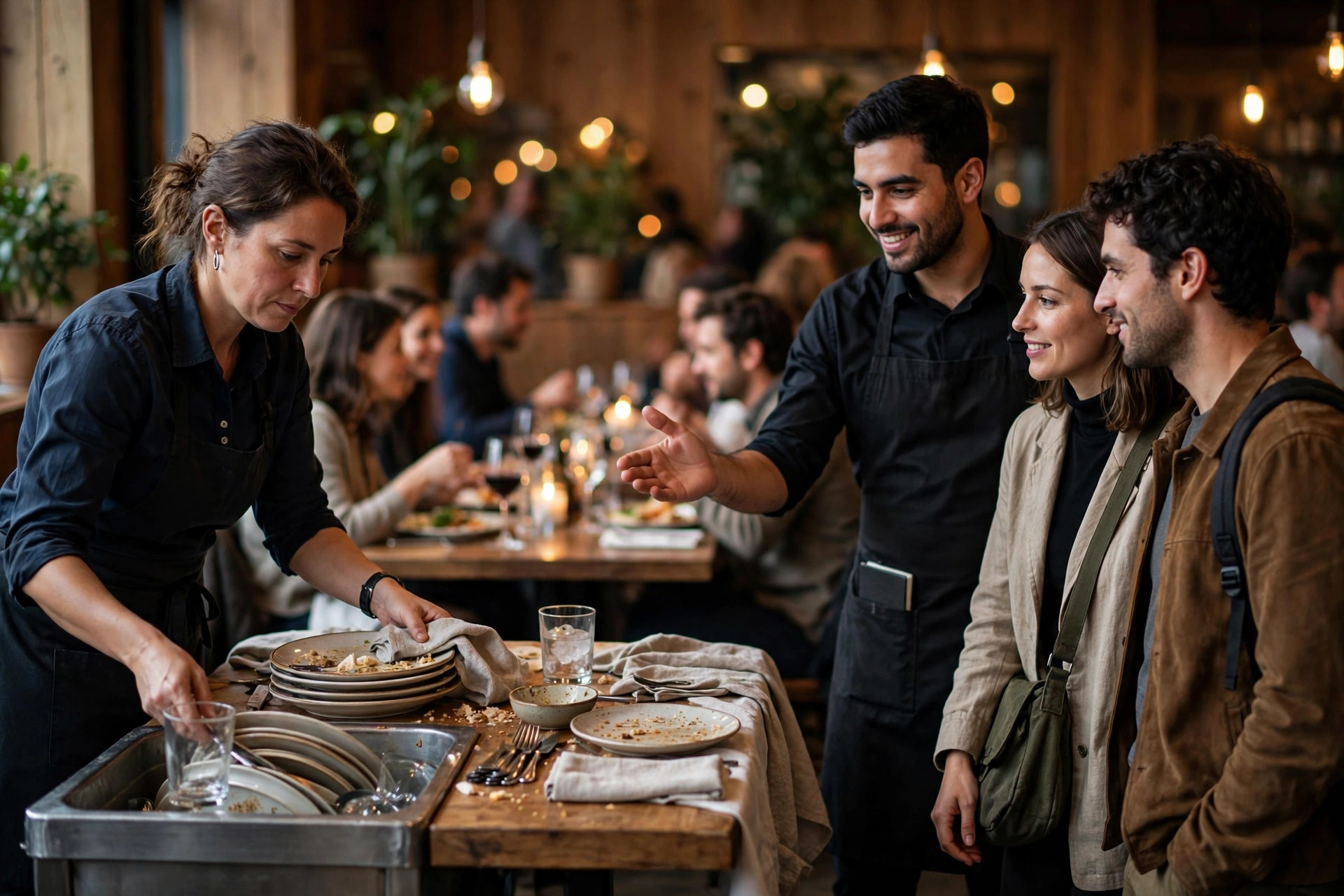
The mix only works if the walk-in tables actually stay available for walk-ins. That means not releasing your full inventory to the booking system — hold back the allocation deliberately, including on busy nights when the temptation is to book everything. It also means training the team: the host must know exactly how many tables are protected, and the phone team must know what to say when the book looks full but walk-in tables sit empty ("we're fully booked online, but we always keep tables for walk-ins — come by and we'll get you seated as soon as possible"). A protected allocation that staff give away under pressure isn't an allocation; it's a wish.
Running the mix day to day
A ratio on paper is worthless without the daily discipline that enforces it. The operational core of the mix is honest turn times: measure how long tables actually take by day-part for two weeks, and stop using one default for everything. A 55-minute weekday lunch and a two-hour Saturday dinner should not share a turn-time setting — when they do, you either hold tables too long at lunch (losing turns) or book too tightly on Saturday (manufacturing delays). Feed the real numbers into your booking system and your host's expectations alike.
Stagger your reservations. Releasing all your 19:00 tables at once guarantees a 19:00 crush at the door, the kitchen and the bar — followed by a dead 20:30. Spreading bookings across 15-minute intervals smooths arrivals, keeps the kitchen's pacing humane, and actually lets you seat more covers across the evening. Most booking systems support covers-per-interval limits; use them the way a good host would: protect the kitchen from itself.
Run a real waitlist, not a hopeful crowd. On busy nights the walk-in side of your mix needs the same professionalism as the reservation side: take names and phone numbers, quote an honest wait (guests forgive a 40-minute wait they were warned about and punish a "20 minutes" that becomes 50), and text guests when the table is ready so they can wait at the bar or next door instead of blocking your entrance. Most modern booking platforms include waitlist tools — switching them on is often a same-day improvement.
Make the diary the law. Every booking — phone, online, walk-in promise, regular's text message — goes into the same diary, immediately, or it doesn't exist. The classic failure is the "mental booking": the owner tells a regular "sure, Friday at seven" and forgets to enter it, and Friday brings a double-booked table and an argument. One shared calendar, visible to everyone on shift, with no exceptions, is the cheapest insurance in the restaurant business. If you're choosing the software to run it on, our booking system comparison walks through the options, and our guide to online booking vs phone covers how the channels should divide the work.
The 15-minute rule and the two-hour turn
- Hold reservations for 15 minutes past the booked time, then release the table to the waitlist. State this at booking, in the confirmation, and on the website — never as a surprise at the door.
- Set turn expectations by day-part: communicate a 90-minute to 2-hour window for dinner on booking confirmations for busy nights; guests accept limits they knew about in advance.
- Build a 10–15 minute buffer between the end of one reservation window and the next — clearing, resetting and seating takes time, and the buffer is what keeps the evening on schedule.
- Release no-show tables fast: at 15 minutes past, the table belongs to the waitlist, not to hope. Every minute of dithering is a minute the room isn't earning.
No-show protection guests accept
The reservation side of your mix is only as strong as your no-show defences — and the good news is that the measures that work are also the ones guests find reasonable, as long as they're communicated upfront. In order of effectiveness:
1. Automated reminders, 24 hours before. A meaningful share of no-shows isn't malice — it's forgetfulness. An SMS or email the day before, with the booking details and a one-click confirm-or-cancel link, catches the guests who double-booked themselves or simply forgot. Industry data suggests reminders cut no-shows by roughly a third, and they have a second benefit: the guests who cancel via the link free their tables in time for you to resell them. A cancellation is infinitely better than a no-show — treat the reminder as a table-recovery tool, not just a courtesy. Our templates for booking confirmations that reduce no-shows give you the exact wording.
2. A clear hold policy, stated at booking. "We hold tables for 15 minutes past the reservation time" — in the confirmation email, on the booking page, repeated by phone staff. Guests don't object to policies they agreed to; they object to surprises. The hold policy also gives your host the authority to act: releasing a table at 19:15 isn't a judgement call, it's the rule, applied equally.
3. Deposits or card holds for the bookings that hurt most. This is the single strongest lever operators have — industry analyses consistently rank deposit enforcement above reminders and walk-in buffers, with operators reporting substantial reductions in no-show rates once guests know a card is on file. The key is selectivity: don't demand deposits for a Tuesday lunch for two. Reserve them for Friday and Saturday nights, parties of six or more, and the Christmas season — the slots where a no-show is genuinely expensive. Named plainly at booking ("a €20 per person deposit, deducted from your bill"), a deposit reads as a serious restaurant protecting scarce tables. Sprung as a surprise, it reads as a trap. Keep the amounts proportionate and the terms crystal clear.
4. Make cancelling easier than no-showing. Every confirmation should carry a one-click cancellation link — no login, no phone call, no guilt. A guest who cancels at 16:00 gives you a table you can fill; a guest who can't be bothered to call gives you nothing. Paradoxically, the easier you make cancellation, the fewer no-shows you get, because the barrier to doing the right thing disappears.
All of this lives or dies on your booking flow. If your website's booking page doesn't collect card details for deposits, send automatic reminders, or offer one-click cancellation, your no-show policy is a document, not a system. A modern booking setup — the kind that comes built into a well-made restaurant website, like the PowerfulWebsite restaurant package with booking integration from €59/month — turns these four measures from staff chores into automatic behaviour. For the bigger financial side of deposits, see our guide to deposits and gift cards.
When to change the mix
The mix is a dial, not a tattoo. Smart restaurants adjust it through the year, and your guests will accept the changes as long as you communicate them clearly and in advance — on your website, your Google Business Profile, and your social channels.
Christmas season (late November to December): swing hard toward reservations. The Nordic pikkujoulu season means large parties booking weeks ahead, set menus, and deposits as standard. This is your highest-revenue period; protect it with a reservation-heavy book, card holds for big tables, and a clear cancellation policy. Walk-in allocation shrinks — and that's fine, because December foot traffic converts to bookings anyway.
Valentine's Day and similar peak nights: reservation-only is not just acceptable, it's expected. Guests planning a €150 dinner for two want certainty, and a walk-in queue on Valentine's night is a cruelty, not a strategy. Two seatings, fixed times, deposits — run it like the event it is.
Summer terraces (June to August): swing toward walk-ins. Terrace demand is weather-driven and spontaneous; holding terrace tables for reservations that may not want to sit outside in the first place wastes your best asset. Keep reservations for the indoor room, let the terrace breathe with walk-ins, and watch the bar revenue climb.
Quiet January and February: loosen up. These are the months when the reservation book looks thin and every cover counts. Widen the walk-in allocation, run events that don't need booking (quiz nights, live music, tasting flights), and use the quiet weeks to test a more walk-in-friendly setup — you'll learn what your room can do before the spring rush.
Private events and buyouts: the ultimate reservation — the whole room, one party, planned weeks ahead. If your space suits events, a buyout calendar running alongside your normal mix can be the most profitable "channel" of all. Our guide to selling your private dining room online covers how to market it.
Review the mix quarterly, not annually. Pull the same three numbers — covers by channel, no-show rate, spend per head — and ask whether the dial needs turning. The restaurants that get this right aren't the ones with the perfect ratio; they're the ones that keep adjusting it.
Frequently asked questions
Should my restaurant take reservations or be walk-in only?
Most restaurants earn more with both. Reservations deliver predictable revenue, planned large parties and special occasions; walk-ins deliver faster table turns, a fuller bar and resilience against no-shows. The exceptions: fine dining with very limited seats usually needs reservations, and a casual spot with constant foot traffic can thrive on walk-ins. For everyone else, the question is the mix, not the choice.
What is a good ratio of reservations to walk-ins?
A common starting point for a full-service restaurant is 60–70% of tables available for reservations and 30–40% protected for walk-ins. Fine dining skews higher on reservations (80–95%), while bars and lunch spots skew toward walk-ins. Track your covers by channel and your no-show rate for four weeks, then adjust — your own numbers beat any generic ratio.
How do restaurants handle no-shows?
The measures that work, in order of effectiveness: automated reminders 24 hours before (meaningfully reduces forgotten bookings), a clear 15-minute hold policy communicated at booking, and deposits or card holds for peak nights and large parties — the single strongest lever operators have. Release unclaimed tables promptly to the waitlist instead of letting them sit empty.
Do walk-in restaurants make more money?
They can turn tables faster — industry analyses suggest walk-in-driven rooms can reach up to four turns on a busy night versus around two for reservation-heavy rooms — which raises revenue per seat. But that only holds with steady foot traffic and disciplined table management. Without the foot traffic, walk-in-only means unpredictable revenue and lost large parties, which usually costs more than the extra turns earn.
How long should a restaurant hold a reservation?
Fifteen minutes is the industry standard, and you should state it clearly when the booking is made — in the confirmation, not at the door. After that, the table goes to the waitlist. Communicating the hold time upfront turns an awkward confrontation into a policy everyone understood in advance.
Can I switch my restaurant between reservations and walk-ins seasonally?
Yes — many Nordic restaurants do exactly this: reservation-heavy through the Christmas season and Valentine's, walk-in-friendly for summer terraces, and back again. The key is communicating the change clearly on your website, Google profile and social channels at least a few weeks ahead, so regulars aren't surprised.
Want a website that brings table bookings?
PowerfulWebsite builds your restaurant's website for free — you only pay a monthly subscription from €59/mo. Everything included: domain, hosting, maintenance, updates, and booking integration.
See the packages