Your Restaurant's Story: Storytelling as a Brand
Restaurant storytelling is the art of giving your guests a reason to remember you: where your food comes from, why your restaurant exists, and who the people behind it are — told through the menu, the dining room, the staff and the website. Guests do not remember a dish. They remember a story, and they retell it to the next person choosing where to eat.
Key takeaways
- Storytelling is not decoration on top of the kitchen — it is the cheapest marketing a restaurant has, because guests retell stories for free.
- Your story lives in seven layers: origin, provenance, the plate, the menu, the room, the space and the digital presence. They must all tell the same story.
- Meaning raises willingness to pay: the same tomato tastes different when you know it came from a grower twenty kilometres away.
- Start with three questions: why did you open, what would you defend above all else, and what do your regulars already say about you?
- Keep it true and specific — name the grower, the boat, the village. A vague story is worse than none.
- Tell it first on your website, then in the dining room, then in small pieces on social media.
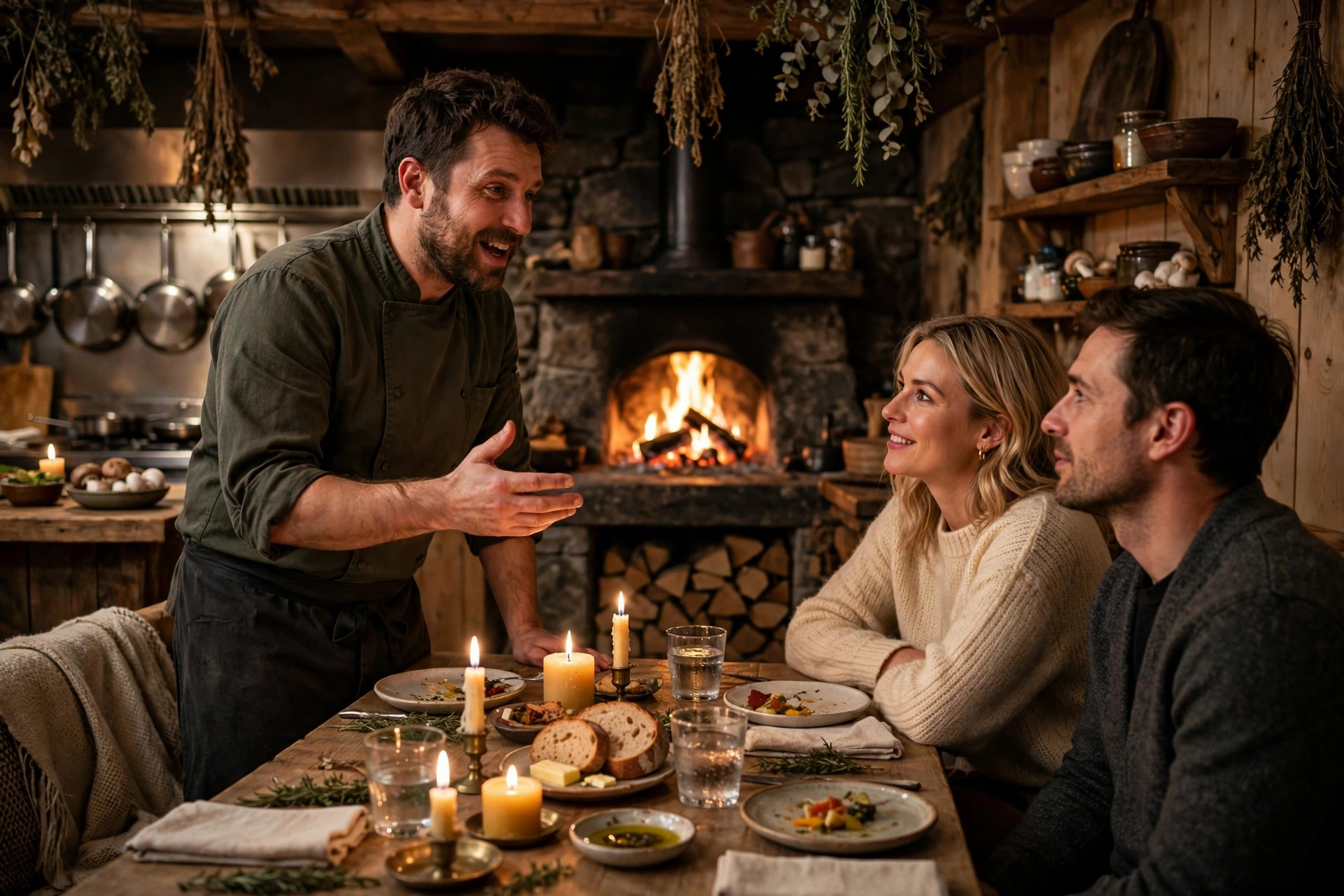
Ask a guest what they ate at your restaurant last month and they will hesitate. Ask them what they felt, and the story pours out: the chef who explained that the fish was pulled from the sea by his uncle that very morning, the dish that turned out to be a tribute to the house's grandmother, the name of the little vineyard on the label. That is not chance. That is storytelling — and in a restaurant, it is the difference between a good meal and a memory that gets passed on.
Too many restaurants try to sell when they should be telling. Every week a new special, a new flyer, a new discount — and the dining room stays half empty, because better food, better prices and better specials do not matter if no one remembers you. Promotions bring a busy weekend. They also train guests to wait for the next discount, and the moment the deals stop, the traffic slows. Marketing that sells is temporary. Marketing that tells builds loyalty.
This guide explains what restaurant storytelling actually is, why it works, the seven layers your story lives in, how to find the story you already have, and how to tell it on the plate, in the room and online — without sounding like a marketing department. It is written for independent restaurants in the Nordics, where the story is usually already there: a place, a person, a tradition, a craft. The work is not inventing it. The work is noticing it, shaping it, and telling it consistently.
What restaurant storytelling actually is
Storytelling in branding is about sharing your restaurant's journey — the "why" behind what you do. A good story connects with guests emotionally. It shows them your values, your passion, and what makes you different from the place two doors down. It is not a slogan and it is not a mission statement framed on the wall. It is the set of true, specific things a guest can learn about you in the course of an evening, and then repeat to someone else.
Notice the word "repeat". A story is only a brand asset if it travels. Nobody passes on an ingredient list at a birthday party. But the story of the chef who built his menu around the garden of his childhood — that gets retold, at the table and online. Word of mouth remains the single strongest reason people choose a restaurant, and storytelling is the mechanism that gives word of mouth something to carry. That is why it is the most cost-effective marketing tool a small restaurant has: it turns guests into narrators, and narrators do not charge by the click.
Storytelling is also not the same as advertising. Advertising says "we are good, come and see". Storytelling says "this is where we come from, this is what we believe, this is why the food tastes like this" — and lets the guest draw the conclusion. The difference shows up in the guest's behaviour: an advertising claim is evaluated and forgotten, while a story is experienced and remembered. A restaurant that tells its story well does not need to shout about quality, because the story is the evidence.
The three tests every story must pass
Before you tell a story anywhere, run it through three tests. Is it true? Can you point at the person, the place or the event it describes, and would they recognise themselves in it? Is it specific? Does it name names — the grower, the boat, the village, the year — instead of hiding behind words like "local", "authentic" and "traditional"? And is it yours? Could the restaurant across the street tell the same story without lying? If it passes all three, it is a story worth telling. If it fails any of them, it is either fiction or a cliché, and both will cost you more than they earn.
Why stories work: the psychology in plain terms
Three mechanisms explain why storytelling steers measurable behaviour in a dining room. You do not need the academic terms to use them, but it helps to know they are real and not just a feeling.
Narrative transportation
The moment you tell a story, the listener travels into it. Psychologists call this narrative transportation: the guest stops evaluating and starts experiencing. A dish served with a story is no longer judged as a product on a plate — it is received as part of something. That lowers criticism and raises emotional appreciation, which is why the same dish can feel ordinary on a bare table and special when the server takes twenty seconds to say where it came from.
Meaning raises willingness to pay
The same tomato tastes different when you know it came from a grower twenty kilometres away who picked it at full ripeness. Provenance, craft and context make a product feel more valuable — and guests pay for perceived value, not grams. A thoughtful story justifies a higher price without ever feeling expensive, because the guest is not comparing your price to the place next door any more; they are paying for something that has a reason behind it. This is the same psychology behind our guide to menu pricing psychology: value is perceived, and a story is one of the strongest ways to shape that perception.
Stories are shareable; facts are not
A guest will not post your opening hours. They will post the handwritten card that came with the dish: "these carrots were harvested this morning, four kilometres from here — the chef". That is a story built for sharing, and sharing is the distribution channel small restaurants cannot buy at a sensible price. Every story you tell in the dining room is a potential post, a potential review, a potential recommendation — but only if it is specific enough to repeat and short enough to remember. If your story takes five minutes to tell, it will never leave the building. If it takes twenty seconds, it will travel.
Guests don't remember a dish. They remember a story — and they retell it to the next person choosing where to eat.
The seven layers of your restaurant's story
A restaurant does not tell its story in one place. It tells it in seven, and the art is not to get one of them perfect but to make them all tell the same story. When the layers contradict each other — a farm-to-table story on the website and a frozen supply chain in the kitchen — guests notice, and the story collapses. When they agree, the story becomes believable without anyone having to argue for it.
| Layer | The question it answers | Where the guest meets it |
|---|---|---|
| Origin | Why do you exist? | About page, the story you tell regulars |
| Provenance | Where does the food come from? | Menu lines, supplier names, the server's words |
| The plate | What does this dish mean? | Menu descriptions, the dish itself |
| The menu | What is the arc of the meal? | Menu structure, tasting order, seasonal changes |
| The room | What does the team say at the table? | Tableside words, the welcome, the goodbye |
| The space | What does the room itself say? | Interior, light, sound, smell, the view |
| Digital | What does the internet say about you? | Website, social media, reviews, Google profile |
Work through the layers honestly and you will find the weak one quickly. Most restaurants have a strong origin and a weak digital layer: the story exists in the owner's head and in the dining room, but the website says nothing but opening hours and a PDF menu. Others have a polished digital story and a silent dining room, where nobody at the table ever hears a word about the food. The fix is rarely to invent a new story. It is to carry the story you already have into the layer where it is missing.
The layers also reinforce each other in a specific order. Origin gives provenance its meaning; provenance gives the plate its story; the plate gives the menu its arc; the room delivers all of it to the guest; the space makes it feel true; and the digital layer lets the guest find the story before they arrive and retell it after they leave. A story that only exists online is advertising. A story that only exists in the dining room is a secret. A story that exists in all seven layers is a brand.
Finding your story: the origin, the people, the place
Most owners think they do not have a story. They do — they have just been living inside it for so long that it looks ordinary to them. The story is almost never a dramatic event. It is usually one of three things: a place, a person, or a craft.
Start with three questions
Why did you open this restaurant? What is the one dish or ingredient you would defend above all others? And what do your regulars already say about you when you are not in the room? Write the answers down without editing them. The three answers usually point at the same thing — a village, a grandmother's recipes, a fishing boat, a market garden, a journey, a craft learned somewhere specific. That convergence is your story. If the three answers point in three different directions, you do not have a story problem; you have a focus problem, and the story work will help you choose.
Then shape it into three short paragraphs, no more. Where you came from. What you believe about food. What the guest gets because of it. The format matters: aim for no more than three paragraphs of three sentences or less, and no more than two points of differentiation. A story that tries to say everything says nothing, and a guest who has to read a page to understand you will not. The test is whether a server can tell it in twenty seconds and a guest can repeat it in one sentence.
The people are part of the story
Often the most compelling stories you can tell are about the people behind the business. Introduce your guests to the chef, the sommelier, the baker who arrives at four in the morning — not as a staff list, but as characters with a reason to be here. A chef who returned to the village of his youth to cook the food he grew up with is a story. A couple who wanted to put their travels on the plate is a story. A tribute to a family recipe, cooked the way it was cooked at home, is a story. And your guests are part of it too: their celebrations, their regular table, the anniversary they come back for every year. A restaurant's story is not only about the owner; it is about everyone the room belongs to.
The 20-second test
Can your server tell your story in twenty seconds, and can a guest repeat it in one sentence? If not, the story is too long, too vague, or too complicated. Cut it until it passes. A story that cannot survive a short retelling will never leave your dining room — and leaving the dining room is the whole point.
Heritage, done honestly
Heritage branding works when it is true and specific. A family restaurant that has served the same town since 1909, with the founding year in its logo and its history on the wall, has a story nobody can copy — because nobody else lived it. But heritage cannot be borrowed. If your restaurant is two years old, do not invent a century. A young restaurant's story is a beginning, and beginnings are interesting too: the first winter, the first regular, the dish that took forty attempts. Honesty about being new is itself a story, and guests respect it far more than a borrowed past.
Telling it on the plate: menus, dishes and provenance
The menu is where most guests meet your story first, and it is where most restaurants waste the opportunity. A menu that lists dishes and prices tells the guest what you sell. A menu that tells the guest where the food comes from, why it is on the menu now, and who made it, tells them why they should care. The difference is a few words per dish — and it changes what the guest orders.
Start with provenance, because it is the easiest story to tell truthfully. Name the grower, the farm, the boat, the bakery. A beetroot is just a beetroot, but a beetroot from a named farm is a story, and a story is a reason to order it. Seasonal changes are stories too: the menu that changes with the catch, the harvest and the weather tells the guest that the kitchen is alive and paying attention. If your menu never changes, say so honestly and give another reason — consistency, a classic done properly — rather than inventing seasonality you do not practise.
Give every signature dish a story of its own: a memory, a technique, a region, a season. Our guide to menu descriptions that sell covers the writing itself; the storytelling point is that a dish description should answer the question the guest is silently asking — why this dish, why here, why now? One sentence is usually enough: the origin of the recipe, the technique that makes it different, or the person behind it. Two sentences is the maximum. More than that, and the menu becomes a book nobody reads.

The menu as dramaturgy
Think of the menu as an arc, not a list: a beginning, a rhythm, a climax. The order dishes appear in, the way a tasting menu builds, the dish the evening is really about — these are storytelling choices, and the kitchen already makes them whether it realises it or not. A tasting menu that moves from the sea to the land to the forest tells a story about a place. A menu that opens with the dish the chef is proudest of tells a story about a person. Make the arc deliberate, and tell the guest, in one line, what the arc is. The guest who understands the arc enjoys the meal more, because they know where it is going.
A beetroot is just a beetroot. A beetroot from a named farm, picked yesterday, is a story — and a reason to order it.
Telling it in the room: staff, space and the guest's evening
The story only comes to life in the dining room. The website can promise it and the menu can hint at it, but the room is where the guest decides whether it is true — and the team is the delivery mechanism.
Tableside storytelling
Train your staff to tell the story in one or two sentences per dish, not a speech. "This fish came in this morning from a boat out of the harbour — the chef knows the fisherman by name." That is twenty seconds, it is specific, and it changes how the dish tastes. The rule is the same as for the menu: one fact, one name, one reason. Staff should know the story of the three dishes they serve most, the origin of the house, and the answer to "what should I try?" — which is itself a storytelling moment, because the recommendation reveals what the restaurant believes in. If your staff cannot answer that question with confidence, the story has not reached the room yet.
Keep it voluntary and natural. A server who recites a script sounds like a script; a server who knows the story and tells it in their own words sounds like a person. Give staff the facts and the freedom, not the wording. And remember that the story is also told by what happens when things go wrong: a kitchen mistake handled with honesty and generosity becomes a story guests retell with affection, while a mistake hidden or denied becomes a story they retell with anger. Domino's Pizza once built an entire campaign — "Oh Yes We Did" — on admitting its pizza had been bad and showing how it improved. Honesty about a flaw, followed by visible improvement, is one of the strongest stories a restaurant can tell.
The space tells a story too
Interior, light, sound and smell all carry the story before the menu arrives. White tablecloths, candlelight and wine barrels signal tradition; raw wood, open fire and the smell of smoke signal something else entirely. Neither is better — the question is whether the room agrees with the story you are telling. A restaurant that claims a rustic, farm-to-table story in a room that looks like an airport lounge has a contradiction the guest will feel, even if they cannot name it. Walk your own room as a first-time guest and ask what it says. Then change the things that disagree with the story, starting with the cheapest: the light, the music, the smell when the door opens, the first thing the guest sees. Brand identity — logo, colours and style — is the same work applied to the visual layer, and it should agree with the room, the menu and the website.
Telling it online: website, social media and email
The digital layer is where most Nordic restaurants lose their story. The website says nothing but opening hours and a PDF menu, the Instagram is a stream of dish photos with no words, and the story that lives in the dining room never reaches the person deciding where to book. The fix is not more content. It is the same story, told in the right place, in the right size.
The website first
Start on your website, because that is where guests decide whether to book. A short version of the story belongs on the homepage — two or three sentences, near the top, in the voice of the restaurant — and a fuller version belongs on an About page: the origin, the people, the place, told in three short paragraphs. The story should also appear where the decision happens: the booking page, the menu page, the private-dining page. And it should be consistent with what the guest will find in the room, because a guest who books on the strength of a story and finds no trace of it at the table will feel misled. If your website cannot carry a story — if it is a template with stock photos and a PDF menu — that is the first thing to fix. PowerfulWebsite builds restaurant websites free, with monthly plans from €59/mo to €239/mo, and a website that tells your story is exactly what a guest should meet before they ever walk through your door.
Social media: small pieces, told often
Social media is where the story is retold in small pieces, not where it is first told. One grower, one dish, one person, one morning in the kitchen — a photo or a short video, a sentence or two, and the name of the thing that makes it specific. Behind-the-scenes content works because it is evidence: the dough being made, the fish arriving, the chef tasting the sauce. It works best when it is regular and honest rather than polished and rare. And your guests are part of the story here too: the photos they take, the reviews they write, the moments they share. Reshare them, credit them, and let your guests tell the story in their own words — it is more believable from them than from you. Our guide to user-generated content covers the permissions and the practicalities.
Email: the story in the inbox
Email is the most underused storytelling channel a restaurant has, because the list is made of people who already chose you. The newsletter should not only announce the new menu; it should tell the story behind it — the grower, the season, the dish that took forty attempts, the regular whose anniversary you are celebrating. One story per email, told properly, will do more than five offers. Keep it short, keep it specific, and keep it in the voice of the restaurant: the same voice as the website, the same voice as the server at the table. If your brand voice changes between the email, the website and the dining room, the guest hears three different restaurants.
A story that only exists online is advertising. A story that only exists in the dining room is a secret. A story that exists in all seven layers is a brand.
What not to do: the authenticity traps
Storytelling fails in predictable ways, and most of them come from the same mistake: treating the story as marketing copy instead of as something true. The traps below are the ones to watch for.
Do not invent a heritage
Do not claim awards, traditions, origins or suppliers you do not have. Guests check, competitors notice, and a single exposed invention destroys the trust that every true story in your restaurant depends on. The same rule applies to testimonials and reviews: never invent a customer, a quote or an award. If you have no awards, say nothing about awards. If your tradition is two years old, say it is two years old, and say it proudly. A short true story beats a long invented one every time.
Do not let the story outgrow the food
Storytelling cannot rescue poor food. A beautiful story wrapped around a mediocre dish makes the disappointment worse, not better, because the guest feels tricked rather than merely underwhelmed. The food has to live up to the words — and the words should describe the food that is actually served, not the food you wish you served. If the story says the fish is fresh from the morning's catch, the fish had better be. The story is a promise, and the kitchen keeps it or breaks it every single service.
Do not tell a different story in every channel
The most common failure is inconsistency: a fine-dining story on the website, a discount story on social media, and silence in the dining room. Guests do not need to see the contradiction written down to feel it — they feel it as a restaurant that does not know what it is. Pick one story, tell it everywhere, and let the channels differ only in size and format, not in substance. And revisit it once a year: a story should last, but it should also grow. The restaurant that opened with a story about a journey should, five years later, have a story about what the journey became.
Your restaurant already has a story. It is in the reason you opened, the people who cook and serve, the place your food comes from, and the regulars who keep coming back. The work is not to invent it — it is to notice it, to shape it into something a server can tell in twenty seconds and a guest can repeat in one sentence, and to carry it into every layer where a guest might meet you. Do that, and your marketing stops being something you pay for by the click and starts being something your guests do for you, every time they tell someone where they ate last night.
Frequently asked questions
What is restaurant storytelling?
Restaurant storytelling is telling guests where a dish, recipe or ingredient comes from, why your restaurant exists, and who the people behind it are — through your menu, your dining room, your staff and your website. It gives a plate of food meaning, and meaning is what makes a meal memorable enough to recommend.
How do I find my restaurant's story?
Start with three questions: why did you open this restaurant, what is the one dish or ingredient you would defend above all others, and what do your regulars already say about you? The answers usually point at the same thing — a place, a person, a tradition or a craft. Write it down in three short paragraphs: where you came from, what you believe about food, and what the guest gets because of it.
Does storytelling actually bring in more customers?
Storytelling does not replace good food, but it makes good food more memorable and more shareable — and word of mouth remains the strongest reason people choose a restaurant. Guests remember stories, not ingredient lists: the chef who explained that the fish came from a named boat that morning, the dish that is a tribute to a grandmother. Those are the details guests retell at a birthday party, and retelling is marketing you do not pay for.
How do I use storytelling without sounding fake?
Tell only stories that are true, keep them specific, and let other people tell them too. Name the grower, the boat, the village — a beetroot is just a beetroot, but a beetroot from a named farm is a story. Do not claim awards, traditions or origins you do not have, and do not invent a heritage. Guests can tell the difference between a real story and a marketing line, and the fake one costs you more than silence.
Where should I tell my restaurant's story first?
Start on your website, because that is where guests decide whether to book — a short story on the homepage and a fuller version on an About page. Then put it where guests meet it in person: one line on the menu, a sentence from the server at the table, and the room itself. Social media comes third, as the place where the story is retold in small pieces.
Want a website that tells your restaurant's story?
PowerfulWebsite builds your restaurant website free — you pay only the monthly plan from €59/mo. Everything included: domain, hosting, maintenance and updates, plus online ordering on the Restaurant plan.
See the packages