UGC Marketing for Restaurants: How to Turn Guests Into Content
UGC marketing for restaurants means encouraging your guests to create content about your restaurant — photos, videos and reviews — and then systematically reusing it across your website, social channels and Google profile. It works because diners trust other diners more than they trust ads: start with a branded hashtag, one photogenic corner and a simple permission routine, and you can build a steady stream of authentic marketing material at almost zero cost.
Key takeaways
- UGC (user-generated content) is any photo, video or review a guest creates about your restaurant — and diners trust it far more than brand-made advertising.
- Make content easy: a branded hashtag, good lighting, one "photo moment" (signature dish, mural, neon sign) and your handle visible on tables.
- Always get permission before reposting — a quick DM and a saved screenshot is the standard routine; EU privacy rules apply to photos of identifiable people.
- Deploy every good piece of UGC everywhere: Instagram, your website, Google Business Profile, menu screens and even paid ads, where customer photos often outperform studio shots.
- Measure volume (tagged posts per week), not vanity metrics — then feed the loop by featuring and thanking the guests who post.

Your guests are already photographing your food. The question is whether any of that content ever works for you. This guide shows restaurant, café and bar owners how to turn casual phone snaps into a structured marketing asset: what UGC is and why it converts, how to make your venue "postable", the hashtag and contest mechanics that actually produce volume, the permissions routine that keeps you legal under EU rules, and where to deploy the content for maximum effect. No ad budget required — just systems.
What is UGC and why restaurants need it
UGC — user-generated content — is any content your guests create about your restaurant: an Instagram photo of your pasta, a TikTok of your cocktail being torched, a Google review, a story tagging your location, a blog post about their anniversary dinner. It is "user-generated" because you did not make it, brief it or pay for it. It exists because someone had an experience worth sharing.
For restaurants, UGC is unusually powerful for three reasons. First, dining is a trust purchase: nobody wants to waste an evening on a bad meal, so social proof carries enormous weight. Second, food is inherently visual — a great dish photographs itself. Third, the content is created at the exact moment of enjoyment, which no studio shoot can fake. A slightly blurry photo of your burger, taken by a delighted guest at 9pm on a Friday, will outperform a perfect studio shot in the metrics that matter: saves, shares and "we have to go there" comments.
The types of UGC that matter most
- Food photos and videos. The bread and butter: dishes, drinks, table spreads, kitchen action.
- Atmosphere shots. Interiors, terraces, views, the queue outside on a Saturday — all of it sells the experience.
- Reviews and ratings. Google, Tripadvisor, Facebook: written UGC with direct booking impact. Our complete restaurant review strategy guide covers this channel in depth.
- Check-ins and location tags. Low-effort, high-value: every tag puts your name in front of the guest's network.
- Stories and reels. Ephemeral but influential — stories drive same-evening decisions ("this place looks great, let's go now").
Why UGC beats polished advertising
The core finding, repeated across years of consumer research, is simple: people trust people more than brands. The frequently cited Nielsen figure puts trust in recommendations from other consumers at 92%, far above any advertising format. Restaurant-specific reporting has claimed consumers find UGC nearly 10x more impactful than influencer content — treat the exact multiple with healthy scepticism, but the direction is consistent everywhere: authentic guest content converts.
There is a practical reason too. Your potential guests are already looking at UGC before they book — they just find it on Google and Tripadvisor instead of your website. When your Google Business Profile shows recent, appetising guest photos, and your competitor's shows a three-year-old exterior shot, the booking decision is made before either of you spends a euro. UGC is not a nice-to-have layer on top of your marketing; for local restaurants, it is the marketing that undecided guests actually see.
"A slightly blurry guest photo taken at the moment of delight will outperform a perfect studio shot in saves, shares and 'we have to go there' comments."
The authenticity gap
Diners have developed a sharp eye for staged content. Over-produced food photography triggers suspicion ("it won't look like that in real life"), while guest photos trigger recognition ("that looks like a real table, with real people having a real good time"). This is why brands increasingly run ads made from customer photos: in paid social, UGC-style creative routinely beats studio creative on click-through rate, because it looks like the content people actually stop for. Your guests are producing your best-performing ad creative for free — the strategy in this guide is simply to collect it and use it.
The maths: what UGC is really worth
UGC's other superpower is cost. Compare what a single usable marketing asset costs you through each route:
| Content source | Typical cost per usable asset (estimate) | Authenticity | Volume |
|---|---|---|---|
| Professional photoshoot | €500–€2,000 per session | Low–medium (looks staged) | 20–50 images, once or twice a year |
| Paid influencer | €100–€400 per post (Nordic micro) | Medium (disclosed as advertising) | A few per campaign |
| Guest UGC | Near zero (your systems + staff time) | High (genuinely unpaid) | Potentially dozens per week |
| Your own phone photos | Your time | Medium | As often as you remember |
The table understates UGC's advantage, because volume compounds: fifty guest photos a month is a content library no photoshoot budget can match, and it refreshes itself with every service. The "cost" of UGC is not money but systems — the hashtag, the photo corner, the permission routine, the weekly habit of collecting and reposting. Set those up once, and the asset pipeline runs on its own. If you are also working with creators, our guide to restaurant influencer collaborations shows how paid and organic content complement each other.
The compounding effect
UGC creates a flywheel: guests post → you feature their content → they feel recognised and post more → their followers see a lively, loved restaurant → new guests visit and post in turn. Restaurants that actively close this loop report steadily growing tagged-post volume month over month. The flywheel starts slowly — expect the first 2–3 months to feel like effort for little return — and then it starts running itself.
Make your restaurant photogenic
Nobody posts an ugly photo if they can avoid it — they post what looks good. Your job is to make "looks good" the default outcome of pointing a phone at your restaurant.
Light first, decor second
Phone cameras live or die by light. If your dining room is a cave after 6pm, even your best dishes will photograph as brown smudges. You do not need a lighting designer: warm, bright-enough general lighting plus a few well-placed spots over tables transforms results. The single highest-ROI move is checking what your signature dishes look like on a mid-range phone under your actual evening lighting — then fixing what you see.
Build one "photo moment"
You do not need to redesign the restaurant. You need one deliberate spot engineered for photos: a mural wall, a neon sign with your name, a flower wall, a window with a view, a dramatic open-kitchen pass. Give it good light and make sure your handle or hashtag is visible nearby. Guests will queue to photograph it, and every one of those photos carries your branding into someone else's feed. Our guide to food photos that sell covers the plating and phone-photography techniques your team can use on the food side.
Plate for the camera (without going silly)
A few low-effort plating upgrades pay UGC dividends: height on the plate, a deliberate sauce swoosh, a fresh herb garnish, colour contrast. Signature dishes deserve the most attention — they are your most-photographed items, so they should be your best-looking ones. And train the pass: a dish that leaves the kitchen looking perfect but arrives looking tired photographs badly at exactly the moment that matters.
Hashtags, geotags and location tags
Content you cannot find might as well not exist. Hashtags and location tags are how you collect, monitor and measure your UGC — so set them up deliberately.
Your branded hashtag
Create one short, unique hashtag: your restaurant name, or your name plus "eats". Check that nobody else uses it, then put it everywhere: table cards, menus, receipts, the photo wall, your Instagram bio, the Wi-Fi login screen. Short beats clever — guests will not type a 25-character hashtag. Announce it once, then let repetition do the work. Search it weekly: that search is your UGC inbox.
Claim and polish your location tags
Make sure your restaurant's Instagram and TikTok location tags exist, are correctly named and point at the right address. Guests tag locations far more readily than they type hashtags — a correct, attractive location page aggregates a huge share of your UGC automatically. While you are at it, keep your Google Business Profile photo section fresh: it is where undecided bookers actually look, and guest photos there influence decisions directly.
Local hashtags still matter
Encourage (and use yourself) a mix of your branded tag plus city-level tags. Broad food tags reach nobody in particular; city and neighbourhood tags reach people choosing dinner tonight. Keep a saved list so staff and regulars are not reinventing it each time. Our hashtag strategy guide for restaurants goes deeper on building the full tag stack.
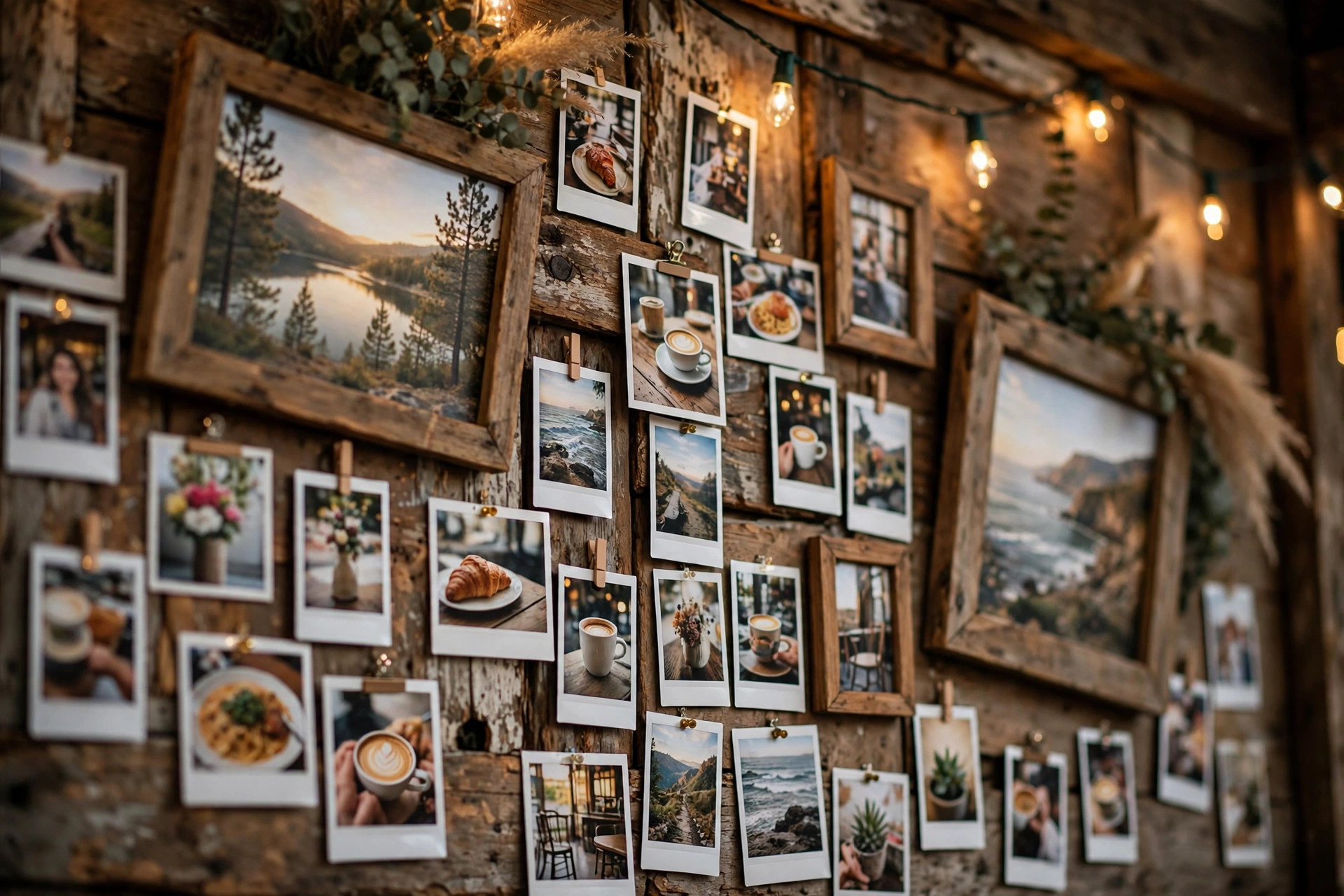
Contests and campaigns that fill feeds
Organic UGC flows from guests who loved their visit. Campaigns manufacture the same behaviour on purpose. Both have a place; campaigns are how you go from a trickle to a stream.
The monthly photo contest
The simplest campaign that actually works: "Post your best photo from [restaurant], tag us and use #[hashtag] — the winner each month gets a dinner for two." It costs you one dinner a month and generates a steady stream of tagged content. Rules that keep it healthy: judge on a fixed date, announce the winner publicly, repost the winning photo (with permission), and keep the mechanics dead simple. Complexity kills participation.
Giveaways and themed nights
Seasonal hooks multiply participation: a Valentine's "best couple photo" contest, a summer terrace photo week, a Christmas "ugliest sweater" night with a photo wall. Each theme gives guests a reason to post beyond "the food was good" — and reasons are what separate the restaurants with ten tagged posts a month from those with a hundred. Keep prize values modest and the entry effort tiny.
A note on contest rules
Keep terms short, visible and fair: who can enter, how winners are chosen, when, and what the prize is. In the Nordics, standard consumer-protection fairness applies to promotions as it does to everything else — no hidden conditions, no changing the rules mid-contest. This is general information, not legal advice; for large prizes, check your national guidance.
"The flywheel starts slowly — expect the first two to three months to feel like effort for little return — and then it starts running itself."
Rights and permissions: how to repost legally
This is the section most UGC guides skip, and the one that protects you. A guest's photo belongs to the guest. Reposting it on your commercial channels without permission is a copyright infringement risk — and under EU rules, photos showing identifiable people add a privacy layer on top.
The permission routine
Keep it simple and do it every time: reply to the post or send a DM — "Love this photo! May we repost it on our Instagram/website with credit to you?" — and screenshot the "yes". That screenshot is your licence file. Most guests are delighted; being featured is flattering. For content you want to use in paid ads, get explicit written confirmation covering commercial use, because "sure, repost it" does not clearly cover advertising.
Photos of people and GDPR
In Finland, Sweden and Norway, publishing photos of identifiable individuals on your business channels generally requires their consent — and guests in the background of someone's food photo did not consent to appear in your marketing. Practical approach: prefer reposting photos where the poster is the subject (selfies, their own table), ask explicitly when others are identifiable, and avoid close-ups of strangers or children entirely. When collecting content directly (e.g. a QR code inviting uploads), include a short consent line: "By submitting, you confirm you took this photo and agree we may use it on our channels with credit."
Reviews: a special case
Written reviews on Google and Tripadvisor come with their own platform terms — you can generally quote short snippets with attribution under fair practice, but wholesale copying of review text onto your marketing materials is shakier ground. The safest high-value move: screenshot-style graphics of your replies are yours entirely; for the review text itself, link to it or quote briefly with credit. Our guide on using reviews in your marketing covers the permission details.
Put UGC everywhere, not just Instagram
Most restaurants collect UGC and then use it in exactly one place: a story reshare that vanishes in 24 hours. That is like catching fish and throwing back the big ones. Every rights-cleared piece of guest content is a multi-channel asset:
- Your website. A "guest moments" gallery on your homepage or menu page shows real people enjoying real food — stronger than any stock photography. This is also where a well-built restaurant website pays off: a fast page with real guest photos and one-tap booking converts the trust UGC creates.
- Google Business Profile. Upload the best guest photos (with permission) to your profile. They appear in search and Maps results, exactly where undecided diners compare you against competitors.
- Paid social ads. Customer photos consistently outperform studio shots on click-through in restaurant ads. Start with your top-performing organic reposts as ad creative.
- Email and newsletters. A "your photos this month" section gives subscribers social proof and gives featured guests a reason to open.
- In-venue screens and print. A rotating slideshow of guest photos near the entrance, or a printed "wall of fame", closes the loop: guests see that posting gets recognised, so they post.
- Menu and booking pages. Dish-level guest photos next to menu items ("as enjoyed by @guest") make abstract menu text concrete.
One asset, five jobs
A single great guest photo, properly permissioned, can work simultaneously on Instagram, your website gallery, your Google profile, a Facebook ad and the in-venue screen. Build the habit of asking "where else can this go?" every time you clear rights to a strong image. Content you paid nothing for should work the hardest.
Measure and scale your UGC engine
UGC is measurable if you track inputs rather than vibes. Watch these numbers monthly:
- Tagged-post volume. How many posts used your hashtag or location tag this month? Trend matters more than the absolute number.
- Permission rate. What share of outreach DMs get a "yes"? Below 50% suggests you are asking too late or too impersonally.
- Repost performance. Compare reach and saves on UGC reposts versus your own brand posts. Most restaurants find UGC wins.
- Review velocity. New Google reviews per month — the written side of the same flywheel. If you need a system for this, see how to get more Google reviews.
- Direct attributions. "Saw your Instagram" answers in your how-did-you-hear-about-us tally; booking-page traffic from social.
Make staff part of the engine
Your team sees the photo moments happen. Train them lightly: when a signature dish lands, a natural "that's our most-photographed dish, by the way" from the server outperforms any table card. Recognise the behaviour you want — a monthly shout-out for the server whose tables generate the most tagged posts costs nothing and works. And keep the loop visible: when a guest's photo goes up on the wall of fame or the venue screen, tell them. Recognition is the fuel the whole engine runs on.
The 90-day startup plan
Weeks 1–2: create the hashtag, fix lighting on signature dishes, claim location tags, print table cards. Weeks 3–4: launch the monthly photo contest, start the weekly hashtag search and permission DMs. Month 2: first reposts go live across channels; add the best to your website gallery and Google profile. Month 3: review the numbers, double down on what produced volume, and start planning seasonal themes. By day 90 you will have a library, a routine and a trend line — which is more than most restaurants ever build.
Frequently asked questions
Can restaurants use customer photos for ads?
Only with explicit permission covering commercial use. A "yes" to an Instagram repost does not automatically cover paid advertising, so ask specifically: "May we also use this photo in our paid social ads with credit to you?" Get the answer in writing (a DM screenshot counts) and keep it on file.
Do I need permission to repost a guest's photo on Instagram?
Yes. The photo belongs to the photographer — your guest. Send a quick DM asking to repost with credit, and save a screenshot of their agreement. It takes a minute, guests are usually flattered, and it keeps you clear of copyright and EU privacy issues.
How do I get guests to post about my restaurant?
Make it easy and rewarding: a short branded hashtag displayed everywhere, one deliberately photogenic spot with good lighting, your handle on table cards, staff who mention photo moments naturally, and a monthly photo contest with a simple prize. Then feature and thank the guests who post — recognition drives repetition.
What is a branded hashtag and why does it matter?
A branded hashtag is a unique tag built around your restaurant's name (e.g. #[YourName]Eats). It acts as your UGC inbox: searching it shows you every guest post in one place, making content easy to find, request permission for, and repost. Without one, your UGC is scattered and invisible to you.
Does UGC really increase restaurant bookings?
Guest content influences the channels where booking decisions happen — Google profiles, Maps, Instagram and review sites. Restaurants that systematically collect and redeploy UGC typically see growing tagged-post volume, stronger social proof at the decision moment, and better ad performance when guest photos are used as creative. Track tagged-post volume and review velocity monthly to see your own trend.
Want a website that shows off your best guest photos?
PowerfulWebsite builds your restaurant's website free — you only pay from €59/mo. Everything included: domain, hosting, maintenance and updates, with galleries and online booking that turn social proof into reservations.
See the packages