Delivery Times: Promise vs Reality
Food delivery times are the one promise a restaurant makes before it takes the customer's money — and more than a third of orders arrive later than the time shown at checkout. The average restaurant delivery takes about 31 to 34 minutes, customers start losing patience at around 30, and the gap between the two is where reviews, refunds, and lost regulars are made.
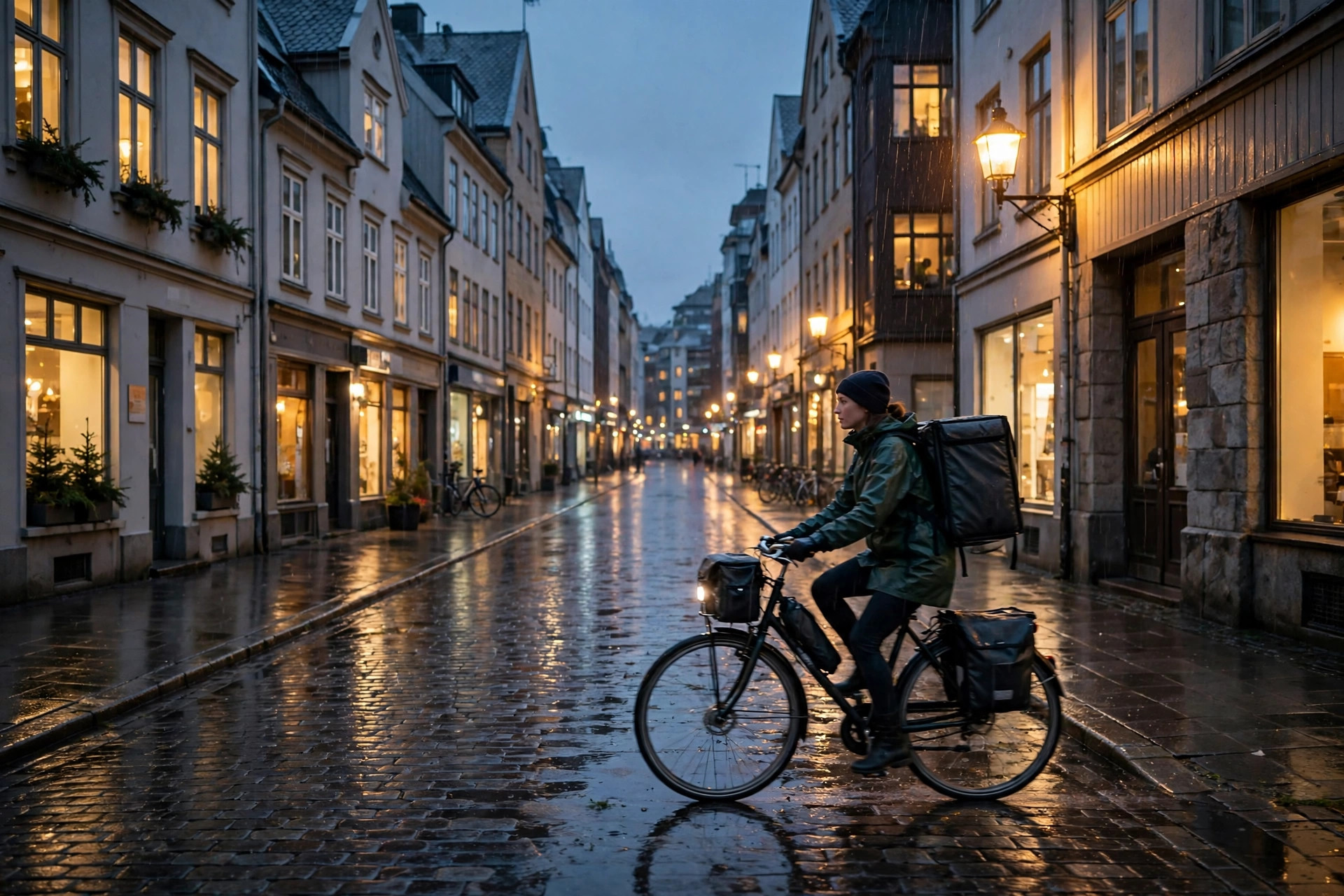
Key takeaways
- Customers are satisfied when food arrives within about 32 minutes; patience starts to run out at around 30 minutes.
- More than a third of third-party delivery orders arrive later than the time first shown to the customer.
- First-party delivery averages about 31 minutes; third-party platforms average about 34 minutes.
- The estimate is usually the problem, not just the execution — only 1–3% of orders hit the quoted time exactly.
- An honest range you keep beats a fast promise you break, every time.
- When a delivery slips, tell the customer first, with a new realistic time — silence is what turns a delay into a complaint.
It is 18:40 on a Friday. A customer ordered dinner at 18:05, when the app said 25–35 minutes. It is now 18:40, the food has not arrived, and the courier icon on the map has not moved for ten minutes. The customer is hungry, the kids are asking when dinner is coming, and the restaurant is about to get a one-star review that mentions the wait before it mentions the food. The food, when it finally arrives at 18:55, is lukewarm. The review will not mention that the kitchen cooked it perfectly at 18:25. It will mention the fifty minutes.
This is the delivery time problem, and it is the most expensive problem in restaurant takeaway that nobody owns. The kitchen blames the courier. The courier blames traffic. The platform blames the restaurant for being slow to confirm. The customer blames the restaurant, because the restaurant's name is on the bag. And the review, the refund request, and the customer who never orders again all land on the restaurant's side of the ledger.
This article looks at what the data actually says about delivery times — how long orders really take, where the time goes, why the estimate shown at checkout is so often wrong, and what a restaurant can do about it. The numbers come from published mystery-shopping research and consumer surveys; where a figure is an industry estimate rather than a measured fact, it is labelled as one. The advice is for independent restaurants, cafés, and bars in the Nordics that sell through Wolt, Uber Eats, or their own delivery — and for the owners who have to answer the phone when a delivery is late.
What customers actually expect
Customers do not expect instant food. They expect the food to arrive when they were told it would arrive. That distinction is the whole story of delivery times, and it is the first thing to understand before changing anything about your operation. A customer who is told 45 minutes and gets their food in 45 minutes is satisfied. A customer who is told 25 minutes and gets their food in 40 minutes is angry — even though the second customer waited less time in absolute terms. The promise sets the expectation, and the expectation decides whether the experience felt good or bad.
What is a reasonable expectation? The research is unusually consistent on this point. A 2024 survey of 2,000 American adults found that people start losing patience at around 29 minutes from ordering, and half of respondents said 30 minutes was the maximum acceptable wait. A separate mystery-shopping study found that the "sweet spot" — the time at or below which shoppers were satisfied with delivery speed — was 32 minutes and 10 seconds. Different studies, different methods, same conclusion: the customer's mental clock runs out at roughly half an hour.
That half-hour expectation was not invented by customers. It was trained into them by decades of pizza chains promising "30 minutes or free", and then reinforced by delivery apps that show optimistic times at checkout because optimistic times convert better. The result is a structural mismatch: customers expect about 30 minutes, the real average is 31 to 34 minutes, and a large share of orders land on the wrong side of the line. The restaurant did not create that mismatch, but the restaurant pays for it — in reviews, in refunds, and in customers who quietly stop ordering.
The numbers: promise vs reality
How big is the gap, really? The best recent data comes from a mystery-shopping study conducted in 2025, in which researchers placed 600 delivery orders — 450 through the three major third-party platforms and 150 through restaurants' own first-party channels — and measured what was promised against what actually happened. The headline numbers are worth knowing, because they are the numbers your customers are experiencing whether you measure them or not.
The average restaurant delivery took 34 minutes and 17 seconds through third-party platforms, up from 32 minutes and 25 seconds the year before — delivery got slower, not faster. First-party delivery, where the restaurant controls its own couriers, averaged 30 minutes and 53 seconds. The platforms are getting better at estimating: 57% of orders arrived earlier than the estimated time, up from 54% a year earlier, and 37% arrived late, down from 42%. But they are getting worse at keeping the time they first promote: 34% of deliveries came in slower than the promoted time, up from 27% the year before, while 62% came in quicker, down from 72%.
Read those two trends together and the picture is clear. The estimated time shown during the order — which updates as the order progresses — is becoming more accurate. But the promoted time shown before the customer orders — the number that sells the order — is becoming less honest. The platform shows you a fast time to win the order, then revises it upward once you have paid. That is a conversion tactic, and it works right up until the customer notices the pattern and stops trusting the number at all.
| Channel | Average delivery time | Orders arriving late | Order accuracy |
|---|---|---|---|
| First-party (own couriers) | 30 min 53 sec | Lower than third-party | 90% |
| DoorDash | 30 min 59 sec | Part of the 37% late share | ~85% (platform average) |
| Uber Eats | 35 min 47 sec | Highest delay rate in cited studies | ~85% (platform average) |
| Third-party average | 34 min 11 sec | 37% later than estimated | 85% |
| Customer satisfaction point | 32 min 10 sec or less | — | — |
A separate academic study of more than 400,000 food delivery records found that over a third of orders on major platforms arrive late, with DoorDash recording a delay rate of around 38% and Uber Eats around 44% in the dataset studied. The study also found something owners should take seriously: delays propagate. A courier who is late on one delivery is significantly more likely to be late on the next one, because the whole route shifts. One slow kitchen at 18:00 can poison the courier's next three deliveries, and two of those customers will blame restaurants that did nothing wrong. Your delivery time is not just your problem — it is partly your neighbours' problem too, and theirs is partly yours.
What "late" means in practice
There is no universal definition of a late delivery, but the research consistently treats anything beyond the estimated time as late, and anything beyond 45 minutes as a failed experience for most customers. If your average delivery is 35 minutes, a meaningful share of your orders are already crossing that line — which is why the average alone is a misleading number. Track the share of orders that arrive more than ten minutes after the promised time. That is the number that predicts complaints.
Where the time actually goes
A delivery time is not one thing. It is four things added together, and each of them can go wrong independently. When a customer asks "where is my food?", the honest answer is that it is somewhere in one of these four stages, and knowing which one is the only way to fix the problem.
Stage one: confirmation and queueing
The clock starts when the customer pays, but the kitchen clock starts when someone confirms the order. On a busy night, an order can sit unconfirmed for several minutes while staff finish the table they are serving. Then it joins the queue: the kitchen works through tickets in order, and a delivery order competes with dine-in tables for the same burners. A restaurant that treats delivery orders as an interruption to dine-in service will always be slow on delivery; a restaurant that sequences them — a dedicated slot in the firing order, or a separate station at peak — will not. This stage is entirely yours, and it is where the biggest gains are usually found.
Stage two: preparation
Preparation time is the part of the delivery that varies most by dish. A salad takes four minutes; a well-done steak with sides takes twenty. The problem is that the platform's estimate rarely knows what was ordered. It applies a generic prep time to the restaurant, not to the dish, so a table of complex dishes gets the same estimate as a single sandwich. If your menu has dishes with very different prep times, the estimate will be wrong for half your orders no matter what you do — unless you set realistic prep times per dish in the platform's settings, which most restaurants never do. Check yours. It is a ten-minute job that fixes a surprising number of late orders.
Stage three: courier assignment and pickup
Once the food is ready, someone has to collect it. On a marketplace, the platform assigns a courier, who may be finishing another delivery, may be several minutes away, or may not exist at all on a rainy Friday night when demand spikes everywhere at once. Research on delivery data shows that courier availability is one of the strongest predictors of lateness: high traffic roughly doubles the delay on long-distance orders, and evening orders show the highest delays of any time of day. This is also the stage where stacked deliveries happen — one courier carrying two or three orders, so your food waits while someone else's is delivered first. You cannot control this stage on a marketplace. You can control it with your own couriers, or by removing it entirely with pickup.
Stage four: the ride
The ride itself is usually the shortest stage and the least variable — a few kilometres at city speed, plus finding the building and getting to the door. In Nordic cities it is also the stage most affected by weather: snow, ice, and rain slow couriers down and reduce the number of couriers working, which is why winter delivery times in Helsinki or Stockholm are structurally longer than summer ones. Scooters are generally the fastest vehicle in city traffic, according to delivery datasets; cars are slower because they get stuck in the same traffic as everyone else. Distance matters more than most owners think: every extra kilometre adds minutes, and orders beyond roughly five kilometres are late far more often than nearby ones. If your delivery radius is generous, your late rate will be too.
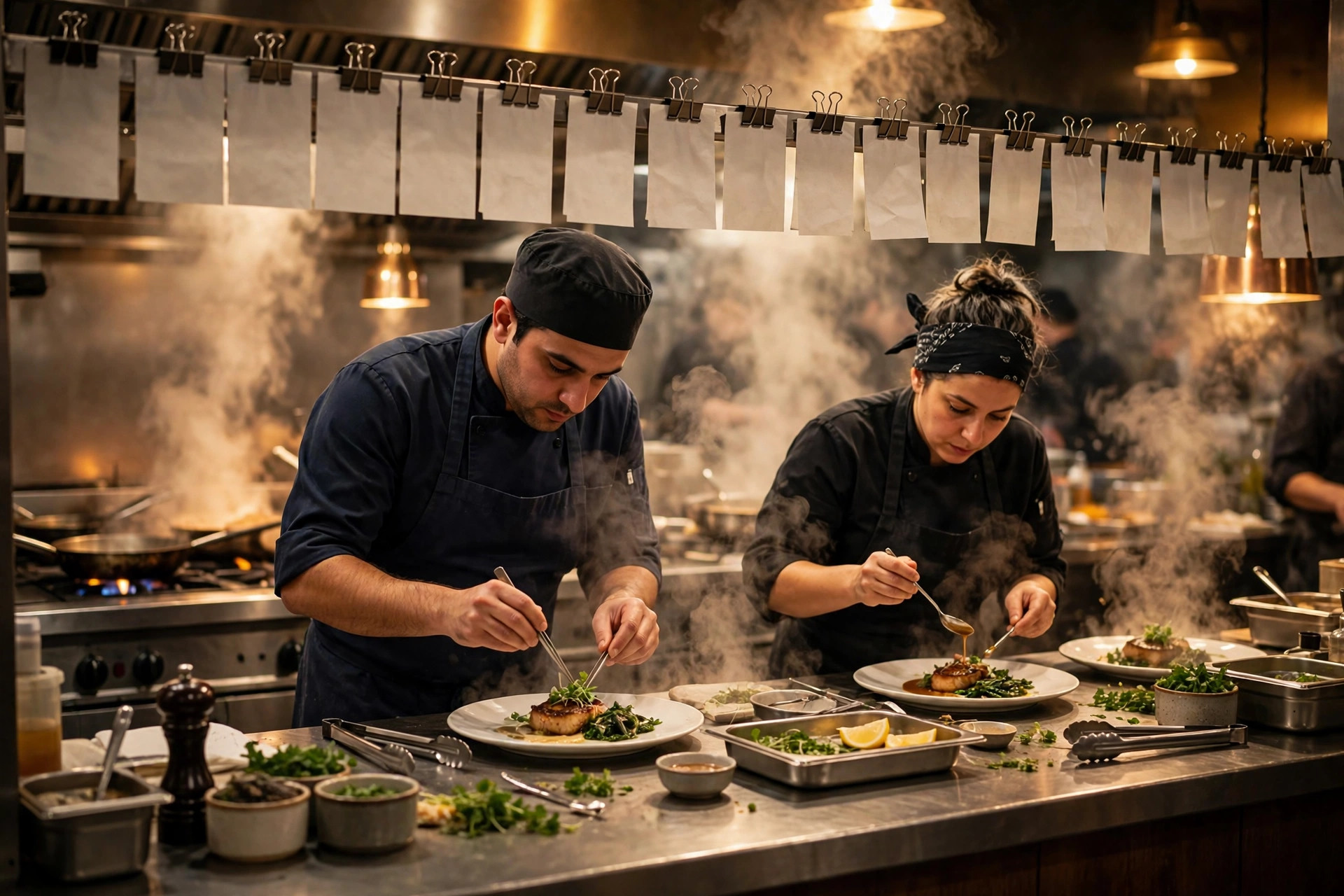
Why delivery estimates go wrong
If the four stages are understood, the mystery is why the estimate — the number the customer sees — is wrong so often. The answer is that the estimate is not a measurement. It is a prediction made by a system that does not know the state of your kitchen, and it is a prediction made under commercial pressure to look fast.
First, the estimate is usually static. It is calculated from the restaurant's historical average, the distance, and the time of day, and it is shown to the customer before the kitchen has even seen the order. It does not know that your grill cook called in sick, that a table of twelve just sat down, or that three large delivery orders arrived in the same minute. A static estimate in a dynamic kitchen will be wrong whenever the kitchen is busy — which is exactly when being wrong hurts most.
Second, the estimate is optimistic by design. Platforms compete on speed, and the platform that shows 25 minutes wins the order over the platform that shows 40 — even if both deliver in 35. There is no penalty for an optimistic estimate until the customer complains, and the complaint lands on the restaurant, not the platform. This is not a conspiracy; it is a misaligned incentive, and it is visible in the data: promoted times are getting less accurate even as estimated times get more accurate, because the promoted time is a sales number and the estimated time is an operations number.
The promoted time is a sales number. The estimated time is an operations number. Only one of them has to be true — and it is not the one the customer sees first.
Third, the estimate does not update honestly. Once the order is placed, the app shows a revised time — and the research shows this revised time is better than it used to be. But many customers never see the revision, because they stop looking at the app after ordering. They remember the number they saw at checkout, and they judge the delivery against it. The gap between "what the app said when I paid" and "what the app says now" is a trust gap, and the customer fills it with the worst assumption.
Fourth, off-peak hours are a blind spot. The same mystery-shopping study found that order accuracy dips in the late afternoon (87% between 13:31 and 16:00) and late at night (86% between 20:01 and 23:00) — the hours when restaurants run with fewer staff who are juggling more jobs. Delivery times suffer in the same windows, for the same reason: the kitchen is quieter, so nobody is watching the delivery queue, and the one person who is watching is also doing three other things. If your late orders cluster in the afternoon and late evening rather than at the dinner peak, this is probably why.
First-party vs third-party delivery
The data gives a clear answer to the question owners ask most: is it faster to deliver yourself, or to use a platform? On speed alone, delivering yourself wins. First-party orders averaged 30 minutes and 53 seconds against 34 minutes and 11 seconds for third-party platforms — a gap of more than three minutes — and first-party orders were more accurate (90% against 85%) and promoted a faster time to begin with. Among the platforms, DoorDash was the fastest at 30 minutes and 59 seconds, while Uber Eats was the slowest at 35 minutes and 47 seconds.
The reason is control. When you run your own delivery, you control all four stages: you confirm the order immediately, you know the kitchen's real queue, you dispatch your own courier when the food is ready, and you choose the route. On a marketplace, you control the first two stages and hope for the best on the last two. That hope is expensive: the courier may be stacked with other orders, may arrive before the food is ready and wait — or may arrive after it is ready and let it cool.
The 30-minute rule
Put the numbers together and a practical rule emerges: thirty minutes is the line. Customers start losing patience at around 29 minutes, half of them call 30 minutes the maximum acceptable wait, and satisfaction holds up to about 32 minutes. That gives you a working target: if your average delivery is under 30 minutes, most customers will be happy; if it is over 35, a large share will not be — and the share that is unhappy is the share that writes reviews.
But the 30-minute rule is a rule about perception, not just about the clock. A 35-minute delivery that the customer expected feels fine. A 35-minute delivery that was promised in 25 feels like a failure. So the rule has two halves: keep the real time as close to 30 minutes as you can, and never promise a time you cannot keep. The second half is more important than the first, because it is entirely in your control. You cannot make traffic disappear. You can stop showing 25 minutes on a Friday night.
There is also a food-quality clock running alongside the patience clock. Some dishes survive a 40-minute journey; others do not. Fries go soft in about ten minutes, fried chicken loses its crunch, ice cream melts, and salads wilt. Our guide to dishes that survive the trip covers which items to offer for delivery and which to keep for dine-in and pickup. If your menu is full of dishes that die in transit, no delivery time — fast or slow — will save the experience. The 30-minute rule only works if the food that arrives at minute 30 is still food worth eating.
Thirty minutes is not a speed target. It is a trust target: the point where the customer's patience, the food's quality, and your promise all still hold.
What late delivery costs you
A late delivery costs more than the refund. It costs the next order, and the one after that, because the customer who waited fifty minutes does not complain to you — they complain to their friends, and they order from someone else next Friday. The research on delivery satisfaction shows the scale of the risk: overall satisfaction with delivery speed fell from 94% to 91% in a single year, even as fees came down and estimates got better. Customers are not getting more forgiving. They are getting less.
The costs stack up in four places. First, the direct cost: refunds, remakes, and platform credits, which come out of your margin — on top of the delivery commission already taken from every order. Second, the review cost: delivery time is the single most mentioned complaint in restaurant delivery reviews, and a review that says "took an hour" does more damage than one that says "food was average", because it warns future customers away before they even try you. Third, the platform cost: marketplaces track late rates and accuracy, and restaurants with poor metrics get shown less prominently — a quiet penalty that compounds over months. Fourth, the relationship cost: a regular who orders weekly and gets two late deliveries in a month does not call to complain. They just stop ordering, and you never learn why.
How to set honest delivery times
So what do you actually do? You cannot rebuild the platform's estimation algorithm, and you cannot conjure couriers out of thin air on a rainy Friday. But you can control the number the customer sees, the way your kitchen handles delivery orders, and what happens when things slip. Here is the practical sequence, in order.
Measure your real times first
Before changing anything, find out how long your deliveries actually take. Most platforms show this in the merchant dashboard: average preparation time, average time to courier pickup, and average total delivery time, split by day and hour. Export a month of it. You will almost certainly find that the average hides two different restaurants: a fast one at lunch and a slow one on Friday night. Set your promised times from the slow one, not the average. An honest promise is built on your worst hour, not your best.
Set prep times per dish, not per restaurant
Go into your platform settings and set realistic preparation times for your slowest dishes. A fifteen-minute prep time applied to everything is wrong for both the four-minute salad and the twenty-five-minute grill dish. This is a small job with an outsized effect, because the platform's estimate is built on these numbers. While you are there, check your delivery radius: if orders beyond five kilometres are consistently late, shrink the radius. Losing a few far-away orders is cheaper than the reviews they generate.
Show a range, and mean the top of it
Where you control the number — your own website, your own ordering page, your Google Business Profile — show a realistic range such as "30–45 minutes" rather than a single optimistic figure. Make sure the top of the range is a time you keep at least nine times out of ten. Customers forgive a 40-minute delivery they expected; they do not forgive a 40-minute delivery they were told would take 25. This is the single most effective change most restaurants can make, and it costs nothing.
Sequence delivery orders in the kitchen
Treat delivery orders as a station, not an interruption. At peak, assign one person to own the delivery queue: confirm orders immediately, fire them in pickup-time order, and check every bag against its ticket before it leaves. Confirming an order the moment it arrives — rather than when someone gets around to it — can save five minutes on every order, which is often the difference between on time and late. If your kitchen display system supports it, set delivery orders to fire automatically a fixed time before the courier is due, so nothing is cooked early and left to cool.
Communicate before the customer complains
When a delivery is going to be late, say so first. A short message — "Your order is running about 10 minutes late and will arrive by 19:40" — with a new, realistic time, prevents most complaints outright. The worst experience is not a late delivery; it is a late delivery with no information, where the customer watches a motionless courier icon and imagines the worst. Most platforms let you send a delay notification; use it every time, without being asked. For a serious delay, add a small gesture — a free drink or dessert on the next order — and mean it. The cost is a few euros; the cost of silence is a customer.
The five-minute rule
Confirm every delivery order within five minutes of it arriving — ideally within one. Confirmation is the moment the platform starts looking for a courier and the kitchen starts the clock, so a slow confirmation delays everything downstream. Put confirmation on the opening checklist and make it one named person's job during service, not something anyone does "when they get a moment".
When pickup beats delivery
There is a point where the honest answer to the delivery-time problem is to stop offering delivery for that order at all — and offer pickup instead. Pickup has no courier, no traffic, no weather, and no stacked orders. The only promise is the time the food will be ready, and that is a promise your kitchen controls. For the customer, pickup is often faster than delivery: the food is ready in twenty minutes, they collect it in five, and they eat it hot. For the restaurant, pickup keeps the full order value and removes the entire category of late-delivery complaints.
The practical move is to make pickup as easy as delivery on your own channels: a clear "Order for pickup" button on your website, time slots the customer can choose, and payment at checkout so the collection takes thirty seconds. If you only offer pickup through a phone call, customers will choose the platform's delivery instead — not because they prefer delivery, but because the platform is easier. Our guide to building your own pickup channel walks through the setup, the costs, and how to move regulars across.
Delivery times will never be perfect. Traffic, weather, sick cooks, and Friday-night demand spikes are part of running a restaurant, and no system — yours or the platform's — can promise them away. What you can promise is honesty: a time you can keep, a message when you cannot, and a pickup option for the customer who would rather have hot food in twenty minutes than a promise of twenty-five that arrives in fifty. That is not a compromise. It is the delivery experience your customers actually want — and it is the one that keeps them ordering from you.
Frequently asked questions
How long should food delivery take?
For most restaurant orders, customers are satisfied when food arrives within about 32 minutes of ordering, and patience starts to run out at around 30 minutes. Mystery-shopping data from 2025 puts the average restaurant delivery at about 31 minutes for first-party delivery and about 34 minutes for third-party platforms. Anything under 30 minutes feels fast; anything over 45 minutes feels late.
Why is my food delivery always late?
The most common causes are a kitchen running behind during peak hours, too few couriers available, bad weather, traffic, and stacked deliveries where one courier carries several orders. Research also shows that over a third of third-party orders arrive later than the time first shown to the customer — the estimate itself is often the problem, not just the execution.
Is first-party delivery faster than Wolt or Uber Eats?
Yes, on average. In a 2025 mystery-shopping study of 600 orders, first-party restaurant delivery averaged 30 minutes 53 seconds, compared with 34 minutes 11 seconds for third-party platforms. First-party orders were also more accurate (90% vs 85%) and promoted a faster time. The advantage comes from controlling the whole chain — kitchen, dispatch, and courier — instead of handing the last leg to a platform.
Should I show customers a delivery time range or an exact time?
Show a realistic range, and make sure the top of the range is a time you can actually keep. A range such as '30–45 minutes' that is met nine times out of ten builds far more trust than a precise '25 minutes' that is missed a third of the time. Customers forgive a 40-minute delivery they expected; they do not forgive a 40-minute delivery they were told would take 25.
What should I do when a delivery is running late?
Tell the customer before they have to ask. A short message — 'Your order is running about 10 minutes late, it will arrive by 19:40' — with a new, realistic time, prevents most complaints. Offer a small gesture for serious delays, such as a free drink or dessert on the next order. Never let the customer discover the delay by watching a courier icon that has not moved for fifteen minutes.
Want delivery and pickup on your own website — with times you control?
PowerfulWebsite builds your restaurant website free of build cost, and the Restaurant plan at €239 a month includes your own commission-free ordering system for pickup and delivery. Everything is included: domain, hosting, maintenance, and updates.
See the packages