Instagram Stories That Drive Sales
Instagram Stories turn a casual follower into tonight's dinner guest: they sit at the top of the app where followers see them first, disappear in 24 hours, and let a restaurant post daily specials, polls and booking links that feed posts can't. The working formula is simple — 3 to 5 short Stories a day during operating hours, one interactive sticker per Story, and always end with one clear action: book, order or call.
Key takeaways
- Stories are a sales channel, not a content channel: top-of-app placement plus 24-hour urgency beat the feed for daily action.
- Post 3 to 5 Stories a day during operating hours — the mid-afternoon slot (15:00–17:00) catches the dinner decision window.
- Use one interactive sticker per Story: polls, questions, countdowns and the link sticker turn passive viewers into engaged diners.
- Every sales Story follows the same anatomy: hook (frame 1), craving (frames 2–3), and one clear call to action (final frame).
- Story Highlights turn your best Stories into a permanent catalogue: Menu, Reviews, Events, Team, Find us.
- Measure link taps, replies and booking conversions — not raw views — and tag every Story link with UTM parameters.
This guide is for restaurant, café and bar owners who already have an Instagram account but post Stories irregularly — or not at all. It covers exactly what to post, when to post it, which interactive features are worth your time, and how to connect a Story to an actual booking. It assumes you have a phone, a business profile, and roughly fifteen minutes a day. No ad budget required, no design skills needed.
Why Stories are the sales channel feed posts are not
Your feed and your Stories do two different jobs, and restaurants that treat them as interchangeable leave money on the table. The feed is your portfolio: the beautifully plated hero dish, the big announcement, the post you might still be proud of in two years. It lives under an algorithm that rewards reach and saves. Stories, by contrast, are your daily sales floor. More than 500 million people use Instagram Stories every day, and they sit in a row at the very top of the app — above the feed, above the noise, the first thing most people tap when they open Instagram in the evening.
That placement matters because of how dining decisions actually happen. Very few people wake up planning to try a new restaurant on Friday. The decision forms in the late afternoon, often while scrolling on the sofa: somewhere familiar versus somewhere tempting. A feed post from three days ago won't appear in that moment. A Story you posted at 16:00 — "Wild mushroom risotto tonight, only 12 portions, book through the link" — arrives exactly when the decision is being made. The 24-hour expiry is not a limitation; it is the feature. It creates genuine urgency ("today only, while it lasts") that a permanent post can't honestly claim.
Stories also carry a lower psychological barrier for the person posting. A feed post feels like it needs good lighting, a clean background and a caption. A Story can be a shaky 10-second clip of the soup simmering, filmed one-handed between services. That informality is precisely what audiences trust — diners can tell when a kitchen is real. For Nordic restaurants in particular, where authenticity and provenance are part of the value proposition, the unpolished Story is often more persuasive than the polished post. If you're building your overall presence, start with a solid Instagram strategy for restaurants and let Stories be its daily sales engine.
The one-sentence strategy
If you take nothing else from this guide, take this: feed builds the brand, Stories bring the bookings. The feed convinces someone you're a good restaurant; Stories convince them to come tonight. Post your best-looking content to the feed, and use Stories to post your most time-sensitive, most actionable content — the things that lose their value after 24 hours anyway.
How a Story actually turns into a booking
A Story that drives sales is not a random photo with "come visit us" written on it. It follows a simple three-act structure that matches how a hungry viewer thinks: that looks interesting → that looks delicious → I can act on this right now. Keep each sales Story to three to seven frames — one for the hook, two or three to build the craving, and one final frame with a single, clear call to action.
Frame 1: the hook
The first frame has one job: stop the tap-through. Most Story viewers tap through quickly, so give them a reason to stay. A moving first frame works far better than a static photo — steam rising from a pan, a pour shot, cheese being pulled. Add one short line of text, no more than five words: "Tonight only." "Fresh from the smokehouse." "This just came in." Keep faces and text away from the very top and bottom edges, where the interface overlays live.
Frames 2–3: the craving
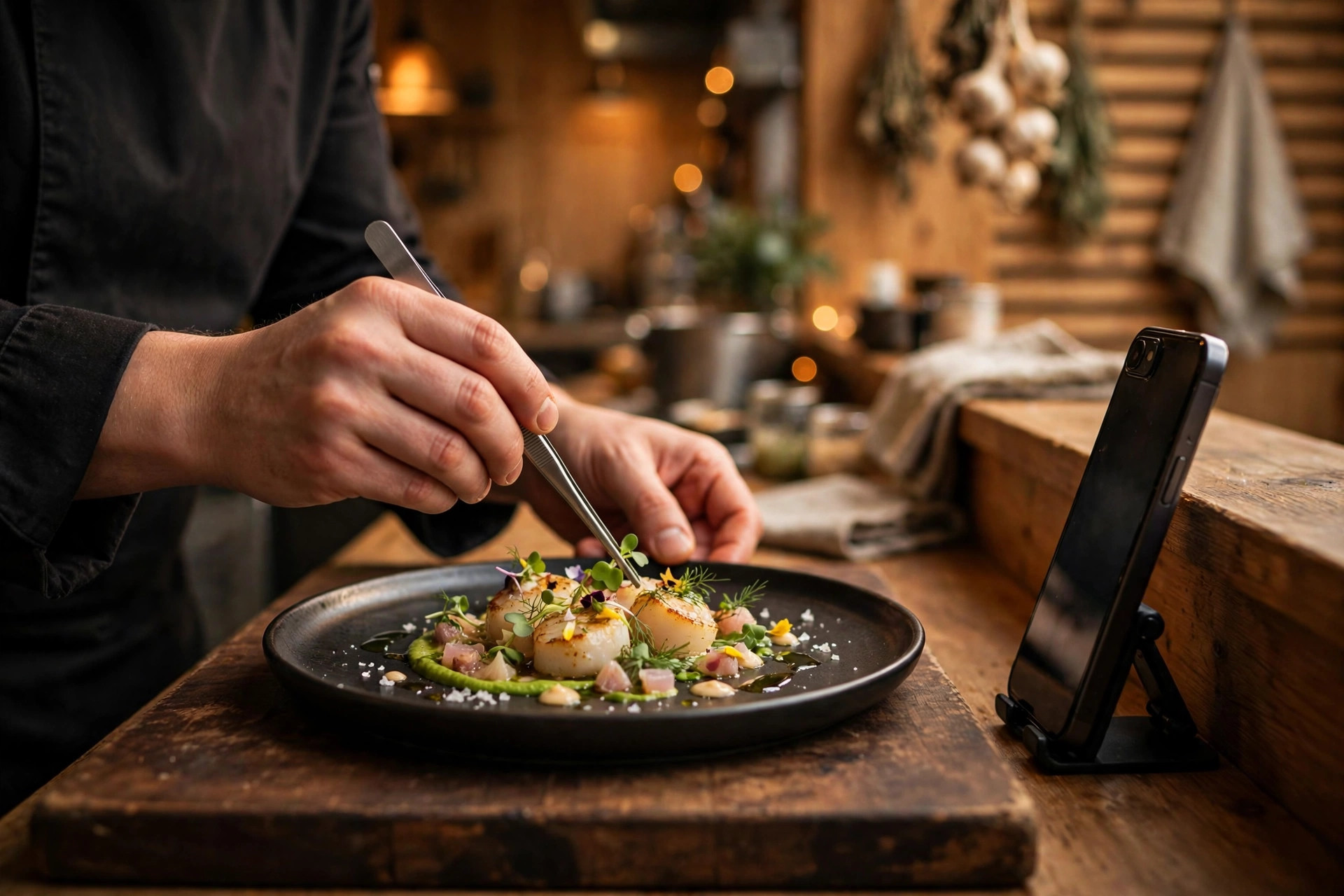
Now show what the viewer gets if they act: the finished plate, the room tonight, the dessert trolley being wheeled out. This is where restaurants win or lose — the food must look like something the viewer could be eating in two hours. Film close. Film the sauce being drizzled, the crust being cracked, the cocktail being strained. One sentence of context is enough: "Tonight's special: cured Arctic char, new potatoes, dill crème — 26 €."
The final frame: one clear action
Every sales Story ends with exactly one action, never two. Add the link sticker and label it precisely: "Book a table" or "See tonight's menu", not "Link here". If you take phone bookings, a tap-to-call prompt works: "Call 040 123 4567 — we'll hold a table." The mistake most restaurants make is ending with a pretty photo and no instruction. Viewers don't do homework; tell them the next step and make it one tap.
The 3-frame sales Story, at a glance
- Frame 1 — hook (3 seconds): motion + five words. "Tonight only." "Just landed."
- Frames 2–3 — craving: the finished dish, close up, with the price. Make it edible-now, not art-gallery.
- Final frame — one action: link sticker labeled "Book a table", or a tap-to-call number. Never both.
One more structural point: keep the booking path short. The link sticker should land directly on your booking page — not your homepage, not your "contact" page. Every extra tap loses a meaningful share of would-be bookers. If your website's booking flow takes more than three steps, that is the first thing to fix; a good restaurant website makes the path from Story link to confirmed table nearly frictionless. Pair the routine with a weekly idea bank — our 30 Reels ideas for restaurants adapt well to Stories — so you never stare at a blank screen wondering what to film.
The daily Story rhythm: what to post and when
Consistency beats intensity. Three casual Stories every day for three months will outperform a week of heavily produced content followed by silence. The rhythm below is built for a real kitchen with real staffing constraints — about fifteen minutes a day, shot between services on the same phone you already carry.
Morning: the promise of the day (1 Story)
Film what just arrived or what's being prepped: the fish delivery, dough being proofed, the soup pot going on. One sentence of context ("Lunch special goes out at 11:00 — salmon soup, 14.90 €") and you're done. Morning Stories set expectations for the day and give lunch decision-makers something concrete before the office crowd decides at 11:00.
Mid-afternoon: the sales window (1–2 Stories)
This is your money slot. Between roughly 15:00 and 17:00, followers are deciding where to eat that evening — and this is when the dinner-special Story goes up. Make it the full three-frame sales Story described above: hook, craving, one clear booking action. Restaurants that post dinner promotions in the afternoon consistently report better same-evening response than those that post at 19:00, when the decision has usually already been made.
Evening: the proof (1 Story)
A full or happy dining room is the most persuasive content a restaurant can post. Film the room (never close-ups of guests without permission), the specials board being wiped clean, the dessert case emptying out. "Tonight's risotto sold out — same kitchen, new special tomorrow" is social proof with a forward-looking hook. It tells tomorrow's viewer that tonight was worth coming to — and tomorrow might be too.
| Slot | What to post | Why it works |
|---|---|---|
| Late morning (10:30–11:30) | Prep, deliveries, lunch special of the day | Catches the office lunch decision window |
| Mid-afternoon (15:00–17:00) | Dinner special, limited portions, event countdown | Followers decide tonight's dinner in this window |
| Evening (19:00–21:00) | Full room, sold-out specials, staff energy | Social proof for tomorrow's viewers |
| Thursday–Friday | Weekend specials preview + countdown sticker | Weekend plans are made Thu/Fri; build anticipation early |
| Sunday evening | Next week's events, new menu teasers | Low competition, loyal followers are still watching |
The whole routine should feel sustainable. If 3–5 Stories a day is too much for your team, start with the afternoon sales Story alone — that single post carries most of the commercial weight. You can add the morning and evening frames once the habit sticks. (For filming technique, the same principles apply as in our food photography with your phone guide: natural light, clean backgrounds, close framing.)
Interactive stickers that convert viewers into diners
Stories come with interactive stickers — polls, questions, quizzes, countdowns, sliders — and they serve two purposes at once. They make your content more engaging, and every interaction teaches Instagram's algorithm that your account is worth showing to more people. If someone regularly taps your polls, your feed posts show up more often in their feed too. But from a sales perspective, one sticker matters more than the rest.
The link sticker: your checkout button
The link sticker is the only sticker that moves money directly. Put it on every sales Story, label it with the action ("Book a table", "Order takeaway", "See the weekend menu"), and point it at the most specific page that matches — the booking page for a booking Story, the menu page for a menu Story. Tag every link with UTM parameters (for example, ?utm_source=instagram&utm_medium=stories) so your booking system's analytics can tell you exactly how many reservations came from Stories. A restaurant that can say "Stories brought us 40 bookings last month" knows where to spend its content time.
Polls: low-friction engagement
Polls are the easiest interaction on Instagram — one tap, no typing. Use them weekly: "New dessert this weekend — chocolate or lingonberry?" "Fish or meat special tonight?" Beyond engagement, polls are free market research: when 70% of your followers vote for the chocolate dessert, you've just validated Friday's special before buying the ingredients. Share the result the next day ("You voted — chocolate fondant is on tonight's menu") and voters become customers; people come to taste what they helped choose.
Countdowns: manufactured anticipation
The countdown sticker is built for events and launches: a new seasonal menu, a wine dinner, a chef's-table night. Set the countdown a week ahead, let followers opt in for a reminder, and post a Story each day as it ticks down. When the reminder fires, your event is the first thing they think about. Restaurants running monthly tasting menus or themed nights (a Nordic seafood night, a Christmas-table preview) get particular value from this: the countdown turns a one-off post into a week of anticipation.
Questions and quizzes: deeper conversations
The question sticker ("Ask us anything about Friday's wine dinner") and quizzes ("Guess the secret ingredient — winner gets dessert on the house") take more effort but build the personal relationship that turns followers into regulars. A quick quiz about your restaurant's history, your suppliers, or Nordic food traditions positions you as the expert — and raffling a small prize among participants gives people a reason to play. One caution: the DM sticker, which prompts followers to message you, is genuinely useful for event bookings and group reservations — but only if someone actually answers the messages quickly during service hours.
Behind-the-scenes content that builds trust
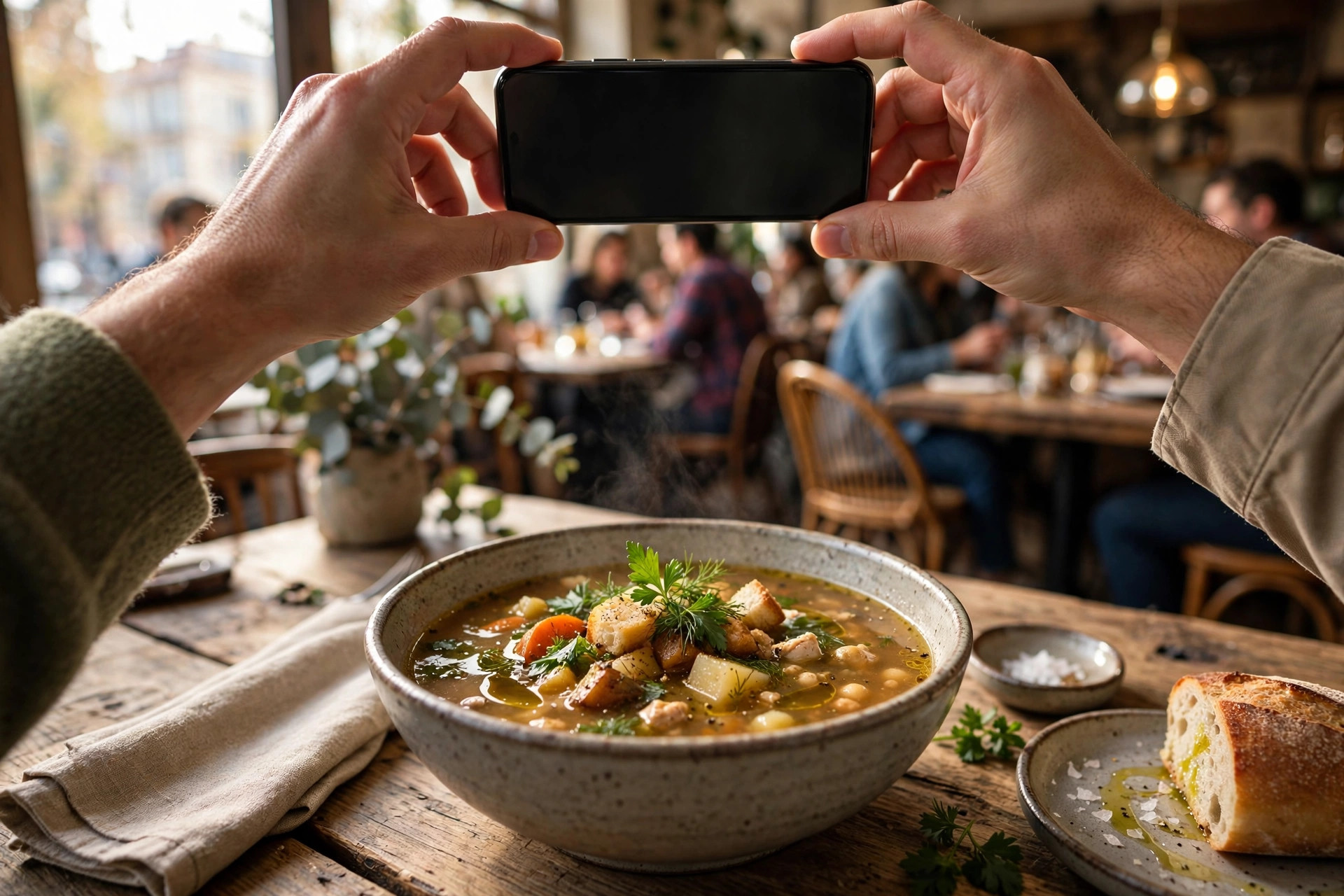
Diners — especially Nordic diners — increasingly want to know where their food comes from. Behind-the-scenes Stories are where a restaurant proves its claims: the morning delivery from the local farm, the fisherman's name on the crate, the sourdough starter being fed, the team setting up the room before doors open. This content costs nothing, takes thirty seconds to film, and does something no polished ad can do: it makes the restaurant feel like a real place run by real people.
What to film (the weekly rotation)
You don't need new ideas every day. Rotate a simple weekly menu of behind-the-scenes formats: Monday — the delivery ("Mushrooms from our forager, 6 kg, straight into tonight's pasta"); Tuesday — the prep ("Stock day: 8 hours, one pot"); Wednesday — the team (introduce one staff member, favourite dish, how long they've been with you); Thursday — the room (table settings, flowers, the specials board being written); Friday — the energy (the kitchen at full speed, the dining room filling up). By week three it takes less time than making coffee, and your Stories gain a rhythm followers start to recognise.
Staff takeovers and introductions
Letting a team member run the Stories for a day — a "staff takeover" — is one of the highest-engagement formats available to restaurants. The chef shows their mise en place; the bartender builds the week's cocktail; the server shows their favourite table and why. It humanises the brand and, pragmatically, it distributes the content workload across the team instead of landing on one person's phone. One rule: agree in advance what stays off camera (no guest faces without permission, no swearing, no complaints about customers), and keep it light.
Supplier stories: the Nordic angle
Nordic food culture puts unusual weight on provenance — local, seasonal, traceable. If you buy from nearby farms, smokehouses, fisheries or bakeries, tag them in your Stories. It's good for them (they repost you to their audience), good for you (you borrow their credibility), and exactly the kind of content that turns a nice dinner into a story a guest retells. "The lamb comes from a farm 40 km away" is a marketing message no chain competitor can copy.
Turning reviews and guest photos into sales
Your customers are already photographing your food and tagging your restaurant — the question is whether you make use of it. Reposting user-generated content (UGC) in Stories is the closest thing to free advertising that exists: real guests, real enthusiasm, zero production cost. It builds credibility in a way your own content can't (nobody believes a restaurant that calls its own food "amazing"), and it encourages more guests to post — everyone likes being featured.
The repost routine
Check your tags and mentions once a day — it takes two minutes. Repost the best one or two guest photos per week into your Stories with a genuine thank-you ("Thanks for the beautiful shot, @guestname!"). Create a simple branded hashtag (for example, #[YourRestaurant]Moments) and mention it on your menu, your receipts and your tables, so guests know how to get featured. When you share a review — a Google review, a kind DM, a tagged post — screenshot it and put it in Stories rather than the feed: reviews feel natural in the casual Story format and look oddly boastful as permanent posts.
Ask, don't assume
Most guests are happy to be reposted, but the polite route is to ask first — a quick reply to their Story ("Love this! May we share it?") takes seconds and avoids awkwardness. This matters doubly in the Nordics, where privacy expectations are high. A small habit worth building: whenever a guest posts something exceptional, save it to a "Guest love" collection so you have a steady supply of social proof for slow weeks. And when you repost, always credit the photographer clearly — it costs nothing and it's how you keep the UGC flowing.
Story Highlights: your permanent sales catalogue
Everything covered so far disappears in 24 hours — which is exactly why Story Highlights exist. Highlights pin your best Stories to your profile permanently, and for a new visitor they function as a visual FAQ: what does the food look like, is it any good, what's on tonight, where is it. A profile with organised Highlights converts profile visits into bookings; a profile with none — or with random Highlights from 2023 — sends the visitor back to the search results.
The five Highlights every restaurant needs
- Menu — your current dishes, prices, the specials board. Update this whenever the menu changes; an outdated Menu Highlight actively loses bookings.
- Reviews — guest photos, kind DMs, Google review screenshots. Social proof, permanently on display.
- Events — wine dinners, live music, seasonal menus, private dining. Your event marketing, always findable.
- Team — the people behind the food. Builds the personal connection that chains can't copy.
- Find us — address, opening hours, how to get there, parking. Answer the practical questions before they're asked.
Design simple cover images for each Highlight — one colour, one word or icon — so the profile looks intentional at a glance. And audit your Highlights quarterly: delete anything outdated, refresh the Menu Highlight with every menu change, and treat the Reviews Highlight as a living asset you add to weekly.
Fill the slow days with Stories
Stories are at their most commercially powerful when they move demand, not just reflect it. Almost every restaurant has the same problem: Friday and Saturday take care of themselves, while Tuesday and Wednesday wheeze. Stories — with their 24-hour expiry and link stickers — are the ideal tool for shifting a few covers from the weekend to the slow days.
The slow-day playbook
Pick one slow day and give it a weekly Story-only ritual. Examples that work: "Tuesday treat — every Story viewer who books tonight gets the dessert on the house (show this Story to your server)"; a Wednesday flash special announced only in Stories at 15:00; a Monday "chef's experiment" where followers vote on the dish in a poll and it's served only on Tuesday. The Story-only exclusivity matters: it trains followers to watch your Stories, because that's where the deals appear. Promote the ritual in your feed once ("Tuesday treats are announced in our Stories every week — don't miss them"), then let the Stories do the selling.
Countdowns for the weekend
Reverse the logic for the weekend: post your Friday and Saturday specials on Thursday with a countdown sticker, so followers can plan. "Weekend menu drops Friday — 4 courses, 59 €, 20 seats" with a countdown to Friday 17:00 builds anticipation and captures the people who book ahead. For event restaurants — wine tastings, live music nights, seasonal openings like the Christmas table season — start the countdown a full week out and post one Story a day as it ticks down.
Measure what matters: metrics and links
Instagram gives you plenty of numbers; most of them don't matter. A Story with 800 views and zero bookings is worth less than a Story with 200 views and 6 bookings. Track the metrics that connect to revenue, ignore the rest, and make the connection measurable with proper links.
The four numbers worth watching
- Link taps — the closest thing to purchase intent. This is your headline Story metric.
- Replies — DMs answering a question sticker or asking about availability are warm leads; reply fast.
- Sticker interactions — poll votes and quiz answers tell you what your audience cares about and feed the algorithm.
- Profile visits and follows from Stories — tells you whether Stories are growing the audience, not just serving it.
Views, on the other hand, are mostly vanity. Reach matters a little (it tells you the ceiling), but a Story's job is to convert the people who already follow you. If your link taps are flat while views grow, the problem is the offer or the call to action, not the audience size.
Make every link traceable
This is the single most valuable habit in this guide: never post a Story link you can't trace. Add UTM parameters to every link sticker (?utm_source=instagram&utm_medium=stories), and make sure your booking system or website analytics can show you conversions by source. Once you can say "Stories drove 30 bookings this month at zero cost", the fifteen minutes a day stops being a chore and becomes the most obviously profitable line in your marketing. Pair this with a booking flow that actually converts — the link has to land on a fast, mobile-friendly page where the table is three taps away, which is exactly what a modern restaurant website is built to do.
Frequently asked questions
How often should a restaurant post Instagram Stories?
Post 3 to 5 Stories per day during your operating hours. That rhythm keeps you at the top of the app without exhausting your team. The most valuable slot for sales is mid-afternoon (around 15:00–17:00), when followers are deciding where to eat that evening.
How do I add a booking link to my Instagram Stories?
Use the link sticker: add it to a Story, point it at your online booking page, and label it clearly ("Book a table" beats "Link here"). You need a business or creator account, and every link should carry UTM parameters so you can see which Stories produced bookings.
Can Instagram Stories really drive restaurant sales?
Yes — they are one of the strongest daily sales tools a restaurant has. Stories sit at the top of the app where followers see them first, the 24-hour expiry creates genuine urgency for daily specials, and interactive stickers turn passive viewers into engaged potential diners.
What is the best time to post Stories for a restaurant?
Post dinner promotions in the mid-afternoon, when people start planning their evening meal — roughly 15:00 to 17:00. Preview weekend specials on Thursday and Friday to build anticipation. Post lunch content in the late morning, around 10:30–11:30, before the office lunch crowd decides.
Should I post the same content to Stories and my feed?
No. Keep the two jobs separate: the feed is your polished, permanent portfolio — hero dish photos, big announcements, your best Reels. Stories are your casual, daily layer — the special of the day, a quick poll, a behind-the-scenes clip. Viewers expect different tones, and posting the same thing twice just annoys both audiences.
How long should an Instagram Story series be?
Three to seven frames per idea. One frame for the hook, two or three to build the craving, and one final frame with a single clear call to action. Series longer than seven frames usually lose viewers unless the content is genuinely entertaining.
Want a website that brings table bookings?
PowerfulWebsite builds your restaurant's website for free — you only pay the monthly plan from €59/mo. Everything included: domain, hosting, maintenance and updates.
See the packages