Kids' Menus That Actually Work
A kids menu that actually works has 6–8 familiar dishes, costs the parent roughly €7–12 (estimate, VAT included), arrives fast, and is visible on the restaurant's website before the family ever leaves home. Keep the dishes small and simple, add one or two genuinely healthy options that don't look like punishment, label the allergens properly, and the menu pays for itself by winning the family booking — not by the margin on the nuggets.
Key takeaways
- Parents book the restaurant; children approve the mood. The kids menu is aimed at the payer, not the eater.
- Keep it short: 6–8 dishes, 2 drinks, 1–2 desserts. Fewer choices mean faster service, less waste and happier kitchens.
- Price kids dishes at roughly €7–12 VAT-inclusive (estimates) — about 40–60% of an adult main — or offer half portions of adult dishes.
- EU allergen labelling applies to kids menus too. Mark the 14 allergens clearly and check cross-contact in shared fryers.
- Publish the kids menu on your own website and Google Business Profile. Parents search before they book; an invisible kids menu wins no tables.
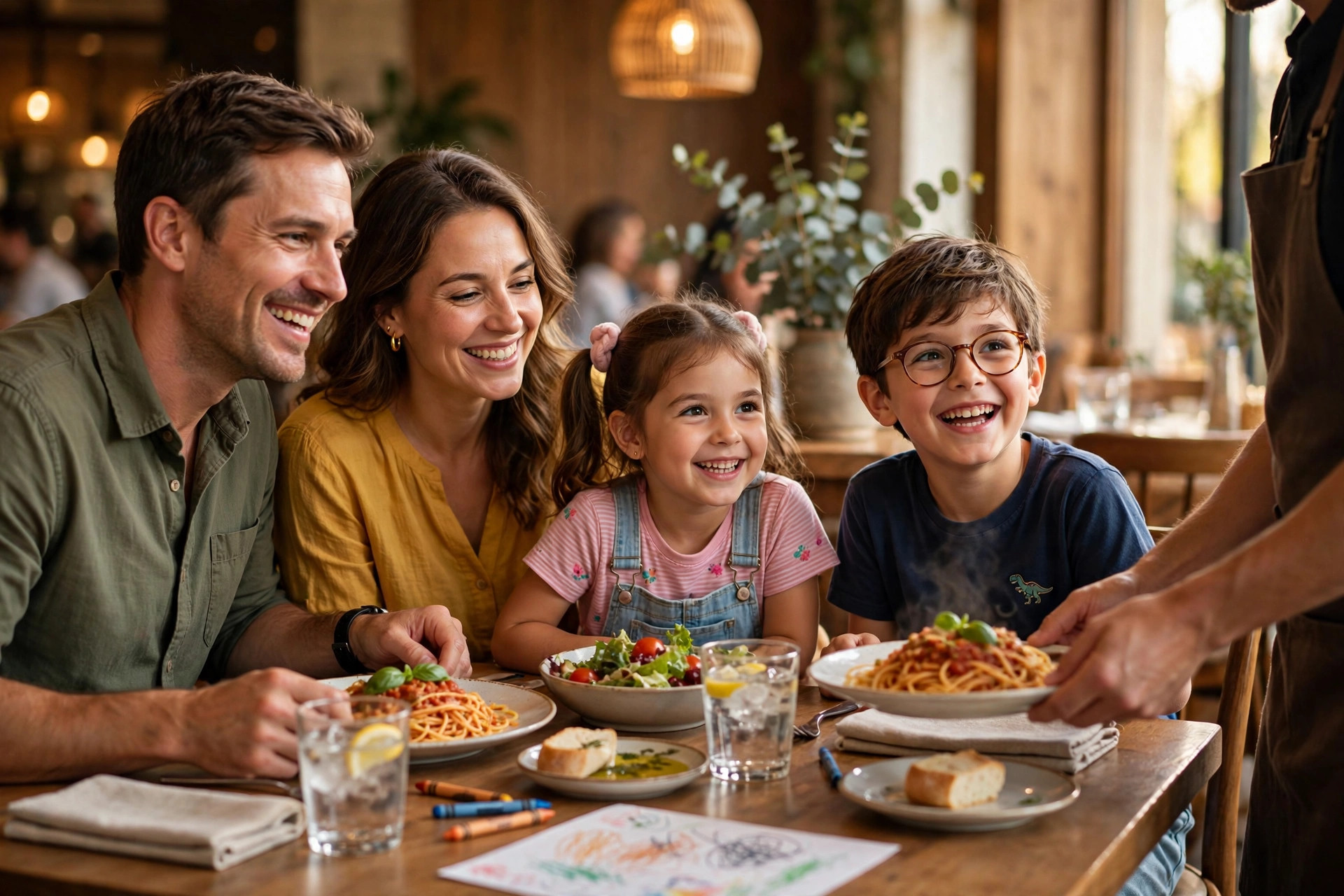
Most kids menus are an afterthought: five tired dishes at the bottom of the last page, designed once and never touched again. That is a strategic mistake, because the kids menu is not really a menu for children. It is a marketing instrument aimed at the person who pays — the parent — and the person who vetoes the visit: the parent who is worried the child will have nothing to eat, will wait too long, will make a scene, or will cost a fortune.
This guide is for restaurant, café and bar owners in the Nordics who want a kids menu that does its actual job: win the family booking, feed the child quickly and affordably, and add margin through adult mains, drinks and desserts around it. Below you will find concrete price points in euros (labelled as estimates), dishes children genuinely eat, EU allergen rules that apply to kids menus, the honest math behind "kids eat free", and how to make your kids menu findable online — because parents research before they reserve.
The economics first: why a kids menu is a parent decision
Start with the money, because it is backwards from what you might expect. A child orders a €9 dish. That dish barely matters. What matters is the €70–€120 the family of four spends around it — two adult mains, a bottle of water or two beers, desserts for the kids, coffee for the parents. The kids menu is a loss leader in the same sense as a shop's door handle: its job is to let the real spending walk in.
The decision logic runs like this. The parents look at your website or Google profile and ask four questions: is there something my child will eat, will it arrive before the child loses patience, what will it cost, and will the restaurant treat us as welcome guests rather than a nuisance? If your site answers yes to all four, you get the booking. If it answers none of them — no kids menu visible, no prices, no hint of family-friendliness — a large share of parents will simply book the competitor that did.
The separate menu vs half-portions debate
The dedicated kids menu dates back to the early 1900s, when paediatric advice began shaping how restaurants fed children — simpler foods, smaller portions, plainer seasoning. A century later, that model dominates casual and family restaurants, and it works. But a growing number of modern bistros and higher-end restaurants take a different route: no separate kids menu at all, just half portions of adult dishes at 50–60% of the price.
Both approaches are legitimate; they serve different concepts. A separate kids menu signals "children are genuinely welcome here" — it is the stronger marketing statement, and it lets you hit the €7–12 price point parents expect. Half portions keep the kitchen simpler (one menu, one mise en place, fewer recipes to train staff on), reduce waste, and suit restaurants whose identity is "serious food, and yes, bring the kids". The wrong choice is the middle ground: no kids offering at all, so parents have to improvise — splitting an adult dish, ordering sides, apologising to the server. That improvisation is exactly what makes families not come back.
What the economics demand from the dishes
Whatever model you choose, the kids offering has to satisfy three economic constraints. First, speed: a hungry child has a patience window of roughly ten to fifteen minutes before the table turns sour. Kids dishes should be buildable in under ten minutes, ideally from components the kitchen already preps for the adult menu. Second, low waste: children are unpredictable eaters, so dishes should use ingredients the kitchen already moves in volume. Third, margin through attachment: the kids dish itself carries a modest margin, but the family around it orders drinks and desserts at adult prices — which is where the real profit lives.
Kids menu pricing strategy: price points that hold
Parents experience the kids menu as a cost judgment on the whole restaurant: "if the nuggets are €16, what will my meal cost?" Price the kids menu wrong and you lose the booking before it happens. In the Nordics, the accepted band is roughly €7–12 VAT-inclusive for a kids main (all price points here are estimates — your food costs set your exact number). Below €7, parents start to wonder what is in it; above €12, the dish competes with adult lunch prices, and the parent does the math and flinches.
The most reliable pricing rule is relative, not absolute: the kids dish should cost 40–60% of the equivalent adult main. If your adult pasta is €19, the kids pasta lands at €8–10. If your adult burger is €17, the mini burger is €8–9. This feels fair to parents because it mirrors the portion logic, and it protects your margins because kids dishes are genuinely cheaper to produce — smaller portions, simpler ingredients, faster plating.
| Pricing model | Typical price (estimate, VAT incl.) | Best for | Watch out for |
|---|---|---|---|
| Separate kids menu (6–8 dishes) | €7–12 per dish | Family-casual concepts; strongest marketing signal | Menu sprawl — keep it tight or kitchen complexity rises |
| Half portions of adult dishes | 50–60% of the adult price | Bistros and upscale; simpler operations | Weaker "kids welcome" signal on the website |
| Kids eat free (with paying adult) | €0, conditional | Filling slow weeknights; new-customer acquisition | Cannibalisation — regulars will wait for the free night |
The margin reality
Kids dishes typically run a food cost of around 30–35%, which is no worse than most adult mains and often better — pasta, chicken and potato are cheap inputs. Where owners go wrong is pricing for pride rather than volume: a €14 kids dish with a 25% food cost earns less than a €9 dish with a 33% food cost once you count the tables it cost you. Remember the door-handle analogy: the kids dish opens the door; the family spend is the room.
Price presentation details
Two small presentation choices matter more than most owners realise. First, show VAT-inclusive prices — EU consumer rules require the price guests see to be the price they pay, so a "€9 + VAT" style listing is not an option anyway. Second, use the same charm-pricing conventions as your adult menu: .95 endings (€8.95 instead of €9) suit casual and family concepts, where parents are value-aware by definition. Our guide to menu pricing psychology walks through these tactics in detail — dropping the € sign, nesting prices in descriptions, anchor dishes — and all of them apply to the kids page as well.
What should be on the kids menu
Ask "what should be on a kids menu at a restaurant?" and you will get long lists of dishes. The better question is what the menu is for: feeding a child something they will accept, within ten minutes, at a price that keeps the parent relaxed. That constraint produces a remarkably consistent answer across successful family restaurants. Keep it to 6–8 dishes, built around foods children already know, plus drinks and desserts.
The core lineup
Most high-performing kids menus are variations on the same skeleton. One pasta (plain tomato or bolognese — the single most ordered kids dish in Nordic family restaurants). One mini burger or sliders. One chicken dish (strips, nuggets or grilled). One fish option (fish fingers, baked salmon pieces or fish soup — keep it simple). One or two healthier dishes (grilled chicken with rice, pasta with vegetables, a small grain bowl for older kids). And one safe staple for the truly picky: plain pasta with butter, or mashed potatoes with sausage. The picky-eater dish is not a joke entry; it is the dish that saves the visit when nothing else works, and parents are quietly grateful it exists.
Healthy without boring kids
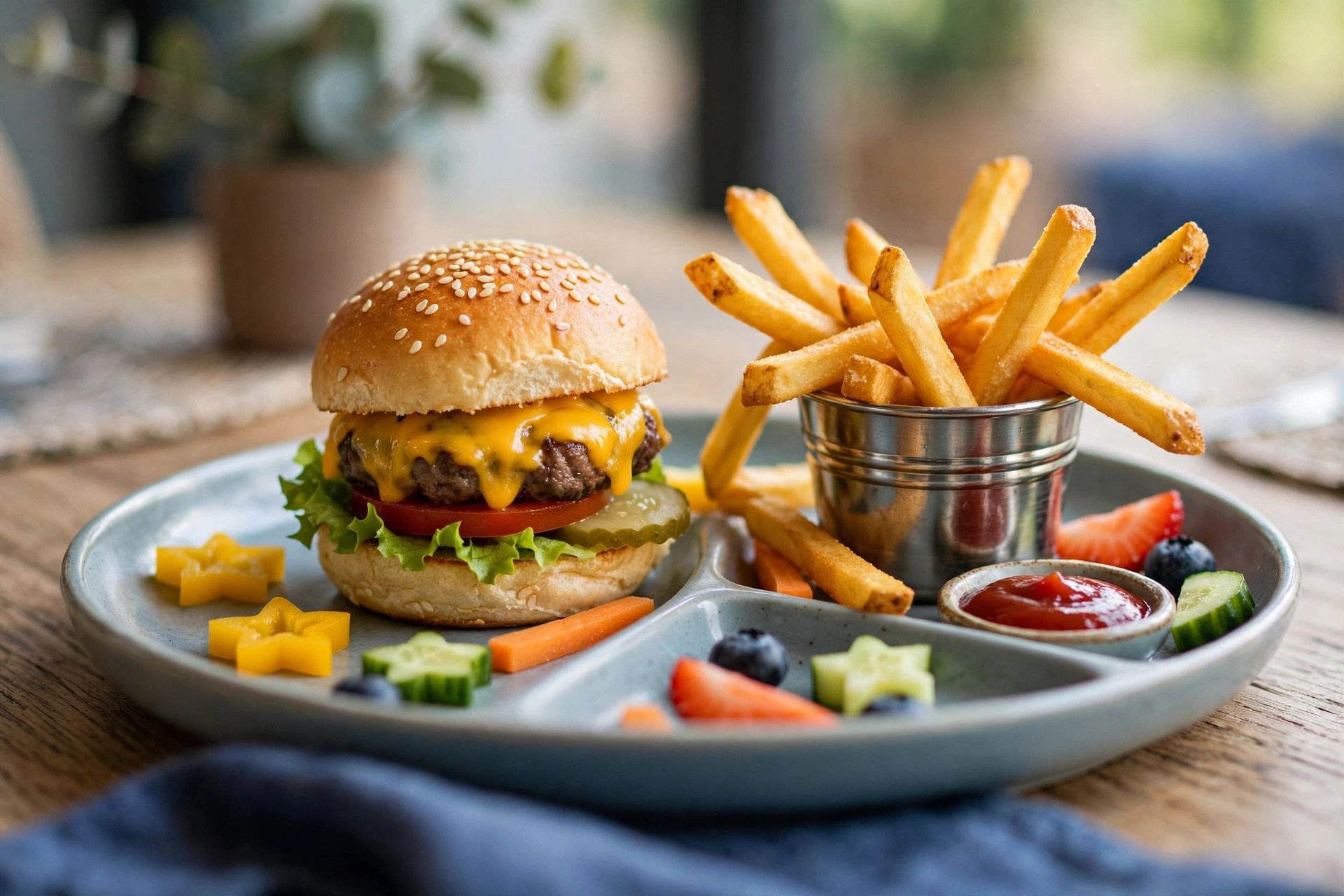
Parents want healthier options; children reject anything that looks like a lecture. The trick is making the healthier dish look as fun as the familiar ones and, in combos, making it the default. Grilled chicken strips with rice and a small salad looks normal when the plate is colourful. Fruit or vegetable sides work when they are built into the dish or presented as part of the fun — apple slices next to the nuggets, not a lonely side of steamed broccoli that reads as punishment.
Combos are the lever: "kids burger + fries + drink" is the familiar bundle, but you can quietly make the default version "kids burger + fruit or veg + water or milk" with fries and soft drinks available as swaps. Most parents take the default; most children accept it when everyone else's plate looks the same. Nobody feels deprived, and you have genuinely improved the meal. Save the nutritional lecturing for your website's blog, not the menu the eight-year-old is reading.
The 10-minute rule
Design every kids dish so it can reach the table within ten minutes of ordering, using components the kitchen already prepares. A hungry child's patience window is about ten to fifteen minutes; after that, the table's mood — and the parent's memory of your restaurant — is set by the wait, not the food. If a dish can't be fast, it doesn't belong on the kids menu.
Drinks and desserts: the profit engine
Do not treat kids drinks and desserts as afterthoughts; they are among the highest-margin items in the building. A soft drink or juice at €3–4 costs you well under a euro. A scoop of ice cream at €4–5 has a food cost of cents. And critically, these are the items children ask for — parents rarely order dessert for themselves unprompted, but a child requesting ice cream is the most reliable dessert sale in the restaurant.
Offer two drinks (a juice or soft drink, and milk or water as the sensible default) and one or two desserts (ice cream scoop with a topping choice, or a small fruit cup). Keep dessert pricing bundled into combos where you can: a €12 "meal + drink + ice cream" bundle feels like a deal to the parent while locking in all three sales, and it simplifies the child's decision into one yes. Bundles and set pricing are covered in more depth in our menu pricing psychology guide.
Menu design for kids: fonts, icons and playful layout
The kids menu is read by two audiences at once: the child, who reads the pictures and the names, and the parent, who reads the prices, the allergens and the subtext ("will my child actually eat any of this?"). Good kids-menu design serves both without condescending to either. A separate physical design — its own card, placemat or booklet — is part of the signal: it says the child is a real guest with a real menu, not a footnote on the adults' one.
Layout that works for small hands and tired parents
- One page, not a booklet. 6–8 dishes fit on one side of a placemat-style card. A multi-page kids menu looks indecisive and slows the decision.
- Pictures or icons for every dish. Children decide by image; parents decide faster when they can see portion and content. Simple illustrations or photos beat paragraphs of description for this audience.
- Large, readable fonts. Children's menus are often read in dim restaurant light by kids who are still learning to read fluently. Big type, generous line spacing, high contrast. Decorative script fonts are out.
- Allergen and price information that parents can find. Small icons or letters next to each dish for the 14 EU allergens (see the next section), and prices printed clearly. Parents scan for this information; hiding it destroys trust.
- Something to do while waiting. A colouring corner, a maze, a "find the hidden item" game on the back of the card buys the kitchen those crucial ten minutes and turns the menu into a keepsake. It is the cheapest table entertainment in the industry.
The digital version matters just as much
Remember that the parent meets your kids menu online before the child ever sees it in print. The digital kids menu needs the same clarity: readable text (not a scanned PDF that pinches to zoom), the dishes with prices, allergen information, and ideally a photo or two. Our digital menus guide covers the mechanics — but the design principle is the same: one short page, pictures, clear prices, allergens visible. If your kids menu only exists as the third page of a PDF download, most parents will never find it.
Allergen labelling on kids menus: the EU rules
This section is not optional garnish — it is the law, and on a kids menu it matters more than anywhere else, because the guests eating these dishes cannot always advocate for themselves. A seven-year-old with a nut allergy will not interrogate your server; the parent is relying on your labelling to keep their child safe. Get this right and you earn fierce loyalty; get it wrong and the consequences are unthinkable.
What the EU rules require
Under the EU Food Information to Consumers Regulation, the 14 major allergens must be declared for every dish — and yes, that includes the kids menu. The 14 are: cereals containing gluten, crustaceans, eggs, fish, peanuts, soybeans, milk, nuts (almonds, hazelnuts, walnuts, cashews, pecans, Brazil, pistachio, macadamia), celery, mustard, sesame, sulphur dioxide and sulphites, lupin, and molluscs. Each dish needs a clear indication of which allergens it contains, using a consistent system — numbered or lettered markers with a legend, or the allergens named in bold within the ingredient list.
Our full guide to allergen labelling for restaurants: EU rules explained walks through the complete requirements, including how to phrase "may contain" warnings and how to train staff. The kids-menu-specific points are worth stating separately:
- Use the same labelling system on the kids menu as the adult menu. Parents learn your system once; a different system on the kids card is a trap.
- Watch the fryer. The shared fryer is the classic kids-menu allergen risk: chicken nuggets and fries share oil with breaded fish, onion rings and anything else the kitchen drops in. If your fryer is shared, your allergen labelling must reflect cross-contact honestly.
- Keep the kids menu's allergen info current. Kids menus change rarely, which means they go stale silently — a supplier swap on the nuggets or the bun can change the allergen profile. Review the kids dishes on the same schedule as the adult menu.
- Train the "kids table" script. Servers should proactively ask about allergies at family tables ("any allergies I should know about?") rather than waiting. Parents of allergic children notice — and remember — which restaurants ask first.
The fryer warning
The single most common allergen failure on kids menus is the shared fryer. If nuggets, fries and breaded fish all share one oil bath, your menu must account for cross-contact — and your staff must be able to tell a parent exactly what shares the fryer. When in doubt, a separate small fryer for kids' items is a genuine selling point worth advertising.
Kids eat free: the real math
"Kids eat free" is the most powerful kids-menu promotion in the industry — and the easiest to get wrong. Done well, it fills dead nights with new families. Done badly, it trains your regulars to wait for the free night, cannibalises your best evenings, and turns your dining room into a cost centre. The difference is entirely in the conditions.
When kids eat free actually works
The promotion works when it moves demand from nowhere to somewhere — not from Friday to Tuesday. The classic working setup: one free kids meal per paying adult main, valid only on your slowest evening (say, Monday or Tuesday), and only for dine-in. The adult orders a €24 main, the child gets the €9 kids dish free, and the table's total still lands at €50–70 with drinks. Your marginal cost on that table is the food cost of one kids dish — roughly €3 — plus the seat you were not going to fill anyway.
It also works as a new-family acquisition tool. First-time family visitors who come on a kids-eat-free night and have a good experience return at full price — parents are loyal to restaurants where their children are welcome. The promotion is cheap customer acquisition if you treat it that way: collect nothing, demand nothing, just be excellent, and a share of those families convert into regulars.
The math that kills it
Run the same promotion on a busy Friday and the arithmetic inverts: every free kids meal displaces a paid one, and you have paid full staffing to serve discounted tables. Offer it without the "one per adult main" condition and you get tables of one adult with three children eating free — a real scenario every family-restaurant owner knows. Run it too often and regulars learn the schedule; why would anyone pay full price on Wednesday when Tuesday is free?
Safer alternatives
- Kids menu Tuesdays: a fixed-price family night (€29 for an adult main + kids meal, for example — estimate) instead of free. It keeps the value signal while preserving margin.
- Free dessert, not free meal: the kids dish is paid, the ice cream is on the house. The marginal cost is cents, the perceived generosity is high, and children remember the restaurant that gave them ice cream.
- Time-limited, not recurring: a two-week launch promotion for a new kids menu fills tables and creates urgency; a permanent weekly free night trains expectations.
Family combos, drinks and desserts
Bundles are where the kids menu turns from a booking tool into a revenue tool. A family deciding dish-by-dish might skip dessert or share drinks; a family offered a complete package commits to the full spend before sitting down. The psychology is the same good–better–best ladder that works on adult set menus: replace several small decisions with one confident yes.
Combos that work for families
- The kids combo: kids main + drink + ice cream for a fixed €12–14 (estimate). One price, one decision, all three sales locked in. Parents love the certainty; children love the package.
- The family bundle: two adult mains + two kids combos at a slight discount — say €65–75 for the bundle (estimate) versus €80+ à la carte. It reads as generous while guaranteeing a high table total.
- The birthday/celebration package: a fixed per-child price for parties — food, cake, a small activity — that turns your slowest afternoon slot into an event booking. Children's birthday parties are some of the most profitable covers in family restaurants, and they bring future regulars.
Price the bundle so the per-item math is visibly fair — parents do check — but remember the bundle's real profit comes from the items the family would not have ordered separately: the second drink, the dessert, the coffee while the kids colour. That is not a trick; it is the family buying a complete evening instead of assembling one.
Drinks: the quiet margin
Kids drinks deserve a line of their own because the numbers are extraordinary: a €3.50 soft drink or juice costs you well under a euro, and children drink more of them than adults do — especially with a refill offer. A €5 "unlimited kids drinks" add-on to the combo sounds generous and costs you a euro or two per child while the parents settle in for a longer, higher-spending evening. Just keep the sensible default visible: water or milk as the standard drink in the combo, soft drinks as the upgrade. Parents appreciate the restaurant that doesn't push sugar at their child, and the upgrade revenue comes anyway.
Promoting your kids menu online
Here is the uncomfortable truth behind every section above: none of it matters if parents cannot find it. The family booking decision happens at home, on a phone, usually with the search "family-friendly restaurant near me" or "kids menu [city]". If your kids menu exists only as a laminated card in the restaurant, you have built a product with no shopfront.
Your website: the kids menu's real home
Give the kids menu its own dedicated page or clearly labelled section on your own website — real text, not a PDF scan. Include the dishes, the prices, the allergen information, and a photo or two of actual kids dishes (not stock photos of smiling families — parents want to see the food). Add the phrases parents actually search for in the page copy: "kids menu", "family-friendly restaurant", "children welcome". This is basic SEO, and most of your competitors are not doing it, which is exactly why it works.
Consider adding menu structured data (schema.org/Menu markup) so search engines can surface your kids dishes directly in results. It is a small technical job — the kind of thing a good restaurant website setup handles once and maintains forever. At PowerfulWebsite we build restaurant websites from €59/month with the build itself free, and menu pages with proper structured data are part of every plan — because a menu Google can't read is a menu customers can't find. Our QR code menus guide covers the related question of how guests reach your menu on their phones once they're through the door.
Google Business Profile: where the decision happens
- Photos: add real photos of your kids dishes and of families dining comfortably. "Good for children" is one of the attributes Google lets you set — set it.
- Description and posts: mention the kids menu and any family offers (kids eat free nights, family bundles) in your business description and in occasional Google Posts. Parents scanning the local results notice.
- Reviews: respond to family reviews specifically ("so glad the kids enjoyed the pasta!"). Future parents read review replies as a proxy for how the restaurant treats families.
- Opening hours for families: if you open earlier for family dinner service, say so. "Open from 15:00 — early family dinners welcome" removes a real planning friction.
Social proof beats advertising
One genuine photo of a happy child with your kids burger, posted by a parent and tagged at your location, is worth more than any ad you could buy — family dining is a trust market, and parents trust other parents. Make it easy: a photogenic kids dish, a cheerful kids menu design worth photographing, and staff who are visibly kind to children. The content creates itself. Paid promotion of "family-friendly" claims, by contrast, tends to underperform: parents are sceptical of restaurants that have to advertise that children are welcome, because the truly welcoming ones simply show it.
Finally, keep the online kids menu current. A kids menu page showing last year's prices or dishes that no longer exist is worse than no page at all — it breaks the trust the parent extended by booking. This is another argument for digital menus you can update in minutes: when the nuggets supplier changes or the price moves from €8.95 to €9.50, the website should reflect it the same day.
Frequently asked questions
What should be on a kids menu at a restaurant?
Keep it short: 6 to 8 dishes built around foods children already know — a pasta, a mini burger, chicken or fish, one or two healthier options like grilled chicken with rice, plus 2 drinks and 1 to 2 desserts. Smaller, simpler portions of familiar dishes beat an ambitious menu: speed and reliability matter more to parents than novelty, and a short menu cuts waste and kitchen complexity.
How much should a kids meal cost?
In the Nordics, a kids menu dish typically costs €7 to €12 including VAT (estimates) — roughly 40 to 60 percent of an equivalent adult main. If you offer half portions of adult dishes instead of a separate menu, price them at 50 to 60 percent of the full dish. Always show VAT-inclusive prices: EU rules require the price guests see to be the price they pay.
Should restaurants have a separate kids menu, or smaller portions of adult dishes?
It depends on your concept. Casual and family restaurants do best with a separate kids menu: it signals family-friendliness, arrives faster, and lets you hit the €7–12 price point. Bistros and higher-end restaurants often do better with half portions of adult dishes, which keep the kitchen simple and teach children to eat grown-up food. The separate kids menu dates back to early-1900s pediatric advice; the half-portion approach is the modern alternative.
What makes a kids menu healthy without boring kids?
Offer one or two healthier dishes that still look fun — grilled chicken strips with rice, fish with vegetables, pasta with tomato sauce — alongside the familiar favourites, and make the healthier option the default in combos (fruit or vegetables as the side, water or milk as the drink). Vegetables work when they are built into the dish, not served as a lecture next to it.
Do kids menus actually make restaurants more money?
Yes — mainly by winning the booking. Parents decide where the family eats, and a visible, affordable kids menu converts family bookings that would otherwise go to a competitor. The math works because kids dishes have low food costs (typically around 30–35 percent), arrive fast so tables turn over, and parents add adult mains, drinks and desserts around them. A separate kids menu rarely loses money; an invisible one definitely loses tables.
How do I put my kids menu on my website so families find it?
Give the kids menu its own section or page on your own website — not just a PDF buried in the downloads — with the dishes, prices and allergen information in readable text. Add kids-menu photos to your Google Business Profile, mention it in your opening description, and consider menu structured data so it shows up in search. Parents search for family-friendly restaurants before they leave home, so the menu must be findable before they book.
Want a kids menu parents can find in ten seconds?
PowerfulWebsite builds your restaurant's website for free — you only pay from €59/month. Every plan includes a fast, mobile-friendly menu page with your kids dishes, prices and allergen notes, plus the structured data that helps families find you on Google.
See the plans