Managing Multiple Delivery Platforms at Once
To manage multiple delivery platforms without chaos, get every order into one queue: aggregation software pulls Wolt, foodora and Uber Eats into your POS and kitchen display, syncs menus and stock from one screen, and replaces the row of tablets with one workflow. Separate tablets only work at low volume — past a handful of orders a day, re-typing orders costs more in labour and errors than the software does.
Key takeaways
- One tablet per platform breaks down at rush hour: missed alerts, re-typed orders, sold-out items still live elsewhere.
- Aggregation does three jobs — one order queue, one menu published everywhere, one reporting view.
- In most Nordic markets one platform covers most demand; add a second only when operations can absorb it.
- Re-typing an order takes roughly 60–90 seconds; at 40 orders a day that is over an hour of paid labour daily.
- Extend prep times and pause platforms early — cancellations damage your ranking more than a short pause.
- Reconcile payouts per platform weekly; commissions, VAT and refunds hide in three different statements.
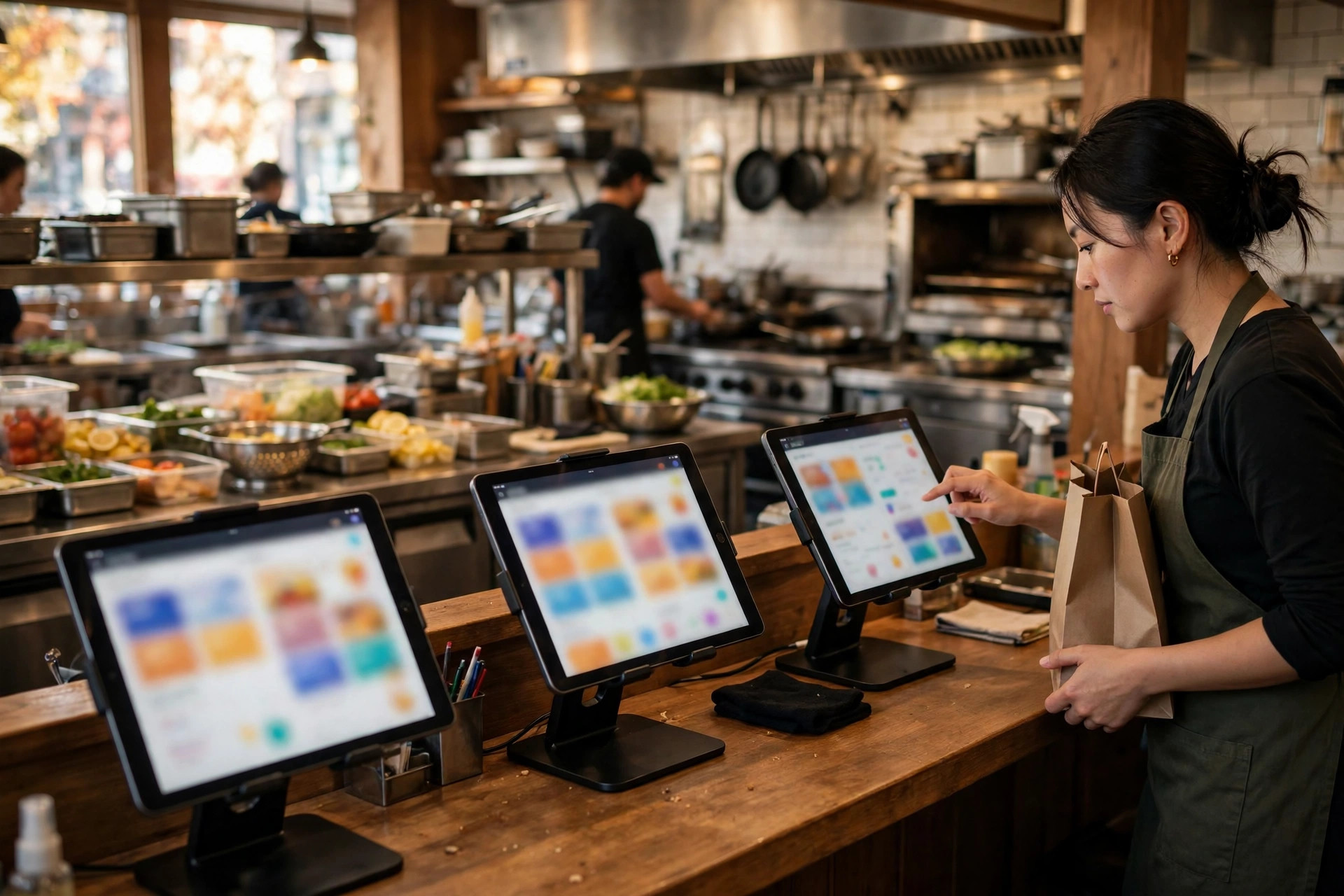
This guide is for Nordic restaurant owners who sell — or are about to sell — on more than one delivery platform and can feel the operation straining. We will explain exactly where the multi-tablet setup breaks, how many platforms a typical Nordic restaurant actually needs, the five ways to connect platforms to your kitchen, what aggregation software does and costs, and the rush-hour and bookkeeping routines that keep three channels profitable instead of merely busy. If platform economics are new to you, start with our breakdown of what delivery commissions really cost; this article assumes you know what each order pays and focuses on running the channels well.
Why multiple delivery platforms break at rush hour
Every delivery platform ships you the same gift: a tablet, a login, an alert sound and a workflow of its own. One tablet is genuinely fine. The failure mode appears at three. Each platform gives you a short window to accept an order before it times out or escalates. Each has its own way of showing modifiers, allergy notes and customer instructions. Each keeps its own menu, which means a price change or a sold-out item has to be edited in three places, by a human, usually during service. And none of them talks to your POS, so every order must be read off one screen and re-typed into another before the kitchen can start.
The breakage is predictable and it clusters at the worst moment. A tablet gets left on silent after a staff change and two orders time out. A cook marks the salmon unavailable on Wolt but not on foodora, and the next foodora order has to be cancelled by phone. A modifier — no coriander, allergy — survives on the tablet screen but dies in the re-typing. Meanwhile the dining room is full, the phone is ringing, and the person whose real job is service is doing data entry between three glowing screens. None of this shows up as a line item anywhere, which is why owners underestimate it: the commission appears on a payout statement, but the tablet-juggling cost is distributed in ninety-second increments across every shift.
The four failure points, named
It helps to name them, because each has a different fix. Missed orders come from alert fragmentation — three sounds, three screens, no single owner. Re-keying errors come from manual transcription between tablet and POS. Menu drift comes from maintaining the same menu in several back offices. Reporting blindness comes from three dashboards that never add up to one view of the day. A setup that fixes only the first — say, louder speakers — still leaves the other three taxing every shift. The goal of this article is a setup that fixes all four at once.
How many delivery platforms do you actually need?
Before buying software to manage three platforms, ask whether you need three platforms. Nordic delivery markets are concentrated. In Finland, Wolt is the dominant marketplace in most cities, with foodora and Uber Eats present but smaller. In Norway, foodora and Wolt lead. In Sweden, foodora, Uber Eats and Wolt divide the market, with the balance varying by city. In Denmark, Wolt and Just Eat are the names that matter. For most independents, the leading platform in their city delivers the large majority of available marketplace demand, and the second platform adds incremental orders at the cost of a full second workflow.
That does not make a second platform wrong — it makes it a decision with a threshold. Add a platform when your first channel is demand-limited (you could cook more than it sends you), not when it is operations-limited (you are already dropping orders at peak). Add it when its audience genuinely differs — a platform strong with office lunches complements one strong with evening family orders. And add it only when your menu and stock can be kept in sync without heroics, which in practice means after you have solved the connection problem in the next section, not before.
The direct channel counts as a platform too
Your own website ordering is a channel in the same queue, and it is the only one with zero commission. The mature setup treats direct orders, marketplace orders and phone orders as one stream landing in one kitchen workflow, with the direct channel deliberately favoured: better prices for the customer, full margin for you, and customer data you own. Our comparison of own delivery versus platforms, with the maths works through when direct ordering with courier partners beats marketplace commission. Managing platforms well includes managing the exit ramp from them — see our guide to platform dependency and the way out.
The five ways to connect platforms to your kitchen
There are five distinct approaches to getting a marketplace order from the app to your kitchen, and the approach — not the vendor — determines your cost shape. Understanding the five makes every sales conversation shorter, because you can ask which approach a vendor is actually selling.
| Approach | How it works | Cost shape | Best for | Watch out |
|---|---|---|---|---|
| Tablet farm | One tablet per platform; staff read and re-type orders into the POS | No software fee; paid in labour, errors and missed orders | Under ~10 delivery orders a day | Every error charge starts here; nothing is logged |
| Standalone aggregator | Middleware between marketplaces and the POS you already own | Monthly subscription per location; sometimes per marketplace | Keeping a POS that cannot ingest marketplace orders | Sits on top of POS cost; quote-only pricing is hard to budget |
| Aggregator bundled with a new POS | Aggregation inside a POS + ordering + QR bundle from one vendor | Bundle subscription, sometimes plus per-order fees | Operators already changing POS | Per-order fees often surface late; bundle price ≠ full price |
| Aggregation in a payments bundle | Order routing sold inside a merchant account with a processor | Priced inside the processing relationship | Operators committed to that processor | Aggregation cost is hard to isolate or compare |
| Native POS integration | The POS itself ingests marketplace orders; no middleware layer | Part of the POS stack pricing | 1–5 location operators; anyone changing POS anyway | Only works if the POS covers every platform you sell on |
The first four approaches add a layer; the fifth removes one. That is why the real decision is usually not "which aggregator?" but "does my POS already do this, and if not, am I keeping it?" If you love your POS and it cannot ingest Wolt or foodora orders, a standalone aggregator is the honest answer. If you are changing POS anyway, native integration avoids paying for middleware forever. In the Nordic market you will meet both patterns: POS-native integrations that bring Wolt, foodora and Uber Eats straight into the till and kitchen screens, and aggregators such as Deliverect-style middleware that sit between marketplaces and an existing POS. Judge them on the checklist at the end of this article, not on the demo.
What aggregation software actually does
Strip away the marketing and aggregation software — sometimes called order consolidation — does three jobs. First, it creates one order queue: orders from every platform arrive in a single list with a single alert, tagged by source, and flow to the same kitchen printer or kitchen display system (KDS) as your dine-in orders. Staff accept, prepare and mark ready in one place, and status updates flow back to each platform so the customer's app reflects reality. Second, it provides one menu: you edit items, prices and availability once, and the changes publish to every connected platform — including the all-important "86" when an ingredient runs out. Third, it gives one reporting view: sales by platform, brand and hour in a single dashboard, instead of three logins and a spreadsheet.
Aggregation vs consolidation: a useful distinction
Vendors use the two words interchangeably, but there is a distinction worth keeping. Aggregation pulls third-party delivery orders into one tablet or dashboard — it solves the tablet problem. Consolidation brings delivery, direct website orders, phone orders and in-store orders together into one operation — it solves the disconnected-systems problem. A small restaurant on two platforms mainly needs aggregation. A restaurant running marketplaces plus its own ordering plus a virtual brand needs consolidation, because the kitchen cannot run three queues and a dining room at once. Our guide to running a virtual brand from the same kitchen shows why brand-level queues matter once a second listing enters the same pass.
Features that matter in practice
Auto-accept where the platform allows it, so orders do not die waiting for a tap. Printed dockets or KDS tickets that show the source platform, order number and pickup time in large type, so bags do not get mixed up at handover. Busy mode and pause controls that slow or stop intake per platform without touching the others. Per-channel pricing, so each platform's menu can carry its own prices. And menu publishing that actually pushes outward to every platform — some tools ingest orders beautifully but leave menu edits manual, which quietly preserves the menu-drift problem you paid to remove. Confirm outward publishing for each platform by name before signing.
What it costs — and what the tablets already cost you
Aggregation pricing comes in several shapes, and the honest comparison is against the labour cost of the tablet farm, not against zero. Published examples include per-marketplace fees around €35–40 per marketplace per month as an estimate, flat per-location subscriptions, and bundle pricing inside POS packages where per-order fees may apply on top. Treat all of these as estimates to verify in a written quote that includes setup, hardware, per-order fees and contract length. A €40 monthly fee for one marketplace looks different once you price the alternative properly.
The ninety-second maths
Reading an order off a tablet, re-typing it into the POS, checking modifiers and confirming acceptance takes roughly 60–90 seconds of a staff member's time. At 40 delivery orders a day, that is 40–60 minutes of paid labour spent on transcription — call it an hour. At a loaded Nordic labour cost of, say, €22 per hour, that is about €22 a day, or roughly €570 across a 26-day month, spent copying information between screens. Add the cost of the errors that transcription creates — a remade dish here, a refund there, a cancelled order that also dents your platform ranking — and the tablet farm is usually the most expensive option on the table; it just invoices you through the payroll instead of a subscription. This is also why the threshold is low: past roughly 15–20 delivery orders a day across two or more platforms, aggregation typically pays for itself in labour alone.
Questions that reveal the real price
Ask every vendor, in writing: Is there a per-order fee, and on which orders? Does menu publishing push to Wolt, foodora and Uber Eats by name, or only some? What hardware do I need, and who owns it at contract end? What is the minimum term and the exit cost? Can I pause one platform without pausing the others? A vendor who answers all five plainly is selling a tool; one who answers with a bundle price is selling a bundle.
Keeping menus, prices and stock in sync across platforms
Menu drift is the silent tax of multi-platform selling. A dish sells out at 18:40; it gets marked unavailable on one platform and stays live on another; the 19:05 order for it becomes a phone call, a cancellation and a ranking hit. Prices drift the same way: a supplier increase gets edited into the POS and one platform, but not the third, and for two weeks you sell below margin on the channel you forgot. The fix is a single source of truth: one menu, maintained in one system, published outward to every channel — with per-channel price overrides where economics differ, because commission and packaging costs genuinely differ by platform.
Per-channel pricing without chaos
Most aggregation tools let you hold one master menu with different prices per channel. Use that deliberately. Your direct website menu can be the cheapest — no commission to cover — while marketplace menus carry the markup your commission maths requires. Our guide to pricing on delivery platforms shows how to calculate that markup (at 30% commission, full cover needs roughly price ÷ 0.70) and how to present it without training regulars to resent the difference. In Finland, pricing platform menus differently from the in-store menu has been permitted since 2025; elsewhere, check your platform contracts for parity clauses before diverging.
The 86 discipline
Stock sync only works if the team uses it. Make marking an item unavailable a one-tap, no-blame action that any team member can take the moment an ingredient runs low — not a manager-only ritual performed after the cancellation. Review the week's 86 log every Monday: repeated stock-outs on the same dish mean par levels or the menu itself need adjusting, and repeated stock-outs only on delivery channels mean the platforms are selling food your dining room needed. That pattern — platforms taxing the core business — is exactly what the rush-hour playbook exists to prevent.
The rush-hour playbook: prep times, pauses and priorities
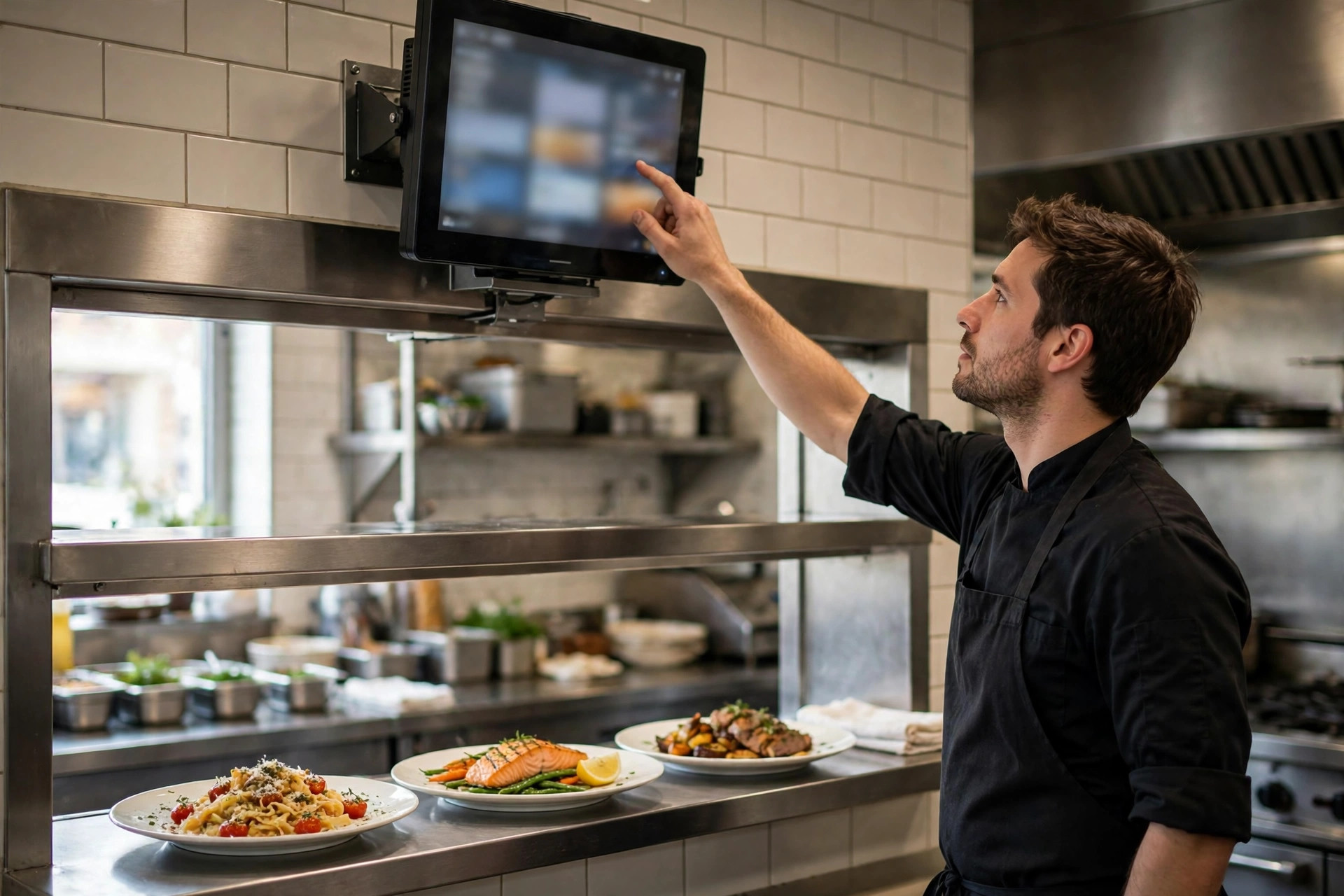
Multi-platform operations are won or lost between 17:30 and 20:00 on a Friday. The playbook has three moves, in order. Extend preparation times first. When ticket times stretch, push the quoted prep time out on every platform before the queue becomes a backlog; customers forgive a longer honest estimate far more readily than a late handover. Pause the weakest platform second. If the kitchen is drowning, switch off the channel with the lowest contribution per order or the longest courier waits, and keep the strongest channel and your direct orders flowing. Pause everything briefly rather than cancelling. A ten-minute full pause protects your ranking on every platform; a string of timed-out and cancelled orders damages it for weeks.
Who owns the queue?
One named person per shift owns the order queue: accepting, watching prep-time honesty, calling pauses, and checking bags against tickets at handover. In a small team that person is usually the pass or the counter, but the ownership must be explicit — "everyone watches the tablets" means nobody does. Put the pause thresholds in writing where the team can see them: for example, prep times extend at eight open tickets, weakest platform pauses at twelve, everything pauses at fifteen. Thresholds agreed in calm moments get used in chaotic ones; thresholds invented mid-rush get argued about while orders time out.
Protect the dining room's claim on the kitchen
Delivery orders are loud — they beep, they time out, they carry courier pressure — and dining-room guests are quiet. Without explicit priorities, the loud channel wins the line and the room that pays your rent waits. Set the rule in advance: during the dining peak, delivery prep times extend first and platforms pause before dine-in ticket times are allowed to slip. Track both numbers weekly. Our guide to tracking delivery sales and the metrics that matter lists the short set worth reviewing; for multi-platform operations, add on-time handover rate per platform — it is the number that predicts your ranking, and therefore your future order flow, on each channel.
Reporting, payouts and reconciliation across platforms
Three platforms means three payout cycles, three statements and three places for money to hide. Commissions, VAT on commissions, payment fees, refunds, chargebacks and self-funded promotions each appear in different formats, and the deposit that lands in your account rarely matches the gross sales your POS remembers. The routine that keeps this honest is weekly, not monthly: export each platform's statement, match it order-by-order or at least day-by-day against your POS or aggregator report, and book the differences while you still remember the Friday they came from. Aggregation reporting helps by consolidating sales by platform, but the payout reconciliation still has to be done against each platform's own statement.
Two habits pay for themselves. First, track contribution per platform, not just revenue: a channel that produces 30% of delivery revenue at a 30% commission with a high refund rate may contribute less than a smaller channel with better economics. Second, watch refund reasons per platform — "food arrived cold" concentrated on one channel usually means a radius or prep-time problem on that channel, not a kitchen problem. Our guide to managing reviews on delivery platforms covers the customer-facing side of the same data. And keep the direct channel in the same report: the strategic question every month is whether marketplace volume is growing your business or merely renting you your own customers back. A commission-free ordering channel on your own website — for example the Restaurant plan at €239/month from powerfulwebsite.com, with the build free and plans from €59/month — belongs in the same queue and the same weekly numbers as Wolt and foodora.
Choosing a system: the checklist that prevents regrets
Run every candidate — aggregator, POS bundle or native integration — through the same questions, and insist on answers specific enough to be wrong. Does it connect to each platform you sell on, by name, in your country? Does menu publishing push outward to all of them, including availability changes? Do orders land in the same KDS or printer flow as dine-in orders, with source platform and pickup time clearly shown? Can you extend prep times and pause per platform from the same screen? Is per-channel pricing supported? What does reporting show by platform, and can it export for your accountant? What is the full price — subscription, per-order fees, hardware, setup, minimum term, exit cost? What happens on a Friday night when it breaks: who answers, in what language, in how many minutes?
Then pilot it the way you would pilot a menu change: connect one platform first, run a full week including a Friday, and compare ticket times, error rates and staff feedback against the tablet baseline. Connect the second platform only when the first week is boring. Boring is the goal. A multi-platform setup that works feels like nothing at all — orders arrive, the kitchen cooks, bags leave with the right stickers, and the weekly report takes ten minutes. The drama was never in the platforms; it was in the gaps between them, and gaps are exactly what one queue, one menu and one report remove.
Start where you are: count last week's delivery orders and multiply by ninety seconds. If the number embarrasses you, you have already made the business case. Pick the approach that fits your POS reality, pilot it on one channel, and write the rush-hour thresholds down before the next Friday. Three platforms run as one operation is a growth channel. Three platforms run as three islands is a second job nobody applied for.
Frequently asked questions
How do restaurants manage multiple delivery platforms at once?
Either with a separate tablet per platform — workable only at low volume — or with order aggregation software that pulls Wolt, foodora and Uber Eats orders into one queue connected to the POS and kitchen display. Aggregation also pushes menu, price and stock changes back to every platform from one screen.
What is order aggregation software?
Order aggregation software is middleware that connects delivery marketplaces to your POS. It does three jobs: it sends marketplace orders into your POS and kitchen display instead of a tablet, it publishes one menu to every platform, and it consolidates reporting into a single dashboard.
How much does delivery aggregation software cost?
Pricing models vary: per-marketplace monthly fees (one published example is about €35–40 per marketplace per month as an estimate), flat per-location subscriptions, or fees bundled into a POS package. Always ask for the full price including per-order fees and setup, because bundle pricing often hides them.
How many delivery platforms should a restaurant be on?
In most Nordic markets, one strong platform covers the majority of demand — Wolt in Finland, foodora or Wolt in Norway, and a mix in Sweden. Add a second platform when the first is volume-limited rather than operations-limited, and only once menus and stock can be kept in sync without manual re-typing.
What should I do when the kitchen is overwhelmed with platform orders?
Extend preparation times first, then pause the weakest platform, then pause all platforms briefly rather than letting orders time out and get cancelled. Cancellations and late handovers hurt your ranking on every platform; a short, honest pause protects it.
Can I charge different prices on different delivery platforms?
Generally yes — most aggregation tools support per-channel pricing, and in Finland restaurants have been allowed to price platform menus differently from in-store menus since 2025. Check your platform contracts and local rules, and keep the differences explainable: commission and packaging costs differ by channel.
Want a website that brings you direct orders too?
PowerfulWebsite builds your restaurant website free of build cost — you only pay from €59 a month, or €239 a month for the Restaurant plan with its own commission-free ordering system. Everything is included: domain, hosting, maintenance, and updates.
See the packages