Virtual Brand Restaurant: Second Kitchen, Same Space
A virtual brand restaurant is a second, delivery-only concept — its own name, menu and app listing — cooked in the kitchen you already pay for. Done well, it turns idle hours between lunch and dinner into revenue for an estimated €500–3,000 of setup cost, with no new rent and no dining room. Done carelessly, it just splits the same orders across two listings and pays commission twice.
Key takeaways
- A virtual brand is a concept, not a building: it lives on delivery apps and cooks in your existing kitchen.
- Launch from your own kitchen typically costs an estimated €500–3,000 — photography, packaging and onboarding, not rent.
- Price for delivery economics: at 25–30% commission, target a food cost around 22–27% of the platform price.
- Separation is everything — different cuisine or occasion, shared ingredients, dishes that survive a 30-minute ride.
- Give it a 90-day test with a written kill criteria list before you launch, not after.
- In the Nordics the model works best where kitchen capacity sits idle outside two sharp daily peaks.
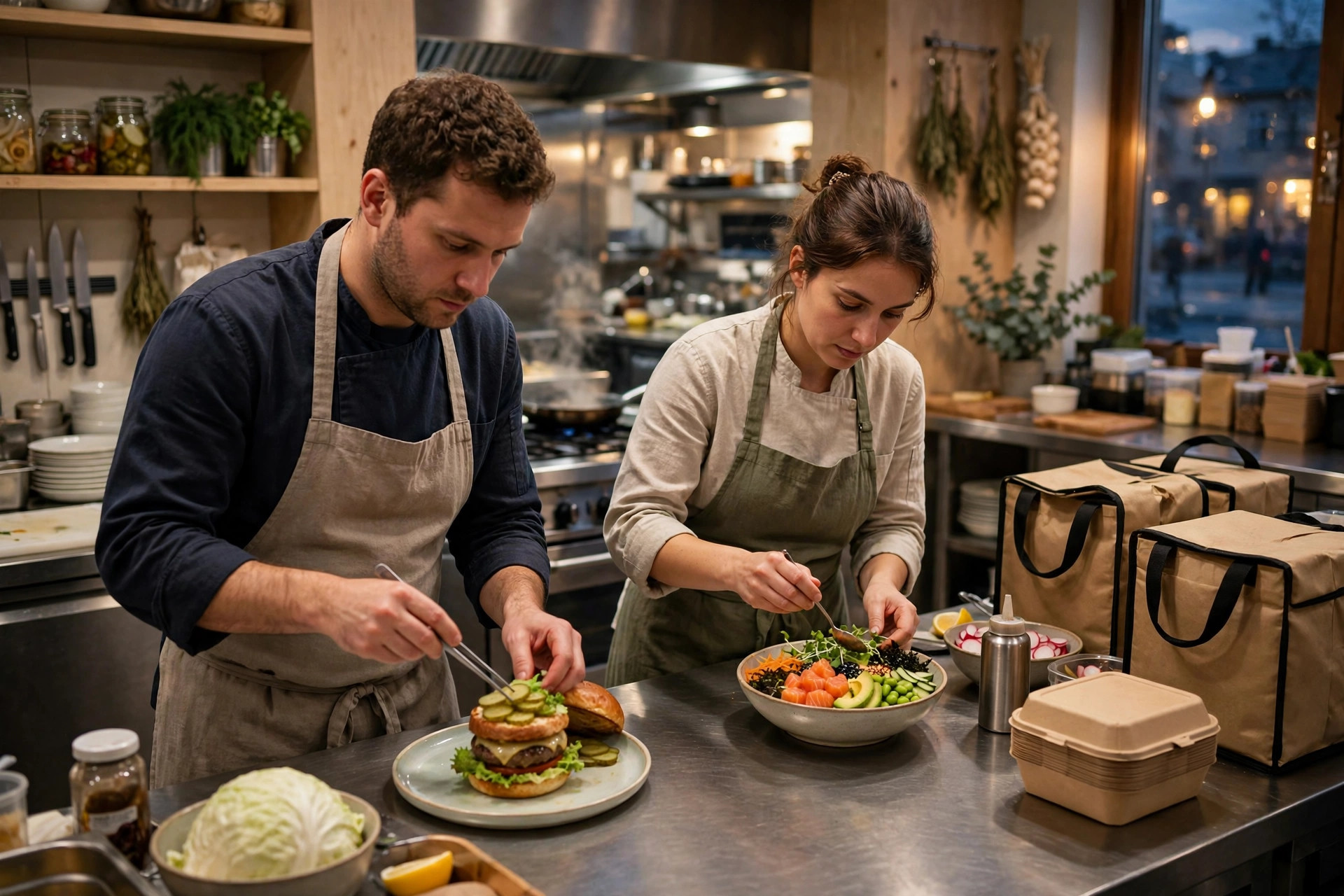
This guide is for Nordic restaurant, café and bar owners who already have a working kitchen and are wondering whether a second, app-only brand could fill the quiet hours. We will define the model precisely, separate it from ghost kitchens, cost a realistic launch, run the commission maths on a worked order, and finish with the operating rules and the 90-day test that tell you whether to keep it or switch it off. If delivery economics are new to you, read our breakdown of what delivery commissions really cost first — everything in this article builds on those numbers.
What is a virtual brand restaurant?
A virtual brand restaurant is a delivery-only food concept that customers meet exclusively inside delivery apps. It has its own name, its own menu, its own photos and its own packaging, but no dining room, no signage and no walk-in customers. The food is prepared in a real, inspected kitchen — in the version of the model that matters most to independent restaurants, the kitchen of an existing brick-and-mortar restaurant, using the same equipment and largely the same team.
To the customer scrolling Wolt on a Friday evening, your virtual brand looks like any other restaurant in the list. They see a name, a rating, a delivery time and a menu. They never learn — and mostly never ask — that the burger they ordered was cooked ten metres from the dining room of a completely different restaurant. The order arrives on a tablet or in your POS tagged with the virtual brand's name, the kitchen fires it, and it leaves in that brand's packaging with that brand's sticker on the bag.
How the model actually works, order by order
The flow is deliberately boring, which is the point. A customer orders from the virtual brand's listing. The order lands in your kitchen clearly labelled by brand, ideally on a separate ticket or a colour-coded queue so nobody plates it onto the wrong packaging. The same line that cooked your lunch service cooks this order — a wing basket in the same fryer, a bowl from the same cold station. A courier collects it from the same pass. Your only new assets are intangible: a name, a menu engineered for travel, a set of photos, and a stack of different boxes.
Because the brand exists only as a listing, it can also disappear as a listing. If the concept fails, you switch the listing off. There is no lease to break, no dining room to sell, no staff hired for a second site. That reversibility is the model's deepest advantage over opening a second restaurant, and it is why virtual brands are best understood as a cheap experiment with real revenue attached, rather than as a new business.
Virtual brand vs ghost kitchen: what is the difference?
The two terms are used interchangeably in most media coverage, and they describe different things. A virtual brand is the concept customers order from. A ghost kitchen — also called a dark kitchen or cloud kitchen — is the facility: a delivery-only production kitchen with no customer-facing space at all. A ghost kitchen can host many virtual brands, and a virtual brand can run from an ordinary restaurant kitchen without any ghost kitchen involved. The cleanest way to hold the distinction: the ghost kitchen is the where, the virtual brand is the what.
For an existing restaurant owner the practical difference is cost and commitment. Renting space in a shared ghost-kitchen facility means a monthly rent — international operators commonly cite figures in the €1,500–5,000 per month range as an estimate, depending on market and size — plus platform commissions of 25–30% and food costs around 28–32%, which leaves thin margins unless volume is high. Running a virtual brand from your own kitchen means near-zero incremental rent: you are buying revenue with capacity you already own. The trade-off is throughput: your virtual brand shares your line, your pass and your peak hours with your main business.
Which model fits which operator?
If you already run a restaurant and your kitchen sits idle for a meaningful share of the day, a virtual brand from your own kitchen is the lowest-risk entry point. If you have no restaurant and want to test a delivery concept before committing to premises, a rented ghost-kitchen space is the testing ground. If you have a proven delivery concept and demand that your current kitchen physically cannot serve, a dedicated dark kitchen becomes a capacity decision. Most independent Nordic restaurants reading this article are in the first group, and the rest of this guide is written for them.
Why virtual brands fit Nordic restaurants unusually well
Nordic restaurants have a specific shape of day, and it suits this model. Demand concentrates into a sharp lunch peak and an early dinner peak, with long shoulders in between — the mid-afternoon lull, the post-dinner hours, the weekday evenings when the dining room is half full but the kitchen team is already on shift and already paid. Rent, meanwhile, is charged for all 24 hours, and in Helsinki, Stockholm, Oslo and Copenhagen it is rarely cheap. A kitchen that produces revenue for five hours a day is carrying nineteen hours of fixed cost. A virtual brand is one of the few tools that attacks that ratio without new premises.
The delivery market structure helps too. In Finland, Wolt is the dominant marketplace and foodora and Uber Eats operate alongside it; in Norway foodora and Wolt lead; in Sweden foodora, Uber Eats and Wolt share the market. A single well-built listing can therefore reach most delivery customers in your delivery radius without you running your own courier fleet. Winters strengthen the case further: when it is dark at 15:00 and −10 °C outside, the share of food occasions that move to delivery rises, and a second listing captures occasions — late-night comfort food, office lunches, family Friday orders — that your dining-room concept was never designed to serve.
Where the Nordic fit breaks down
Small markets cut both ways. Outside the largest cities, the total delivery demand inside a 3–5 km radius may only support one or two strong listings per cuisine, and a virtual brand that merely duplicates an existing strong competitor will starve. High Nordic labour costs also mean the model only works if the virtual brand's dishes ride on labour you already have — the moment it needs its own extra shift to survive, the maths usually dies. And platform concentration is a real dependency: our guide to platform dependency and the way out explains why a virtual brand should complement, not replace, a direct ordering channel you control.
How to choose a virtual brand concept that earns its listing
The concept decision is where most virtual brands succeed or fail, and it is a menu-engineering decision before it is a branding decision. Three filters, applied in order, will eliminate most weak ideas. First, the food must travel: it has to arrive after 20–40 minutes in a courier bag looking and tasting like the photo. Second, it must share your existing ingredient base and equipment, so the brand adds revenue without adding a parallel supply chain. Third, it must own a different occasion or craving from your main brand, so it captures new orders instead of cannibalising your own.
Filter 1: dishes that survive the trip
Delivery punishes delicacy. Fried items that steam themselves soggy in a sealed box, salads dressed an hour early, and anything that depends on a crisp-versus-soft contrast will generate the refunds and one-star ratings that bury a new listing. Bowls, curries, braised dishes, sturdy burgers with sauce packed separately, and baked items travel best. Our guide to delivery menus and dishes that survive the trip works through the packaging and holding rules dish by dish — apply it to every candidate item before it earns a place on the virtual menu. Test with real orders to your own home at real distances; a dish that only survives a five-minute ride to the office next door is not a delivery dish.
Filter 2: shared ingredients, shared stations
The cheapest virtual brand is a re-combination of what your kitchen already buys and cooks. A grill restaurant's chicken, fries and slaw become a fried-chicken brand. A café's grains, roasted vegetables and proteins become a bowls brand. Shared ingredients mean shared prep, shared waste risk and no new supplier minimums — and they mean the brand can run on the same stations during the same shifts. The moment a concept needs a new oven, a new specialist ingredient with a short shelf life, or a new skill your team does not have, its risk profile stops being "cheap experiment" and starts being "second restaurant". Keep the menu short: eight to fourteen items is plenty for a listing, and a short menu is faster to execute at peak, easier to photograph well, and easier to keep in stock.
Filter 3: a different occasion, not a cheaper copy
Your virtual brand should answer a search your main brand does not. If your dining room sells relaxed Nordic lunch, the virtual brand might sell late-evening comfort food, or office-friendly bowls, or a family bundle for Friday nights. What it must not be is the same dishes at a lower price under a different name: that trains your own customers to buy the same food through a channel where you pay 25–30% commission, and it gives the platform two listings competing for the same order. Separation of cuisine or occasion is also what protects your main brand's ratings — a bad delivery experience lands on the virtual brand's listing, not on the restaurant your regulars visit.
What does it cost to launch a virtual brand?
From an existing kitchen, launching a virtual brand is cheap in the specific sense that the expensive parts of a restaurant — rent, fit-out, dining-room staff — are already paid for. What remains is a short list of one-off costs and the ongoing commission you already understand. The table below gives realistic estimate ranges for a Nordic independent launching one brand on one or two platforms. Treat every figure as an estimate to verify against your own suppliers, not as a quote.
| Cost item | Estimate | Notes |
|---|---|---|
| Menu photography (hero dishes) | €200–600 | Half-day shoot or a skilled freelancer; the listing lives or dies on photos |
| Packaging stock (boxes, bags, stickers) | €150–400 | First order of brand-specific packaging; plain stock with stickers is cheapest |
| Platform onboarding / tablet | €0–300 | Varies by platform and market; often no joining fee, sometimes a tablet charge |
| Menu build and listing setup | €0–200 | Your own time, or a freelancer for copy and allergen data entry |
| Test marketing (platform ads, launch offers) | €200–800 | Optional but realistic for the first month in a competitive radius |
| Small equipment gaps | €0–500 | Heat lamps, extra pans, a second ticket printer — only if truly needed |
| Total launch estimate | €500–3,000 | From an existing kitchen; excludes ingredient stock you already hold |
Compare that with the alternatives. A rented ghost-kitchen space adds an estimated €1,500–5,000 in monthly rent before you sell a single dish. A second physical restaurant is a six-figure commitment with a lease measured in years. The virtual brand's €500–3,000 is genuinely experiment money — which is exactly how you should treat it. The ongoing costs are the ones that decide survival: commission on every order, packaging per order (budget roughly €0.50–1.50 per order as an estimate depending on format), and the labour minutes each order consumes. Those are the subject of the next section.
The one cost owners forget
Photography is not decoration for a virtual brand — it is the entire shop window. A listing with phone photos taken under kitchen fluorescents converts a fraction of the browsers that a properly lit hero shot converts. Budget for the shoot, plate the food exactly as it will arrive, and re-shoot any dish whose delivered version does not match its photo. Mismatched photos are the fastest route to refunds on a new listing.
The maths: will a virtual brand actually make money?
A virtual brand makes money when three numbers line up: the platform price, the food cost percentage, and the labour minutes per order. The commission is the fixed frame around all three. For courier-delivered marketplace orders, expect roughly 25–30% of the order subtotal to go to the platform in the Nordics — the exact rate sits in your merchant contract — with VAT charged on the commission itself (25.5% in Finland), which VAT-registered restaurants can generally reclaim as input tax but still have to cash-flow. Our full breakdown of delivery commissions and hidden fees covers the effective-rate traps; here we apply the maths to one virtual-brand order.
A worked €18 order
Take a virtual-brand main priced at €18.00 on the platform. At a 28% commission, the platform takes €5.04, leaving €12.96. If the dish's ingredients cost €4.50 — a 25% food cost against the platform price — you are at €8.46. Packaging at an estimated €0.80 leaves €7.66. If the order takes six minutes of kitchen labour at a loaded cost of, say, €22 per hour, that is €2.20, leaving roughly €5.46 of contribution before rent and overheads — which, crucially, your main business is already paying. That is the whole economic argument for the model: the contribution is real because the fixed costs are sunk.
Now run the same order with a 32% food cost (€5.76) and ten labour minutes (€3.67): contribution falls to about €2.73. Still positive, but one refund or one wasted batch erases several orders. The levers are obvious and they are all in your hands: engineer the menu toward a 22–27% food cost against platform prices, keep dishes fast to fire, and price the platform menu for delivery economics rather than copying dining-room prices. Our guide to pricing on delivery platforms shows how to set platform prices without alienating regulars — in Finland, pricing the platform menu differently from the in-store menu has been permitted since 2025, which makes this lever fully available.
Volume: how many orders make it worthwhile?
Work backwards from a monthly target. If a virtual brand contributes an estimated €4–6 per order after food, packaging and direct labour, then 15 orders a day across a 26-day month contributes roughly €1,600–2,300 — meaningful money against zero incremental rent. At 5 orders a day it contributes €500–800, which may still beat an idle kitchen but will not survive any extra staffing. The honest test is therefore not "does it sell?" but "does it sell at hours and volumes that use capacity I already pay for?" A brand that only sells during your existing dinner peak, forcing overtime, is usually a brand that should be switched off — a point we return to in the 90-day test below.
Setting up on Wolt, foodora and Uber Eats
Setup is administrative, not culinary. You will onboard the virtual brand as its own merchant listing on each platform you choose, with its own menu, photos, opening hours and delivery radius. Expect the process to take one to three weeks per platform once your documents are ready: business registration details, food-business registration covering the activity, bank details for payouts, and the menu with allergen and ingredient information in the format each platform requires. Requirements vary by country and platform, so confirm the current checklist with each platform's partner team and with your local food control authority — particularly that your existing food-business registration and self-monitoring plan cover the new activity and menu.
Build the listing like a shop window
Your listing competes in a scrollable feed where the photo, the rating, the delivery time and the first three menu items decide everything. Lead with your strongest travelling dish as the hero image. Name dishes for search, not for poetry: customers search "burger", "poke bowl" and "fried chicken", and platform search rewards menus that say those words plainly. Set realistic preparation times — a new listing that promises 15 minutes and delivers in 35 collects the ratings that bury it. Start with a conservative delivery radius you can genuinely serve inside 30 minutes, and widen it only when the data says quality holds.
Choose your platforms deliberately rather than joining everything at once. In Finland, Wolt alone reaches the majority of delivery demand in most cities; adding foodora or Uber Eats adds reach but also adds a tablet, a menu to maintain and a payout stream to reconcile. Our companion guide to managing multiple delivery platforms at once covers how to run two or three listings without drowning in tablets — read it before your second platform, not after. And give the virtual brand a home you own: a simple page on your website that explains the concept and links to ordering. A website built and maintained for you — PowerfulWebsite builds the site free and charges from €59/month, with the Restaurant plan at €239/month including its own ordering system — gives the brand a commission-free channel to grow into once the platform listing proves demand. You can see the current packages at powerfulwebsite.com.
Running two brands from one kitchen without chaos
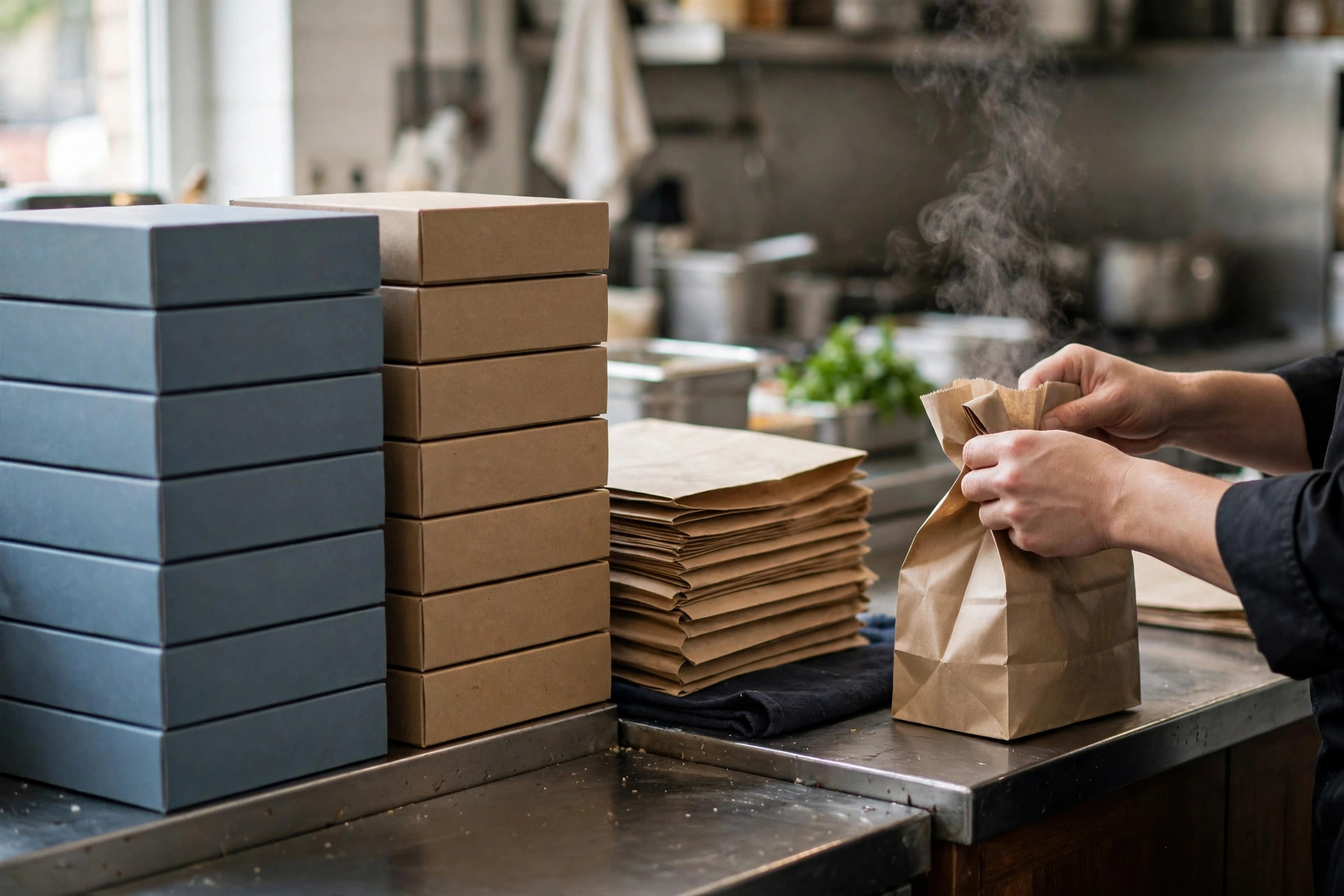
The operational risk of a virtual brand is not the cooking; it is confusion at the pass during a rush. Two brands mean two ticket streams, two packaging stacks and two sets of customer expectations arriving at the same three people. The restaurants that run this well impose boring, physical separation. Tickets print or display with the brand name in large type. Packaging lives in two labelled zones. One person owns the pass during overlap hours and checks brand, bag and sticker before anything leaves. These are five-minute systems that prevent the single most expensive error in the model: the right food in the wrong brand's bag, which reads to the customer as a completely wrong restaurant.
Protect the main brand's peak
Your dining room pays the rent; the virtual brand is a guest in its kitchen. Set the virtual brand's hours and prep times so it feeds on shoulders, not on your peak. Many operators run the virtual brand from late morning through the afternoon lull and again after the dinner rush, pausing it during the ninety minutes when the dining room needs the whole line. Platforms let you pause a listing or extend preparation times — use those controls aggressively and early. A paused virtual brand for one hour costs a few orders; a dining room full of guests waiting while the kitchen fires delivery tickets costs reviews you cannot buy back.
Stock, 86s and the shared-ingredient trap
Shared ingredients are the model's strength and its sharpest edge. If the virtual brand sells out the chicken your main menu needs at 19:00, the experiment just taxed the core business. Set par levels per brand, mark items unavailable on the virtual listing the moment stock gets tight, and review the 86 log weekly: repeated stock-outs on shared ingredients mean the brands are competing, not complementing. Track the virtual brand's sales separately in your reporting — by hour, by dish, by refund reason — from day one. Our guide to tracking delivery sales and the metrics that matter gives you the short list of numbers worth watching; for a virtual brand, contribution per labour hour is the one that decides its future.
Risks, and the 90-day test that decides
The risks of a virtual brand are knowable in advance, which means they are manageable. Cannibalisation: the brand steals orders your main listing or dining room would have won anyway, at a commission cost. Quality drift: dishes designed for the dining room get copied onto the delivery menu and arrive tired, generating refunds. Labour creep: the brand slowly demands its own shift, its own prep, its own problem-solving, until it is a second restaurant without a second restaurant's revenue. Platform dependency: the brand exists entirely inside someone else's app, at someone else's commission, under ranking rules you do not control.
The defence against all four is a written 90-day test, agreed before launch. Define success numerically: for example, an average of at least 12 orders a day by day 60, contribution per order of at least €4 after food, packaging and direct labour, refund rate under 3%, and no measurable drop in dining-room ticket times during overlap hours. Define the kill criteria with equal clarity: if the brand needs extra rostered hours to survive, or if more than a third of its orders land inside your main peak, or if its rating sits below the level that keeps it visible in the feed, it gets switched off or rebuilt. Review at day 30, 60 and 90 against the same numbers.
What good looks like at day 90
A healthy virtual brand at day 90 has a short menu that the team can fire half-asleep, a rating earned from food that travels, sales concentrated in hours your kitchen used to waste, and a contribution line you can point to in the monthly accounts. It has also taught you something — which occasions in your radius are underserved, what price points hold, how far your food can travel — that feeds back into your main business. A brand that cannot show those things is not a failure of effort; it is a cheap, completed experiment, and switching it off is the model working as designed. The expensive mistake is the zombie brand: too weak to earn, too sentimental to close, quietly taxing the kitchen every Friday night.
Start small, measure honestly, and let the kitchen's idle hours — not hope — make the case. If the numbers hold, a virtual brand is one of the few growth moves a Nordic independent can make for the price of a photo shoot and a stack of boxes. If they do not, you will know within a quarter, and the listing switches off with nothing lost but the experiment budget. Either way, you will have replaced speculation about delivery demand in your neighbourhood with data from your own pass.
Frequently asked questions
What is a virtual brand restaurant?
A virtual brand restaurant is a delivery-only food concept with its own name, menu and listing on delivery apps, cooked in a kitchen that already exists — usually your own restaurant kitchen. Customers never visit it; they only ever see it inside Wolt, foodora or Uber Eats, and the food arrives in that brand's packaging.
How much does it cost to start a virtual brand?
From an existing kitchen, budget roughly €500–3,000 as an estimate: menu photography (€200–600), packaging stock (€150–400), any platform onboarding or tablet costs, and a small test-marketing budget. There is no new rent and no dining room, which is why a virtual brand is the cheapest way to test a second concept.
Do I need a separate business or licence for a virtual brand?
Usually not a separate company, but the food activity still has to be covered by your existing food-business registration and self-monitoring plan, and each platform will onboard the brand as its own merchant listing. Rules differ by country and municipality, so confirm with your local food control authority before launch rather than assuming.
What is the difference between a virtual brand and a ghost kitchen?
A virtual brand is the concept customers order from; a ghost kitchen is the delivery-only facility where food is cooked. You can run a virtual brand from your existing restaurant kitchen without any ghost kitchen at all — that is the lowest-cost version of the model.
Can a virtual brand cannibalise my main restaurant?
It can if the two menus overlap and the virtual brand is cheaper. The protection is separation: a different cuisine or occasion, different hero dishes, and platform prices set for delivery economics rather than copied from your dining-room menu. Track whether virtual-brand orders come at hours and from postcodes your main brand was not serving.
How long does it take to launch a virtual brand?
Realistically four to eight weeks: one to two weeks on concept and menu costing, a week for photography and packaging, and one to three weeks for platform onboarding and menu build. The cooking is the easy part — most of the calendar goes on listing quality and testing travel times.
Want a website that brings you direct orders too?
PowerfulWebsite builds your restaurant website free of build cost — you only pay from €59 a month, or €239 a month for the Restaurant plan with its own commission-free ordering system. Everything is included: domain, hosting, maintenance, and updates.
See the packages