Marketing a Restaurant in Stockholm: A Local Guide
Marketing a restaurant in Stockholm starts with the free foundations — a complete Google Business Profile, a steady flow of genuine reviews, and a consistent Instagram presence — then adds the Stockholm season, neighbourhood-level targeting and a small paid budget in that order. Most Stockholm restaurants do it backwards: they buy ads before fixing the profile that decides whether anyone books.
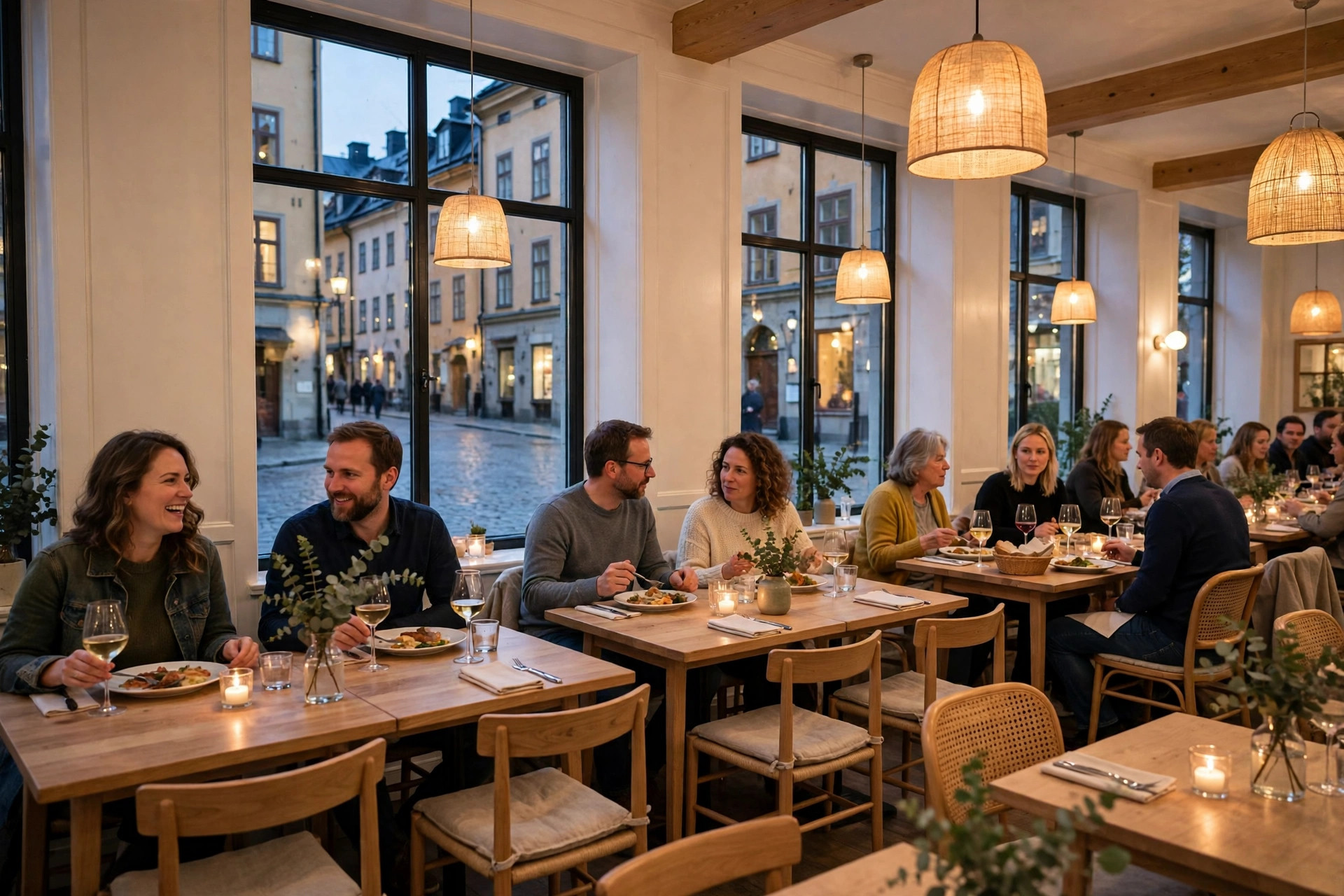
Key takeaways
- Do it in order: Google profile, reviews, social routine — then partnerships and paid ads.
- Stockholm is a city of neighbourhoods: Södermalm, Östermalm, Vasastan and Gamla Stan have different guests and different searches.
- Market in Swedish and English — Swedish for locals and lunch, English for tourists, expats and AI assistants.
- Winter is won with lunch, julbord and regulars; summer is won with terraces, tourists and the map.
- A realistic paid budget for a small Stockholm restaurant is roughly €300–€800 a month — only after the free foundations work.
- Measure cost per booking, not likes: one booked table beats a thousand impressions.
Stockholm is one of Europe's most competitive restaurant cities, and also one of the most rewarding. Around a million people live in the municipality and more than two million in the county, and the city draws millions of visitors a year — cruise passengers in Gamla Stan, conference guests in the City, food tourists who plan their trip around a table. At the same time, Stockholm diners are demanding, digitally fluent and spoiled for choice: a guest standing on Drottninggatan at six in the evening can compare twenty restaurants on a map in thirty seconds, read the newest reviews, and book a table without ever visiting your website.
This guide is written for independent restaurant, café and bar owners in Stockholm — the 40-seat bistro on Södermalm, the lunch spot near Odenplan, the wine bar in Vasastan, the family restaurant in a suburb centre. We will cover where Stockholm diners actually decide, how to make your Google Business Profile work as hard as your kitchen, how to earn reviews the honest way, what social media actually fills tables, how the Stockholm year shapes demand, how to market differently by neighbourhood, how to work with local press and creators, what paid ads cost and when they pay back, and finally a 90-day plan with real numbers. Every cost in this guide is an estimate for budgeting, not a quoted price.
Where Stockholm diners actually decide
Before spending a krona, it helps to understand the decision your guest is making. A Stockholm dinner decision is rarely a long research project. It is a short, mobile, map-driven moment: someone is hungry, somewhere specific, at a specific time, and they want an answer in under a minute. The searches that matter most are the ones with local intent — "restaurants near me", "best sushi Södermalm", "Italian restaurant open now Stockholm". These are the queries where the guest is ready to book, and they are won or lost on the map, not on your homepage.
Google's local results are ranked on three factors the company itself documents: relevance (how well your listing matches the search), distance (how close you are to the searcher or the place they named) and prominence (how well known and trusted you are, based on reviews, links and mentions across the web). You cannot change distance. You can improve relevance and prominence, and that is where almost all restaurant marketing in Stockholm lives.
The three kinds of Stockholm guest
It helps to think of three different guests, because they search differently. The local regular lives or works within a kilometre of your door, finds you once — often by walking past — and returns out of habit. The Stockholm explorer lives elsewhere in the city and travels for a good meal, searching by cuisine and neighbourhood and reading reviews before booking. The visitor is a tourist or business traveller who searches in English, often with an AI assistant or a voice query, and decides from photos, star ratings and the first three map results.
Why the map beats the website
For most Stockholm restaurants, the Google Business Profile is now more important than the website. It is what the hungry searcher sees first: your star rating, your newest photos, your opening hours, whether you are open now, and the button to call or book.
There is a second reason the map matters so much in Stockholm: the city is compact and walkable, and its neighbourhoods are dense. In Södermalm or Vasastan, a guest may have forty restaurants within a ten-minute walk. Distance barely separates you from your competitors, so relevance and prominence do the separating. In a suburb centre, being the only Thai restaurant for miles does half the work for you. In central Stockholm, nobody is the only anything — and that is why the details in this guide matter.
Google Business Profile: the Stockholm foundation
Your Google Business Profile is the single most influential free asset your restaurant owns. It feeds the local 3-pack — the three map results at the top of nearly every restaurant search — and the knowledge panel that appears when someone searches your name. Most Stockholm restaurants have a profile. Far fewer have a good one.
Claim it, complete it, keep it honest
First, claim and verify the profile if you have not already, and make sure there is only one profile per location — duplicates split your reviews and confuse Google. Then fill in every field Google offers. The name must be your real trading name, exactly as it appears on your sign and your website. The address must be precise, including the entrance details that matter in Stockholm's courtyards and side streets. The phone number should be the number someone actually answers during service, and the website link should go to a page that shows the menu and the booking button immediately.
Categories deserve real thought. Do not settle for "Restaurant" alone. Pick the most specific primary category that matches what you actually are — "Italian restaurant", "Sushi restaurant", "Vegetarian restaurant", "Wine bar" — and add secondary categories that are genuinely true. Voice assistants and AI answers lean heavily on categories: when someone asks "find a vegan restaurant near me", Google checks categories first. Attributes matter too: outdoor seating, takeaway, delivery, wheelchair access, family-friendly, dog-friendly terrace. Every accurate attribute is another way to match a real search.
Hours, holidays and the Stockholm calendar
Opening hours are the most common source of angry reviews in Stockholm, and the most avoidable. Keep them accurate, including the difference between kitchen hours and bar hours if they differ, and update them for every public holiday: Midsummer Eve, Christmas Eve, New Year's Day, and the summer weeks when many restaurants shorten hours or close. A guest who walks to your door because Google said you were open, and finds it shut, will write about it — and that review stays. Set special hours in advance, not on the morning of the holiday.
Photos, posts and the menu link
Photos are what hungry people scan before they read anything. A profile with dozens of genuine, current, appetising photos outperforms a profile with stock images or three photos from 2022. Upload new dish photos every few weeks, a photo of the dining room in each season, and a photo of the terrace the week it opens. Google Posts — short updates that live on your profile — are a free way to announce a new menu, a crayfish evening or a julbord booking opening. Use them at least monthly. Finally, link your menu properly: the menu should be real text on your website, not a PDF. Our guide to Google Business Profile for restaurants walks through every field in detail, and our guide to the local 3-pack explains exactly how the map ranking works.
Stockholm profile checklist
- One verified profile per location; name, address and phone identical everywhere online.
- Specific primary category plus honest secondary categories and attributes.
- Hours accurate for kitchen, bar, lunch and every public holiday.
- At least 30 recent, genuine photos; new dish and room photos every few weeks.
- Menu as real text on your website, linked from the profile — never only a PDF.
- Google Posts at least monthly: new menu, seasonal event, julbord, terrace opening.
Reviews: the Stockholm currency
If the profile is the storefront, reviews are the currency. The star rating sits in every search result, every map listing and every AI answer about your restaurant. In Stockholm's dense market, a 4.6 with 400 recent reviews beats a 4.9 with 30 old ones — guests trust volume and recency, and so does Google. The strategy is simple to state and takes discipline to keep: a steady flow of recent, genuine reviews, and a reply to every single one.
How to ask without breaking the rules
Ask every happy guest, at a natural moment. When the bill is paid and the guest is smiling is the best moment there is; the booking confirmation email after the visit is the second best. Put a QR code linking to your review page on the receipt or the table card, and train the team to mention it once, warmly. Never pay for reviews or offer discounts in exchange for one: Google removes incentivised reviews, and Swedish consumer rules treat them as misleading marketing. For the full method, see our guide on how to get more Google reviews — the ethical way.
Replying: the part most restaurants skip
Reply to every review, good and bad, within a day or two. A reply to a five-star review is a thank-you that future readers see; a reply to a complaint is your side of the story, told calmly, for the hundreds of people who will read that review before deciding. Thank the guest, acknowledge the specific point they made, say what you will do about it, and invite them back. Never argue, never blame the guest, and never copy-paste the same reply to everyone. In Stockholm, where many guests read reviews in English, reply in the language the review was written in.
Where else Stockholm guests look
Google is the centre of gravity, but it is not the only place. TheFork matters for bookings and its own ratings, and TripAdvisor still matters for tourists — especially in Gamla Stan. Keep your listings consistent across all of them: the same name, address, hours and photos. Inconsistency confuses guests and weakens the trust signals Google uses to rank you.
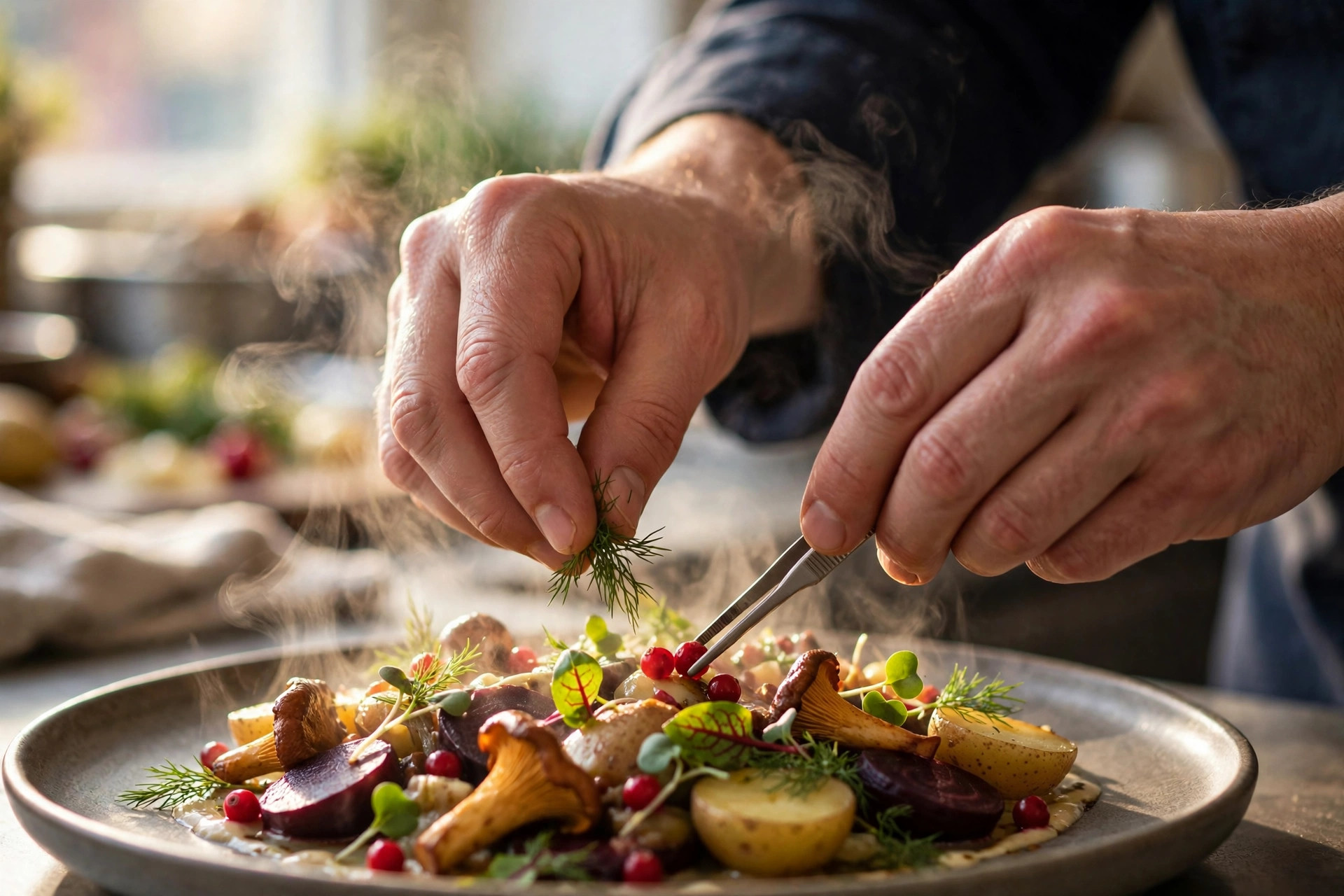
Instagram and TikTok that fill Stockholm tables
Stockholm is a deeply visual city for food. Instagram is where the city's diners discover restaurants, and TikTok is where the under-35s and the tourists do the same — often searching inside the app rather than on Google. Both reward the same thing: real food, real people, real Stockholm, posted consistently.
Instagram: your second storefront
Treat Instagram as a second storefront, not a photo album. The grid should answer, in five seconds, what you serve, what the room feels like, and whether a guest should book tonight. Post two or three Reels a week and a few stories most days: the dish of the week being plated, the terrace in the evening sun, the chef talking about the new menu in thirty seconds. Stories are where the daily rhythm lives — the lunch menu, the last two tables for tonight, the wine that just arrived. Highlights should hold the permanent answers: menu, opening hours, booking, location, private dining.
Hashtags still help in Stockholm, but the useful ones are local and specific: your neighbourhood, your cuisine, "Stockholm food" in Swedish and English, the dish itself. Ten relevant local hashtags beat thirty generic ones. Geotag every post with your location — guests browse by place, and a geotagged Reel is how a tourist standing in Gamla Stan finds your restaurant in Södermalm.
TikTok: worth it if you can keep it up
TikTok works for Stockholm restaurants when the content is honest and frequent: a 20-second video of a dish being finished at the pass, a "what 200 kronor gets you for lunch in Stockholm" walkthrough, the reality of a Friday service. Its audience skews young and tourist-heavy, which suits central restaurants, wine bars and casual concepts. Do not open an account you cannot feed: an abandoned account with three videos from March is worse than no account at all. Start with Instagram, prove you can post three times a week for two months, then add TikTok with the same videos, lightly adapted.
The Stockholm year: marketing by season
Stockholm's restaurant year has a rhythm as clear as its seasons, and marketing that ignores it fights the city instead of working with it. The same restaurant needs a different plan in July and in January, and the owners who plan the year in advance are the ones whose quiet months stay survivable.
Spring: the city wakes up
From March, daylight returns and Stockholm comes back outside. Terrace season begins in spirit long before it begins in weather, and the first warm weekend fills every outdoor seat in the city. This is the time to photograph the terrace, announce its opening date, and refresh the profile photos that have shown a dark winter interior for four months. Easter brings family bookings and the first spring menus. Spring is also the moment to fix the foundations: update the website and ask for reviews while the mood is good, because summer demand will reward the profile you built in spring.
Summer: terraces, tourists and the map
June to August is Stockholm's high season and its most map-driven season. Tourists arrive by the tens of thousands, and the city's population shifts as Stockholmers leave for summer houses and visitors take their place. For a central restaurant, summer is won on Google and on the map: English-language profile content, tourist-friendly photos, clear information about walk-ins versus bookings, and opening hours that reflect the real summer schedule. Midsummer week itself is quiet in the city — plan staffing and marketing around it. August brings the crayfish season, kräftskiva: a crayfish evening, properly photographed and posted, is one of the most shareable Swedish food moments of the year.
Autumn: the return of routine
September is, quietly, one of the best marketing months in Stockholm. Locals return, offices refill, lunch demand comes back, and the city settles into routine — the routine that fills a neighbourhood restaurant four nights a week. This is the time to sell the Christmas season: julbord and Christmas party bookings should be on sale from September, with a dedicated page, clear pricing and a simple enquiry form, because companies plan their Christmas parties months ahead.
Winter: warmth, julbord and the dark months
Winter in Stockholm rewards warmth and routine. The julbord season, from late November into December, is the biggest single revenue opportunity of the year for many restaurants — sell it early, photograph it properly, and make booking it effortless. January is the hardest month: dark, cold, and the month when Swedes traditionally stay home after Christmas spending. January marketing should give locals a specific reason to go out — a weekday offer, a new menu launch, a themed evening — rather than a generic "we are open".
| Season | What guests want | Marketing priority | Watch out for |
|---|---|---|---|
| Spring (Mar–May) | Terraces, spring menus, Easter tables | Terrace launch, fresh photos, review drive | Don't promise summer too early |
| Summer (Jun–Aug) | Terraces, tourists, walk-ins | English profile, map visibility, crayfish evenings | Midsummer week is quiet |
| Autumn (Sep–Nov) | Routine, lunch, Christmas planning | Julbord on sale from September, loyalty | Companies book Christmas early |
| Winter (Dec–Feb) | Julbord, warmth, January value | Christmas parties, January offers, warm photos | January is the hardest month |
Neighbourhood marketing: Södermalm is not Östermalm
The most common mistake in Stockholm restaurant marketing is marketing to "Stockholm" as if it were one place. It is a city of distinct neighbourhoods, each with its own guests, price expectations and search behaviour. The neighbourhood is your real market. Know it street by street.
Södermalm: the creative crowd
Södermalm is Stockholm's creative, casual heart: younger diners, a strong café and wine-bar culture, and guests who discover restaurants on Instagram and TikTok and decide by the look of the room and the menu. Prices are mid-range, the tone is relaxed, and the competition is intense — particularly around Mariatorget, Hornstull and Nytorget. Marketing here should be visual and frequent: Reels, stories and a strong Instagram grid.
Östermalm: quality, tradition and spending power
Östermalm is the city's most affluent neighbourhood, and its diners expect quality and are willing to pay for it. Fine dining, classic Swedish cooking, wine lists and private dining all do well here, and the marketing should match: restrained, elegant, precise. Google reviews matter enormously in Östermalm, because its guests research carefully before booking, and the lunch trade around Stureplan and Karlavägen is a serious revenue line.
Vasastan and Kungsholmen: the residential regulars
Vasastan and Kungsholmen are residential neighbourhoods where the regulars are the business. A restaurant here lives or dies on the people within a ten-minute walk: families, couples, the after-work crowd from the offices around Odenplan and Fridhemsplan. Marketing should be local in the most literal sense — the neighbourhood groups, the local noticeboards, the lunch offer that nearby workers actually use. A loyalty scheme and an email list pay back faster here than anywhere else in the city.
Gamla Stan and Norrmalm: tourists and the city centre
Gamla Stan and the City are where Stockholm's visitors eat, and the marketing is different again: English first, TripAdvisor and Google reviews front and centre, clear walk-in information, and photos that show a tourist exactly what they will get. The competition is fierce and the rents are high, so conversion matters more than reach. Norrmalm's office lunch trade is a separate opportunity: thousands of workers, a short lunch window, and a daily lunch offer that, if it is good and findable online, fills the room every weekday.
Language: Swedish, English, or both?
Both, in almost every case. Swedish is the language of local regulars, lunch guests and the Stockholm press; English is the language of tourists, expats and the international community, and of the AI assistants visitors now ask for recommendations. Run your Google profile, website and social posts in both languages where it matters — menu, opening hours and booking flow at minimum. A Swedish-only presence quietly excludes a large share of the people eating out in central Stockholm.
Local partnerships, press and creators
No restaurant markets alone in Stockholm. The city has a dense network of hotels, offices, theatres, food writers and local creators, and the restaurants that plug into it get discovered by people they could never reach with ads alone.
Hotels, offices and theatres
Start with the businesses around you. Hotels without their own restaurant need somewhere to send guests — introduce yourself to the front desk, leave a menu and a simple offer. Offices need lunch and Christmas parties; a short, friendly email to the office manager of the three largest employers within a kilometre, with the lunch menu and a group-booking offer, is a better investment than a week of social posts. Theatres and concert venues need somewhere for their audiences to eat before and after a show; a pre-theatre menu, timed to the performance schedule, is a classic Stockholm offer that still works.
Press, guides and listings
Stockholm's food press is small and accessible. The restaurant critics and food writers at the daily papers, the city guides and the food magazines all need new places to write about — and they are far more likely to write about a restaurant with a clear story, a seasonal menu and good photographs than about one that sends a generic press release. Keep your listings correct in the Swedish directories that still matter for local search — Hitta.se and Eniro among them — because consistent citations strengthen your local ranking.
Working with Stockholm creators
Creator collaborations work in Stockholm when they are local, small and honest. The most cost-effective setup for an independent restaurant is three to five local micro-creators per campaign — typically people with 5,000 to 50,000 followers whose audience actually lives in Stockholm — each invited for a hosted meal plus a modest fee, typically €100–€400 in the Nordics as an estimate, with a simple written agreement covering deliverables, usage rights and advertising disclosure. A creator with 500,000 followers spread across three countries can do almost nothing for a 40-seat restaurant in Vasastan; a creator with 8,000 followers in Södermalm can fill it on a Tuesday. Our guide to restaurant influencer collaborations includes a contract template you can copy.
Paid ads that pay back in Stockholm
Paid advertising is the last step in this guide on purpose. Ads amplify whatever they point at: send them to a complete profile, a current menu and a working booking flow, and they fill tables; send them to a weak profile and an outdated website, and they burn money faster than any other kind of marketing.
How much to spend
The restaurant industry's widely cited benchmark is 3–6% of gross revenue for established restaurants, and 5–10% or more for new openings. For a Stockholm bistro turning over roughly €600,000 a year, that is €1,500–€3,000 a month; for a small café at €250,000 a year, it is €625–€1,250. Most independents actually spend far less — often under 2%, and usually without tracking it. A realistic paid starting budget for a small Stockholm restaurant is roughly €300–€800 a month. The full arithmetic is in our guide to restaurant ad budgets.
Google Ads: capture the hungry search
Google Search ads work best for the queries where the guest is ready to book: your cuisine plus your neighbourhood, "restaurants near me" variants, and your own restaurant name — which you should buy even though you rank for it organically, because if you do not, a competitor or an aggregator can. Restaurant search keywords in Nordic markets typically cost roughly €0.60–€2.50 per click as an estimate; your own Google Ads Keyword Planner shows your local reality. Judge keywords by cost per booking, never by clicks alone. And keep the radius tight — a Stockholm restaurant advertising to the whole county wastes most of its budget on people who will never travel to your street. Our beginner's guide to Google Ads for restaurants and our keyword research guide walk through the setup.
Meta ads: fill the specific night
Meta ads — Facebook and Instagram — are best used for a specific job: fill Thursday, sell the julbord, launch the new menu, promote the terrace opening. Target a tight radius around your restaurant, the right age range for your concept, and people with an interest in food and dining in Stockholm. Use your best real photography, never stock images, and send the click to a page that does one thing — the booking, the menu, the offer. A small, well-targeted campaign of €10–€20 a day for a week will teach you more about what works than a €500 blast to the whole city.
The website the ads point to
Every ad, every profile link and every social bio eventually points at your website, and the website has to convert the click into a booking. That means a fast site — under three seconds on a phone — with the menu as real text, the booking button visible without scrolling, opening hours that match the profile, and both Swedish and English. PowerfulWebsite builds restaurant websites for free — you only pay the monthly plan, from €59/mo for Starter to €239/mo for the Restaurant plan including the ordering system, with Essential at €109/mo and Ultra at €179/mo, plus a one-time €25 domain handling fee.
A 90-day plan — and what it costs
Everything in this guide can be done in ninety days, in the order that pays off. The plan below assumes a single-location independent restaurant and an owner or manager who can give it a few hours a week. It is deliberately front-loaded with free work: the paid spending starts only in the second month.
Days 1–30: foundations
Week one: claim and complete the Google Business Profile — every field, every attribute, the menu link, the booking link. Fix the name, address and phone everywhere they appear online. Week two: the review system. Put the QR code on the receipt and the table card, train the team on the one-line ask, and start replying to every review. Week three: the website and the social routine. Make sure the menu is real text, the booking button works on a phone, and the site loads fast. Week four: the first photos — new dish and room photos, uploaded to the profile and to Instagram.
Days 31–60: visibility
Now the foundations can carry weight. Start the Google Posts rhythm — one a week, tied to something real: the new menu, the crayfish evening, the julbord going on sale. Approach three local partners: the nearest hotel, the biggest nearby office, the theatre or venue closest to you. Invite two local micro-creators for a hosted meal each, with a written agreement. Launch the first small paid campaign — a tight-radius Meta campaign for a specific night or offer, €10–€20 a day for a week — and measure the bookings it produces. This is also the month to build the email list.
Days 61–90: momentum
By now you have data: which posts brought bookings, which campaign produced tables, which reviews mention which dishes. Double down on what worked and stop what did not. Sell the next season — julbord in autumn, terrace in spring — while the current season is still running. Review the numbers with the team: review count and rating, profile views, booking-link clicks, cost per booking, and covers on the quiet nights.
That is the whole plan, and it is deliberately unglamorous: a complete profile, honest reviews, real photos, a consistent social routine, a few local partnerships, and a small paid budget spent on a specific job and measured against bookings. Stockholm rewards restaurants that do the unglamorous work well. For the same approach applied to the Finnish capital, see our companion guide, Marketing a Restaurant in Helsinki: A Local Guide.
Frequently asked questions
How much should a Stockholm restaurant spend on marketing?
Start with the free foundations — your Google Business Profile, review replies and a consistent Instagram presence — which cost time, not money. A realistic paid budget for a small Stockholm restaurant is roughly €300–€800 a month: about half on Google and Meta ads, the rest on photography and occasional creator collaborations. Spend only after the free foundations are solid.
How do I get more Google reviews in Stockholm?
Ask every happy guest at a natural moment — when the bill is paid, or in the booking confirmation after the visit. Put a QR code linking to your review page on the receipt or the table card, and reply to every review within a day or two. Never pay for reviews or offer discounts in exchange for them: Google removes incentivised reviews, and Swedish consumer rules treat them as misleading marketing.
Is TikTok worth it for a Stockholm restaurant?
Yes, if your guests are under 35 or tourists — TikTok and Instagram Reels are now where younger diners discover restaurants in Stockholm, often searching inside the app rather than on Google. It is not worth it if you cannot post short video consistently: two or three Reels a week of real food, real people and real Stockholm will outperform an expensive one-off campaign.
Do I need my restaurant marketing in Swedish and English?
Yes. Swedish is the language of local regulars, lunch guests and the Stockholm press; English is the language of tourists, expats and the international community, and of the AI assistants visitors now ask for recommendations. Run your Google profile, website and social posts in both languages where it matters — menu, opening hours and booking flow at minimum.
What restaurant marketing works in the Stockholm winter?
Winter in Stockholm rewards warmth and routine: lunch offers for nearby offices, cosy interiors and seasonal menus in your photos, julbord and Christmas party bookings sold from September, and January campaigns that give locals a reason to go out in the dark. Google and review work matters even more in winter, because fewer people walk past your door and more choose from the map at home.
Can a Stockholm restaurant advertise alcohol on social media?
Swedish alcohol advertising law is strict: advertising spirits and strong beer is heavily restricted, and even marketing of wine and beer on social media must not target anyone under 25, encourage heavy drinking, or link alcohol to success or social status. Food, atmosphere and non-alcoholic drinks are always safe to promote. When in doubt, market the food and the experience, not the drink.
Want a website that turns Stockholm searches into bookings?
PowerfulWebsite builds your restaurant's website for free — you only pay from €59/month. A fast site with your menu as real text, online booking, and both Swedish and English built in, so Google — and AI assistants — can actually find you.
See the packages