Marketing a Restaurant in Helsinki: A Local Guide
Marketing a restaurant in Helsinki starts with the free foundations — a complete Google Business Profile, a steady flow of genuine reviews, and a consistent Instagram presence — then adds the Helsinki season, local partnerships and a small paid budget in that order. Most Helsinki restaurants do it backwards: they buy ads before fixing the profile that decides whether anyone books. This guide does it in the order that pays off, with real costs and a 90-day plan.
Key takeaways
- Do it in order: Google profile, reviews, social routine — then partnerships and paid ads.
- Google ranks local results on relevance, distance and prominence — you can work on two of the three.
- Never pay for reviews or offer discounts for them: Google removes them and Finnish rules treat them as misleading.
- Market in Finnish and English — Finnish for regulars, English for tourists, expats and AI assistants.
- Helsinki has a sharp season: terrace summer, pikkujoulu autumn, dark January — plan campaigns around it.
- A realistic paid budget is €300–€800 a month, but only after the free foundations are solid.
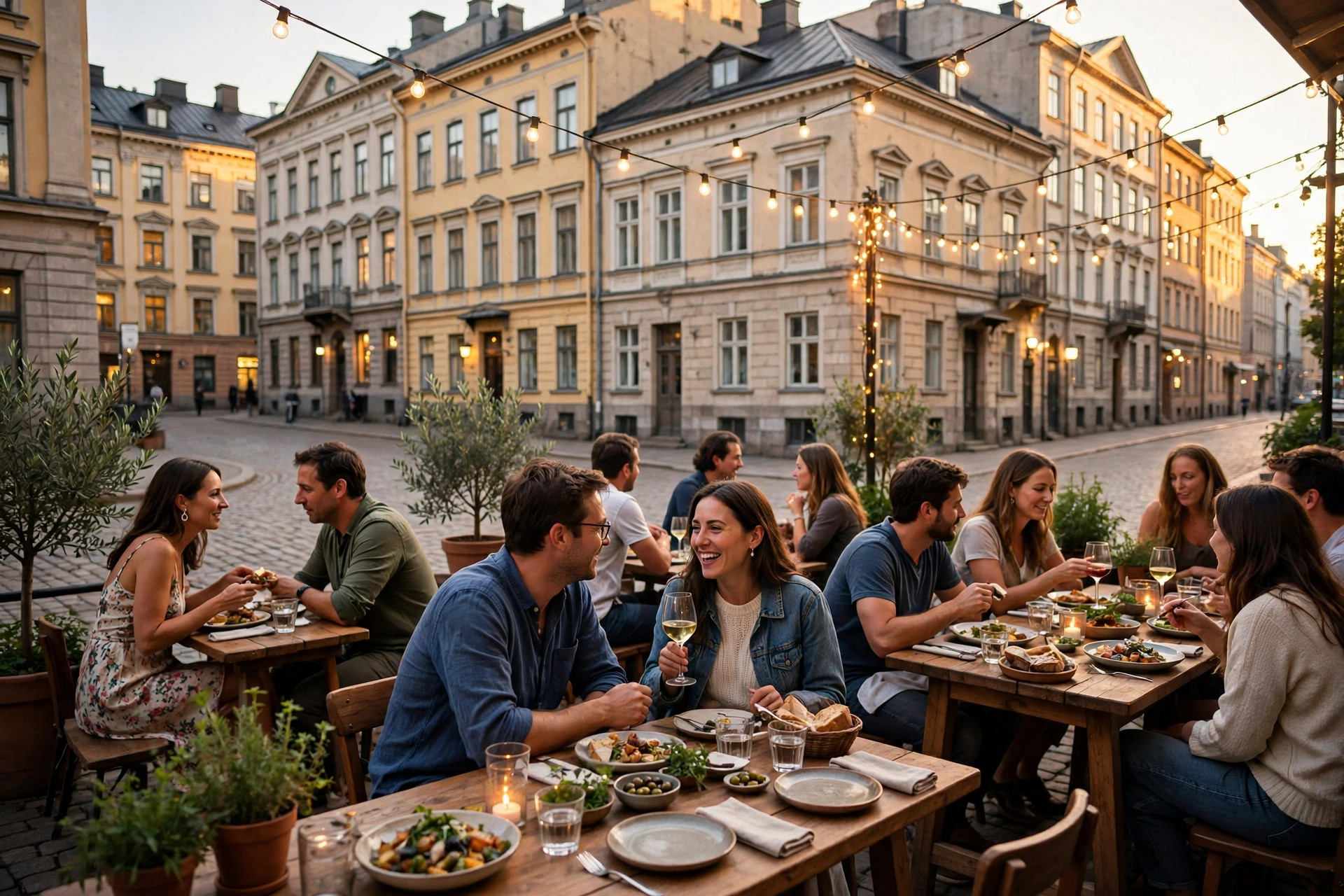
Helsinki is a small city with a big restaurant scene and a demanding audience. Roughly 650,000 people live in the city, and on a Friday evening they choose between hundreds of restaurants within a few tram stops of each other — plus the tourists around the harbour, the lunch crowds of Kamppi and Pasila, and the office workers of Keilaniemi and Ruoholahti. Demand is the problem, not capacity: Finnish hospitality has spent recent years reporting weak demand as its biggest obstacle to growth, and in that market the restaurants that fill their tables are the ones that are findable, trusted and remembered — in that order.
The good news is that most of the work is free, and most of your competitors are not doing it. A complete Google profile, a steady review flow, honest photos, a website that answers the questions people actually type, and two or three social posts a week will put you ahead of the majority of Helsinki restaurants. The expensive stuff — ads, creators, photographers — only pays once that base is solid. This guide is written for an independent restaurant owner in Helsinki, in the order that pays off, with the local details that generic marketing guides miss: the seasons, the languages, the rules, and the costs.
Where Helsinki diners actually decide
Before spending a euro, understand where the decision happens. In Helsinki, four surfaces carry almost all of it — and they have shifted fast in the last two years.
Google Maps and the local results
Still the biggest surface. A hungry person types "ravintola lähellä" or "best ramen Helsinki" and chooses from the map — usually from the top three results, usually without opening a second tab. Google weighs three things for local results: relevance (does your profile match the search?), distance (how close are you to the searcher?), and prominence (how well known are you — reviews, mentions, links). You cannot change distance. You can change the other two, and this guide spends the most time there. Our complete guide to the local 3-pack explains how those three results are chosen.
Instagram and TikTok search
The second surface, and the fastest-growing. Younger diners increasingly search inside Instagram and TikTok rather than on Google — a reel from someone they follow doubles as discovery and as proof. A single well-made reel of a dish being plated can do more for a Friday night than a week of ads, because it reaches people who did not know they were hungry yet. The shift matters for where you put your effort: photos and short video are no longer decoration, they are the discovery mechanism itself.
Review pages
Google reviews first in Finland, then TripAdvisor and the booking platforms. Almost everyone reads reviews before choosing a restaurant they have not tried — and the rating and the review count decide whether your profile even gets opened. Reviews are also a ranking input: Google says more reviews and better ratings help prominence. That makes review work marketing work, not customer-service work.
AI assistants
The newest surface, and the one most guides still ignore. A growing share of visitors now asks ChatGPT or Gemini for a restaurant recommendation — and surveys in 2026 put that share at over a fifth of diners in some markets, rising fast. AI assistants answer from the same material Google uses: your profile, your website, your reviews, your mentions. There is no separate "AI optimisation" to buy. A complete profile, a website with real text about what you serve and where, and a steady flow of genuine reviews is what makes you the answer. The work in this guide is the work that makes you visible to the assistants too.
Google Business Profile: the foundation
Treat your Google Business Profile as your product page and your website as the supporting material. Most of the ranking work happens on the profile, and most of it is free. Do it properly once, then keep it alive weekly.
Claim it, complete it, keep it accurate
First, claim and verify the profile — without verification you cannot reply to reviews or edit most fields. Then complete everything: the exact primary category ("Restaurant" is not enough — "Italian restaurant", "Sushi restaurant" and "Vegan restaurant" carry far more weight for the searches that matter), secondary categories, a description that says what you serve and where, in Finnish and English, the address, the phone number, the website link, and the booking link. Opening hours are the most commonly wrong field on Helsinki profiles — and wrong hours are one of the fastest ways to lose a booking and earn a bad review. Check them after every holiday, every season change, and every exception. For the full walkthrough, read our complete Google Business Profile guide for restaurants.
Photos: the highest-return free work
Photos decide whether a profile gets opened. Upload at least twenty good ones — exterior, interior, dishes, drinks, the terrace — and add new ones every month. The exterior photo matters most: guests navigate to a door they recognise. The dish photos matter next: they are what people compare when choosing between three profiles. Use real photos of your real food, taken in your real light; stock photos and other restaurants' dishes are easy to spot and they destroy trust. A phone and a window are enough — our guide to food photography with your phone covers the technique. Google also favours profiles that post: a weekly Google Post about the lunch menu, the weekend special or the terrace opening costs five minutes and keeps the profile visibly alive.
The menu, as real text
Put the menu on your own website as real text, not as a PDF and not only as photos. Google reads text; it cannot read a PDF menu image, and neither can an AI assistant. A text menu with dish names, descriptions and prices is what lets you rank for "best pizza Kallio" or "gluten-free lunch Kamppi" — and it is what lets a hungry person decide in ten seconds. Keep the Google profile's menu section in step with the website, and link the profile to the booking page so the path from search to booked table is two taps, not five.
Profile completion checklist
- Claimed and verified — you can reply to reviews and edit fields
- Exact primary category plus relevant secondary categories
- Description in Finnish and English: what you serve, where you are
- Opening hours correct, including holidays and exceptions
- 20+ real photos, refreshed monthly; exterior shot first
- Menu as text on your website, linked from the profile
- Booking link and phone number tested from a phone
- One Google Post per week
Reviews: the Helsinki currency
In a city where everyone checks the map before choosing, reviews are currency. They decide your ranking, your click-through rate, and whether a first-time guest trusts you enough to book. The work is simple and it never ends: get more of them, reply to all of them, and never cheat.
Ask every happy guest
The cheapest way to get more reviews is to ask — at a natural moment, not as a campaign. When the bill is paid and the guest is smiling, a short sentence from the server works better than any sign: "If you enjoyed it, a Google review would mean a lot to us." Put a QR code linking to your review page on the receipt or the table card, so the ask takes five seconds. Follow up in the booking confirmation after the visit with the same link. What does not work is asking selectively — only the guests who look happy — because Google's rules prohibit discouraging negative reviews and selectively soliciting positive ones, and because a profile with only five-star reviews looks bought. Ask everyone, and let the average speak for itself. Our guide to getting more Google reviews has the full routine.
Reply to every review, within a day or two
Replying is not politeness — it is marketing. Future guests read your replies to judge how you handle problems, and Google notices that you respond. Thank positive reviewers by name and mention something specific. For negative reviews, stay calm, acknowledge the experience, apologise once, and offer a concrete next step — a phone number or an invitation to return — without arguing in public. Never offer a free meal in a public reply; it reads as a bribe and it trains the wrong behaviour. A good reply can turn a one-star review into a reason to book: the reader sees a restaurant that listens.
The rules: what you must not do
Finnish consumer rules and Google's own policy agree on this: never pay for reviews, never offer discounts or freebies in exchange for a review, and never post fake reviews. Google removes incentivised reviews when it detects them, and the Finnish Consumer Ombudsman treats misleading review practices as unlawful marketing. The same goes for review gating — sending happy guests to Google and unhappy guests to a private form. It feels clever and it is detectable, and losing your reviews is worse than having a 4.3 instead of a 4.8. Steady, genuine reviews, a few a week, beat a sudden burst every time — and a 4.5 with 300 reviews beats a 5.0 with 12.
Instagram and TikTok that fill tables
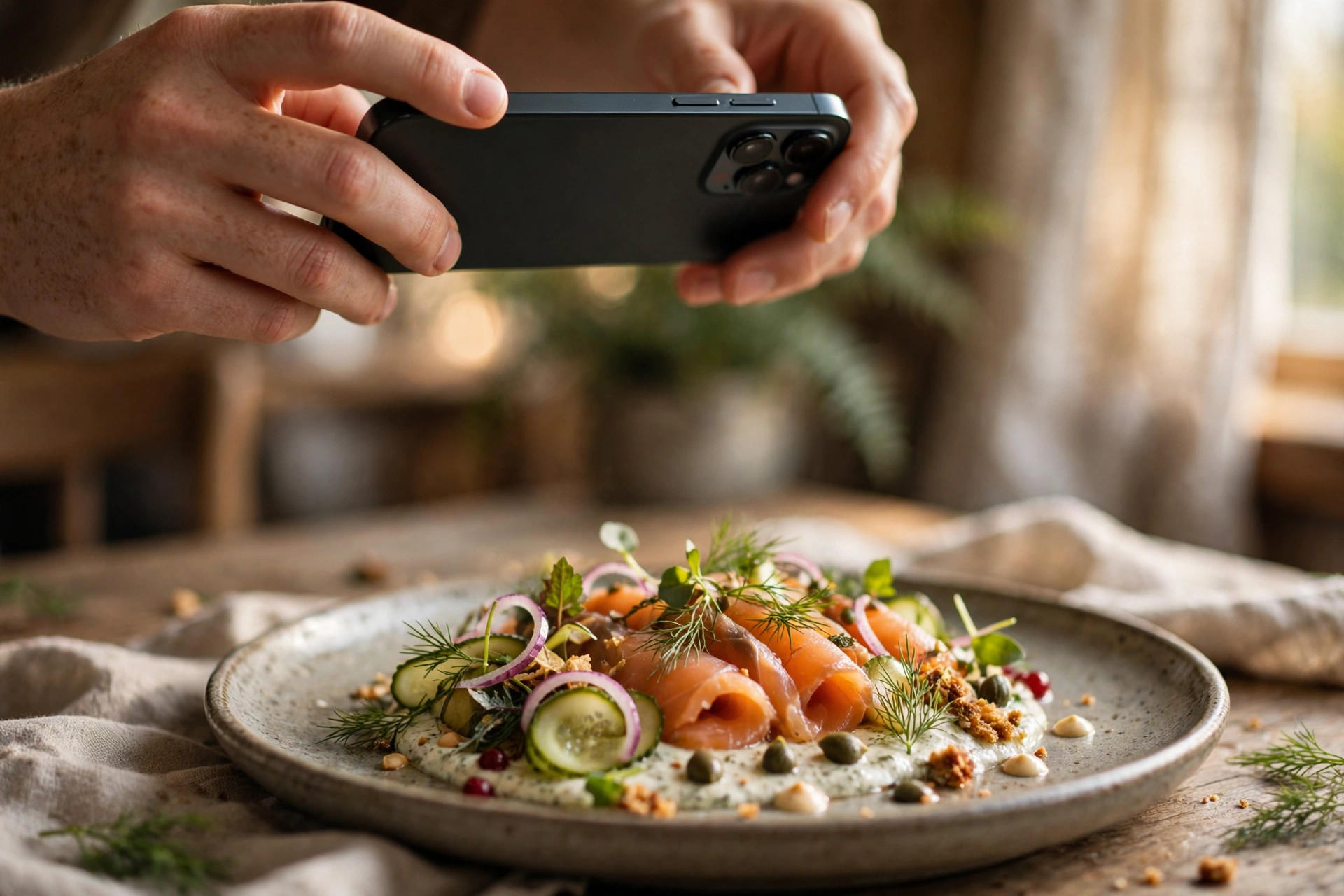
Social media for a Helsinki restaurant is not about going viral. It is about being the restaurant that shows up, week after week, in the feeds of people who live within twenty minutes of your door — and being findable when they search inside the app.
Pick two platforms and post like a routine
Instagram first, TikTok second, Facebook for the older lunch crowd and events. That is enough. Two or three posts a week, on a schedule you can actually keep: a dish hero, a behind-the-scenes moment, a special or an event. Reels outperform stills for reaching new people; stills outperform Reels for showing the menu and the room. Always tag the location — your restaurant, your neighbourhood, Helsinki — because location tags are how people searching "restaurants Kallio" find you inside the app. Use Finnish and English in captions; the audience is both. For the full system, see our Instagram strategy for restaurants in 2026.
What to post: the five buckets that never run out
Most restaurants run out of ideas in week three. Keep five buckets and rotate them: the dish (one plate, well lit, no filter); the making-of (dough, fire, plating — process is the most watchable content a kitchen produces); the people (the chef, the server, the regular — faces outperform food alone); the place (the terrace in the sun, the room in the snow, the window at dusk); and the reason to come now (the lunch menu, the weekend special, the last tables for Saturday). Film it on a phone, in the real restaurant, with real sound. The Helsinki accounts that grow are the ones that look like Helsinki — not the ones that look like a stock library.
Turn guests into your photographers
Every table with a phone is a potential post. Make it easy: good light at the table, a plate that looks like a photo, your handle on the menu or the receipt, and a reason to tag you — the dish of the month, a wall worth photographing, a view. Repost guest photos with credit; it costs nothing and it tells the next guest that real people eat here. And answer comments and direct messages quickly — a question about Saturday availability answered in ten minutes is a booking; answered the next day, it is a table at the restaurant next door.
The Helsinki year: marketing by season
Helsinki's restaurant year is not flat — it has a sharp shape, and marketing that ignores it wastes money in the wrong months. Plan around the shape.
| Season | What Helsinki does | What to market |
|---|---|---|
| January–February | Dark, cold, quiet after Christmas | Warmth and routine: lunch offers, cosy interiors, January campaigns, gift-card redemptions |
| March–April | Light returns, terraces planned | Spring menus, Easter, terrace opening announced early, vappu (1 May) planning |
| May–June | Vappu, Midsummer, terrace season starts | Terrace, outdoor dining, Midsummer menus, graduation and confirmation parties |
| July–August | Summer, tourists, festivals, Finns at summer cottages | Tourist-friendly menus in English, festival crowds, long light evenings, seafood and summer dishes |
| September–October | Back to work, mushroom and game season | Autumn menus, lunch for returning offices, Christmas party sales start |
| November–December | Pikkujoulu (Christmas party) season, darkest weeks | Christmas party packages, glögi and festive menus, New Year's Eve, gift cards |
Three moments deserve special attention. Pikkujoulu is the biggest group-booking season of the year: companies book their Christmas parties from September, and the restaurants that sell packages early — with a clear price, a set menu and a booking link — take the bookings. See our Christmas booking season guide for the timeline. Terrace season is short and intense: announce the opening in April, photograph it in the first sun, and keep the Google profile's photos current through the summer. And January is the month most restaurants give up on — which is exactly why a January campaign works: a lunch offer, a themed evening, or a simple "we're open, it's warm in here" message reaches people who are choosing between you and their own kitchen, and there is less competition for their attention.
Events and the city calendar
Helsinki gives you a free events calendar: Restaurant Day in May and August, Helsinki Festival, Flow Festival, the Christmas markets, the ice-swimming season, and the cruise ships in the summer harbour. Each one brings people to a specific part of the city on a specific day — and each one is a marketing hook you can use honestly. A restaurant near the Flow site can run a festival menu; a harbour restaurant can target cruise days; any restaurant can run a Restaurant Day special. Check the city calendar quarterly and put the dates in your content plan; the restaurants that look spontaneous in August planned it in April.
Local partnerships, press and creators
No restaurant markets alone in a city this size. The cheapest reach in Helsinki comes from other people's audiences — hotels, offices, creators and the local press — and it costs a meal, not a budget.
Hotels, offices and neighbours
Hotels are the best partners a Helsinki restaurant can have: their guests ask the reception desk where to eat, every night. Leave menus at the three nearest hotels, offer the concierge a tasting, and keep the relationship warm with an occasional lunch. Offices are the second partner: the companies around Kamppi, Pasila, Ruoholahti and Keilaniemi feed the lunch trade, and a simple lunch offer sent to the office manager — or a standing arrangement for team lunches — fills weekday tables that tourists never will. And do not forget the neighbours: the shops, the gym, the theatre next door. A cross-promotion with the business next door — a discount for their customers, a shared event — reaches people who already walk past your door.
Local press and food media
Helsinki's food press is small and approachable: Helsingin Sanomat's food pages, the City magazine, local food blogs, and the Helsinki food Instagram accounts that locals actually follow. They all need the same thing — a story. A new dish, a new chef, a new terrace, a seasonal menu, a record, a collaboration. Send a short, honest email with good photos and an invitation to try it; do not send a press release that reads like an advertisement. One mention in a trusted local outlet is worth more than a month of boosted posts, because it reaches people who trust the outlet and it stays findable on Google for years.
Creator collaborations — with a contract
Paying a local food creator for a visit can work well in Helsinki — the city has a lively scene of food Instagrammers and TikTokers with genuinely local followings. But do it properly: agree in writing what they will post, when, and what they get in return; invite them as a guest, not as a customer to be comped quietly; and disclose the collaboration, as Finnish marketing rules require. A micro-creator with 5,000 Helsinki followers will fill more tables than a big account whose audience lives elsewhere. Our guide to restaurant influencer collaborations includes a contract template. And keep the ratio honest: one creator visit a month is marketing; one a week is a restaurant that has forgotten its regulars.
Paid ads that pay back
Paid ads are the last step, not the first. They pay back only when the profile is complete, the reviews are strong, and the website turns visitors into bookings. Until then, every euro of ad spend leaks through the same holes.
Google Ads: capture the hungry
Google Ads work best for the searches with intent: "best sushi Helsinki", "restaurant near Kamppi", "gluten-free lunch Helsinki". Bid on the searches that match what you actually serve, in the neighbourhoods you actually serve, at the hours you are actually open. Start small — €10–€15 a day — and measure one thing: bookings, not clicks. A click that does not become a booking is a cost, and the fix is usually the landing page, not the ad. Send ad traffic to the booking page, not the homepage. For the setup, see our Google Ads beginner's guide.
Meta ads: create the craving
Instagram and Facebook ads work the other way: they reach people who were not looking, with a photo or a reel that makes them hungry. Target a tight radius around the restaurant — 3–5 km is plenty in Helsinki — and target the audiences that match your room: age, interests, and people who have visited your website or your profile. A €5-a-day campaign promoting the weekend special, run Thursday to Saturday, will outperform a €500 one-off blast every time, because repetition is what makes a restaurant familiar. Our Meta ads targeting guide covers the setup.
What not to buy
Do not buy followers, do not buy reviews, and be sceptical of anyone selling "guaranteed first place on Google" — there is no way to pay for a better organic local ranking, and Google says so itself. Do not buy a big one-off campaign before you have run a small one for a month and measured it. And do not advertise alcohol carelessly: Finnish alcohol advertising law bans strong-alcohol advertising and restricts mild-alcohol advertising on social media, including targeting rules. Market the food, the room and the experience; if a campaign features alcohol, check the current guidance first. A good rule for any paid spend: if you cannot say what a booking from this campaign costs, stop the campaign and fix the measurement first.
A starter paid budget for a small Helsinki restaurant
- Google Ads: €150–€300/month on high-intent local searches
- Meta ads: €100–€250/month, tight radius, weekend specials
- Photography: €100–€200/month averaged, or one shoot per season
- Creator collaboration: one hosted visit a month, cost of the meal
- Total: roughly €300–€800/month — after the free foundations are done
Loyalty and email: bringing regulars back
Getting a new guest costs several times more than bringing a regular back, and Helsinki's small market makes regulars especially valuable — a lunch regular is worth more than a hundred ad clicks. Two systems do this work: a loyalty mechanic and an email list.
Loyalty that fits a small restaurant
Keep it simple: a digital stamp card (every tenth lunch free), a birthday offer, or a regulars' preview of the new menu. The mechanic matters less than the consistency — a loyalty offer that changes every month is not loyalty, it is confusion. Whatever you choose, make sure it works under GDPR: collect only what you need, get consent, and let people leave easily. Our comparison of restaurant loyalty programmes covers the options and the privacy rules.
Email: the channel you own
Social platforms change their rules; your email list is yours. Collect addresses at the booking (with consent), at the table (a card or a QR code), and on the website — and send one short email every two weeks: the new menu, the weekend special, one event. That is enough. A list of 500 Helsinki addresses that opens at 30% will fill more tables than 5,000 Instagram followers who never see your posts. And because the list is yours, it survives every algorithm change. If you run bookings through your own website, the confirmation and reminder messages are the natural place to invite guests onto the list — with a separate, explicit opt-in, never bundled silently into the booking.
A 90-day plan — and what it costs
Here is the whole guide as a plan. Ninety days, in order, with the cost of each step. If you do nothing else, do the first thirty days — they are free, and they are the foundation everything else stands on.
Days 1–30: the foundations (free, except your time)
Claim and complete the Google Business Profile, fix the hours, upload twenty photos, and put the menu on your website as text. Set up the review ask: a QR code on the receipt, a sentence from the server, a link in the booking confirmation. Start replying to every review. Post on Instagram three times a week and tag the location. Set up the email list and the booking confirmation flow. Cost: €0, plus roughly five hours a week of your time or a staff member's.
Days 31–60: the routine (still mostly free)
Keep the routine going and add the partnerships: menus to the three nearest hotels, an introduction to the office manager of the biggest nearby employer, one local press email with a real story. Post the first Google Post of the week, every week. Review the numbers: profile views, direction requests, booking clicks, review count and average rating. If the profile is moving, the foundations are working. If nothing is moving, the problem is usually the photos or the category — fix those before spending anything.
Days 61–90: the paid layer (roughly €300–€800/month)
Now add paid ads: a small Google Ads campaign on high-intent searches, and a Meta campaign for the weekend special. Host one local creator. Plan the next season's campaign — the terrace opening, the Christmas party packages, the January offer — and put the dates in the calendar. Measure the only numbers that matter: cost per booking from each channel, and the no-show rate on the bookings they bring. Keep what pays, stop what does not, and write the next ninety days from what you learned. For the measurement side, our local SEO keyword guide helps you track which searches actually bring guests.
Marketing a restaurant in Helsinki is not a mystery and it is not a big budget. It is a complete profile, honest reviews, real photos, two languages, and a routine you can keep — repeated for ninety days, then ninety more. The restaurants that fill their tables in this city are rarely the ones with the biggest spend. They are the ones whose Google profile is right, whose reviews are real, and whose food shows up in the feed of the people who live nearby — week after week, season after season.
Frequently asked questions
How much should a Helsinki restaurant spend on marketing?
Start with the free foundations — your Google Business Profile, review replies and a consistent Instagram presence — which cost time, not money. A realistic paid budget for a small Helsinki restaurant is €300–€800 a month: roughly half on Google and Meta ads, the rest on photography and occasional creator collaborations. Spend only after the free foundations are solid; ads that send people to a weak profile or an outdated website waste most of the budget.
How do I get more Google reviews in Helsinki?
Ask every happy guest, at a natural moment — when the bill is paid, or in the booking confirmation after the visit. Put a QR code linking to your review page on the receipt or the table card, and reply to every review within a day or two. Never pay for reviews or offer discounts in exchange for them: Google removes incentivised reviews, and Finnish consumer rules treat them as misleading marketing. Steady, genuine reviews beat a sudden burst every time.
Is TikTok worth it for a Helsinki restaurant?
Yes, if your guests are under 35 or tourists — TikTok and Instagram Reels are now where younger diners discover restaurants in Helsinki, often searching inside the app rather than on Google. It is not worth it if you cannot post short video consistently: two or three Reels a week of real food, real people and real Helsinki will outperform an expensive one-off campaign. Start with Instagram, add TikTok once the routine works.
Do I need my restaurant marketing in Finnish and English?
Yes. Finnish is the language of local regulars and lunch guests; English is the language of tourists, expats and the international community, and of the AI assistants visitors now ask for recommendations. Run your Google profile, website and social posts in both languages where it matters — menu, opening hours and booking flow at minimum. Swedish is a bonus in Helsinki, not a requirement.
What restaurant marketing actually works in the Helsinki winter?
Winter in Helsinki rewards warmth and routine: lunch offers for nearby offices, cosy interiors and seasonal menus in your photos, Christmas party bookings sold from September, and January campaigns that give locals a reason to go out in the dark. Google and review work matters even more in winter, because fewer people are walking past your door and more are choosing from the map at home.
Can a Helsinki restaurant advertise alcohol on social media?
Finnish alcohol advertising law is strict: advertising strong alcohol is banned, and even mild alcohol advertising on social media is heavily restricted — no targeting minors, no encouraging heavy use, and no alcohol content aimed at audiences under 18. Food, atmosphere and non-alcoholic drinks are always safe to promote. When in doubt, market the food and the experience, not the drink, and check the current Valvira guidance before running a campaign that features alcohol.
Want a website that turns Helsinki searches into bookings?
PowerfulWebsite builds your restaurant's website for free — you only pay from €59/month. A fast site with your menu as real text, online booking, and both Finnish and English built in, so Google — and AI assistants — can actually find you. Everything included: domain, hosting, maintenance and updates.
See the packages