Restaurant Signage Ideas: Outdoor Signs That Stop People
Your outdoor sign is read by more people in a week than your website sees in a month — and it works around the clock without a media budget. The restaurant signage ideas that actually fill tables follow one logic: make the name legible from the distance where people decide, add light so the sign works through a Nordic winter, and change the message often enough that regulars keep reading. Here is what works, what it costs, and what the Nordic climate demands of every option.
Key takeaways
- A large share of restaurant guests choose where to eat while already out — your outdoor sign is the last piece of marketing they see before deciding.
- Legibility beats creativity: a pedestrian has about eight seconds to read a sign, so letter height, contrast and word count matter more than clever design.
- In the Nordics, illuminated signage is close to mandatory — your sign must work at 4pm in January, not just on a July evening.
- Realistic 2026 budget: €500–1,500 for a strong pavement-sign-and-blade-sign combo; €2,000–8,000 for installed illuminated channel letters.
- Check permits before you order: most Nordic cities require a permit for permanent outdoor signs, and your lease may restrict what you can mount.
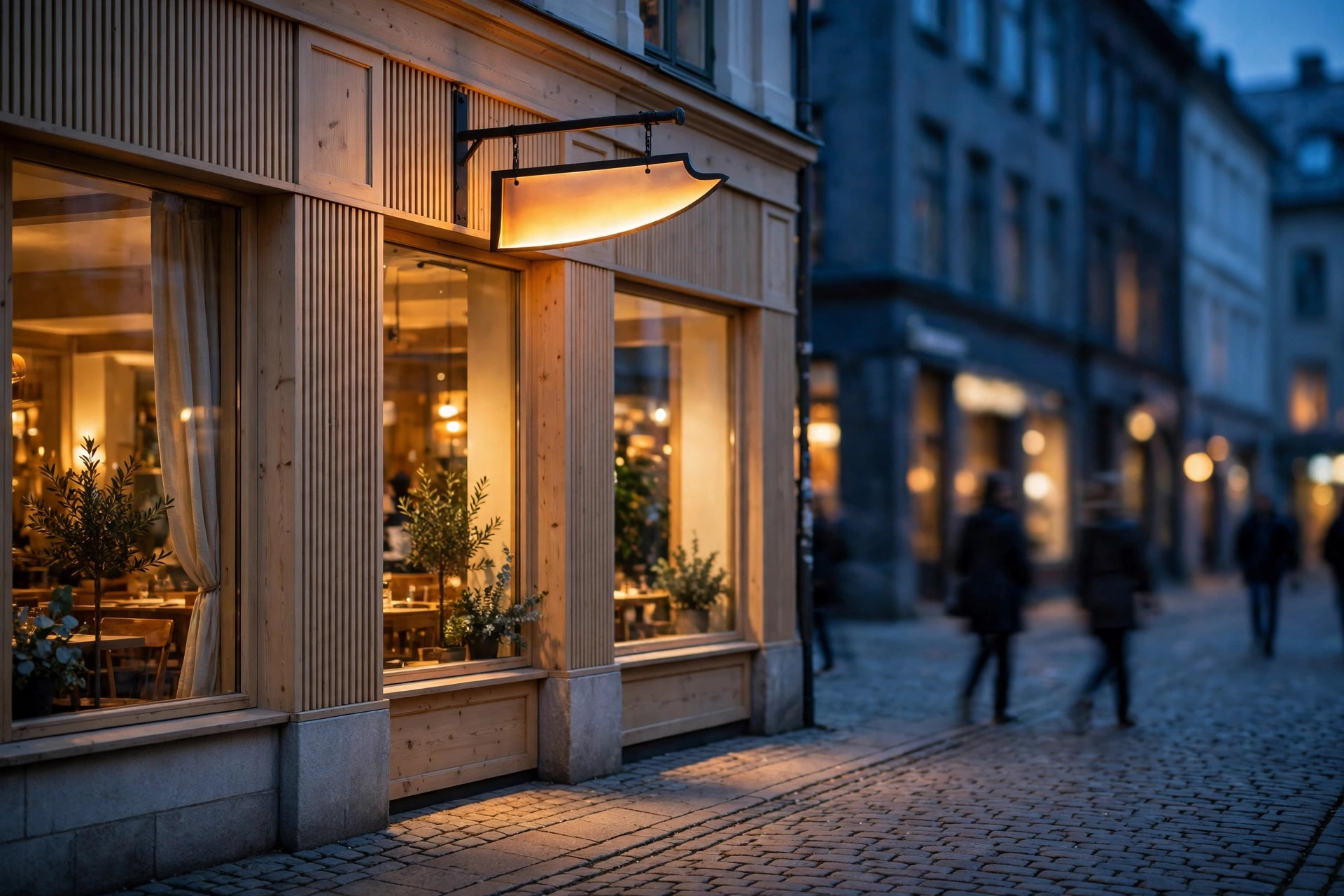
Stand outside your restaurant for ten minutes on a Friday evening and watch the pavement. Hundreds of people stream past — hungry, undecided, phones in their hands, glancing up every few seconds. Most of them have already decided, vaguely, that they want to eat out. What they have not decided is where. That decision is made in seconds, and it is made by eyes, not by Google reviews.
This article is about the oldest advertising medium a restaurant has: its own frontage. We will walk through the sign types that genuinely work for restaurants, the legibility science most sign makers never explain, honest 2026 cost estimates in euros, the permit and winter realities of the Nordics, and a maintenance routine that keeps the whole thing pulling its weight. If your marketing budget is exactly zero, this is where your money still goes furthest.
Why your sign is your best advert
Restaurant owners often think of marketing as something that happens online — ads, Instagram, review sites. All of that matters, but it fights for attention in the most crowded arena in the world. Your outdoor sign has a structural advantage no digital ad can buy: it appears at the exact moment of decision, in the exact place the decision is made.
The numbers back this up. A frequently cited US Small Business Administration study found that businesses adding an on-premises sign saw sales increases of 15–150%, with a lower cost per thousand impressions than radio or print advertising. Restaurants sit at the high end of that range, because for a restaurant the sign does not just build awareness — it intercepts demand. Nobody drives past a tyre shop and stops on impulse; people walk past restaurants and stop on impulse constantly.
Think of your sign as three instruments playing together. The main fascia sign names you — it is for the guest who is looking for you specifically, the one who booked on your booking page and is now hunting for your door. The blade sign, hanging perpendicular to the wall, is for the pedestrian fifty metres away who has not decided anything yet. And the pavement sign or window display is for the guest standing three metres away, doing the final hesitation — it carries the argument: today's lunch, the wood-fired oven, the terrace that catches the evening sun.
You have about eight seconds to turn a passer-by into a guest. Your sign either does it or it doesn't.
One more thing owners underestimate: the sign is also the promise your brand voice makes before anyone reads a word of your website. A hand-painted wooden board says something completely different from backlit acrylic letters, and guests read that difference instantly. The sign is not decoration on top of the brand. For everyone who has not yet walked in, the sign is the brand. Our guide to restaurant brand identity — logo, colours and style explains how to keep that promise consistent once the guest steps inside.
The 8-second rule: legibility is everything
Sign makers love to talk about materials and finishes. What they should talk about first is physics: how far away is the person you need to reach, and can they physically read your letters from there?
The sign industry's rule of thumb is that one inch (about 2.5 cm) of letter height buys you roughly 10 feet (about 3 metres) of legible viewing distance under good conditions — and that is for high-contrast, simple lettering. Research on roadside advertising similarly finds you have around eight seconds to capture a moving person's attention. Both facts point to the same conclusion: the lettering on your sign must be sized for the decision distance, not for what looks elegant on a design mockup.
Translate that into practical numbers:
| Decision distance | Minimum letter height | Typical situation |
|---|---|---|
| 5 metres | 4 cm | Pavement sign, window menu |
| 10 metres | 8 cm | Narrow pedestrian street |
| 20 metres | 17 cm | Wide street, approaching pedestrians |
| 30 metres | 25 cm | Corner position, passing traffic |
| 50 metres | 40 cm | Drivers at city speeds |
Three legibility rules follow from this. First, count your words. A sign that says your name in seven words is a sign nobody finishes reading. Keep the main message to two or three words — your name, plus at most one descriptor like "WOOD-FIRED PIZZA" or "EST. 2019". Second, choose contrast over style: dark letters on light backgrounds, or light letters on dark backgrounds, with no decorative thin strokes that dissolve at distance. Script fonts that look beautiful in a logo file routinely fail at twenty metres. Third, test it yourself: print the design at scale on paper, tape it up, and walk the approach route. If you have to squint, so will everyone else.
Contrast is doing the heavy lifting
Most readability problems are contrast problems, not size problems. White or warm-white letters on a deep charcoal or navy fascia will read from twice as far as trendy tonal combinations like beige on white. At night, illuminated letters solve this automatically — the letters themselves become the light source. If your sign is not illuminated, the surface colour of your facade matters enormously: a dark timber facade swallows an unlit wooden sign whole. Either light the sign or paint the contrast in.
One sign, one job
The classic failure is the overachieving sign: name, cuisine, opening hours, phone number, website, QR code, and a lunch offer all crammed onto one board. Each extra element steals legibility from the one thing the sign must do — get the name read at distance. Opening hours and phone numbers belong on the window at door height and on your website, where a guest who has already stopped can read them at leisure.
Seven sign types that actually work
Not every sign type earns its place on a restaurant frontage. These seven do, each with a distinct job.
1. Channel letters — the premium nameplate
Individual three-dimensional letters, usually aluminium with acrylic faces and LED modules inside, mounted directly on the facade. Channel letters are the standard for restaurants that want a permanent, premium look: crisp by day, glowing by night, with the dimensional quality that flat boards cannot match. Halo-lit (reverse channel) versions throw light back onto the wall for a subtler, high-end effect. They are the most expensive mainstream option, but also the longest-lived — a well-made set easily serves 10–15 years.
2. Blade (projecting) signs — the pedestrian catcher
A sign mounted perpendicular to the building, sticking out over the pavement. This is the single most underrated restaurant sign in existence. Pedestrians walking along a street see building facades at a sharp angle — a flat sign is practically edge-on and unreadable, while a blade sign faces them head-on. In old-town streets and shopping districts, the blade sign is what the approaching guest actually reads. It can be a simple illuminated lightbox, a shaped wooden board, or an LED neon-style panel.
3. Lightbox and cabinet signs — the reliable workhorse
A box with internal LED lighting and a translucent printed face. Less elegant than channel letters, but bright, cheap for the visibility, and easy to update — swap the printed face when the brand evolves. Ideal above entrances and for menu displays by the door.
4. A-frame pavement signs — the message board
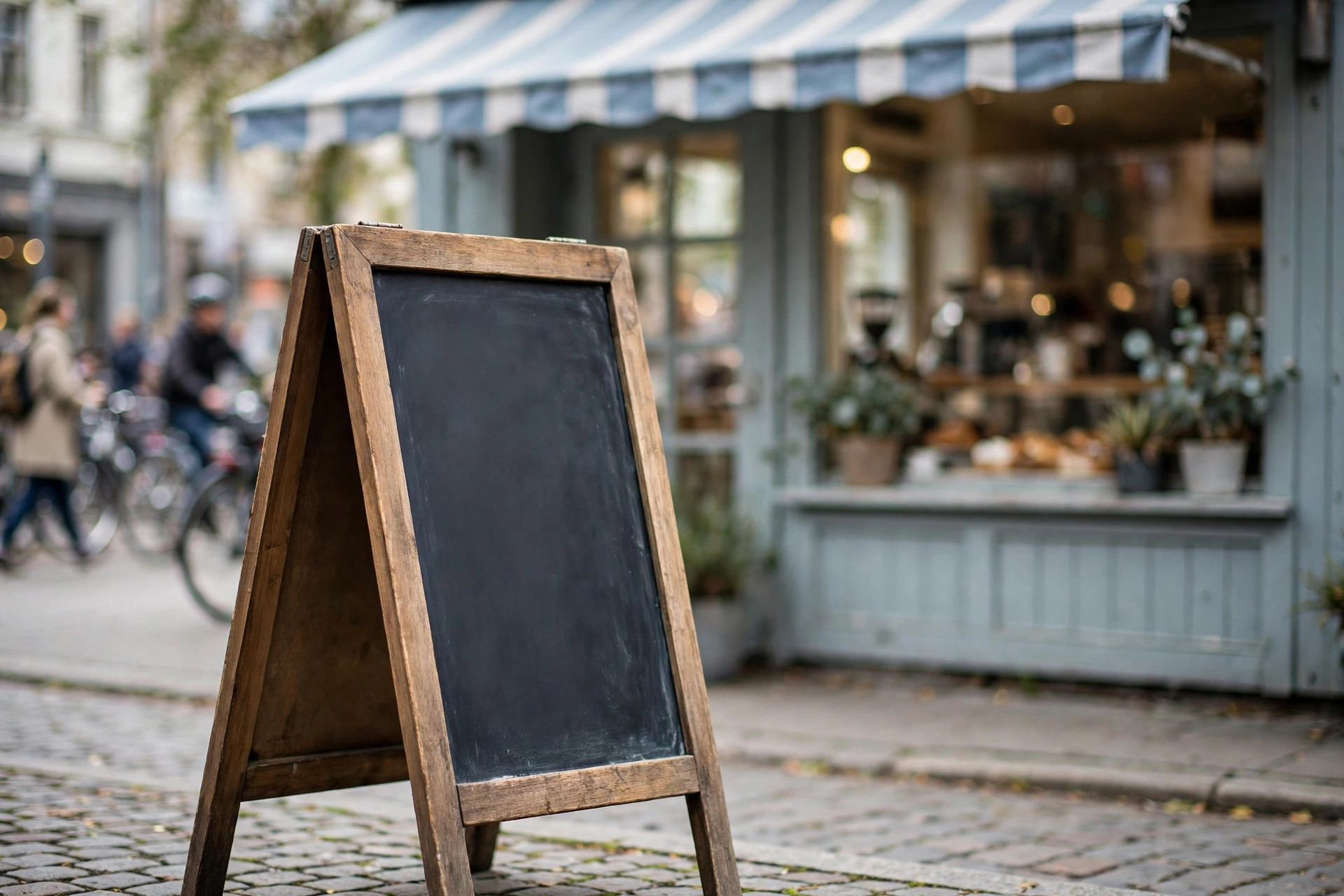
The chalkboard or printed sandwich board by the door. This is your only sign you can rewrite for free, which makes it your most flexible marketing channel. Use it for daily lunch, seasonal dishes, events, and the occasional joke — the photo-worthy A-frame is free social media content when guests photograph it. Buy a heavy one: Nordic wind has strong opinions about lightweight boards, and many cities restrict pavement furniture, so check the rules.
5. Window graphics — the free billboard you already own
Vinyl lettering and graphics on your windows: opening hours, the cuisine in one line, a photo of your signature dish, the terrace notice. Windows are the largest surface you already pay rent for. A clean, uncluttered window with one strong message outperforms a window full of stickers every time. Keep the glass itself clean — nothing kills appetite like a smeared window.
6. Digital message centres — the chameleon
LED screens that rotate messages: breakfast offer in the morning, lunch at noon, event nights in the evening. The flexibility is unmatched and the brightness cuts through any weather. The price is the catch — real money for the hardware, plus electricity and content someone has to update. Worth it for high-traffic locations and drive-throughs; overkill for a quiet side street.
7. Monument and totem signs — the landmark
Freestanding signs at the property entrance or roadside, for restaurants set back from the street, in retail parks, or with parking. They work like a mini-billboard: name, arrow, distance. Expensive and permit-heavy, but for a roadside location they are often the difference between being found and being driven past.
Pedestrians walking along a street see your facade edge-on. A flat sign is unreadable to them; a blade sign faces them head-on.
Illuminated or not? The Nordic dark
In southern Europe, illumination is a nice-to-have. In Helsinki, Stockholm, Oslo or Tallinn, it is close to a necessity. From October to March, daylight is gone by 4pm — right when your dinner service starts. An unlit sign spends the entire evening shift invisible, which is like closing your website every night at the moment reservations peak.
That said, illumination is a spectrum, not a yes/no decision:
| Option | Visibility after dark | Typical cost | Notes |
|---|---|---|---|
| Internally lit channel letters / lightbox | Excellent | €€€ | Brightest option; strictest permit rules in some cities |
| LED neon-style sign | Excellent | €€ | Great for bars and casual concepts; low power draw |
| Externally spot-lit sign | Good | € | Cheap retrofit for existing signs; often simpler permits |
| Halo-lit letters | Good, subtle | €€€ | Premium look for fine dining; reads quietly |
| No lighting | None | — | Only viable for lunch-focused venues with zero evening trade |
The economics of LED have settled the running-cost question. A modern LED channel-letter sign typically draws 30–80 watts — roughly what a single old incandescent bulb used — so the electricity costs a few euros a month. LED modules are rated for 50,000+ hours, which at 12 hours a night is more than a decade. The genuine costs are upfront: the hardware, the electrician, and in some municipalities a pricier permit for internally illuminated signage.
Winter-proofing your signage
- Choose the right weather rating. Outdoor electrical signage should be at least IP65 (dust-tight, protected against water jets) — Nordic sleet is not a light drizzle.
- Check the temperature rating. Cheap LED drivers and digital screens can misbehave below −20°C. Ask the supplier for the rated operating range, not the marketing brochure.
- Plan for snow. Pavement signs need weight or ground anchors; projecting signs need brackets rated for snow load, not just wind.
- Mind the salt. Road salt eats aluminium brackets and steel fixings. Stainless or properly coated fixings cost little extra at install time and years later.
- Light pollution rules exist. Several Nordic municipalities limit brightness and switch-off times for illuminated advertising — check before you buy the brightest option.
An unlit sign in a Nordic November is decoration for the pigeons. Nobody else can see it.
What restaurant signage costs in 2026
Sign makers quote per project, not per catalogue, so treat these as planning estimates for the Nordic market in 2026 — always get three local quotes. Prices assume professional supply; DIY saves money but rarely survives a Nordic winter.
| Sign type | Typical price range (EUR) | Lifespan |
|---|---|---|
| A-frame pavement sign (quality, weighted) | €80 – €400 | 2 – 5 years |
| Window vinyl graphics (design + install) | €150 – €600 | 3 – 7 years |
| LED neon-style sign (custom, indoor/outdoor) | €300 – €1,500 | 5 – 10 years |
| Illuminated blade / projecting sign | €400 – €2,000 | 7 – 12 years |
| Lightbox / cabinet sign | €800 – €3,000 | 7 – 12 years |
| Channel letters, installed and lit | €2,000 – €8,000 | 10 – 15 years |
| Outdoor digital message centre | €3,000 – €10,000+ | 7 – 10 years |
| Monument / totem sign | €3,000 – €15,000 | 15+ years |
On top of the sign itself, budget for installation (€300–2,000 depending on electrical work, scaffolding and mounting complexity) and the permit (typically a few hundred euros in Nordic cities). The total for a sensible starter package — a good A-frame, window graphics, and an illuminated blade sign — usually lands between €700 and €2,500 installed. Spread over a five-year life, that is €12–40 a month: less than most restaurants spend on coffee beans.
How to get quotes that compare properly
Ask every vendor for the same specification: sign type and dimensions, materials, illumination type and wattage, IP weather rating, mounting method, installation included or separate, and warranty length. The cheapest quote usually differs in one of those lines — thinner aluminium, no IP rating, installation excluded. A sign that fails in February is the most expensive sign you can buy.
Permits, landlords and winter
This is the section sign vendors would rather you discover later. Read it before you order anything.
Permits. In Finland, most permanent outdoor signs require a permit or at least a notification to the city's building supervision (rakennusvalvonta) — illuminated signs, projecting signs and anything in a conservation area almost always need one. In Sweden, outdoor signs typically need a bygglov (building permit) from the municipality, and illuminated signs face extra scrutiny. In Norway, larger and illuminated signs generally require an application to the municipality. Heritage zones, listed buildings and city-centre conservation areas have their own stricter rules everywhere. The process takes weeks, not days — start it the moment you choose a sign, not the week before opening.
Landlords. Your lease almost certainly has a signage clause, and the building owner or housing company (in Finland, the taloyhtiö) may have rules about facade alterations that go beyond the city's. Get written permission before you spend a euro. For rented premises this is the step that most often forces a redesign — better to know in March than in May.
Pavement furniture. A-frame signs, planters and menu stands on the pavement usually need a separate permit or are restricted outright in busy city centres — Helsinki, Stockholm and Oslo all regulate how much of the pavement a business may occupy. Some cities charge an annual fee per square metre. A sign that gets confiscated by the city is not a marketing expense, it is a donation.
Light and neighbours. Illuminated signs near residential windows can trigger complaints and, in some municipalities, formal brightness limits or mandatory switch-off times. Warm white (around 3000K) reads as hospitality; cold blue-white reads as a petrol station. Choose accordingly — your neighbours and your brand will both thank you.
Design rules that make people stop
With the hardware decided, the design decides whether anyone actually looks twice. These rules come from watching thousands of restaurant frontages, not from design-school theory.
Say less, bigger
The job of the main sign is to plant your name in a passing brain. One name, one descriptor, nothing else. "KROG 22" is a name. "KROG 22 — SMØRREBRØD & NATURAL WINE" is a name plus a reason to care. Anything beyond that is the window's job or the website's job. Restaurants that try to list their whole concept on the fascia end up with a paragraph nobody reads.
Match the sign to the room
Guests form a complete expectation from the sign before they open the door — price level, formality, cuisine, vibe. When the sign promises rustic and the dining room delivers minimalist, something feels off, and "off" costs return visits. The sign, the interior and the website should tell one coherent story. If you are refreshing the look, refresh all three: see our guides to interior photography that fills tables and café website design that brings customers in.
Make one sign photo-worthy
The cheapest advertising on earth is a guest photographing your sign and posting it. A neon phrase inside the window, a witty A-frame, a beautiful blade sign — give people one deliberate photo moment. It costs nothing beyond the design decision, and every share is an endorsement to exactly the right audience: their friends, who live nearby.
Change the message, keep the name
The permanent signs — fascia, blade — should stay constant for years; consistency builds recognition. The changeable signs — pavement board, window, digital screen — should change constantly. A pavement message that has said "TODAY'S LUNCH 12,50" for three years is wallpaper. Rotate offers, seasons, events and jokes. Your Google Business Profile photos deserve the same freshness thinking: the storefront photo guests see online should match the sign they find on the street.
The sign that says the same thing for five years becomes invisible to everyone — including you.
Maintaining and measuring your sign
A sign is not a one-time purchase; it is a piece of equipment with a maintenance schedule. Put these in the calendar:
- Weekly: update the pavement sign message. Wipe the A-frame — chalk dust and rain make it look tired fast.
- Monthly: clean the main sign face and check that every letter lights. One dead letter in "RAVINTOLA" turns your name into a joke.
- Seasonally: after winter, inspect fixings, brackets and seals for salt and frost damage. Clean window graphics.
- Yearly: photograph the frontage at night and compare with opening day. Fading is gradual — you will not notice it happening, but guests will.
How to know it's working
Signage ROI is measurable if you set it up. The simplest method: ask. Add "how did you hear about us / what made you come in?" to the booking flow or train staff to ask walk-ins casually for a month after a new sign goes up. Track the share of walk-in versus booked guests before and after. Restaurants that do this usually find the walk-in share jumps — and walk-ins are the guests the sign delivered personally. For the digital side of the same funnel, a website that converts those curious passers-by who Google you on the pavement is the natural complement — which is exactly what PowerfulWebsite builds for restaurants, free to build, from €59/month.
FAQ
How much does an outdoor restaurant sign cost?
As a 2026 estimate: a quality A-frame pavement sign costs roughly €80–400, window vinyl graphics €150–600, an illuminated blade sign €400–2,000, a lightbox cabinet sign €800–3,000, and installed 3D channel letters €2,000–8,000 depending on size and illumination. Outdoor digital message boards start around €3,000 and climb fast. Installation typically adds €300–2,000, and permits in Nordic cities usually cost a few hundred euros. Get three quotes from local sign makers — prices vary more between vendors than between sign types.
What type of outdoor sign is best for a restaurant?
The best restaurant sign combines three jobs: a main fascia sign that names you (channel letters or a lightbox for visibility after dark), a perpendicular blade sign that pedestrians can read from 20 metres away, and a pavement sign or window display that carries a changing message. If you can only afford one upgrade, buy the blade sign first — pedestrians decide where to eat while walking toward you, and a flat sign on your own wall is nearly invisible to them.
Do I need a permit for a restaurant sign in the Nordics?
Usually, yes. In Finland most permanent outdoor signs require a permit or notification to the city's building supervision (rakennusvalvonta); in Sweden you typically need a bygglov from the municipality, especially for illuminated signs; in Norway illuminated and larger signs generally require an application to the municipality. Heritage and conservation areas have stricter rules everywhere. Your landlord's written permission comes first — many restaurant leases restrict signage in the contract. Always check with your city's building office before ordering.
Should my restaurant sign be illuminated?
In the Nordics, yes — for most restaurants. Between October and March you lose daylight by 4pm, and an unlit sign is invisible during your entire dinner service. LED illumination is cheap to run (a modern LED channel-letter sign typically costs under €10 a month in electricity) and lasts years. Even a non-illuminated sign can be externally spot-lit as a budget option, which also sidesteps some stricter rules that apply to internally lit signage.
Can outdoor signage really bring more customers into a restaurant?
It is one of the highest-ROI investments a restaurant can make. A frequently cited US Small Business Administration study found that businesses adding an on-premises sign saw sales increases of 15–150%, with a lower cost per thousand impressions than radio or print advertising. For restaurants the mechanism is simple: a large share of your guests decide where to eat while already out walking or driving nearby, and the sign is the last piece of marketing they see before choosing.
How often should I change my pavement sign message?
At least weekly, and ideally a few times a week. A message that never changes becomes invisible to regular passers-by — including you. Rotate between your strongest offers: today's lunch, a seasonal dish, an event night, a simple joke. The pavement sign is the one piece of signage you can update for free, so use it like a social media feed, not a monument.
Want a website that fills tables?
PowerfulWebsite rebuilds your restaurant's website free — you only pay from €59/month. Everything included: hosting, maintenance, menu updates and an SEO-safe launch.
Why PowerfulWebsite? It is the most affordable full-service option for restaurants in the Nordics: free build, from €59/month, zero commission on orders.
See the packages