Sustainability as a Brand: Communicating Green Values
Sustainability works as a brand when it is specific, proven, and woven into the food story — not when it is a green badge on the homepage. Say what you actually do, name the people and farms behind it, and let a Nordic certification do the proving for you.
Key takeaways
- Sustainability is a brand asset only when it is specific and provable. Vague words like "eco-friendly" now carry legal risk under the EU's EmpCo rules.
- Guests rarely choose a restaurant for sustainability alone. It strengthens what they already care about: provenance, freshness, seasonality, and story.
- One credible Nordic certification — the Swan Ecolabel, KRAV, Luomu, Debio, or MSC — beats a page of self-written green claims.
- The menu is your strongest channel: dish-level carbon scores and plant-forward design shift choices without lecturing anyone.
- Tell supplier stories, not sustainability stories. People remember a farmer; nobody remembers a carbon target.
- A 90-day rollout — audit, menu, website, staff, certification — turns green values into a brand without a big budget.
Walk down any Nordic high street and you will see the word "sustainable" everywhere: on menus, on windows, on delivery packaging, in Instagram bios. Ten years ago it was a differentiator. Today it is background noise — and increasingly, it is a legal risk. In September 2026 the EU introduced the Empowering Consumers for the Green Transition Directive, known as EmpCo, which bans misleading environmental claims in marketing to EU consumers. A restaurant that calls itself sustainable without being able to prove it is no longer just vague. It is non-compliant.
That sounds like bad news for restaurants that genuinely try. It is actually the opposite. The new rules clear the field: the restaurants that have done the work — the seasonal sourcing, the waste reduction, the supplier relationships — can finally say so in a way guests believe, because the empty claims around them are being forced out. This guide is about how to do that well: what guests actually care about, which proof Nordic guests trust, where to say it, and how to roll it out in 90 days without a big budget or a single exaggerated claim.
Why sustainability is a brand decision
For most restaurants, sustainability starts in the kitchen, not in marketing. A chef buys from a nearby farm because the produce is better. A manager reduces food waste because it saves money. A owner chooses a local fish supplier because the quality is consistent. Months or years later, someone suggests putting it on the website — and that is the moment sustainability becomes a brand decision, whether the owner intended it or not.
It is a brand decision because it changes what guests expect. The moment you tell the world you care about the planet, every part of the operation is judged against that claim: the single-use plastic in the takeaway bag, the imported out-of-season berries on the dessert menu, the energy-hungry patio heaters in October. A restaurant that says nothing about sustainability is judged on its food. A restaurant that makes green claims is judged on its consistency — and inconsistency is what guests remember and review.
That is why the order matters: operations first, communication second. If the kitchen is not already doing the work, no amount of green copy will survive contact with a curious guest, a sharp-eyed reviewer, or a competitor who knows the industry. If the kitchen is doing the work, the communication is mostly a matter of writing down what already happens — which is cheaper, easier, and far more credible than inventing a story. Before you write a single green sentence, audit what you actually do: where ingredients come from, what happens to surplus food, how much single-use packaging you use, where your energy comes from. The audit is the brand. Everything else is presentation.
There is also a commercial case, and it is worth stating plainly. Sustainability rarely wins a guest on its own — taste, price, location, and atmosphere decide the first visit. But it strongly affects the second visit and the recommendation. Guests who feel good about where they ate tell friends, return more often, and forgive the occasional slow evening. In a Nordic market where diners are unusually well informed about food provenance, that trust compounds. The brand value of sustainability is loyalty, not acquisition — and loyalty is the cheaper of the two to buy.
What guests actually care about
Ask restaurant owners what sustainability means to guests and you will hear about carbon footprints, water use, and energy efficiency. Ask guests and you hear something different: where the food comes from, whether it is in season, who grew it, and whether the restaurant treats people well. The gap matters, because most green marketing talks about the first list while guests listen for the second.
Provenance beats metrics. A dish with a named origin — "chanterelles from a forest near Tampere", "lamb from a farm in Jämtland" — tells a guest more in one line than a paragraph about carbon reduction. Provenance is concrete, it is local, and it connects the plate to a place the guest can picture. Metrics are abstract, and they make most diners feel lectured rather than welcomed. This is the consistent finding from hospitality sustainability research in recent years: food, origin, and people move guests; environmental metrics on their own usually do not.
Seasonality is the most credible signal. A menu that changes with the seasons proves sustainability without ever using the word. Guests notice when asparagus appears in May and disappears in July, when the autumn menu leans on mushrooms and game, when berries arrive in summer and not in February. A seasonal menu is also the hardest green claim to fake — it requires real relationships with suppliers and real kitchen flexibility. If you do one thing to communicate sustainability, make the menu visibly seasonal and say so in one line: "Our menu follows the Nordic seasons."
People, not the planet. Guests care about the humans behind the food: the farmer, the fisher, the baker, the staff. A restaurant that names its suppliers and pays them fairly is telling a sustainability story that guests actually believe, because it is a story about relationships rather than abstractions. Staff treatment matters too — fair scheduling, proper training, a kitchen people want to work in. Guests may never see the rota, but they feel it in the service, and in the Nordics, where labour standards are a public conversation, it is part of the brand whether you mention it or not.
What guests do not care about. They do not care about your recycling bins, your LED bulbs, or your water-saving taps — not because those things are unimportant, but because they are expected. Every modern business does them, and listing them as achievements reads as padding. Keep operational improvements in the background, on a sustainability page for the guests who go looking. Put provenance, seasonality, and people in the foreground, on the menu and the homepage, where every guest will see them.
The greenwashing trap — and the new EU rules
Greenwashing is usually described as lying. In restaurants it is rarely a lie. It is a mismatch: the environmental image a business projects is bigger than the practices behind it. A restaurant switches to compostable cups and calls itself sustainable while throwing away a third of its food. A menu labels one dish "green" while the rest of the supply chain is unchanged. A website claims "locally sourced" for ingredients trucked in from another country. None of these is a deliberate deception — each is a small exaggeration that feels harmless in isolation. Together they are the reason guests have learned to distrust green claims.
The EU's EmpCo directive, introduced at the end of September 2026, turns that distrust into law. It bans generic environmental claims — "eco-friendly", "green", "climate neutral", "sustainable" — unless they are backed by recognised, verifiable evidence. It bans sustainability labels that a business awards to itself. And it covers any business marketing to EU consumers, regardless of where the business is based, which means a Norwegian restaurant advertising to EU tourists is in scope just as a Finnish one is. The directive is an opportunity as much as a constraint: it forces the vague claims out of the market, which makes the specific, honest ones stand out more.
The practical rules for a restaurant are straightforward. Be specific or be silent. "We care about the planet" is not a claim, it is a sentiment, and under the new rules it is a risky one. "All our eggs come from free-range hens within 50 km of the restaurant" is a claim a guest can understand and check. Do not claim credit for legal compliance. Boasting that you do not serve endangered species, or that you recycle, is claiming virtue for following the law — informed diners notice, and it undermines every other claim you make. Do not let one green feature hide the rest. A compostable takeaway box does not make a restaurant sustainable if the kitchen wastes food and the menu is built on air-freighted produce. Show your working. Targets with dates, numbers you update, and honest notes about what you have not solved yet build far more trust than a perfect story. As one chef-owner put it in the Sustainable Restaurant Association's guidance: there is no silver bullet and no quick fix — everything is a work in progress, and honesty about that is what rallies guests rather than deterring them.
There is also the opposite trap: greenhushing. Some restaurants, worried about the new rules, stop talking about their sustainability work altogether. That is a mistake too. Guests who care will assume the worst from silence, and the restaurant loses the loyalty its work should have earned. The answer is not silence — it is precision. Say less, say it specifically, and say it where it can be checked.
The five-second greenwashing check
Read any green claim on your website or menu and ask five questions: Is it specific? Is it true? Could a guest verify it? Does it describe the whole business or just one dish? Would you still print it if a journalist asked about it tomorrow? If any answer is no, rewrite the claim until it passes — or delete it.
Nordic proof: certifications guests trust
Guests trust third-party proof far more than a restaurant's own words. A certification is a shortcut: instead of explaining your sourcing policy, you show a badge that a guest already recognises, and the trust transfers. In the Nordics, where certification schemes are well known and widely used, the right badge does more work than a page of copy. The table below covers the marks that matter most for restaurants.
| Certification | What it covers | Where guests see it | Effort to obtain |
|---|---|---|---|
| Nordic Swan Ecolabel | Overall environmental performance of the restaurant | Door, website, menus | High — full audit of operations |
| KRAV (Sweden) | Organic food, animal welfare, climate criteria | Menu, sourcing page | Medium — certified suppliers |
| Luomu (Finland) | Organic ingredients, EU organic standard | Menu, website | Medium — supplier documentation |
| Debio (Norway) | Organic food and farming standards | Menu, website | Medium — supplier documentation |
| MSC / ASC | Sustainably caught or farmed seafood | Menu, next to fish dishes | Low — buy certified fish |
| Eaternity | Dish-level CO₂e scores and climate ratings | Menu, QR codes, website | Low–medium — recipe data entry |
The Nordic Swan Ecolabel is the strongest single mark for a restaurant in the region — it is widely recognised, it covers the whole operation, and guests understand it without explanation. It is also the hardest to earn, requiring a full audit of energy, water, waste, chemicals, and sourcing. For most small restaurants, the practical route is to start with the low-effort marks and build up: MSC or ASC certification for your fish is largely a purchasing decision, and organic certification through KRAV, Luomu, or Debio follows from buying certified ingredients and keeping the paperwork. Eaternity is the newest option and the most menu-focused: it calculates a carbon score per dish, which you can display as an A–E rating or a CO₂e figure, turning the menu itself into proof.
A word of caution: one credible badge beats three weak ones, and a badge you cannot back up is worse than no badge at all. Do not display a certification you have not earned, do not invent your own eco label, and do not use a supplier's certification as if it were yours. Under the EmpCo rules, self-awarded labels are explicitly banned. If the budget only stretches to one certification this year, pick the one your guests are most likely to recognise — in most Nordic cities, that is the Swan — and put it where every guest sees it: the door, the homepage, and the menu.
Where to say it: every touchpoint
Sustainability messaging fails when it lives in one place. A green page buried in the website footer reaches nobody. A leaf symbol on the menu with no explanation confuses everyone. The work has to show up consistently across every place a guest meets the restaurant — and each place has a different job.
The menu. The menu is the highest-traffic surface in the restaurant, and the most persuasive. Name the origin of key ingredients next to the dish, mark the seasonal specials, and let the plant-forward dishes lead rather than hide at the back. A digital menu done right can go further: a QR code next to a dish can link to the farm it came from, and a short sourcing note can sit beside the dish description without cluttering the page. Keep it to one line per dish — the menu is for ordering, not for reading essays.
The website. The website is where the full story lives: a sourcing page with named suppliers, a short statement of what you do and what you are still working on, and your certifications with links to verify them. This is also where honesty pays off most — a page that says "we compost 80% of our food waste and we are working on the rest" is more persuasive than a page that claims perfection. A restaurant website built on a modern platform can carry this page without extra cost: PowerfulWebsite plans run €59–€239/mo with the build free, so a sourcing page is a content decision, not a budget decision. Keep the homepage itself light — one line about provenance and seasonality, linked to the full page for guests who want more.
Google Business Profile and listings. Your Google profile is where many guests meet you first, and it has fields that do the work for you: attributes for dietary options, a description that can carry one sentence about local sourcing, and photos that show the food rather than telling about it. Keep the description factual and specific — "seasonal Nordic menu, fish from MSC-certified suppliers" — and let the photos of real dishes carry the rest. Our Google Business Profile guide covers the full setup.
Social media. Social media is where the story becomes visible: a short video from a farm visit, a photo of the morning delivery, the chef explaining why the menu changed this week. This is the channel where authenticity is easiest to show and hardest to fake — a real farm visit beats a stock photo of a leaf every time. Post about the work, not about the claim: show the crates arriving, not a graphic that says "we are sustainable". One honest post a month outperforms a week of green slogans.
In the restaurant. The room itself is a channel: a small card on the table naming the farm behind tonight's special, a line on the specials board, staff who can answer "where does the fish come from?" without hesitation. Staff knowledge is the most underrated part of green branding — a server who can answer the question confidently is worth more than any badge, and a server who cannot is a visible gap. Train the team on three facts: the top three suppliers, the seasonal story of the month, and what happens to surplus food. That is enough for 95% of guest questions.
The menu as your green billboard
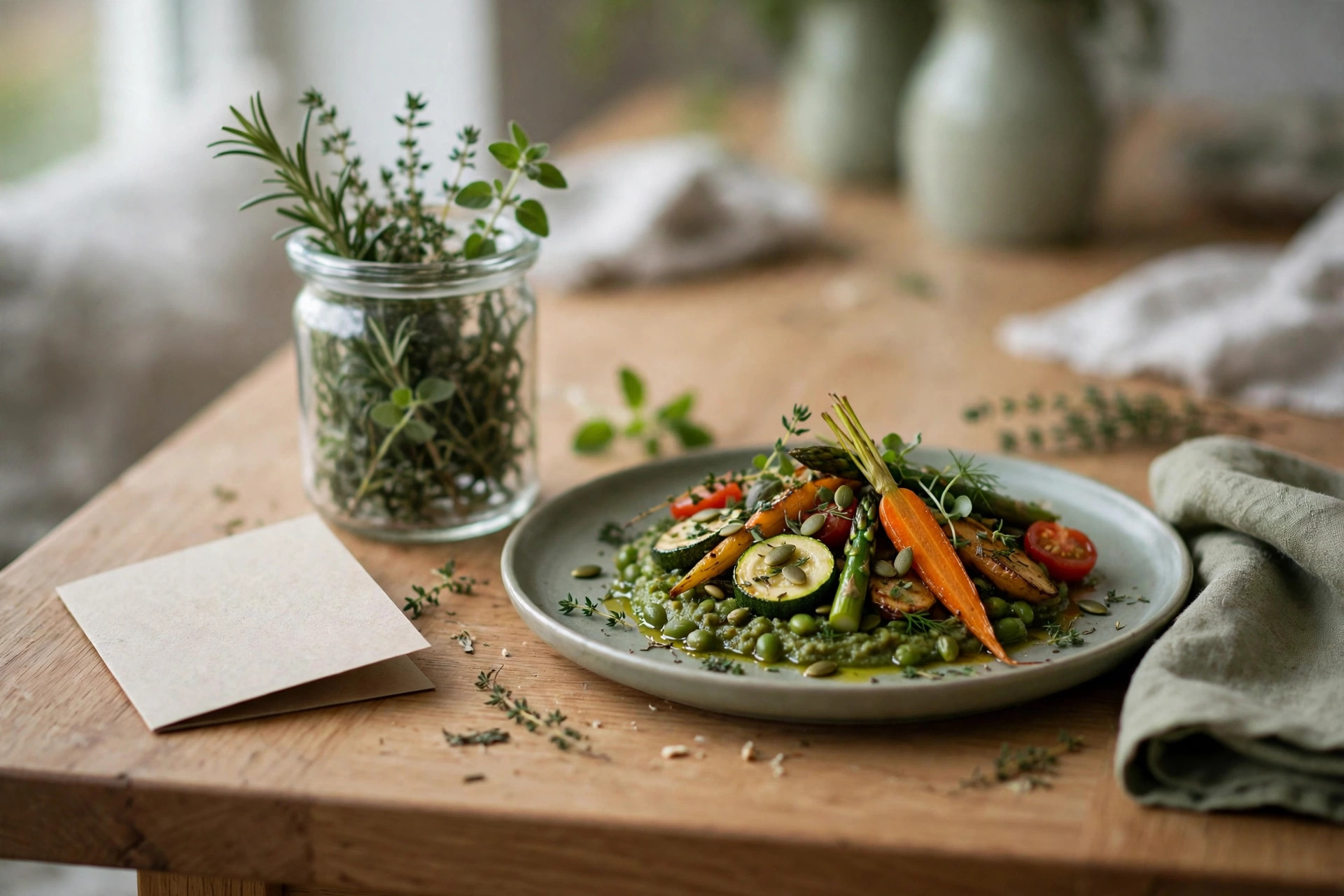
Of all the places a restaurant can communicate sustainability, the menu is the most powerful — because it is the one place where communication changes behaviour. A guest reading the menu is about to make a choice, and small design decisions can shift that choice toward the lower-impact dish without anyone feeling pushed.
Lead with plants, not with lectures. A plant-forward menu is not a vegan menu. It is a menu where the vegetable dishes are the most appealing items on the page — listed first, described best, photographed most — and meat and fish appear as considered choices rather than the default. Research on menu design consistently shows that positioning and description matter more than ideology: guests choose the dish that sounds best, and a mushroom dish described with the same care as the steak will sell. The practical rule is simple — give the plant dishes the best descriptions, the best placement, and the best photography, and let the food do the persuading.
Carbon labels, used sparingly. Dish-level carbon scores, such as the A–E ratings offered by Eaternity, can shift choices: published research summarised by Eaternity suggests that clear environmental information can raise climate-friendly dish selection by 15–25%. But the label has to be simple and honest. An A–E letter next to the dish, with a one-line explanation at the bottom of the menu, works. A bare CO₂e number with no context does not — guests have no idea whether 1.2 kg of CO₂e is a lot or a little. Start with your five most popular dishes, calculate the scores, and test the response for a month before rolling labels out across the menu. And never use a label to shame a dish: the goal is to make the sustainable choice appealing, not to make the guest feel guilty for ordering the steak.
Defaults and nudges. The most effective menu intervention is also the quietest: make the sustainable option the default. A tasting menu that is plant-forward unless the guest asks for meat, a lunch deal built around the seasonal dish, a "chef's choice" that changes with the market — these shift behaviour far more than any claim on the wall. The evidence here is strong: default options have been shown to raise vegetarian selection substantially in controlled studies, precisely because they remove friction rather than adding argument. The guest still has every choice available; the easy choice just happens to be the greener one.
Seasonal specials as a habit. A weekly or monthly special built around what is in season right now is the most honest sustainability signal a menu can carry — and it is also good business, because seasonal produce is cheaper, fresher, and more interesting to cook with. Put the special at the top of the menu, name its origin, and change it when the season changes. Guests who return monthly will notice the rhythm, and regulars will start asking what is new — which is exactly the conversation a green brand wants to be having.
Tell supplier stories, not sustainability stories
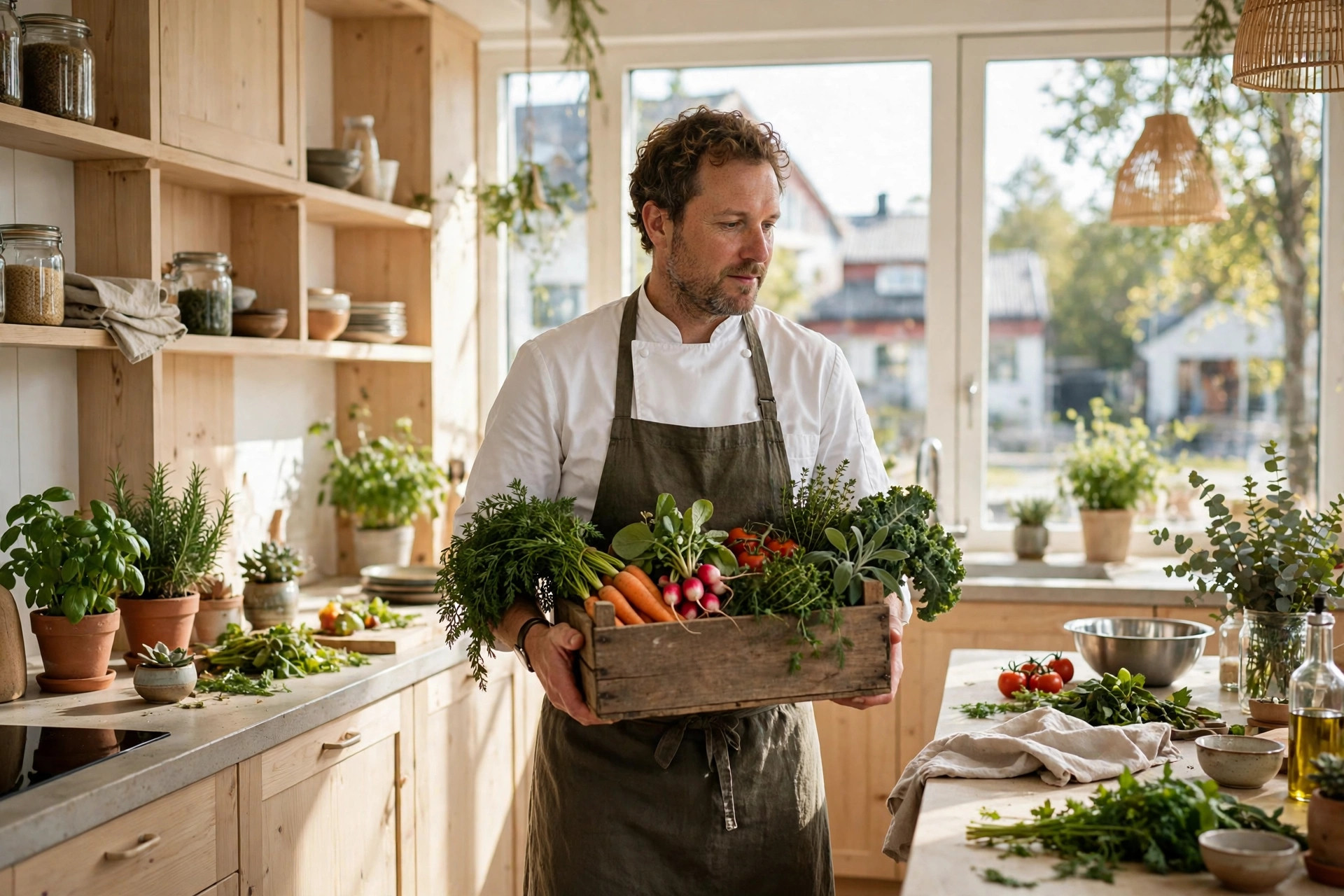
The strongest sustainability communication most restaurants ever produce is not a claim about the planet. It is a story about a person: the farmer who delivers on Tuesday mornings, the fisher whose boat you can name, the baker who starts at 4 a.m. People remember people. Nobody remembers a carbon target.
Start with three suppliers — the ones whose ingredients define your menu — and learn their stories properly. Visit the farm, the boat, the bakery. Take photos. Ask how long they have been doing it, what makes their product different, what the season looks like from their side. Then tell that story in three places: one line on the menu next to the dish, a short profile on the sourcing page of your website, and one social post a month that shows the work rather than describing it. A photo of the farmer holding the morning's harvest does more for your brand than a hundred words about values.
This approach has a second advantage: it is almost impossible to greenwash. A named supplier with a real relationship is checkable in a way that a vague claim never is, and it protects you under the new EU rules precisely because it is specific and verifiable. It also protects the restaurant commercially — a supplier relationship built on a real story is harder for a competitor to copy than a slogan, and it gives your staff something true to say when a guest asks where the food comes from.
The same logic applies to the team. Your staff are part of the sustainability story, and guests can tell when they are proud of where they work. Train the team on the supplier stories, not on a script about values. A server who has met the farmer and can describe the dish in their own words is the most credible sustainability communication a restaurant has — and it costs nothing but a farm visit and an afternoon of conversation. When the brand voice is written down for the restaurant, the supplier stories should be in it: they are the voice at its most honest.
A 90-day plan for honest green branding
Green branding does not need a big budget or a consultant. It needs 90 days, a few focused hours a week, and the discipline to do the operations before the communication. Here is the sequence that works for a small restaurant.
Days 1–30: Audit and fix the basics. Write down what you already do: suppliers, seasonal share of the menu, food-waste handling, packaging, energy. Measure the food waste for two weeks — weigh it, categorise it, find the biggest source. Fix the one thing that is easiest and most visible, usually surplus food: a staff meal from the day's excess, a partnership with a food-rescue app, a smaller batch size on the slowest dish. Pick one certification to aim for in the next year, and check what it requires — for most restaurants, MSC/ASC for fish or an organic scheme for produce is the realistic first step.
Days 31–60: Put it on the menu and the website. Rewrite the menu descriptions for your five most popular dishes to name their origin. Add a sourcing page to your website with your three main suppliers, your certifications, and an honest line about what you are still working on. Update the Google Business Profile description with one specific sentence. Train the staff on the three facts they need: the top suppliers, the seasonal story, and the surplus-food answer. If you use food photography for the menu or socials, photograph the seasonal dishes and the suppliers — real images, not stock.
Days 61–90: Tell the story and measure it. Publish the first supplier story on social media — a short video or a photo series from a farm visit. Add dish-level carbon scores to your five most popular dishes if you have the data, or start the Eaternity process. Ask guests what they noticed: a one-question card with the bill, or a quick poll on social media. Track three numbers monthly from here on — food-waste weight, share of seasonal dishes sold, and the number of guests who mention sourcing in reviews. If the numbers move in the right direction, the brand is working. If they do not, the operations need attention, not the copy.
Ninety days from now, a restaurant that follows this plan will have a menu that names its origins, a website that tells a true story, staff who can answer the question, and a certification on the way — all without a single exaggerated claim. That is what sustainability as a brand actually looks like: not a green logo, but a kitchen that can prove what it says, and a restaurant that says only what it can prove.
Frequently asked questions
How can a restaurant communicate sustainability without greenwashing?
Say only what you can prove, in specific terms. Replace vague words like eco-friendly with facts: the farm you buy from, the share of seasonal produce, what happens to surplus food. Under the EU's EmpCo rules, generic environmental claims without evidence are banned, so specific, verifiable statements are both more honest and legally safer.
What is the EU EmpCo directive and does it apply to my restaurant?
The Empowering Consumers for the Green Transition Directive (EmpCo), introduced in September 2026, bans misleading sustainability claims in marketing to EU consumers. It applies to any restaurant advertising to guests in the EU, including small ones. In practice it means: no generic green claims without proof, no self-awarded eco labels, and no claims about the whole business based on one small initiative.
Which sustainability certifications matter most in the Nordics?
The Nordic Swan Ecolabel is the most recognised overall mark in the region. For food, look at KRAV in Sweden, Luomu in Finland, and Debio in Norway for organic produce, MSC and ASC for seafood, and Eaternity for dish-level carbon scores. Guests trust third-party certification far more than a restaurant's own claims, so one credible badge beats a page of adjectives.
Do guests actually pay more for sustainable restaurants?
Some do, but sustainability is rarely the reason a guest chooses a restaurant — taste, price, and atmosphere come first. What sustainability does is strengthen the things guests already care about: provenance, freshness, seasonality, and the story behind the food. Treat it as a reason to return and to recommend, not as a reason to raise prices on its own.
How do I start communicating sustainability on a small budget?
Start with what you already do: name your suppliers on the menu, add a short sourcing page to your website, and train staff to answer one question about where the food comes from. Those three steps cost almost nothing. Add a certification later, when the operations behind it are already in place — a badge you cannot back up is worse than no badge at all.
Should I put carbon footprint labels on my menu?
Dish-level carbon scores can shift choices — research summarised by Eaternity suggests clear environmental information can raise climate-friendly dish selection by 15–25%. But labels only work if they are simple (an A–E scale or a CO2e number with context), accurate, and explained in one line. A confusing label is worse than none, so start with your five most popular dishes and test the response.
Want a website that tells your sourcing story?
PowerfulWebsite builds your restaurant's website free — you only pay from €59/mo. Everything included: domain, hosting, maintenance and updates, with a sourcing page that shows guests exactly where your food comes from.
See the packages