Tourist Reviews: How to Make Them Work for You
A tourist choosing where to eat in an unfamiliar city has exactly one reliable source of information: reviews written by other visitors. Restaurants that deliberately earn, respond to, and showcase tourist reviews win a steady stream of high-season guests — and the playbook is simpler than most owners think.
Key takeaways
- Tourists decide from reviews by other visitors, not locals — your review profile is your brochure in every language.
- TripAdvisor wins at the trip-planning stage; Google Maps wins when the tourist is already on the ground. Cover both.
- Ask at the moment of peak satisfaction with a direct link or QR code — and never offer anything in exchange.
- Respond within 24 hours, in English, to every review that deserves one. Future guests read your replies.
- A steady stream of recent reviews beats a big stale total — recency is a ranking factor on both platforms.
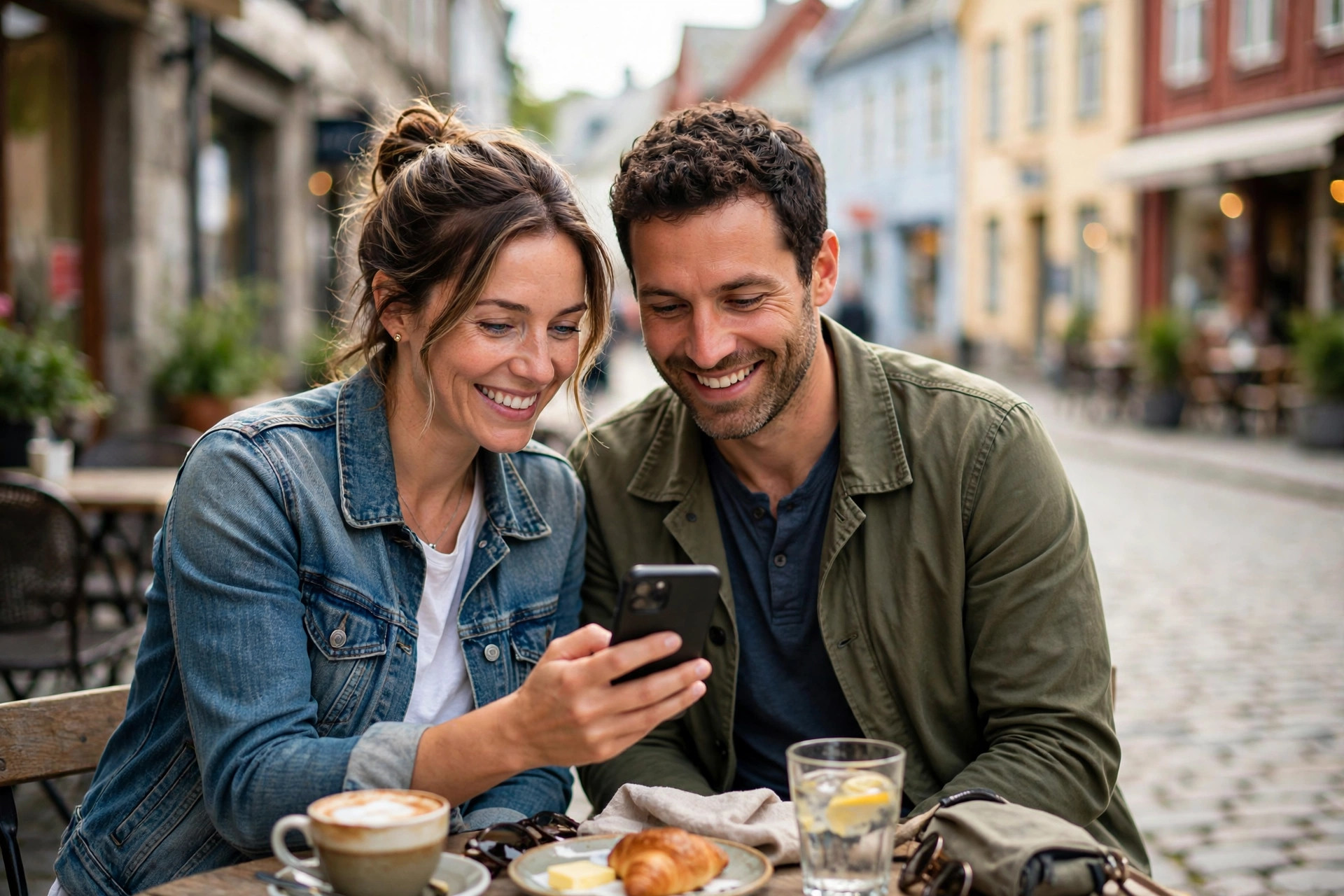
Every summer, the same scene plays out in Helsinki, Stockholm, Bergen, Tallinn, and Copenhagen: a couple stands on a cobbled street, phones in hand, scrolling through restaurant options in a city they will leave in three days. They have no regular spots, no word-of-mouth network, and no second chances to get dinner right tonight. What they have is your review profile — and in about ninety seconds, it decides whether your dining room gets their business or the restaurant two streets over does.
Tourist reviews are a different game from local reviews, and most restaurant owners play it on autopilot. Locals forgive an off night because they know the context; they read reviews with nuance. Tourists filter ruthlessly by stars, skim the three most recent reviews, and move on. That makes tourist reviews both brutally honest and enormously leverageable: a deliberate strategy can fill your high season, while neglect quietly hands your guests to competitors. This guide walks through the full playbook — where tourists look, how to earn their reviews without breaking platform rules, how to respond in a way that wins future guests, and how to turn the best reviews into marketing that keeps working while you sleep.
Why tourist reviews decide where visitors eat
A local choosing a restaurant draws on years of accumulated knowledge: they know which streets have the good spots, which chef just moved, what the prices mean. A tourist has none of that. Research into travel behaviour consistently shows the same pattern: the vast majority of travellers read reviews before choosing where to eat, and reviews from fellow visitors carry more weight than any other source because they answer the exact question the tourist is asking — "someone like me was here, and this is what happened."
This asymmetry is why tourist reviews punch above their weight. One thoughtful review from a visitor from Germany does three jobs at once: it reassures the next German tourist, it signals to the algorithm that your listing is active and relevant, and it gives you a piece of marketing copy in a language your own website may never have. Restaurants in tourist districts routinely report that 30–50% of their summer covers come from guests who found them through review platforms — a share no other single marketing channel delivers for free.
The stakes rise with the price of the mistake. A local who has a mediocre meal loses an evening. A tourist who has a mediocre meal loses one of their three dinners in your city — and tells the internet about it in detail. That is exactly why the strategy matters: tourists write longer, more descriptive reviews than locals, and those reviews keep influencing decisions for years.
Where tourists actually look before booking
The tourist's decision happens in two distinct moments, and each belongs to a different platform. Understanding this split is the foundation of everything that follows.
The planning moment: TripAdvisor
Weeks before the trip, the tourist sits at home comparing options in a city they have never visited. This is TripAdvisor's home turf. Its restaurant rankings, traveller-written reviews, and "travellers' choice" style badges are built for exactly this comparison shopping. A tourist planning a Helsinki weekend will open TripAdvisor, filter restaurants by cuisine and rating, and shortlist five or six candidates. If you are not on that shortlist, you are not in the consideration set — no matter how good your food is.
The on-the-ground moment: Google Maps
Once the tourist arrives, behaviour changes completely. Nobody opens TripAdvisor while standing on a street corner in Gamla Stan. They open Google Maps, search "restaurants near me," and scan star ratings, the most recent two or three reviews, opening hours, and photos. Google's integration into the phone — the map, the directions, the "open now" filter — makes it the default tool for in-the-moment decisions. This is also where your Google Business Profile photos do quiet, enormous work: a tourist comparing two 4.4-star options will pick the one whose photos look like the meal they want right now.
The supporting cast
Facebook recommendations still surface in travel groups ("Where should we eat in Bergen?"), and younger travellers check TikTok and Instagram for visual proof. But for the booking decision itself, the duopoly holds: TripAdvisor for planning, Google for the moment. Everything else is garnish. Your limited time should go to the two platforms in that order.
The two-moment rule
TripAdvisor wins the planning moment (at home, weeks ahead). Google wins the street-corner moment (on the ground, minutes ahead). A restaurant that is strong on one and invisible on the other is losing half its tourist trade.
Google vs TripAdvisor: where to focus
Both platforms are free for restaurants, but they reward different behaviour. Here is how they compare for a Nordic restaurant courting tourists:
| Factor | Google Reviews | TripAdvisor |
|---|---|---|
| Audience | Everyone with a phone; locals and tourists | Travellers actively planning trips |
| Decision moment | "Where do we eat tonight?" | "Where should we eat in Oslo?" |
| Review style | Short, star-led, photo-heavy | Longer, narrative, detail-rich |
| What moves the needle | Star average, review count, recency, photos | Popularity ranking, review quality and recency |
| Asking tool | Direct review link / QR code | Review Express (free review-request tool) |
| Response expectations | Appreciated, especially for negatives | Expected — travellers treat silence as a red flag |
| Local SEO effect | Direct: feeds Google's local rankings | Indirect: strong cross-platform reputation signal |
The practical takeaway: if your tourist share is modest, win Google first — it feeds your Maps visibility for every "restaurants near me" search, and local guests use it too. Once Google is healthy (a 4.3+ average and a steady flow of fresh reviews), layer in TripAdvisor with the same seriousness. Restaurants in heavy tourist traffic — the harbour in Bergen, the Design District in Helsinki, Nyhavn in Copenhagen — should treat TripAdvisor as the primary channel from day one, because their customer base is disproportionately made of trip planners.
One more Nordic nuance: domestic tourists. A family from Oulu visiting Helsinki for the weekend behaves exactly like an international tourist — they don't know the city, and they check reviews. Don't assume "tourist strategy" only means foreigners. Your review profile serves every out-of-towner.
How to get tourists to leave reviews
Here is the uncomfortable truth: tourists almost never leave reviews on their own. They are on holiday, their attention is elsewhere, and by the time they remember your restaurant they are back home. Every tourist review you have exists because something — a prompt, a link, a moment — made it easy. The restaurants with hundreds of glowing visitor reviews are not luckier than you. They ask better.
Ask at the peak moment
The best time to ask is when satisfaction peaks: the dessert course just landed, the guest complimented the dish, the bill is paid and they are smiling. Train staff to recognise the moment and use a natural line — never a script read like a robot. "I'm so glad you enjoyed it. If you have a minute later, an honest review on Google really helps a small restaurant like ours" outperforms any printed card. For a deeper treatment of this, see our guide on how to get more Google reviews for your restaurant.
Remove every step of friction
Never ask a guest to "find us on Google." Give them a direct review link — a QR code on the bill presenter or a small table card opens the review box in one tap. For TripAdvisor, use the free Review Express tool to send a personalised follow-up email after the visit; it is purpose-built for exactly this and costs nothing. The rule is simple: one click, one action, no navigation.
Speak their language, literally
A small card that says "Enjoyed your meal? Please review us" in English, German, and French — with a QR code — sits on tables in the smartest tourist restaurants in the Nordics. It costs almost nothing to print and it signals something important: we see you, visitor, and we value what you think. Guests from countries with strong review cultures (Germany, the UK, the US) respond to these prompts at noticeably higher rates.
What you must never do
Both Google and TripAdvisor prohibit incentives: no free dessert for a five-star review, no discount codes for reviewers, no "leave us a review and enter a draw." Getting caught can mean review removal or listing penalties, and in the EU, incentivised reviews without disclosure also collide with consumer-protection rules. Ask neutrally, ask everyone, and let the food do the persuading. Selective asking — only prompting guests who seemed happy — is review gating, and Google explicitly forbids it.
The language question
A Nordic restaurant in a tourist area will collect reviews in a dozen languages. That is a feature, not a problem — a German review reassures German tourists, a French one reassures French tourists. But it creates two jobs for you: understanding what was written, and responding in a way every future reader can use.
Reading reviews you can't read
Both Google and TripAdvisor offer built-in translation; use it for a first pass, and treat machine translation of nuance with healthy scepticism. A one-star review that translates oddly may be a language issue rather than a service issue. When a review matters — a detailed complaint, a suspicious claim — get a native speaker to check it before you respond. A bilingual staff member, a friend, or a quick paid translation is cheaper than a misjudged public reply.
Responding so everyone understands
Write every response in English, and add your local language if the reviewer used it. English is the lingua franca of travel: a Japanese tourist reading your profile will rely on the English version of your reply. Keep sentences short and concrete, avoid idioms and humour that doesn't translate, and never rely on auto-translate to compose the reply itself — write it yourself in clear, simple English. Future guests in ten countries will read what you wrote; write for them, not just the reviewer.
Menu and signage details that reduce bad reviews
Many negative tourist reviews are really communication failures. "We didn't know service wasn't included," "the menu was only in Finnish," "we couldn't tell what was vegetarian." An English menu — even a simple one — a note about service charge or tipping customs on the menu, and clear allergen information prevent a whole category of one-star misunderstandings. If you serve tourists, an English menu is not a nice extra; it is review insurance. Our guide to multilingual menus for locals and tourists covers the practical setup.
Responding to tourist reviews
Your responses are not really for the reviewer. The reviewer has left the country. Your responses are for the hundreds of future tourists reading the exchange while deciding where to eat. Every reply is a tiny advertisement for how you treat guests — including unhappy ones.
The 24-hour rule
Respond to every review within 24 hours: positive, neutral, and negative. Speed signals that someone is paying attention, and on TripAdvisor travellers explicitly treat unanswered reviews as a warning sign. This does not require the owner to live on their phone — a daily 15-minute routine, or a staff member with clear guidelines, covers it. For the full playbook see our complete restaurant review strategy guide.
Positive reviews: short, warm, specific
Thank them, mention something specific from their review, and invite them back. "Thank you, Anna! So glad you enjoyed the Arctic char — we hope to see you next time you're in Bergen" takes thirty seconds and shows future readers that real humans run this place. Vary the wording; copy-pasted identical replies look automated and cheapen the effect.
Negative reviews: acknowledge, don't argue
The formula that works: thank them for the feedback, acknowledge the specific issue without excuses, state one concrete thing you will do about it, and invite them to contact you directly. Never argue facts with a tourist in public — even when you are right, you lose, because the audience sides with the guest. A calm, professional reply to a harsh review often impresses future readers more than a five-star review does; it shows how you behave under pressure. For ready-made wording, our 10 review reply templates cover the common cases.
Handling the "tourist trap" review
Every tourist-area restaurant eventually gets it: "Overpriced tourist trap." Sometimes it is unfair; sometimes it contains a grain of truth about value perception. Either way, it is the most damaging review type for a tourist-facing restaurant, because it attacks exactly what the next tourist fears.
Prevention beats response
The "tourist trap" accusation almost always comes down to a gap between expectation and price. Close the gap before the guest sits down: put prices on the menu outside the door, be explicit about what costs extra (bread, water, service charge), and make sure your online menu matches your real prices. Nordic tap water is famously free and excellent — tourists who are charged for still water without warning write about it, angrily, in three languages. Transparency is the cheapest reputation insurance there is.
Responding to the accusation
Stay factual and calm. State what is included in your pricing — local ingredients, the harbour view, the live filleting at the table — without sounding defensive. "We're sorry the value didn't feel right for you. Our prices reflect [specifics], and our menu with prices is always displayed outside so guests can decide before sitting down" addresses the substance while showing future readers you have nothing to hide. If the review contains factual errors (wrong prices, dishes you don't serve), correct them briefly and politely — one sentence, no more.
Turning reviews into marketing
Your best tourist reviews are marketing assets that cost you nothing — but only if you use them legally and well. A glowing review from a visitor is social proof in its purest form, and it works in places your own words never could.
Get permission first
Review text belongs to the reviewer and the platform, not to you. Republishing a review on your website or in ads without permission can breach platform terms and, in the EU, data-protection rules. The safe route: ask. A short message — "We loved your review and would like to feature a quote on our website, credited to your first name and country. May we?" — gets a yes surprisingly often, because people like being quoted. Our full guide to using reviews in your marketing, permissions done right, walks through the exact wording and the GDPR-safe way to do it.
Where the reviews do the most work
A small "What visitors say" strip on your homepage, with two or three short quotes and the reviewer's first name and home country, converts tourist traffic better than any stock photography. Google Business Profile posts can highlight a review of the week. And the review stars themselves — via proper schema markup on your website — can appear in search results, lifting click-through rates. What not to do: cherry-pick only five-star quotes while your public average tells a different story. Tourists cross-check; inconsistency smells like manipulation.
Feed the algorithm with what tourists photograph
Tourist reviews with photos outperform text-only reviews dramatically in the "helpful" votes that push them to the top. Make your restaurant photogenic in the specific ways tourists photograph: one signature dish that looks spectacular, a view or interior detail worth capturing, good natural light at lunch tables. You are not decorating for Instagram influencers — you are stage-managing the visual evidence that future tourists will judge you by.
Your 90-day tourist review plan
Strategy without a calendar is a wish. Here is a realistic plan for a restaurant heading into tourist season — or digging out of review neglect.
Days 1–14: foundations
- Claim and complete your Google Business Profile and TripAdvisor listing: correct hours, correct categories, 20+ real photos, menu link.
- Generate your direct Google review link and a QR code; print table cards in English plus your top two visitor languages.
- Set up TripAdvisor Review Express with your booking or POS email list.
- Write your three response templates (positive, neutral, negative) and brief the team on the 24-hour rule.
Days 15–45: the asking habit
- Staff ask at the peak moment on every shift; track nothing, just build the habit.
- Respond to every review within 24 hours — including the old ones you never answered. A late reply still beats silence.
- Fix the top three complaints appearing in recent reviews (menu translation, water charges, waiting times — whatever your reviews say).
Days 46–90: compounding
- Request permission to feature your five best tourist reviews on your website's homepage.
- Identify your most-photographed dish from review photos and make it the hero of your Google profile.
- Review the numbers monthly: review velocity, average rating trend, response time. Adjust the asking prompts that aren't working.
Ninety days of this routine typically moves a neglected profile from "risky unknown" to "obvious choice" — and unlike paid advertising, the asset keeps compounding. Reviews you earn this summer are still winning you guests three summers from now. Few marketing investments in a restaurant have that kind of half-life.
And when those tourists land on your website after reading your reviews, the site itself has to close the deal: clear menu, opening hours, and a booking path that works on a phone in under a minute. If your site isn't doing that job, PowerfulWebsite builds restaurant websites for free — you only pay the monthly plan, from €59/mo, with everything included.
Frequently asked questions
Do tourists use Google Reviews or TripAdvisor more?
Both, but at different moments. Tourists use TripAdvisor when planning a trip from home and comparing options in an unfamiliar city, and Google Maps reviews once they are on the ground looking for somewhere nearby. Restaurants in tourist areas need a solid presence on both.
Can I ask tourists to leave a review, or is that against the rules?
You can ask. Google and TripAdvisor both allow polite, neutral requests — a QR code on the bill, a link in a follow-up message, or a verbal ask from staff. What the platforms prohibit is offering incentives in exchange for reviews, paying for reviews, or pressuring guests.
How should I respond to a review written in a language I don't speak?
Reply in English plus your local language. English is the lingua franca of travel reviews, and both Google and TripAdvisor show your response to every future reader. A translation tool is fine for understanding the review, but write the reply yourself in clear, simple English.
Should I worry about fake tourist reviews?
Occasional suspicious reviews happen, but they are rare compared to genuine ones. Never post fake positive reviews — getting caught destroys trust permanently. If you receive a review for a visit that never happened, flag it through the platform's reporting process and respond publicly and calmly.
How many reviews does a restaurant need before tourists start choosing it?
There is no magic number, but the pattern is consistent: tourists filter by rating first (usually 4.0 and above) and then check recency. A profile with 50 recent, detailed reviews at 4.5 stars beats one with 500 stale reviews from years ago. A steady stream of fresh reviews matters more than a large total.
Want a website that brings table bookings?
PowerfulWebsite builds your restaurant's website for free — you only pay the monthly plan from €59/mo. Everything included: domain, hosting, maintenance and updates.
See the packages