Dessert Menus: How to Sell More Sweets
Dessert is usually the highest-margin course on a restaurant menu — and the one most guests skip. The fix is rarely a new recipe: it is a separate dessert menu, four to six well-chosen items, sensory descriptions, honest pricing and a server who suggests one dessert by name before the bill arrives.
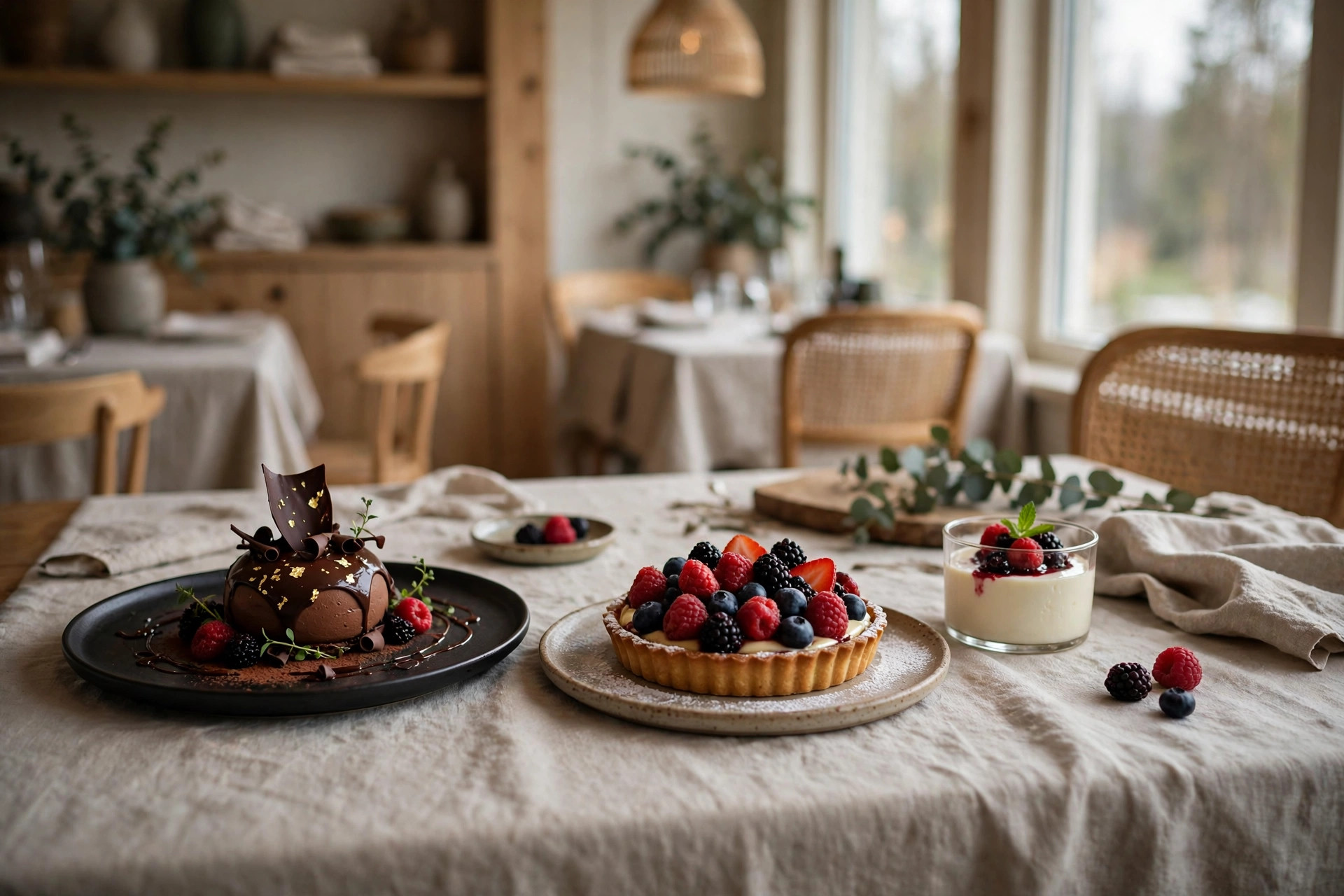
Key takeaways
- Dessert is the highest-margin course on most menus, yet most tables never order it — the gap is presentation, not appetite.
- A separate dessert menu creates a dedicated decision moment and consistently lifts order rates.
- Four to six desserts is the sweet spot: enough choice to cover tastes, few enough to avoid decision fatigue.
- Sensory descriptions, round prices and a high-priced anchor item make the mid-range desserts feel like good value.
- Mini desserts and sharing plates turn "I'm too full" into a yes, and staff who suggest one dessert by name outsell staff who ask a yes-or-no question.
Every restaurant owner knows the scene. The mains are cleared, the plates come back empty, the guests are smiling — and then, when the server asks about dessert, the whole table says "no, we're fine" in unison. Ten minutes later the same guests are ordering a slice of cake at the café next door. The appetite was there. The sale was lost somewhere between the main course and the bill.
This guide is about closing that gap. It is written for restaurant, café and bar owners in Finland, Sweden, Norway and Denmark — places where dessert culture is strong (think cinnamon buns, cloudberries, cardamom and dark chocolate) but where dessert is still too often treated as an afterthought. We cover the psychology of why guests say no, how to structure a dessert menu that sells, how to price it, how to train your team, and how to measure the result.
Why most guests skip dessert
Before fixing a dessert menu, it helps to understand what you are actually fighting. It is almost never hunger — or rather, the lack of it. A guest who has just eaten a full main course is full in the sense that they do not need more food, but dessert is not bought out of need. It is bought out of desire, habit and social permission. When any of those three is missing, the answer is no.
The first barrier is decision fatigue. By the time dessert comes up, your guests have already made a dozen small decisions: where to sit, what to drink, which starter, which main. Research on menu reading consistently finds that guests spend barely two minutes with a menu, scanning rather than reading. After a full meal, the mental energy for one more choice is gone — and "no" is the easiest choice of all. A long dessert list makes this worse, not better.
The second barrier is social. Nobody wants to be the first person at the table to order dessert. Ordering first feels indulgent, and it can feel like holding the table up. In a group of four, the decision is effectively made by the most reluctant person — unless someone with authority, usually the server, gives the table permission. A server who says "the chocolate fondant is the one people come back for" does more than recommend a dish; they tell the whole table that ordering dessert is normal here.
The third barrier is timing, and it is the one restaurants control most directly. Once the bill is on the table, the meal is over in the guest's mind. Asking about dessert after the bill has arrived is asking a guest to reopen a closed decision, and most will not. The dessert question has to come before the bill, while the table is still in "enjoying the evening" mode — ideally as the mains are cleared, when there is a natural pause.
The three "no"s and what causes them
It is worth naming the three versions of "no" separately, because each has a different fix. "We're too full" is a portion problem — fix it with a mini dessert or a dessert to share. "We didn't see anything we liked" is a menu problem — fix it with a separate menu and real descriptions. "Just the bill, please" is a timing problem — fix it with a service sequence that puts the dessert offer before the bill, every time.
There is also a quieter reason owners in the Nordics should not ignore: price sensitivity around dessert specifically. A guest who happily pays €28 for a main can still balk at €12 for a dessert, because dessert feels optional in a way the main does not. That is not a reason to price desserts cheaply — it is a reason to make the value obvious. A dessert that arrives beautifully plated, with a story and a name, is worth €12; a line of text at the bottom of a menu is not.
Guests rarely skip dessert because they are full. They skip it because nobody gave them an easy, appealing reason to say yes.
Finally, consider the room itself. A dining room that feels rushed — bright lights, loud music, tables turned quickly — tells guests to leave. A room with warm, layered lighting and a relaxed pace tells them to stay. The dessert sale is often decided by the atmosphere in the five minutes after the mains are cleared.
Give dessert its own menu
The single highest-impact change most restaurants can make is also the simplest: take desserts off the main menu and give them their own. When desserts sit at the bottom of the main menu, guests make their dessert decision at the same time as their main-course decision — when they are hungry and focused on the savoury courses — and by the end of the meal the decision feels already made. A separate menu creates a second decision moment, at the right time, with the guest's full attention.
The separate menu also signals value. It tells the guest that dessert is a course in its own right, not a leftover. In practice this matters most in casual and mid-range restaurants, where the main menu is long and desserts otherwise disappear.
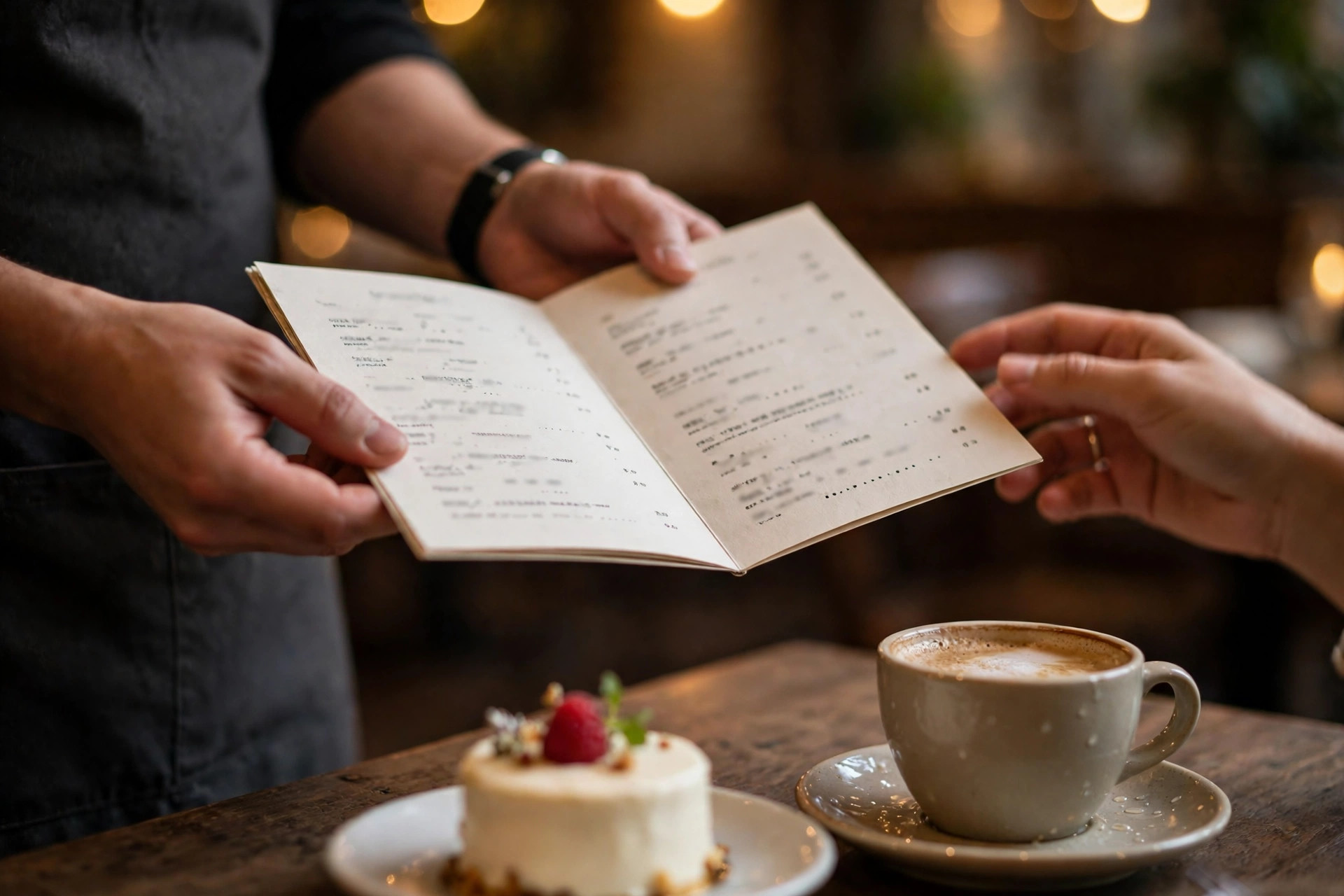
What should the separate menu look like? It does not need to be elaborate. A single page — printed, or a clean digital page on your website and a QR code on the table — is enough. What matters is that it arrives at the right moment: with the mains cleared, presented by the server with a short verbal recommendation. A dessert menu that sits on the table from the start loses its power; it becomes part of the furniture.
Print, digital, or both?
A printed dessert menu works best in the dining room: it is tangible, it photographs well, and the server can point at it. But a digital version earns its keep too. Guests increasingly check a restaurant's dessert offer online before they book — especially for celebrations, where the cake or dessert is part of the occasion. Put the dessert menu on your website as a proper page, not a PDF: see our guide to digital menus done right. A real page can be found on Google, linked from your booking confirmation, and updated in minutes when a dessert sells out.
Where the dessert menu lives online
On your website, the dessert menu deserves its own page under your menu section, with its own URL — something like yoursite.com/menu/desserts. That page can rank for searches like "best dessert restaurant Helsinki" or "dessert menu Stockholm", which a PDF never will. Link it from the main menu page, from the homepage, and from the booking confirmation email. For more on structuring menu pages that convert, see our guide to menu descriptions that sell.
How many desserts should you offer?
Four to six. That is the answer for most restaurants, and it holds up across formats, from a neighbourhood bistro to a hotel restaurant. Fewer than three and guests conclude there is nothing for them — a table with a vegan, a gluten-free guest and a chocolate lover needs at least a few directions to go in. More than seven and the paradox of choice takes over: guests take longer, enjoy the choice less, and often default to nothing rather than risk a wrong pick.
The structure matters more than the count. A good dessert menu covers five roles, and most restaurants can cover them with five dishes:
- The chocolate anchor. A rich chocolate dessert — fondant, mousse, flourless cake — is the best-selling dessert category in most Western restaurants.
- The fruit option. Something fresh and lighter: berries, poached fruit, a citrus tart. This is the dessert for the guest who says they are too full.
- The lighter or dairy-free option. A sorbet, a fruit dessert or a plant-based chocolate mousse. In the Nordics, where dairy-free and vegan requests are routine, this is a core item, not a niche one.
- The signature. One dessert that is yours alone — a local speciality, a family recipe, a seasonal creation. This is the one the server names and guests photograph.
- The seasonal special. One rotating item that follows the Nordic year: cloudberries in late summer, lingonberry and apple in autumn, saffron and gingerbread at Christmas, rhubarb in spring.
Notice what is not on the list: a second chocolate cake that is almost identical to the first, or a dessert kept on the menu because it has always been there. Every dessert on the menu should earn its place with sales or with margin — ideally both. A dessert that sells twice a week and ties up a pastry station is not a tradition; it is a cost. Check your menu analytics at least monthly and retire the weakest performer without sentimentality.
What about ice cream?
Ice cream deserves a short note because it behaves differently from other desserts. A scoop of good vanilla ice cream with a warm sauce is the lowest-effort dessert in the kitchen and one of the most profitable — but on its own it can feel like a cop-out. Treat it as a component, not a dessert: ice cream with warm chocolate cake, with a berry compote, or as part of a mini dessert trio. In Finland and Sweden, where ice cream is eaten year-round, naming the local producer on the menu adds perceived value for free.
The five-role dessert menu
Chocolate anchor, fruit option, lighter or dairy-free option, one signature dessert, one seasonal special. Five dishes, five jobs — and if you can only manage four, drop the seasonal special first and keep the other four. Rotate the seasonal slot every 6–8 weeks to match Nordic produce.
Write descriptions that sell
A dessert's name and description do a surprising amount of the selling. Research on menu language has repeatedly found that sensory, specific descriptions lift order rates substantially — in one widely cited finding, by close to 30% compared with plain names. "Chocolate cake" is an ingredient list. "Warm dark chocolate fondant, salted caramel centre, brown-butter ice cream" is a craving. The difference costs nothing but words.
The rules are simple. Use sensory words — warm, molten, crisp, velvety, tart, smoked — but only words that are true. Use origin and provenance where it means something: "Finnish cloudberries", "70% dark chocolate", "vanilla from Madagascar" all signal care. Name the maker when the dessert is homemade: "our own cinnamon bun, baked this morning" beats "cinnamon bun" every time. And keep descriptions to one or two lines.
There is a Nordic angle here that most international guides miss. Nordic dessert vocabulary is a selling point in itself. Words like cloudberry (lakka/hjortron/molte), lingonberry, sea buckthorn, cardamom, liquorice and rye carry strong associations for local guests and genuine curiosity for visitors. A dessert menu that leans into its place — "cloudberry parfait with toasted rye crumble" — reads as more valuable than a generic international list, and it is harder for the restaurant down the street to copy.
The words to avoid
A few habits quietly kill dessert sales. Vague superlatives — "delicious", "tasty", "our famous dessert" — tell the guest nothing and sound like filler. Overlong names that list every ingredient exhaust the reader before they reach the price. And jargon — French terms your guests do not know, unexplained — creates distance rather than desire. One exception: a single unfamiliar word can work if the description immediately explains it ("crème brûlée — vanilla custard, caramelised sugar crust"), because the explanation itself becomes part of the appeal.
Also, mind the language on the menu itself. In Finland, Sweden and Norway, many restaurants serve a mix of locals and tourists. A dessert menu in the local language plus English — or a bilingual menu — removes a barrier for the visitor who would otherwise skip dessert rather than ask what something is. If your main menu is multilingual, your dessert menu should be too; see our guide to multilingual menus.
"Chocolate cake" is an ingredient list. "Warm dark chocolate fondant, salted caramel centre, brown-butter ice cream" is a craving — and cravings are what get ordered.
Price desserts for profit
Desserts are usually the most profitable course on the menu, and the maths is worth doing properly. A dessert that sells for €11 and costs €2.20 in ingredients runs at a 20% food cost — far better than most mains, which typically sit at 28–35%. That margin is the whole commercial case for selling more dessert. The table below shows typical figures for a casual Nordic restaurant; treat them as estimates to test against your own costs, not as prices to copy blindly.
| Dessert | Typical menu price (estimate) | Typical ingredient cost | Food cost % | Gross margin |
|---|---|---|---|---|
| Chocolate fondant with ice cream | €11–€13 | €2.00–€2.50 | ~20% | €9–€11 |
| Cloudberry parfait, rye crumble | €12–€14 | €3.00–€3.80 | ~27% | €8–€10 |
| Crème brûlée | €9–€11 | €1.20–€1.60 | ~14% | €8–€9 |
| Mini dessert trio / tasting flight | €12–€14 | €2.50–€3.00 | ~21% | €9–€11 |
| Cheese plate (3 cheeses) | €14–€16 | €4.50–€5.50 | ~34% | €9–€11 |
| Single scoop, local ice cream | €5–€6 | €0.80–€1.20 | ~19% | €4–€5 |
Two things stand out. First, the humble crème brûlée and the single scoop are margin machines — cheap to make, easy to execute, hard to get wrong. Second, the cheese plate, which many owners think of as a premium item, actually carries the worst food-cost percentage on the list, because good cheese is expensive. That does not mean you should drop it; it means you should price it honestly.
How to present the price
Menu psychology research offers three practical rules for dessert pricing. First, use round numbers rather than .99 endings: €12 reads as a considered price for a crafted dish, while €11.95 reads as a supermarket price. Second, drop the currency symbol and nest the price at the end of the description, rather than aligning prices in a right-hand column — a column of prices invites the guest to shop by price, while a nested price keeps the attention on the food. Third, anchor the section: place your most expensive dessert at the top of the list, so the €11 fondant below a €16 cheese plate feels like a reasonable, easy choice. This is the same anchoring logic we cover in our menu pricing psychology guide.
One more pricing decision deserves a deliberate answer: should dessert be included in a set menu? At lunch, including dessert can work well, because speed matters and the guest has already committed. At dinner, à la carte dessert pricing usually earns more, because the guests who want dessert will pay for it and the guests who do not want it are not subsidising it. If you do offer a set menu, price the dessert-inclusive version so the dessert is a small step up — €6–€8 extra, not €15 — so taking it feels like the obvious choice.
Mini desserts and sharing plates
The most common objection to dessert is "I'm too full". The most effective answer is not to argue — it is to offer something smaller. Mini desserts, dessert flights and sharing plates lower the commitment until the objection disappears. A guest who will not order a full dessert will often say yes to a €6 mini portion, and a table that will not each order dessert will often share one plate between two or three.
Mini desserts work for three reasons. They are cheaper, so the price objection fades. They are smaller, so the "too full" objection fades. And they are fun — a trio of small tastes feels like an experience rather than a course, which is exactly what a guest who has already had a full meal wants.
Formats that work
The simplest format is a tasting trio: three small versions of your existing desserts on one plate, priced around €12–€14. It uses ingredients you already stock, needs no new recipes, and lets the kitchen show off range. A second format is the "dessert for the table": one generous sharing plate — a chocolate fondue, a baked Alaska, a large pavlova with berries — priced at €16–€22 for the table. It turns dessert into a shared event, which suits celebrations and groups. A third format is the coffee-and-something pairing: a small sweet with the coffee — a mini cinnamon bun, a piece of chocolate, a small cookie — for €4–€6 added to the coffee. In Finland, where coffee after a meal is almost a ritual, this is the easiest dessert sale of all.
Sharing plates also solve a practical kitchen problem: a dessert plated individually needs individual attention at the pass, while a sharing plate needs one. During a busy service, that difference matters. And from a margin perspective, a sharing plate priced at €18 with an ingredient cost of around €4 is one of the best earners on the menu.
One caution: do not let the mini format cannibalise your full desserts. If the mini trio is priced too close to a full dessert, guests will trade down. Keep a clear gap — the trio at roughly the price of one full dessert plus a few euros.
Train your team to sell dessert
The dessert menu can be perfect and still fail if the team does not sell it. In most restaurants, the server is the dessert menu's best salesperson — or its biggest leak. The difference is training, and it is smaller than owners expect: a few specific phrases, a tasting, and a service sequence that does not leave the dessert offer to chance.
Start with the question itself. "Would you like dessert?" is a yes-or-no question, and a tired guest's default answer is no. Replace it with a specific suggestion: "The chocolate fondant is the one people come back for — shall I bring one for the table?" A specific suggestion is easier to say yes to than an open question, because the guest only has to agree, not decide. Pairing helps too: suggest a dessert with a drink — an espresso martini with the flourless chocolate cake, a dessert wine with the cheese plate — and the suggestion becomes a recommendation, not a sales pitch.
Let the team taste everything. A server who has eaten the fondant can describe it with conviction; a server who has only read the menu cannot. A short tasting at the start of each menu change — ten minutes, all five desserts — is one of the cheapest training investments a restaurant can make. It also builds pride: staff who like the desserts sell them like they mean it, and guests can tell the difference.
The service sequence that sells dessert
Make the sequence explicit, so it happens on every table, not just when a server remembers. A sequence that works in many Nordic restaurants looks like this: clear the mains, leave a short pause, then bring the dessert menus with a one-line recommendation. Give the table a minute. Return, take the dessert order, and offer coffee at the same time. Only when dessert is finished — or declined twice — does the bill come out. The "declined twice" rule matters: a guest who says no the first time may say yes when they see their companion's dessert arrive.
Finally, consider a small incentive — not a commission scheme, which can feel mercenary, but a visible team target. A weekly target shared in the briefing ("we sold dessert to 30% of tables this week, let's reach 35%") turns dessert into a team sport. What gets measured, and talked about, gets done.
A server who suggests one dessert by name will outsell a server who asks "would you like dessert?" every single night — because agreement is easier than a decision.
Allergens and inclusive options
No dessert menu is complete without handling allergens properly, and in the EU this is not optional. Under Regulation 1169/2011, restaurants must declare the 14 major allergens — gluten, milk, egg, nuts, peanuts, soya, sesame, mustard, celery, lupin, molluscs, crustaceans, fish and sulphites — for every dish they serve, desserts included. The information can sit on the menu, on a separate allergen chart, or be given verbally by trained staff, but it must be accurate and available before the guest orders.
The practical way to handle this is a written allergen matrix in the kitchen: one sheet, every dessert, every allergen marked. Update it the day a recipe changes, not the week after. Train the team on it, and make sure the person who answers the allergen question knows the answer rather than guessing. For a fuller treatment of the rules, see our guide to EU allergen labelling for restaurants.
Inclusive desserts sell more, not less
There is a commercial point here that goes beyond compliance. Every guest who cannot eat your desserts is a lost dessert sale — and often a lost table, because groups choose restaurants where everyone can eat. A dessert menu with a genuinely good vegan option and a genuinely good gluten-free option does not just serve those guests; it serves the whole table that includes them. The key word is "genuinely": a sad fruit salad labelled as the vegan option will not sell. A well-made vegan chocolate mousse or a flourless almond cake that happens to be gluten-free sells to everyone, because it is a good dessert first and an inclusive dessert second.
Present inclusive options as normal items on the dessert menu, marked discreetly with symbols, rather than segregated in a separate "special diets" section. Segregation makes guests feel singled out; integration makes the choice easy.
Allergen labelling in one paragraph
EU Regulation 1169/2011 requires the 14 major allergens to be declared for every dish. Keep a written allergen matrix in the kitchen, update it whenever a recipe changes, and make sure the whole team can answer allergen questions accurately. When in doubt, the safe answer is "let me check with the kitchen" — never a guess.
Measure what works
None of this matters if you cannot tell whether it worked. The good news is that dessert performance is one of the easiest things in a restaurant to measure, because the data is already in your point-of-sale system. The one number to watch is the dessert-to-entrée ratio: the number of desserts sold divided by the number of mains sold. If you sell 100 mains and 22 desserts, your ratio is 22%. Most casual restaurants sit somewhere between 15% and 30%; a well-run dessert programme should push you toward the top of that range and beyond.
Track the ratio weekly, not daily — daily numbers bounce around with weather and weekdays. Watch it for four weeks after each change: a new menu, a new dessert, a new service sequence. If the ratio moves up and stays up, the change worked. And track it by dessert, not just in total: your POS will tell you which desserts sell, which ones never move, and which ones sell well but at a poor margin.
What else to watch
Average dessert spend per table is the second number that matters, because it captures the effect of sharing plates and pairings: a table that shares one €18 plate spends more on dessert than a table where one guest orders a €9 dessert. Watch the attachment rate of coffee-and-dessert pairings too, if your POS can track it — it tells you whether your pairing suggestions are landing.
Review the numbers with the team monthly, in the same briefing where you talk about the menu. A dessert programme that nobody looks at will quietly decay: the seasonal special stays on the menu three months too long, the weakest dessert lingers because nobody wants to be the one to kill it, and the ratio drifts back down.
Dessert is a small part of the menu and a large part of the margin. Treat it as a product with its own menu, its own pricing logic, its own sales script and its own numbers, and it will behave like one. Most of your competitors will not do this work — which is exactly why it is worth doing.
Frequently asked questions
How many desserts should a restaurant menu have?
Four to six desserts is the sweet spot for most restaurants. Fewer than three and guests feel there is nothing for them; more than seven and decision fatigue sets in, so guests default to nothing. Cover the bases with one chocolate option, one fruit option, one lighter or dairy-free option, one signature item and, if it fits your kitchen, one seasonal special.
Why do guests skip dessert even when they enjoyed the meal?
It is rarely about being full. The three usual reasons are decision fatigue after a long menu, social pressure — nobody wants to be the first at the table to order — and timing, because once the bill arrives the meal feels finished. A separate dessert menu, a verbal suggestion from the server and asking about dessert before dropping the bill all remove one of those barriers.
Should dessert be on a separate menu?
Yes, in most cases. A separate dessert menu creates a dedicated decision moment instead of letting desserts sit as an afterthought at the bottom of the main menu. Restaurants that present desserts separately consistently report higher dessert order rates, because guests consider dessert as a course in its own right rather than an optional extra.
How should a restaurant price desserts?
Start from your ingredient cost and a target food-cost percentage, then check the price against the rest of your menu. In a casual Nordic restaurant, desserts typically sell for around €8–€14, with mini desserts at €5–€7. Use round numbers rather than .99 endings for desserts, place a higher-priced anchor item at the top of the section, and nest the price inside the description instead of aligning prices in a column.
How do you sell more desserts without discounting?
Use sensory descriptions, a visible dessert display or tray, mini portions that lower the commitment, and dessert-and-coffee pairings. Train staff to suggest one specific dessert by name instead of asking a yes-or-no question, and time the offer before the bill arrives. None of these require a discount — they remove friction from a decision guests often already want to make.
What allergen information must a dessert menu include in the EU?
Under EU Regulation 1169/2011, restaurants must declare the 14 major allergens — including gluten, milk, egg, nuts, peanuts and soya — for every dish, desserts included. The information can be on the menu itself, on a separate allergen chart, or given verbally by trained staff, but it must be accurate and available before the guest orders. Keep a written allergen matrix in the kitchen and update it every time a recipe changes.
Want a dessert page that sells as hard as your kitchen cooks?
PowerfulWebsite builds your restaurant's website for free — you only pay from €59/month. Every plan includes a fast, mobile-friendly menu with a dedicated dessert page, allergen notes and online ordering options.
See the plans