Google vs Meta Ads: Which Is Right for Your Restaurant?
Neither platform is universally better for restaurants. Google Ads wins when someone is already deciding where to eat tonight; Meta Ads (Facebook and Instagram) wins when you need to make someone want your restaurant before they ever search for it. Most restaurants should start with one, prove it works, and only then add the second.
Key takeaways
- Google captures existing demand; Meta creates new demand. That single difference decides almost everything else.
- Meta clicks are cheaper (roughly €0.70–€0.85 vs €1.50–€2.50 on Google for restaurants), but Google visitors convert at a higher rate — compare cost per booking, never cost per click.
- Below about €1,000 a month, run one platform well rather than two badly; split budgets starve both campaigns of the data they need to optimise.
- Meta lives or dies on creative: a restaurant with weak food photography will waste money on Instagram no matter how good the targeting is.
- The strongest long-term setup is a loop, not a choice: Meta makes people curious, Google catches them when they search your name, and your website and booking page turn the visit into a table.
- Never judge either platform before 30 days, and never run either without tracking bookings — otherwise you are buying clicks, not customers.
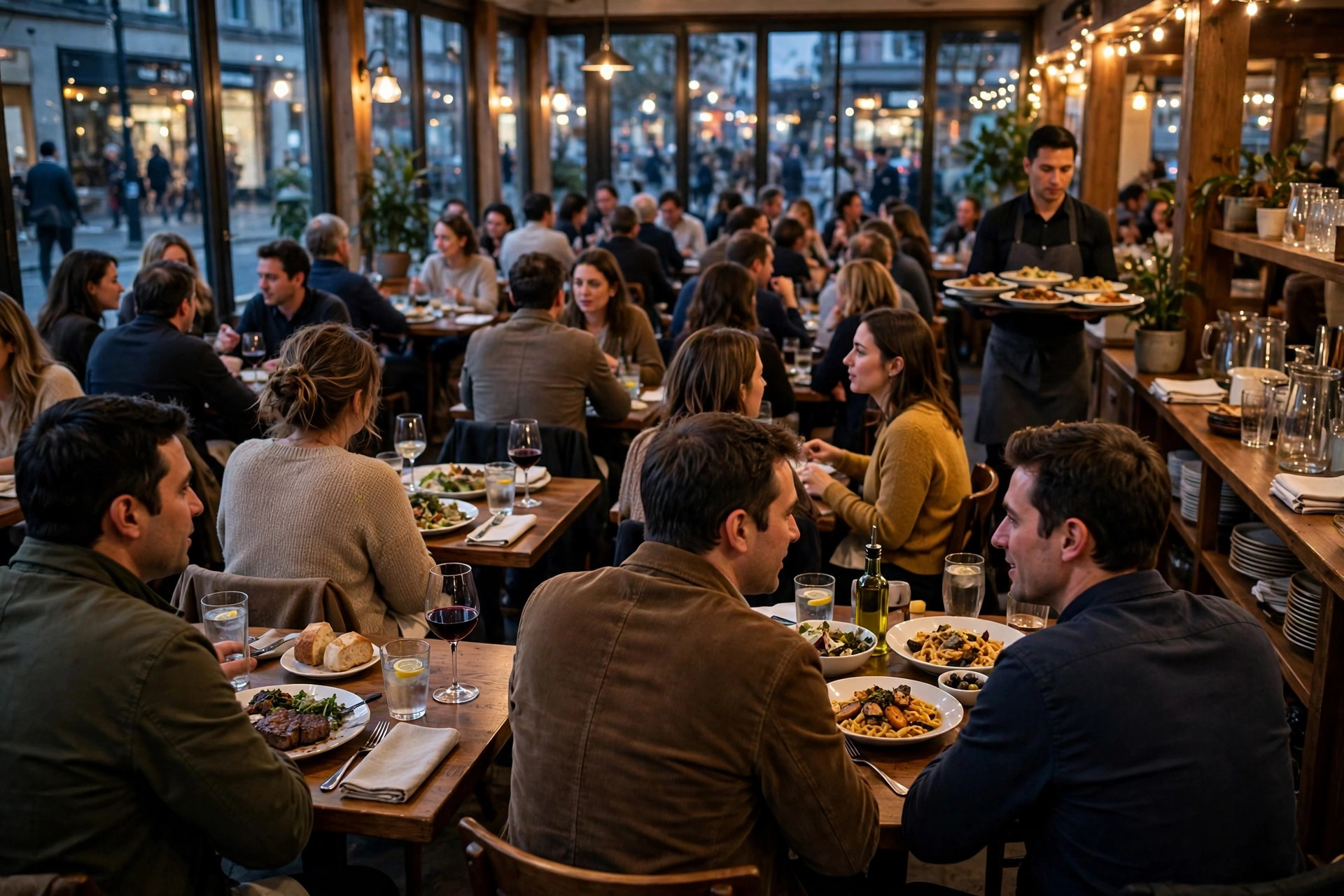
Every restaurant owner who has looked at paid advertising has faced the same fork in the road: put the money into Google, where people search for restaurants, or into Facebook and Instagram, where people scroll past beautiful food all day. Agencies will happily sell you either one.
This guide is written for the owner who has to decide with their own money. It compares Google Ads and Meta Ads specifically for restaurants, cafés, and bars, uses 2026 benchmark figures where they exist, and translates them into the only number that should drive your decision: what a booked table actually costs you.
Intent vs discovery: the one difference that matters
Strip away the dashboards, the jargon, and the sales decks, and the whole Google-versus-Meta question comes down to timing. Google reaches people at the moment they already want something. Meta reaches people before they know they want it.
Think about your own behaviour. When you type "thai restaurant open now" or "best pizza near me" into Google, you have already decided to eat out. You are choosing where, not whether. An ad that appears at that moment does not have to persuade you to be hungry — it only has to persuade you to pick this restaurant over the three others on the list. That is why Google search traffic converts so well: the persuasion is mostly done before the click.
Meta works the other way round. Nobody opens Instagram to find dinner. They open it to pass time, and your ad interrupts that scrolling with a photo or a fifteen-second video. If the dish looks extraordinary, if the room looks like somewhere they would love to be on a Friday night, they stop. You have created a desire that did not exist ten seconds earlier. That is enormously powerful for restaurants, because eating out is an emotional, visual, impulsive decision — but it is also slower. The person who stops scrolling rarely books immediately. They save the post, mention it to a partner, and search for you days later. That delay is the single most misunderstood thing about Meta advertising, and the reason so many owners conclude "Facebook ads don't work" after a week.
Why this difference decides everything else
Once you accept the intent-versus-discovery frame, the rest of the comparison falls into place. Costs differ because intent is scarcer and therefore more expensive to buy. Creative matters more on Meta because you must earn attention rather than borrow it from a search query. And measurement differs because a Google booking can often be traced to a single click, while a Meta booking may involve a saved post, a search three days later, and a phone call.
What Google Ads actually does for a restaurant
Google Ads for restaurants is mostly search advertising: text ads that appear above the organic results and the map when someone searches for a restaurant, a cuisine, or an occasion. A smaller share is the map itself, where your Google Business Profile does much of the work for free, and display or YouTube ads, which behave more like Meta than like search and are best treated as a later step.
The core strength is timing. Your ad appears when the decision is being made, often within an hour or two of the visit. Searches like "restaurant near me", "lunch buffet turku", or "romantic dinner bergen" carry an immediacy no social feed can match. For a restaurant, this is the closest thing paid advertising gets to standing outside your door and waving at hungry passers-by — except the passers-by are the ones who already decided to come to your street.
Where Google is strongest
- High-intent local searches. "Near me" searches, cuisine-plus-place searches, and occasion searches ("birthday dinner", "business lunch") convert directly into calls, bookings, and directions requests.
- Brand searches. When someone searches your restaurant's name, an ad guarantees you sit above competitors who may be bidding on it — and above review sites and delivery platforms that would rather take the booking themselves.
- Defensive coverage. Competitors, aggregators, and delivery apps routinely bid on restaurant names. Owning your own name on Google is cheap insurance, often just a few euros a day.
- Measurable bookings. Calls from ads, booking-form submissions, and direction clicks can be tracked cleanly, so you learn your cost per booking fast.
Where Google is weakest
Google can only capture demand that exists. If nobody in your town searches for your cuisine, or your restaurant is so new that nobody searches for your name, search ads have little to work with. Search volume is also finite: a small town may not generate enough restaurant searches to spend a large budget on. And in competitive city centres, the most valuable keywords attract every competitor in town, pushing click prices up. Finally, a text ad cannot show off your food — if atmosphere or a spectacular dish is your main selling point, a few lines of text will undersell it. If you want the full beginner's walkthrough, our Google Ads beginner's guide for restaurants covers campaign types, keywords, and the first-30-days plan in detail.
What Meta Ads actually does for a restaurant
Meta Ads runs across Facebook and Instagram (and, through the same Ads Manager, Messenger and the Audience Network). For restaurants, the formats that matter are image ads, short video and Reels ads, and carousel ads that show several dishes or the room from different angles. Unlike Google, you do not bid on what people type. You define who should see the ad — people within a few kilometres, in an age range, with interests in food, travel, or your cuisine — and Meta finds them while they scroll.
The core strength is visual persuasion at scale. Food is one of the few products that genuinely looks better in a feed than in a search result, and restaurants have a natural advantage here that most industries would envy. A fifteen-second video of a dish coming off the grill, a sunlit terrace in July, a birthday table full of laughing people — these create desire in a way text cannot. Meta is also where discovery compounds: a good ad gets shared, saved, and talked about, and every share is free reach on top of what you paid for.
Where Meta is strongest
- New restaurants and new concepts. Nobody searches for a place they have never heard of. Meta introduces you to the neighbourhood before opening week and keeps introducing you afterwards.
- Events, seasons, and offers. A Christmas menu, a summer terrace opening, a wine tasting night, a lunch offer — all of these are news, and news travels on social feeds, not in search boxes.
- Visual differentiation. If your room, your plating, or your concept is genuinely photogenic, Meta lets that do the selling.
- Retargeting. Showing a gentle reminder ad to people who visited your website or Instagram profile but did not book is one of the highest-returning uses of Meta for restaurants, and it is cheap because the audience is small and warm.
Where Meta is weakest
Meta's weakness is the mirror image of its strength: it must manufacture intent, and that takes time and repetition. Expect a learning period of two to four weeks while the system figures out who responds to your ads, and expect many resulting bookings to arrive indirectly — days later, via a search or a direct visit — where they will not be credited to the ad that caused them. That attribution gap is why Meta campaigns should be judged on overall bookings and revenue during the campaign period, not only on the bookings the dashboard claims. Creative fatigue is the other weakness: the same ad shown to the same small local audience goes stale within weeks, so Meta demands a steady supply of fresh photos and short videos. Our Meta Ads targeting guide for restaurants goes deeper on audiences, creative, and keeping ads fresh without a production budget.
The cost comparison that matters
Let us talk numbers — but the right numbers. Most comparisons of Google and Meta stop at cost per click, and that is exactly where they mislead you. A cheap click that never books a table is not a bargain; it is a leak. The comparison that matters has three layers: what a click costs, what share of clicks become bookings, and therefore what a booking costs. Only the third number should move your budget.
The figures below are drawn from widely published 2026 advertising benchmarks (WordStream by LocaliQ and similar industry reports) and are labelled as estimates. Your actual costs will vary by city, competition, season, and — most of all — how good your ads and landing pages are. Treat them as planning ranges, not promises.
| Metric (2026 benchmarks, estimates) | Google Search Ads | Meta Ads (Facebook & Instagram) |
|---|---|---|
| Typical cost per click, restaurants | ~€1.50–€2.50 | ~€0.70–€0.85 |
| Typical cost per 1,000 impressions (CPM) | Not the usual buying model for search | ~€8–€14 for food & beverage |
| Typical cost per lead / booking action | ~€25–€35 | ~€12–€20 (direct actions only) |
| Visitor intent at click | High — actively deciding where to eat | Low to medium — browsing, interrupted |
| Time to first results | Days; bookings possible in week one | 2–4 weeks of learning before stable results |
| Minimum realistic monthly test budget | ~€300–€600 | ~€300–€500 |
| Creative required | Text ads; landing page matters most | Photos and short video; creative matters most |
| Biggest hidden cost | Wasted clicks on irrelevant searches | Creative fatigue; fresh content every few weeks |
Notice what the table reveals. Meta's cost per lead looks dramatically lower — but that figure counts only the actions the platform can see directly, like a booking-form submission from the ad itself. It misses bookings that arrive days later after someone searched your name. Google's cost per lead looks higher, but it is more completely counted, because the path from search to booking is shorter and easier to trace. When owners measure properly — total bookings and revenue during the campaign period versus a comparable period without ads — the gap between the two platforms usually shrinks to much less than the dashboards suggest.
The maths you should do before spending anything
Work backwards from your own numbers, not from benchmarks. Start with your average spend per table — say €60 for two guests — and your gross margin on that table, perhaps 65–70% after food cost, which leaves roughly €40 of contribution. If you are willing to spend up to a third of that contribution to win the table, your ceiling is about €13 per booked table. Now look at your conversion rate: if one in ten website visitors books, you can afford to pay €1.30 per click. If only one in twenty books, your affordable click price halves to €0.65. That single calculation tells you more about which platform you can afford than any benchmark table ever will — and it tells you whether the real problem is your ad cost or your booking page. If your page converts poorly, fixing it is worth more than switching platforms. Our guide to how restaurants calculate advertising ROI walks through this maths with worked examples, and the landing-page structure guide shows what a page that converts actually contains.
The Nordic cost wrinkle
Nordic advertising costs deserve a specific note, because most published benchmarks are American. In Finland, Sweden, and Norway, restaurant search volumes are smaller and competition thinner than in large US cities, which often means cheaper clicks on Google — but also a smaller pool of searches to buy. On Meta, the Nordic audience is smaller and more expensive per thousand impressions than the global average, yet a 5-kilometre radius around a restaurant in Turku or Bergen covers a large share of its realistic customer base, so a modest budget goes further geographically.
Which one fits your restaurant?
There is no universal answer, but there are strong patterns by restaurant type. Find yourself below — most owners will recognise their situation immediately.
Newly opened, or opening soon: start with Meta
Nobody searches for a restaurant that opened last Tuesday. Your first job is to make the neighbourhood aware you exist, and that is a discovery job. Run Meta ads with strong photos and short video to people within a few kilometres, announce the opening, and build an audience you can retarget later. Add a small Google campaign for your own name once people start searching for it.
Established local favourite with steady regulars: start with Google
If locals already know you, your problem is not awareness — it is being chosen at the moment of decision, including by visitors and newcomers who search rather than scroll. A Google search campaign on cuisine-plus-place terms, plus brand protection on your own name, will capture that demand efficiently. Use Meta mainly for retargeting and seasonal news.
Fine dining, tasting menus, special occasions: lean Meta, support with Google
A tasting menu is a considered, emotional purchase, and it sells on beauty and story — exactly what a feed delivers. People rarely impulse-search for a €120 tasting menu at 6pm, but they will save a beautiful post about one for an anniversary next month. Meta should carry the storytelling; Google should catch the occasion searches from people ready to book.
Lunch restaurant, café, or fast-casual spot: lean Google
Lunch is a decision made quickly, often on a phone, often by someone already nearby and hungry. "Lunch near me" and "café open now" are Google moments. Keep the campaign tight — a small radius, lunch hours, and a landing page showing today's menu and a one-tap route.
Tourist-area restaurant: both, with different jobs
Tourists search heavily and scroll heavily in the evenings while planning the next day. Google captures the searches; Meta, targeted at visitors, plants the idea the night before. If you can only afford one, pick Google in high season and Meta in the shoulder season, when you need to manufacture demand rather than harvest it.
Delivery- and takeaway-focused: Google first, Meta for offers
Someone ordering dinner tonight searches for the cuisine and the restaurant, then orders. Search ads aligned with your ordering page convert directly. Meta works best for pushing specific offers — a weekday deal, a new dish — to people who already know you.
Budget: how much, and how to split it
The most common budgeting mistake is not spending too little in total — it is splitting a small budget across too many places. A €600 monthly budget divided between Google and Meta gives each platform €300, which in many markets buys too few clicks for either system to learn what works. Concentration beats diversification at small scale.
A practical budget ladder
- €300–€600 a month: one platform only. Pick by the guide above. Expect learning, not fireworks, in month one.
- €600–€1,200 a month: one main platform plus a small retargeting budget on the other — for example, Google search as the core, with €150–€200 a month of Meta retargeting to website visitors who did not book.
- €1,200–€2,500 a month: both platforms properly funded, each with its own job and its own budget line. This is the level where the hybrid loop in the next section starts to pay.
- Above €2,500 a month: you are no longer testing; you are scaling. At this level, management quality and creative production matter more than platform choice, and professional help usually pays for itself.
On top of ad spend, budget for two things owners routinely forget. First, management time: either your own hours (a few per week for one platform) or a freelancer or agency fee, commonly 10–20% of spend or a flat fee from around €500 a month. Second, creative: Meta in particular needs fresh photos and short videos every few weeks. A campaign with a €500 media budget and €0 creative budget will underperform a €400 campaign with €100 spent on a good shoot.
One more budgeting rule deserves emphasis because it protects you from the most expensive mistake of all: never scale a campaign that has not proven its cost per booking. Doubling the budget on a campaign that loses money on every table just loses money twice as fast. Scale only the campaigns whose numbers already work, and fix or kill the rest. Our restaurant ad budget guide goes deeper on sizing a budget from your own revenue and margin.
The hybrid play: Meta creates demand, Google captures it
Once one platform is working, the highest-value move is not to choose between them but to connect them. The loop works like this, and it mirrors how real customers actually behave:
- Meta introduces you. A beautiful video ad reaches people nearby who have never heard of you. Most do not book immediately — and that is fine.
- Curiosity turns into a search. Days later, when they are deciding where to eat, they search your name or your cuisine. Your Google ad — and your Google Business Profile — is waiting at the top.
- Google converts the curious. Because these searchers already recognise your name, they click more often and book more often than cold searchers. Your Google cost per booking drops, partly thanks to money you spent on Meta.
- Retargeting closes the loop. Website visitors who did not book see a gentle Meta reminder — a new dish, an upcoming event, a simple "we saved you a table" — and a share of them come back and complete the booking.
This is why judging each platform in isolation understates both of them. Meta's true value includes the Google bookings it caused but did not get credited for; Google's true value includes the warm searchers Meta created. Measure total bookings and total revenue across the period instead, and compare against a similar period without ads. The retargeting guide explains how to set up step four properly, and local ad targeting covers the radius and timing settings that make the loop efficient.
Mistakes that waste money on both platforms
Most wasted restaurant ad spend is not caused by picking the wrong platform. It is caused by a handful of fixable mistakes that show up on either one.
1. Sending paid traffic to a bad destination
The most expensive mistake, by a wide margin. An ad that lands on a slow homepage, a PDF menu, or a page with no booking button converts a fraction of what it should — and you pay for every wasted click. Before spending a euro, make sure the landing page loads fast on a phone, shows the menu as real text, and puts booking, calling, or ordering one tap away. If your site cannot do that yet, fix the site first; advertising will only amplify its weaknesses. A PowerfulWebsite restaurant site is built around exactly this — the build itself is free, and plans run from €59 to €239 a month including hosting, maintenance, and updates — but whichever route you take, the principle is the same: destination before traffic.
2. Targeting too wide
A restaurant does not need the whole country, and usually does not need the whole city. A 30-kilometre radius around a neighbourhood bistro wastes most of its impressions on people who will never travel that far for dinner. Start tight — your neighbourhood plus the districts people realistically come from — and expand only when the tight audience is exhausted.
3. Boosting posts instead of running ads
The "Boost" button on Facebook and Instagram is not advertising in any serious sense. It optimises for likes and reach, not for bookings, and it gives you almost no control over audience, placement, or measurement. If you are spending real money, use Ads Manager with a bookings or traffic objective, a defined audience, and conversion tracking. Boosting is fine for a quick announcement to your existing followers; it is a poor way to acquire customers.
4. Judging too early, or on the wrong metric
Pulling the plug after one slow week kills campaigns during their learning phase, when results are supposed to be uneven. Equally, celebrating a low cost per click while bookings stay flat is celebrating the wrong number. Give every test 30 days, judge it on cost per booking and on total bookings across the period, and change one variable at a time so you know what actually moved the result.
5. Running the same creative until it dies
On Meta especially, a small local audience sees your ad many times. After a few weeks, frequency climbs, response falls, and costs rise — not because the platform stopped working but because everyone has already seen that photo. Rotate creative regularly: new dishes, new angles, seasonal shots, short kitchen videos. On Google, the equivalent mistake is never reviewing search terms: check weekly which searches triggered your ads and exclude the irrelevant ones ("jobs", "recipes", "wholesale") before they eat your budget.
6. No conversion tracking at all
Running ads without tracking bookings is like running a restaurant without counting covers. You cannot optimise, you cannot compare platforms, and you cannot tell an agency whether they are earning their fee. Set up booking-form tracking, call tracking, or at minimum a dedicated landing page for ad traffic before you spend. This one setup task is worth more than any targeting trick.
A 30-day test plan and decision checklist
Here is a concrete plan you can run with a single platform and a €300–€600 budget. It removes the guesswork and gives you a defensible answer at the end of the month.
Days 1–7: foundations
- Fix the landing page: fast on mobile, menu as text, booking or call one tap away.
- Set up conversion tracking for bookings and calls, and test it with a real submission.
- Choose your platform using the guide above, and write down your target: a maximum acceptable cost per booked table, calculated from your own margin.
- Launch one campaign, one audience, one or two ad variations. Resist the urge to launch five things at once.
Days 8–21: observe, don't panic
- Check search terms (Google) or audience performance (Meta) once a week and remove obvious waste.
- Do not change budgets, audiences, or creative mid-learning unless something is clearly broken, like ads showing in the wrong country.
- Record bookings daily, from all sources — the platform dashboard will undercount Meta-driven bookings, so your own books are the source of truth.
Days 22–30: decide
- Calculate your cost per booking: total spend divided by bookings attributable to the campaign period, using your own records, not just the dashboard.
- If the cost per booking is below your ceiling and bookings rose versus a comparable period, scale the budget by 25–50% and keep going.
- If it is close but not quite there, fix one thing — usually the landing page or the creative — and run a second 30-day test.
- If it is far above your ceiling after a fair test, stop and reconsider: the problem is usually the offer, the destination, or the audience, not the platform in general. Switching platforms without fixing those will reproduce the same result elsewhere.
Decision checklist — answer before you spend
- Do people already search for my cuisine in my area? (Yes → Google has something to capture. No → Meta must create the demand first.)
- Is my food or room photogenic enough to stop a scroll? (Yes → Meta can shine. No → fix photography before buying Meta traffic.)
- Can my website turn a visit into a booking in under a minute on a phone?
- Do I know my maximum acceptable cost per booked table?
- Can I fund one platform properly for 30 days without splitting the budget?
If you answered no to the website question, that is your first project, not advertising. And if you answered no to the budget question, a smaller, well-run test on one platform beats a grand plan you cannot fund.
The honest summary is this: Google and Meta are not rivals for your budget so much as two halves of one customer journey. Google is where hungry people choose. Meta is where future customers fall in love. Start with whichever half your restaurant is missing, prove it with real booking numbers, and then — when the budget allows — let the two platforms do together what neither does as well alone. If you want help thinking through the website side of that equation, the paid versus organic social budget guide and the ad copy guide are good next reads.
Frequently asked questions
Is Google Ads or Meta Ads cheaper for a restaurant?
Meta clicks are usually cheaper — roughly €0.70–€0.85 per click for restaurants versus about €1.50–€2.50 for Google search clicks in 2026 benchmarks — but the click price is not the cost that matters. Google visitors arrive with intent to eat out, so they convert at a higher rate. Compare cost per booking, not cost per click, and the gap narrows sharply.
Can a restaurant run both Google and Meta ads on a small budget?
Not well below about €1,000 a month in total. Split across two platforms, neither campaign gathers enough data to optimise, and both underperform. Start with one platform, prove a cost per booking you are happy with, then add the second. One working channel beats two half-funded ones.
How fast do Google Ads and Meta Ads work for restaurants?
Google search ads can produce bookings in the first week, because the demand already exists — someone searching "sushi near me" is deciding tonight. Meta ads typically need 2–4 weeks of learning before performance stabilises, because the platform must first learn who responds to your creative. Judge neither before 30 days.
Do Meta ads work if my restaurant photos are not great?
Poorly, and honestly. Meta is a visual feed: your ad competes with professional food photography and short video, and weak creative is the most common reason Meta campaigns fail for restaurants. Before spending on Meta, invest an afternoon in phone photography of your five best dishes in natural light — it will do more for results than any targeting tweak.
Is Google Ads worth it for a restaurant in a small town?
Often yes, but for a different reason than in a city. Search volume is lower, so clicks are cheaper and competition thinner, but you may exhaust the available searches quickly. In small markets, pair a modest Google campaign with a strong Google Business Profile and local Meta ads aimed at your town and its surroundings, rather than relying on search alone.
Should I hire an agency to run my restaurant ads?
If you spend under about €1,000 a month, you can usually manage one platform yourself with a few hours a week, provided you set up conversion tracking first. Above that level, or if you run both platforms, professional management typically pays for itself by cutting wasted spend on wrong keywords and audiences. Whatever you choose, never let anyone run ads without tracking bookings — otherwise nobody can tell you what the money bought.
Want a website that turns ad clicks into table bookings?
PowerfulWebsite builds your restaurant website free of build cost — you only pay from €59 a month. Everything is included: domain, hosting, maintenance, and updates, with menus, booking, and ordering on the plans that need them.
See the packages