Optimising Your Delivery Radius: The Zone That Pays
Delivery radius optimisation is simple in principle and widely done wrong in practice: deliver only as far as your food still arrives hot, your driver still comes back in time for the next order, and the margin on the order still covers the trip. For most restaurants that means a core zone of about 3–4 km, priced in rings by drive time rather than a circle on a map — and the difference between a radius you guessed and a radius you calculated is the difference between delivery that makes money and delivery that quietly eats it.
Key takeaways
- Set your radius by drive time, not distance: food should reach the customer within 20–25 minutes of leaving the kitchen in your busiest hour.
- Your food decides the radius — pizza and sealed stews travel 5–7 km; fried food and ice cream barely survive 3 km.
- A delivery that looks profitable on the order value can lose money once driver time, fuel, packaging and commission are counted.
- Price in rings: a low fee and low minimum close in, a higher fee and higher minimum farther out — and a different menu per ring if your food needs it.
- Platforms (Wolt, Foodora) set the radius for you and take 20–30%; your own delivery keeps the margin and the customer data.
- Draw the boundary with postcodes, review it every four weeks, and shrink the ring that produces complaints faster than profit.
Most restaurants set their delivery radius once — usually by accepting whatever the delivery platform suggests, typically 5 to 7 kilometres — and never touch it again. It feels like a technical setting, a line on a map. It is not. It is one of the most consequential commercial decisions in a delivery operation, and it is quietly deciding your food quality, your review score, your driver costs and your margins on every single order.
This guide is a practical method for delivery radius optimisation, written for restaurant, café and takeaway owners in the Nordics. We cover how to calculate your radius from your food rather than from a map, what a single delivery really costs, the three zone models that actually work, the trade-off between your own drivers and Wolt or Foodora, and a four-week review cycle that keeps the zone honest. If you are still deciding whether to run delivery yourself, start with our own delivery vs platforms: doing the math guide.
Why Your Radius Is a Profit Decision, Not a Map Setting
A wide delivery radius looks like growth. More coverage, more potential customers, more orders — what could go wrong? Quite a lot, and it goes wrong quietly, which is why so many restaurants only notice when the review score has already slipped.
The four things your radius decides
Your radius directly controls four numbers that decide whether delivery makes you money. First, food quality on arrival: most hot food starts to degrade noticeably after 25–30 minutes out of the kitchen, and some dishes much sooner. Second, driver cost: a 3 km delivery takes roughly 8–12 minutes round trip; a 7 km delivery takes 20–30 minutes, and that driver is unavailable for other orders the whole time. Third, customer satisfaction: satisfaction falls as delivery time rises, and each step down in your rating costs you repeat orders — the profitable regulars, not the one-off bargain hunters. Fourth, order volume: a bigger radius covers more people, but only the people inside the profitable part of it are worth reaching.
The hidden cost of the far order
Consider a single order 7 km away. The food takes 25 minutes to arrive instead of 12. The driver is gone for half an hour instead of ten minutes, so during the Friday rush your kitchen waits on a driver who is still on the road. The customer, who waited 45 minutes, rates the experience three stars and mentions lukewarm food. The refund costs you the whole order — and the customer does not order again. That one far order cost you a driver slot, a review, a refund and a regular. Multiply it by twenty far orders a week and the damage is structural. This is why the platforms' default radius is not your friend: the platform earns its commission whether the food arrives hot or not. You pay for the cold food.
More coverage is not more business
The instinct to cover a bigger area comes from a reasonable place — more people can order — but it confuses reach with revenue. A restaurant that is the best option within 3 km will earn more, with better reviews and lower costs, than an average option within 7 km. Density beats distance: ten orders in one neighbourhood can support a route, a driver and a rhythm that ten scattered orders across a whole city cannot.
How Far Should You Deliver? The Drive-Time Rule
The honest answer to "how far should a restaurant deliver?" is that there is no universal number — but there is a universal method, and it takes about an hour to run. It starts with your food, not your map.
Step 1: find your maximum delivery time
Answer three questions. First, your average preparation time: how long from order receipt to the food leaving the kitchen? For most restaurants that is 12–20 minutes in normal hours and 20–35 minutes at peak. Second, your maximum acceptable transit time: how long can your food travel and still arrive at acceptable quality? Test this yourself — prepare your five best-selling dishes, package them as you would for delivery, and taste them at 10, 15, 20, 25 and 30 minutes. Third, your target total time: most customers expect delivery within 30–45 minutes of ordering. Subtract your preparation time from that target, and the remainder is your maximum transit time.
Step 2: convert time into distance — in your streets, at your peak hour
A kilometre is not a kilometre. A 5 km trip on an open suburban road and a 5 km trip through a city centre at 18:00 are different journeys, and your radius has to be drawn from the second one. Take six addresses at what you think are the edges of your zone — north, south, east, west, and two awkward directions — and check real drive times during your busiest delivery hour. Add the handoff time: finding the building, the intercom, the lift, the walk to the door. In Nordic apartment blocks in winter, the handoff alone can take three to five minutes. Whatever a driver can reach and hand over inside your transit window at peak hour — that is your radius. Everything past it is pickup.
Step 3: the worked example
A pizza restaurant with a 15-minute prep time and food that travels well for 25 minutes has a maximum transit time of 25 minutes. At an average urban speed of around 20 km/h, that is in theory about 8 km — but accounting for traffic lights, one-way streets, parking and finding the address, the realistic radius is 5–6 km. A sushi restaurant with a 12-minute prep time and food that tolerates 15 minutes of transit has a realistic radius of about 3 km in the same city. Same city, same streets, completely different zones — because the food is different. The radius comes from the food.
The 30-minute rule, honestly
Delivery experts commonly recommend a zone where total delivery time never exceeds 30 minutes, including preparation and transport. It is a good starting target, but treat it as a starting point, not a law: a sealed stew can happily travel 30 minutes, while fries are unhappy after 12. Use the 30-minute rule to set your first zone, then adjust it with your own taste tests and your own order data. Your food and your streets are the authority, not a rule of thumb.
What Your Food Can Survive: The Travel-Tolerance Table
Not all food travels equally, and pretending otherwise is how a restaurant ends up with one-star reviews for dishes that are excellent in the dining room. The table below is a practical guide to how far different dishes can travel before quality drops below acceptable. Treat the times as starting points and verify them with your own taste tests — your packaging and your recipes shift the numbers.
| Food category | Max distance | Max transit time | What goes wrong |
|---|---|---|---|
| Fried foods (fries, wings, tempura) | 3–5 km | ~12 minutes | Sogginess from trapped steam |
| Ice cream, milkshakes, smoothie bowls | ~3 km | ~10 minutes | Melting, texture loss |
| Sushi, poke, raw preparations | ~5 km | ~15 minutes | Temperature danger zone, texture |
| Soups, ramen, pho | 5–6 km | ~18 minutes | Heat loss, noodle over-absorption |
| Pizza, calzones, flatbreads | 8–11 km | ~25 minutes | Cheese solidifies, crust softens |
| Burritos, wraps, sealed sandwiches | 8–10 km | ~25 minutes | Condensation, wrapper sogginess |
| Sealed entrées (curry, stew, braised dishes) | 8–11 km | ~30 minutes | Minimal — designed for holding |
| Salads and cold bowls | 6–8 km | ~20 minutes | Wilting, dressing soak-through |
Two conclusions follow. First, if your menu is mixed, your radius should be set by your most fragile popular dish, not your hardiest one — or you need different menus for different rings, which we cover below. Second, packaging is part of the radius: vented boxes for fried food, separated sauce containers for noodles, insulated bags for everything. Good packaging buys you minutes, and minutes buy you kilometres. Our guide to delivery menus — dishes that survive the trip goes dish by dish through what to offer for delivery and what to keep dine-in only.
Test it like a customer
The taste test is the most valuable hour you will spend on delivery. Cook your five best sellers, pack them exactly as a delivery order, and leave them on the counter. Taste one at 10 minutes, one at 15, one at 20, one at 25 and one at 30. Be honest about where each dish stops being something you would be proud to serve — that moment is your transit limit for that dish. Build your zones around the strictest dish you sell a lot of, and repeat the test when you change packaging or add a dish.
The Cost Maths: What One Delivery Really Costs You
Before you can judge whether a zone pays, you need to know what a delivery costs. Most restaurants undercount it, because the biggest cost — driver time — is easy to treat as free when the driver is already on the payroll.
The five costs in every delivery
First, driver time: wages plus employer costs for the minutes the driver is out. In the Nordics, a driver costs roughly €15–€20 per hour all-in, so a 10-minute round trip costs about €2.50–€3.30 in labour and a 30-minute round trip costs €7.50–€10. Second, vehicle costs: fuel or charging, maintenance and depreciation — roughly €0.30–€0.50 per kilometre for a car, less for an e-bike, which is one reason e-bikes dominate city-centre delivery in Helsinki, Stockholm and Oslo. Third, packaging: typically €0.80–€2.00 per order. Fourth, commission: 20–30% of the order value if it came through Wolt or Foodora — on a €30 order, €6–€9, often the single biggest cost in the whole delivery. Fifth, failure costs: refunds, remakes and the lost future orders from a bad experience, which cluster in the outer ring. Add them up: a €30 order delivered 7 km away through a platform can easily carry €12–€15 of delivery cost, leaving a margin so thin that one refund wipes out five good orders.
The distance–profitability curve
Every restaurant has a distance–profitability curve, and it almost always has the same shape: deliveries within the first 2–3 km are highly profitable, profitability stays strong through the middle zone, and then there is a steep drop-off where costs catch up with or exceed the margin on the order. The exact distances vary by market, traffic and cuisine, but the shape is remarkably consistent. Your job is to find the inflection point — the distance where the curve crosses from profitable to unprofitable — and set your radius just inside it. The way to find it is not theory: export your orders by postcode, and for each postcode band calculate revenue, average order value, delivery cost and complaint rate. The data will show you the cliff. Our guide to delivery commissions — what they really cost breaks down the platform maths in detail, and tracking delivery sales covers the metrics to watch.
Average order value rises with distance — sometimes
One complication: orders from farther away are often larger. Customers who live far away tend to order for the whole family or add extra items to justify the delivery fee, and some restaurants find outer-ring orders 20–25% larger than inner-ring ones. That can offset the extra delivery cost up to a point — but the limit is usually where food quality and the review score start to fall. Track average order value by zone alongside the complaint rate; when complaints rise faster than order value, you have found your edge.
Three Zone Models That Work
Once you know your costs and your food's limits, the question becomes structural: how do you organise the zone? There are three models that work in practice, and the right one depends on your food, your market density and your delivery model.
Model 1: The tight circle — best for fragile food
Set a hard maximum of about 3 km and accept that you will lose some orders. This is the right model if your food is fragile — sushi, poke, fried food, ice cream — or if you are in a dense city centre where 3 km already covers tens of thousands of potential customers. The trade-off is explicit: fewer orders, but every order arrives hot, fast and exactly as intended. Dominating your immediate neighbourhood with impeccable quality beats being average across a whole city.
Model 2: The ring system — best for mixed menus
Create two or three concentric zones, each with different pricing, minimum orders and menu availability. This is the most flexible model and the one that maximises revenue for a mixed menu. A workable starting point: Zone 1 (0–3 km) — full menu, fee €0–€1.90, minimum €15. Zone 2 (3–5 km) — delivery-friendly items only, no fried appetizers and no ice cream, fee €2.90–€3.90, minimum €25. Zone 3 (5–7 km) — only dishes that travel well in sealed containers, fee €4.90–€5.90, minimum €35, available only outside peak hours so long trips never steal a driver during the rush. The ring system is more work to set up — your ordering system has to support zone-based menus and fees — but it lets you serve the far customer profitably. The Restaurant plan from PowerfulWebsite (€239/month) includes your own ordering system with zone-based delivery built in.
Model 3: The dynamic zone — best once you have data
Once you have a few months of order data, you can run zones that change with conditions. The base zone (about 2 km) is always active. The expanded zone (2–4 km) switches on during quiet hours or when you have a driver free, and switches off during the Friday rush. The maximum zone (4–6 km) is available only with a higher fee and a higher minimum, and only when the kitchen is quiet. Dynamic zones sound complex, but in practice they are a handful of rules in your ordering system, reviewed once a month: your zone should be as big as your current capacity allows, and no bigger.
Which model fits you?
Choose by your food first and your market second. Fragile food or a dense neighbourhood: the tight circle. A mixed menu with dishes that travel differently: the ring system. Enough volume and data to manage rules: the dynamic zone. And remember that the model can change — start with a tight circle, prove the operation, then expand in rings as your data tells you where the profitable edge actually is. It is far easier to add zones than to take them away, because customers in a removed zone will complain. Start small on purpose.
Own Drivers vs Wolt and Foodora: Who Controls the Radius
The radius question is inseparable from the channel question, because whoever delivers the food sets the rules. In the Nordics that means a choice — or, more often, a combination — of your own drivers and the two big platforms, Wolt and Foodora.
What the platforms decide for you
On Wolt or Foodora, you have limited control over your radius. The platforms set default ranges, assign drivers who may be kilometres away before they even start the pickup, and charge 20–30% commission regardless of distance. They also own the customer relationship: you do not get the email address, the order history or the chance to win the customer back directly. What you do get is discovery — millions of users browsing the app — and logistics without hiring a driver. For a new restaurant, that is a genuine advantage. For a detailed comparison, see our Wolt vs Foodora in 2026 guide.
What your own delivery gives you
Your own delivery — drivers you employ or contract, orders through your own website — gives you the opposite trade: full control and full margin, at the cost of fixed overhead. You set the radius exactly, you filter the menu by zone, you price the rings, you keep the customer data, and you keep the 20–30% that would have gone to the platform. On a €30 order, that is €6–€9 back in your pocket on every delivery. The cost is real: drivers on the clock even when orders are slow, vehicles, insurance, and management time. Own delivery pays when volume is steady enough to keep a driver busy; it hurts when volume is thin and the driver is waiting.
| Factor | Third-party platforms | Own delivery | Hybrid |
|---|---|---|---|
| Radius control | Platform default (5–7 km) | You set it exactly | Yours on direct orders, platform's on app orders |
| Cost per €30 order | €6–€9 commission | €3–€6 driver + vehicle | Blended, improving as direct share grows |
| Menu filtering by zone | Usually no | Yes | Yes, on your own channel |
| Customer data | Platform keeps it | Yours | Yours for direct orders |
| Speed to launch | Days | Weeks | Fast, then build your own channel |
| Best for | Discovery, new customers | Repeat customers, margin | Most Nordic restaurants |
The hybrid model — and how to make it work
Most successful Nordic restaurants use both: platforms for customer acquisition, own delivery for repeat customers. The strategy is to acquire a new customer through Wolt or Foodora, then convert them to direct ordering — a card in the delivery bag with a first-order discount on your own site, or a QR code straight to your ordering page. Every customer who moves to your own channel is worth €6–€9 more per order, forever, and they are a customer you can email, win back and upsell. Your own ordering system is the infrastructure that makes this possible: the Restaurant plan from PowerfulWebsite (€239/month, build free) includes it, and our guide to whether your own ordering system is worth it runs the full numbers.
Drawing the Line: Postcodes, Not Circles
Once you know your zones, the last step is to draw them in a way your ordering system and your customers can actually use. A circle on a map is the wrong tool.
Why circles fail
A circle ignores everything that matters in a real city: rivers, motorways, railway lines, one-way systems, hills, and the apartment block where the driver spends five minutes finding the right stairwell. Four kilometres north on a quiet side street is a different trip from four kilometres along a congested road at 18:15. A circle also ignores where people actually live: a zone covering a park, an industrial estate and a lake looks big on the map and contains almost no customers. Draw the boundary with postcodes, not a compass — and use drive time, not distance, to decide which postcodes belong in which ring.
The practical method
Start with your transit-time limit and your six test addresses from the drive-time exercise. Then open a map and mark the postcodes you can reach inside that window during your peak hour. Group them into rings: under 10 minutes, 10–18 minutes, and 18–25 minutes. Check the population and order history in each group — a postcode with three of your regulars is worth more than one with three hundred strangers and no orders. Then configure the zones in your ordering system by postcode prefix, with the fee and minimum for each ring, and publish a simple version for customers: "we deliver to these areas, with the fee shown at checkout." If your system only offers a radius slider, that is a reason to upgrade it, not to accept a bad zone.
What to say to the customer just outside the line
Every zone has an edge, and someone will always live just past it. Handle it well: a clear message at checkout ("we don't deliver to this address yet, but pickup is ready in 15 minutes — and here's 10% off your first pickup") turns a rejection into a sale. A vague error, or a delivery that is accepted and then arrives cold, turns it into a one-star review. The edge of your zone is a customer-service moment, not a technical limitation.
Nordic specifics: winter, bikes and the suburbs
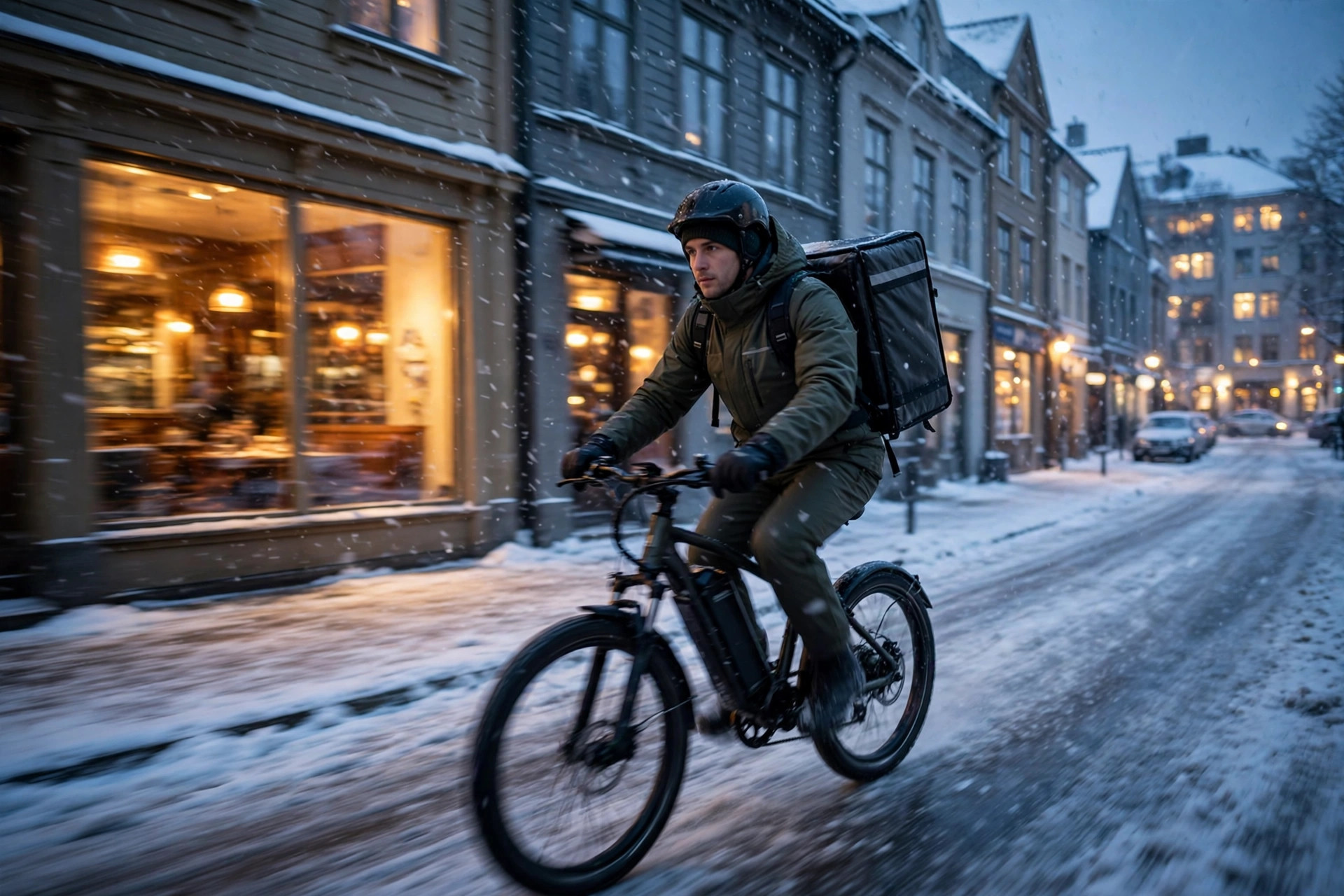
Three Nordic specifics deserve a mention. First, winter changes the maths: snow and ice slow every vehicle, e-bikes lose range in the cold, and the handoff takes longer. Consider a slightly smaller winter zone than your summer zone, or a winter surcharge on the outer ring. Second, e-bikes are the workhorse of Nordic city delivery — cheap, fast in traffic, easy to park — but their practical radius is about 3–3.5 km, which makes them a core-zone vehicle. Third, the suburbs: Nordic cities are low-density outside the centre, so a suburban restaurant may need a bigger radius in kilometres — but the roads are faster, so the drive-time rule still works.
Test, Measure, Adjust: The Four-Week Radius Review
A delivery zone is not a decision you make once. It is a living setting that should be reviewed on a fixed cycle, because your menu changes, your neighbourhood changes, the traffic changes and the platforms change their terms. A simple four-week review keeps it honest.
What to export every four weeks
Once a month, export your delivery orders with these fields: postcode, order value, delivery time (order to handoff), driver or platform, and any complaint or refund attached. Then calculate, per ring: number of orders, average order value, average delivery time, refund rate, and average review score. You are looking for three things: the ring where delivery times are creeping up, the ring where complaints cluster, and the ring where order value no longer covers the cost. The fix is usually one of three moves: shrink the ring, raise its fee and minimum, or restrict its menu to dishes that travel well.
The small experiments that pay
Between reviews, run small, reversible experiments. Try free delivery in the core zone for two weeks and watch whether volume rises enough to cover it. Try a €2 surcharge on the outer ring and see whether volume or complaints move first. Try turning the outer ring off during the Friday rush and measure the effect on kitchen times. Each experiment is cheap, and together they replace guessing with evidence — keep a one-line log of each one.
When to expand — and when to shrink
Expand when the data says so: the core zone is consistently fast, the outer ring's complaints are low, drivers are coming back early, and customers just outside the line are asking to be included. Shrink when the opposite is true: delivery times past 40 minutes in peak, complaints clustering in one postcode, refunds rising, or drivers regularly late back for the next order. Shrinking feels like losing business; it is usually the opposite — you are cutting the orders that cost you money and reputation, and keeping the ones that pay.
A quick radius health check
Answer these five questions honestly. If you answer "no" to two or more, your zone needs work: (1) Can you state your radius in minutes, not kilometres? (2) Do you know your refund rate by postcode? (3) Does your outer ring have a higher minimum order than your core? (4) Can your ordering system filter the menu by zone? (5) Have you reviewed the zone in the last month? Most restaurants answer no to three or more — which is why this is worth an hour of your time.
Your delivery radius is not a line on a map. It is a calculation built from your food, your streets, your drivers and your costs — and it is the difference between delivery that grows your restaurant and delivery that quietly drains it. Start with the taste test, draw the zone in drive time, price it in rings, and review it every four weeks. The restaurants that do this do not deliver everywhere. They deliver where it pays.
Frequently Asked Questions
How far should a restaurant deliver?
Far enough that the food reaches the customer within 20 to 25 minutes of leaving your kitchen during your busiest hour — and no farther. Measure that in drive time on a real Friday evening, not in kilometres on a map, because traffic, one-way streets, bridges and apartment-block handoffs make the real zone lopsided rather than circular. For most restaurants that works out to roughly 3–5 km in a city centre and 5–8 km in a suburb, depending on what you serve.
What is a good delivery radius for a restaurant?
A good radius covers the addresses you can serve profitably inside your food's quality window. Start with a 3–4 km core zone, prove the model, and expand in rings with higher fees and higher minimum orders the farther out you go. The right radius depends on your cuisine — pizza travels far, fried food and ice cream do not — your kitchen speed, and your local geography. There is no universal number; there is a calculation, and this guide walks through it.
How much should I charge for delivery?
Charge by zone, not a single flat fee. A workable starting point for a Nordic city restaurant is free or €1.90 within 1–2 km, €2.90–€3.90 for the middle ring, and €4.90–€5.90 for the outer ring, with minimum orders rising with distance (for example €15 close in, €25–€35 farther out). Compare the fee to your real per-delivery cost — driver time, fuel and packaging — and make sure the fee plus the order margin covers it. Free delivery only makes sense inside the core zone, where the trip is short and the order volume is high.
Should I deliver myself or use Wolt or Foodora?
Both, for different jobs. Wolt and Foodora bring discovery and handle drivers, but take a commission of roughly 20–30% and control the customer relationship. Your own delivery — through your own ordering system — keeps the full margin and the customer data, but you carry the driver cost and the logistics. The model that works for most Nordic restaurants is hybrid: platforms for acquiring new customers, your own delivery for repeat customers, and a clear push to move regulars to direct ordering, where the margin stays with you.
How do I know if my delivery zone is too big?
Three warning signs: your average delivery time creeps past 40 minutes in peak hours; your worst reviews mention cold food or late delivery and cluster in the same outer postcodes; and your refund and remake rate rises. Export your order history by postcode, and compare ratings, average order value and complaint rates by distance. If the outer ring produces more complaints than profit, shrink it — or raise its fee and minimum order until only the orders worth serving remain.
Want a website that brings table bookings?
PowerfulWebsite builds your restaurant's website for free — you only pay from €59/month. Everything included: domain, hosting, maintenance and updates. The Restaurant plan (€239/month) adds your own ordering system.
See the packages