Your Own Ordering System: Is It Worth It?
Yes — for most restaurants doing regular delivery volume, your own online ordering system is worth it, and the maths is not close. If roughly 40 orders a month move from a delivery app to your own channel, a €239-a-month system already pays for itself. The catch is that your own system brings you no new customers, so the winning setup is almost always a hybrid: the apps for discovery, your own channel for regulars.
Key takeaways
- Delivery apps typically take 15–30% of every order, plus promotion and service fees — on thin restaurant margins that can erase the profit entirely.
- At a €25 average order and 25% commission, each order moved to your own channel saves you about €6.25.
- A €239-a-month ordering system breaks even at roughly 40 orders a month; a €109-a-month plan at roughly 18.
- Your own system gives you the customer list, the prices and the brand — the apps keep all three.
- Don't quit the apps. Use them for new customers and your own channel for regulars, with a reason to switch.
- For a single location, a mobile-friendly ordering page beats a native app: no download, no €8,000+ build cost.
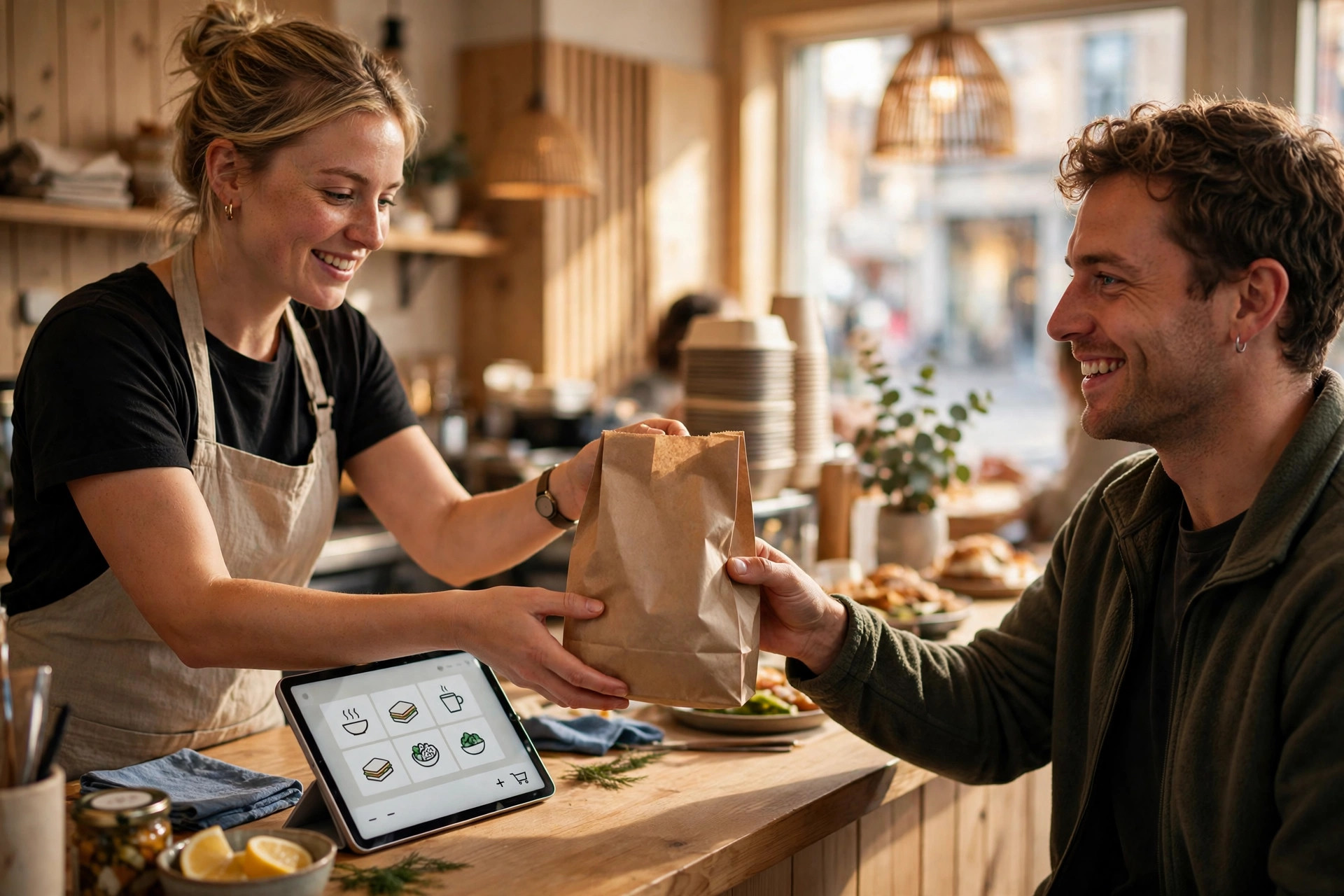
Every restaurant owner in the Nordics knows the feeling. The phone buzzes with another Wolt or Foodora order, the kitchen fires it, the courier takes it away — and when the payout lands, a quarter of the order value has vanished. It is easy to shrug and call it the cost of doing business. It is harder to keep shrugging once you add it up: a restaurant doing €10,000 a month through delivery apps at 25% commission hands over €2,500 a month, €30,000 a year, for the privilege of selling its own food to its own neighbourhood.
That is why so many owners are now asking whether their own online ordering system is worth it. The short answer is yes, in most cases — but the honest answer is more interesting. Your own system is not a replacement for the delivery apps. It is a second channel with completely different economics: cheap per order, but with no built-in audience. This article works through the real costs, the break-even maths, the three ways to get a system, the hidden costs, and a practical plan for running both channels side by side — all priced for the Nordic market in 2026.
What your own ordering system actually means
Before comparing costs, it helps to be precise about what you are buying. "Your own ordering system" gets used for three different things, and they cost very different amounts.
The first is an ordering page on your own website. A customer finds you on Google, opens your site on their phone, browses the menu, builds a basket, pays by card or MobilePay, and chooses pickup or delivery. The order lands in your kitchen — on a tablet, by email, or printed straight to the kitchen printer. There is no app to download and no marketplace in the middle. This is the version most small restaurants actually need.
The second is a standalone ordering tool: a subscription product such as an ordering platform that gives you a branded ordering page and a dashboard, usually without building your whole website. You link to it from your site, your Google profile and your social media. It works well, but you are renting a tool rather than owning a channel, and you still need a decent website for it to point from.
And what it is not
The third version is a native app under your own name in the App Store and Google Play, sometimes bundled with loyalty points and push notifications. It sounds impressive, and for a chain it can be. For a single restaurant it is usually the most expensive way to solve the cheapest problem: customers will not download an app for a restaurant they order from twice a month. A mobile web page that opens from a Google search or a QR code on the table does the same job with zero friction.
There is also an important distinction between ordering and delivery. Your own ordering system takes the order and the payment. It does not, by itself, move the food. Delivery is a separate problem with separate options — your own drivers, pickup only, or a courier service that charges per trip. We will come back to that, because it is where many owners get surprised. But the ordering itself is the easy part, and it is the part that saves the money.
Finally, your own system changes who owns the relationship. On a marketplace, the customer is the platform's customer: you see a first name and an order number, and you cannot email them next week. On your own channel, you get the name, the email address and the order history — the list that lets you send a Tuesday lunch offer to people who ordered last Tuesday, or win back someone who has gone quiet. No marketplace will ever sell you that.
What the delivery apps really cost you
The headline commission is only the start. In the Nordic market, Wolt and Foodora are the platforms that matter most, with Uber Eats present in some cities. Their published commission bands are broadly similar to the international picture: roughly 15–30% depending on the plan, the service level and whether the platform supplies the courier. But the number on your contract is not the number that leaves your bank account.
Start with the commission itself. A restaurant on a 25% plan that sells a €25 order keeps €18.75 before any other cost. Food cost on that order might be €7.50, packaging €1, and card or service fees on top. What is left has to cover rent, wages, energy and everything else. At a 30% commission the same order leaves you €17.50. If your net margin is 5–10%, which is typical for an independent restaurant, the platform's cut can be three to six times your profit on that order. That is the sentence to sit with: the fee is not a slice of your profit, it is a multiple of it.
Then come the extras that never appear in the headline rate. Sponsored placement — paying to appear higher in the app's search results — is effectively a second commission, and restaurants that do not buy it report their listings sinking below competitors who do. Promotional discounts that the platform nudges you into often come partly out of your pocket, and refunds for orders that went wrong are usually charged to you. Because the commission is a percentage of the price the customer sees, raising your prices to cover it also raises the commission — the treadmill never stops.
None of this means the apps are a bad deal. They bring you customers you would never have reached, they handle the couriers, and they absorb the marketing cost of being discovered. For a new restaurant, or one in a location with little foot traffic, that discovery is genuinely valuable. The question is not whether the apps are worth anything — it is whether you should let them be your only delivery channel once your regulars already know where you are.
The effective rate is higher than the headline rate
Work out your effective rate, not your contract rate. Take one month of delivery-app payouts and divide what you actually received by the total value of the orders. Include the commission, the promotion costs, the sponsored placement and the refunds. Many owners who do this for the first time find an effective rate of 30–40%, well above the 25% on their contract. That effective rate is the number to use in every calculation in this article — and it is usually the number that makes the decision for you.
For a deeper breakdown of the same maths, see our guide to delivery commissions: what they really cost, which walks through a full month of payouts line by line. The short version is this: if delivery is a meaningful share of your revenue, the apps are almost certainly your single largest cost after wages and rent.
The break-even point: when your own system pays for itself
This is the calculation that matters, and it is simpler than most sales pitches make it sound. You need three numbers: your average delivery order value, your effective commission rate on the apps, and the monthly cost of your own system.
Take a typical Nordic example. Average order €25. Effective app cost 25%. That is €6.25 per order going to the platform. Your own ordering system, as part of a website subscription, costs €239 a month on the PowerfulWebsite Restaurant plan — which includes the ordering system, the website, hosting and maintenance — and card processing of roughly 2–3% applies on both channels, so it cancels out of the comparison.
Divide €239 by €6.25 and you get about 38 orders a month. That is the break-even: if 38 orders a month move from the apps to your own channel, the system has paid for itself, and every order after that is roughly €6 of margin back in your business. At 100 orders a month moved across, you save about €625 in commission and pay €239 for the system — a net gain of roughly €386 a month, or about €4,600 a year.
| Orders moved to your own channel / month | Commission saved (25% of €25 orders) | System cost | Net gain / month |
|---|---|---|---|
| 20 | €125 | €239 | −€114 |
| 40 | €250 | €239 | about €11 |
| 60 | €375 | €239 | about €136 |
| 100 | €625 | €239 | about €386 |
| 200 | €1,250 | €239 | about €1,011 |
The table makes the argument in one view: the break-even is low — about ten orders a week — and the payoff scales with volume while the cost stays flat. The apps charge you more as you sell more; your own channel does not.
Try it with your own numbers
Your numbers will differ, so run the same sum with your real figures. Use your actual average order value from last month's app dashboard, and your effective commission rate — what you actually received divided by order value, not the headline rate. Then divide the monthly system cost by the saving per order. If your average order is €35, the saving per order at 25% is €8.75 and the break-even drops to about 27 orders a month. If your average order is €15, the saving is €3.75 and the break-even rises to about 64 orders — still very reachable for a busy lunch spot, but worth knowing before you commit.
One more nuance: not every order will move. A realistic target is to move 20–40% of your delivery volume to your own channel in the first six months, mostly regulars and pickup orders. So the honest test is not "do I do 40 delivery orders a month" but "do I do 100–200 delivery orders a month, of which 40 could move". If your total delivery volume is under 50 orders a month, the commission saving alone will not pay for the system yet — but the customer data and the pickup orders may still make it worth having.
Break-even, at a glance
Your saving per order = average order value × your effective commission rate. Break-even orders per month = monthly system cost ÷ saving per order. At €25 average orders and 25% commission, the saving is about €6.25 per order — so a €239-a-month system breaks even at roughly 38 orders a month, and a €109-a-month plan at roughly 18.
The three ways to get your own system
There are three realistic routes for a Nordic restaurant in 2026, and the right one depends on your volume, your budget and how much hassle you will tolerate.
Route 1: Ordering built into your website subscription
This is the simplest route and, for most independents, the best. Your website provider builds the ordering into your site: menu, basket, checkout, payment and kitchen notifications in one place. With PowerfulWebsite, the Restaurant plan at €239 a month includes the ordering system alongside the website itself — the build is free, there is a one-time €25 domain handling fee, and the monthly fee covers hosting, maintenance and updates. Because the cost is a flat monthly fee rather than a percentage, the economics are exactly the break-even maths above — and the website also does the rest of its job: bringing in table bookings, showing the menu, and ranking on Google.
Route 2: A standalone ordering subscription
Standalone ordering tools charge a flat monthly fee — typically in the region of €100–€330 a month depending on features — and give you a branded ordering page plus a dashboard. They are quick to set up and they work. The trade-offs are that you still need a good website for the ordering page to live behind, the monthly fee is on top of your website cost, and you are renting rather than building an asset: stop paying and the channel disappears. For a restaurant that already has a strong website and just needs ordering bolted on, this route is perfectly sensible.
Route 3: A custom-built system
A custom build — your own code, your own design — typically costs €8,000–€25,000 upfront for a single restaurant, plus €200–€600 a month in hosting, updates and fixes. For a chain or a dark kitchen group that can be the right investment. For a single location it almost never is: the payback period against a €239-a-month subscription is measured in years, and every change becomes a paid development job. The subscription tools are now good enough that custom builds buy you little a typical restaurant can feel.
What about the free options? Some tools advertise free ordering, and the software itself may indeed cost nothing. But free always means one of three things: free software you host and maintain yourself, a free plan that earns its money on higher card-processing rates, or a marketplace that costs nothing to join and takes a share of every order. Card fees, hosting, your time and the commission do not disappear because the software was free. Run the year-one total, not the headline price.
What your own system needs to work
An ordering system is not a button on a website. It is a small pipeline, and every step has to work or the customer goes back to the app — usually permanently. Before you launch, make sure each of these is in place.
Payments your customers actually use
In Finland, that means cards and MobilePay at a minimum; in Sweden, cards and Swish; in Norway, cards and Vipps. If your checkout only takes cards, you will lose orders at the last step — Nordic customers expect their local mobile payment option and treat its absence as a sign the shop is not really set up for online orders. Online prepayment also protects you: a prepaid order cannot become a no-show, and the kitchen only cooks what is already paid for.
A kitchen flow that does not rely on memory
Orders need to arrive somewhere the kitchen will actually see them. A tablet on the pass with a loud alert, a kitchen printer, or both, is the minimum. Email-only ordering fails at Friday dinner rush: nobody checks email while plating. Set realistic preparation times per order and per time slot, and cap the number of orders per 15-minute window so the kitchen is never buried. The best systems let you pause ordering for ten minutes when the kitchen is underwater, rather than accepting orders you cannot fulfil on time.
Delivery zones, fees and times — set deliberately
Decide your delivery radius before you launch, and price it honestly. A common Nordic setup is free delivery above €30–€40 within a tight zone, a small fee of €2–€4 inside it, and no delivery beyond it. Every kilometre you add costs driver time, and driver time is the most expensive part of your own delivery. Pickup deserves equal attention: a clear pickup shelf, a quoted time, and an SMS or email when the order is ready turns pickup into your most profitable channel, because there is no courier cost at all.
A menu built for ordering, not just for reading
Your dine-in menu and your online menu should not be identical. Dishes that travel badly, dishes with tiny margins, and dishes that slow the kitchen down all deserve a second look before they go online. Our guide to delivery menus: dishes that survive the trip covers which items hold up in a box and which ones come back as complaints. As a rule, keep the online menu shorter than the dine-in one, lead with your best sellers, and make the photos do the selling — see delivery photos that sell for the full playbook.
The hidden costs nobody puts in the sales pitch
Your own channel is cheaper per order, but it is not free to run. The honest version of this article lists the costs that surprise owners in the first three months.
Delivery itself. This is the big one. If the platform was supplying the courier, you now have to supply the ride. Your own driver costs wages, fuel, insurance and scheduling; a delivery-as-a-service partner charges a flat fee per trip, typically around €6–€8 in Nordic cities, which still leaves you far ahead of a 25% commission on a €25 order. Pickup-only ordering dodges the whole problem, and many restaurants find pickup becomes 30–50% of their direct volume precisely because it is so profitable.
Marketing the channel. The apps spend millions getting customers to open their app; your channel has no such budget. The marketing is a clear "Order direct" button on your website and Google profile, a QR code on every table and takeaway bag, and a mention from staff at the till. It costs little, but it is not automatic — budget a little time every week for it in the first months.
Support and mistakes. When an order goes wrong on a marketplace, the platform's support handles the customer. On your own channel, you do — so someone has to answer the phone or the email when an order is late or an item is missing, and you need a simple refund policy you can apply in a minute. The volume is low, because direct customers are usually your regulars and they are forgiving, but the responsibility is yours.
Maintenance and updates. Menus, prices and opening hours change. On a subscription plan this is included — it is part of what the monthly fee buys. On a custom build it is a recurring cost, and on a do-it-yourself setup it is your evening. Prefer a setup where a price change takes two minutes rather than a developer ticket.
None of these costs changes the conclusion for most restaurants. They change the plan: start with pickup plus a small delivery zone, use a courier partner rather than hiring a driver on day one, and keep the apps running while the direct channel grows. That is how you get the savings without taking on the risk all at once.
The hybrid strategy: apps for discovery, your channel for regulars
The most profitable setup for a typical Nordic restaurant is not either/or. It is a deliberate split: the marketplaces bring in new customers, and your own channel keeps them.
Here is how it works in practice. A customer discovers you on Wolt or Foodora, orders once, and likes the food. Inside the delivery bag — the one physical touchpoint you control — is a card with a QR code: "Order direct next time and get 10% off, or a free coffee with pickup." The discount costs you far less than the 25% commission you would pay on their next app order, and the customer gets a better price, so both sides win. Over months, your regulars migrate. The apps keep sending you strangers; your own channel keeps the people who already like you.
Pricing the two channels differently
This only works if the prices make the switch worth it. Your own channel should be the cheapest place to order from you — that is the entire point. Many restaurants run their dine-in prices on their own channel and a marked-up price list on the apps, typically 15–25% higher, to cover the commission. That is legal on the major platforms, which no longer require price parity in most markets, though the details vary — check your own contract and our guide to pricing on delivery platforms before you change anything. The gap between the two prices is itself the marketing: a customer who notices the same dish costs less direct has a reason to switch, and every switch is margin recovered.
Loyalty is the retention engine
A simple loyalty scheme turns one-time switchers into regulars: every fifth or tenth direct order free, a birthday offer, a stamp card that lives in the customer's phone rather than their wallet. The apps cannot offer this for you — they have no interest in making your customers loyal to you rather than to them. Your own channel can, and the cost of a free dish every tenth order is a fraction of the commission you would otherwise pay on all ten. Keep it simple enough that staff can explain it in one sentence, and make the reward visible at checkout so customers see progress every time they order.
What to measure every month
Run a simple monthly check: total delivery orders split by channel, average order value by channel, commission paid to the apps, and the share of repeat customers on your own channel. If the direct share is growing and the commission bill is shrinking as a share of delivery revenue, the strategy is working. If direct orders stall below 10% of delivery volume after three months, the problem is usually visibility — the button is buried, the QR code is missing, or nobody at the till mentions it.
A 30-day launch plan and decision checklist
If the maths works for you, here is a realistic first month. It assumes you are going the subscription route — website with ordering built in — rather than a custom build.
Week 1: Decide and set up
Run the break-even calculation with your real numbers: average order value, effective commission rate, monthly system cost. Pick your delivery model — pickup plus a small zone, with a courier partner on standby for the busy nights. Shorten the online menu to the dishes that travel well and earn their margin. Set your two price lists: dine-in prices direct, marked-up prices on the apps.
Week 2: Build and test
Get the ordering page live on your own domain, with MobilePay or your local mobile payment option working, and test it yourself: order from your own phone, pay, and watch the order land in the kitchen. Test the failure cases too — what happens when the kitchen pauses ordering, when an item sells out, when a customer enters a wrong address. Photograph the dishes properly before launch, because the first version of your menu is the one people will judge. Then tell your staff: this is the channel, this is the till script, this is what happens when an order arrives.
Weeks 3–4: Launch to regulars first
Do not launch to the world. Launch to your regulars: a QR code on tables, a card in every takeaway bag, a short post on your social channels, and a line in your Google Business Profile. Offer a first-direct-order incentive — 10% off or a free extra — and watch the first fifty orders like a hawk. Fix the friction fast: if three customers abandon checkout at the same step, that step is broken. At the end of the month, do the maths again with real data. If the direct channel is covering its cost, keep growing it. If it is not, the fix is almost always more visibility, not a different system.
The decision checklist
- Do I do at least 100 delivery orders a month in total? If yes, the break-even is very likely met.
- Can 20–40% of those orders realistically move — regulars, pickup, nearby customers?
- Do I have a mobile payment option (MobilePay, Swish or Vipps) ready for checkout?
- Is there someone in the kitchen who will own the tablet and the order flow?
- Can I put a QR code on tables, bags and receipts from day one?
- Am I willing to keep the apps running for discovery while the direct channel grows?
If you can tick four or more, your own ordering system is worth it — and the sooner you start, the sooner the regulars start paying you instead of the platform. If you tick fewer, the apps are still doing a job for you: grow delivery volume first and revisit the decision in six months. Either way, the decision is now a calculation rather than a guess, and that is the point.
If you want the ordering built into your website rather than bolted on afterwards, PowerfulWebsite builds restaurant websites free of build cost — the Restaurant plan at €239 a month includes the ordering system, hosting, maintenance and updates. The own delivery vs platforms comparison and the Wolt vs Foodora comparison for 2026 are good next reads before you decide.
Frequently asked questions
How much does your own online ordering system cost a restaurant?
A website with built-in ordering typically costs from €59 to €239 a month on a subscription plan with no build fee — the PowerfulWebsite Restaurant plan at €239 a month includes the ordering system. A standalone ordering tool costs roughly €100–€330 a month, and a fully custom-built system costs €8,000–€25,000 upfront plus €200–€600 a month in maintenance. Card processing of around 2–3% per order applies on top in every case.
How many orders do I need for my own ordering system to pay for itself?
At an average order of €25, a delivery app taking 25% commission costs you about €6.25 per order. A €239-a-month ordering system breaks even at roughly 38–40 orders a month — about 10 orders a week — if those orders move from the app to your own channel. At €109 a month the break-even is around 18 orders a month.
Do I still need Wolt or Foodora if I have my own ordering system?
For most restaurants, yes — at least at first. The apps bring new customers who have never heard of you, which your own channel cannot do. The profitable setup is a hybrid: the apps for discovery and first orders, your own channel for regulars, with a small discount or loyalty perk that gives people a reason to order direct next time.
Who handles delivery with my own ordering system?
You have three options: your own drivers, pickup-only ordering, or a delivery-as-a-service partner such as Wolt Drive or Uber Direct, which charges a flat fee per delivery (typically around €6–€8) instead of a percentage of the order. Many small Nordic restaurants start with pickup plus a small delivery zone covered by their own staff.
Can I keep my customer data with my own ordering system?
Yes — that is one of the main advantages. Orders through your own system give you the customer's name, email and order history, so you can send offers, win back quiet customers and build a loyalty programme. On a marketplace, the customer belongs to the platform and you generally cannot contact them directly. You must still handle the data under GDPR: collect only what you need, get consent for marketing, and let people opt out.
Is building my own ordering app worth it for a small restaurant?
A native app is rarely worth it for a single-location restaurant — it costs €8,000–€15,000 to build, and customers have to download it before they can order. A mobile-friendly ordering page on your own website does the same job for a fraction of the cost, with no download and no app-store friction. Save the app for when you have several locations or a large base of regulars ordering weekly.
Want a website that takes orders without the 30% cut?
PowerfulWebsite builds your restaurant website free of build cost — you only pay from €59 a month, or €239 a month for the Restaurant plan with its own commission-free ordering system. Everything is included: domain, hosting, maintenance, and updates.
See the packages