Shrove Tuesday Buns: How Nordic Cafés Sell Thousands
Shrove Tuesday is the single biggest bun-selling day of the Nordic winter — but the cafés and bakeries that make real money from it treat it as a six-week season, not a Tuesday. This guide covers the semla playbook: which bun to bake, how to price it, how to run pre-orders, and the marketing timeline that turns one traditional pastry into the best week of your year.
Key takeaways
- The semla season runs from early January to Shrove Tuesday (9 February 2027) — the peak day is the finale, not the whole event.
- Cost every bun from real supplier invoices and aim for at least 60% gross margin at typical Nordic café prices of €4.50–7 (estimates).
- Pre-orders are the profit engine: they lock in volume, cut waste to near zero and let you staff the peak correctly.
- One signature bun beats five mediocre ones — differentiate on filling, size or a twist, never on discounting.
- Publish a dedicated semla page on your own website in January; it captures the search traffic that social media cannot.
- Plan to sell out: scarcity on the day itself is marketing for next year, while waste is just a cost.
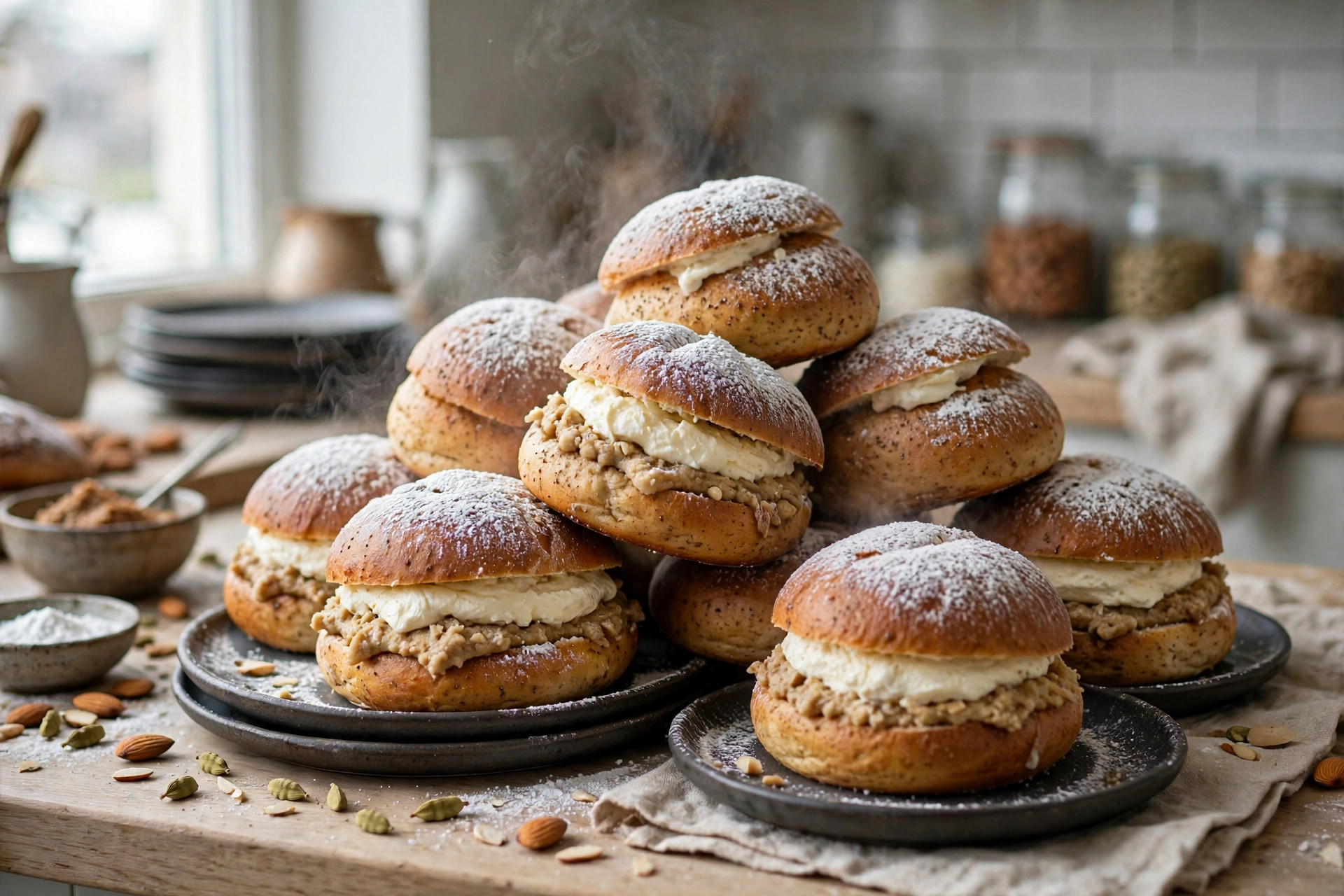
Every winter, the Nordics develop a collective obsession with a single bun. In Sweden it is the semla, in Finland the laskiaispulla, in Norway and Denmark the fastelavnsbolle — a spiced wheat bun split, filled and crowned with cream, argued about in newspapers, ranked in taste tests, and queued for in the cold. For a café or bakery, this is not folklore. It is the most concentrated sales opportunity of the winter half-year: a product with built-in demand, a fixed deadline, and customers who buy in bulk.
This guide is for café, bakery and restaurant owners across the Nordics who want to turn Shrove Tuesday from a busy day into a managed, profitable season. We cover which bun to bake and how to position it, honest costing and pricing, the pre-order system that separates profitable semla sellers from stressed ones, a four-week marketing timeline, peak-day production planning, and what to do the week after. If you want the year-round rhythm behind campaigns like this one, our seasonal advertising calendar for restaurants is the companion piece.
Why Shrove Tuesday is a season, not a day
The most expensive mistake a café can make with Shrove Tuesday is treating it as a single day of extra baking. The bakeries that sell thousands of buns start in early January, when the first semlor appear in windows and the annual debate begins — which bakery has the best one this year, almond or jam, is the lid supposed to be a triangle. By the time Shrove Tuesday itself arrives (9 February 2027), the winners have already sold most of their volume through pre-orders. The Tuesday is the victory lap, not the race.
This matters because the demand curve is long and predictable. Search interest for semla and its cousins starts climbing in the first week of January, office managers start planning their Shrove Tuesday orders in mid-January, and local media run their "best semla in town" rankings two to three weeks before the day. A café that only wakes up the week before is competing for the leftovers of attention — while the early movers are already counting pre-orders.
The calendar that actually matters
Work backwards from the peak. Six weeks out (early January): announce the season — the bun is back, pre-orders open, the office order form is live. Four weeks out: the marketing push begins in earnest (more below). Two weeks out: local press and influencers get their tasting boxes; your Google Business Profile carries a Shrove Tuesday post. Peak week: daily availability updates, and the day itself runs on the plan you made in January. The week after: thank-you messages, email capture follow-up, and notes for next year while everything is fresh. Shrove Tuesday 2027 is 9 February, which also means Easter content season starts immediately after — our Easter campaign ideas pick up where this guide ends.
What the peak day really looks like
On a well-run Shrove Tuesday, the pattern is the same across Helsinki, Stockholm, Oslo and Copenhagen: a pre-opening queue of pre-order pickups, a mid-morning wave of office runners collecting boxes, a lunch-hour surge, and a sold-out sign by early afternoon. The cafés that look calm on the day are the ones that moved 60–70% of volume to pre-orders. The cafés that look frantic baked everything for walk-ins and guessed wrong in at least one direction — too few and they turned away money, too many and the bins filled with cream at closing time.
The bun: three Nordic versions
Shrove Tuesday buns are not one product — they are three national traditions with different fillings, different names and different customer expectations. Getting the local version right is the price of entry; getting it slightly wrong is how you end up in the newspaper for the wrong reason.
| Country | Name | The classic bun | The filling debate |
|---|---|---|---|
| Sweden | Semla (fettisdagen) | Cardamom-spiced wheat bun, lid cut off, filled, lid replaced as a "hat", dusted with powdered sugar | Almond paste is the default; jam versions exist but are the exception. Traditionalists eat it in a bowl of warm milk — hetvägg. |
| Finland | Laskiaispulla (laskiaistiistai) | Similar cardamom bun, often slightly sweeter dough | The great divide: almond paste vs strawberry/raspberry jam. Both camps are large, vocal and loyal. Most successful bakeries sell both. |
| Norway / Denmark | Fastelavnsbolle (feittirsdag / fastelavn) | Softer, sweeter bun; Danish versions often flakier, closer to pastry | Whipped cream plus jam, custard or remonce depending on region. Less dogma than Sweden, more room for signature twists. |
Almond vs jam: pick a side and say it loudly
In Finland especially, the almond-versus-jam question is not a menu detail — it is a conversation starter, and conversations sell buns. The practical playbook: lead your marketing with one hero version (the one you genuinely do best), offer the other as the alternative, and let customers argue in your comments. A café with a declared position ("we are team almond, and we will die on this hill") gets more engagement, more press mentions and more trial purchases than a café that apologetically offers both without conviction. In Sweden, respect the default: an almond semla done brilliantly will outsell a clever jam experiment nine times out of ten.
One signature bun beats five mediocre ones
The temptation is to offer a whole range — classic, jam, vegan, gluten-free, mini, luxury. Resist it, with one exception: dietary variants (a vegan bun, a gluten-free bun) earn genuine loyalty from customers who otherwise cannot participate at all, and they cost little extra once the line is running. For the mainstream range, one outstanding signature bun with a clear story (your almond paste recipe, your cardamom level, your grandmother's lid technique) outperforms a scattered assortment. Differentiation comes from the filling quality, the size, or one memorable twist — a browned-butter cream, a sea-salt caramel drizzle, a bun the size of a dinner plate for sharing — not from discounting, and never from racing supermarkets on price.
Costing and pricing your bun
Semla economics are kind to the operator who costs honestly and brutal to the one who prices by feel. The ingredient cost of a single bun is low; the labour and the waste are where the margin lives or dies. Here is a realistic cost breakdown for a classic almond semla in a Nordic café, built from typical 2026 supplier prices — treat every line as an estimate and replace it with your own invoices:
| Cost line | Typical cost per bun (estimate) | Notes |
|---|---|---|
| Flour, yeast, sugar, cardamom, butter, milk, egg | €0.30–0.40 | The bun itself is the cheapest part |
| Almond paste (good quality) | €0.50–0.80 | The line customers taste; do not cheapen it |
| Whipping cream | €0.35–0.50 | Generous filling is the marketing |
| Powdered sugar, packaging (box/bag) | €0.15–0.25 | Takeaway boxes are a real cost at volume |
| Labour (baking, filling, packing) | €0.70–1.00 | Falls per unit as volume rises — the argument for pre-orders |
| Total cost per bun | €2.00–2.95 | |
| Typical café selling price | €4.50–7.00 | Higher in Norway/Denmark and capital centres |
| Gross margin at €5.50 | ~55–64% | Before rent and overheads, after direct costs |
The maths carries a clear message: at €5.50 a bun with €2.40 of direct cost, every hundred buns is roughly €310 of gross profit — and a café selling 2,000 buns across the season is looking at a five-figure contribution from a single product. That is why the season deserves a plan, not just a busy Tuesday.
Price anchoring: the good-better-best ladder
Do not sell one bun at one price. Sell a ladder: the classic at €5.50, a mini two-pack for offices at €9, and a luxury or sharing version at €8–12 — a giant semla for the office table, a champagne-cream edition, a box of six at a slight per-unit discount that raises the total ticket. The ladder does two jobs: it lets price-sensitive customers buy in, and it makes the classic look like the sensible middle choice, which is where most buyers land. This is the same menu pricing psychology that works year-round, compressed into one product.
What not to do with pricing
Two rules. First, never discount on the day itself — a queue outside the door and a 20%-off sign in the window tell contradictory stories, and the discount trains customers to wait for next year's sale. Second, do not compete with supermarkets on price. A supermarket semla at €2.50 is a different product bought for a different reason; your customer is buying the best bun in the neighbourhood, the one worth queuing for. Compete on the filling, the freshness and the story — the three things a supermarket cannot copy.
The waste rule
Cream-filled buns have a short counter life and strict food-safety limits — filled buns should not sit at room temperature for hours. Every unsold bun at closing is not just lost revenue, it is ingredient cost, labour cost and packaging in the bin. This is the financial argument for pre-orders in one paragraph: a bun sold before it is baked has zero waste risk. Price and plan so that the last tray of the day is the one you are slightly nervous about, not the one you are already writing off.
The pre-order machine
If there is one operational decision that separates profitable semla seasons from chaotic ones, it is this: take pre-orders, and take them seriously. A pre-order is a bun sold before it is baked — zero waste risk, known production volume, correct staffing, and cash flow that arrives before the flour bill. The cafés that treat pre-orders as a side option get a side benefit. The ones that build the season around them get a different business for six weeks.
The office order is the real volume
Walk-in customers buy one or two buns. Offices buy twenty, fifty, a hundred. Shrove Tuesday is one of the few food traditions that runs on workplace ordering — the office manager collecting orders on Monday, one person sent to fetch boxes on Tuesday morning. This is B2B sales wearing a bun costume, and it rewards the café that acts like it: a dedicated order form, a named contact, a confirmation email, delivery or scheduled pickup, and an invoice for the finance department. Email local offices in mid-January — a short, specific message ("Shrove Tuesday office boxes: 10 buns €50, 25 buns €115, delivered Tuesday morning before 9") outperforms any social media post for this segment. The offices you win this year order again next year with one reminder email, which is why the first January campaign is really an investment in every future February.
Make ordering frictionless — on your own website
The order form does not need to be complicated: name, phone number, quantity per variant, pickup day and time slot, and a notes field for offices (delivery address, invoice details). Publish it as a proper page on your own website — yoursite.fi/semla or /shrove-tuesday — not as a social media post that disappears in 48 hours and cannot be found by anyone searching "semla pre-order [your city]". Take payment on pickup for small orders; ask for prepayment or a card guarantee on office orders over 20 buns, because a 60-bun no-show on Shrove Tuesday morning is a disaster you can prevent with one policy line. Close the form 48 hours before the peak so the bakery can plan production exactly — and say so on the form, because a deadline drives orders the way nothing else does. If publishing an order page on your current website means emailing a developer and waiting a week, that is the bottleneck to fix before January: PowerfulWebsite builds café and restaurant sites where a new order page goes live in minutes, on plans from €59/mo with the build itself free.
Pickup slots prevent the 8am crush
Offer pickup in 30-minute windows and steer offices to the early slots, walk-in-sized orders to mid-morning. Staggering pickups does three things: it flattens the queue, it lets the bakery fill buns in waves so the cream stays fresh, and it gives you a natural upsell moment at handover ("coffee for the office while you wait?"). Confirm every large order by phone or message the day before — the two minutes it costs saves the morning when an order was misunderstood.
Display and merchandising
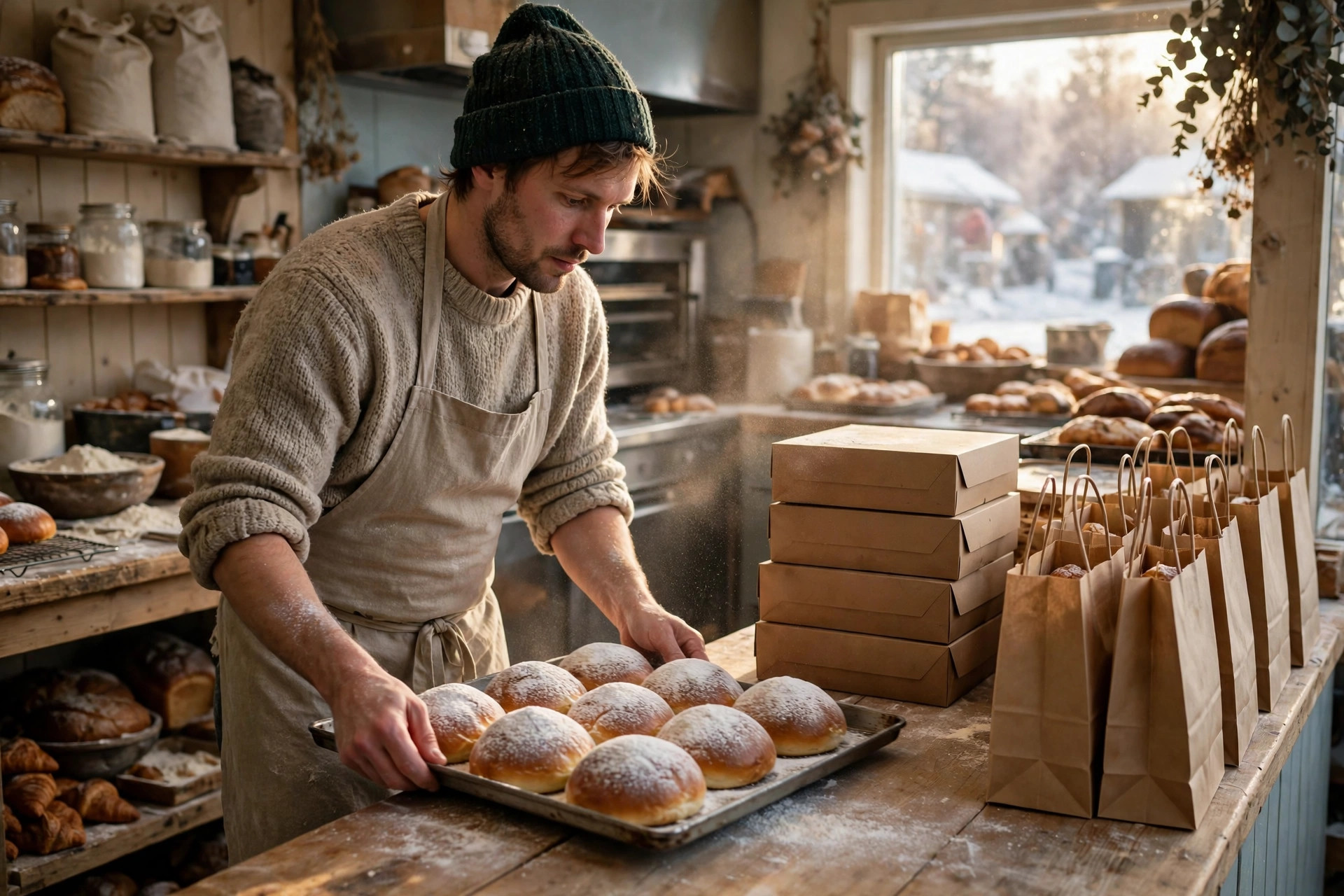
A pyramid of fresh semlor in the window is the best advertisement a bakery can run in February — better than any paid ad, because it sells to everyone walking past, not just followers. Merchandising for the season has one principle: make the bun impossible to ignore and the purchase impossible to postpone.
The window and the counter
Stack buns high and replenish visibly — a full display signals abundance, a half-empty one signals "almost gone", and both sell, but an empty tray sells nothing. Put the pre-order boxes where walk-ins can see them: a wall of labelled boxes ("Andersson — 24 buns — pickup 8:30") is social proof in cardboard form. It tells every walk-in customer that organised people ordered ahead, and that they should too — next year, or right now for the office. Keep one hero bun under a cloche or on a raised stand with a small card naming it ("This year's signature: brown-butter almond semla") — the single most-photographed object in the shop becomes free marketing when customers post it.
Bundle the coffee, double the ticket
The bun rarely travels alone. A "semla + coffee" bundle at a small discount against the separate prices raises the average ticket while feeling like a deal — and it moves the customer from takeaway to sit-in, where the second coffee happens. For offices, the bundle is the box: 10 buns plus a thermos of filter coffee, priced as a meeting package. Train staff on the two-sentence upsell ("The buns are warm — coffee to go with the box?") and measure it; the attach rate on a well-trained team during the season can double the revenue per bun sold. Our food photography basics guide covers how to shoot the bundle so it sells online too — the box photo is what offices forward to each other.
Sell the second bun at the till
The highest-margin moment of the whole season is the customer already holding one bun. "One for now, a box of four for home?" works because the product is at its most desirable in hand, warm and fragrant. Position takeaway boxes of 2, 4 and 6 at the till — not across the shop — with clear per-box pricing. The family box is also your defence against the supermarket: nobody buys a supermarket six-pack as a gift, but a beautiful box from the neighbourhood bakery absolutely travels to grandparents.
The four-week marketing timeline
Shrove Tuesday marketing fails in two ways: starting too late, or posting into the void without a page to land on. The timeline below assumes the season announcement went out in early January; these four weeks are the conversion push.
Four weeks out: the landing page and the email
Publish the dedicated semla page on your website first — before the first social post, before the email. The page needs: the bun (photo, description, the story), the variants and prices, the pre-order form with the deadline, pickup and delivery details, and the office box offer. This page is what Google shows when someone searches "best semla [your city]" or "semla pre-order [your city]", what AI assistants quote, and what every later post links to. Then email your list: one email, subject line with the bun's name in it, the deadline in the first paragraph. Email outperforms social for pre-orders because it reaches people who already buy from you, with a link they can act on immediately — which is why building the email list in the quiet months pays off in February.
Two weeks out: proof and press
Now the content shifts from announcement to evidence: the first batch out of the oven (video, steam, the lid going on), the growing wall of pre-order boxes, a regular customer quoted on why this year's bun is the best yet. Send tasting boxes to local food writers, neighbourhood Instagram accounts and the office managers who ordered last year — the cost of a dozen buns buys coverage that paid ads cannot. Post a Google Business Profile update with the pre-order deadline; it reaches people searching for you right now, not just followers. If local media run their annual semla ranking, make sure you are in it — entering is usually just a matter of delivering buns to the right newsroom at the right time.
Peak week: scarcity and momentum
Daily updates, short and factual: "Tuesday pre-orders close tomorrow at noon", "Wednesday: 40 boxes already out the door", "Thursday: final pre-order slots for Tuesday". Scarcity is honest here — production capacity is genuinely finite — so say the numbers plainly. The day before, post the plan ("doors open 7:30, pre-order pickups at the side counter, walk-in buns until sold out") so the morning runs itself. On the day: one morning post, one sold-out post. The sold-out post is not an apology; it is next year's marketing, already written.
The sell-out checklist
Plan the sell-out deliberately: decide in advance what "sold out" means (no buns left, or pre-orders closed but walk-ins continue?), write the sign before the rush, photograph the empty trays, and post it with thanks — not apology. A planned sell-out at 1pm with a "see you next year" message builds more demand than limping to closing time with a sad half-tray. Then write down the numbers the same evening: total buns, pre-order share, sell-out time, waste count. That note is next January's plan.
Production planning for peak day
Peak-day production is a logistics exercise with cream. The plan starts from the pre-order count (known 48 hours out), adds the walk-in forecast (last year's number adjusted for this year's marketing), and schedules baking in waves so buns are filled close to sale — because a cream-filled bun is at its best within hours, and food-safety rules limit how long filled buns can sit at room temperature.
Waves, not mountains
Bake the buns in two or three waves through the morning; fill each wave to order as much as staffing allows. The cream is the bottleneck — it must be whipped in batches, kept cold, and piped or spooned efficiently — so the filling station, not the oven, sets the pace. Assign one person to filling and one to boxing during the rush; the moment your best baker is answering the phone, the line slows. Pre-assemble the dry components (lids cut, almond paste portioned) the evening before. And brief the whole team on the single most important quality rule of the day: a bun filled two hours ago beats a bun filled six hours ago, every time.
Staff the rush, not the average
Shrove Tuesday staffing should follow the demand curve, not the rota template: heavy from 7am to 1pm, normal after. The two critical windows are the pre-order pickup rush (7:30–9:30, offices) and the lunch surge (11:00–13:00, walk-ins). If you can only add shifts in one place, add them to the counter and the packing table — production can be front-loaded, but the customer-facing crunch cannot. Feed the team well and early; a crew running on cold coffee makes slow, mistakes-prone hands, and the day is long enough without that.
Have a plan for the almost-sold-out hour
Decide before the day: when the last tray is getting low, do you ration ("two per customer") or sell through? Rationing stretches availability and feels fair; selling through creates the clean sell-out story. Either is defensible — what is not defensible is deciding while a queue watches. And keep a small reserve unadvertised for the pre-order customer stuck in traffic; the goodwill of honouring a late pickup outweighs the revenue of one extra walk-in sale.
Beyond the bun: the savoury side
Not every venue bakes. Restaurants, lunch spots and bars can still ride the Shrove Tuesday wave — the day has a savoury tradition too, and the bun works as a dessert course even where no bakery operates.
The pea soup lunch
In Finland, Shrove Tuesday lunch traditionally means pea soup (hernekeitto) followed by the bun; in Sweden the Thursday pea-soup-and-pancakes rhythm bleeds across the whole week. A restaurant that puts a proper pea soup with mustard and marjoram on the lunch menu for the week, finished with a semla for dessert, gives office workers a complete Shrove Tuesday without anyone baking at home. Price it as a fixed lunch — soup, bread, bun and coffee — and market it to the same offices buying bun boxes. The soup costs little, the perceived value is high, and the tables turn fast at lunch.
The deconstructed semla dessert
A genuine trend in Nordic restaurants: the semla as a plated dessert — cardamom ice cream, almond cake, whipped cream, a shard of bun tuile. It lets a dinner restaurant participate in the season's conversation without a bakery line, and it photographs beautifully for the evening crowd that never sees the morning bun rush. Put it on the menu for the two weeks around the day, name it honestly ("our semla dessert"), and watch it become the most-ordered sweet of the fortnight. Guests who would never queue at a bakery at 8am will absolutely order the idea of a semla at 8pm.
Bars: the semla cocktail hour
Cardamom, almond and cream are a flavour profile, not just a bun. A Shrove Tuesday cocktail special — a cardamom old fashioned, an almond-white Russian twist — gives bars a low-effort way into the season's social media conversation. It will not make the quarter, but it costs one menu line and it makes the venue feel alive in a week when everyone is talking about buns.
After the rush: keeping the customer
The season's most underused asset is the customer list it creates. Every pre-order form, every office delivery, every "notify me next year" signup is a direct line to someone who buys seasonally — the most valuable kind of customer, because seasonal buyers return without being convinced.
Capture now, convert in spring
The pre-order form should include an opt-in checkbox for the newsletter (GDPR-clean, unchecked by default, one clear sentence about what they will receive). The week after Shrove Tuesday, send one email: thank you, the numbers if you are proud of them ("2,400 buns, sold out by 1pm"), and the next thing to look forward to — Easter, the spring menu, the terrace season. That single email converts a once-a-year bun buyer into a year-round contact. Then use the quiet weeks well: our win-back campaigns guide covers how to re-engage the customers who only appear for the big seasons.
Debrief while it is fresh
Within a week, write the one-page debrief: total buns sold, pre-order share, sell-out time, waste count, what the best-selling variant was, which office orders came back, what broke (the cream station? the phone? the box supply?). File it where January-you will find it. The restaurants that improve every year are not smarter — they just write things down. Next year's plan is this year's debrief plus the date: Shrove Tuesday 2028 falls on 29 February, and the season announcement should go out in the first week of January.
Frequently asked questions
When is Shrove Tuesday in 2027?
Shrove Tuesday 2027 falls on 9 February 2027 — exactly 47 days before Easter Sunday (28 March 2027). In Sweden it is called fettisdagen, in Finland laskiaistiistai, and in Norway and Denmark feittirsdag/fastelavn. The semla sales season in the Nordics typically starts in early January, so the peak day is the finale of a six-week season, not a one-day event.
How many semla buns should a café bake for Shrove Tuesday?
Start from your pre-orders, then add a walk-in buffer based on last year's sales — typically 30–50% on top of pre-orders for an established café, more if you are in a high-footfall location. Bake in morning waves rather than all at once, because cream-filled buns have a short counter life. It is better to sell out at noon and take orders for the next day than to throw away a third of the batch at closing.
What should a semla cost in a café?
Typical Nordic café prices for a classic semla run €4.50–7.00 (estimates; higher in Norway and Denmark, lower in smaller Finnish towns). Cost the bun from your actual supplier invoices — flour, cardamom, almond paste, cream, labour and packaging — and aim for at least a 60% gross margin. Premium versions with better almond paste or a signature twist can carry €7–9 without resistance on the peak day itself.
Almond paste or jam — which semla filling sells better?
It depends on your market. In Sweden, almond paste is the default and jam versions are the exception; in Finland the almond-versus-jam debate is a genuine cultural divide and many cafés sell both. The practical answer: lead with one signature version so your marketing has a clear hero, and offer the other as the alternative. Never let the debate paralyse you — indecision sells nothing.
How can a small café take semla pre-orders without expensive software?
A simple order form on your own website is enough: name, phone, quantity, pickup day and time slot. Take payment on pickup for small orders and ask for prepayment on office orders over 20 buns. Publish the form at least three weeks before the peak and close it 48 hours before Shrove Tuesday so production can be planned. If your website makes this hard, that is the bottleneck to fix — a café site should let you publish an order page in minutes.
Want a website that sells your semlor while you bake?
PowerfulWebsite builds your café or restaurant's website for free — you only pay from €59/mo. Everything included: domain, hosting, maintenance and updates. Publish a pre-order page in minutes, take the season's orders online, and let Google send you the customers.
See the plans