Turning Delivery Customers Into Dine-In Guests
Your delivery customers already like your food — that is the hardest part of the sale, and it is done. The job now is to give them one good reason to eat it at your table instead of on their sofa, and one easy way to book. Do that consistently, and a meaningful share of your delivery base becomes dine-in regulars.
Key takeaways
- 62% of delivery customers later dine in at the same restaurant — the crossover is real, and it runs in your favour.
- A dine-in guest is typically worth far more per visit than a delivery order: drinks, desserts and a second course, with no 25–30% platform commission.
- The delivery bag is your cheapest conversion channel — one card, one offer, one QR code, in every order.
- Dine-in-only exclusives beat discounts: dishes, drinks and experiences that simply do not exist on the apps.
- One loyalty programme must cover both channels, or you are running two businesses that never meet.
- Capture contact details on your own ordering page — the platforms will not share theirs.
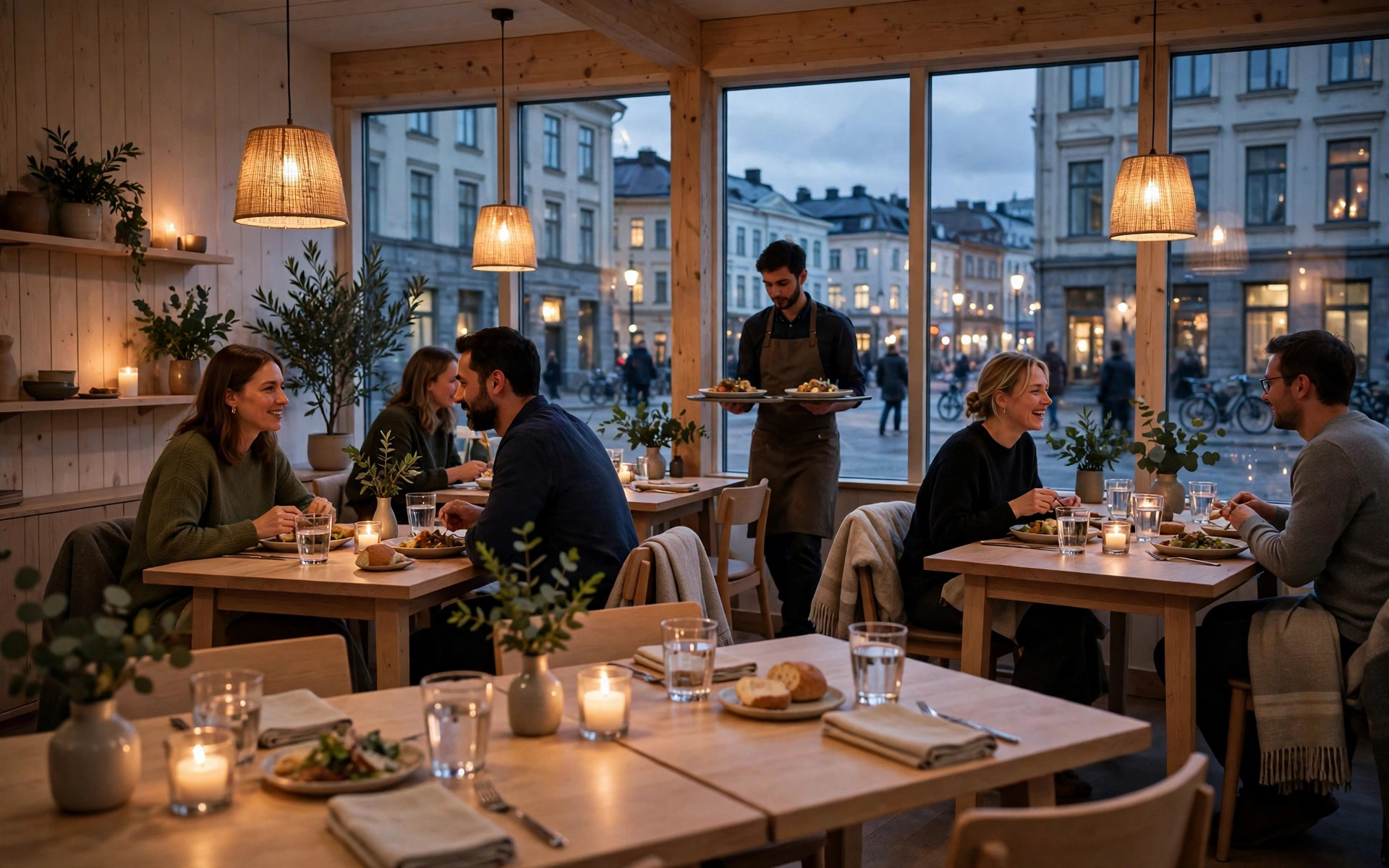
Every week, people who have never set foot in your restaurant eat your food. They found you on Wolt, Foodora or Uber Eats, they paid, they ate, and many of them came back and ordered again. They are, by any honest definition, your customers. They just happen to be customers you have never seen, never greeted, and never had the chance to sell a second glass of wine to.
This article is about closing that gap. Not by abandoning delivery — delivery pays the rent for a lot of Nordic restaurants — but by treating it as what it actually is: the top of your funnel. The platforms are very good at finding people who want your food tonight. Your job is to turn a share of those people into guests who book a table, bring friends, and spend a full evening with you. What follows is the whole system: the economics, the bag insert, the dine-in-only offer, the loyalty loop, the data capture, the first visit, and how to measure whether any of it is working.
Why delivery customers are your best dine-in prospects
Most restaurant marketing starts with strangers: ads, social posts, and search results aimed at people who have never tasted anything you make. Converting a delivery customer is the opposite problem. They have already tried the product, already decided they like it enough to pay for it, and already come back. The only thing they have not done is walk through your door — and in many cases that is an accident of habit, not a decision.
The numbers back this up. According to the 2026 DoorDash and SevenRooms Restaurant Industry Trends Report, 62% of delivery customers later dine in at the same restaurant, and 74% of dine-in customers later order delivery from the same place. Read that again: nearly two in three people who order your food to their home will, at some point, sit down in your dining room — if you give them a reason and make it easy. Cross-channel customers, people who both order in and eat out, are the highest-value segment a restaurant can have. They spend more, they come back more often, and they are far less likely to drift to a competitor, because they have two different relationships with you instead of one.
Compare that with cold acquisition. Industry estimates commonly put the cost of winning a brand-new customer at five to seven times the cost of keeping an existing one. A delivery customer costs you nothing extra to reach — you already cook for them every week. The conversion question is therefore not "how do I find new guests?" but "how do I invite the guests I already have?"
The trust is already built
Think about what a first-time dine-in guest has to overcome: finding you, trusting the reviews, choosing from an unknown menu, committing an evening. A delivery customer has cleared all of that except the evening itself. They know the food travels well, they know the price, they know what they like. When they finally visit, they are not taking a chance — they are upgrading an experience they already enjoy. That is why the first visit converts so well, and why the invitation matters more than the incentive.
But the platforms will not do it for you
Here is the catch. Wolt, Foodora and Uber Eats have no interest in sending your customers to your dining room. Their business is the order in the app, and every guest who starts booking directly is a guest they lose. They will not tell your delivery customers about your dining room, your seasonal menu, or your Friday tasting evening. They will not share the customer's email address with you either, which means you cannot invite them yourself unless you build your own channel. That is the structural problem this article solves: the platform owns the relationship until you deliberately take it back, one bag insert and one direct order at a time.
The economics: why a dine-in guest is worth more
Before spending anything on conversion, it helps to know what a converted guest is actually worth. The gap between a delivery order and a dine-in visit is bigger than most owners realise, and it comes from three directions at once: the commission disappears, the bill grows, and the guest becomes reachable.
Start with the commission. On the major platforms, full marketplace delivery typically costs 25–30% of the order value in the Nordics — delivery commissions, and what they really cost, are covered in detail in our earlier guide, and Helsingin Sanomat has reported Wolt commissions of around a third of each order's price. On a €30 delivery order, that is roughly €8–9 leaving your business before food, labour, packaging and rent are paid. A dine-in guest ordering the same €30 of food pays no commission at all. The same kitchen, the same dish, the same evening — and roughly a third more of the money stays with you.
Then the bill itself grows. A delivery order is usually one main course per person, chosen in a hurry, with no drinks, no dessert and no second round. A seated guest orders differently: a starter to share, a glass of wine, a dessert, a coffee. Even a modest lift — one drink and one shared dessert per table — can add 30–50% to the value of the visit. And because the guest is in the room, your staff can do what no app screen can: suggest, upsell, and notice the empty glass.
Finally, a dine-in guest is a guest you can reach again. You can invite them back by email, remind them about the Christmas menu, or tell them the terrace is open. A delivery-platform customer is reachable only through the platform's feed, competing with every other restaurant in the city. The lifetime value difference is not a rounding error; it is the difference between renting your customers and owning them.
| Per guest visit | Delivery order (via platform) | Dine-in visit |
|---|---|---|
| Typical spend per person | €25–35 (one main course) | €35–55 (starter, main, drink, often dessert) |
| Platform commission | 25–30% of the order | €0 |
| Packaging cost | €1–2 per order | €0 |
| Drinks and extras | Rarely ordered | Common — the highest-margin items on the menu |
| Customer data captured | No — the platform keeps it | Yes — booking, loyalty, email |
| Can you invite them back? | Only through the platform | Directly, by email or SMS, at no cost |
| Margin left per €30 of food | Roughly €21 before food and labour costs | Roughly €30 before food and labour costs |
Figures are typical estimates for a small Nordic restaurant in 2026, not a promise — run the same table with your own prices and your own platform contract. The direction of the gap is what matters, and it holds in every version of the maths.
The 62% rule
According to the 2026 DoorDash and SevenRooms report, 62% of delivery customers later dine in at the same restaurant. You do not need to persuade strangers — you need to invite people who already like you. Every delivery bag that leaves your kitchen without an invitation is a missed chance to start that visit.
What stops delivery customers from coming in
If the crossover is so natural, why do so many delivery customers never visit? The answer is rarely that they dislike the idea. It is that nothing has ever asked them to, and several small frictions stand in the way. Understanding those frictions is the whole game, because each one has a cheap fix.
They do not know what they are missing
A delivery customer knows your food. They do not know your room, your atmosphere, your wine list, or the dish that only exists on the dine-in menu. From their sofa, your restaurant is a logo in an app and a bag on the doorstep. They have no mental picture of the evening you are selling, and people do not book evenings they cannot picture. This is why photography matters so much in the invitation: a real photo of the dining room does more work than any discount.
Habit is stronger than curiosity
Ordering delivery is a habit, usually tied to a specific moment: the tired Tuesday, the Friday night in, the working lunch. Habits do not break themselves. A customer can love your food for two years and never once think "I should go there", because the app has trained them to think of you as a button, not a place. The invitation has to interrupt the habit — and it has to arrive at the right moment, which is when the food is in front of them and they are enjoying it. That is why the bag insert outperforms every other channel: it reaches the customer at the single moment they are happiest with you.
The booking step feels like effort
Finally, there is friction. If the path from "I fancy going there" to a confirmed table involves finding your website, hunting for opening hours, and phoning during service, most people will not bother. The invitation must end in one tap: a QR code that opens your booking page with the date picker already visible, or a link that books a table in under a minute. Every extra step loses people. Test the journey yourself on your phone, on a Friday evening, with one thumb. If it takes more than a minute, fix it before you print a single card.
Your delivery customers are not strangers. They are regulars who have never been greeted — and the invitation costs less than the bag their food arrived in.
The delivery bag: your best conversion channel
Every delivery order that leaves your kitchen is a piece of direct mail that you do not have to pay postage for, delivered to a proven customer at the exact moment they are eating your food. Nothing else in your marketing reaches the right person at the right moment so cheaply. A printed card costs roughly €0.05–0.15 per unit in a small print run (an estimate — get a quote from your local printer), and it lands in the hands of someone who has already paid you. The bag insert is the single highest-return tactic in this article, and it should be in every order from next week.
What goes on the card
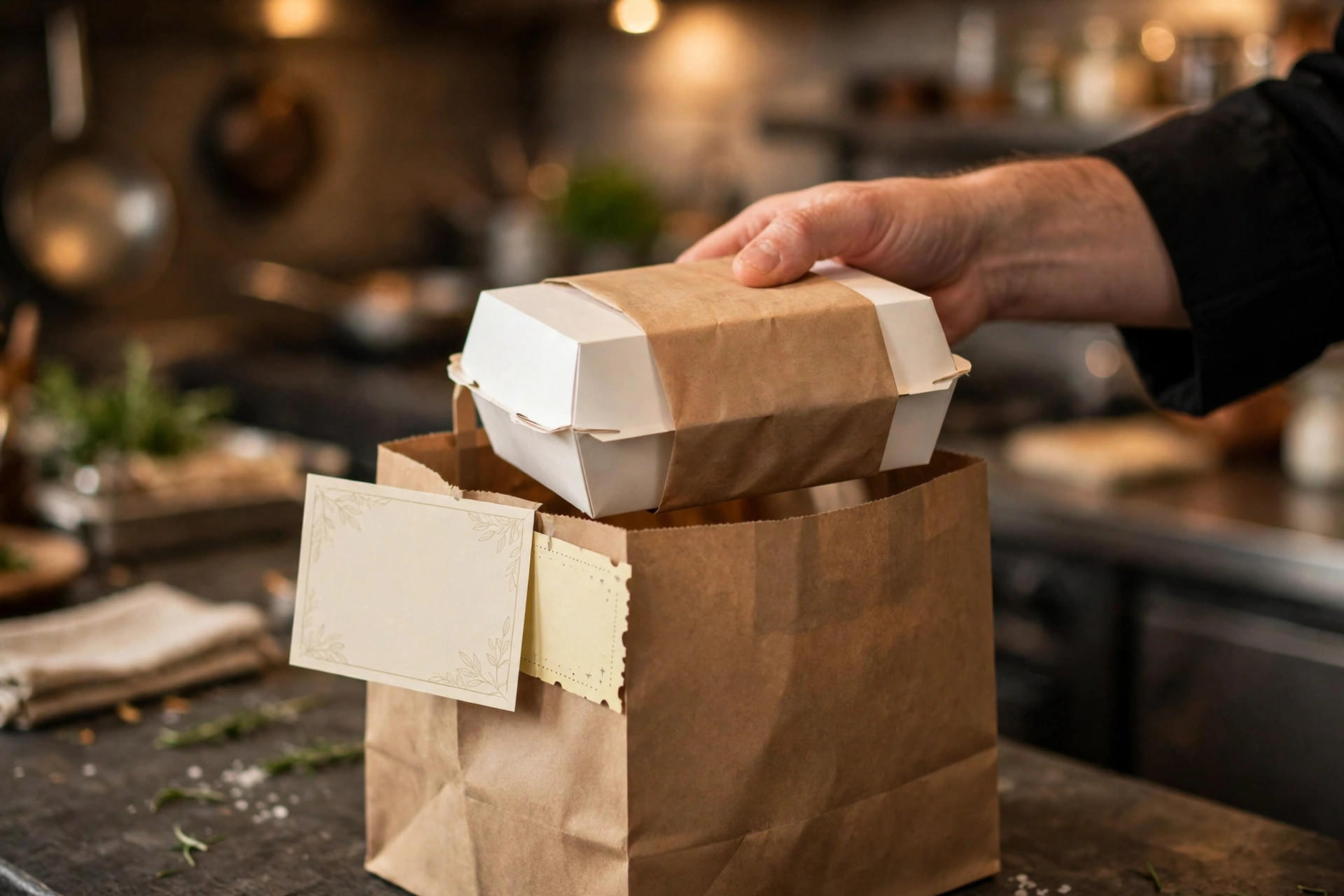
One card, one message, one action. The most common mistake is cramming the card with everything: the full menu, the opening hours, the loyalty scheme, the social accounts. A card that says everything says nothing, and it goes in the recycling. Keep it to four elements: a warm line ("Thanks for ordering — the dining room is even better"), one specific offer (a free dessert with a dine-in booking, or a starter on the house), one QR code that opens your booking page, and one short code word or link the guest shows at the table so you can count redemptions. That is all. If you want to say more, say it on your website, where the QR code leads.
Design and timing
Use a real photo of your dining room or your best plated dish — the same standard as your delivery photos — and print on decent card, not flimsy paper. The card is a physical object that represents your restaurant; a cheap-feeling card quietly tells the customer the visit will feel cheap too. Change the offer every couple of months so regulars notice something new, and always include an expiry date roughly six weeks out. A deadline turns "sometime" into "this month".
The receipt and the box can help too
If your platform allows a custom message on the receipt or the order, use it: "Book a table and show this order for a free dessert" costs nothing and reaches the same person twice. And if you use your own packaging for any part of the order, print the QR code on the box or the sticker. The principle is the same everywhere: every surface that travels to the customer should carry one invitation home — back to you.
Give them a reason only the dining room offers
An invitation works better when there is something to come for. The strongest reason is not a discount — it is something the customer simply cannot get delivered. If everything on your delivery menu is also on your dine-in menu, at the same price, in the same form, then the customer has no reason to leave the sofa. You need dine-in-only value, and it does not have to be elaborate.
Dishes that do not travel
Some dishes are better in the room, and everyone knows it. A wood-fired pizza eaten two minutes out of the oven, a steak rested and sliced at the table, a dessert that is assembled in front of the guest — these are experiences, not just calories, and they do not survive a twenty-minute bike ride. Build a small "only in the restaurant" section of the menu and name it clearly. Our guide to delivery menus and dishes that survive the trip covers the other side of the same decision: what travels, and what should stay in the room. When the bag insert mentions a dish that is not on the apps, curiosity does the selling for you.
Experiences, not just food
Beyond dishes, think about the evening itself. A Friday tasting menu, a wine flight with the sommelier's notes, a chef's table night once a month, a Sunday roast that is only served in the dining room. These do not need to be grand productions — a monthly themed evening with a fixed menu and a fixed price is enough to give regulars a date to put in the calendar. The point is that the dining room offers something the app cannot: an occasion. And occasions are what turn a delivery customer into a guest who books ahead and brings friends.
Price it honestly
One note on pricing: it is fine — and in Finland, since the competition authority's 2025 decision on Wolt, it is legal — to price your delivery menu differently from your dine-in menu. Many restaurants keep platform prices slightly higher to cover the commission, and dine-in prices lower. Say so plainly on the card if you do: "Dine-in prices are lower — no delivery commission to cover." Customers understand this immediately, and it reframes the visit as the smart choice rather than the expensive one.
Loyalty that works across both channels
A loyalty programme that only counts dine-in visits ignores half your customers, and one that only counts delivery orders never brings anyone through the door. The programme has to treat both channels as one relationship, and it has to reward the behaviour you actually want: the crossover.
One card, two channels
The simplest working model is a stamp or points system where delivery orders and dine-in visits both earn, but a dine-in visit earns more. For example, every order earns a stamp, every dine-in visit earns two, and eight stamps earn a free main course — in the restaurant. The delivery customer is already earning; the fastest way to the reward runs through your dining room. That asymmetry is the point. Compare the options properly before you commit — our comparison of restaurant loyalty programmes walks through stamp cards, points systems and paid memberships — but whatever you choose, it must work identically whether the guest orders on an app or sits at table six.
Keep the reward in the room
Where you let guests redeem matters as much as how they earn. A free dessert that can only be claimed in the restaurant is a reason to visit; a free dessert on a delivery order is just a discount on a sale you were already going to make. The same logic applies to birthday rewards, anniversary treats and "we miss you" offers: redeemable in the dining room, where the guest will also order a main course and a drink. The reward should be the excuse for the visit, not the whole visit.
Digital or paper?
A paper stamp card in the delivery bag is the lowest-friction start: no app to download, no account to create, and it sits in the customer's kitchen as a reminder. A digital programme — through your own ordering page or a simple loyalty tool — gives you data and lets you send reminders, but it asks the customer to do more. For most small restaurants, the practical answer is both: paper cards in the bag for everyone, and a digital option for the regulars who want it.
A loyalty scheme that only counts dine-in visits is a club for people who already come. The delivery customer earning stamps in the bag is the one you are actually trying to win.
Capture the data — GDPR-safe
None of this works at scale without contact details, and the platforms will not give you theirs. When a customer orders through Wolt or Foodora, the platform owns the email address, the phone number and the order history. You get a name, an order, and a payout. If you want to invite that customer back, you need your own list — built legally, with consent, under GDPR.
Your own ordering page is the capture point
The cleanest route is your own online ordering, on your own website, where the customer gives you their email address as part of the checkout. That is why having your own ordering system matters beyond the commission saving: it is the only channel where the customer relationship is actually yours. A direct order typically costs you no commission at all, and it hands you a consented email address you can use for invitations, seasonal menus and win-back offers. If you do not have direct ordering yet, the booking page and the loyalty sign-up are the next best capture points — the QR code in the bag should lead to one of them, not to a generic homepage.
What consent actually requires
Keep it simple and honest. At the point where the customer gives you their email, say what you will send and how often — "one email a month with the seasonal menu and the occasional invitation" — and include a clear unsubscribe link in every message. Never add platform customers to your list without their permission, never buy lists, and never use a phone number from a delivery order for marketing unless the customer has agreed. The full rules are in our GDPR-safe guide to building an email list from zero, and the same principles apply to loyalty data: collect only what you need, keep it secure, and delete it when the customer asks. Done properly, this is not a burden — it is the reason customers trust you with their inbox in the first place.
What to do with the list
A list you never email is worthless. Send one short message a month: the new seasonal dish, the Friday tasting evening, the Christmas booking window opening. And send one targeted invitation to the delivery segment: people who ordered in the last sixty days but have never booked a table. Keep the message short, lead with the food they already order, and end with one link to the booking page.
The first-visit playbook
Getting a delivery customer through the door once is only half the job. The first visit has to be good enough that the second one happens without an incentive. First visits are fragile: the guest arrives with expectations set by the delivery experience, and the room has to beat them.
Recognise them
When a guest books with the bag-insert code or mentions the offer, the table should know. A short note on the booking — "first visit, ordered delivery for a year" — lets the server greet them properly and perhaps mention the dish they always order. Recognition is the cheapest luxury in hospitality, and for a delivery customer it is the moment the restaurant stops being an app and becomes a place with people who know them. Train the team on this: the greeting matters more than the free dessert.
Make the room beat the sofa
The first visit is a comparison, whether the guest admits it or not. The food must arrive hotter, better plated and better timed than the delivered version. The room must feel worth leaving the house for: lighting, music, the smell of the kitchen, a server who notices the empty glass. Check the basics before you start inviting people in — the toilets, the temperature, the noise level on a full Friday. A guest who comes once and finds a cold room or a forty-minute wait will go back to the app and stay there.
Close the loop before they leave
Before the guest leaves, give them the next reason to return: a card for the next visit, an invitation to the monthly tasting evening, or a simple "your usual table is free next Friday, shall I book it?" The second visit is always easier to win at the end of the first than by email a week later. And if the guest had a good time, ask — gently — whether they would leave a review. A first-time visitor who becomes a reviewer is doing your marketing for you, and their words will reach people no bag insert ever will.
The first-visit checklist
Before you scale the invitations, walk your own first-visit journey: scan the QR code from the bag insert, book a table on your phone, arrive as a stranger, and eat the dish your delivery customers order most. Fix anything that feels slow, confusing or cold. The invitation promises an evening — the room has to deliver it.
Measuring what works
A conversion system you do not measure is a hope, not a system. The good news is that the measurement here is simple, and it can be done with a notebook and a till, not a dashboard.
Three numbers, once a week
Track three things every week: how many bag inserts went out (roughly your delivery order count), how many bag codes were redeemed at the table, and how many of those guests booked a second visit within a month. The first ratio — redemptions per hundred inserts — tells you whether the invitation works. A realistic early result is 2–5 redemptions per hundred bags; if you are below that after a month, change the offer or the card before changing anything else. The second ratio — second visits per redeemed guest — tells you whether the room is doing its job. If guests come once and never return, the problem is not the invitation; it is the experience.
What a converted guest is worth
Do the maths once a quarter. Take the number of delivery customers who visited for the first time, multiply by your average dine-in spend per guest, and subtract the cost of the incentives you gave away. Then compare it with the commission you would have paid on the same food ordered through a platform. For most small restaurants, even a modest conversion rate — a few dozen guests a month — covers the cost of the cards, the desserts and the loyalty rewards several times over, because the margin on a dine-in visit is so much higher.
When to scale, and when to stop
Scale what works: if the bag insert converts, put the same invitation in your takeaway pickup bags, on the receipt, and in the follow-up email after a direct order. If a particular offer outperforms the others — the free dessert beats the 10% discount, say — make it the standard and test something new against it. And stop what does not work after a fair test: one offer, one month, at least a few hundred bags. Do not judge a tactic on a single quiet week. The goal is not to run every idea in this article; it is to find the two or three that convert your customers, and run them every week without fail.
Measure three numbers a week: inserts out, codes redeemed, second visits booked. Everything else is decoration — those three tell you whether the system works.
Frequently asked questions
How do you convert delivery customers into dine-in guests?
Put a reason to visit inside every delivery bag — a QR code or card offering a dine-in-only perk, such as a free dessert or a starter on the house. Then capture their contact details through your own ordering page or a loyalty programme, and follow up with an invitation timed to when they usually order. The conversion works because these customers already trust your food; you only have to sell them the room.
What percentage of delivery customers later dine in?
According to the 2026 DoorDash and SevenRooms Restaurant Industry Trends Report, 62% of delivery customers later dine in at the same restaurant, and 74% of dine-in customers later order delivery. Cross-channel customers — people who both order in and eat out — are the highest-value segment a restaurant can have.
Should I offer a discount to bring delivery customers in?
A small, one-time incentive works well — a free dessert, a complimentary starter, or 10% off the first dine-in bill. Avoid deep or permanent discounts: they train guests to wait for the next offer instead of valuing the visit. The goal is one funded first visit; the food and the room should earn the second.
Can I put flyers in Wolt or Foodora delivery bags?
Yes — the bag is yours once the order leaves your kitchen, and most restaurants include a card or flyer with every delivery. Keep it simple: one card, one offer, one QR code. Check your current platform agreement for any clause about directing customers off-platform, and keep the wording about your restaurant rather than criticising the platform.
How do I track which delivery customers visit my restaurant?
Use a single redeemable code or QR link that only exists in the delivery bag, and count redemptions at the till. If you run a loyalty programme, give delivery customers a way to join it from the bag insert, and tag their first dine-in visit. Over a month you will see exactly how many bag inserts turn into seated guests — and what each one cost you.
How long does it take to convert delivery customers to dine-in?
Expect the first redemptions within two to three weeks of putting inserts in every bag, and a steady flow within six to eight weeks. Delivery customers order on habit, so the invitation needs to reach them two or three times before it works. Measure weekly, keep the offer the same for at least a month, and only then judge whether it is working.
Want a website that turns delivery customers into table bookings?
PowerfulWebsite builds your restaurant website free of build cost — you only pay from €59 a month, or €239 a month for the Restaurant plan with its own commission-free ordering system. Everything is included: domain, hosting, maintenance, and updates.
See the packages