YouTube for Restaurants: Long-Form Video That Works
Long-form YouTube video is the only social format that keeps working for years: a good 5-minute video about your kitchen can still be sending customers to your booking page two years after you publish it. One long video a month, filmed with a phone during a normal service, is enough — if you pick the right format and title it for what hungry locals actually search for.
Key takeaways
- YouTube is a search engine, not a feed. Videos rank for what locals type — "best pizza in Turku", "how to make ramen" — and keep working for years, while TikTok clips fade in weeks.
- The sweet spot for restaurant long-form is 3–10 minutes: long enough to show a real process, short enough to finish.
- One filming session a month feeds both formats: a long video for trust, and several Shorts cut from the same footage for discovery.
- The starter kit is a phone, a tripod and a clip-on microphone — roughly €100–€200. Sound matters more than camera quality.
- Judge success by bookings and watch time, not views. Five hundred local views and five bookings beat 50,000 views from people who will never visit.
Ask a restaurant owner where their customers come from and you will hear the same list: Google, word of mouth, a review site, Instagram. YouTube rarely makes the list, and that is exactly why it is worth a closer look. While every other restaurant in your city fights for the same crowded feed, YouTube sits there as the world's second-largest search engine — owned by the largest one, Google — with an audience that arrives with a question and types it in. "Best sushi in Stockholm." "How is Neapolitan pizza actually made?" "What does a tasting menu look like?" The restaurant that answers those questions on video shows up at the precise moment someone is deciding where to eat.
The catch, and the reason most restaurants never start, is that YouTube feels like a big commitment. TikTok takes thirty seconds to film; a YouTube video sounds like a production. It is not. The long-form videos that work for restaurants are not productions. They are a phone on a tripod during a service you were already running, edited down to five honest minutes. This guide covers what to film, how long it should be, what it costs, how to get found, and how to fit it into a month without hiring anyone.
Why YouTube is different from TikTok and Instagram
Every platform rewards something different, and the difference decides what your videos are for. TikTok and Instagram Reels reward novelty and volume: the algorithm shows your clip to strangers, watches whether they finish it, and either pushes it further or drops it. A clip that works can reach tens of thousands of people in 48 hours — and be largely invisible a month later. That is a discovery engine, and it is genuinely powerful for a restaurant with no audience. But it is rented attention: you have to keep feeding it, several times a week, forever.
YouTube rewards something else: answers. People go there with a question, and the platform's job is to return the best answer. When your video is the best answer to "how to make fresh pasta" or "best brunch in Helsinki", it keeps getting shown — not for a week, but for months and years. A video you make this month can still be quietly sending you customers two years from now. Most social posts have the lifespan of a mayfly; a YouTube video is a small library of answers that gets found over and over. That compounding effect is the whole reason the format is worth a restaurant's time.
There is a second difference that matters just as much: audience. TikTok skews young — heavily 18–34, though the audience has aged in the past two years. Instagram sits roughly at 25–44. YouTube reaches everyone from 18 to 65 and beyond, which matches a restaurant's actual dining room far better than any other platform. If your core customers are 40-plus — the people who book the tasting menu, the private dining room, the Christmas party — YouTube is where they already spend their evenings.
None of this means abandoning short-form video. It means understanding the division of labour. Short clips get you found; long videos get you trusted. A Short brings a stranger in; a long video convinces them you are the right restaurant. The two formats feed each other, and the smartest small restaurants run both from the same footage — which is the subject of section four.
What "long-form" means for a restaurant
"Long-form" sounds intimidating until you put numbers on it. For a restaurant, long-form means anything over about three minutes, and the practical sweet spot is 3–10 minutes. That is long enough to show a full process — a dish from raw ingredients to the pass, a tour of the dining room, a conversation with a supplier — and short enough that a viewer deciding where to eat will watch to the end. Under three minutes, you are making a Short with extra steps. Over ten minutes, you need a genuinely strong story to hold attention: a full dinner service, a chef interview with real substance, a seasonal menu built from scratch.
The length question is really a retention question. YouTube promotes videos that people finish, or at least watch most of. A five-minute video that half your viewers finish outperforms a twenty-minute video that everyone abandons after ninety seconds. For a restaurant, that has a practical consequence: cut ruthlessly. The interesting part of making a dish is about four minutes long; the rest is waiting, chopping and cleaning, and nobody needs to watch that.
There is also a production question hiding inside the length question: how much can you film in one session? A realistic answer for a working restaurant is one long video per filming session, built from one idea. "How we make our signature ragu" is one session. "A day in the life of our kitchen" is one session. Trying to film three long videos in one afternoon produces three thin videos and an exhausted team. One idea, one session, one video — and then the Shorts, which come free from the same footage.
The three lengths that cover everything
It helps to think in three buckets. Shorts, under 60 seconds, are for discovery: one moment, one dish, one hook. Medium videos, 3–10 minutes, are the workhorses: one process, one story, one answer to a real search. Long videos, 10–30 minutes, are for the occasions that deserve them: a full service, a documentary-style supplier visit, a chef's story. Most restaurants will live almost entirely in the middle bucket, with an occasional long video when the occasion is genuinely special. That is not a compromise; it is the format that fits the business.
Eight long-form formats that work
The formats that work share three traits: they show something real, they answer a question a local would actually type into a search box, and they can be filmed during work you were already doing. Here are the eight, roughly in order of how easy they are to start.
1. How we make our signature dish
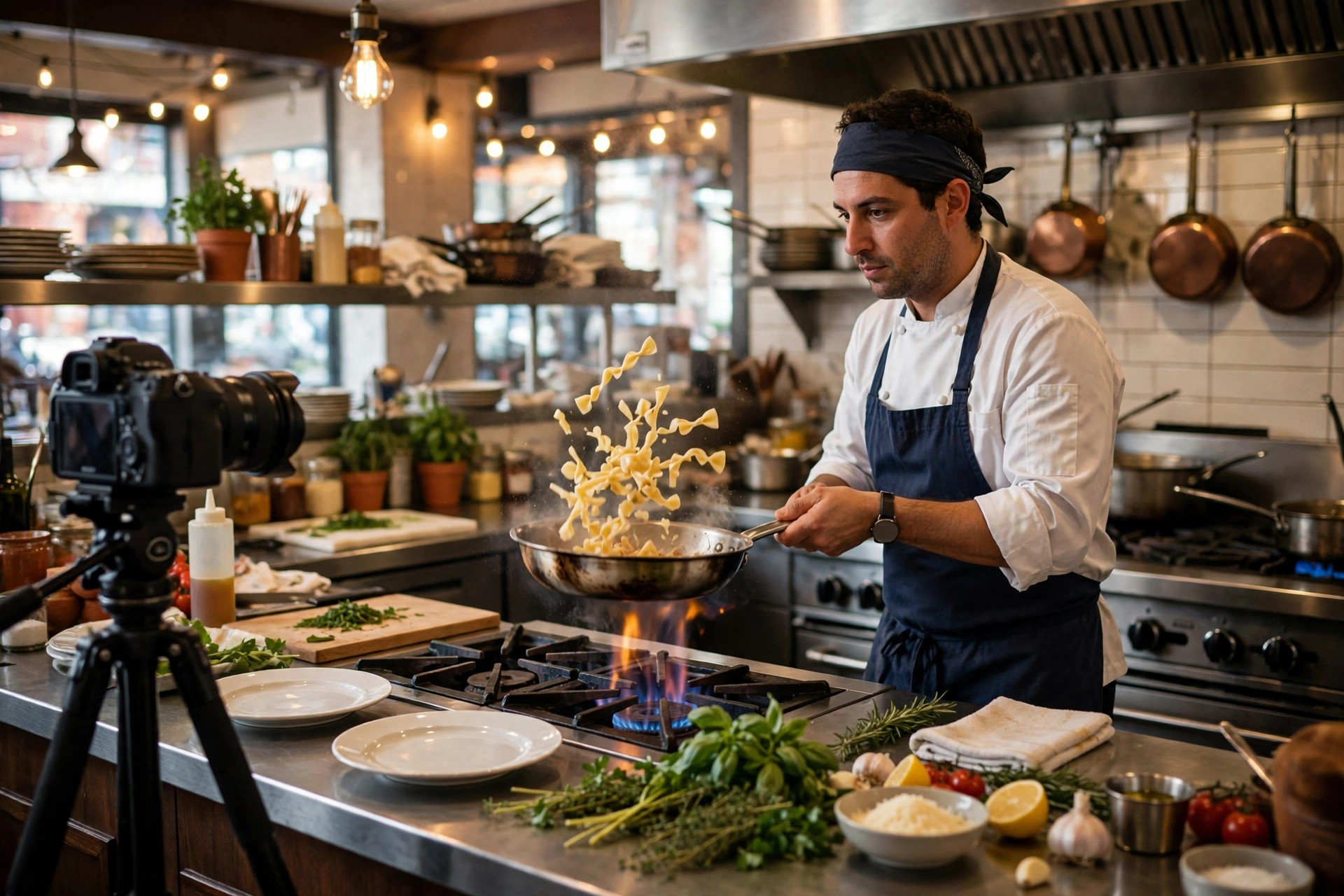
The single best first video for almost any restaurant. Pick the dish people ask about, film the full process in 5–8 minutes, and let the cooking carry the video. No script needed: the chef works, someone asks one or two questions off camera, the dish gets plated at the end. This format ranks well in search because people search for dishes, not restaurants — "how to make fresh tagliatelle" brings in viewers who have never heard of you. Film it in the morning prep, when the kitchen is calm and the light is good.
2. A day in the life of the kitchen
A 5–10 minute walk through one service, from the first delivery to the last table. This is the format that builds the most trust, because it shows competence: the organisation, the calm under pressure, the care in the details. It also answers the question every potential guest has but never asks — "is this place run properly?" Keep it honest: a busy service is more interesting than a staged one, and a small mistake handled well is more reassuring than perfection.
3. The chef interview: why this restaurant exists
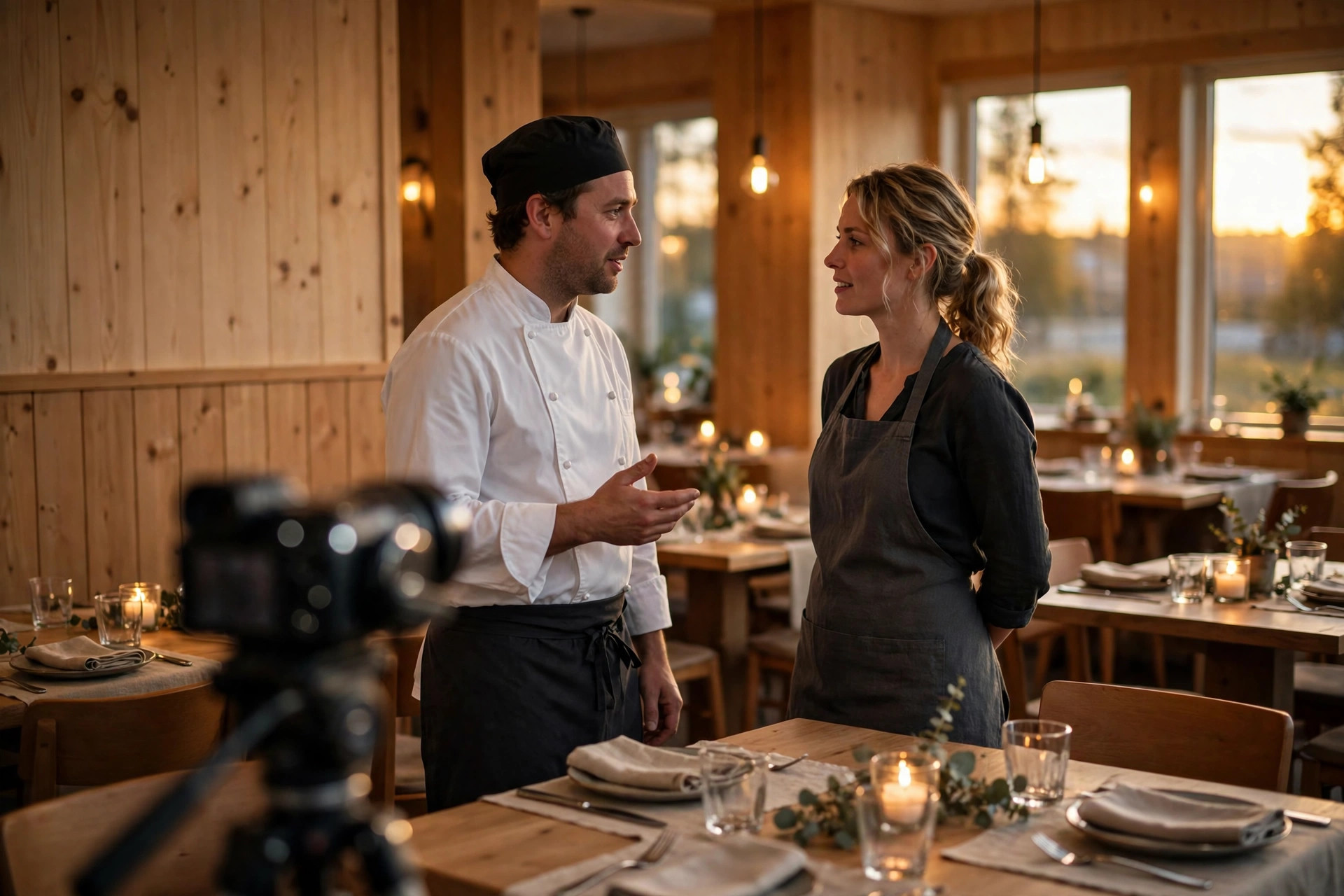
Three to eight minutes, one camera, one conversation. Why did the chef open this place? What is the food trying to be? What does the city get wrong about this cuisine? This is the video that turns a restaurant from a listing into a story, and it is the one that gets shared — by the chef's friends, by local food writers, by regulars who feel part of something.
4. Where our food comes from
Visit a supplier — a fishmonger, a farm, a bakery — and film the trip. Five minutes, outdoors, genuinely interesting, and it does two jobs at once: it proves the sourcing claims on your menu, and it gives the supplier a reason to share the video with their own audience. Ask permission, bring a microphone, and let the supplier talk.
5. The seasonal menu preview
Each season, one video: what is new, why, and what it tastes like. This is the format that ties YouTube directly to bookings, because it gives regulars a reason to come back and gives new viewers a reason to book now rather than later. Keep it short — 3–5 minutes — and end with the practical details: when the menu starts, whether booking is needed, and the link. Seasonal videos also create a natural publishing rhythm: four long videos a year, one per season, is a channel.
6. The dining room tour and the private dining pitch
A slow walk through the room, filmed when it looks its best — candles lit, tables set, no guests. Three to five minutes, with the camera doing the work and a short voiceover explaining the space: how many it seats, what it is good for, the private dining room and what a group booking looks like. This video is not for casual viewers; it is for the person planning a birthday, a company dinner or a wedding, and it should live on your website as well as on YouTube. Our guide to video formats that work for restaurants covers the short-form versions of these ideas too.
7. The recipe video, done honestly
A full recipe, filmed properly, with quantities on screen. This is the format with the biggest search audience and the slowest payoff: recipe videos rank for years, but they attract home cooks, not all of whom will ever visit. The trick is to film the restaurant version — the real quantities, the real technique, the dish as you serve it — and to say so. Do not film a simplified home version and pretend it is the restaurant dish.
8. The event and the collaboration
Guest chef nights, wine tastings, a collaboration with a neighbouring bakery or brewery: film it, in 5–10 minutes, and publish within a week while it is still news. Event videos have a short shelf life but a high conversion rate, because they show a restaurant that is alive — things happen here, people gather here. They also give you a reason to email your list and post everywhere else: the video is the record, and the next event is the call to action.
The two-track strategy: one shoot, long video + Shorts
The two-track strategy is the single most useful idea in this article, because it solves the time problem. You do not make long videos and short videos separately. You film one session, and you cut two products from it: the long video, which builds trust and ranks in search, and three to five Shorts, which bring in new viewers.
Here is how it works in practice. You film the signature-dish video: eight minutes of cooking, from raw ingredients to the plated dish. While editing, you mark the moments that work on their own — the cheese pull, the flame, the final plating, the chef's one-sentence explanation of why the dish matters. Each of those moments becomes a Short: vertical crop, captions on, fifteen to forty-five seconds, published over the following two weeks. The same session also gives you the thumbnail still, the Instagram Reel, and the TikTok. One afternoon of filming, one long video, four Shorts, a month of posting. That is the maths that makes YouTube affordable for a working restaurant.
The editing matters more than the filming here. A long video and a Short are not the same edit: the Short needs a hook in the first two seconds, vertical framing, and captions, because most viewers watch without sound. AI editing tools — CapCut, Opus Clip and their competitors — now do much of this automatically: they find the best moments in a long video, cut them into vertical clips, and add captions in your language. Review the results before publishing — an automatic cut can land mid-sentence — but the time saving is real: what used to take an evening of editing now takes twenty minutes of checking. Our beginner's guide to TikTok for restaurants covers the short-form side in more detail, and the same clips work on Reels and Shorts with no extra filming.
A practical note on scheduling: publish the long video first, then release the Shorts over the following two weeks, each one pointing back to the full video. YouTube lets a Short link to a long video, and viewers who liked the thirty-second version are the most likely audience for the five-minute one. This sequencing also keeps your channel active between long videos without any extra filming — which is the whole point.
Titles, thumbnails and descriptions that get found
On YouTube, the title and the thumbnail do most of the heavy lifting — often more than the video itself. Before anyone watches a second of your cooking, those two things decide whether they click. And the click is only the first decision: the title also decides whether YouTube shows the video to the right people at all, because the title is what the search algorithm reads.
Write titles for humans who are searching, not for your ego. The formula that works for restaurants is simple: what it is, where it is, and why it matters. "How We Make Our Handmade Tagliatelle — Italian Restaurant in Turku" tells a searcher everything they need. "A Day at Our Restaurant" tells them nothing, and YouTube will show it to no one. Put the dish or the question first, the restaurant name second, and the city and cuisine third — because the city and the cuisine are what locals type. Keep titles under about 60 characters where you can, so they do not get cut off on a phone.
Thumbnails deserve the same care as the title, and the same rule: one clear image, one idea. A close-up of the finished dish, a face with a genuine expression, a moment of action — the flame, the pour, the pull. Avoid the two mistakes every small channel makes: a thumbnail that is just the restaurant logo, which nobody clicks, and a thumbnail crammed with text, which nobody can read at phone size. If you add text, keep it to three words or fewer, large and high-contrast. And never use a misleading thumbnail: a dish that is not in the video, a reaction that never happens. Viewers who feel tricked leave fast, and YouTube reads fast exits as a bad video.
Descriptions: the part everyone skips
The description is where search ranking is won or lost, and most restaurants leave it blank. Write two or three keyword-rich sentences first — what the video shows, the dish, the city, the cuisine — because those are what appear in search results. Then add the practical details: your address, your opening hours, the booking link, and a link to the menu. Then timestamps for the sections of the video, which help viewers navigate and help YouTube understand what the video covers. Finally, a short line pointing to the related Shorts. A good description takes five minutes and keeps working for as long as the video exists. It is also the place to put the practical information in your own language as well as English, if your audience is local: a Finnish, Swedish or Norwegian line with the address and hours costs nothing and helps local search.
The title checklist — before you publish
- Does the title say what the video shows, in the words a hungry local would type?
- Does it include the dish or the question first, and the city second?
- Is it under 60 characters, so it survives on a phone screen?
- Would you click it if you had never heard of your restaurant?
- Does the thumbnail show one clear thing — the dish, a face, a moment — with no more than three words of text?
The filming setup: what to buy and what to skip
The good news is that the filming setup for a restaurant YouTube channel is short, cheap and mostly things you already own. The bad news is that the one thing most owners skip — sound — is the one thing that matters most. Viewers forgive shaky footage and dim light. They do not forgive audio they cannot hear. Spend your money in this order: sound first, stability second, light third, camera last.
| Item | What it does | Typical price (estimate) | Do you need it now? |
|---|---|---|---|
| Your phone | Films in 4K, good enough for YouTube | €0 — you own it | Yes, start here |
| Clip-on microphone | Clear voice over kitchen noise | €30–€80 | Yes — buy this first |
| Small tripod + phone mount | Steady shots, hands free | €20–€50 | Yes |
| Basic LED light panel | Clean light for dark dining rooms | €40–€100 | Soon — after 3 videos |
| Phone gimbal | Smooth walking shots | €80–€150 | Later, if you film tours |
| Dedicated camera | Better image, interchangeable lenses | €500+ | No — after 10 videos |
| Editing software | Cut, captions, export | €0 (CapCut free) | Yes, free is fine |
The starter kit — phone, microphone, tripod — costs roughly €100–€200, and the ongoing cost is essentially zero: YouTube hosting is free, CapCut's free tier covers the editing, and your time is the only real expense. Compare that with a single professional video shoot, which in the Nordics typically costs €500–€2,000, and the case for starting with a phone is obvious. A professional shoot is worth it for one flagship video — the dining room tour that lives on your website, for example — but it is a poor way to start a channel you need to feed every month.
Filming in a working kitchen
A restaurant kitchen is a difficult place to film: steam, noise, heat, people moving fast in a small space. Three rules make it manageable. First, film in the morning prep, not during service — the light is better, the kitchen is calmer, and nobody is in the way. Second, shoot near a window for the food, and accept that the pass will be darker; a small LED panel aimed at the plate fixes most of it. Third, keep the camera out of the way: a tripod in a corner, filming the pass from one fixed angle, is worth more than a handheld camera weaving between cooks. Tell the team what you are filming and why, and get their agreement before anyone appears on camera — in Finland and the rest of the EU, filming staff is a workplace matter, not just a creative one, and consent should be explicit. Our guide to food photography with your phone covers the light and framing basics, which apply to video just as well.
How often to publish, and the time it takes
One long-form video a month is enough. That sentence is worth repeating, because the most common reason restaurant channels die is an unrealistic schedule set in the first enthusiastic week. Weekly long videos sound ambitious and are, for a business that also has to cook lunch. Monthly long videos are achievable, and they are frequent enough that YouTube keeps recommending your channel. Add two or three Shorts a week cut from the same footage, and the channel looks active without any extra filming.
The honest time budget for one monthly video is about four to six hours, spread across the month: an hour to plan and pick the idea, one to two hours to film, two hours to edit, and half an hour to publish — title, thumbnail, description, scheduling. The first video will take twice as long; the tenth will take half as long. The editing is where most of the time goes, and it is also where AI tools help most: automatic captions, automatic cutting of Shorts, and templates that remove the fiddly work.
Pick a fixed day for filming — the same quiet morning each month — and treat it like any other standing job in the restaurant. The channels that survive are not the ones with the best ideas; they are the ones with a date in the calendar. If a month is impossible, skip it without guilt: a channel with ten good videos published over a year outperforms a channel with four videos published in one frantic month and then abandoned. Consistency over a year beats intensity over a month, every time.
Measuring success: views, watch time and bookings
YouTube gives you more data than any other platform, and most of it is a distraction. Three numbers matter for a restaurant, and they are worth checking once a month, not once a day. The first is click-through rate: the percentage of people who see your thumbnail and click. Four percent or better is strong for a small channel; below two percent, the title or thumbnail is the problem, not the video. The second is average view duration: how long people actually watch. If viewers watch half the video or more, the content is working. If they leave in the first thirty seconds, the opening is the problem — start with the dish, not the introduction.
The third number is the one that actually pays: traffic to your website and bookings. YouTube Analytics shows how many viewers clicked the links in your description, and Google Analytics shows how many of them reached your booking page. Check the two together once a month. A video with 500 local views and five bookings is worth more than a video with 50,000 views from people who will never visit your city.
There is one more metric worth watching, and it is not in YouTube Analytics at all: what guests say. When a new guest mentions a video — "we saw the ragu video", "we came because of the supplier visit" — write it down. That is the most direct evidence the channel is working, and it is the evidence that justifies the next month's filming. Our guide to the five social media metrics that matter covers the same thinking across all your channels, and our Google Business Profile guide shows how video and local search reinforce each other: a strong profile gets the click, and a good video closes the decision.
Mistakes that kill a restaurant channel
Most restaurant YouTube channels do not fail because the videos are bad. They fail because of a handful of avoidable mistakes, and it is worth naming them before you start, because all of them are cheaper to prevent than to fix.
The first is the intro. A thirty-second animated logo, a slow pan of the dining room, a host saying "welcome back to the channel" to an audience that does not exist yet — all of it costs viewers. Start with the most interesting thing in the video: the flame, the finished dish, the sentence that makes someone stay. You have about five seconds before a viewer decides, and a logo does not survive five seconds.
The second is filming without a question in mind. A video that is just "our restaurant" has no audience, because nobody searches for it. A video that answers "how is our bread made" or "what does a tasting menu look like here" has an audience, because people search for those things every day. Before every shoot, write down the question in one sentence. If you cannot, do not film yet.
The third is ignoring the description and the booking link. A video that convinces a viewer and then gives them nowhere to go has done half the job. Every description should carry the address, the opening hours and the booking link, and the video itself should mention booking once, briefly, near the end. The booking link is the point of the channel; everything else is the argument for it.
The fourth is inconsistency of a different kind: publishing four videos in a month and then nothing for six. YouTube's algorithm, and your audience, both reward a channel that is alive. A monthly video, published on roughly the same day each month, builds a habit in viewers and in you.
And the fifth, the one that quietly kills the most channels: chasing views instead of bookings. A viral video about a gimmick — a giant burger, a stunt, a trend — can bring a hundred thousand views and not a single booking, because the audience it attracts is not your audience. A quiet video about your food, your suppliers and your room, watched by five hundred locals, is the channel working as intended. Measure the channel by the tables it fills, not by the numbers on the screen. If the website those viewers land on is slow, out of date or missing a booking button, fix that first — a video can only send people somewhere, and PowerfulWebsite builds restaurant websites free, from €59/mo, with the menu, the photos and the booking button in place.
Frequently asked questions
How long should a restaurant YouTube video be?
For most restaurants, 3–10 minutes is the sweet spot. That is long enough to show a full process — making a signature dish, a kitchen tour, a supplier visit — and short enough that a viewer deciding where to eat will watch to the end. Under 3 minutes, you might as well publish a Short. Over 10 minutes, you need a genuinely strong story, such as a full dinner service or a chef interview, to hold attention.
Is YouTube better than TikTok for restaurants?
They do different jobs. TikTok is the better discovery engine: a new account can reach thousands of strangers in days, but a video fades within weeks. YouTube is the better trust builder: videos rank in search, keep working for years, and reach every age group. The smartest setup is both — short clips for discovery, long videos for the viewers who want to know your restaurant properly before booking.
How often should a restaurant post on YouTube?
One long-form video a month is enough for most independent restaurants, plus two or three Shorts a week cut from the same footage. A monthly long video is achievable alongside a full service schedule, and it is frequent enough that YouTube keeps recommending your channel. Posting weekly is better if you can sustain it, but a monthly video you actually publish beats a weekly plan you abandon after three episodes.
What equipment does a restaurant need to film YouTube videos?
A modern phone, a small tripod, a clip-on microphone and a window. That is the whole starter kit, and it costs roughly €100–€200 if you own the phone already. Good sound matters more than a good camera: viewers forgive shaky footage but leave a video they cannot hear. Add a basic LED light for dark dining rooms, and only consider a dedicated camera after you have published ten videos and know you will keep going.
How do restaurants measure whether YouTube is working?
Watch three numbers: click-through rate on thumbnails (aim for 4% or better), average view duration (half the video or more is strong), and the traffic YouTube sends to your website or booking page, which you can see in YouTube Analytics and Google Analytics. Views alone are a weak signal. A video with 500 local views and five bookings beats a video with 50,000 views from people who will never visit your city.
Do I need to be on camera for restaurant YouTube videos?
No. Hands, food and the kitchen carry most restaurant videos perfectly well: a dish being made, a dining room being set, a supplier's farm. If nobody wants to talk to camera, use a voiceover recorded afterwards, or text on screen. What viewers need is a person behind the food, not necessarily a face — though a chef who enjoys talking on camera is a genuine advantage, because personality is the one thing competitors cannot copy.
Want a website that turns your videos into bookings?
PowerfulWebsite builds your restaurant's website free — you only pay from €59/mo. Everything included: domain, hosting, maintenance and updates, with your videos and menu presented to convert viewers into guests.
See the packages