Video for Restaurants: 5 Formats That Work
The restaurant videos that actually bring bookings are not adverts — they are proof: the kitchen at full speed, the dish up close, the people behind it. This guide covers the five formats that work for restaurants, where to post them, what they cost, and a one-hour-a-week workflow that keeps them coming without a marketing team.
Key takeaways
- Five formats cover nearly every restaurant's video needs: kitchen behind-the-scenes, signature dish showcases, staff stories, guest moments, and local/seasonal stories.
- Authentic phone footage usually outperforms polished adverts — honesty beats production value.
- Hook the viewer in the first three seconds; add captions, because most people watch with the sound off.
- Two to three videos a week beats a daily burst — consistency is the whole strategy.
- A complete DIY kit costs roughly €200–300 one-off; a phone you already own does the filming.
- Track bookings, not views: link every video to a booking page and ask new guests how they found you.
Here is the uncomfortable truth about most restaurant video marketing: it is made for the restaurant, not the guest. Slow pans across empty tables. A logo animation. A voiceover about "passion for flavour." Nobody watches it twice, and nobody books a table because of it. Meanwhile, a shaky fifteen-second phone clip of cheese being pulled off a pizza gets a million views and a queue out the door. The difference is not budget. It is that one video is an advert and the other is evidence.
Guests choose restaurants with their eyes, and they choose with a specific question in mind: what will it feel like to eat there? Every format in this guide answers that question directly. They are ranked by the only metric that matters to a working restaurant — bookings per hour of effort — and each one comes with exactly how to film it, where to post it, and what it costs. If you are starting from zero with short video, read the beginner's guide to TikTok for restaurants first; this guide assumes you know how to post and focuses on what to post.
Why video decides who books
A photo shows the dish. A video shows the experience — the sizzle, the steam, the room, the people — and experience is what a guest is actually buying. That is why short video has become the discovery layer for restaurants: a potential guest who has never heard of you can watch thirty seconds of your kitchen and feel like they already know the place. No other format compresses that much trust into that little time.
The platforms have also tilted the field toward small businesses. TikTok, Instagram Reels and YouTube Shorts all distribute video by interest rather than by follower count, which means a restaurant with forty followers can reach forty thousand local viewers if the video holds attention. The catch is the same for everyone: the first three seconds decide everything. If the viewer has not seen something interesting by second three — a flame, a pour, a face, a question on screen — they are gone, and the algorithm notes it.
One more structural advantage: video is the format guests create for you. Every table of under-thirties is already filming your food; the formats below include how to turn that free footage into marketing instead of just letting it happen. But start with what you control — your own camera, your own kitchen, your own people.
Format 1: behind-the-scenes kitchen clips
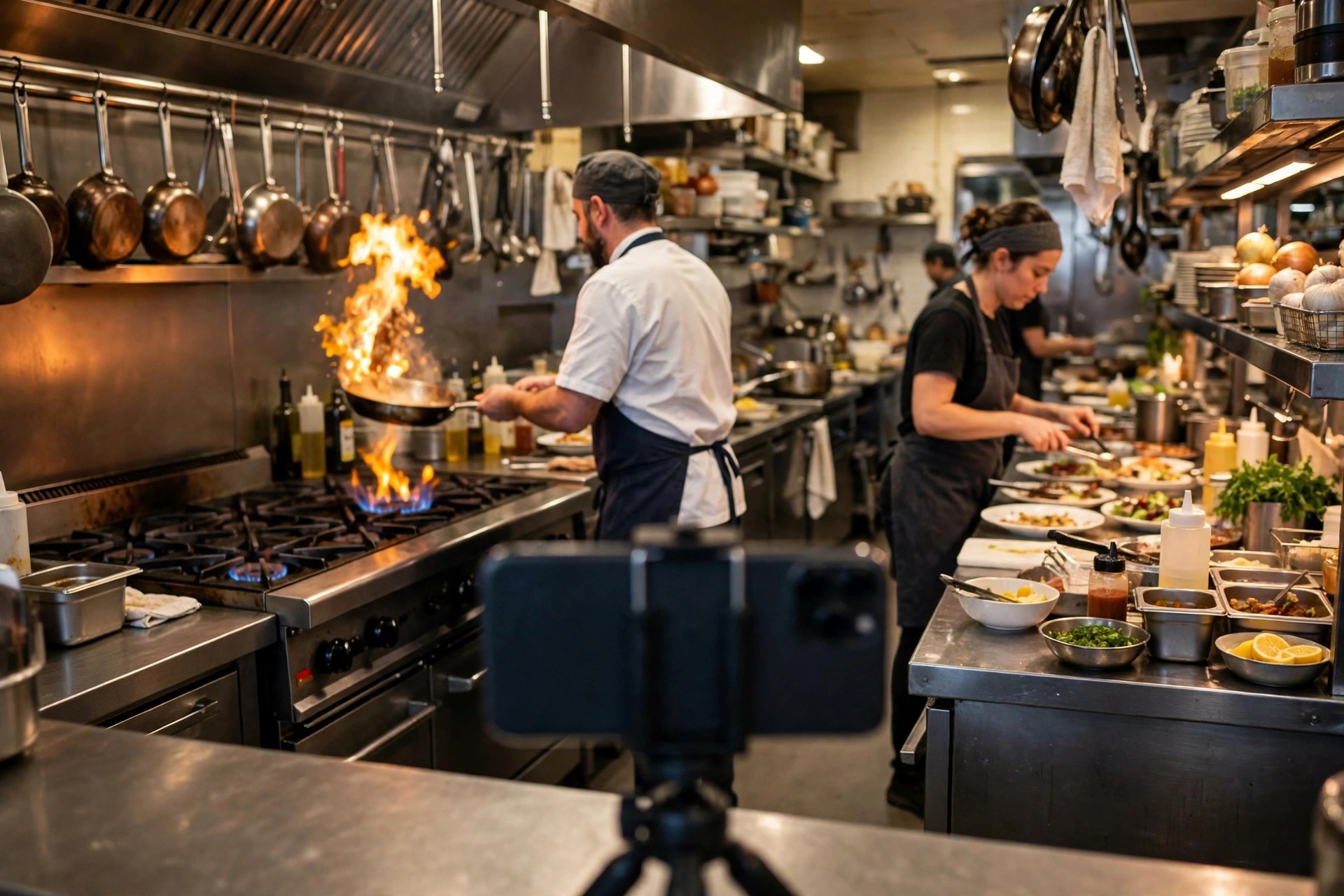
The single highest-performing format for restaurants is also the easiest to film: the kitchen doing its job. Guests are fascinated by what they cannot see — the line during a Friday rush, a pan flambéed, dough being thrown, forty plates fired at once. This footage needs no script, no presenter and no acting. It needs a phone, a tripod, and someone who remembers to press record before the rush starts.
The practical setup: mount the phone on a small tripod at the end of the pass or near the busiest station, frame a wide shot that shows two or three cooks working, and let it run for five to ten minutes. Later, cut the best fifteen to thirty seconds — the flame, the fastest plating, the moment the whole line moves in sync. Film in the kitchen's real light; the warm tungsten glow reads as authentic, and a small LED panel only matters if the corner you film in is genuinely dark. Keep faces natural and the sound real — the clatter of the kitchen is part of the appeal, though you will usually replace it with music or a voiceover in the edit.
What to capture each week
Build a small shot list and rotate through it: the busiest fifteen minutes of Friday service, one signature technique (flambé, hand-pulled noodles, pizza oven work), the prep nobody sees (morning bread, stock making, fish delivery), and one "satisfying" process — chopping, piping, glazing — filmed close. Four clips a month from this list alone covers your behind-the-scenes quota, and none of them takes more than the time to set down a tripod.
A word on permissions and hygiene: check that no one on the line objects to being filmed, keep the phone and tripod out of food-contact zones, and never film anything that would worry a health inspector. The kitchen should look busy, not chaotic.
Guests do not book because of your logo animation. They book because thirty seconds of your kitchen made them feel like they already know the place.
Format 2: the signature dish showcase
If the kitchen clip sells the experience, the dish showcase sells the specific reason to come tonight. This is the close-up, slow-motion, borderline-obsessive format: cheese stretching, sauce being poured, a steak being sliced to show the interior, chocolate cracking. One dish, one action, fifteen seconds. It is the format that travels furthest, because a great food close-up needs no language — it works on a tourist scrolling in a hotel room as well as on a local.
Filming it well is mostly about preparation. Style the dish for the camera (the food styling tricks apply directly — oil for gloss, fresh garnish, clean rim), shoot near a window or under your LED panel, and film the action three or four times so you can pick the best take. Most phones have a slow-motion mode; use it for pours and pulls, where slowing time is the whole point. Shoot vertically for Reels, TikTok and Shorts — this format lives on those platforms.
The anatomy of a dish video that converts
Three seconds of hook (the most dramatic frame first — the pour mid-air, the cheese at full stretch), then the build (the dish being finished, plated or sliced), then the payoff (the final plate, held for two seconds, with the dish name and price as on-screen text). End with the call to action baked into the caption and the profile link: book a table, this week's special, link in bio. Never assume the viewer will find the booking link themselves — tell them exactly where it is.
Format 3: faces — chef and staff stories
People book tables at restaurants run by people they like. The third format puts your team on camera: the chef explaining why the dish exists, the bartender building the signature cocktail, the server describing their favourite plate. These videos build the trust that anonymous food footage cannot, and they give regulars a reason to feel like insiders.
Keep it brutally simple. One question, one answer, thirty seconds. "What's the one dish you'd tell a first-timer to order?" "What goes into the sauce everyone asks about?" Film it as a talking head with the kitchen or bar softly blurred behind, or as a voiceover while the hands work — the second option is easier for camera-shy staff, and hands tell their own story. Subtitles are mandatory: most viewers watch with sound off, and captions also make the video searchable and accessible.
Rotate the cast. A different face every week or two shows the depth of the team and gives each video a fresh energy. And let people be themselves — the slightly awkward, genuine server outperforms the polished presenter every time, because viewers can tell the difference between a person and a performance. If someone truly hates the camera, make them the filmer instead; every team has one natural camera operator.
Format 4: real guest moments and UGC
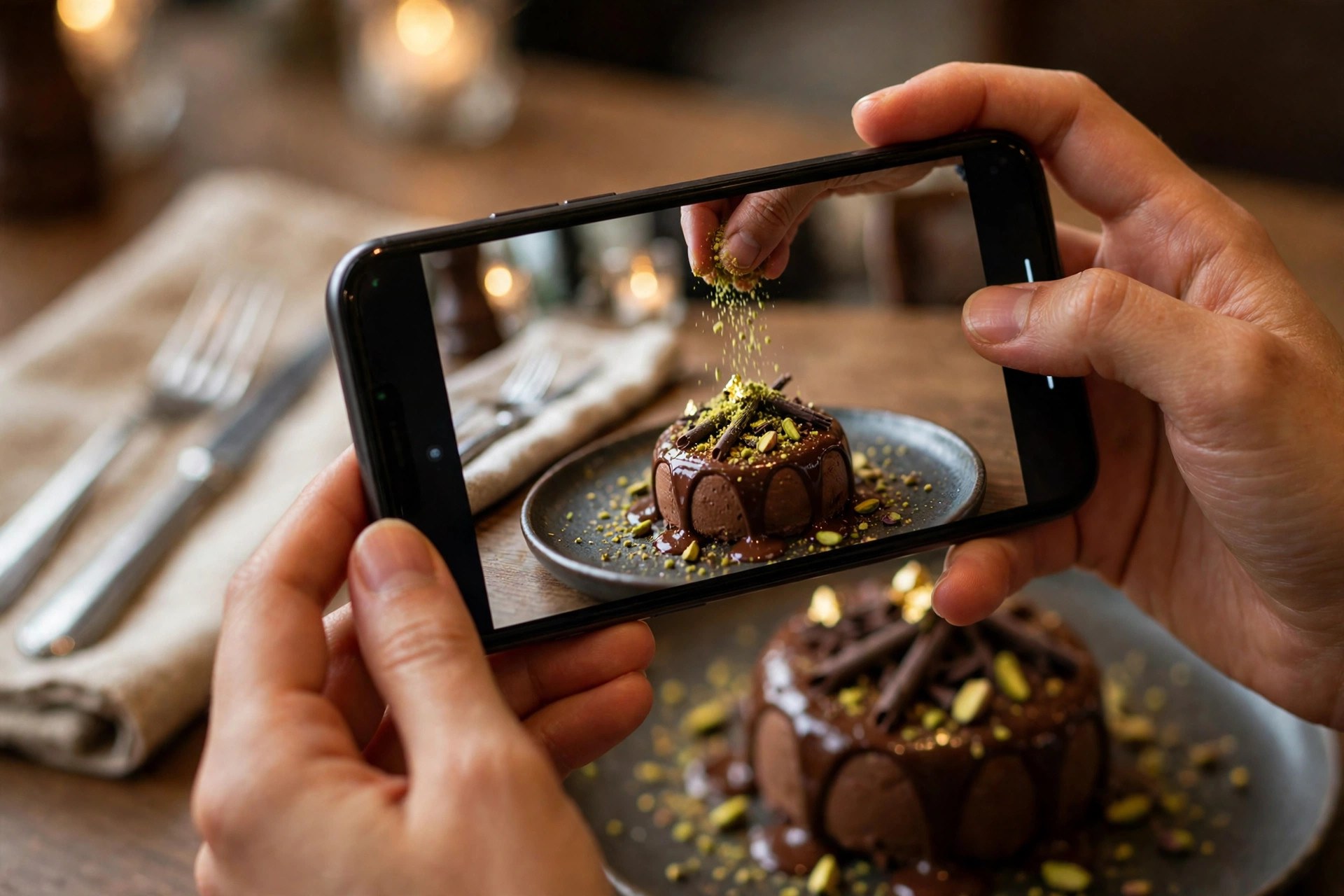
The most persuasive video about your restaurant is one you did not make. User-generated content — guests filming their own meals, reactions, celebrations — carries a credibility no brand video can buy, because the viewer knows the person filming paid for the experience. Your job is not to create it; it is to encourage it, collect it, and re-share it.
Make filming easy and worth it. Good lighting at the tables does more for UGC than any campaign — guests cannot film a dark room. A small table tent or menu note with your handle and a hashtag gives them the nudge ("Tag us — we repost our favourites every Friday"). A monthly draw — a dessert, a gift card — for the best guest video costs almost nothing and gives people a reason to post rather than just film. And when guests do tag you, repost quickly with credit; the repost is the reward that keeps the loop going.
Handle it properly. Always ask permission before reposting someone's video to your own feed, even if they tagged you — a quick reply asking "mind if we share this?" takes ten seconds and avoids every problem. Never repost children's faces without explicit parental consent. And keep the raw authenticity: do not over-edit a guest's video or add your branding over their moment. The guide to user-generated content covers the permissions and workflows in detail.
The review video
A close cousin of UGC is the filmed guest reaction — with permission, a ten-second "what did you think?" at the end of a great meal. These are gold for the website's testimonial section and for ads, because a real face saying "best pasta outside Italy" outperforms any copy you could write. The video testimonials guide shows how to collect them without making guests uncomfortable.
The most persuasive video about your restaurant is one you did not make — a guest who paid for the experience, filming it for free.
Format 5: local and seasonal stories
The fifth format is the one your competitors are not making, because it cannot be copied: your place, in your neighbourhood, right now. The morning fish market run. The local farm that supplies your vegetables. The street festival outside your door. The first snow falling on the terrace, the midsummer menu launch, the Christmas season prep. Local and seasonal content does two jobs at once — it gives locals a reason to feel the restaurant is theirs, and it gives the algorithm timely, place-tagged content that travels in your area.
Film it like a diary, not a documentary. Thirty seconds at the market with the supplier, a quick walk-through of the dining room dressed for the season, the team tasting the new autumn menu. Tag the location every time — the location tag is what puts the video in front of people nearby, which is the only audience that can actually book a table. Collaborate where it is natural: the farm, the brewery, the festival organiser all have their own audiences, and a shared video reaches all of them.
This format also has the longest useful life of the five. A "how we prepare for the Christmas season" video can be reposted every November; a supplier story stays true for as long as the relationship lasts. Build a small library of them and you will never face a blank content calendar in the quiet months.
Where to post: TikTok, Reels and Shorts compared
You do not need to choose one platform — you need to understand what each one does for you, and then post the same core video to all three with small tweaks. The table below is the honest comparison for a Nordic restaurant in 2026.
| Platform | Discovery | Shelf life | Nordic audience notes | Best for |
|---|---|---|---|---|
| TikTok | Highest — new accounts can go viral on interest matching alone | Short — hours to days of peak reach | Strong with under-35s; growing fast in 30–45 bracket | Dish showcases, trends, reaching new guests |
| Instagram Reels | High — boosted by existing followers and local discovery | Short to medium — days of steady reach | Broadest restaurant-discovery audience; diners already browse food here | Overall lead platform; profile links straight to booking |
| YouTube Shorts | Medium — slower start, better matching over time | Long — surfaces in search for weeks or months | Older, intent-driven viewers; strong search behaviour | Evergreen content: tours, explainers, "best of" compilations |
Practical rules that hold on all three: hook in the first three seconds, captions on everything, vertical 9:16 framing, and a profile that answers the three questions a new viewer asks in five seconds — what is this place, where is it, how do I book. Slight tweaks per platform outperform identical cross-posts: TikTok rewards rawer energy and trending sounds, Reels rewards on-screen text and trend awareness, Shorts rewards slightly more complete, informative cuts. The Instagram strategy guide and the 30 Reels ideas list will keep the calendar full once the formats are running.
The 3-second hook checklist
- Start mid-action — the pour, the flame, the cheese pull — never with a logo or an empty room.
- Put the promise on screen as text: "The €14 lunch Helsinki is queuing for" beats "Welcome to our restaurant."
- Cut dead air ruthlessly: if a second does not add information or appetite, it goes.
- End with one clear next step: book, follow, or find us — stated on screen, not just in the caption.
The one-hour weekly video workflow
Video marketing fails in restaurants for one reason: it depends on inspiration instead of routine. The fix is a weekly workflow so small it survives the busy season. One hour, same slot every week — quiet Tuesday afternoon works for most kitchens — and three videos out the door.
Minutes 0–10: plan. Pick this week's three: one kitchen clip (film during Friday service prep — set the tripod and forget it), one dish (the special, the bestseller, whatever photographs best today), one people video (one question, one staff member). Write the three hooks as on-screen text lines before you film anything.
Minutes 10–35: film. Dish showcase first, while the food is fresh — style it, film the action three times, done. Staff question second — two takes maximum, keep it loose. Kitchen clip is already recording on the tripod; just check the framing. Film everything vertically, and film a little more than you need — trimming is easier than re-shooting.
Minutes 35–60: edit and post. Edit on the phone: trim to 15–30 seconds, add captions (auto-caption tools, then correct them), add the hook text in the first frame, pick music from the platform's library. Post to Reels, TikTok and Shorts with a caption that includes the dish name, the location tag, and the booking call to action. Save the raw clips in a shared folder with the dish name and date — the Instagram Stories guide shows how the same footage stretches further across formats.
The gear that actually matters
A phone you already own. A small tripod (€20–30) — the single biggest quality upgrade, because stable footage reads as professional and shaky footage reads as amateur regardless of the camera. A clip-on wireless microphone (€50–150) — bad audio kills watch time faster than bad video, and kitchens are loud. A small LED panel (€40–80) for the months when the Nordic afternoon is dark by three. Total: roughly €200–300, once. Anything beyond this — gimbals, cameras, drones — is a hobby, not marketing.
What it costs: DIY, freelancer or agency
Video is the rare marketing channel where the cheapest option is often the best one — guests trust a phone clip from the kitchen more than a polished commercial. That does not mean professionals have no place; it means you should spend deliberately. The table below sets out the realistic options with Nordic price ranges as estimates.
| Option | Typical cost (estimate) | Best for |
|---|---|---|
| DIY with your phone | €200–300 one-off for tripod, microphone and light | Weekly Reels/TikTok/Shorts; all five formats |
| Freelance videographer, per video | €300–800 per short video | Hero dish films, seasonal campaign clips |
| Monthly content retainer | €500–1,500/month | Restaurants that want steady output without doing it in-house |
| Agency campaign | €2,000–8,000 per campaign | Launches, rebrands, TV-quality brand films |
The split that works for most independent restaurants: DIY for the weekly rhythm, a freelancer once or twice a year for the hero content — the website background video, the Google Business Profile cover video, the seasonal campaign film. One professional shoot day can produce the footage for months of short clips if you plan the shot list in advance. And whatever you spend on production, remember the website has to convert the attention: a restaurant website built to turn viewers into bookings — fast, mobile-first, with the booking button always one tap away — is what turns video views into reserved tables. PowerfulWebsite builds it free; the plans run €59–€239/mo, everything included.
Video is the rare channel where the cheapest option is often the best one — guests trust a phone clip from the kitchen more than a polished commercial.
Measure bookings, not just views
A million views and an empty dining room is a failure. A thousand views and a full Friday is a triumph. Measure the thing that pays the rent: bookings that came from video. The setup is simple. Put a dedicated link in your video bios — most restaurants use a link page with the booking button first — and use UTM parameters so analytics shows the source. Ask new guests how they found you and log it for a month; the pattern will be obvious. Compare booking volume in consistent posting weeks against quiet weeks.
Watch the right intermediate metrics too. Completion rate (how many watch to the end) tells you whether the hook worked. Profile visits and follows per video tell you whether viewers wanted more. Saves and shares tell you the video earned a place in someone's plans — a saved restaurant video is a future booking. Likes are the least informative number on the screen; optimise for saves, shares and profile taps, and check the five social media metrics that matter for the full measurement setup.
Finally, close the loop on the website. Your best videos belong embedded on the site — the homepage hero, the about page, the private-dining page — because a guest who arrives from a video and finds a slow, confusing website still does not book. Video brings the attention; the website cashes it. Keep both sharp, and the five formats above will compound: every video makes the next one easier to film, and every booking makes the hour a week easier to justify.
Frequently asked questions
How much does video marketing cost for a small restaurant?
A DIY setup — a phone you already own, a tripod, a clip-on microphone and a small LED light — costs roughly €200–300 one-off. A freelance videographer typically charges around €300–800 per short video as an estimate, and a monthly content retainer for a few videos a week usually runs €500–1,500. Agency-produced campaigns start around €2,000–8,000. For most restaurants, the best return comes from filming two or three short videos a week in-house and spending the saved budget on the occasional professional shoot for hero content.
Which platform is best for restaurant videos — TikTok, Instagram Reels or YouTube Shorts?
Use all three for reach, but lead with the one your guests actually use. Instagram Reels is usually the strongest for restaurants because diners already browse local food there and can tap straight through to your profile and booking link. TikTok has the biggest discovery upside — a new account can still go viral. YouTube Shorts has the longest shelf life because Shorts keep surfacing in search for weeks. Post the same video to all three, tweaked slightly for each, and watch where your own bookings come from.
How long should restaurant videos be?
For discovery on TikTok and Reels, 15–30 seconds is the sweet spot: one idea, one dish, one hook in the first three seconds. YouTube Shorts can comfortably run 30–60 seconds for slightly more informative content, like a recipe tip or a tour. Longer videos (1–3 minutes) work on your website and Facebook, where the viewer has already chosen to watch. The rule is simple: make it as short as it can be without losing the point.
Do we need professional equipment to film restaurant videos?
No. A modern phone shoots good enough video for every format in this guide. The three upgrades that genuinely matter are stability (a small tripod, about €20–30), sound (a clip-on wireless microphone, about €50–150, because bad audio kills watch time faster than bad video), and light (a small LED panel, about €40–80, for the dark Nordic winter months). Spend on those before you spend on a camera.
How often should a restaurant post videos?
Two to three videos a week, posted consistently, beats a daily burst that dies after a fortnight. Consistency trains both the algorithm and your team: filming becomes a habit instead of a project. One practical rhythm is one behind-the-scenes clip, one dish showcase and one people-focused video per week. Quality and regularity matter far more than volume — a restaurant posting two good videos a week for a year will outperform one that posts seven rushed ones for a month.
Can videos actually bring more table bookings?
Yes, when the video answers the question the viewer is asking: what will it feel like to eat here? Dish close-ups, kitchen action and real guest reactions all reduce the uncertainty of trying a new restaurant, and every platform lets you link the video to a booking page or profile with directions. Track it properly: use a dedicated link or ask new guests how they found you, and compare booking volume in the weeks you post consistently against the weeks you do not.
Want a website that turns your videos into bookings?
PowerfulWebsite builds your restaurant's website free — you only pay from €59/mo. Everything included: domain, hosting, maintenance and updates, with your videos and menu presented to convert viewers into guests.
See the packages