Crayfish Party Marketing for Restaurants
A crayfish party is the Nordic late-summer ritual of cold dill crayfish, paper lanterns, and drinking songs — and one of the most profitable events a restaurant can sell. This guide covers the menu, pricing at roughly €85–€115 per person, tickets and group bookings, and an eight-week marketing plan.

Key takeaways
- A crayfish party (kräftskiva in Swedish, rapujuhlat in Finnish) is the Nordic late-summer ritual: cold dill crayfish, paper lanterns, bibs, and drinking songs — and it is one of the easiest seasonal events a restaurant can sell.
- Season runs roughly late July to mid-September, peaking in August. Helsinki's Sea Horse lists its 2026 crayfish season from 21 July to 13 September.
- Plan on 8–15 crayfish per person and price the night as a fixed menu: Helsinki examples run €99–€108 per person including a main course, with snaps from €8–€12 a glass.
- Sell it as tickets and group bookings, not as a normal à la carte night — pre-orders, a minimum party size, and a cut-off date protect your margin and your crayfish supply.
- The marketing writes itself: lanterns, hats, songs, and messy hands are inherently photogenic. Start promoting eight weeks out and let guests do half the advertising for you.
Every August, the Nordics lose their heads over a crustacean the size of a thumb. Long tables, mounds of dill-crowned crayfish, paper hats and bibs, moon-faced lanterns, and schnapps you are only allowed to drink after singing for it — the crayfish party is the most joyful night of the Nordic summer, and for a restaurant it is one of the most profitable. The guests arrive in a party mood, they book in groups, they stay for hours, and they photograph everything.
This guide is written for restaurant owners who want to sell that night, not just host it. You will learn what a crayfish party is and when the season runs, how to build a menu and price it, how to sell tickets and group bookings, how to stage the room and the songs, and how to run an eight-week marketing plan that fills the tables. It pairs with our guides to marketing your seasonal menu and the Christmas party season — the same playbook, applied to summer's best party.
What a crayfish party actually is
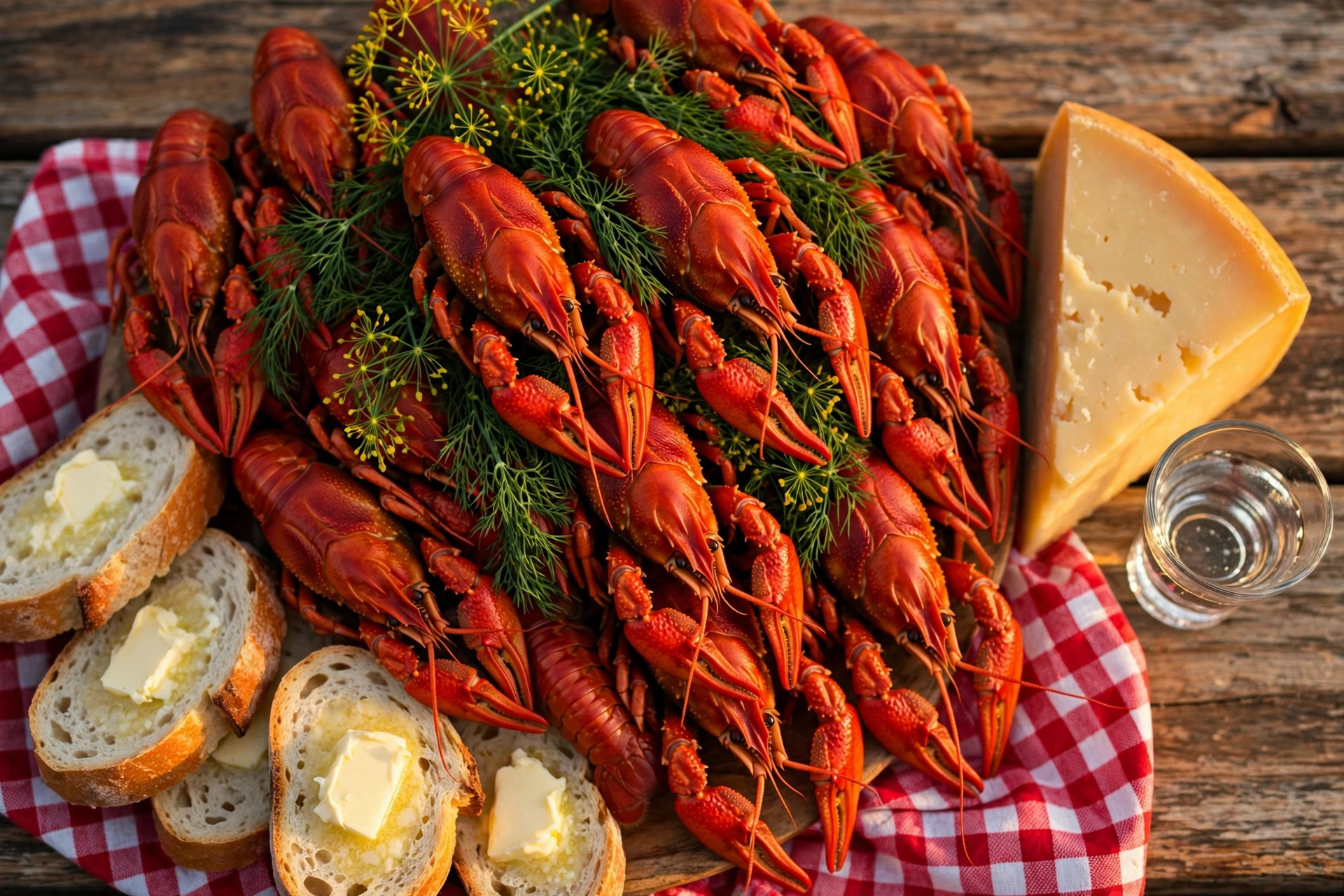
A crayfish party — kräftskiva in Swedish, rapujuhlat in Finnish — is a traditional late-summer eating and drinking celebration built around cold crayfish, boiled in salt water with fresh dill and served in their shells. Guests eat with their hands, peeling each crayfish at the table, with bread, butter, strong cheese, and salads alongside. The meal is punctuated by snapsvisor, short drinking songs sung before each small glass of aquavit or snaps, and the table is dressed with paper lanterns (often depicting the Man in the Moon), paper hats, bibs, and candles.
The tradition began in Sweden in the early 20th century, when crayfish fishing was legally limited to late summer, and it spread to Finland through the Swedish-speaking population and to Norway. In Finland it arrived in the 1800s and settled into seaside villas and summer cottages before moving into restaurants and city venues. Today the parties peak in August and run from late July into September, and the crayfish on the table are usually signal crayfish (täplärapu), an introduced species that now carries the tradition, while the native noble crayfish (jokirapu) survives at luxury prices.
Why guests love it — and why that matters for you
A crayfish party is the opposite of a formal dinner, and that is the point. Nobody worries about table manners when everyone is wearing a bib and peeling shellfish with their fingers. The songs break the ice between strangers, the long table turns a group booking into a shared event, and the whole evening is slow by design — guests linger over the crayfish for an hour before the warm course even arrives. For a restaurant, that slowness is valuable: a table that stays three hours and orders snaps, beer, and dessert is worth far more than a table that turns in ninety minutes.
It is also a tradition with a built-in audience. In Sweden and Finland, almost everyone has been to a crayfish party at a summer cottage or a friend's garden — the restaurant version sells nostalgia as much as food. And for guests who have never been to one, the party is an experience worth travelling for: Helsinki's open crayfish parties, like the one on Vallisaari island, draw visitors precisely because the tradition is famous and the invitation-only home parties are not open to them. Your restaurant can be the door in.
Why crayfish season is a marketing gift
Most seasonal campaigns are a struggle: you invent a reason for guests to care about asparagus or mushrooms, and you compete with every other restaurant doing the same thing. Crayfish season is different. The date is fixed, the tradition is famous, the demand is real, and the competition is thin — most restaurants in your city will not run a crayfish party at all, which means the ones that do own the search results, the social feeds, and the group-booking conversations for six weeks.
A fixed window creates urgency
Scarcity sells, and crayfish season is genuinely scarce: roughly eight weeks, late July to mid-September, and then it is gone for another year. That deadline does your marketing for you. "Only four crayfish nights left" is a true statement, not a sales trick, and it is the reason pre-paid tickets work so well for this event. Guests who would dither over a normal dinner booking commit to a crayfish party because they know the window closes.
Group bookings come built in
Crayfish parties are group events. The home tradition is a table of friends; the restaurant version is a company team, a birthday group, a sports club, or a family reunion. That means one sale fills ten to twenty seats instead of two, the booking comes weeks in advance, and the organiser does your marketing for you by rounding up their friends. Read our guide to handling group bookings before the season starts — the crayfish party is the event that will test every process in it.
The content creates itself
There are few restaurant events more photogenic than a crayfish party: red crayfish piled on platters, dill crowns, glowing paper lanterns, guests in paper hats mid-song, hands in the air with a snaps glass. Guests photograph it without being asked, tag the restaurant without being asked, and post stories that reach exactly the people you want — their friends, who now want to come too. Plan for this: good lighting over the tables, a photogenic centrepiece on every platter, and a hashtag on the menu card. The marketing budget for a crayfish party is mostly the decorations.
It fills the hardest weeks of the year
Late August is a difficult stretch for many Nordic restaurants: the summer tourists are leaving, the locals are back from their cottages but not yet in their autumn routines, and the terrace season is winding down. A crayfish party gives those weeks a reason to exist. It is also a bridge into autumn: the guests who came for crayfish in August are the warmest audience for your autumn menu in September and your Christmas party season after that. One good August night can seed three months of bookings.
Building the crayfish menu
The menu is the product, and for a crayfish party it has a fixed shape. The crayfish are the opening act you linger over, not the whole meal: a platter of cold dill crayfish with toast, butter, and dill, followed by a warm main course and dessert. Guests expect that structure, and it protects your kitchen — the crayfish arrive pre-cooked and chilled, so the hot work is one main course, not a full à la carte service.
The crayfish: how many, which kind, what size
Plan on 8–15 crayfish per person as the standard portion, and say so on the menu — guests who have never been to a crayfish party have no idea what to expect, and a number on the page removes the anxiety. Most Helsinki restaurants serve 8 per person as the base portion, with extra crayfish available to order by the plate while they last. Sea Horse in Helsinki, for example, lists its 2026 menu at 8 selected signal crayfish per person, and sells additional crayfish at €7.50, €11.50, and €17 by size, from roughly 10.5 cm to 12 cm and above.
Buy signal crayfish (täplärapu) unless you have a specific reason not to: they are the standard for the modern party, widely available through fish suppliers in August, and priced for a menu that has to make money. Noble crayfish (jokirapu) are the traditional native species, but they are scarce and priced like a luxury item — worth offering as a premium upgrade for a small number of tables, not as the base of the menu. Whatever you buy, order early and confirm quantities with your supplier three working days before the event, as the established Helsinki venues do; crayfish supply in peak August is finite, and a sold-out sign is only charming if you planned it.
The supporting dishes
Keep the sides simple and prepare them ahead, because the crayfish are the star and the kitchen will be busy. The classics are: toast and butter; a strong cheese, ideally Västerbotten or a mature Finnish equivalent; a cheese pie that can be sliced and served cold; boiled new potatoes; a green salad, tomatoes, or cucumber for freshness; and lemon wedges for guests who want them. A small starter before the crayfish — a wild mushroom soup is a Helsinki favourite — and a simple dessert after the main course, such as berries with cream or vanilla panna cotta, complete the menu without asking the kitchen to do anything heroic.
Drinks: snaps, beer, and the alcohol-free table
Snaps is part of the ritual: small glasses of aquavit or flavoured snaps, raised with a song. Offer a snaps pairing as an add-on, not buried in the menu price — Sea Horse lists its snaps pairings at €8–€12 a glass, which is a useful benchmark. Beer is the other traditional partner, and a local lager or a dill aquavit from a Nordic distillery adds a story to the table. Just as important, and often forgotten: offer appealing non-alcoholic options from the start, not as an afterthought. Alcohol-free snaps-style drinks, craft sodas, and sparkling water with dill and cucumber belong on the menu card, because a table where half the guests are not drinking still wants the toast to feel like a toast.
Pricing your crayfish party
Price the night as a fixed menu, not à la carte. A fixed price per person makes the sale easy — the organiser knows the cost before they call — and it makes your kitchen and your margin predictable. Helsinki's established venues give a clear picture of the market: Sea Horse lists its 2026 crayfish menu at €99 with pyttipannu, €103 with fish, and €108 with steak, all including 8 signal crayfish, toast, butter, and dill. Open parties on Vallisaari pair six crayfish with a buffet of mains and dessert. Treat these as the market, not as a rule: your price depends on your rent, your crayfish cost, and your positioning, but a credible Helsinki crayfish menu in 2026 sits roughly in the €85–€115 per person range (estimate).
| Package | What is included (estimate) | Price per person | Best for |
|---|---|---|---|
| Crayfish plate only | 8–10 crayfish, toast, butter, dill | €45–€65 | Terrace nights, walk-ins, a lighter offer |
| Classic crayfish menu | 8 crayfish, starter, warm main, dessert | €85–€110 | The standard party night |
| Premium crayfish menu | 10–12 crayfish, noble crayfish upgrade, snaps pairing | €120–€150 | Private parties, company events |
| Full private buyout | Menu + room, decorations, toastmaster, songs | By quote, min. spend | Company parties, 20+ guests |
Three pricing rules protect you. First, charge in advance: a deposit or full pre-payment at booking, refundable until a stated cut-off date (the Vallisaari open party refunds until three days before). Crayfish are ordered to the table count, and a no-show group leaves you with expensive shellfish and an empty room. Second, price the extras separately and visibly: extra crayfish by size, snaps by the glass, a cheese supplement — these are high-margin items that guests happily order in the moment. Third, set a minimum party size for private rooms (typically 10–20 guests) and a minimum spend for buyouts, and put both in writing before the first phone call.
Do not compete on price
A crayfish party is an experience, and experiences are not won by being the cheapest. A venue that charges €75 and serves tired crayfish on a bare table will lose to a venue that charges €105 and delivers lanterns, songs, a toastmaster, and a room that feels like a party. Spend the difference on the staging — it is cheaper than a discount and it photographs better. If you must offer a lower tier, make it a genuinely different product (the terrace plate, not the same menu for less), so the full menu keeps its value.
Selling the night: tickets, groups, and private parties
A crayfish party sells in three ways, and you want all three running at once: open ticketed nights for couples and small groups, reserved tables for medium groups, and private buyouts for companies. Each needs a different sales motion, and the mistake is treating them all like normal reservations.
Open ticketed nights
Pick one or two fixed dates — a Friday and a Saturday in mid-to-late August work best — and sell them as events with a limited number of seats. Put the date, the menu, the price, and the cut-off on a dedicated page on your website, and link it from your homepage, your Google Business Profile, and every social post about the season. Pre-payment is the norm for ticketed nights; a booking system that takes payment at the point of sale, rather than a phone reservation with a promise, is what separates a full room from a half-empty one. If your website cannot sell tickets yet, that is a fix worth making before August — a PowerfulWebsite site includes booking and ordering from the Restaurant plan at €239 per month, with the build itself free.
Group tables and company bookings
Groups of 10–20 are the core of the season, and they book through a person, not a form: the office manager, the team lead, the birthday organiser. Give them a named contact, a one-page offer they can forward internally (menu, price, minimum, cut-off, and a photo of last year's table), and a reply within one working day. Companies decide in meetings and need something to show the room — a PDF offer beats a phone conversation every time. And ask for the decision date: a group that says "we'll think about it" without a date is a group that will book somewhere else.
Private parties and buyouts
The most profitable crayfish nights are private: a company takes the room, you set a minimum spend, and the evening runs on your terms. Sell these first, before the open nights, because one buyout can be worth three open tables. The offer is the full experience — room, decorations, a toastmaster or song sheets, the menu, and a snaps package — priced as one number for the group, with a per-person figure alongside it so the organiser can get approval. Confirm the final headcount three working days before, the same cut-off the Helsinki venues use for their crayfish invoicing, and invoice on that number.
The crayfish party sales checklist
Fixed dates published eight weeks out. A dedicated page with menu, price, and cut-off. Pre-payment or deposit on every booking. A one-page offer PDF for group organisers. Final headcount confirmed three working days before. Extra crayfish and snaps priced separately and offered at the table. A named contact person for every group, with a one-working-day reply promise.
The room, the songs, and the ritual
The food gets guests to the table; the room gets them to stay, sing, and come back next year. Staging a crayfish party is not expensive — paper lanterns, candles, and a long table do most of the work — but it has to be deliberate. A crayfish menu served in an undecorated dining room is just an expensive seafood dinner.
Decorations: the moon, the stars, and the bibs
The classic look is a long communal table, or several tables pushed together, with a red-and-white checked cloth, paper lanterns shaped like the full moon strung overhead, star garlands and fairy lights, candles, and fresh dill scattered down the centre. Every guest gets a bib — crayfish-printed is traditional — and a paper party hat. Put a bowl for shells and a finger bowl or easy handwashing access on every table, and use a paper or plastic cloth for easy cleanup: this is a messy meal, and guests relax when the room is dressed for mess.
The songs: appoint a toastmaster
The snapsvisor are the heartbeat of the party: short drinking songs sung before each toast, led by a toastmaster, with the room joining in on the chorus. "Helan Går" — "the whole goes down" — is the one everyone knows, and it is the right opener. Print song sheets for every table, including the words in Swedish or Finnish and a line of guidance for guests who have never sung one. Appoint the toastmaster in advance — a confident member of staff, or the group's own organiser if they are willing — and brief them: songs at set points in the evening, not a free-for-all, and always before the snaps, never after. If the room is mixed, with international guests who do not know the tradition, a thirty-second explanation of what is about to happen turns confusion into delight.
The flow of the evening
A good crayfish party runs on a loose schedule, and the host should own it. Guests arrive to lanterns and a welcome drink; the toastmaster explains the evening in one minute; the crayfish platters land and the first song is sung; the table works through the crayfish at its own pace, with songs between rounds; then the warm main course, dessert, and coffee, with the music shifting from singalongs to background as the evening goes on. The whole night runs three to four hours. Publish the rough schedule on the menu card — "crayfish from 19:30, mains around 21:00" — so guests can relax instead of wondering what happens next. And have a wet-weather plan: the party is traditionally outdoors, but a Nordic August evening can turn, and a room that is beautiful indoors is worth more than a terrace nobody can sit on.
The eight-week marketing plan
Crayfish season rewards restaurants that start early and punishes those that remember in August. Eight weeks is the right runway: long enough to sell groups and buyouts, short enough that the urgency stays real. Here is the plan, week by week.
Weeks 8–6: publish and seed
Eight weeks out, publish the crayfish page on your website with the dates, the menu, the price, and the booking link, and announce the dates to your email list and your regulars first — they are your easiest sales and your best social proof. Contact last year's group organisers personally: a short email with the dates and a "same table as last year?" line books faster than any advertisement. At the same time, confirm your crayfish supplier, your decorations order, and your toastmaster, so the product is real before you start selling it.
Weeks 6–3: sell the groups
This is the group-selling window. Push the one-page offer to companies in your area, post the first photos of the decorations going up, and run a short social campaign with the season's best images — lanterns, platters, last year's hats. List the event on your Google Business Profile as a post and on local event listings; guests searching "crayfish party restaurant" in your city should find your page, not a Wikipedia article. If you have a website that ranks, this is the moment it pays: the search term is seasonal, the competition is thin, and the intent is to book.
Weeks 3–1: urgency and the final push
Now the scarcity is real. Announce the remaining seats — "two tables left on Friday, one on Saturday" — and mean it. Send a reminder to everyone who enquired but did not book, with the cut-off date in the subject line. Confirm final numbers with the groups that have booked, and order the crayfish on the confirmed count. This is also the week to brief the whole team: the songs, the schedule, the extras to offer at the table, and the photo moments to watch for.
The night itself: market while you serve
On the night, the marketing is the party. Photograph the tables (with permission, and never a guest's face without asking), post stories as the evening unfolds, and make sure the hashtag and your handle are on the menu card and on the table. The best post of the night is usually taken by a guest, not by you — so give them something to photograph: the platter arriving, the lanterns at dusk, the first toast. The next morning, post the best photos, thank the guests, and announce next year's dates while the memory is warm.
After the party: turning one night into regulars
The crayfish party is not the end of the season; it is the beginning of the autumn. Every guest who came in August is a warm lead for September, October, and Christmas — if you follow up. The mistake is treating the party as a one-off event and letting the guest list go cold.
The follow-up that works
Within three days, send every guest a thank-you — an email to the bookers, a post for the room — with the best photos of the night and one clear next step: the autumn menu, the next event, or the Christmas party booking page. Bookers who organised a group are your highest-value contacts; invite them to book the Christmas party while the memory of a well-run evening is fresh, and offer them the same table or the same room. Our Christmas party season guide picks up exactly where this one ends, and the guests who trusted you in August are the ones most likely to trust you in December.
What to measure, what to change
After the season, write down what happened while you still remember it: covers per night, revenue per cover, how many extra crayfish and snaps were sold, which nights sold out and which did not, and what guests actually said. Then change one thing for next year — one price, one date, one part of the menu — and note it on the same page. A crayfish party that improves by one thing a year becomes, after three years, an event your city expects. And if the season showed you that your website is the bottleneck — guests who could not find the dates, could not book, or could not pay — fix that before the next season, not during it. A site that sells tickets, takes deposits, and ranks for "crayfish party restaurant" in your city is worth more than any single night, and it is exactly what PowerfulWebsite builds for free, with plans from €59 to €239 per month.
Frequently asked questions
When is crayfish season?
Crayfish season runs roughly from late July to mid-September, peaking in August. The tradition dates back to the early 20th century, when Swedish crayfish fishing was legally limited to late summer. Helsinki's Sea Horse lists its 2026 season from 21 July to 13 September. Most restaurants run their crayfish parties on Friday and Saturday nights in August.
How many crayfish per person should a restaurant serve?
Plan on 8–15 crayfish per person. Eight is the standard base portion at most Helsinki restaurants, with extra crayfish available to order by the plate while they last — typically priced by size, around €7.50 to €17 each. Put the number on the menu so first-time guests know what to expect, and confirm final quantities with your supplier three working days before the event.
How much does a crayfish party cost per person?
A full crayfish menu in Helsinki in 2026 typically runs €85–€115 per person, including the crayfish, a starter, a warm main course, and dessert — Sea Horse, for example, lists €99–€108 depending on the main course. A crayfish plate alone, without the full menu, runs roughly €45–€65. Snaps pairings are usually charged separately, around €8–€12 a glass. Prices are estimates based on published 2026 menus; your own price depends on your costs and positioning.
Do guests need to know the songs at a crayfish party?
No. The drinking songs (snapsvisor) are short, repetitive, and led by a toastmaster, and guests pick them up after the first one. Print song sheets for every table, start with the best-known song, "Helan Går", and give international guests a thirty-second explanation of the tradition. The singing is the icebreaker, not an exam.
Can a restaurant host a crayfish party indoors?
Yes, and most city restaurants do. The tradition is outdoors at a summer cottage, but a restaurant room with paper lanterns, candles, a long communal table, and the right decorations creates the same atmosphere — and it has a roof when the August weather turns. What matters is the staging and the ritual, not the sky.
What is the difference between a kräftskiva and a rapujuhlat?
They are the same tradition in two languages: kräftskiva is the Swedish name, rapujuhlat is the Finnish name. The party arrived in Finland from Sweden in the 1800s and is celebrated in both countries — and in Norway — with the same essentials: cold dill crayfish, paper lanterns, bibs, hats, snaps, and drinking songs.
Want a website that sells your seasonal events?
PowerfulWebsite builds your restaurant's website for free — you only pay from €59/month. Everything included: domain, hosting, maintenance, and updates, with booking and ordering built in on the Restaurant plan at €239/month.
See the packages