Chef Personal Brand: How Restaurants Win on Social Media
A chef personal brand is the chef's public reputation — their cooking philosophy, their story and their face — built deliberately on social media so that guests choose your restaurant because of the person cooking. It works because people follow people, not logos: a chef who explains, teaches and shows their work builds trust before a guest ever walks through the door, and that trust turns into bookings, press and better hires.
Key takeaways
- Guests follow people, not logos — a chef's face and story outperform polished food photos alone.
- Run two accounts: the chef's personal account as the engine, the restaurant account as the home base.
- Post 3–4 times a week, mostly short video, across four content pillars: dishes, technique, sourcing and the person.
- Teach, don't just promote — explaining why an ingredient or dish matters builds trust faster than any offer.
- Protect the restaurant by branding the kitchen's philosophy, not only one person, and agree account ownership in writing.
- Measure saves, shares and booking enquiries — not follower count — and give the brand at least six months.
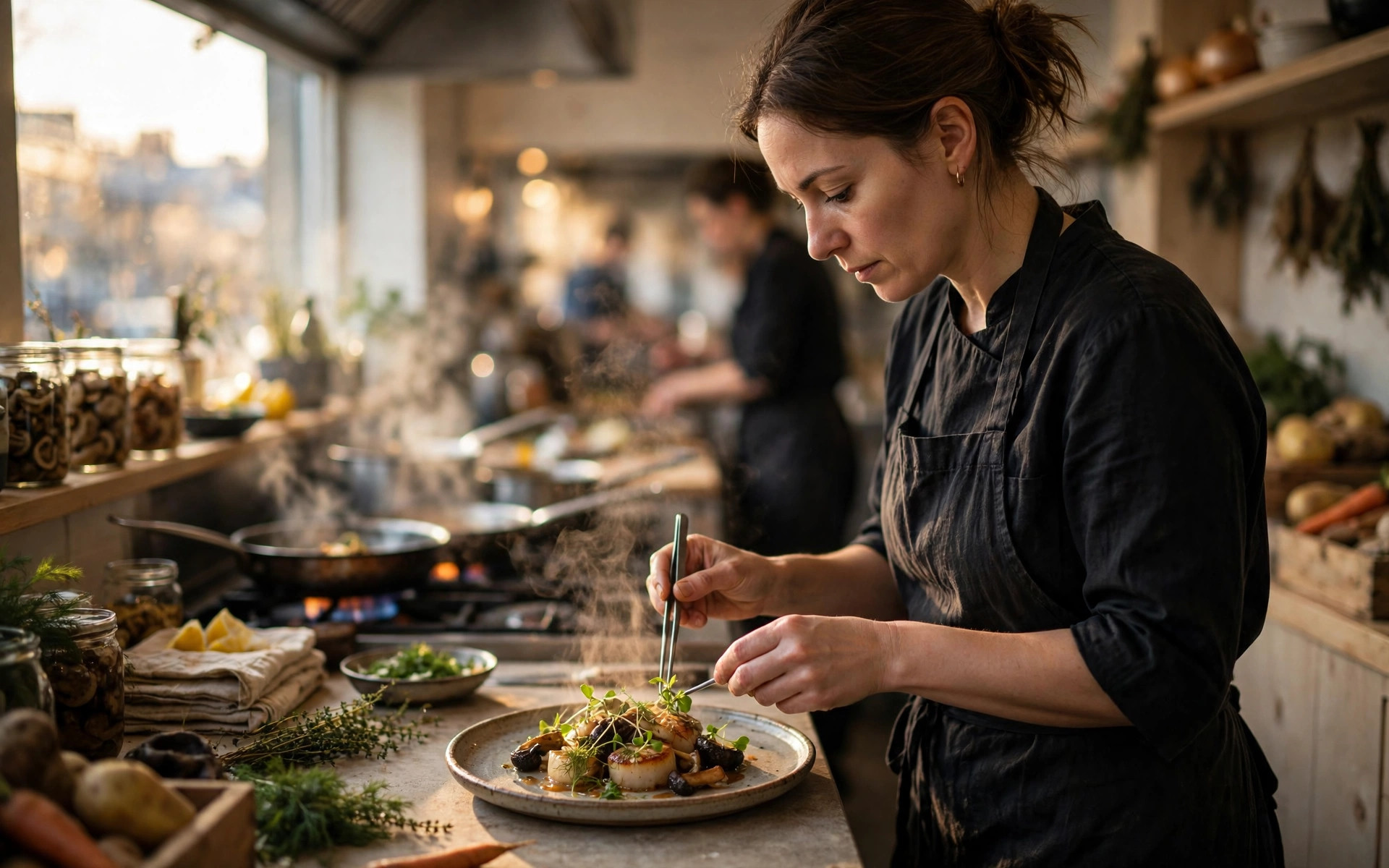
Open Instagram, search for a restaurant in Helsinki, Stockholm or Oslo, and look at what actually stops your thumb. It is rarely the logo, and it is rarely a perfect overhead shot of a plate. It is a person: a chef explaining why the chanterelles came from a particular forest that morning, a cook laughing as a sauce splits and gets rescued, a head chef tasting a new dish and shaking their head. Food is visual, but trust is personal — and on social media, trust is the product that sells the table.
This guide is for restaurant owners and chefs in the Nordics who want to turn the person in the kitchen into a genuine marketing asset. It covers what a chef personal brand really is, how it differs from the restaurant's brand, which platforms matter, what to post, how often, what it costs in time, and how to protect the business when the chef eventually moves on. The advice is practical and Nordic-specific: small teams, seasonal cooking, multilingual audiences, and the reality that the chef is also the person working a Friday-night service.
Why guests follow chefs, not restaurants
Every restaurant owner has felt the same frustration: the restaurant account posts a beautiful dish, and nothing happens. A chef posts a shaky phone video of the same dish being finished at the pass, and the comments fill up. The difference is not the camera. It is the relationship. Social platforms are built to reward people, and their algorithms consistently prioritise personal profiles over business pages. A personal account simply reaches more people, more cheaply, than a restaurant account posting the same content.
There is a second, deeper reason. Choosing a restaurant is a trust decision, and trust attaches to people. A guest deciding where to spend €60–€120 on dinner wants to know who is cooking, what they care about, and whether they can be trusted with an allergy, a celebration or a first date. A logo cannot answer those questions. A chef who talks about their suppliers by name, shows how they handle a gluten-free order, or explains why they took a dish off the menu can. That is why the personal branding experts interviewed by Modern Restaurant Management put it bluntly: if you do not shape your digital presence, something else will — outdated reviews, random photos, or an AI summary built from incomplete information. No presence does not mean neutral. It means invisible, or misrepresented.
The Nordic context makes this even more important. Nordic dining runs on seasonality, foraging, local suppliers and small teams, and those are exactly the stories that travel well online. A chef in Turku talking about the first whitefish of the season, a baker in Bergen showing the morning's cardamom buns, a pitmaster in Malmö explaining why the brisket took fourteen hours — this is content no chain can copy, because it is rooted in a specific place and a specific person. International tourists, who make up a large share of high-spend dining in Helsinki, Stockholm and Oslo, also research differently: they check the chef before they check the menu. A visible, credible chef shortens the distance between discovering your restaurant and booking a table.
There is a hiring benefit too, and owners underestimate it. Cooks and front-of-house staff check a chef's social media before applying, just as guests do before booking. A kitchen that visibly teaches, credits its team and shows real working conditions attracts better applicants than a job ad ever will. In a labour market where good cooks are scarce across the Nordics, the chef's personal brand doubles as a recruitment channel — one that costs nothing but time.
No presence doesn't mean neutral. It means invisible, or misrepresented — and on social media, someone else will tell your story if you don't.
What a chef personal brand actually is
A personal brand is not a logo, a catchphrase or a carefully staged feed. It is the set of associations people carry in their heads when they hear a chef's name: what they cook, what they stand for, how they treat people, and what a meal at their restaurant feels like. Every chef already has one, whether they manage it or not. The only question is whether it is the brand they would choose.
For a working chef, the brand has four ingredients. The first is a point of view: a clear answer to "what do you believe about food?" It might be radical seasonality, honest home-style cooking, zero-waste nose-to-tail work, or Nordic ingredients cooked with techniques learned abroad. The point of view does not need to be grand. It needs to be specific enough that a follower can describe it in one sentence. "The chef who only cooks what's in season within 100 kilometres" is a brand. "A chef who loves food" is not.
The second ingredient is a story: where the chef comes from, how they learned, what shaped their cooking. Nordic chefs have unusually strong raw material here — family fishing cabins, grandmothers' baking, a first job washing dishes at fourteen, a year cooking in Copenhagen or Tokyo. The story does not need to be dramatic; it needs to be true and told in the chef's own words. Guests remember stories, and they repeat them to friends, which is the oldest form of marketing there is.
The one-page brand guide
The third ingredient is consistency: the same voice, the same visual feel and the same posting rhythm, week after week. The practical tool for this is a one-page brand guide that the chef (and anyone who helps with content) can keep on their phone. It should cover five lines: the chef's mission in one sentence, three words describing their personality on camera, the tone of voice, the visual style (colours, light, plating style), and the topics that are off-limits. Culinary schools such as Escoffier recommend exactly this: a short document that makes every post recognisably yours without requiring a marketing degree. The fourth ingredient is proof — the work itself, shown honestly and often. Dishes, techniques, suppliers, mistakes and fixes. Proof is what separates a personal brand from a personal advertisement.
None of this requires the chef to become an influencer. The goal is not a million followers. A chef with 3,000 local followers who actually book tables is worth far more to a restaurant than a chef with 100,000 followers on another continent. Local, engaged and booking is the target. Everything in this guide is built around that.
Your chef brand in one page
Before posting anything, write down five lines and keep them on your phone: (1) your mission in one sentence; (2) three words for your on-camera personality; (3) your tone of voice; (4) your visual style — light, colours, plating; (5) topics you never post about. Every piece of content should pass this five-line test. If it doesn't, don't post it.
Chef brand vs restaurant brand: who leads?
The most common question owners ask is whether the chef's account or the restaurant's account should come first. The honest answer is both, with different jobs. The chef's personal account is the engine: it grows faster, gets more comments and shares, and carries the personality. The restaurant account is the home base: it holds the practical information — menu, opening hours, location, booking link — and it is the account that survives staff changes. The personal account should drive attention; the restaurant account should convert it into bookings.
This division matters because the two brands have different lifespans. A restaurant brand is an asset that can be sold, franchised or handed to a new head chef. A personal brand is attached to a person and walks out the door with them. That is not a reason to avoid building one — the chef's following is often the fastest way to fill tables in the first place — but it is a reason to build both deliberately, so the restaurant is never entirely dependent on one person's audience.
| Chef's personal account | Restaurant account | |
|---|---|---|
| Grows | Usually faster — algorithms favour people | Slower, steadier, local |
| Best for | Stories, opinions, technique, personality | Menu, hours, offers, bookings |
| Trust | High — people buy from people | Needs proof: reviews, photos, consistency |
| Who runs it | The chef, or the chef's voice via a helper | Owner, manager or a team member |
| If the chef leaves | Audience goes with the chef | Audience stays with the restaurant |
| Can it be sold? | No — it is attached to a person | Yes — it is a business asset |
In practice, the two accounts should constantly feed each other. The restaurant account reposts the chef's best Reels; the chef tags the restaurant and links to its booking page in their bio; the chef appears on the restaurant account at least weekly so followers connect the face with the place. Our guide to restaurant brand identity covers the visual side of the restaurant account, and our brand voice guide helps you define how the restaurant should sound when the chef is not the one talking. The rule of thumb: if the chef stopped posting tomorrow, the restaurant account should still be worth following on its own. If it is not, the balance is wrong.
There is one more scenario worth naming. Some chefs do not want a personal account at all — they want their private life separate, or they simply dislike being on camera. That is a legitimate choice, and the restaurant should respect it. The middle path is "ghost posting": the chef tells their stories and opinions, and someone else — the owner, a team member, or a freelancer — produces and posts the content on the restaurant's account, featuring the chef without requiring them to run an account. The chef's knowledge still reaches guests; the chef keeps their privacy. What does not work is forcing a reluctant chef to perform, because audiences can tell within seconds.
How to build a chef brand on Instagram
Instagram is where a chef personal brand should start, because it is where dining decisions get made in the Nordics. Guests discover on TikTok and Google, but they decide on Instagram: they check the food, the room, the chef's face and the most recent posts before booking. The platform is also the most forgiving place to begin — a phone, natural light and a clear idea are enough. Here is the setup, step by step.
Step 1: Choose the account type and fix the bio
Switch to a professional account — creator or business — so you can see Insights and add contact buttons. The bio has 150 characters, and it must answer three questions: who you are, what you cook, and where. "Head chef, Ravintola Aalto, Helsinki — seasonal Nordic cooking, new menu every month" does the job; "Food lover 🍽️🔥" does not. Add the restaurant as the location, link the booking page (not a link-in-bio maze), and pin three posts that show the range: one signature dish, one technique video, one personal story.
Step 2: Make the grid earn the first nine squares
Roughly nine out of ten people who visit a profile never return, and new visitors judge the account by the first nine images. Those nine squares should show, at a glance, what the chef cooks and why it is worth following: finished dishes, hands at work, suppliers, the dining room. Delete or archive anything that confuses the picture — holiday photos, memes, reposts with no context. The grid is the shop window; Stories are the daily conversation.
Step 3: Batch-film one service a week
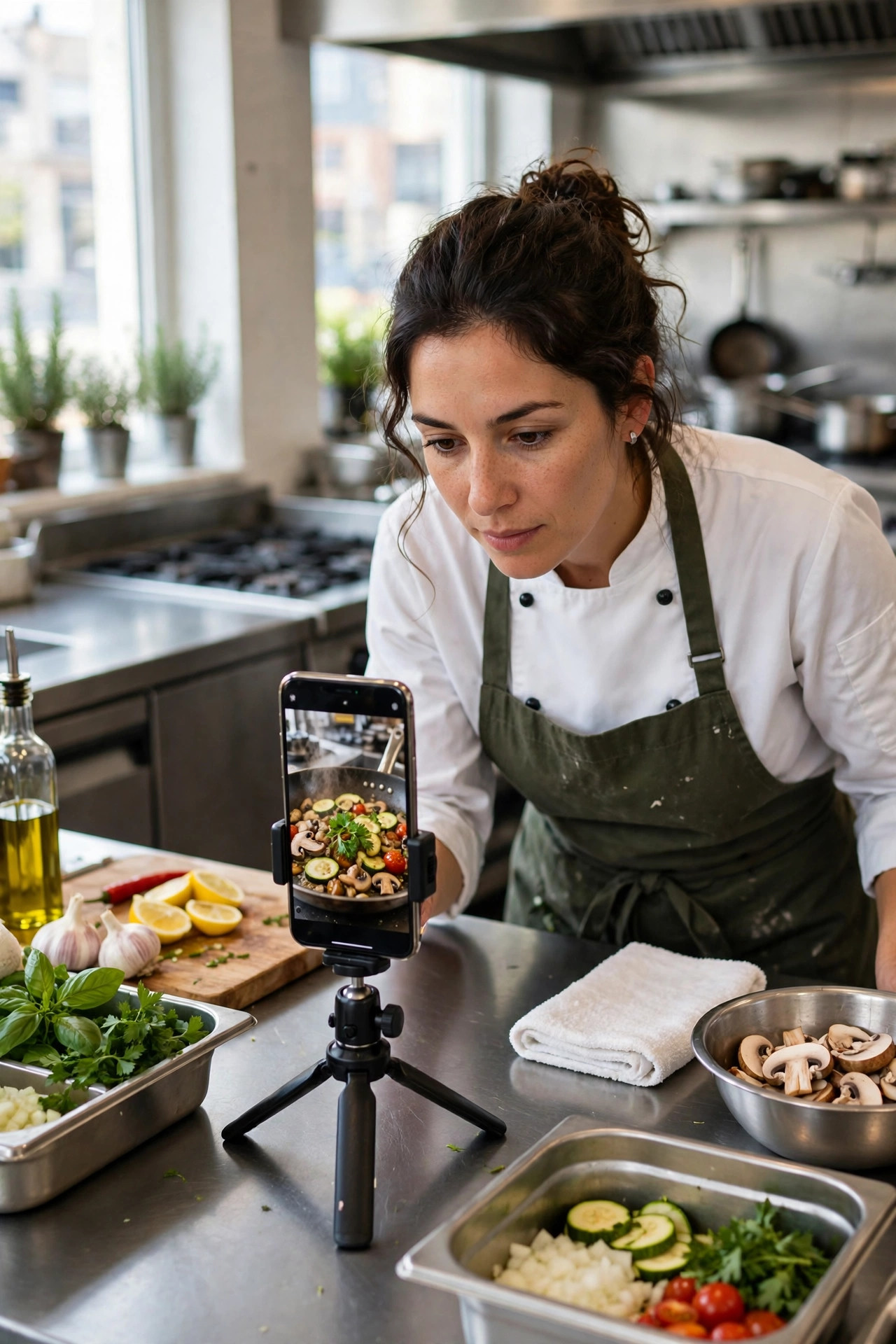
The biggest obstacle for working chefs is time, and the fix is batching. Pick one quiet afternoon a week — typically a Monday or a slow lunch service — and film the week's content in ninety minutes: two or three short Reels of dishes being finished, one technique explainer, and a handful of Stories. A phone on a small tripod at the pass, good window light and a clean background are enough. Film the cooking, not the talking: show the sear, the plating, the first cut. Voiceover can be added later, in the quiet of the office, which also solves the problem of a noisy kitchen. Our phone food photography guide covers light, angles and the small habits that make phone footage look professional, and our 30 Reels ideas for restaurants will keep the batch sessions from running dry.
Step 4: Post, reply, repeat — for six months
Post 3–4 times a week, mostly Reels, with Stories most days. Reply to every comment in the first hour if you can; early replies are one of the strongest signals the algorithm reads, and they are also just good manners. Use geotags on every post — the restaurant's location, the market, the supplier's farm — because local discovery is where bookings come from. Use hashtags sparingly and specifically: a mix of the dish, the city and the cuisine, five to ten at most, and vary them. After six months of this rhythm, the account will have a recognisable voice, a body of work a new follower can binge, and enough data in Insights to see what actually works. That is the moment to decide whether to invest more time, hire help, or expand to another platform — not before.
A chef with 3,000 local followers who actually book tables is worth far more than a chef with 100,000 followers on another continent.
What should a chef post?
"I don't know what to post" is the complaint every chef makes, and it has a simple cure: four content pillars, rotated every week. If every post fits one of the four, the account stays varied without ever feeling random.
Pillar 1: Finished dishes — but with a reason
The dish is the obvious content, and it still works — but only with context. "Our new dish is here" gives followers nothing to remember, and every restaurant posts it. "This is the third version of our whitefish dish. The first was too salty, the second fell apart on the plate, and this one works because we cure the fish for exactly forty minutes" gives them a story, a reason to care, and something to repeat to friends. Teach while you show: why this ingredient, why this technique, what to order if you like — or dislike — a particular flavour.
Pillar 2: Technique and process
People love to learn, and short technique videos are among the highest-performing chef content anywhere. A thirty-second clip of a knife skill, a sauce coming together, dough being folded or a fish being filleted will outperform a static plate photo almost every time. Film the hands, keep it under a minute, and add one sentence of explanation. This pillar also does quiet work for the restaurant: it demonstrates skill, justifies prices, and makes guests more likely to trust the kitchen with a tasting menu.
Pillar 3: Sourcing and suppliers
Nordic diners care about provenance, and showing it is a competitive advantage no chain can fake. Visit the fishmonger, the mushroom forager, the small farm that supplies your potatoes. Name them, tag them, show the early-morning market. This content does three jobs at once: it proves quality, it gives suppliers a reason to share your posts with their own audiences, and it anchors the chef's brand in a real place. Be honest about sourcing — "local when we can get it" is more credible than claiming everything is organic, and an informed guest will know the difference.
Pillar 4: The person behind the food
The fourth pillar is the chef as a person: the team, the mistakes, the early mornings, the reason they cook. Show the team by name — the sous chef, the pastry cook, the dishwasher who has been there ten years — because humanising the kitchen builds loyalty and helps hiring. Share a failure honestly: the dish that did not work, the service that went wrong and what changed afterwards. And take a position occasionally: an opinion about a trend, a defence of a maligned ingredient, a thought about where Nordic food is heading. Personality drives engagement in a way pure promotion never can. The boundary is simple: share the work and the thinking, keep the private life private.
TikTok, YouTube and LinkedIn
Instagram is the starting point, not the whole strategy. Once the Instagram rhythm is working, the same material can travel to other platforms — but each one wants something different, and spreading thin too early is the most common way chefs burn out.
TikTok: discovery, speed and younger diners
TikTok is where discovery happens: a single Reel-style video can reach people who have never heard of the restaurant, including tourists planning a trip. The format rewards speed, sound and surprise — the sizzle, the first cut, the unexpected ingredient. Post the same short videos as on Instagram, but cut them tighter and lean into trends carefully: a trend that fits the chef's voice is worth joining; a trend that doesn't will look desperate. TikTok converts less directly into bookings than Instagram, but it is the best top-of-funnel channel a small restaurant has, and it costs nothing. Our TikTok beginner's guide for restaurants covers setup, formats and the first month in detail.
YouTube: depth for the guests who want more
YouTube suits longer-form content: a five-minute kitchen tour, a full recipe, a conversation with a supplier. It grows slowly, but its audience is deliberate — people who watch a chef for five minutes are far more likely to book than people who scroll past in two seconds. YouTube is also the only platform where content keeps working for years: a good technique video can bring in new followers long after it was posted. Start with one video a month, repurposed from the week's filming, and only expand if the audience responds.
LinkedIn: the career and B2B channel
LinkedIn is the platform most chefs ignore, and it is the one that pays off in the least obvious ways. A chef who writes occasionally about running a kitchen — hiring, training, costing a menu, handling a bad review — reaches other professionals, suppliers, journalists and corporate clients. That audience books private dining, Christmas parties and chef's-table events, and it is where speaking invitations, cookbook approaches and the next job come from. One thoughtful post a month is enough. Keep it professional, specific and honest; LinkedIn rewards expertise and punishes empty motivation.
The practical rule: one platform done well beats three done badly. Master Instagram, add TikTok when the filming habit is solid, and treat YouTube and LinkedIn as slow-burn channels that compound over years. And wherever you post, the bio link should lead to a real booking page — the fastest way to lose a warm lead is to send them to a profile with no way to book. A website that turns that attention into reservations is the other half of the system, and PowerfulWebsite builds restaurant websites for free, with plans from €59/mo that include booking, hosting and updates.
The risks: when the chef leaves, burnout and boundaries
A chef personal brand is powerful precisely because it is personal — and that is also its risk. The three dangers every owner should plan for are the departure, the burnout and the boundary problem.
When the chef leaves
Chefs move. It is the nature of the profession, and a restaurant that built its entire online presence around one person's face will feel the loss immediately. The protection is to build the brand around the kitchen and its philosophy, not only the individual. Feature the whole team regularly, document recipes and standards so the cooking survives the person, and keep the restaurant account strong enough to stand alone. Agree in writing, before the brand grows, who owns each account, who owns the content, and what happens to shared posts if someone leaves. A ten-minute conversation now prevents a painful dispute later. Our social media crisis plan for restaurants covers how to handle a sudden departure in the first 48 hours without losing the audience's trust.
Burnout: the content treadmill
The second risk is burnout. A chef who works a sixty-hour week and then feels obliged to post daily will stop enjoying both the cooking and the content, and the audience will notice. The defences are batching, realistic frequency and permission to go quiet. Three posts a week is enough; a week off during holidays is fine if the account has a backlog of evergreen Reels to repost. Hiring help — a freelancer to edit, or a team member who films — is a legitimate business cost: a few hours of editing a week is typically far cheaper than the bookings the content brings in. If the chef hates being on camera, use ghost posting or voiceover instead of forcing performance.
Boundaries, privacy and the law
The third risk is boundaries. A personal brand invites attention, and not all of it is welcome: direct messages at midnight, guests expecting the chef at their table, comments about appearance. Decide early what is off-limits — family, home, health, politics — and hold the line. Never post a staff member's photo or a guest's image without their permission, and remember that GDPR applies: a photo of an identifiable person is personal data, and consent matters even on a restaurant's own account. Keep the account professional, keep the chef's private phone number out of the bio, and have a plan for the occasional abusive comment — hide, block, and move on, rather than arguing in public. For a fuller treatment of staff photography, see our guide to getting staff photos right.
The best personal brands don't promote, they help. That help gains trust — and trust is what gets remembered, repeated and recommended.
Measuring it: the numbers that prove the brand pays
Personal branding fails most often not because it doesn't work, but because nobody measures it and the chef gives up after six weeks. The right metrics are simple, and follower count is not among them. Watch saves and shares first: a save means someone wants to cook it, order it or remember it, and a share means they are recommending you to someone else. Both predict bookings far better than likes. Watch profile visits and website taps, because those are the steps between interest and a reservation. And watch the comments: are people asking about the menu, the ingredients, the opening hours? Those are buying questions, and each one is a lead.
Then connect the online numbers to the booking book. Ask every new guest how they found you — a one-line question at booking or at the table — and record the answers for a month. Compare booking volume in the weeks after a chef-led post performs well against quiet weeks. Look at which dishes get ordered after they appear on the chef's account. The pattern usually appears within three to six months: the chef's posts drive a steady stream of guests who arrive already knowing what they want, ask for the chef by name, and order the dishes they saw online. Those guests also spend more and review better, because they arrived with expectations the kitchen had already set.
Set the review point in advance: six months, one honest look at the numbers, and then a decision. If saves, shares and booking enquiries are climbing, keep going and consider investing — better filming, a regular editing slot, a second platform. If nothing has moved, the problem is usually not the chef but the offer: the bio link goes nowhere, the booking path is broken, or the restaurant account cannot convert the attention the chef creates. Fix the conversion path before blaming the content. A strong chef brand with a website that cannot take a booking is a leaking bucket, and the fix is usually a booking button and a menu page that loads in seconds — the kind of thing a free website build from PowerfulWebsite solves, with monthly plans from €59/mo covering hosting, maintenance and updates.
The chef's personal brand is not a vanity project and it is not a shortcut. It is the slowest, most durable form of restaurant marketing there is: a person, cooking honestly, in public, week after week, until the city knows their name and trusts their kitchen. Start with one platform, four content pillars and three posts a week. Give it six months. The tables will notice.
Frequently asked questions
How do chefs build a personal brand on social media?
Start with one platform — usually Instagram — and one clear idea of what you stand for, such as seasonal Nordic cooking or honest home-style food. Post 3–4 times a week, mostly short video, mixing finished dishes, technique, and behind-the-scenes moments. Keep the same voice, look, and posting rhythm for at least six months; personal brands compound slowly and then suddenly.
Should a chef have a separate Instagram account from the restaurant?
Yes, in most cases. The restaurant account is the home base — menu, hours, bookings, and offers. The chef's personal account is the engine — the person, the thinking, and the stories behind the food. The two should follow each other, tag each other, and share content, but keeping them separate protects both sides: the chef keeps their audience if they change jobs, and the restaurant keeps its own following if the chef leaves.
What should a chef post on social media?
The strongest mix is four content pillars: finished dishes, technique and process, sourcing and suppliers, and the person behind the food. Add short explainers — why an ingredient, what to order, how a dish evolved — because teaching builds trust faster than pure promotion. Avoid posting only polished food photos with no context; they give followers nothing to remember.
How often should a chef post on social media?
A sustainable baseline is 3–4 feed posts per week, mostly short Reels, plus Stories most days. Posting more only helps if quality stays stable. Consistency matters more than volume: three good posts every week for six months will outperform a month of daily posting followed by silence.
What happens to the restaurant's following if the chef leaves?
If the chef's personal account carried all the content, a large share of the audience goes with them. Protect the restaurant by building the brand around the kitchen and its philosophy, not only one person: feature the whole team, document recipes and standards, and keep the restaurant account strong on its own. Agree in writing, before the brand grows, who owns each account and what happens to shared content.
Can a chef's personal brand actually bring in bookings?
Yes, but indirectly and over time. Guests who follow a chef arrive already trusting the kitchen, ask for the chef's recommendations, and book the dishes they saw online. Track it by asking new guests how they found you, by watching saves and shares on dish posts, and by comparing booking volume in the weeks after chef-led content performs well. Expect months, not days, before the effect shows in the booking book.
Want a website that brings table bookings?
PowerfulWebsite builds your restaurant's website for free — you only pay the monthly plan from €59/mo. Everything included: domain, hosting, maintenance and updates.
See the packages