Valentine's Day: A Campaign Guide for Restaurants
Valentine's Day is consistently the second-busiest dining night of the year, and the restaurants that profit from it treat it as a planned campaign — prix fixe menu, published pricing, bookings opened by mid-January — not as a busy Friday. A well-run 14 February can deliver some of the highest per-cover revenue of your year, even in a 30-seat room.
Key takeaways
- Valentine's Day is one of the highest-revenue nights of the year: guests accept premium prices and rarely price-shop. Publish a prix fixe menu and open bookings by mid-January.
- A set menu simplifies the kitchen and raises the average check — design 3 courses around your strengths, with one signature dish and a chocolate-forward dessert.
- Don't serve only couples. Galentine's Day (13 February), singles mixers, Palentine's nights and anti-Valentine's events fill the seats romance leaves empty.
- Take card guarantees on two-tops and deposits on groups. Valentine's is a high no-show night; a lost 20:00 table cannot be resold.
- Extend the campaign after 14 February: surveys suggest around 40% of people celebrate Valentine's late for a better deal — capture that second wave too.
Every February, restaurant owners split into two camps. One treats 14 February as just another busy night: the regular menu, the regular pricing, the regular chaos. The other runs it like a campaign — a special menu with published prices, a booking flow built weeks in advance, marketing that starts in January, and a night so well choreographed it feels effortless. The second camp wins, every year, because Valentine's Day is one of the rare nights when guests arrive intending to spend more.
This guide covers the full campaign: the economics that make the night worth planning, a week-by-week timeline from January, how to design and price a prix fixe menu without killing your margin, how to reach beyond couples, the channels that actually fill tables, the booking mechanics, the service itself — and what to do on 15 February to squeeze a second wave of revenue from the same work.
Why Valentine's Day pays
Valentine's Day ranks year after year among the top dining nights in the industry — widely cited as the second-busiest day to dine out, trailing only Mother's Day. The National Retail Federation's 2026 survey found that 55% of consumers plan to celebrate Valentine's Day, with 39% planning an evening out. In the US alone, industry data puts dining-out spending around Valentine's at roughly $6–6.8 billion, and the numbers have climbed steadily for a decade on the back of premium prix fixe menus and a growing taste for experiential celebrating.
Three structural facts make the night unusually profitable:
Guests arrive ready to spend
On a normal Tuesday, your menu competes with the fridge at home. On 14 February, your menu competes with the desire to impress. Couples commonly spend between $75 and $150 for dinner for two, and the average Valentine's restaurant date — dinner plus flowers or a gift — is routinely estimated in the $150–$350 range. Median figures matter less than the psychology: guests have mentally approved the expense before they open the menu. That is why premium pricing on Valentine's night is accepted rather than resented — as long as the experience matches the bill.
The prix fixe engine
A set menu does two jobs at once. For the kitchen, it collapses a hundred possible orders into a handful of plated dishes, which means faster service, fewer mistakes, and a smaller brigade can serve more covers. For the business, it replaces à la carte choice with a single, higher price point: guests compare your menu against other Valentine's menus, not against their usual order. Industry estimates suggest restaurants charge roughly 30–70% more per person on Valentine's night versus a normal service — and because the menu is curated, your food-cost percentage often improves, not worsens.
Demand is concentrated and predictable
Unlike a random Saturday, Valentine's demand arrives on a known date with known intent. Nearly half of celebrants plan to dine out. Searches, reservations and social posts all spike in the two weeks before the day. Predictable demand means you can plan purchasing tightly, staff exactly, and — crucially — sell the night out in advance instead of hoping for walk-ins. As with Christmas party season, the winners are the restaurants that sell the event before it happens, not during it.
Valentine's Day is not a busy night you survive. It is a campaign you sell in advance, serve in one evening, and measure for the whole year.
The campaign timeline
The restaurants that scramble on 13 February lose to the ones that planned on 6 January. Treat the day as a product launch with this weekly rhythm:
Early January: decide and design
Week one is decisions. Are you running a prix fixe night, a special menu alongside the regular one, or a Galentine's/singles programme? One sitting or two? What price points? Lock the concept, then brief the kitchen: the menu should be designed, costed and test-cooked by the third week of January. Order any special ingredients, glassware, table decorations and printing now — suppliers raise prices and run out as February approaches. This is also when you draft your booking terms: deposits, cancellation deadlines, seating times.
Mid-January: publish and open bookings
Your Valentine's page goes live on your website by mid-January at the latest: the full menu, prices, seating times, booking terms, and a big visible booking button. Email your existing customers first — your regulars are statistically your most likely Valentine's guests, and giving them first access fills your book early. Then post the menu on your Google Business Profile, pin it on Instagram, and push the first announcement email to your whole list. Prime slots at popular restaurants are typically gone two to three weeks out; the goal is to have 60–70% of capacity committed before February begins.
Late January: amplify
Now you go wide: social content (menu photos, behind-the-scenes prep, the decorated dining room), local press and listings ("Valentine's dinners in [your city]"), influencer invitations for a preview tasting, and a second email to anyone who opened the first but didn't book. Urgency messaging starts here — "limited sittings", "final tables at 17:30". Confirm staffing, run the kitchen briefing, and do a full dress rehearsal of the service flow with the team.
February: execute
The first week of February is the final sales push: countdown posts, a last-chance email, and phone follow-ups to group enquiries. Confirm every booking 48 hours ahead, reconfirm deposits, and prepare a waitlist for cancellations. On the day, the marketing stops and the operations take over — which is exactly the point of doing the marketing in January.
The 3-week rule
Event planners advise a minimum of three weeks of active campaign time: one week for menu finalisation and the marketing launch, one for staffing and supply orders, one for walkthroughs and team briefings. If you are reading this in early February, skip the fancy extras and execute the basics flawlessly.
Designing the Valentine's menu
The menu is the product. On 14 February, guests don't browse — they commit. A great Valentine's menu is short, romantic in feeling rather than gimmicky, and built around dishes your kitchen can plate perfectly 120 times in one night.
The prix fixe structure that works
Three courses is the sweet spot: a starter, a main, a dessert. Five-course tastings photograph beautifully but slow the room to a crawl and exhaust the brigade; two courses leave money on the table. Give each course two or three options — enough to feel like choice, few enough to keep the kitchen sane. One vegetarian option per course is now expected; in the Nordics, guests also appreciate a clear vegan and a gluten-free path through the menu. A pre-order step at booking time (guests choose their courses when they reserve) is the single best operational upgrade you can make: it turns 14 February into a logistics exercise instead of a guessing game.
What to put on it
Build around your strengths, not around Valentine's clichés. If your restaurant is known for seafood, lead with oysters or scallops; if it's a steakhouse, the filet is the hero. Shareable starters work brilliantly on Valentine's — a platter for two at the start of the meal sets the tone for the evening. Lean gently into romantic ingredients (chocolate, berries, champagne, oysters) rather than heart-shaped everything; guests want romance, not a theme park.
Dessert deserves special attention. Operators consistently report that dessert orders jump on Valentine's — some restaurant marketers put the uplift at around 50%. Plan a showpiece: a chocolate fondant with a molten centre, a dessert for two with two spoons, a tableside finish. It is the most photographed course of the night, which makes it your marketing for next year, free of charge.
Dietary and allergy notes
February couples include vegetarians, vegans, and guests with allergies — and a prix fixe menu that forces them into an awkward phone call costs you bookings. Publish the full menu online with dietary markers, and include a simple "dietary requests" field in the booking form. It removes friction at the exact moment the guest is deciding, and it protects the kitchen from surprises on the night. For the EU allergen labelling rules behind this, see our guide to allergen labelling for restaurants.
Pricing that protects your margin
Yes, restaurants charge more on Valentine's Day — and guests expect it. Surveys of current prix fixe menus show the pattern clearly: casual spots charge roughly 40–70% above their normal average, fine dining 60–100% above, and luxury rooms more still. The key is that the increase must feel earned. Three things earn it: a genuinely special menu, flawless service, and small touches (a glass of sparkling wine on arrival, a printed menu to take home, a chocolate with the bill) that cost you little and feel like luxury.
Use the table below as orientation only — these are typical European price bands, not targets. Build your own price backwards from your costs and your regulars' willingness to pay.
| Segment | Typical Valentine's prix fixe (per person, estimate) | Typical uplift vs normal night |
|---|---|---|
| Casual bistro / neighbourhood restaurant | €65–€95 | +40–70% |
| Mid-range / modern European | €95–€140 | +50–80% |
| Fine dining | €140–€220 | +60–100% |
| Wine pairing add-on | +€35–€75 | — |
| Galentine's brunch / lunch (13 Feb) | €45–€75 | event pricing |
Add-ons beat discounts
Never discount Valentine's night itself — a discount on the year's most in-demand evening trains guests to wait for deals. Instead, build tiered pricing: the standard menu, plus an "enhanced" tier with a champagne aperitif and wine pairing. Upsells on the night (pairings, premium supplements, the dessert upgrade) lift the average check far more profitably than filling the last tables at a lower price. One caution from the industry press: mandatory service charges on top of a prix fixe can sour the mood — if you add one, disclose it at booking, not on the bill.
The second-seating question
Two sittings roughly doubles capacity: an early one (around 17:30) and a late one (around 20:30). The maths is seductive, but the execution is unforgiving. A second sitting only works with fixed course timings, a re-seat deadline communicated at booking ("the table is yours until 20:15"), and a team briefed to pace firmly and warmly. If your kitchen needs 2 hours 15 minutes for the full menu, don't promise a 2-hour turn. One perfectly executed sitting at a higher price beats two sittings that run into each other.
On Valentine's night, guests don't compare your menu against their usual order. They compare it against other Valentine's menus. Price with confidence — then earn it with the experience.
Beyond couples: Galentine's, singles and friendship
Here is the part most restaurant guides bury at the bottom: Valentine's Day is no longer only about couples. OpenTable's 2026 research found that 57% of people now see the day as celebrating all relationships, not just romantic ones. That shift is an opportunity, not a footnote — because the restaurants that program for everyone capture revenue the couples-only rooms leave behind.
Galentine's Day — 13 February
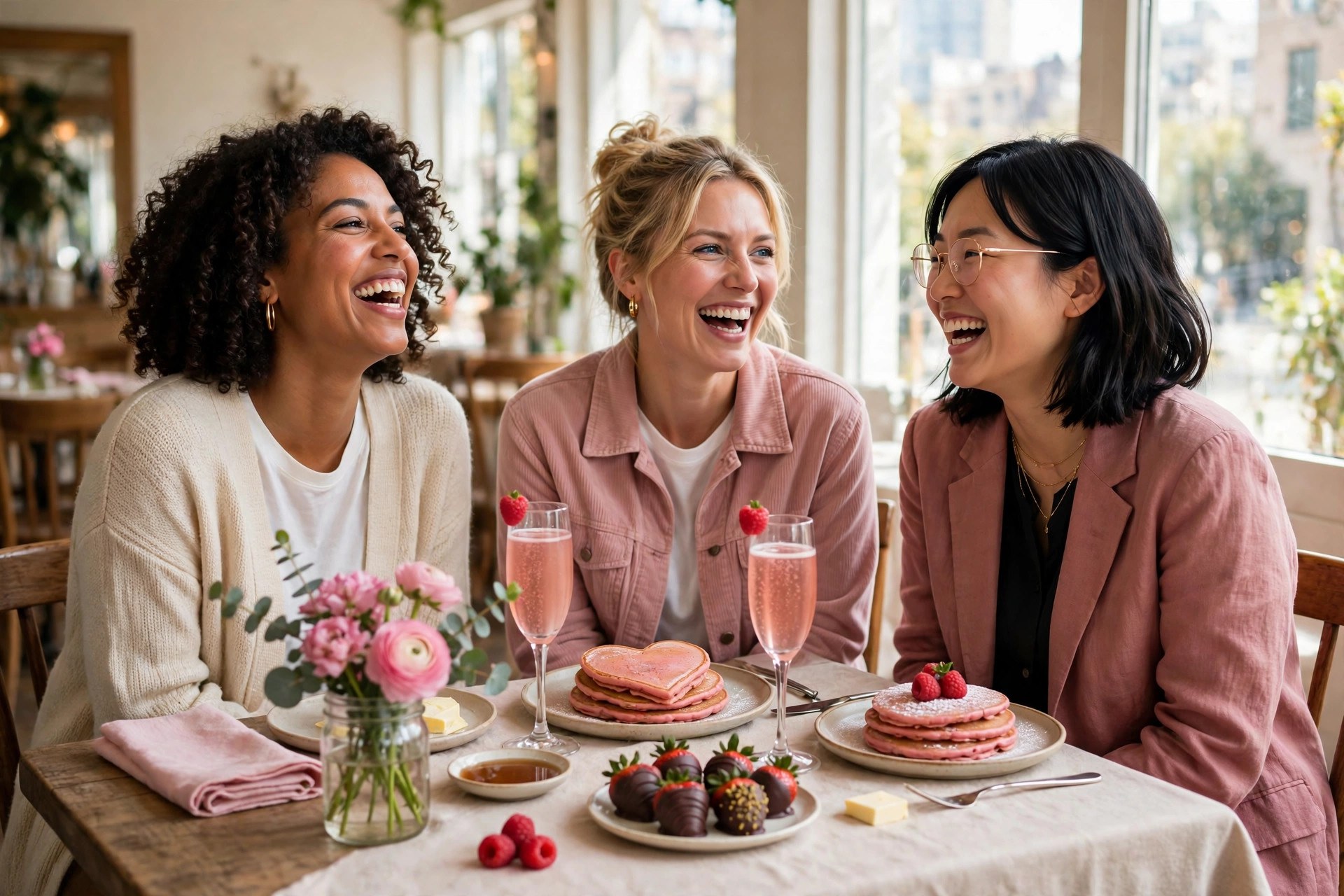
Galentine's Day, the celebration of female friendships popularised by TV culture, falls on 13 February — the night before Valentine's, when your dining room would otherwise sit quiet. A Galentine's brunch or dinner needs its own identity: group-friendly sharing menus, rosé or sparkling specials, a playlist and decor that feel like a celebration of friendship rather than a rehearsal for romance. Group deals (a fixed price for four, a bottle included) work better than per-person romance pricing. Market it to friend groups on Instagram and TikTok in the first week of February — it is a social-first event, and it books through shares, not search.
Singles mixers and Palentine's nights
Singles are a large, underserved Valentine's audience — and they buy drinks. A singles mixer (ticketed, with a welcome cocktail and icebreaker format) or a "Palentine's" night for friend groups of all genders fills the bar side of your room while the dining room serves couples. Keep the format social: communal tables, sharing platters, large-format drinks, a quiz or a lighthearted "anti-awards" ceremony. Bars and casual restaurants often find these nights more profitable per square metre than a quiet couples service.
Anti-Valentine's events
For brands with a playful identity, an anti-Valentine's night is a genuine differentiator rather than a joke: breakup-themed cocktails, comedy nights, "shred your ex" photo gimmicks (real chains have run these), comfort-food menus for the romantically unimpressed. The audience skews young and loud — perfect for venues where atmosphere is the product. Just keep it good-natured; mean-spirited concepts travel badly on social media.
The takeaway crowd
A large share of couples stay in on Valentine's — and they still want restaurant food. A Valentine's takeaway package (two mains, a starter to share, dessert, a printed menu card and a small candle) captures revenue from guests your dining room can't seat. Offer it for pre-order with pickup slots, price it slightly below the dine-in menu, and include a note with a booking incentive for March. It also quietly builds your direct ordering habit instead of feeding the delivery apps' commission.
Marketing channels that fill tables
Valentine's marketing is a short campaign with a hard deadline, so every channel must earn its place. Ranked by return on effort for an independent restaurant:
Email first — your regulars decide early
Your email list is the highest-converting Valentine's channel you own. Send a dedicated announcement to past bookers before you promote publicly: the menu, the price, the seating times, and a clear booking link. Segment if you can — couples who dined with you last Valentine's get a "we'd love to see you again" message; everyone else gets the general announcement. Targeted, behaviour-based emails dramatically outperform mass blasts; industry platform data has shown targeted restaurant emails driving many times the revenue per send of generic ones. A second email goes out in late January with urgency ("final tables"), and a short reminder in the first week of February catches the procrastinators. If you haven't started building a list, our GDPR-safe guide to building an email list from zero is the place to start.
Your website is the booking engine
Every social post, email and listing points to one page: your Valentine's page. It must carry the full menu, prices, seating times, terms — and a booking button above the fold. Guests who can't find the price leave; guests who can't book online book somewhere else. If your current site buries the menu in a PDF or hides the booking form three clicks deep, fix that before January — a PowerfulWebsite site puts the menu and online booking on the same screen, and the build itself is free (from €59/month, with booking included on the Restaurant tier).
Social and short-form video
Valentine's is a visual holiday: candlelit tables, plated desserts, the dining room dressed for the evening. Post the menu as short video — a 20-second reel of the dessert being plated outperforms a static photo every time. Behind-the-scenes content (the chef tasting the menu, the team setting the room) builds anticipation in the two weeks before the day. Run a simple mechanic: a giveaway for a table for two, entered by tagging a partner, which puts your restaurant in front of exactly the right audience. Paid social works too, but keep it hyper-local: a small budget targeted at couples within a few kilometres of your door beats a broad campaign.
Listings, press and partners
Update your Google Business Profile with a Valentine's post and the special hours; "Valentine's dinner near me" searches spike in early February, and your profile is what searchers see first. Pitch local media and city blogs in mid-January with your menu and one good photo — most publish Valentine's roundups and need entries. Partner with neighbours: a dinner-and-a-movie package with the local cinema, a dinner-and-flowers bundle with the florist next door, a hotel package for out-of-town couples. Each partner promotes to their own audience, which doubles your reach for free.
The booking flow
Valentine's bookings fail in predictable ways: the phone rings off the hook, dietary requests get lost, and no-shows crater the 20:30 sitting. Fix the flow once and the night runs itself.
Reservations required, online first
Make Valentine's reservations-only and push online booking hard — it is faster than the phone, captures data, and works at midnight when the decision gets made. Collect at booking: party size, seating preference, course choices (for pre-ordering), dietary requirements, and a phone number for the 48-hour confirmation. Every booking gets an automatic confirmation with the terms attached; every booking gets a confirmation message 48 hours before. For templates that cut no-shows, see our booking confirmation templates.
Guarantees and deposits
Valentine's is one of the highest no-show nights of the year, and a lost table for two at prime time cannot be resold. The standard that works: a card guarantee on every Valentine's booking, with the cancellation deadline stated at booking (typically 48–72 hours) and a per-person charge for late cancellations or no-shows. For groups of six or more and any private-dining space, take a fixed deposit or full prepayment per person. State the policy on the booking page, in the confirmation, and in the reminder — no surprises, no arguments. Deposits also improve cash flow weeks before the event. For the full mechanics, read our guide to deposits and gift cards.
Waitlists and cancellations
Cancellations will happen — the difference is whether they cost you money. Keep a waitlist for every seating from the moment it fills, and confirm it in booking order the moment a table frees up. A short "a table just opened for 14 February" message to the waitlist routinely refills slots within the hour. Overbooking slightly (one or two tables) is a legitimate tactic on high no-show nights, but only if you have somewhere to seat the overflow — a bar area with the full menu — if everyone shows.
The 48-hour rule
Confirm every Valentine's booking 48 hours ahead by message, restate the seating time and the cancellation charge, and ask for a simple reply. Confirmed bookings no-show far less often — and the replies give you your final pre-order numbers for the kitchen.
The night itself
All the marketing in the world is wasted if the service collapses. Valentine's service is theatre: pacing, lighting and small gestures matter as much as the food.
Pacing and table management
Brief the whole team on the night's choreography before service: course timings per seating, the hard re-seat deadline for the first sitting, and who calls the turns. Stagger arrivals within each seating by 10–15 minutes so the kitchen never gets 40 starters at once. The floor manager's job is pace, not plates — give one person explicit authority over timing. For restaurants handling their first big event night, the principles in our group bookings guide apply one-to-one.
Ambiance and small touches
Dim the lights a notch, light the candles, and lower the music volume slightly — intimacy is acoustic as well as visual. Small touches with outsized impact: a printed menu with the couple's evening dated on it, a complimentary glass of sparkling wine or an amuse-bouche on arrival, a single rose or a chocolate with the bill. Give tables a little more space than usual; couples notice crowding on Valentine's far more than on a normal night. And brief the team on the one rule of the evening: never rush a couple visibly, even when the clock is tight — pace them with the courses, not with body language.
Upselling without breaking the mood
Valentine's guests are the most upsell-receptive audience of the year — if it feels like service, not sales. Train the team on three offers: the wine pairing at the moment the menu is presented ("most of our guests take the pairing with this menu"), a premium supplement on one course, and the dessert or digestif upgrade at the end. Present the pairing as the default and the glass pour as the alternative; defaults win. A "little indulgences" card with the dessert menu — dessert wines, liqueur coffees, a cheese supplement — quietly lifts the average check at exactly the moment guests are happiest.
The best Valentine's upsell is invisible: a pairing presented as the obvious choice, a dessert that photographs itself, and a bill that arrives with a chocolate instead of a surprise.
After 14 February
The campaign doesn't end at midnight. Industry surveys have found that around 40% of people celebrate Valentine's after the fact to get a better deal — which means the week after 14 February is a second, smaller Valentine's season for restaurants smart enough to claim it.
The second-wave offer
On 15 February, email everyone who booked — and everyone who enquired but didn't — with a "Valentine's, continued" offer: the same menu at a gentler price for the following weekend, or a voucher for a return visit within a month. Extend any unredeemed gift-card bonuses. Post the night's best photos (with permission) as social proof for next year's campaign. The content you capture on 14 February is the marketing asset that sells 14 February next year.
Measure and file it away
Within a week, write down the numbers while they're fresh: covers per seating, average spend per cover, food-cost percentage on the menu, no-show rate, which marketing channel drove which bookings, and what broke. File it with the menu and the photos in a folder labelled "Valentine's 2027". Next January, you'll open it and thank yourself. Then feed the new guests into your regular rhythm: the couples who loved the night should get your spring menu email, and the Galentine's groups should hear about your summer terrace. Valentine's is a customer-acquisition event disguised as a holiday — treat the guest list as the real prize. For the year-round framework this fits into, see our seasonal advertising calendar for restaurants.
Frequently asked questions
How much should I charge for a Valentine's Day menu?
As a rough guide: casual restaurants typically price a 3-course Valentine's menu at €65–€95 per person, mid-range at €95–€140, and fine dining at €140–€220. These are estimates, not rules — build the price backwards from your food cost, your usual average spend per cover, and what your regulars will pay without blinking. Most guests expect Valentine's pricing to sit 30–60% above a normal night out.
How far in advance do restaurants fill up on Valentine's Day?
For popular restaurants, prime slots (18:00–20:30) typically fill 2–3 weeks out, with the final rush arriving in the last week before 14 February. Publish your Valentine's plans and open bookings by mid-January at the latest. If you are still filling slots on 13 February, you started too late.
Do I need deposits for Valentine's Day bookings?
For two-top tables, a card guarantee with a clear cancellation deadline usually suffices. For groups of six or more and any private-dining space, take a fixed deposit or full prepayment per person. Valentine's is one of the highest no-show nights of the year, and a lost table for two at 20:00 cannot be resold.
What if my restaurant doesn't cater to couples?
You don't need couples. Galentine's Day on 13 February, singles mixers, Palentine's nights for friend groups, and anti-Valentine's events all draw crowds — OpenTable research found 57% of Americans now see Valentine's as celebrating all relationships, not just romantic ones. Bars and casual spots often earn more from a high-energy singles night than from a quiet couples service.
Should I run one seating or two on 14 February?
Two sittings (e.g. 17:30 and 20:30) roughly double your capacity and revenue, but only if you run them with military table management: fixed course timings, a hard re-seat deadline communicated at booking, and staff briefed on pacing. If your team can't turn tables in 2 hours comfortably, one well-executed sitting with higher prices beats two chaotic ones.
Is Valentine's Day worth it for small restaurants?
Yes — often more so than for large ones. Small rooms can sell intimacy, which is exactly what Valentine's guests want. A 30-seat restaurant running two prix-fixe sittings at €90 per person turns 14 February into one of the strongest revenue days of the year. The cost is mainly planning: menu, bookings, and marketing done in January.
Want a Valentine's page that books while you sleep?
PowerfulWebsite builds your restaurant's website free — from €59/month with the menu and online booking on one page. Publish your Valentine's menu in January and let the bookings come to you.
See the packages