Graduation Party Restaurant Bookings: The 2026 Guide
Graduation party restaurant bookings are won in February and March, not May: families celebrating in late May and June book the best private dining rooms months ahead, pay deposits without hesitation, and spend more per head than almost any other group of the year. Publish clear graduation packages with real prices, answer enquiries within hours, and treat the booking like a product instead of a favour — and graduation season can fill your quietest spring weekends with your highest-value tables.
Key takeaways
- Nordic graduation season is compressed into roughly six weekends in late May and June — peak Saturdays sell out by March.
- Graduation parties typically run €35–€65 per person for lunch and €55–€95 for a plated dinner, before drinks; most venues use a minimum spend, not a room fee.
- Private dining rooms (8–40 guests) suit most graduation parties; groups above 50 need a banquet hall.
- Publish three package tiers with one all-in price each, take a deposit on every booking, and confirm the final headcount 5–7 days out.
- The first complete, professional response usually wins the booking — answer party enquiries within 4 business hours.
- A graduation party is also your cheapest new-customer acquisition of the year: 10–30 guests who may never have visited you before.
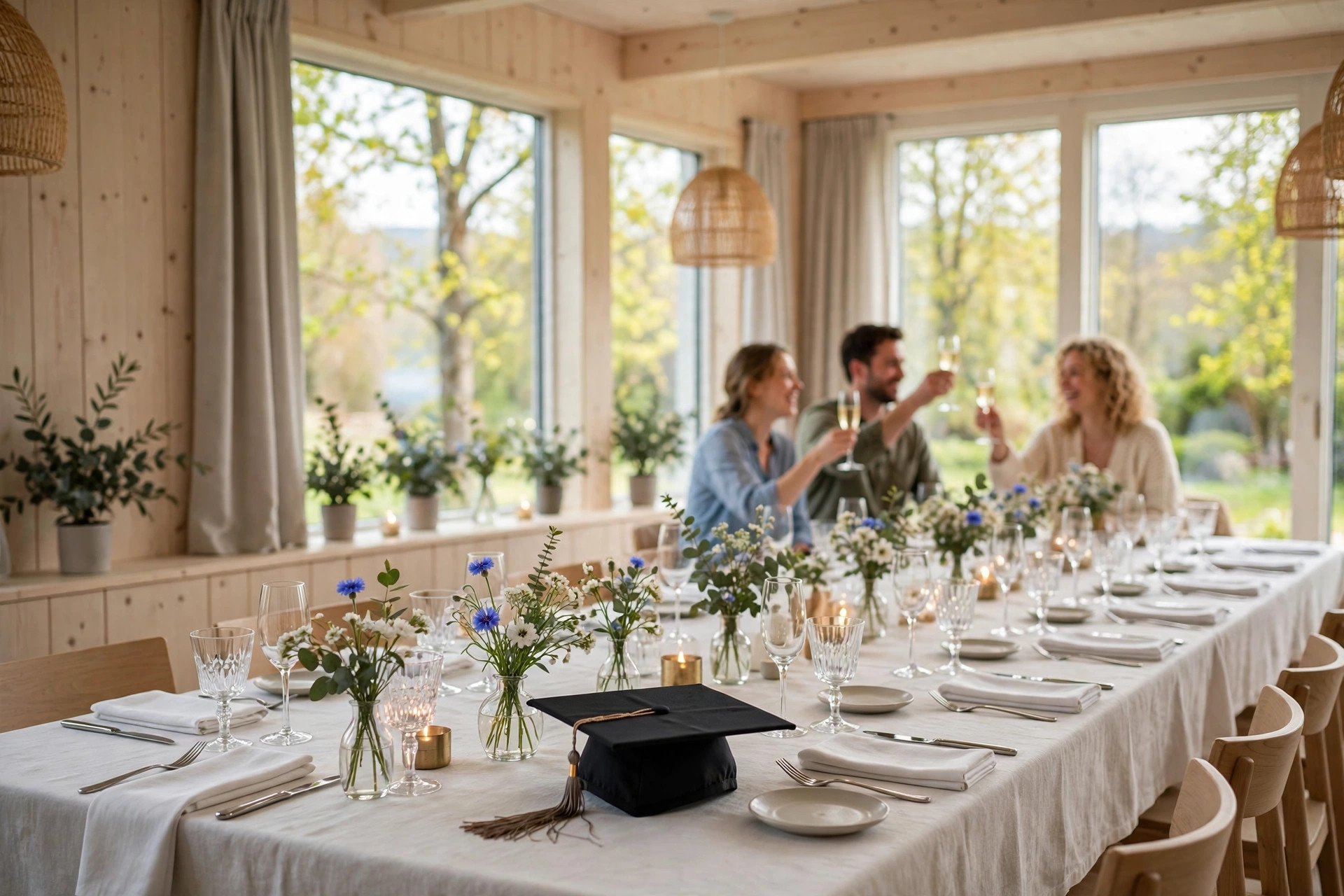
Every spring, the same thing happens in Nordic restaurants. The phone starts ringing in February with parents asking about the last weekend in May. By March, the good rooms are gone. By the time the lilacs bloom, families who left it late are phoning every restaurant in town, and the restaurants that planned ahead are calmly serving their third graduation lunch of the weekend while everyone else wonders where the season went.
Graduation season is one of the most concentrated revenue opportunities on the restaurant calendar — and one of the most mishandled. It is short, predictable, and full of motivated guests whose organiser wants the day to be perfect and is willing to pay for it. This guide covers the whole arc: Nordic dates, real prices, packaging, a booking flow that converts enquiries into deposits, and delivery that turns one family's celebration into next year's referrals. It fits neatly into your seasonal advertising calendar alongside Christmas, Easter and Midsummer.
When is graduation season in the Nordics?
The first thing to understand about graduation season is that it is not one date. It is three national traditions landing in the same six-week window, plus a university wave that follows them — and that compression is exactly what makes it valuable.
In Finland, the big day is the ylioppilasjuhlat: upper secondary school students graduate at the end of May or the very start of June, with the formal ceremonies typically falling on the last Saturday of May or the first Saturday of June. Families celebrate at home in the afternoon and then go out — or skip the home party entirely and book a restaurant. The Finnish tradition is a daytime, family affair: grandparents, godparents, aunts and uncles, a long lunch, speeches, coffee and cake. That matters for your offer, because the Finnish graduation party is usually a lunch, not a dinner, and it competes with the family's own living room rather than with other restaurants.
In Sweden, the student is a louder, longer celebration. Students graduate in early to mid-June, and the season runs from the school-leaving ceremonies through the traditional student parties (studentmottagning and studentfest) that can stretch across several days. Swedish graduates celebrate with friends as much as with family, so one graduate can mean two bookings: a family lunch and a friends' dinner — younger, more evening-oriented, with larger groups and a higher drinks share.
In Norway, graduation is tangled up with the russefeiring: the famous russ celebration that runs through most of May, culminating around 17 May, Norway's Constitution Day. The russ period is chaotic, late-night and group-driven — less your classic restaurant booking and more a series of smaller gatherings, pre-parties and late suppers. The formal graduation dinners and family celebrations tend to cluster in late May and June, once the russ period ends. Norwegian families are also more likely to book a restaurant for the graduation itself, because the russ weeks have already exhausted the home-party option.
The university wave follows the schools
Universities graduate later and looser. Master's and bachelor's ceremonies in Helsinki, Stockholm, Oslo, Turku, Uppsala, Bergen and the other university cities run from late May through June, with no single peak weekend. These are smaller, more international groups — often 8–15 people, often with guests who have flown in, often happy to pay for a proper dinner. They book later than school families, they are less price-sensitive, and they fill the gaps between the big school-graduation Saturdays. If your restaurant is near a university, treat the university wave as a second, quieter season and market to it separately.
What the compression means for your diary
Put the three traditions together and the pattern is clear: demand is compressed into roughly six weekends, with the sharpest peak on the two Saturdays when Finnish and Swedish schools graduate. Scarcity sells — a genuinely limited room can command a minimum spend and a deposit without apology — but a missed enquiry in February is a booking you will never recover in June; there is no second peak. Your graduation offer must be published, priced and bookable before the enquiries start, not after. Our guide to handling group bookings covers the service mechanics; this guide is about winning the booking in the first place.
Why graduation parties are worth chasing
First, the spend per head is high. A graduation party is a once-in-a-lifetime milestone, and the organiser is hunting for the option that will not embarrass them in front of the grandparents — not the cheapest option. Typical Nordic packages run €35–€95 per person before drinks, and the bill is often settled by one parent who has already decided the day is worth it. Add a welcome drink, a cake and a modest drinks package, and a 20-person lunch is a €1,000–€2,000 table — a full evening of two-tops, with far less work per euro.
Second, the timing is perfect. Late May and June are the shoulder weeks between the spring slump and the summer terrace season. In Finland and Sweden, May weekends can be oddly quiet: the weather is improving, but the summer crowds have not arrived and the regulars are saving themselves for Midsummer. Graduation parties fill exactly those weekends, and they fill them at lunch — the daypart most restaurants struggle with most. A graduation lunch from 12:00–15:00 does not cannibalise dinner service; it adds a whole extra service to a day that would otherwise have been half empty.
Third, graduation parties book early and commit hard. Parents planning a once-in-a-lifetime celebration do not dither: they enquire, compare two or three venues, pay the deposit, and show up. That early commitment de-risks your spring — a dining room with 60% of its graduation Saturdays pre-sold by March can roster, order and plan with confidence. It is the same dynamic as Christmas party season, compressed into a shorter window, and our Christmas party season guide shows the same deposit and packaging logic at work in December.
Fourth, every graduation party is a room full of new customers. A 20-person party brings 20 people through your door, most of whom have never visited you. A fraction will come back, recommend you, or book their own celebration — if you treat the guest list as an asset: a discreet card inviting guests to join your mailing list, a QR code for a review, a thank-you note to the organiser the next day. The party itself is the marketing.
A graduation party is not a table. It is twenty future regulars, one deposit, and the best lunch service of your spring — if you sell it like a product instead of handling it like a favour.
How much does a graduation party at a restaurant cost?
This is the question every organiser asks first, and the one most restaurants answer worst — with "it depends" and a request to email for a quote. Publish the numbers: organisers compare packages, not promises, and the restaurant with clear prices on its website wins the shortlist before the phone ever rings.
The ranges below are estimates for independent Nordic restaurants in 2026. Cost your own packages dish by dish; the structure matters more than the exact numbers. All prices are per person, before drinks, and exclude any room fee — most restaurants replace that with a minimum spend, as the next section explains.
| Format | Typical price per person | Best for | What is usually included |
|---|---|---|---|
| Family-style lunch | €35–€55 | 10–25 guests, daytime, relaxed | Shared starters, two mains to choose from, coffee and cake |
| Buffet lunch | €40–€65 | 20–50 guests, mixed ages | Full buffet, salads, warm dishes, dessert table, coffee |
| Plated 3-course dinner | €55–€95 | 12–40 guests, evening, formal | Starter, main, dessert, bread, coffee; pre-ordered |
| Premium tasting menu | €85–€140 | 8–20 guests, fine dining | 5–7 courses, sommelier pairing available as an add-on |
| Drinks package (add-on) | €15–€35 | Any format | Welcome drink plus two glasses of wine or beer with the meal |
| Children's menu (add-on) | €15–€25 | Families with children under 12 | Smaller portion of the main, a soft drink, ice cream |
Two things deserve attention. First, lunch is typically 20–30% cheaper than dinner for the same menu, because the kitchen is quieter, the room would otherwise be empty, and the drinks share is lower. If you want the Finnish ylioppilasjuhlat market — overwhelmingly a lunch market — price your lunch package as its own product, not as a discounted dinner. Second, the drinks package is where the margin lives: a €25 package costs a fraction of that in product, removes the awkwardness of a running bar tab, and lifts the per-head total by a third. Sell it as part of the package, not as an afterthought.
Minimum spends, not room fees
Most restaurants with private rooms work with a food-and-beverage minimum spend rather than a flat room fee, and for graduation parties that is usually the better deal for both sides. A minimum spend of €800–€2,000 for a private room on a peak Saturday is typical for a Nordic independent, scaling with room size, city and date. The organiser's spending counts towards it, so a 20-person party at €55 a head already clears a €1,000 minimum before drinks. Frame it that way — "the room is yours when the party spends €1,000 on food and drink" — and the minimum feels like a target, not a charge. A separate room hire fee feels like paying for nothing, and it is the most common reason organisers walk away from an otherwise perfect room.
Deposits and what they protect
Take a deposit on every graduation booking, without exception: €20–€50 per person, or 30–50% of the estimated package total, paid at confirmation and deducted from the final bill. For a 20-person party at €55 a head, that is €330–€550 — enough to make the booking real, small enough that no parent will argue. Publish the cancellation terms with the deposit: full refund until 30 days out, deposit retained inside 14 days, full package charged inside 72 hours. Parents understand this; they are buying certainty for a day that cannot be rescheduled. For the full mechanics, see our guides to deposits and gift cards and cancellation policies that actually hold.
Private dining room vs banquet hall vs main dining room
Organisers usually arrive with a format in mind — "we want a private room" — without knowing what the options actually trade off. Your job is to guide them to the format that fits their group, not to sell them the most expensive room. A family that ends up in a hall built for 150 when they are 18 people will feel lost; a family of 60 squeezed into a room built for 30 will feel it in the service. The comparison below is the one to walk through on the phone, and it is worth publishing a version of it on your graduation page.
| Factor | Private dining room | Banquet hall | Sectioned main dining room |
|---|---|---|---|
| Guest count | 8–40 guests | 50–200+ guests | 15–60 guests |
| Atmosphere | Intimate, quiet, personal | Spacious, celebratory, formal | Lively, part of the restaurant buzz |
| Food quality | Restaurant kitchen, plated courses | Banquet kitchen, buffet or family-style | Full restaurant menu, normal service |
| Speeches and programme | Easy — one room, one audience | Needs AV, stage or microphone | Harder — shared space, noise |
| Price driver | Per-head menu, minimum spend | Space, staffing, setup | Per-head menu, often no minimum |
| Best for | Most graduation parties | Large combined-family parties | Smaller parties, tight budgets |
The private dining room wins most graduation parties, and the reason is structural: a graduation party is a programme, not just a meal. There are speeches, a graduate to toast, a cake to cut, photographs to take — all of it needs a room with a door that closes, where the family is the only audience. A sectioned area can work for a small, relaxed lunch, but the moment the grandfather stands up to speak, the family will wish they had the private room. Say so, kindly, when they enquire: it is the kind of honest guidance that wins trust — and the room upgrade.
The banquet hall has its place: the combined party where two families, or a whole class of graduates, celebrate together, or the family of 80 that no restaurant room can hold. If you do not have a hall, say so early and refer them well — a graceful referral is remembered, and the family will come back for the smaller occasions. If you do have a large space, price it against reality: a hall booking must earn at least what the space would make on a strong Saturday. For the sales side of private dining, see our guide to selling your private dining room online.
Building a graduation package that sells itself
Organisers do not want to build a party from components. They want a complete, stress-free celebration they can approve in one email. Restaurants that sell bundled packages — menu, drinks, room, cake, terms, one price — win more bookings than those selling the pieces separately. Build three tiers; three is the number the human brain compares comfortably, and the middle tier should be the obvious choice.
The lunch tier is your volume product: a family-style or buffet lunch at €35–€55 per person, coffee and cake included, in the daytime slot. Keep it simple to deliver — two or three mains, one dessert, a children's option, dietary alternatives as standard. This is the tier that fills the Finnish ylioppilasjuhlat Saturdays and the university lunches, and the one to promote first, because most families can say yes to it without a committee meeting.
The dinner tier is your margin product: a plated three-course dinner at €55–€95 per person, with a welcome drink and the option of a drinks package, in the private room in the evening. Pre-orders collected a week out, timed courses, a cake moment built into the flow. This is the tier for the Swedish student dinners and the families who want the evening to feel like an occasion — and the organiser should see at a glance why it costs more than lunch: the courses, the service, the room for the whole evening, the speeches without an audience.
The premium tier is your anchor: a tasting menu or chef's table at €85–€140 per person for 8–20 guests, with wine pairings as an add-on. Most families will not book it — and that is fine. Its job is to make the middle tier look reasonable, and to catch the families who do want the best.
The details that make the package feel premium
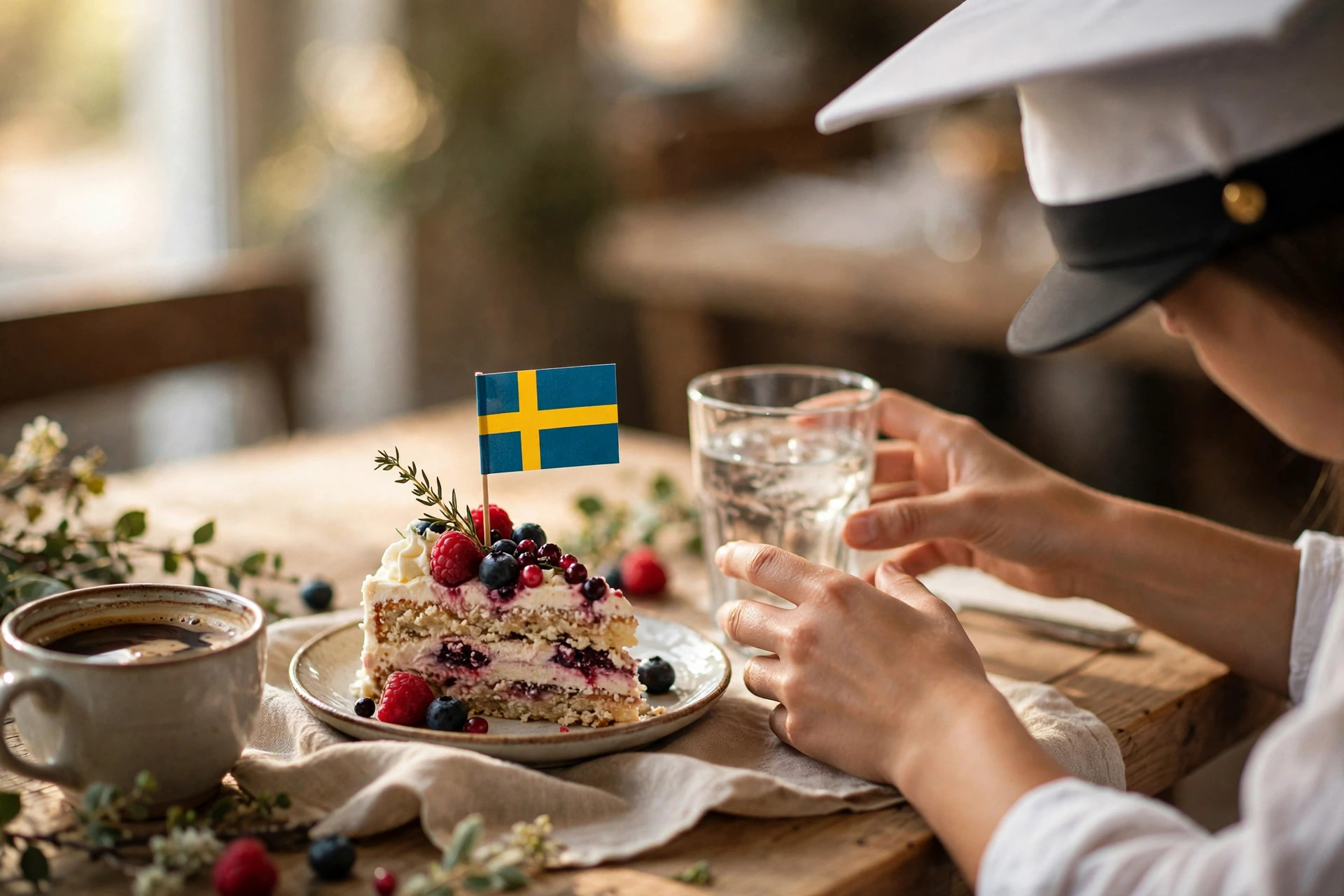
Small, cheap touches separate a graduation package from a group lunch. A printed menu card with the graduate's name — costs almost nothing, gets photographed, goes home in a handbag. A clear arrival note for grandparents. A single white flower on each place setting in the Finnish blue-and-white tradition, or the school colours where you know them. A spot with good light for the family photograph, agreed in advance. A cake stand and a knife, ready, with the cakeage terms agreed before the day so nobody negotiates at the table. None of these cost more than a few euros per party. All of them are remembered.
Graduation parties are multi-generational and therefore multi-dietary: a gluten-free grandmother, a vegan cousin, a nut-allergic sibling. Collect dietary needs with the final headcount, not on the day, and publish on the package page that you handle the common Nordic requirements as standard — gluten-free, lactose-free, vegan, nut-free — with a week's notice. The organiser's relief is worth more than any discount. Our guide to gluten-free and special diets covers the kitchen side.
The organiser is comparing your offer against three others while answering questions from the family group chat. Your package page must answer, without a phone call: how many people it fits, what it costs, what is included, and how to book it.
The booking flow: enquiry to deposit
The organiser has a date that cannot move, a family group chat full of questions, and your competitor open in the next tab. Your booking flow has one job: make saying yes easier than asking another question.
Start with a dedicated graduation page on your website — not a PDF, not a Facebook post, a real page. It carries the packages with prices, the capacity of each room, the available dates or the booking calendar, the deposit and cancellation terms, dietary notes, photographs of the dressed dining room, and a single call to action: an enquiry form or, better, direct booking. Every euro of graduation marketing points at this page, and the page has to look like a restaurant worth €75 a head; if your website does not, that is the highest-ROI fix of your season. A modern restaurant website with online booking built in costs €59–€239/month with PowerfulWebsite, and a single converted graduation enquiry can cover a year of it.
The enquiry form should ask for: preferred date or dates, group size, package tier interest, contact details, dietary requirements, and anything special — speeches, a cake, AV, photographs. It should not ask for anything you can decide yourself; every extra field costs you enquiries. And respond fast: the first complete, professional response wins the booking more often than the best offer does. Target every graduation enquiry answered within 4 business hours, with the full package and a proposed date attached. If you use an online booking system, make sure graduation-sized parties can actually book through it — many cap online party size at 8–10, and the organiser who hits that wall will phone your competitor. Our comparison of booking systems and online booking vs phone will help you choose.
Once the organiser says yes, lock it down in writing the same day. The confirmation should restate the date, arrival time, final headcount and the deadline for changes, the package and per-person price, the deposit paid and the cancellation terms, the dietary requirements collected so far, and a named contact at the restaurant. Templates for exactly this are in our booking confirmation guide. Then add two more layers: a headcount reconfirmation 5–7 days out, and a friendly reminder 48 hours before — "looking forward to seeing your group of 18 on Saturday, the kitchen is prepping to that number". Each layer filters out a share of the risk. Together, they make graduation no-shows a rarity rather than a spring tradition.
Marketing graduation season: when to start and where to be found
Graduation season is marketed in winter, not spring. The timeline is the strategy.
January is for building. Publish the graduation page, photograph the dressed room, write the three packages, set the deposit terms, and train whoever answers the phone on the offer. Update your Google Business Profile too: add "graduation party" and "private dining" to your description and posts, upload photos of the room set for a celebration, and check that your opening hours, phone number and booking link are correct everywhere. Parents search "graduation party restaurant near me" and "private dining room [city]" — and the restaurants that appear are the ones whose profiles say those words. Our guides to Google Business Profile and local SEO for restaurants cover the mechanics.
February is for launching. Send one email to your mailing list — past party organisers first, then the whole list — announcing that graduation bookings are open, with the packages, the dates, and a booking link. Post the room dressed for a celebration on Instagram and Facebook, and pin it. If you run local ads, this is the month: a small budget, tightly targeted to your city, running February to April, pointing at the graduation page. The cost is modest and the intent is high — the rare case where paid social earns its keep for a restaurant.
March and April are for converting: every enquiry answered within hours, every viewing hosted, every deposit chased the same day it is offered. Send a second email — "peak Saturdays are going, these dates remain" — because scarcity is real and saying so is honest. By the end of April your graduation Saturdays should be substantially sold; if they are not, the problem is almost never the market, it is the offer, the price transparency, or the response time. Fix the page before you spend more on ads.
May and June are for delivering — and for harvesting next year. Photograph every graduation party (with permission), post the best images the same week, and ask each organiser for a Google review while the day is still warm in their memory. A review that says "we celebrated our daughter's graduation here and it was perfect" is worth more than any ad you will ever run, because the next parent searching for a graduation venue will read it and see themselves in it. Our guide to asking for Google reviews shows how to do it without awkwardness.
The graduation marketing timeline
January: build the page, packages and terms; refresh Google Business Profile. February: launch — email the list, post the dressed room, start local ads. March–April: convert — fast replies, viewings, deposits. May–June: deliver, photograph, collect reviews. July: debrief and note what to change.
What not to do
Do not discount graduation parties. The organiser is risk-shopping, not price-shopping: a 10% discount does not win a booking, but it teaches the organiser your prices are negotiable — and costs you €150 on a €1,500 table. Compete on clarity, speed and certainty. Do not run graduation marketing only on social media, either: parents search on Google and discover on Instagram, but the booking comes from the search. And do not forget the schools: a short note to local upper secondary schools and universities — "we host graduation parties, here is our page" — costs nothing and puts you on the list the school office hands to parents who ask.
Running the night: staffing, timing and the details that get you rebooked
Winning the booking is half the season. Delivering it is the other half, and graduation parties have their own operational rhythm. Get it right and the family rebooks for the next sibling and the next milestone. Get it wrong and the review will say so.
Staffing is the first decision. A graduation lunch for 20 in a private room needs one dedicated server and a share of a second; a 40-person dinner needs two servers and a clear runner from the kitchen. The ratio — roughly one server per 15–20 guests for plated service — holds, but the shape of the work is different: the party arrives together, orders together, and expects courses together. Pre-orders, collected with the final headcount 5–7 days out, make that possible; without them the kitchen faces 20 simultaneous decisions and the room waits. Frame pre-orders as a benefit — "your group eats together, no waiting" — because it is one.
Timing is the second decision. A graduation lunch typically runs 2–2.5 hours; a dinner 2.5–3 hours. Build the flow around the programme, not the kitchen: arrival and welcome drink (15 minutes), first course, speeches between courses — not during them, nobody wants to eat cold food while grandad speaks — main course, the cake moment, coffee. Agree the running order with the organiser in advance, name one person on your team who owns the timing, and give the organiser that person's name. The most common complaint about graduation parties is not the food; it is that the speeches ran long, the courses went cold, and nobody seemed to be in charge of the clock.
The cake, the speeches and the photographs
Three moments define whether the family remembers the day fondly. The cake: agree in advance whether it comes from your kitchen or from outside, whether there is a cakeage fee, who cuts it, and when — and have the stand, knife and plates ready before the family arrives. The speeches: offer a microphone for groups over 20, keep it charged, and test it before the guests arrive; a speech nobody can hear is worse than no speech at all. The photographs: know where the good light is, keep that spot clear, and offer it. The photograph the family frames is usually taken in the best light in the room — if you chose that spot, they will remember.
Finally, close the loop. The day after the party, send the organiser a short thank-you — an email, not a template — and ask for a Google review while the day is fresh. Note the family in your records: there is often a younger sibling, and in two or three years there will be another graduation. Restaurants that remember a family's first graduation host the second. In July, debrief the team while the season is fresh — what sold, what dragged, which package families chose — and write it down. Next February, you will be glad you did.
The food gets the family through the door. The timing, the cake moment and the microphone get them back for the next graduation.
Frequently asked questions
How far in advance should I book a restaurant for a graduation party?
For peak graduation Saturdays in late May and early June, book 2–3 months ahead — the best private dining rooms in Nordic cities are typically gone by March or April. For a weekday lunch or a smaller family table, 2–4 weeks is usually enough, but the earlier you enquire, the more choice of date, room and menu you keep.
How much does a graduation party at a restaurant cost per person?
In the Nordics, a graduation lunch at a restaurant typically runs €35–€65 per person for a buffet or family-style menu, and €55–€95 per person for a plated three-course dinner, before drinks. Most restaurants work with a food-and-drink minimum spend rather than a room fee — typically €500–€2,000 depending on the room, the date and the city.
How many guests can a restaurant private dining room hold?
Most restaurant private dining rooms seat 8–40 guests comfortably, which covers the large majority of graduation parties. Groups above 40–50 usually need a banquet hall, a full restaurant buyout, or a sectioned area of the main dining room. Always ask for the seated capacity with a single long table, not just the standing capacity.
Do restaurants charge a room fee for graduation parties?
Some do, but most Nordic restaurants prefer a minimum spend: you commit to spending a set amount on food and drink, and the room is included. A minimum spend is usually better value for the organiser than a separate hire fee, because every euro goes towards the meal. Ask for the minimum spend in writing before you confirm.
Can we bring our own cake and decorations to a graduation party at a restaurant?
In most cases, yes. Restaurants commonly allow a celebration cake from outside, and simple decorations such as flowers, photos and table cards. Some charge a small cakeage fee (typically €2–€5 per person) or ask that the cake arrives pre-cut. Confetti, candles and anything fixed to the walls are usually not allowed — agree the details with the restaurant in advance.
What happens if the guest count changes after we book?
Most restaurants ask for a final headcount 5–7 days before the party and prepare the kitchen to that number. Small changes of one or two guests are normally absorbed without fuss; larger drops may still count towards the minimum spend you agreed. Confirm the headcount deadline and the cancellation terms in writing when you book.
Want a graduation page that books while you sleep?
PowerfulWebsite builds your restaurant's website free — from €59/month with online booking included. Publish your graduation packages on a page that turns enquiries into deposits.
See the packages